Author Archives: Eva Lee

Lahaul: Garsha Khandroling, Land of the Dakinis

Dancing Dakini, Tibet, ca.18th century

Lahaul is known by Tibetan meditation practitioners and adepts as Garsha Khandroling, Land of the Dakinis. Dakinis are energetic female spiritual guides often depicted as blissful and fierce dancers.

Lahaul has an illustrious Drukpa Kagyu lineage of highly realized yogis and yoginis who do the Six Yogas of Naropa, esoteric methods bestowed by master to disciple in direct teachings. These are the meditators who go into seclusion in caves or simple dwellings for years or decades in order to realize spiritual liberation–that is to say, Buddha-nature through tantric wisdom and compassion practices.

As I mentioned in my last post, I have heard about some of the mind-over-matter feats that yogis demonstrate which confound conventional explanations, such as levitation, miraculous healing of the sick, making snow fall, taking bad karma upon oneself for the benefit of another. Another perplexing thing, upon death, the bodies of many advanced practitioners do not decay according to the normal time frame of most people. They are believed to be fully aware in the bardo state, the intermediate stage between death and rebirth.

Well, I’ve learned that while it’s difficult to wrap one’s rational mind around such reported phenomena, sitting on the I-don’t-know fence is a flexible and open-minded place to be. After all, outside of spiritual matters we can’t explain, for example, quantum entanglement or what Albert Einstein called “spooky action at a distance,” but it appears to happen!

The great yogi Shakya Shri

Garsha has attracted and hosted countless masters and disciples in pursuit of enlightenment for over 2000 years in unbroken continuity. Inspirations for pilgrims include the sacred abodes of Chakrasamvara at Drilbu Ri Mountain opposite Keylong; Avalokiteshvara at Phakba Temple in Triloknath; and Varjavahari at Markula Devi Temple in Udaipur.

Keylong, Lahaul’s largest village, has several important monasteries only a few kilometers away. These were flourishing Buddhist centers centuries ago, such as Kardang, Shashur and Tayul Monasteries. The oldest one, Gandhola (Guru Ghantal) dates to 1st century C.E. according to archeological evidence. I visited each of these places and to come will be posts featuring them.

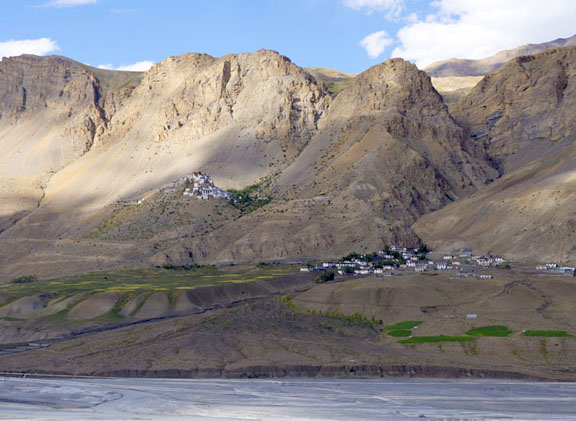
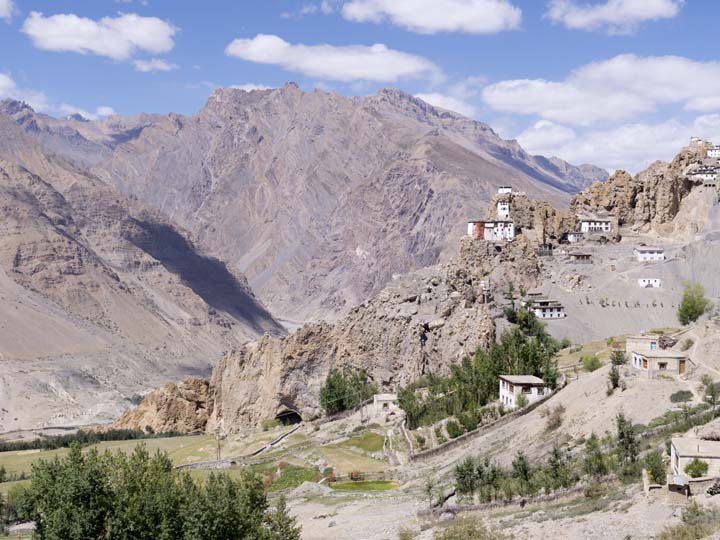
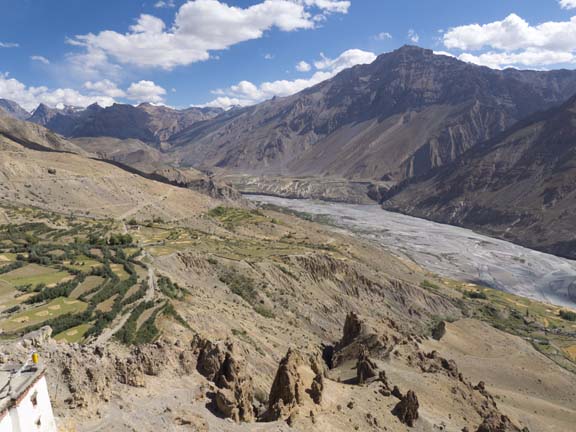
View of Gandhola (Guru Ghantal) Monastery, upper left, with Thupcholing Monastery below on the plateau, overlooking Tandi bridge where the Chandra and Bagha Rivers join.
View of Gandhola (Guru Ghantal) Monastery, way upper left, with Thupcholing Monastery below on the plateau. Those green-roofed structures are meditation huts for retreatants. Both sites overlook Tandi bridge where the mighty Chandra and Bagha Rivers join in what is considered by Buddhists and Hindus alike as a sacred union.

The delight to be found in Lahaul is that over time, masters have left legends, relics, shrines, stupas, sacred paintings, sculptures, and other spiritual encounters that dot the landscape awaiting discovery by travelers and seekers. The more you look, the more you will see, but it takes some uncovering. For example, what looks unimpressive on the outside may contain a treasure on the inside, such as Jabjes Monastery in Kardang Village. Or one has to do a bit of breathless hiking up a mountain to see some of these old monasteries, hidden meditation caves, and charnel grounds.

Jabjes Monastery located in Kardang Village which was once the capital of Lahaul, India
Jabjes Monastery located in Kardang Village was built around a legendary rock with the miraculous imprints of yogi Gyalwa Gotsangpa’s knees and genitalia, which formed in the stone as he passionately chased and tried to embrace a dakini who disappeared into it. The rock may be seen today inside the temple, Lahaul, India.

However, I’m told by locals that most visitors just pass through Lahaul, heading to the more tourist traveled and trekked sites in Ladakh or Spiti. What a pity!

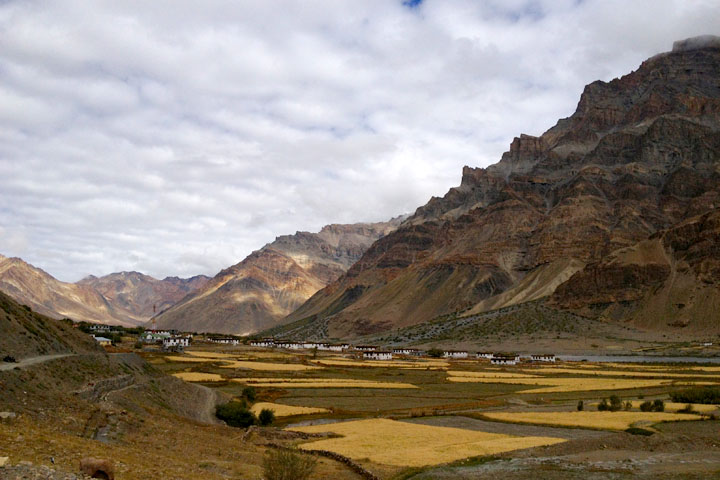
More readily noticeable and understood by travelers is that Keylong stretches along the main trade route between the Rohtang and Baralacha passes above the Bhaga River. Besides being a thoroughfare between Ladakh, Kullu and Spiti regions, it is also the district headquarters of Lahaul and Spiti, with strategic military presence. In addition, above and below the village one sees lush farmlands growing barley, peas, potatoes, corn, cabbage, mustard greens, squash, and much more. Apples and other fruit orchards are plentiful. My local driver D told me that agriculture is the economic mainstay of Lahaul, and judging from some of the mansions built by some farming families, the wealth of this abundant agrarian heartland is evident. The food harvested is transported all over India. I would not have guessed that at an altitude of over 10,000 feet there would be such a cornucopia!

View of Keylong on hiking trail from Kardang Monastery to Keylong, Lahaul
View of Keylong on hiking trail from Kardang Monastery to Keylong

D’s ancestral farmland is in the Manali area of Kullu Valley, but he lives and works in Keylong to service the tourist industry as an extension of the family business. Indeed, it’s all in the family. I’ve learned from Lahaulis and Spitians I met that relatives live and work together. This was always the tradition, and it largely continues today.

Another thing I learned was that unlike Tibetans, Lahaulis, Spitians and Ladakhis, while culturally and historically part of Tibet, are indigenous to their regions, and as such are not refugees in India but full citizens. In addition, they have their own language and customs. In fact, the Indian government recognizes them as ethnic “tribals,” who may therefore qualify for certain affirmative action positions or opportunities.

It isn’t only just the passerby tourist who may miss the treasure to be found in Lahaul. I realized that my driver, while he probably identifies himself as a Buddhist, is fairly uninformed about the great legacy of his roots. At one point in our travels, he asked me how much I knew about the Dalai Lama and Buddhism. I thought it was a prompt for me to in turn ask him what he knew and be enlightened by his local knowledge, but it was not a segue way to that at all! He told me he tried to find books on Buddhism in Hindi, but could not. It pained me to hear this–that someone looking for knowledge could not access it.

D said that Lahaulis are educated in Indian schools, are fluent in Hindi but not Tibetan, and frequently not English, either. I noticed this is especially true of the women, who largely live domestic lives caring for family and have little contact with others. English is spoken mainly to communicate with foreigners. Feeling affinity for Indian culture and language, many Lahaulis have assimilated to a large extent in recent generations. Most cannot read the readily available contemporary books in Tibetan on Tibetan Buddhism to fill in on the lack of local education on this topic. Books in English are plenty, but nor can they read these since the written language is “too deep” to understand. It was an exquisite and sad irony that I, a foreigner from the other side of the world, knew more about his spiritual roots than he did. That he, a resident in the incredible Garsha, a descendent of the local culture, could not find one book he could read to study Buddhism deeper!

Farm land above and below Keylong in the fertile valley of Bagha River, Lahaul
Farm land and orchards above and below Keylong Village in the fertile valley of Bagha River, Lahaul

It’s a double whammy of cultural distance and spiritual loss. Without being able to study Buddhist philosophy and learn about its unique teachings on dependent origination, one runs the risk of meaningless ritual practice with no or limited realization of freedom from life’s delusions and sufferings.

What’s more, Tibetan Buddhists have a marvelous literary and scholarly tradition, founded on the translation and study of original source materials. Lotsawa Rinchen Zangpo’s translations of Buddhist scriptures from Sanskrit to Tibetan has not only preserved a written heritage now lost in India but produced a renaissance of tantric study and practice. This was during the late 10th to 11th centuries, a flourishing period referred to as the second great propagation of Buddhism. It is the Indo-Tibetan history I’ve been trailing through the sacred art of mandalas, monastery murals, and sculptures.

Garsha: Heartland of the Dakinis

In fact, a (French) Tibetan Buddhist nun, while living in Keylong, discovered the very same thing–that Lahaulis did not know much about the dharma history of their own land. Furthermore, part of why Lahaul’s Buddhist legacy is little known is due to a dearth of literature on it. So she wrote the book Garsha: Heartland of the Dakinis in 2011, published by the Garsha Young Drukpa Association. I have a copy in English, the language it was originally written in. Currently, it needs to be translated into Hindi for local readers.

It is a remarkable small book, jam-packed with a wealth of information about Garsha’s ancient history, the Drukpa lineage masters, dakinis, the founding of monasteries, anecdotes, local legends, descriptions of sacred sites, miracles, reliquaries, carved stones, and much more. It is probably the most, and perhaps only, comprehensive account of Lahaul’s history from the Buddhist perspective. Because it is written by a monastic with open access to living lineage teachers, and unpublished historic materials in Bhoti/Tibetan, the book is a treasure trove of knowledge.

I learned about the book and purchased it from Khandro Thrinlay la when I met her in Manali en route to Spiti (see earlier post here). She is a lama and direct descendent of the Drukpa Kagyu Shakya Shri lineage, with very close spiritual ties to Lahaul. My travel companion J was happy to find it available for sale later in Keylong because she wanted to buy it and donate copies to Tabo Monastery Library in Spiti and The Library of Tibetan Works and Archives in Dharamsala. Funny thing, though, she did not find it in a book store but at a small travel agency/internet cafe establishment run by a lovely Lahauli man keen on the book. You see what I mean? The more you look, the more you will find around here!

All photos © 2013, Eva Lee.
It’s India!

Sept 9, 2013        Spiti adventure continues…on to Lahaul, India

After a jaunty jiggly jeep ride of over 10 hours from Kaza back through the magnificent giant boulder rubble of Spiti Valley, Kunzum-la Pass (this time populated by yaks grazing and loafing!) and getting stuck fording a glacial melt waterfall that flooded the rocky road, we arrived in Keylong, Lahaul.

Keylong will be home base as I travel to visit Kardang, Guru Ghantal, Shashur, and Tayul Monasteries, as well as Phakba/Triloknath and Markula Devi temples.

View of farms in early morning Spiti Valley, en route to Keylong, Lahaul
View of farmland in early morning Spiti Valley, en route to Keylong, Lahaul
Spiti Valley in the marbleized lighting of morning sun, India
Spiti Valley in the marbled early morning sun. As dry and desolate as Spiti may seem, there is always the play of light and colorful vistas
Approaching the stupas of Kunzum la pass, where this time there was a herd of yak grazing and resting. Glaciers can be seen at above left.
Approaching the stupas of Kunzum la pass, the high point of the road at about 15000 ft altitude. This time there was a herd of yak grazing and resting. Glaciers can be seen within relatively close range.
Approaching the stupas of Kunzum la pass, where this time there was a herd of yak grazing and resting. Glaciers can be seen at above left.
Kunzum la pass, where I circumambulated the stupas and got a close look at yaks gathered there. Glaciers can be seen at above left.
Herd of yaks at Kunzum la pass, at about 15000 feet altitude, Spiti Valley
Herd of yaks dotting Kunzum la pass, at about 15000 feet altitude, the highest point of the road through Spiti Valley
Yak grazing at Kunzum la pass, Spiti Valley
Yak grazing, this one looks like he’s molting or has been shaved
Yaks grazing and resting at Kunzum la pass, Spiti, India
Yaks grazing and resting at Kunzum la pass, seen en route from Spiti to Lahaul
Stupas at Kunzum la pass, at about 15000 feet altitude, Spiti Valley, India
Tibetan Buddhist stupas at Kunzum la pass, monuments in honor of this high point of the road through Spiti Valley
Glacial melt streams on the roadside, Spiti, India
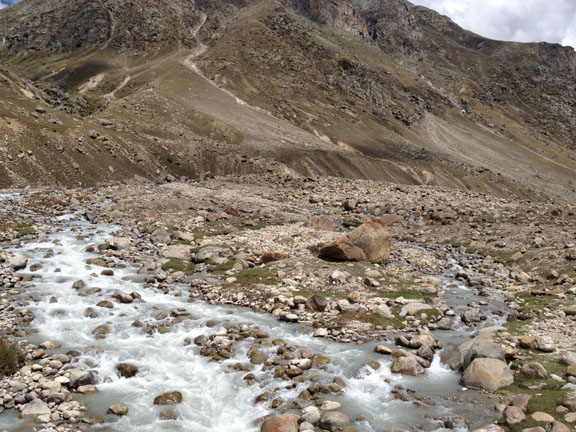
At this time of year in September, there are streams of glacial melt such as this one which frequently cross the road. They can be as small as trickles or as large as river flows, and it’s wise to travel as much as possible in the morning before the hot afternoon sun increases the flow of these waters that you have to cross with your vehicle.
Huge boulder piles along the road from Kaza, Spiti, to Keylong, Lahaul
Huge boulder piles along the road from Kaza, Spiti, to Keylong, Lahaul. It’s difficult to judge the monumental scale from just a photo, but to give you an idea, this foreground rock is as tall as a person.
Huge boulder piles along the road from Kaza, Spiti, to Keylong, Lahaul

Magnificent and desolate…

Our jeep on the road through the dry desert terrain of Spiti Valley, India

Once you experience the vast scale of the Himalayas, you can readily understand why the environment induces existential concerns and spiritual development. There’s nothing like realizing our small duration as human beings in the context of gigantic geological time and space, and beyond this, the grand cosmos to put human desires and expectations into a completely different focus.

16-IMG_2575_yes_72

A large Tibetan Buddhist stupa is dwarfed by the magnificent scale of the Himalayan mountains

Here is our jeep stuck on rocks while attempting to ford the rapidly flowing waterfall that flooded the road in the afternoon. We had patiently waited while the vehicle before us was stuck and finally managed to get out. In that 45 minutes or so, unfortunately, the water flow started increasing as the hot afternoon sun melted more glaciers! We got out eventually though with the help of others waiting to pass, including military men and a monk who moved earth and rubble, pushed and rocked the car, as our driver revved forward.

Jeep stuck on rocks while attempting to ford rapidly flowing waterfall, Spiti Valley, India
Our jeep stuck on rocks while attempting to ford the rapidly flowing waterfall that floods the road in the afternoon in Spiti Valley.
Rapidly flowing waterfall in the afternoon glacial melt, which creates a river across the road, Spiti Valley, India
The said rapidly flowing waterfall which created a river across the road, Spiti Valley, India

In contrast, as you approach and enter Lahaul Valley, high waterfalls are plenty but do not flood the roads. Lahaul is also a welcoming green landscape with grass, shrubbery, trees, and evergreens. The region is also well known for its delicious potatoes, as well as crops of barley, peas, cabbage, apple and other fruit orchards. Even here in high altitude, it is a heartland for growing food to be transported throughout India.

High waterfall, Lahaul Valley
One sees many high waterfalls throughout the more verdant Lahaul Valley

With arrival in Keylong, Lahaul, in late afternoon we spent the rest of the day trying to get some logistics done.  For my part, it was to get (yet another) SIM card that will get a cell signal here in the high Himalayas, and hopefully maintain a signal when I later travel to Ladakh further north.  After the last week in Kaza, Spiti, without any cell phone coverage by my existing SIM card to communicate with family or arrange meetings or call for travel, etc., I decided to get another with a different carrier. Here in India, there is no single carrier that can provide national coverage, so one gets used to swapping out SIM cards and switching providers as the need arises when you travel from area to area. I have three SIMs now. The last one took so long to do—don’t ask the maddening details about how it took well over two hours to buy the SIM in one place and take it to another place to cut down. Around here you get used to relatively simple things taking an inordinate amount of time to accomplish, in this case, out of lack of coordination and know-how on merchants’ part. I’ve learned to smile a lot, shake my head, and say to myself, “It’s India…” Trust me, even Indians say this!

I never got to treat my very dry leather shoes as I had promised myself. They look like they’re going to crack from the dust-pounding they get in this high desert climate and unpaved roads.  Nor did I get to download from the internet café the software plug-in I desperately need to manage my photographs. I couldn’t do it in Spiti because my download was too big for the internet café’s monthly ration of data permitted. Who knew an internet cafe would be rationed for data?! But, ok, lack of resources…I shook my head and smiled, it’s India.

But what India lacks, it definitely makes up for in its sublime experiences!

View of Keylong nestled in the Bhagha River Valley, Lahaul

Which brings me to Lahaul, also known by Buddhists as Garsha Khandroling, a region with a deep history of highly realized yogis.  These are the practitioners who spend many years or decades in seclusion meditating in caves.  You may have heard about adepts who can demonstrate astounding practices of mind over matter, such as levitate or dry wet sheets in the snow with heat generated from their bodies, confounding the scientists who studied this phenomena.  Or you may have heard of Jetsunma Tenzin Palmo, the American Tibetan Buddhist nun and her Cave in the Snow. In any case, more on Garsha in the next post…

All photos © 2013, Eva Lee.

Tabo Monastery and “The Forgotten Gods of Tibet”

In the book The Forgotten Gods of Tibet: Early Buddhist Art in the Western Himalayas,  published in 1997, authors Peter van Ham and Aglaja Stirn wrote about Tabo Monastery‘s Tsug Lhakhang: “Unfortunately many of the paintings, especially in the lower register, are badly damaged. In fact the northern wall has a large area where nothing except for the grey wall can be made out. Some of these gaps were painted over in recent times–enhancing the impression of the high artistic merit of the old paintings since these newer additions only show a mediocre level of execution.”

Perhaps this may be an example (see image below). Notice how the figure to the left of the central Buddha is stylistically so different from the one on the right. As a trained fine arts painter as well as decorative painter, I must agree with authors van Ham and Stirn.

Stylistic inconsistency in repainted figure on left, Tabo Monastery Tsug Lhakhang

This below example of stylistic continuity is what the above example should look like.

Stylistic continuity in these three figures, Tabo Monastery Tsug Lhakhang
Stylistic consistency in these three figures, Tabo Monastery Tsug Lhakhang

Here is a view of a comparable original painting on the left and the one in question on the right.  Stiff and simplistic in appearance, the repainted one bears little resemblance to the refined and delightfully detailed original.

Example of original painting on left and repainted version on right, Tabo Monastery tsug Lhakhang
An example of original painting on left and repainted version on right, Tabo Monastery Tsug Lhakhang

Here, above the doorway, is another example of repainting in the chevron border and the two figures underneath.

inpainting_bkWall1
Repainted areas in Tabo Monastery Tsug Lhakhang

Presented above are only a couple of examples. In person onsite at Tabo’s Tsug Lhakhang, one finds upon scrutiny numerous incidences of such inpainting and overpainting. I fear that if this kind of “restoration” continues, over time, the temple’s extraordinary original murals will be obliterated rather than preserved. That would be an immeasurable loss for India, art history, and world posterity.

Experience the interior of Tabo Monastery’s Tsug Lhakhang by watching this video walk-through here.

Tabo Monastery – Tsug Lhakhang (Main Assembly Hall) from Eva Lee on Vimeo.

Tabo Monastery is under the protection of the Archeological Survey of India, but it is unclear to me who is doing the painting.

The book Architectural Heritage: Ladakh by The Indian National Trust for Art and Cultural Heritage, published in 2003, says it is often the monastics who do not realize the need for proper conservation, being more concerned with the religious content of the murals and not the art historical significance.

“In the great temples, the execution of wall paintings is carried out by monks and scholars whose canonical knowledge is profound…Most wall paintings are done on perishable mud plaster, and as these begin to disintegrate, these are either removed to draw fresh paintings or retraced and retouched to maintain their vibrancy and freshness. This way it is sometimes painful to witness a ruthless operation in which centuries old paintings are lost along with the structure by eager lamas to construct new structure and, consequently, draw another set of wall paintings…As soon as the walls begin to crack, or paintings fade, they are at once repainted.”

While it appears that at times the goals of Tabo Monastery and Archeological Survey of India may be at cross-purposes with one another, there seems to be great effort for mutual respect. After all, Tabo is a functioning Tibetan Buddhist religious site. At the same time, it is a rare Indo-Tibetan historical site under ASI’s charge. The question is, how are these two establishments proceeding forward?

Repainting, however, is only one of the man-made challenges to the preservation of Indo-Tibetan murals. There are also issues involving structural changes to historical buildings (see this earlier post regarding repairs to the roof of Tabo’s Great Assembly Hall), vandalism, and the effects of tourism, to name some others. Then there are the natural challenges such as wet conditions caused by snow or rainfall, and movement caused by earthquakes.

Partial repair and rudimentary inpainting in the Thousand Buddhas inner wall of Tabo Monastery Tsug Lhakhang inner sanctum, Spiti, India
Partial repair and rudimentary inpainting in the Thousand Buddhas inner wall of
Tabo Monastery Tsug Lhakhang inner sanctum, Spiti, India

I heard that it’s possible ASI may have applied for UNESCO World Heritage status for Tabo Monastery. In terms of conservation and preservation, this would be wonderful if it were to come about! I understand that the Ajanta Caves in Southern India, which contain stunning, well-preserved, ancient Buddhist paintings as old as 2nd century B.C.E., is a World Heritage site.

For further information about the Indo-Tibetan significance of this site, see Tabo Monastery: Vajradhatu Mandala Spendor.

All photos © 2013, Eva Lee.

Thoughts on Craving, Desire, and Addiction in Dharamsala

I just spent the past week attending Mind & Life Conference which was held with the Dalai Lama at his residence here in Dharamsala, India. Well, that is, I attended the live broadcast of it at the adjacent Namgyal Monastery. I wish I had been able to be at the conference in person!

I’ve been to public ones in the U.S. and India in the past and they are always thought-provoking, authentically open dialogues between scientists, scholars, and contemplative practitioners. I absolutely love these conferences because exciting interdisciplinary ideas emerge and unexpected conversations evolve about, well, what mind is and how we can work with our minds to live skillfully and beneficially.

Organized around a chosen topic, invited presenters speak about their research or practice, then open it up to questions and discussions. In the process, paradigms, assumptions, and philosophical traditions are examined. Issues are raised for how we can improve or solve humanity’s contemporary problems.

The topic of this one was “Craving, Desire, and Addiction.” Check out the Program and Schedule of Events.  Mind & Life Institute assembled a remarkable group of participants–neuroscientists, clinicians, a sociologist, a Christian mystical scholar, monks, and others–who brought first-person perspectives to the table. One neuroscientist, Mark Lewis, had been an addict himself and talked about his subjective experience of the craving cycle, and his objective one as a researcher working on identifying the neurological structures of the brain involved in and affected by substance abuse.

Some eye-opening things I learned from research findings include the idea of the “erosion of free will” in addiction. Dopamine and serotonin structures in the brain involved in thinking, restraint, and projected rewards are actually altered and “hijacked” by addiction so that addicts are, in fact, biochemically disadvantaged in breaking the cycle of craving-imagining-planning-taking the substance, as opposed to non-addicts. Studies indicate that addiction recurs even though addicts no longer find pleasure in the substance and know that it will cause them and others harm.

One anthropologist presented some stunning statistics about the regulation of addictive substances as a program of prevention. In the U.S., criminalization of drugs has resulted in disproportionate incarceration. The American population is 5% of the world population, but is 25% of the world’s incarcerated! African-Americans form 13% of the U.S. population, but are 45% of those jailed for non-violent drug offense! There seems to be a serious bias in the implementation of drug laws. Another example, in New York City, more white people use marijuana, but more black people are arrested for it.

These facts, and many other compelling ones on prevention, intervention, and treatment were discussed. Incidentally, Mind & Life will be posting videos of the conference soon on its website. So if you missed the live webcasts, you can watch them archived online. I highly recommend it if you are or you know someone who is affected by substance abuse and addiction.

The conference was profound in scope. Key discussions centered on definitions and experiences of desire and craving, and how they can be met and transformed. It was insightful not only for illuminating root causes of suffering for addicts but for all of us living in contemporary materialistic culture where craving things becomes the norm for excessive consumption. I read recently that acquiring more than what you need was considered by many pre-industrialized indigenous cultures as pathological. What prescience!

It makes a lot of sense when you consider the suffering of anxiety, depression, neuroses, and suicides in the U.S. among young people who are desperately stressed, competing with each other towards educational goals aimed ultimately at attaining material wealth. The documentary Race to Nowhere is a disturbing and sad account of this phenomena. It illustrates a basis for the alarming disconnection between emotional health and well-being, and what is defined as “success” in American life. See the trailer here.

And while I’m on this topic, the book Teach Your Children Well: Parenting for Authentic Success also takes an insightful look at how we are raising and educating kids.  The New York Times writes, “It would be easy, on first glance, to dismiss [psychologist] Madeline Levine’s Teach Your Children Well as yet another new arrival in a long line of books that have urged us…to push back and just say no to the pressures of perfectionistic, high-performance parenting. But to give in to first impressions would be a mistake. Levine works with teenagers who are depleted, angry and sad…so lost are they in the pursuit of goals that have drained their lives of pleasure, contentment and connection. ‘Our current version of success is a failure,’ she writes. It’s a damning, and altogether accurate, clinical diagnosis.”

And how much of this cultural milieu might drive people to substance use and abuse in an unfortunate attempt to alleviate suffering? It is known that the harmful patterns of addiction take a profound toll on both the individual and society. According to Mind & Life, addiction to alcohol, tobacco, and illicit drugs, for example, is estimated to cost the United States $600 billion per year. Did you just read that correctly? Yes, you did, $600 BILLION. On the emotional level, it’s immeasurable how deeply it traumatizes families and friends, sometimes for generations.

At this Mind & Life conference, as part of the discussion on effective treatment for addiction, the Dalai Lama advocated prevention through new initiatives in education that increases self-awareness and connection to others through the practice of kindness. Because many social ills come from the hyper-individualism championed by the contemporary industrialized world, such excessive self-focus, he said, ultimately produces separation and unhappiness. It gives rise to an “us and them” mentality which makes aggression, greed, and war possible. Instead, we need to develop not only our thinking skills but our emotional ones as well.

If you’re an educator, counselor, or parent, take a look at this nascent movement and see what you can do to make a difference.

See an example of how incorporating kindness in children’s education works in this PBS video. Groundbreaking studies of children learning through mindfulness and kindness curricula currently under way and developed by University of Wisconsin Center for Investigating Healthy Minds are yielding increases in positive social behavior. See here for further information on this and similar programs.

Tabo Monastery: Vajradhatu Mandala Splendor

September 7th     Tabo Monastery Part Two…here it is!

Tabo Monastery Tsug Lhakhang, Spiti, India
Tabo Monastery Tsug Lhakhang, with meditation caves in the cliffs beyond, Spiti, India

Six-o’clock morning puja for the recently deceased beloved abbot at Tabo Monastery was quite beautiful. I wasn’t fully awake for it, and drifted through listening to each monk use his voice artfully to express himself through prayer. Very nice. I found out later from a lama that while they all learn the basic rhythm, it is up to each individual monk to say the prayer as he wishes. In other words, they all chant the same prayer, but some go out and come in on certain parts, using their voices to inflect sound, create variety, meld, or syncopate, etc.

Afterwards I was able to do some documenting at Tabo today! Limited time, however, permitted only doing the interior of the Tsug Lhakhang, the Great Assembly Hall. I was thrilled because it was the most significant temple in terms of its Vajradhatu mandala arrangement and my research project.

Experience the interior of Tabo Monastery’s Tsug Lhakhang  or Main Assembly Hall by watching this video walk-through.

Tabo Monastery – Tsug Lhakhang (Main Assembly Hall)

Entering the Great Assembly Hall, Tabo Monastery
Entering the Great Assembly Hall from its antechamber, Tabo Monastery

Wow, what a place! Dark and dramatic, with rays of light coming in through small ceiling windows, shining brilliantly on the main altar and then fading out towards the periphery of the assembly hall. I was stunned by the large number of statues and paintings to feast my eyes on! In a space that envelopes you in semi-darkness, it took some time to realize that just about every inch of wall and ceiling had been richly decorated.

See floor plan here.

With over a thousand years of continuous use as a meditation hall, I soaked in the sense of countless generations of monks who have spent their days here in peaceful meditation. I tried to fathom the devotion that Tabo’s Tsug Lhakhang has seen and sheltered. The overall impression is that of quiet yet teeming spiritual beauty.

Founded in 996 C.E. by the Guge (Western Tibet) king Yeshe O’d, the temple and statues are viewed clockwise in a Buddhist kora or circumambulation.

According to scholars, Kashmiri artists were responsible for the refined style of the statues and paintings. At the time, Buddhism had flourished in Kashmir and the region’s art was aesthetically sophisticated in expression and detail. Most of the art was executed circa 1042 C.E. during the renovation of the interior by Jangchub O’d, Yeshe O’d’s grand nephew.

The main altar features a gilded Vairocana. What a sight this tantric deity is with its larger-than-life four bodies, seated back to back, its serene faces looking out in the four cardinal directions. Distinctly Indian features include Indo-style trousers, painted red palms, procession carriage structure, and naga/garuda mount at top.

There are 32 multi-colored, graceful clay sculptures of Vairocana’s associated deities that line the assembly hall walls in Vajradhatu mandala order. Each is seated on a lotus pedestal, and cantilevers out of an attached sculpted halo background. Situated above eye-level, the figures look kindly and seem to lean towards you. Surrounding these deities on the wall are elaborate, colorful fresco paintings—scenes of Prince Sudhana’s pilgrimage and Buddha’s life on the lower frieze area; buddhas, bodhisattvas, other tantric deities and Bon goddesses in the upper area.

Clay statues of tantric deities, Tabo Monastery
Clay statues of tantric deities in Vajradhatu mandala arrangement, Tabo Monastery

Sudhana's pilgrimage depicted on lower frieze, Tabo Monastery Tsug Lhakhang
Sudhana’s pilgrimage on lower frieze, Tabo Monastery Tsug Lhakhang.  Much of it is too deteriorated to see clearly.

Painted buddhas and bodhisattvas on upper areas of TAbo Monastery Tsug Lhakhang
Guardian deity at far left, painted buddhas and bodhisattvas on upper areas of Tabo Monastery Tsug Lhakhang

Tabo Monastery Tsug Lhakhang altar, Spiti, India
Vairocana statue, main altar, Tabo Monastery Tsug Lhakhang, Spiti, India
Distinctly Indian features include Indo-style trousers, painted red palms, procession carriage structure, and naga/garuda mount at top.

Gilded Vairocana statue, Tabo Monastery Tsug Lhakhang altar, Spiti, India
View of gilded Vairocana statue from inner sanctum, Tabo Monastery Tsug Lhakhang, Spiti, India

Detail of gold Vairocana, Tabo Monastery Great Assembly Hall altar, Spiti, India

Tabo’s Main Assembly Hall, and in fact, the whole monastic complex was originally built according to a mandala concept as set forth by the Sarva-tathāgata-tattva-samgraha Tantra, practically a literal translation of it which distinguished this monastery. To the practitioner, therefore, Tabo’s interior and exterior order symbolized his sacred inner and outer realities. (More on this topic in previous post But Wait, A Bit About Mandalas.)

“The main temple, Tsug Lhakhang, was at the center of the whole complex.  The center of the temple was also the center of the compound along the east-west axis, having its major statue, Saravid Vairocana, placed in the central spot [now moved to the altar] not only of its surrounding 32 statues but also of the whole complex….Later additions have diluted the concept, but temples from Tabo’s heyday, together with stupas or chorten, form a simple but clearly visible mandala in the architectural layout-plan.” (The Forgotten Gods of Tibet: Early Buddhist Art in the Western Himalayas by Peter van Ham and Aglaja Stirn.  See also this book for excellent descriptions and further details on Tabo’s iconography)

Vajradhatu mandala arrangement of Vairocana and 32 associated deities, Tabo Monastery, Spiti, India.

Above is the floor plan of the Main Assembly Hall showing the Vajradhatu mandala arrangement of the Five Buddha Families: Vairocana, Amitabha, Amoghasiddhi, Akshobya, and Ratnasambhava, with their associated deities. These represent aspects of Buddha-nature that guide a practitioner to attain enlightenment according to the lower yoga tantras. Tibetan Buddhists today generally practice highest yoga tantra or Annutarayoga.

Vairocana, main altar, Tabo Monastery, Spiti, IndiaSide view of Vairocana statue, main altar, Tabo Monastery, Spiti, India.  The statue is built in the tradition of an Indian procession carriage, used for carrying the god around the temple or outside for blessing. 

For photography and viewing, I came prepared with flashlights. Thank goodness they were fully charged, and that our current guesthouse has power! We would not have been able to see most of these dark interiors without them.

Vajrahasa statue, Tabo Monastery
Vajrahasa statue, part of the Gem family of Ratnasambhava, Tabo Monastery

What a challenge it’s been to ensure my equipment is all charged and ready to go. Sadly, I am told by locals that Spiti in general lacks electricity because the Indian government is remiss in providing good infrastructure to all its citizens, and particularly to those communities that are remote, less populated, and lack political clout. As you can imagine this makes Spiti’s growing tourism especially difficult when hotel and restaurant owners, cyber cafes, etc., must routinely apologize to their clientele for not being able to meet their needs due to lack of power. I got creative with calculating how long my cell phone, laptop and camera equipment would last before finding the next feasible charging place.

Vajrakarma statue, Tabo Monastery Tsug Lhakhang
Vajrakarma statue, part of the Action family of Amoghasiddhi
Tabo Monastery Tsug Lhakhang

Vajrayaksa statue, Tabo Monastery Tsug Lhakhang
Vajrayaksa statue, part of the Action family of Amogasiddhi
Tabo Monastery Tsug Lhakhang

Akshobya statue,Tabo Monastery Tsug Lhakhang
Akshobya statue, Vajra family
Tabo Monastery Tsug Lhakhang

Behind the main altar is a small inner sanctum or cella that contains a 13th century statue of Amitabha in an elevated niche, flanked by two crowned statues of bodhisattvas, Padmapani on the left and Mahashtamaprapta on the right. Above him are figures identified as Apsaras or minor gods in the act of homage, and painted on his left and right are female attendants.

Amitbha statue, inner sanctum, Tabo Monastery Tsug Lhakhang
Amitabha statue, inner sanctum, Tabo Monastery Tsug Lhakhang
Stylistically different from the statues in the main hall, it looks like a later addition or replacement.

Mahasthanaprata statue, inner sanctum, Tabo Monastery Tsug Lhakhang
Padmapani statue, inner sanctum, Tabo Monastery Tsug Lhakhang. Visible on the left are some of the Thousand Buddhas that are painted on the circumambulatory inner walls.

Vajrapasa statue, Tabo Monastery Tsug Lhakhang
Vajrapasa statue guarding entrance to inner sanctum, Tabo Monastery Tsug Lhakhang

A narrow corridor for circumambulation surrounds Amitabha. Its inner walls are richly painted from floor to ceiling with Thousand Buddhas, manifestations of the enlightened one in splendid iteration of the five colors, different robes, lotus pedestals, and haloes.

Small buddhas on inner sanctum walls, Tabo Monastery Tsug Lhakhang
Buddhas in a Thousand Buddha depiction on inner sanctum circumambulatory walls, Tabo Monastery

On the outer walls are magnificent bodhisattvas and Supreme Buddhas (Tathagatas). These are my favorites! I really appreciate the mastery of these paintings in the inner sanctum. The below bodhisattva is an example of one of sixteen that symbolize aspects of Buddhahood stemming from Vairocana.

Bodhisattva, from outer circumambulatory wall of Tabo Monastery Tsug Lhakhang

The bodhisattva figures literally took my breath away when I saw them revealed by my flashlight! Every brushstroke showed ease, delicacy and variety in execution.  The highly inventive and detailed jewelry, as well as the fabric patterns, was a pleasure to discover. In addition, these paintings are well-preserved and dated 1042 C.E. when the temple was renovated. In other words, they appear as they were first created, untouched by other painters or conservators since then. What an incredible indication of the original quality of work that existed!

These inner sanctum figures look different from the ones on the upper register of the Tsug Lhakhang in that they are far more elaborate and refined. Additionally, Indo-Tibetan paintings show a freedom of composition not found in later Tibetan artworks where proportions and poses are more defined by convention.

The Supreme Buddhas were also delightfully painted, exhibiting a similar level of refinement and delicacy but painted at a much larger scale, about life-size.

Supreme Buddha, outer wall of circumambulatory, inner sanctum Tabo Monastery Tsug Lhakhang
Supreme Buddha dressed in unusual pleated robe, painted on outer wall of circumambulatory,
Tabo Monastery Tsug Lhakhang inner sanctum

I particularly like the sense of ease yet energy that this below Buddha expresses.  His face and gaze are sublime, his hands in graceful repose. But his unusual robe depicts rhythm and movement in the undulating sleeves and neckline detail. Coupled with the artist’s use of primary colors and radiating spirals in the halo, the overall effect of this painting is vibrant immediacy.

Supreme Buddha on outer wall, inner sanctum of Tabo Monastery Tsug Lhakhang

Detail of Supreme Buddha on outer wall, inner sanctum of Tabo Monastery Tsug Lhakhang

All photos © 2013, Eva Lee.

But Wait, a Bit about Mandalas

Okay, I know I promised to post Part Two of Tabo Monastery next, but as I’ve been writing, I’ve found it necessary to do a lot of explaining.  In fact, so much explaining in between the photos of Tabo’s interior that it’s a bit interrupting. So I’ve decided to get the explaining done with first. All right with you? Great, read on!

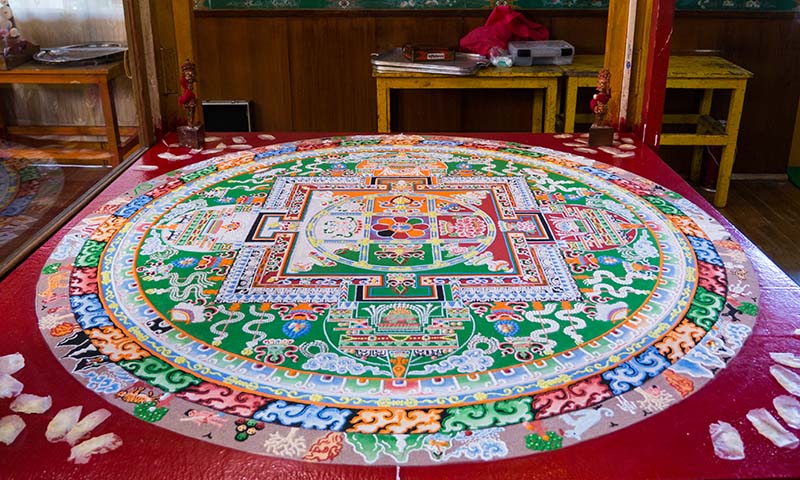
When I first came to Namgyal Monastery in 2010 to observe and document a highest yoga tantra ritual Yamantaka, I knew precious little about the vast world of Tibetan Buddhist tantric deities. What I knew was that an elaborate sand mandala would be made by the Dalai Lama’s monks in their temple in McLeod Ganj, India. I did not know at that time, for example, that this intricate 2-dimensional Yamantaka design represented a 3-dimensional palace, in which the deity resides at the center.

Yamantaka Sand Mandala
Yamantaka Sand Mandala, Namgyal Monastery, India

I learned that as a sacred art, whether made of sand, cloth, or metal, its purpose is to be a meditation aid to a tantric practitioner. A sort of blueprint, a sand mandala usually depicts a square multi-storied abode with four gates centered within a circle. Every element, from color, dots, vases, banners, letters, animals, etc., represents an essential part of the deity, his or her teachings, and Buddhist philosophy. Each deity in turn has a retinue of associated deities, which are also depicted. A person contemplating the mandala imagines entering into its palace and encountering all these elements, which is to say, meditates on the qualities and teachings they symbolize. To a devout practitioner, a mandala ultimately represents the mind of the Buddha.

An esoteric and advanced practice, Tibetan Buddhist tantra (also known as Vajrayana) is intended for the properly receptive initiate, with guidance from a qualified teacher or lama. It is an accelerated, experiential way to realize the Buddhist wisdom of the ultimate nature of mind and reality, and great compassion.  First taught by the historical Shakyamuni Buddha over 2500 years ago, it has been passed through oral tradition by lineage teachers. Its goal is enlightenment of the practitioner for the benefit of all sentient beings. And, believe me, this means all.  One of my favorite little prayers is one I learned on a meditation retreat, and it goes like this:

May all beings, large or small
or middling, near or far,
visible or invisible,
born or yet to be born,
May all beings be happy and content.
Let no one deceive another.
Let no one despise another,
whether out of greed, hatred, or ignorance.
And as a mother would risk her life
to save her only child,
let us cultivate this feeling
of loving friendliness towards one another.

Quite a vast scope!  And speaking of scope, there are literally hundreds of tantric deities, each with unique mandalas representing different sets of details and qualities specific to his or her teachings and practice. All varieties transmit fundamentally the same Buddhist wisdom and compassion, but each deity provides a different identity with which practitioners, according to their particular personality, can relate to or find affinity with. It is important to note that it is understood in tantra that none of these deities are real in the conventional sense. They do not exist, but are symbols, visualized in their mandala in a specific and procedural meditation practice.

This multiplicity is something Buddhism shares with its Hindu beginnings.  Prince Siddhartha, after all, was born and raised a Hindu before his ascetic wanderings led him to enlightenment as Shakyamuni Buddha.  I really appreciate India’s cultural acceptance of many-paths-to-the-same-truth.  I understand that Hindu deities are so vast they number in the millions.  This acknowledgement of relativity, even acceptance of the co-existence of apparent contradiction, is truly an admirable hallmark of Hinduism, and in particular, Buddhist non-duality.

Although intricate, aesthetically compelling, and often mysterious to the non-practitioner, mandalas are meant for religious use and are not intended as works of art for museum or private collection. In fact, I had occasion recently to discuss this very topic with a Buddhist nun.  Her position was that tantra is a secret and profound practice, the art of which should only be for the eyes of practitioners.  What would it serve to reveal what is not meant for the uninitiated? While I can understand her viewpoint, I believe that since the Tibetan diaspora has led to the spread of Buddhist teachings, and the increasingly ubiquitous access to seeing tantric mandalas, it is better for the sake of education to reveal some things about them accurately rather than risk erroneous speculation and misunderstanding.

In 1988, the Dalai Lama permitted the first public construction of a mandala in the West as a means of teaching about and preserving Tibetan culture. This was the Kalachakra Mandala, an example of which can be seen here, constructed in sand at the Museum of Natural History in New York City by Namgyal monks from Dharamsala, India. He also felt that it would be a benefit because a mandala is thought to bring peace and harmony to the area where it is being created. Even viewing a mandala is believed by Buddhists to be enough to effect positive change for greater compassion, awareness, and a better sense of well-being.

Since the construction of this first mandala in the West, many have been created all over the world. Drepung Gomang Monastery in Southern India has a group of monks who come to the United States annually to demonstrate their arts through the Sacred Arts Tour.  Last year, I had the privilege to witness and document a Compassion Sand Mandala which these monks made as an offering to the Dalai Lama on the occasion of his talks on Compassion and Creativity at Western Connecticut State University.

Beyond the artistic representation of a mandala, there is the mandala principle, which I believe was first clearly articulated and taught in the U.S. by Chogyam Trungpa Rinpoche.  (See his book Orderly Chaos: The Mandala Principle) From a philosophical point of view, everything is dependently interrelated, the seeming order and chaos are one and the same, the joy and the suffering, and so forth.  The apparent dualities abound, and yet they are all constituently the same.

In real life situations, I think of mandala principle as Buddhism-in-action in the sense that your immediate surroundings is your mandala, and all the people you encounter are part of it, too.  You have Buddha-nature within you, and so do they.  With awareness and practice that comes from meditation, you have at every moment the potential to actualize compassion and wisdom in what you think, what you say, and what you do.

Tabo Monastery: Himalayan Setting and Meditation Caves

Sept 6th, Tabo Village, the Spiti adventure continues…

Tabo Monastery within Tabo Village
Tabo Village, where Tabo Monastery is nestled in Spiti Valley unlike other Buddhist monasteries that were built as fortress-like compounds on hilltops

Well, here we are in Tabo! The famed Tabo Monastery is known as the oldest continually functioning Tibetan Buddhist monastery, the art of which the Dalai Lama said “delightfully expresses the vigor of the transmission of Buddhism from India to Tibet and the dynamic mingling of cultures.” Established in 996 C.E. by the Buddhist king of Guge in Western Tibet, Yeshe O’d, and the The Great Translator Rinchen Zangpo, it flourished in a golden epoch of Indo-Tibetan collaboration in spreading Buddhist culture.

Tabo Monastery complex behind stone walls in Tabo Village
Tabo Monastery complex behind stone walls in Tabo Village, Spiti Valley, India

Tabo’s existing sacred artwork and architecture have unique historical significance, not only for the aesthetic evidence of such cultural exchange, but also for its rarity. Due to the enormous destruction during the Chinese Cultural Revolution, where over 6000 monasteries and their artworks were destroyed between 1959-61, practically none of the early examples of Buddhist culture have survived in Tibet. Consequently, the monasteries of the Western Himalayan border areas of Spiti, Lahaul, and Ladakh, once part of Tibet, is of great importance for its legacy of early Tibetan Buddhist culture, and in particular, its connection with India.

Street view of Tabo Chokhor
Street view of entrance to Tabo Choskhor,Spiti, with the museum and library in building on right

Upon entering Tabo Monastery complex, the first building one sees is Tsug Lhakhang, the grand main assembly hall

The Tsug Lhakhang, TAbo Monastery, Spiti
The Tsug Lhakhang, Tabo Monastery, Spiti

Of the monasteries I’ll visit, Tabo, Alchi, Mangyu, Lamayuru, and Lhalung strike me as being of special importance. These have exceptional murals, unusual in cross-cultural style and depiction, executed in astounding refinement, with ornate clay sculptures that are cantilevered off the walls in Vajradhatu mandala arrangement of sacred space (more on this in the next post!) This type of work is specific to the area and is not found in any other Buddhist temples in the world. These monasteries also date back to that fertile period of Buddhist philosophical exchange and revitalization from India to Tibet beginning in the 10th century during The Great Translator Rinchen Zangpo’s time.

Documenting the extant artwork and architecture of these sites is essential because they are remarkable, and extreme Himalayan winters and potential earthquakes, such as the one that occurred in 1975, continue to threaten their survival. Proper conservation and restoration is critical for art history and posterity. Of immediate concern is the effects of climate change and increased rainfall in the normally more arid Spiti that has damaged Tabo’s murals and architecture. This 2010 article entitled “A Monastery’s Fading Colours,” published in The Indian Express, is about the challenging circumstances facing the monastery’s care under the maintenance of the Archeological Survey of India (ASI).  The Times of India recently questioned the national organization’s general efficacy in its article, “92 ASI-protected Monuments Missing.”

Rear view of Tsug Lhakhang, Tabo Monastery, Spiti
Rear view of Tsug Lhakhang with workers currently repairing the mud exterior. Its back walls are as thick as 2.5 meters!

Workers repairing the mud exterior of Tabo Monastery
Workers currently repairing the mud exterior of Tabo Monastery, Spiti

I find myself wishing these monasteries were designated UNESCO World Heritage sites, such as the early Buddhist Ajanta Caves are in India, or considered World Monuments. Perhaps this would bring more international attention and expertise to help hasten the appropriate preservation and protection against man-made as well as environmental challenges.

Fortunately, I was able to arrive in Tabo with all my equipment fully charged because the electrical power was mostly on during my previous night in Kaza, Spiti. But unfortunately, I was unable to photograph due to administrative details still to iron out. Perhaps by tomorrow, after the special 6:00 a.m. morning prayers for the recently deceased and venerated abbot of Tabo which will be performed as part the traditional 49 days’ observance. Despite not being able to photograph, the monk in charge of the monastery kindly showed me most of the temples in the complex.

What is so immediately striking is the contrast between the simple exterior architecture of mud brick and the resplendent interiors. Wow, the ornate interiors leave you speechless, what treasures of Indo-Tibetan art, history, and philosophy! Especially the dramatic, dark, moody, pensive main assembly hall (Tsug Lha-khang); the older Dromton Temple (Brom-ston Lha-khang), founded by the main disciple of the great teacher and adept Atisha; Initiation Temple (dKyil-kHor-khang), where monks are initiated; Bodhisattva Maitreya Temple (Byams-Pa Chen-po Lha-khang), with a 20 foot high painted mural of the future Buddha Maitreya; and the Golden Temple (gSer-khang).

3_OtherVws (10)
View of Tabo Monastery complex showing Dromton Temple on far right and Bodhisattva Maitreya Temple left of it, Spiti, India

Oh, news flash! For incredible floor plans of these temples, including elevations, sections, 3D models, photo montages, and more, see this excellent website of an Austrian research team at Graz University of Technology that has been studying the architectural heritage of the Western Himalayas.

And did I mention caves? Yes, caves on a steep cliff above Tabo Monastery and village where, according to archeological evidence, monks had lived and practiced meditation since the 11th century. Now it is an ASI protected site. Most caves are open spaces showing evidence of ancient occupation–sooty interior walls and carved out niches, etc., as well as perhaps picnic use by modern visitors. But while exploring with my flashlight, I peered into an opening of a small closed door of a dark cave only to find a blanched seated figure looking back at me! Startled and flustered, realizing this was a real person and not a phantom, I muttered a quick, deepest apology, and left in a hurry! Well, I guess today there are still some practitioners who retreat to these caves. Whether this was a tourist trying it out, or a yogi, I have no idea.

Path to Tabo caves
Path to numerous caves above Tabo Monastery and village, Spiti, India

Tabo caves
One of numerous caves carved into the cliffs above Tabo Monastery, used by monks from the 11th century on, Spiti

View of Tabo Monastery from inside cave
View of Tabo Monastery from inside a cave, Spiti

Have a virtual walk-through here of the insides of some of these caves:

View inside a Tabo cave
View of the inside of the above Tabo cave, Spiti

View of Tabo caves
View of Tabo caves located on a steep cliffside above Tabo Monastery, Spiti

View of Tabo Village from cave sites, Spiti, India

Ok, I hope I have a headache-less night’s sleep tonight.  Day four at high altitude and I’m still adjusting, but Tabo is at about 10,000 feet high, 2000 feet lower than Kaza, so it should be better.  Need to get up early to make it to 6am puja!

All photos © 2013, Eva Lee.

Key Monastery: Marauding Monastics and the Western Himalayas

September 8th     A Return to Key Monastery

View of Key Monastery from across the Spiti River Valley

A second try today to document the ancient interiors of Key Monastery, whose abbot had in the 11th century been none other than The Great Translator Rinchen Zangpo himself, proved to be a challenge. However, in a nice turn of events, we discovered upon arrival that a special demonstration of sacred dances was in progress. The occasion was the visit of an important official from Shimla.

Entrance to Key Monastery, Spiti

The main interior courtyard was filled with visitors and administrators, with the monastery abbot presiding over the ceremony, as junior and senior monks looked on.

Key Monastery monks demonstrate ritual dance, with abbott presiding over the ceremony, Spiti
Key Monastery monks demonstrate the Black Hat cham dance, with abbott presiding over the ceremony as young ones watch

Key Monastery monks demonstrate ritual dance, with abbott presiding over the ceremony as young monks look on, Spiti

Young monks attending a ritual dance demonstration performed by more senior monks

A word about the architecture of Key…Built on a hilltop with a fortress appearance, this reflects typical Western Himalayan monastic architecture after circa 12th century, influenced by the development of invaders.

Key Monastery built atop a hill, characteristic of the later period of post-12th century Buddhist architectural development, Spiti
Key Monastery built atop a hill, characteristic of the later period of post-12th century Buddhist architectural development

Earlier period structures such as late 10th century nearby Tabo Monastery and Alchi Monastery (in Ladakh) are located in the valley on flat open land, integrated with their villages. Invaders were oftentimes rival Buddhist sects supported by the might of the Mongolian military, such as the Sakya sect who headed Key Monastery in the 14th century, and the Gelugpa sect who headed it in the 17th century. The latter came to dominate the majority of monasteries in Spiti.

In fact, most of us don’t associate monastics with marauding, but post-12th century onwards, the region saw inter-sectarian clashes, conquering by bloodshed, innumerable invasions by Chinese and Mongolian forces, shifting power structures, and political unrest throughout the Western Himalayas. Thus, that illustrious period of refined Indo-Tibetan art and architecture under the guidance of Lotsawa Rinchen Zangpo and the collaboration of Kashmiri artists eventually came to an end.

View of Spiti en route to Key Monastery, with a village nestled in its valley

_1010360_yes_72
Vast and dynamic view of Spiti River Valley

All photos © 2013, Eva Lee.

Key Kye Kee Ki Monastery and the Fine Art of Imprecision

September 5th – Spiti adventure continues…

Key, Kye, Kee, Ki Monastery, Spiti

Spelling is a flexible art in India. One often finds multiple spellings for names, places, and in signs. Take Key Monastery, for instance. It is also known as Kye, Kee, and Ki Monastery. It’s all good, take your pick! I’ve even had one monk spell his own name twice for me because sometimes he goes by Tanzin and sometimes Tenzin.

For a stickler about spelling like I am, this is an interesting lesson in imprecision. Especially if you’re asking for directions to a certain street or hotel, and you find that it’s spelled differently by different people, and you can’t help but wonder if you’re talking about the same place. Well, it’s okay, you’ll just do what you have to do, which is, you’ll find out!

It seems to me there’s a kind of accepted uncertainty principle here. It even extends to what people say. If, for example, you ask someone for directions, and he doesn’t know where the place is, he will not say he doesn’t know. He will give you information about where it is. Yes, that’s right, he will tell you something about what he does not know. My Western mind with its penchant for exactness doesn’t get it at all, but let me take a stab and guess:  This fellow might think to himself, it may not be right, but it may be approximately right, so it will help.

I have noticed that when my Indian friends need directions, they will ask numerous people the same thing. One time, I was driving with a friend and we were looking for a particular site. He stopped to ask probably half a dozen people within only a half mile’s distance, a kind of cross-reference overkill. A precision begotten by statistical probability. The wider you cast your bets, the better your chances are to get the (flexible and imprecise) jackpot. At least, I think it’s something like that…

It seems to me that here in India, it’s implicitly understood that circumstances, and the world, and the universe, are not exact. And more importantly, we are not masters of these spheres, we are just part of the process. Everything is relative, everything changes, everything has the potential for uncertainty at any time. It is readily, deeply accepted and tolerated that things might or might not work out.

One Indian friend quipped, “I.S.T.–Indian Stretchable Time,” (instead of Indian Standard Time) when he told me a story about his friend who was supposed to come pick him up in a remote area by car, but arrived three days later than expected! Okay, so maybe that example is an extreme one, but the moral of the story is not that the friend let him down, but that he came despite the fact that he had deterring factors that prevented him from coming on time!

Oh, the power has just come back here at the hotel, praise be! So I’m quickly plugging everything in to charge. Spiti has been largely without electricity for the past eight months! And it is being doled out to different areas at the moment, so no power here until about 8 or 8:30pm, supposedly anyway, because the past two nights here have been powerless. I can’t understand the reason why exactly. I mean eight months is a long time to have a vital civic repair apparently unattended to, or not tangibly improved.  Not sure if it’s because of devastating natural disaster or simply government mishandling and bad infrastructure. Maybe both. I do know that the next state, Utterakand, has suffered devastating floods and landslides recently, so it’s perhaps spillover?

Today was a bit hard to get kickstarted since I had another headache-filled sleep last night—altitude adjustments still. It’s Day 3 at about 12,000 feet high. Hope tonight will be better. I woke up disoriented, not knowing the time because my iPhone was out of power, head splitting. But we ended up going to Key Monastery after I spent the morning charging at a nearby café. The owner is getting power from the petrol station’s generator across the street. Thank goodness for their help! Otherwise, I literally would not be able to continue my work without charged batteries for my camera, or power to backup files onto laptop!

En route to Key Monastery, Spiti, India
View of Spiti Valley en route to Key Monastery, India

Key Monastery’s current spiritual leader is Lochen Tulku, the 19th reincarnation of Losatwa Rinchen Zangpo, the Great Translator wand former abbott who was so instrumental in this area for revitalizing Buddhism, translating all the original Sanskrit sutras, and building new monasteries in the 10th-11th centuries.

It turned out to be difficult to get permission to photograph the older murals here, despite my having a Spitian connection to a high level administrative monk. The concession is I can photograph the new assembly hall, which is nice but not so interesting for my Indo-Tibetan mural and mandala project. Nonetheless, the day spent at the monastery was pleasant. The monks were kind and invited us to tea, showed us the older temples, and merely asked that we not photograph. J’s local Spitian friend has offered to do some further investigation on my behalf, and we will see if possibly in a couple of days, there may be an opportunity to shoot the older murals.

View of Key Monastery's new main temple, Spiti
View of Key Monastery’s new main temple and assembly hall, Spiti

All photos © 2013, Eva Lee.

Dharamsala Return, Monsoon Mist, and Midst

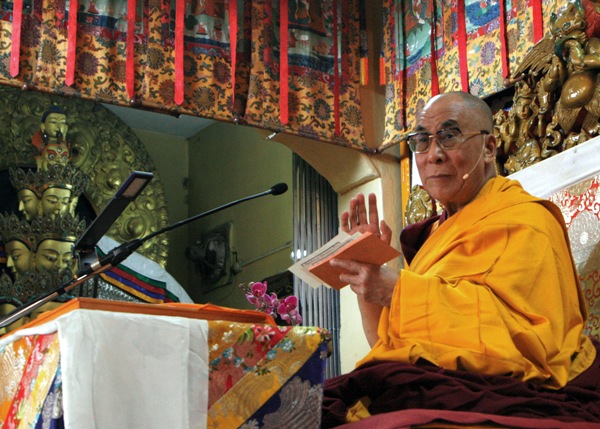
His Holiness the Dalai Lama giving teachings at Namgyal Monastery. Photo by Abhishek Madhukar

I loved that last week I happened to get back to Dharamsala just in time again for the Dalai Lama’s teachings. This one was on Nagarjuna and Tsongkhapa‘s writings, at the request of a Taiwanese group. Great bookend that I arrived Dharamsala first in August to attend a teaching before leaving for the High Himalayas, and then arrived again to attend a teaching after my journey! This one was four days long, and included an initiation for Vairocana tantra. The town swells with visitors and cars during these times, and then very quickly shrinks back when the teachings end.

I was so happy also to return to my little home-away-from-home here. Very grateful to a friend for helping me find this place, in prime location close to Namgyal Monastery, with wraparound terrace, mountain view, morning sun streaming in. It’s clean, no bad mildew or mold odors like many spaces here are stricken by because of monsoon.

Speaking of monsoon, it is still raining here! Locals said it not only began early this year and would normally be over by mid-September, but is still lingering. I have been caught in it again and totally drenched, thinking rueful thoughts to myself as my pants were soaked and my shoes like wet squishy sponges that would take days to dry. I had expected that by my return in October the rainy season would be over. But, well, who am I to complain? I haven’t even had to live through months of this!

And let me quickly add, it’s better. Did I mention the sun? Yes, many mornings it does come streaming into my room. Such a joy to wake up to! The weather pattern currently is, some sun in the morning, and then by afternoon or evening the mist and clouds roll in. The whiteout this creates make the visibility of the switchback roads about 12 feet ahead.

Sunny view, Dharamsala

Monsoon mist view, Dharamsala
Monsoon whiteout mist view, Dharamsala

Upon my return, I met with two geshes for further guidance on research resources and references. I’ve now got thousands of photos and image management to do, and will be spending time identifying what I’ve shot.

I think I will be frequenting the Tibetan Library & Archives a lot. Oh, and what a sight to see when I toured it! It has been, and is still, undergoing renovations since I was last here three years ago. The director is commendably bringing it into the 21st century! I’m thrilled to see that the old museum, previously saddled by poor lighting and exhibition conditions, is now newly expanded and nearing completion. There will be proper track lighting, display cases, and descriptive placards to do its fine collection of paintings and sculptures justice. The library stacks are newly organized in archival and accessible contemporary shelving. Their collection of sacred texts, which are tens of thousands of leaves of text traditionally bundled and kept tied together in fabric, is now being digitally scanned and stored.  What else…Oh, a New Media Department! A room with computer monitors dedicated to storing and presenting its new collection of videos and other digital media on Tibetan subjects. Lastly, soon to come will be a new floor of offices and administrative space.

Meanwhile, J organized a film night in which my work was featured along with an American documentary filmmaker, Ronny Novick. In attendance were two chodpas, lay tantric practitioners who do special meditation practices at cemetaries in order to cut through ego and realize emptiness, and who were interested in my latest animation Into the Midst because they said it’s just like what they visualize when they practice Chod. Wow. The conversation that ensued with these Kagyu yogis about some of their inner experiences was eye-opening.

Chodpas are also spiritual healers, and as traveling mendicants, may be invited by community members to conduct prayers for the deceased, the living, and those believed to be wandering spirits.  See them in a Chod prayer session here.

Tibetan Buddhist chodpas, Dharamsala, India
Two chodpas, Tibetan Buddhist mendicants who live by travelling and receiving alms for their prayer services, engaged in a Chod session. Tibetans have a strong tradition of welcoming chodpas to stay at their home for a day or two to say prayers for the deceased, the living, and wandering spirits.
Photo by Tenzin Tsundue.

Out of Order in the Himalayas

It will be a bit out of order, but what the heck….Of course, I mean out of sequence, not broken!

I’m working on retroactive blog posts of basically all my experiences from last month’s travels through Spiti, Lahaul, and Ladakh to research and document Indo-Tibetan murals. Why didn’t I just post along the way? Because, internet stick and four SIM cards later, I was not able to access the internet while on the road. Especially in electricity-challenged Spiti, where kerosene for generators is even rationed, and Ladakh, border security area where cellular and other signals are highly controlled. I gave up trying and decided I would post when I got back to Dharamsala.

And here I am back in Dharamsala…but I did not think it would take long to back-post since I’ve already written a lot of material while still traveling. However, with image management and identification of thousands of photos shot in monasteries, it’s proving to be more time-consuming to present with accompanying photos. And who wants to read text here without the images? Not me!

So here’s what I’m going to do.  I’m going to toggle back and forth between posting about the present, and posting about last month, as I continue researching here in the lower Himalayas. In addition to Dhangkar and Lhalung Monasteries which are already here on this blog, stay tuned for accounts of what I saw and did at Key Monastery, Tabo Monastery, Kardang, Guru Ghantal, Shashur, Tayul, and Poekar Monasteries, including Phakpa in Triloknath and Markul Devi Temple in Udaipur sojourns. Then Alchi, Mangyu, Lamayuru, Likir, Shey, Thiksey, Hemis, and Mulbek Chamba Monasteries.  Yes, jam-packed with history, anecdotes, incredible landscapes, and ponderings!

Dhangkar and Lhalung Monasteries in Spiti

Image
Dhangkar Monastery is seen on the ridge in the upper right. It consists of multi-storeyed buildings perched together, containing five different devotional halls.

September 4th

Our first day out to photograph was at Dhangkhar and Lhalung Monasteries. Both places granted permission because of local and monastic support. I was on my first documenting journey, and how positive an experience it was!

Dhangkar Monastery's Lha O-pa Gompa
Entering Dhangkar Monastery’s Lha O-pa Gompa.

Dhangkar Monastery
Dhangkar Monastery clings to its rocky outcrops. Shown here is the level in which the Dukhang and Lhakang Gongma may be accessed.

I’ll let the images speak for themselves, but it bears saying that Dhangkar was an original home of the ruling Spitian kings over a thousand years ago, built on a ridge and rock outcrop as a fortress. It clings to the mountain with its whitewashed buildings and traditional thatched roofs. Some buildings seem to be built one on top of the other.

Dhangkar Monastery narrow passageways

The interiors are navigated by narrow stairs (more like ladders, they’re so steep) and often low-ceilinged passageways. And when you scramble higher and higher, some stairs lead to the rooftops where you climb some more, on gravelly footpaths next to sheer cliff drops, in order to get into other adjacent buildings. Whenever you step outside, you are stunned by the incredible panorama of Spiti Valley in its splendor before you, dotted by the verdant, partitioned farmlands below, and the rigor of the sun casting impressive shadows across the mountain ridges.

View of Spiti Valley from rooftop of Lha O-pa Gompa, Dhangkar Monastery

Inside the Dukhang, which was the former assembly hall for monks before the new one was built a few years ago, sits a life-sized statue of Vajradhara, the “Diamond Being” who sees the ultimate nature of reality. One who does so is said to have wisdom, or right view.

Vajradhara statue, Dhangkar Monastery, Spiti

Kanjur Lhakang, library, Dhangkar Monastery

In the lower level Kanjur Lhakang (library containing Buddhist scriptures) are three wooden figures: Lama Chodrag, Shakyamuni, the historical Buddha, and Maitreya, the future Buddha. On the walls are faded and sooty murals, which one can barely see. It’s easy to understand from these murals alone why in 2006 Dhangkar Monastery was named by World Monuments Fund as one of the 100 most endangered sites in the world.

Kanjur Lhakang, library, Dhangkar Monastery
Kanjur Lhakang library of Buddhist scriptures, Dhangkar Monastery, Spiti, India

In the uppermost building of Lha O-pa Gompa is Lhakang Gongma, which has the most to see in terms of murals. Its central back wall dominates with Shakyamuni, Je Tsongkhapa (the reformer and Gelugpa founder of the 14th century), and Lama Chodrag.

Lhakang Gongma murals, Dhangkar Monastery
View of murals on the back central wall of Lhakang Gongma, Dhangkar Monastery, Spiti

The adjacent walls depict various manifestations of Buddha. I was struck in general by how varied the paintings are in terms of color, style, and deterioration. It’s clear evidence of selective repainting over the centuries. In the back central wall, for example, Shakyamuni is obviously brighter and more saturated in color than the other two figures. According to Peter van Ham’s book, The Forgotten Gods of Tibet: Early Buddhist Art of the Western Himalayas, only a few of the paintings have been left untouched. The rest stylistically suggest a date of around 17th century.

Buddha murals, Lhakang Gongma, Dhankar Monastery
Buddha murals, Lhakang Gongma, Dhankar Monastery, Spiti

Buddha murals showing evidence of repainting over the centuries, Lhakang Gongma, Dharkar Monastery
Buddha murals showing evidence of repainting over the centuries, Lhakang Gongma, Dhangkar Monastery

Of note in the murals is the frieze below the main figures, which largely depicts the life of Prince Siddartha, who became the historical Buddha, Shakyamuni. Tabo Monastery has a similar frieze in its Tsug Lhakang, the main assembly hall. Much of it is faded but the below two images are readily identifiable as the life of Siddartha at the palace of Kapilavastu, and the death of Buddha.

Dhangkar_Lhakang Gongma frieze
Life of Prince Siddartha at the palace of Kapilavastu, painted frieze at Lhakang Gongma, Dhangkar Monastery

Life of Prince Siddartha at the palace of Kapilavastu, painted frieze at Lhakang Gongma, Dhangkar Monastery
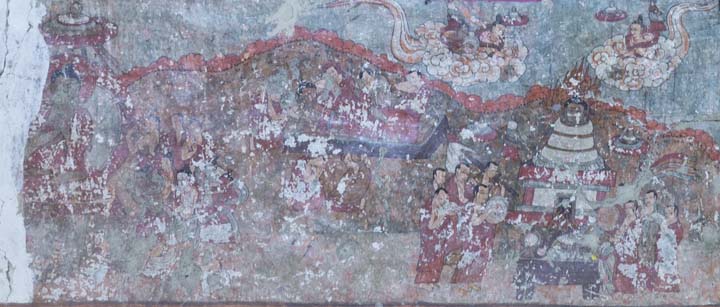
Death and cremation of Buddha, painted frieze at Lhakang Gongma, Dhangkar Monastery

We were told by locals that Dhangkar is older than the famous Tabo Monastery because, as the ancient home of indigenous kings, it contained a private temple from before the time of The Great Translator Rinchen Zangpo, pre-dating 10th century. Indeed, at the very top of the Dhangkar citadel are the remains of the palace, which you climb up to through a sleepy and steep quaint village that looks like it has maintained its same way of life for millenia.

Later in the day, we went to Lhalung Monastery. I really loved this small temple pictured below.

Lhalung Monastery, Spiti
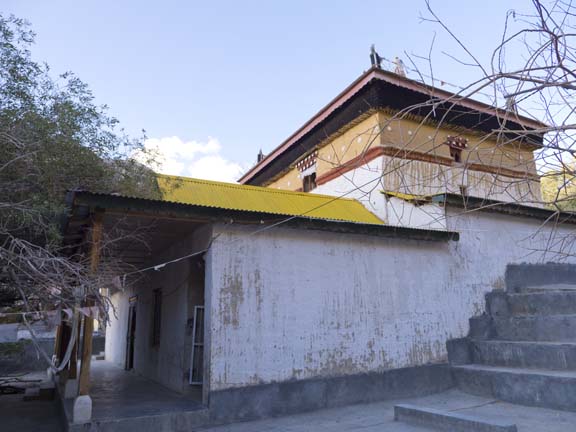
Lhalung Monastery’s Serkhang or Golden Hall, Spiti

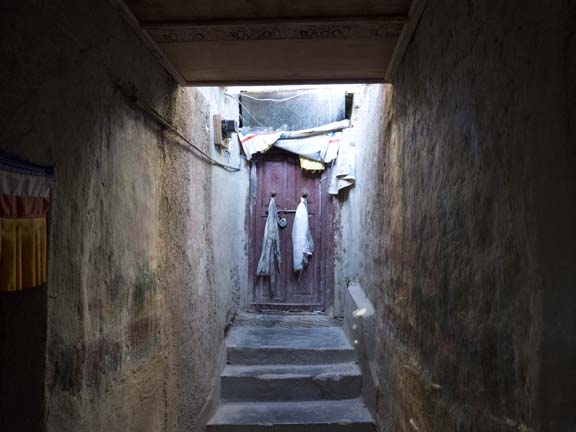
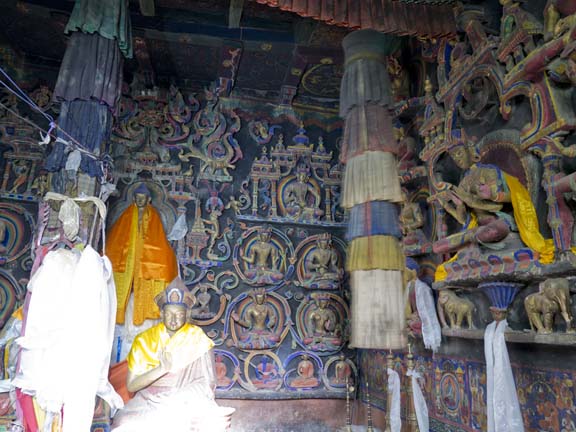
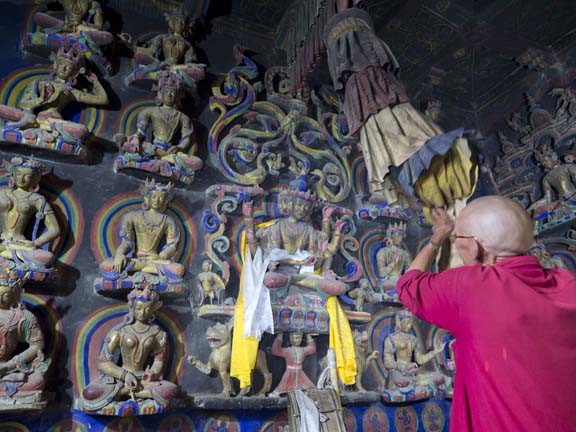
Lhalung Monastery, believed to be founded by The Great Translator Rinchen Zangpo, late 10th century C.E., was quite impressive. You enter through a narrow passageway to get to its Serkhang, which means literally House of Gold, but more often referred to as Golden Hall. Attached to its walls are sculptures of deities and other Buddhist personages. Three-dimensional figures in relief against the interior architecture of Buddhist temples are a distinctive feature of Indo-Tibetan artistry in Spiti and Ladakh areas. Similar ones are found at Tabo, Alchi, and Mangyu Monasteries.

Experience the rare and beautiful interior of Lhalung Monastery’s Serkhang by seeing a walk-through video here.

Entrance to Lhalung Monastery's Serkhang or Golden Hall
Entrance to Lhalung Monastery’s Serkhang or Golden Hall

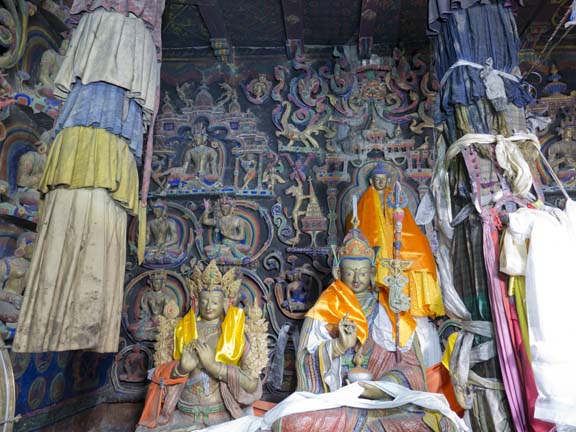
Once inside, the splendor of the ornately gilded and polychromed clay figures strikes you. The sculptures fill the temple practically from floor to ceiling. There are over 51 figures mounted on the walls or placed in the temple, arranged in mandala formations on each wall. Geshe-la said that these types of cantilevered relief sculptures are specific to the Trans-Himalayan region and are not found in Buddhist temples anywhere else.

On the central wall is Shakyamuni in the middle, flanked by two elaborate groups of five figures, each dominated by a deity–identified as Dharmadhatu Vagishvara, a complex form of Manjushri on the left, and Vajrasattva on the right. These figures are set in architectural alcoves, while the others are contained within lotus motif scrollwork, accented by decorative animals and dancers.

Serkhang, Golden Hall, Lhalung Monastery
Maitreya, Guru Rinpoche, and Rinchen Zangpo (partly visible on right behind the column) form a trinity in the Serkhang altar of Lhalung Monastery, Spiti

Visible below is the right wall with sculptures arranged in a Prajnaparamita mandala, with Vairocana in the center surrounded by four Dyanibuddhas or Buddha-families: Ratnasambbhava, Akshobhya, Amoghasiddhi, and Amitabha, and their female attendants.

Serkhang, Lhalung Monastery, Spiti
Rinchen Zangpo statue among a pantheon of sculpted deities, Serkhang (Golden Hall), Lhalung Monastery

On the left wall (photo below) is a Vajradhatu mandala arrangement around the three-faced and eight-armed Saravid Vairocana. Around him are the 16 deities in his cycle, including once again the Buddha families of Ratnasambhava, Akshobya, Amitabha, and Amoghasiddhi.

Vajradhatu Mandala, Serkhang of Lhalung Monastery, Spiti
Left wall with Vajradhatu Mandala, Serkhang of Lhalung Monastery, Spiti

So now, that’s a lot of deities in one small temple! Their plethora really conveys not only aesthetic richness but also the complexity of Tibetan Buddhist tantric practice. What do all these deities represent in these mandala arrangements? Put simply, mandalas are visual guides for a practitioner in their meditation. They are aids in the realization of the true nature of mind and reality. As an oral and esoteric tradition, one needs a lineage teacher. Experiential understanding of this leads to liberation from conditioned existence–that is to say, leads to enlightenment or nirvana. Here is a succinct description of what the Five Buddha Families represent.

Geshe-la had said that the temples in these areas really demonstrate only the lower three tantras, not highest yoga tantra, which is mainly what Tibetan Buddhists practice today. The lower three are more concerned with purification, whereas the fourth level is actualizing self and deity, and therefore, enacting profound experience and understanding of emptiness. In The Great Translator Rinchen Zangpo’s time, late 10th century, focusing on the three lower tantras was a way to go back to roots and revitalize/reform tantric practice in Tibet which had grown distorted. This was partly the reason for the enormous interest in the original texts and their teachings, translating them from Sanskrit to Tibetan.

Lastly, the coffered ceilings were painted with delightful and folk-looking decorative motifs. Now I know what scholars mean when they speculate that these must reflect 10th century Kashmiri–influenced textiles.

Coffered ceiling of Serkhang, Lhalung Monastery, Spiti
Coffered ceiling of Serkhang, Lhalung Monastery, decorated with Kashmiri-influenced patterns that scholars believe reflect 10th century textile designs.

All photos © 2013, Eva Lee.