Author Archives: Eva Lee

Spiti Adventure Begins

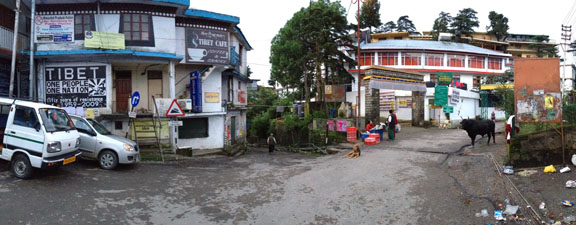
My home corner in Dharamsala, with Namgyal Monastery entrance at right.

September 1st

J and I started off for Manali 6am from Dharamsala, watching the sun rise along the way. At a certain altitude, the sun in full array, we saw a veritable Roerich painting before our eyes. It was snow-peaked mountains appearing to float above a thick, solid, fluffy white cloud bank. I always thought the man took artistic license with his imagery, but sure enough, the chiseled facets cast by morning light on the Himalayas were in orange and purple-gray displays, the base of the mountains nestled in airy clouds. The scene looked like a fairytale setting.
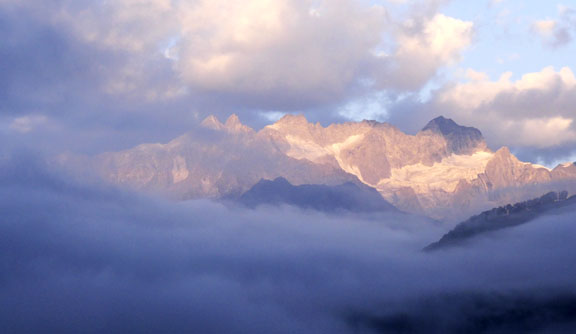
My first encounter with Nicholas Roerich-like scenery.  I always thought the painter used artistic license to enhance colors and compositions of his Himalayan scenes, but  they in fact look this dreamy and stunning
My first encounter with Nicholas Roerich-like scenery. I always thought the painter used artistic license to enhance colors and compositions of his Himalayan scenes, but they in fact look this dreamy and stunning

The main road where Rohtang pass is looks by our standards like a single lane dirt road.  There is no railing at the irregular precipitous edge, and passing the slow trucks that ply the road means a lot of honking on the driver’s part and then a wing and a prayer to get back in lane without encountering oncoming traffic. Might makes right on Indian roads so trucks have the de facto right of way. Somehow it all works out, amazing.

I got a bit carsick from the descent, switchbacks all the way, the driver taking them maybe a bit faster, with blind passing, than my stomach could take. The diesel fumes and road dust was killing me. The smell of diesel alone is enough to nauseate me. Fortunately, there was AC which I asked for halfway through. We arrived around 1pm, with pitstop for breakfast at cheesy hotel bar/dining hall (J said she’d have to work on the driver to get him to choose better stops). Well, anyway, the aloo parathas (potato-filled flatbreads) were tasty and it was good to use the bathroom. Otherwise, it’s a roadside affair of finding a large rock or bush to go behind when nature calls!

We stayed at a place called Leela Huts after finding that J’s fave old Johnson’s Lodge, with English-styled cottage accommodations, was under renovation and closed. Leela Huts has a hilarious website: www.leelahuts.com. The sentence that had us in tears with laughter was, “Leela Huts swear sheer solitude to that tired man who has retired to the valley for a bracing vacation, away from the irksome crowd.”  Now there’s some florid Indian English for you! But anyway, it was a well-kept, walled off little oasis with two and three-bedroom houses with full kitchen and baths. We opted for just the hut with single large room.

We hightailed it to Manali because Khandro Thrinlay-la was in town for the afternoon before needing to leave for her next teaching engagement, and she invited J and I to come for a visit. OK, so here is one bit of convoluted family history. Her older brother is Sey Rinpoche, their father a great Drukpa Kagyu practitioner named Apho Rinpoche, who descended from the great grandfather Shakya Shri, who began this special lineage of masters in the Six Yogas of Naropa, a Milarepa tradition. These are the accomplished meditators who retreat for three years, three months, and three days to practice the secret tummo and other methods which develop, I am told, levitation skills and various abilities that defy convention. You would never know who was a great practitioner usually because they can look like any humble villager, and they never reveal their abilities normally.
Bhutanese-style temple, Manali
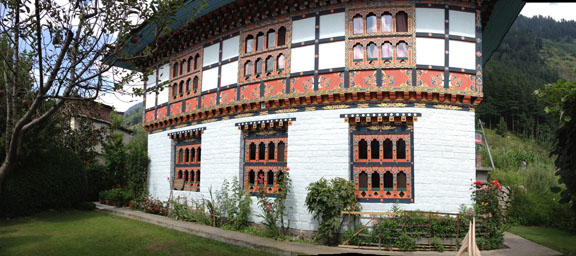
Khandro-la’s Bhutanese-style temple, Manali

Sey Rinpoche was supposed to be in Manali upon our arrival to meet with us, and make arrangements for access to monasteries in Lahoul where the family hails from, but we found he had left for Pangi where he is building a new retreat center. Instead, his sister Khandro-la (www.khachodling.org) was at home briefly, a lovely Bhutanese-styled house with colorful painted motifs on the crown and windows. She received us in her prayer room where she was doing prayers for safe travels, since it is the astrological snake year, and by Tibetan beliefs an obstacle year for those born in snake years.   I thought snake year was auspicious for snakes, but this must be the Chinese thinking. We discovered we all three are snakes.

Khandro-la has an international following which includes a lot of Australians, and women. She has a feminist approach, and is educated in the U.S., with MA in psychology, completed by the advice of none other than His Holiness the Dalai Lama. I find her interesting and contemporary. After learning about my Fulbright project, she asked me to photograph the murals at Gandhola, which turns out to be Guru Ghantal where I had planned to visit and document. She said it’s the oldest temple in Lahaul and she is interested in preserving its heritage properly.

We went back late in the afternoon to see Khandro-la’s assistant, and her younger brother who runs Druk Expeditions. He gave suggestions on places to visit in Lahaul, and so did Khandro-la’s assistant. It turns out that there is not so much to see in the way of murals of mandalas in Lahaul, but rather, Lahauli temples and area are structured spatially like a mandala. The suggestion was to go for a kora (a clockwise circumambulation around a sacred location) of Drilbu Ri Mountain, a holy site of the tantric deity Chakrasambhava, near where Guru Ghantal is, and experience the mandala physically, but to hire a guide so as not to get lost, and also to help carry things. Sounds like a nice idea, but we’ll see how I adjust to high altitude by then! I have so far been suffering from night headaches (like having a vice grip around my head!) and shortness of breath, bit of loss of appetite.
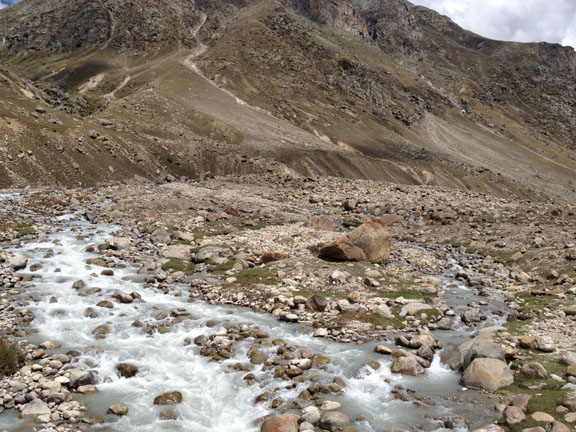
Often the road in Spiti is nothing more than rocky terrain in which one must ford a glacial stream.

Next morning 5am we were off to Spiti.  Aaah, at last the journey to high Himalayas truly begins!  Our driver was a nice man, very good careful driver, and not as aggressive as some others. He drove a Toyota Qualis which J remarked didn’t look like the most comfortable car, but it was a tanker, and boy, I was happy about that.  You wouldn’t believe how parts of the road were like fording small rivers and waterfalls, with large rocks and vertiginous drops!  These are areas where glacial melts can wash out the road by afternoon.  After a couple of particularly nerve-wracking spots, we cheered our driver for his skillful driving! J said many a car or truck has been caught stuck in these.  One has to be on the road early enough to pass these before the water starts rushing down in the warmest part of day.
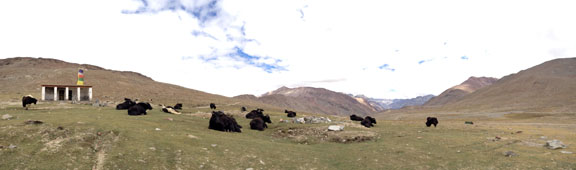
Kunzum la with herd of yaks, altitude of about 15,000 feet

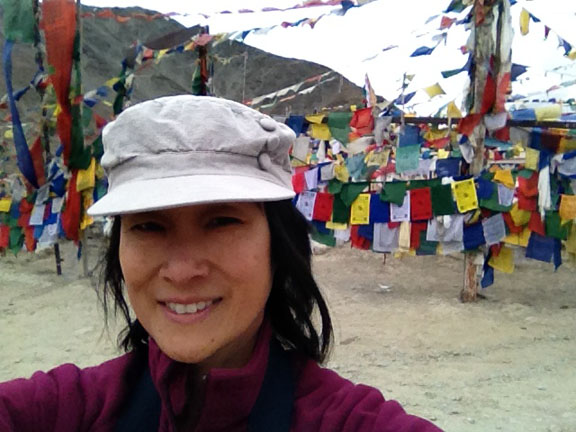
I took a lot of photos en route, what spectacular vistas! We had also many pit stops at big rocks where we could hide and relieve ourselves by the side of the road. Kunzum-la was quite windy. It’s a high point at about 15,000 ft altitude, and marked by three stupas and small shrines to the Dalai Lama and Karmapa and other lamas. J and I made incense offering here as a Geshe-la (title of a learned Tibetan Buddhist scholar akin to a PhD) suggested was an auspicious thing to do en route. I was feeling the shortness of breath by now, and when the wind blew the incense into my face, the odor caused me to feel nauseous. However, I totally loved seeing the wildly billowing and plentiful, layered, colored prayer flags blowing in the wind. We ended up not picnicking at the Nechung stupa as originally planned because J thought it was too windy and cold.  She was mindful not to be exposed too much in case of causing illness.  We instead ate in a large, flat valley, which was also windy, but at least less so.
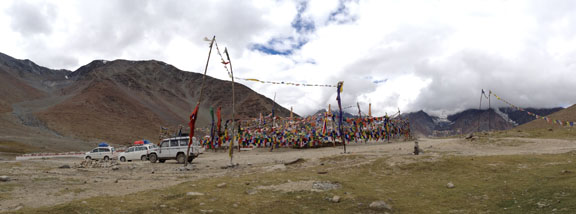
Tibetan prayer flags and stupas mark Kunzum la pass
Exhilarated and a bit short of breath at Kunzum la pass, altitude approximately 15,000 feet high
Exhilarated and a bit short of breath at Kunzum la pass, altitude approximately 15,000 feet

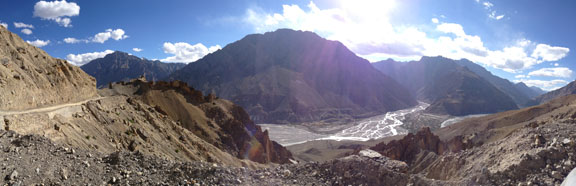
The Spiti Valley is grand beyond belief! While passing Kullu Valley earlier was stunning, too, for its lush steep landscape, cascading, tall waterfalls that put Yosemite National Park ones in the kids’ playground, grazing sheep and goats, impossibly tall and regal pine trees, Spiti land looks like gigantic rock and sand slides of barren beauty, with a wide river valley that equally shocks one with its scale.  The river rushes in what looks like silver rivulets wending its way within the valley from the road high above, but any of its strands would dwarf a normal inland river.  J said this is what is characteristic about Spiti, and at every switchback turn on the road, another great Roerich-like view is to be had.  If I had stopped the car every time I wanted to take a photograph, we never would have arrived in time.  Manali to Kaza was about a 10-12 hour jaunty, bumpy car ride.
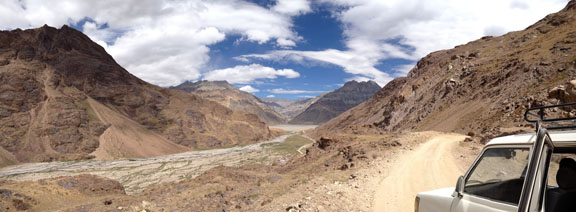
En route to Kaza, Spiti, a high altitude desert landscape
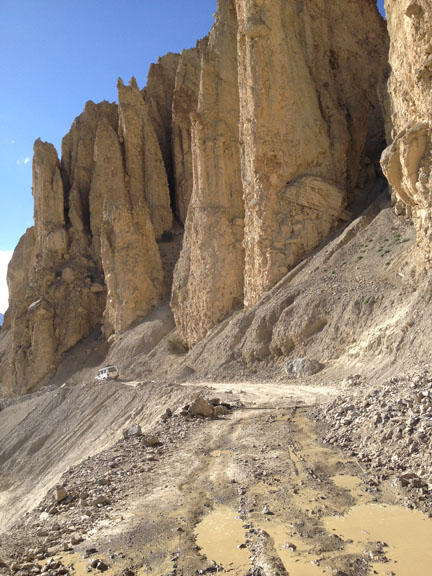
Magnificent rock structures, nature's sculptures, en route to Dhangkar Monastery, Spiti
Magnificent rock structures, nature’s sculptures, en route to Dhangkar Monastery, Spiti
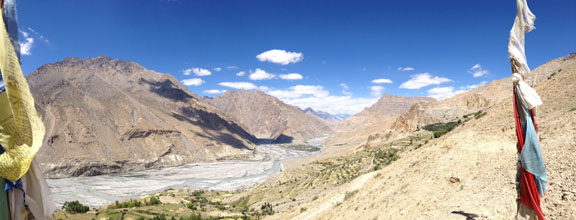
Spiti Valley heading towards Dhangkar Monastery.
Spiti Valley heading towards Dhangkar Monastery. The grandeur of scale is stunning!
En route to Dhangkar Monastery
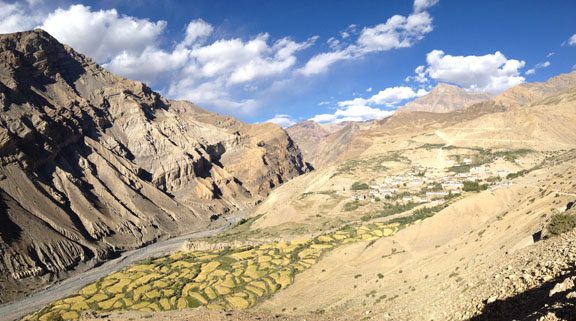
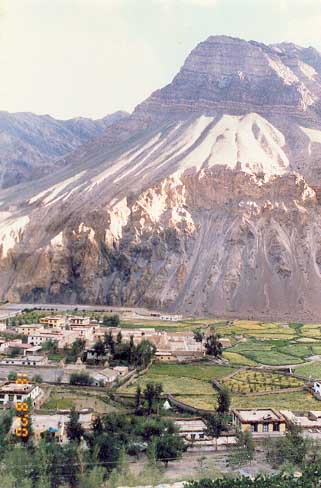
Himalayan scale is overwhelming. What looks here like squiggly bits of green is actually massive farmland. En route to Dhangkar Monastery
En route to Dhangkar Monastery.  Spiti Valley in any lighting is stunning.
En route to Dhangkar Monastery. Spiti Valley in any lighting is stunning.

All photos © 2013, Eva Lee.
 

When it Rains in Dharamsala

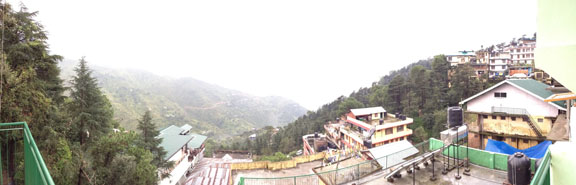
View of Dharamsala from my balcony near Namgyal Monastery

I’ve arrived in Dharamsala! “Land of the Mahayana,” as one monk fondly referred to it. It is the home of the Dalai Lama and the Tibetan government in exile. It’s as I remember it from three years ago.  With some new construction, new businesses, but largely as before, though I had not seen it in monsoon season. It’s warm but wet everywhere. Sheets of rain whip through during different times of the day. Honking cars with foggy windows (how can drivers possibly see?) ford overflowing water which rushes down the narrow hilly roads like a bowling ball follows a gutter. Shopkeepers and street vendors shuffle their wares in and out of shelter.  Pedestrians dodge canyon-sized potholes and sludgy puddles. I’ve been drenched twice while foolishly attempting to get to my next destination with a measly umbrella that may as well be one of those toothpick paper ones you get as a decoration on a cocktail. The rain just soaks everything, and wet clothes take days to dry.  Now I know what Tibetan poet Tenzin Tsundue means when he writes, “When it rains in Dharamsala/raindrops wear boxing gloves/thousands of them/come crashing down and beat my room.”

In fact, I read that Dharamsala area is one of the wettest monsoon places in India. Residents here tell me stories about how this season defies your attempts at staying mold-free. Electronic equipment, beware of condensation. A photographer friend told me he has to store his cameras in a small closet where he keeps a light shining for warmth and dryness.

I’m also told that monsoon will end in about two weeks. How do we know? The sun is beginning to shine more in between the rain bouts, and the fog lifts for some sneak previews of the beautiful vistas here in the foothills of the Himalayas.

No rest for the weary here, as I prepare for my trip to the higher altitudes. And I am weary, believe me, still getting over jetlag, and overjoyed when I can sleep for more than four hours and wake up when it’s dawn instead of the dark of night!

I arrived just in time for the second day of the Dalai Lama’s three-day teachings at Namgyal Monastery—nice way to begin! His Holiness looks as warm and jolly as ever. The temples and mezzanine areas have been outfitted with large flat screen TVs and speakers for translations.  For security reasons, all electronic equipment is banned and one must check in these items at a designated counter. This includes even small items like USB sticks and earphones. It used to be that you could bring in transistor radios and headphones to tune into the channel that translated in your language. After being issued my ID pass to attend the teachings, I passed security and found my way to the Kalachakra temple where English-speakers are directed.

The Dalai Lama was seated in the adjacent main temple, and from my spot in the rear kitty-corner, I could see him faintly through a glass window, albeit distorted from the reflection of ambient light. I marveled that I was once again in this temple where I had previously filmed Yamantaka ritual three years ago, as monks generously served butter tea with the morning breakfast of Tibetan bread (like a large English muffin). Yes, they actually cook and serve this to all the masses of people who come for the teachings, picking their way through everyone seated knee-to-knee on the floor, pouring tea from large steaming metal kettles and handing out bread from buckets.

Aside from attending the teachings, I have also been delivering letters of introduction, and meeting with Tibetan administrators, advisor, and a Geshe. This is a Buddhist scholarly title roughly the equivalent of the PhD title of Doctor, although it takes many more years of study to earn. Geshe-la shared with me some of his critical and historical knowledge of the areas I’ll be visiting as well as the images I’ll see.  I’ve now acquired my letters of support from various Tibetan offices for my research.  I will bring these with me to monasteries of the Himalayas seeking permission to photograph. These last few days have also been filled with meeting old friends and new ones over meals, tea, and even movie screening of Escape from Tibet one night, followed by discussion.

Tomorrow I leave bright and early for Manali, en route to Spiti. Today’s agenda is to pack, buy katas which are offering scarves, food for the road, pick up my internet stick and hope that it might work in the high altitudes. I am told, good luck! Spiti may sometimes lack electricity even for charging your electronic devices. Fingers crossed that I can keep my camera charged to be able to document monasteries and murals! J, my travel companion and longtime resident of India, has arranged for a meeting with Khandro-la, an exceptional female Buddhist practitioner, so we must hightail it to Manali and arrive before she leaves for her next teaching engagement.

Vandana’s Guest House and PBJ

I always marvel when I travel that it isn’t all that difficult to change one’s reality. Here I am! India! Landed three days ago. United Airlines, Newark to Delhi direct, I highly recommend it. Smooth flight, quiet fellow passengers, seats have personal touchscreens for entertainment, and more importantly, power! You can plug in your device for charging. I was relieved to find this because I wanted to at least be able to text home that I’d arrived, and call a local if I needed help.

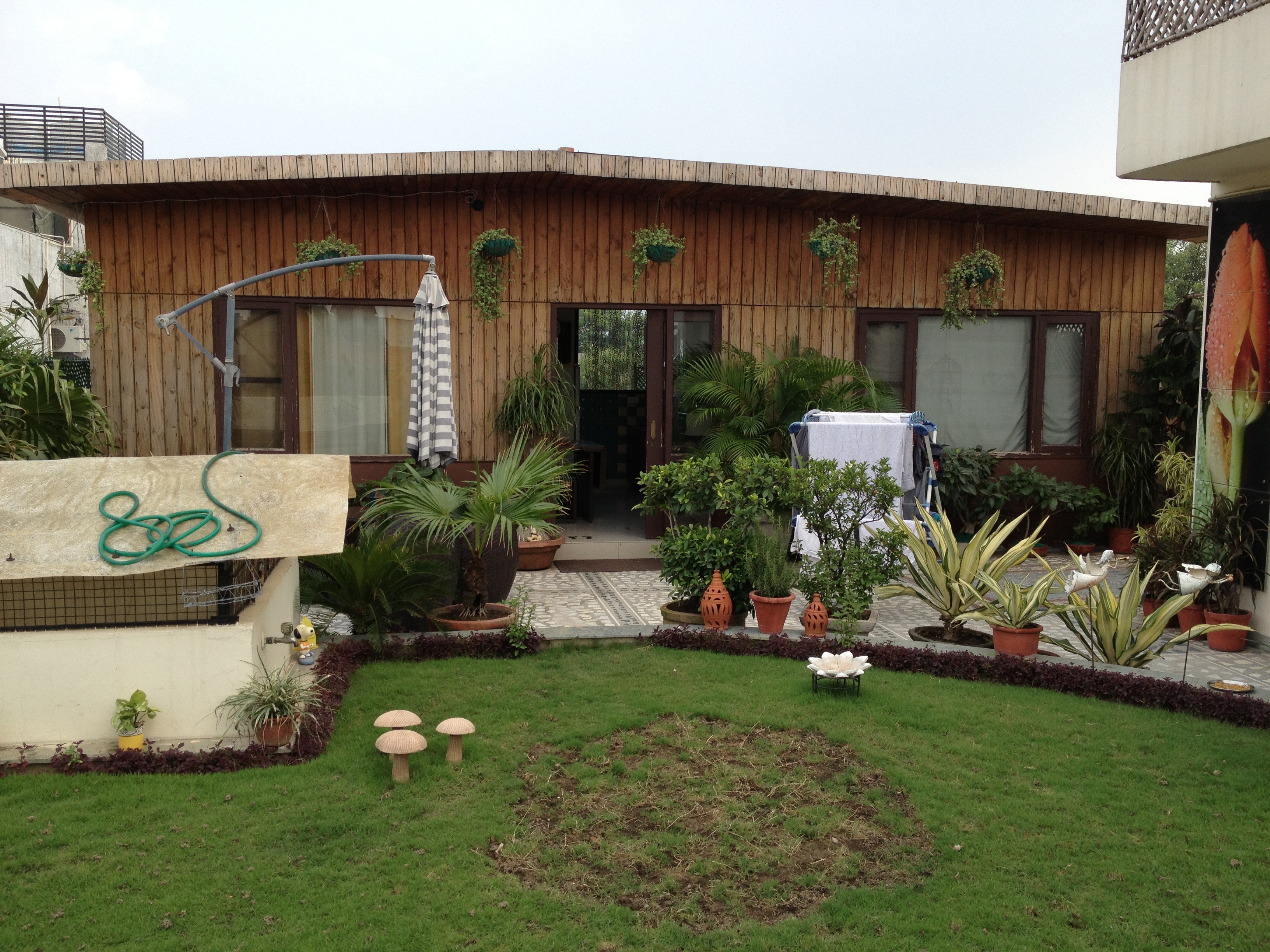
Vandana's Guest House rooftop garden rooms, Delhi, India
Vandana’s Guest House rooftop garden rooms, Delhi, India

Speaking of this, I’m thankful for help from others who look out for me! Fulbright sent a driver to pick me up at the airport. It was fantastic because after a long flight you emerge with jetlagged fuzziness. I found myself equally concerned with whether I could still purchase duty-free, as I was with completing an accurate customs form. Then later, there’s the confusing ruckus of countless drivers looking for passengers, holding placards or not, congested by the exit where travelers are also wending their way with loaded luggage carts. As it turns out, I couldn’t find my driver because I was standing in the wrong place, but he found me by looking in this wrong place!

The ubiquitous tuktuk or auto rickshaw

They also prearranged my weeklong stay at lovely Vandana’s Guest House. It’s home away from home for now, run by a warm, helpful family who live here, too. My garden rooftop room with adjoining kitchen which I share with the next door Fulbrighter is perfect because I can stow away my PBJ fixings. Don’t laugh, those sandwiches, which I make and pack for the day as emergency snacks, have proved to be vital in our face-paced quest to complete paperwork as quickly as possible so I can get to the Himalayas in time. Yesterday we didn’t have time for lunch all day, shuttling to and fro in tuktuks from USIEF to University of Delhi where I am affiliated, to Connaught Place for errands, to Archeological Survey of India from whom I’m seeking permission to photograph the interiors of monasteries under its jurisdiction. This glycemically-challenged traveler was happy to think straight after snarfing my PBJ on the run!

Fulbright also offered a ‘Facilitator’ to help with the initial transition. Thank goodness! He has been an enormous guide through Delhi these past two days, fording me through congested traffic, bureaucracy, electronic logistics, and procedures! Yes, i need an ATM machine, Citibank is great. Oh and yes, an Indian SIM card please, micro chip with reception in the Himalayas. Yes, I will definitely take that surge protection power strip with universal plugs!

To top it off, he has been a great conversationalist–interested, approachable, frank. Bustling with vision and ideas. We even discussed caste, a subject often considered delicate and charged in this nation’s changing order.

Today’s largest agenda: complete registration at FRRO, the Foreigners Regional Registration Office. Quite an exercise in following directions. Three copies of this, originals only of that, retrieve this signed form from here, fill out (or ‘fill up’ as Indians say) this form online, etc. One fellow Fulbrighter quipped, carry lots of extra passport photos and copies of your passport, they love them here. Indeed! For example, for a foreigner to get a SIM card, you need to supply both.

I Don’t Know, it’s a Mystery

I just watched “Shakespeare in Love,” that feel-good movie starring Gwyneth Paltrow and (a very handsome) Joseph Fiennes. There is a line that repeats throughout it. It goes something like this: “It all turns out well…How?  I don’t know.  It’s a mystery.”

That’s how it is right now. I will be leaving soon.  Incredible India, here I come! Oh wait, after I set things in order here on the home front. Dozens of loose ends to tie up, to ease my absence upon family who will not be traveling with me. Then there are all kinds of details about travel, timing, how to meet someone, how to gain access, how to get permission, stay healthy, and so on…that I just simply can’t wrap my head around.  Ah well, maybe that’s the whole point, like in the chaos of the theater, you just have to let go and trust in the process.  Stay open to the moment, and let the players do their parts.

Some wonderful friends and acquaintances are stepping forward to help. Glad to have travel companions to ply with U.S. lotions, scotch, and chocolate. Also, so they can gently tease me not to worry so much about recent news of Sino-Indian border disputes, or crimes against women, or potential terrorist attacks in Himachal Pradesh where I will be traveling. Ok, it’s a bit worrisome, but also true that everywhere there are dangers to keep in perspective. Sadly, here on the home front, Sandy Hook happened, and even though that is not far from me, I would still encourage travelers to come visit.

I also met fellow Fulbrighters recently in New York City, and we new friends shared a meal and laughter over visa challenges, other logistical victories and curiosities. I was lucky I got my visa without a hitch, before the Indian Consulate changed over to a new visa outsourcing agency.  The changeover, and transitional pains that ensued, literally happened only a day or two after I secured my visa. An auspicious beginning? I hope so.

The door is open!  And I think it’s going to be quite a journey…

Bodhgaya & Terrorism

Statue of Buddha inside the Mahabodhi Temple, Bodhgaya, India

Bodhgaya and terrorism. I would never have put these two concepts together. That is, not until I heard about the bombings that occurred just a little over a week ago at this venerable holiest-of-the-holy site. The very place where Buddha became enlightened sitting under a bodhi tree. The place where thousands of pilgrims rich and poor alike travel to, to do full body prostrations, or make butter lamp offerings, meditate, circumambulate, chant songs and mantras, and other practices that cultivate one’s mind to turn towards wisdom, to enact compassion, to see the true nature of reality, the illusion of selfhood, amidst impermanence.

If you’ve ever been here, and experienced the electrifying devotion practitioners bring, you would be hard pressed to pair the scene with terror. It makes me feel sad for the perpetrators that they would harbor such contorted mentalities and ill plans among peaceful people.

Read some coverage of it here.

Fortunately, it seems there were no fatalities, and no serious structural damage done to the World Heritage site.

The Indian government today has however issued alert warnings for further possible terrorist strikes on Himachal Pradesh Buddhist monasteries.

This is discouraging and unwelcome news, to say the least, as I plan to travel to over a dozen such Himalayan sacred sites soon.

Green Light GO on India Reseach and Visa

It’s been a flurry of paperwork, and orientation, reading guides, asking questions, learning protocols and so forth, to move on to the next step of clearance by the Indian Consulate for Fulbright research and visa. What a lesson in following directions! After lastly traipsing through torrential rain, a fat stack of organized forms and documents with regulation passport photos in hand, to New York City where I applied in person, here I am with the green light GO!

Fulbright Guide for U.S. Scholars

Wow, this means that I will now be working on the nitty-gritty of travel plans.

Meanwhile, it’s been wonderful to “meet” the USIEF staff as well as other Fulbrighters traveling to India during the virtual orientation. Someone also set up a Google group so we can all chat with each other and perhaps connect when we’re abroad. It’s inspiring to hear about what others are doing. All different scholars, areas of expertise and research–Islamic intellectual and cultural history, Ragamala painting, management science and information systems, Indian philosophy and the Transcendentalists, ecology and the environment, recovery from serious mental disorders and why India does better than other countries in this area, climate change and energy efficiency, Holocaust refugees in India during WWII, Indian public pension and health system, Indian and American portrayals of democracy, Tamil poetry, Ayurvedic medicine, ancient rock-cut monuments, deployment and commercialization of renewable energy in villages, Hindu-Jewish encounters, ethnography of divorce, domestic violence, courts and marriage, national parks. The list goes on…

Getting to the Land of Snows in Time

I am so pleased to hear that my documents for visa application are on their way from India! Having a relatively small window of travel before the snow arrives in October in the high Himalayas means that timely visa approval will be critical to my research. Otherwise, major roads close and there is no access or travel until they reopen in about May of 2014! Spiti, Lahaul, and Ladakh regions were once-upon-a-time part of Tibet, and there is good reason for why they call it the Land of Snows! It is, by golly, snowy there for the majority of the year.

Yosemite National Park

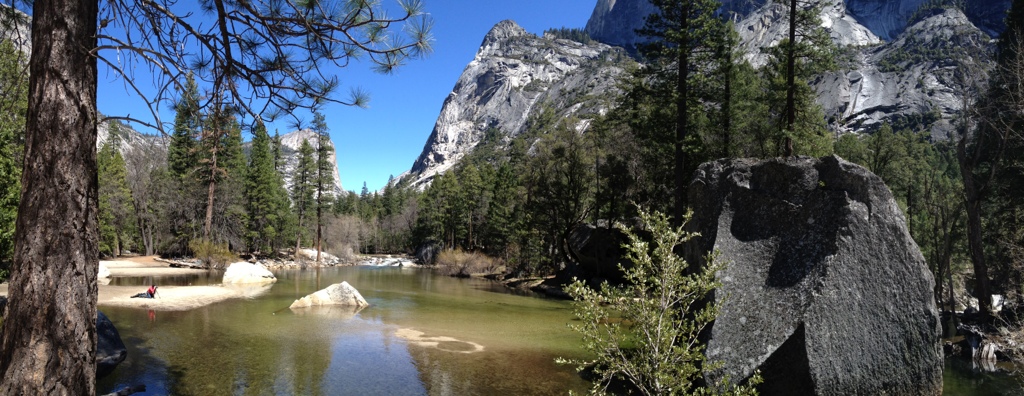
If the weather in the Himalayas in summer is anything like the weather in Yosemite National Park in spring, then I think I’ll be all right with what to wear for trekking to monasteries. What hiking it’s been here in California with sun, vistas, rainbows, waterfalls, and snow! Exhilarating.

Mirror Lake, Yosemite National Park

Of course, altitude figures as a large difference. The scale of even the highest of Yosemite’s mountains pales in comparison to the Himalayas. Yet a taste of such grandeur truly makes me look forward to being present in Spiti, Lahaul, and Ladakh. Below is a view of Yosemite Falls, one of the world’s tallest waterfalls.

Yosemite Falls, Yosemite National Park
Yosemite Falls, one of the world’s tallest waterfalls, Yosemite National Park

The Great Translator Rinchen Zangpo

I’m currently reading David Snellgrove’s “Indo-Tibetan Buddhism: Indian Buddhists & Their Tibetan Successors.” It concentrates on the tantric period of Buddhist theory and practice, from the 8th to the 13th centuries. This was a fertile time of the transmission of Buddhism from India to Tibet. I’m particularly interested in the prodigious legacy of The Great Translator Rinchen Zangpo (958–1055 C.E.) who translated voluminous original Sanskrit sutras into Tibetan, and therefore helped preserve the doctrines and teachings. These original Sanskrit sources are now largely lost in India.

Tabo Monastery, Spiti, Himachal Pradesh, India
Photo: Tabo Monastery

Rinchen Zangpo is also credited with building over one hundred monasteries in Western Tibet, many still existing now in modern day Indian Himalayas, including the famous Tabo Monastery in Spiti, Himachal Pradesh.

I really look forward to seeing Tabo’s murals. They are extensive and among the best preserved from Rinchen Zangpo’s time. In addition to the art, its architecture is an excellent example of mandala layout and structure, built in direct relationship to sutra descriptions. Founded in 996 C.E., Tabo is considered to be the oldest continuously functioning Buddhist monastery in India and the Himalayas.

Tips for Artists: How to Get a Fulbright Scholar Fellowship

Fulbright logoThis post is to pay it forward! I’m so grateful for the help that I’ve received from others. A few years ago, I didn’t even know artists could apply for a Fulbright Scholar fellowship, and now I have been awarded one to conduct research and create new work in India. I was emboldened to consider it thanks to a fellow artist who told me about her own Fulbright to India. I always thought it was for professors, students, and others associated with academia. NOT SO. Professionals “at-large,” that is, not associated with a college or university, may apply if they are of “recognized professional standing and have substantial professional accomplishments in their field.”

If you are an artist and interested in applying for the U.S. Core Fulbright Scholar program, now is the time to do so for 2014-2015. While the deadline is August 1st, 2013, I would advise you begin right away. It took about five months for me from beginning to end–from thoroughly reading the Fulbright website, understanding their mission, to researching at the library, drafting, writing, revising, revising, revising a good project statement. Your proposal should have quotes, footnotes, and bibliography, like a short research paper. It should be clear and concise. Be sure not to go over the number of pages allowed. Be sure your project is feasible and can be accomplished within the amount of time proposed.

Fulbright logoThese tips are intended to supplement Fulbright’s project statement guidelines. Please read and follow what’s on their website carefully. Here was my outline, using these subtitles:

  • Title and Intro – My first paragraph immediately said what my objective was and addressed these two key aspects:  Why I needed to conduct research in India that could not be done anywhere else, and how it is related to my work. Don’t make reviewers, who are reading hundreds of proposals, look around for what you propose to do! Say it right away.
  • Methodology – i.e., research and documentation, creative work and application
  • Academic and Professional Context – why I was interested in doing this, how my work is related to the research, fellow artists whose work have influenced mine, etc. Say why there is a worthy professional art context for your proposal.
  • Dissemination – My understanding was that some reviewers may not be familiar with how artists disseminate their research, so I was careful to be specific about how artists share ideas and their work through exhibitions, artist talks, lectures, workshops, etc. Do your homework and identify places abroad and in the U.S. where you could or would in fact be showing artwork, be on panel discussion, and so forth.
  • Significance of Research to My Discipline, My Development, and Host Country – I described how my research would contribute to contemporary art, what I envisioned my new creative work would be as a result of the fellowship experience, and how it would foster cross-cultural understanding.

Be sure to have helpful readers give you feedback as you work on your drafts.

I would recommend you have your project statement written two months in advance of the deadline so you can send it along to your referees for them to review and have time to write you letters of recommendations. You will also need to find an affiliation in your host country. Even though it is not required in India, it was highly recommended to me by other Fulbrighters. It took me 4-6 weeks to identify an Indian university faculty member with related interests, and secure his letter of invitation. I sent numerous emails, with my proposal attached, to different faculty I identified online. I also reached out to Indian and American friends with any connections or leads. Really appreciated their aid!

For the three letters of recommendation, I followed an artist Fulbright fellow’s advice. I asked the dean of my alma mater who was familiar with my work over the years since I graduated; a curator; and a Fulbright fellow. Even though I was applying as an at-large artist, Fulbright is still a scholarly program and having at least one academic referral strengthens one’s application.

For supplemental materials, which would be examples of your artwork, I recommend you include a list of works submitted, providing all the usual information (title, medium, dimensions, date) with short descriptions if necessary. Again, not all reviewers will be from your art discipline, so write for fellow professionals as well as layperson.

Fulbright also conducts webinars to provide further information and demystify the grant application process. I highly recommend these. There is a question-and-answer period at the end of the presentation. Webinar schedule for 2014-2015 application period can be found here.

I hope these are helpful tips. Good luck on your application!

________________________________________________________________

The Fulbright Program is the flagship international educational exchange program sponsored by the U.S. government and is designed to “increase mutual understanding between the people of the United States and the people of other countries.” With this goal as a starting point, the Fulbright Program has provided almost 310,000 participants—chosen for their academic merit and leadership potential — with the opportunity to study, teach and conduct research, exchange ideas and contribute to finding solutions to shared international concerns. —from Fulbright website

Himalayas / hi-MAAL-yah

Learn something new every day. The correct pronunciation for Himalaya is “hi-MAAL-yah.”

Mountains and the Indus River Valley as seen from Alchi Monastery circumambulatory, Himalayas.

I look forward to going there later this year to conduct research as an artist, made possible by a Fulbright-Nehru Scholar award. Excited and honored! Truly grateful for this opportunity! I will be researching murals of Indo-Tibetan monasteries in Lahaul, Spiti, and Ladakh districts, with a focus on mandalas as a blueprint for understanding the nature of mind and reality.

So while my departure is still months away, I’ve already begun traveling in my mind as I await further details from Fulbright.