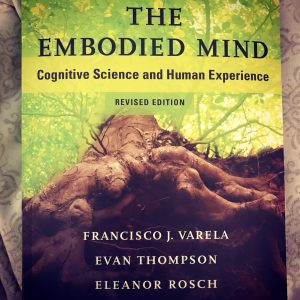
THIS book blew me away! Ready? Here goes my synopsis:
The Embodied Mind examines the shortfalls of Western philosophy which arrives at nihilism in our secularized times, but which offers no method to inform and transform how to live, so contemporary life is filled with existential anxiety, leading people to cling to dogmatic notions of solid selves in a reified world, or alternately to fall into the meaningless abyss of groundlessness, and life is thus expressed as fragmented, hyper-relativist, post-modernist alienation. The writers say, if, however, we look to how Buddhist philosophy bridges both extremes through its arrival at dependent origination, the Middle Way, AND see that there is a method to transform groundlessness into leading wholesome, meaningful, ethical contemporary lives, then this points a vital direction to head towards in the 21st century. Most importantly, they propose that mindfulness/awareness practice be integrated through science by understanding the embodied mind and what they call its enaction. It’s a brilliant analysis of how Buddhism and cognitive sciences can conjoin.
Wooo, well, after taking that in, on the tails of this, I recently went to a talk called “On Possible Minds: Philosophy and AI” featuring two eminent philosophers, David Chalmers and Daniel Dennett, at Pioneer Works in Brooklyn, NY. I was particularly interested in hearing Chalmers speak, whether two radical ideas–Panpsychism and consciousness as fundamental–would come up, such as he proposed in his TED talk on the hard problem of consciousness. These ideas did not come up. However, the two philosophers of very differing standpoints had an amiable go at stating their views on what consciousness is, what it can be, how it relates to AI now and possibly in the future. Dennett, an advocate of an empirical approach only, is known for his position that consciousness is an illusion, that our subjective experiences of phenomena are nothing more than the physical functions of the brain and its cognitive processes. He discusses this in his TED talk.
Buddhist philosophers say that indeed all phenomena is an illusion. However, this is not because subjective experience or an analysis of qualia is problematic, but because laws of causality show that nothing exists on its own. This is the principle of dependent origination, a non-dualistic approach central to Buddhist philosophy.* Nothing exists on its own yet our conditioned minds and perceptions deem it so, and we call the apparent phenomena around us “reality.” From the context of The Embodied Mind, Dennett and most Western philosophers do not question this reality, what Buddhist philosophers refer to as conventional reality, as differentiated from ultimate reality. When Dennett states we humans mistakenly reify consciousness, it is ironic that he does not see his materialist approach reifies conventional reality. In addition, Dennett’s conventional reality is full of “zombies,” entrapped by dualism and what Varela, Thompson, and Rosch call the meaningless abyss of groundlessness.
What does this mean for everyday life?
I chatted with David Chalmers after the talk. I wanted to know his thoughts on The Embodied Mind, if he had read it or was familiar with its ideas. He certainly knew of the book, but said that he would have to look further into it. I hope he does, because as a philosopher whom I believe wants to address qualia and its meaning for consciousness, the book is a great beginning.
The Embodied Mind is unique in its approach to human experience and cognitive science. It articulates well how Buddhist mindfulness/awareness practices, built upon millennia of human empirical understanding and predicated upon an ethically-based model of mind in dependent origination, can provide a way to live a positive, meaningful life. I believe this is essential. All forms of existence must evolve together through the rapid, revolutionary development of AI. We are the architects today of future AI. We should look to Buddhism’s model of mind and the benefits of its meditation practices for guidance.
*A shout out here to philosopher Keiji Nishitani for his book Religion and Nothingness, which I read years ago, and which opened the door to Buddhist philosophy, gave me my A-hah! moment in understanding dependent origination, as well as nothingness vs. nihilism.