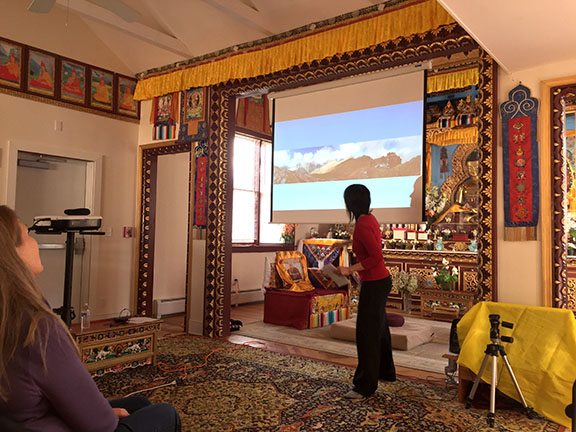
It was another lovely gathering of curious minds at my latest Fulbright Artist Talk, presented at DNKL Tibetan Buddhist Center in Redding, CT, Jan. 28th, 2017. I call it 2.0 because I had given another one there about two years ago, so this was the second version.
Hey, it was New Year’s Day, too! An auspicious way to begin the first day of the lunar calendar, surrounded by folks who wanted to know about meditation and how Buddhist philosophy can benefit our inner and outer lives together. Nice!
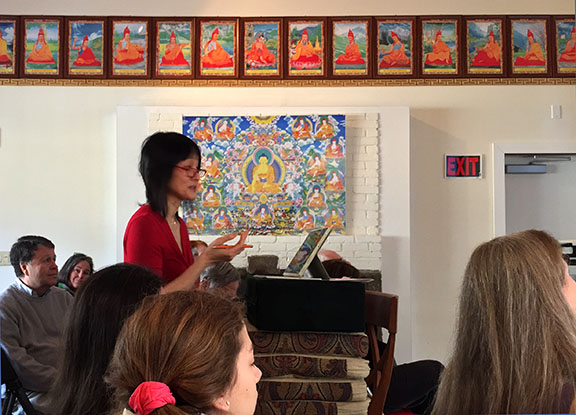
Many thanks to DNKL for the invitation to speak again. I always enjoy fulfilling the Fulbright mission of cultural exchange, sharing what I learned about Indo-Tibetan mandalas in the Indian Himalayas, and their continued relevance to contemporary life.
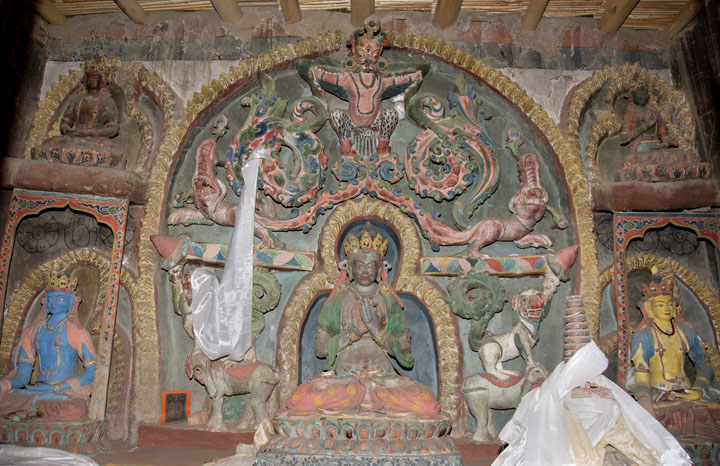
Attendees asked some excellent questions about the ephemeral sand mandalas we mostly see today, and how they relate to the more permanent nature of 10th to 12th century sculpted clay figures that characteristically formed the mandalas of this time period. Yes, indeed, the mandalas of this era were spatial, 3-dimensional ones, typically mounted on walls, often with a central free-standing one. There were exquisitely painted mandalas as well, and I showed photos of these, too.
We talked at length about the idea of the “mandala principle,” which Chogyam Trungpa Rinpoche first articulated to Western students in the 1970s. I read excerpts from his essay “The Five Buddha Families,” to share how understanding these figures and what they represent is essential not only for Indo-Tibetan Buddhist sacred art and practice, but also for the foundation of contemporary Tibetan Buddhist practice.
I love the way Trungpa Rinpoche relates it, in his very straightforward grasp of modern psychology. He strips downs the esoteric mystique, and makes it clear that these buddha families are essentially personality types, through which we can identify our own emotional makeup and tendencies. In this way, we can work on improving our “baggage” or shortcomings through what is basically the cognitive-behavioral techniques of Buddhist meditation, often referred to as cultivating wisdom and compassion.
Well, I’ll just leave it at that! There is SO much more to learn, and that’s what keeps me interested in pursuing more. Hopefully, your interest is piqued, and you might go and discover for yourself.