Author Archives: Eva Lee

Eva Lee: Fulbright Artist in India, Mandala Research

Welcome! I am an artist and experimental filmmaker. This blog is about my travels in India on a Fulbright research project entitled, “Indo-Tibetan Mandalas: Blueprints for Discovering the Nature of Mind and Reality.” It documents the entire process, from pre-departure, through travels in the Himalayas for four months, my return to the US, and what I have done post-research. The purpose of this blog is educational, to share results of my work through presenting photographs, videos, writings, anecdotes, and other engaging discoveries that Fulbright made possible.

My project takes a look at the roots of Himalayan Buddhist art, from its Indian beginnings through its Tibetan transmission, and how such art functions as a guide for meditation. In this way, mandalas continue to have relevance today. Neuroscientific studies link meditation practice to beneficial changes in emotions as well as the structure and function of the brain. Increasingly, mindfulness practices are used in contemporary clinical, educational, and therapeutic settings to positive ends.

Eva Lee on trail up to Guru Ghantal (Gandhola) Monastery, Lahaul, India
On trail up to Guru Ghantal (Gandhola) Monastery, Lahaul, India

During my time in India from late August to December, 2013, I spent September in the high Himalayan altitudes of Spiti, Lahaul, and Ladakh regions traveling to monasteries in search of 10th-12th century mandalas. I visited Tabo, Key, Dhangkar, and Lhalung monasteries in Spiti; Kardang, Guru Ghantal (Gandhola), Tayul, Shashur, Markul Devi, Phakpa, Poekar, Jabjes monasteries in Lahaul; Alchi, Mangyu, Likir, Lamayuru, Hemis, Shey, Thiksey monasteries in Ladakh. I’ve written about most of these sites here. You can see photographs and some videos of their incredible interiors. Oh, and I also trekked to the summit of Drilbu Ri Mountain, an exhilarating experience of what local Tibetans informed me was a living mandala at over 15,000 feet high. I still gasp when I think about it now! From remembering the amazing climb, and being out of breath in high altitude, to the incredible and enduring wonder this unexpected adventure indelibly inscribed in my heart.

After completing travels to the above places, I went down to the Himalayan foothills of Dharamsala, home of Tibetan spiritual leader His Holiness the 14th Dalai Lama and Namgyal Monastery. That was a lovely base to continue research from October to early December. I also observed a Mind & Life conference while there and wrote about it here, documented Yamantaka ritual, and traveled to local contemporary Tibetan Buddhist monasteries and institutes for comparative examples of modern mandalas and sacred art. These were Zigar, Sherabling, Dorzong, Khampagar monasteries, Dzongsar Khyentse Chokyi Lodro, and Deer Park institutes.

Lastly, later in December, I traveled south to Ajanta and Ellora Caves near the city of Aurangabad in Maharashtra to see Indian Buddhist art which preceded the 10th century. What an eye-opening trip! I’ll never think of the word “cave” the same again. These were not dark holes dug into cliffsides. They were sophisticated excavations with fully designed and carved architecture, elaborate wall paintings, bas reliefs, and sculptures.

Since my return to the US in late December, 2013, I have completed four short documentaries of the interiors of Tabo Monastery, Lamayuru Monastery, Mangyu Monastery, and Lhalung Monastery. I feel honored to have received permission to visually archive these historic, rare Tibetan sacred sites for research and educational purposes when ordinarily photography is prohibited. In addition, I completed a feature length documentary of Yamantaka, a ten-day-long annual ritual performed at Namgyal Monastery. This Fulbright documentary series is now part of the collection of Library of Tibetan Works and Archives in India, as well as Columbia University Tibetan Studies Collection of the C.V. Starr East Asian Library in New York City. The most current documentary completed is Hemis Monastery.

Additionally, I have continued creating new artwork inspired by my Fulbright research and enriching experiences in India, writing new entries for this blog, as well as giving Fulbright Artist Talks at art organizations, colleges, and community centers. These visual presentations have been wonderful opportunities for live discussions with audience members, and I have been so happy to fulfill the Fulbright mission of cultural exchange on the home side.

Thank you for visiting, and I hope you enjoy reading these pages!

View of Lamayuru Monastery, Ladakh

Betwixt: New Animation and Experimental Film by Eva Lee

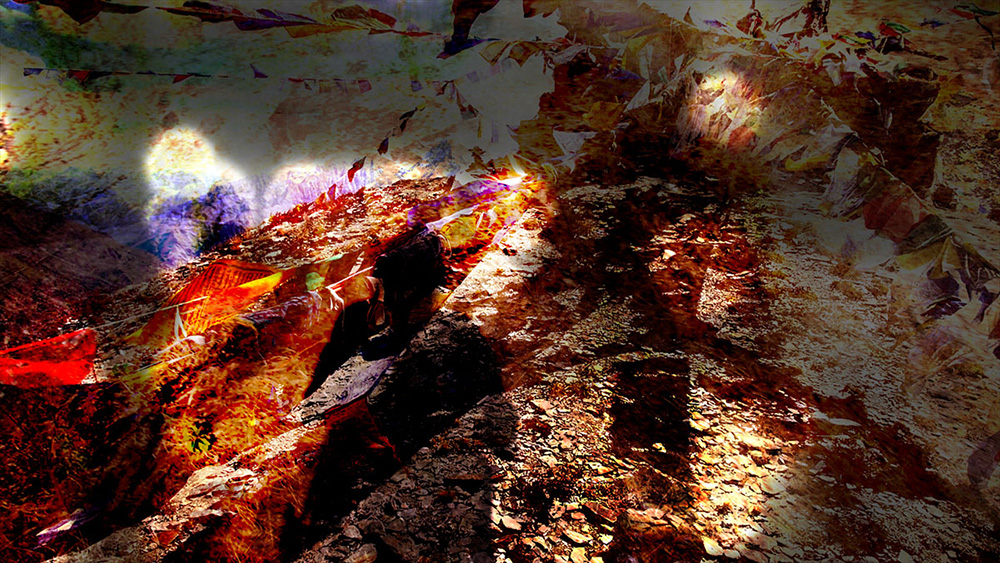
Found adventures and forgotten homes, dreams of departures and arrivals. Yes, that is the description for “Betwixt,” my latest new animation and experimental film.

You want to see a sneak peek, you say? Why not! Click on the image below.

Still from "Betwixt," new animation and experimental film by Fulbright artist Eva Lee
Still from “Betwixt,” new animation and experimental film by Fulbright artist Eva Lee

Inspired by  research on Tibetan Buddhist mandalas in Indian Himalayas. Made possible in part by support from Fulbright Scholar Program.

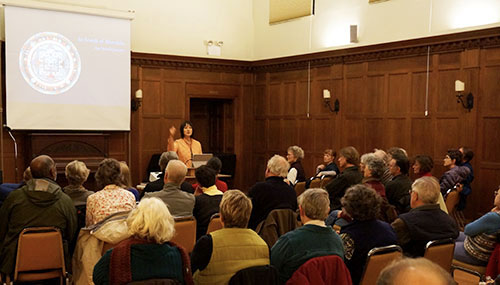
Upcoming Fulbright Artist Talk at DNKL Tibetan Buddhist Center

Fulbright Artist Eva Lee talks at DNKL Tibetan Buddhist Center

I am honored to give a Fulbright Artist Talk soon at Do Ngak Kunphen Ling Tibetan Buddhist Center for Universal Peace, Sunday, Feb. 1st, 11:00 am – 12:30 pm in Redding, CT. This center was the co-sponsor, along with Western Connecticut State University, for the Dalai Lama’s talk on Compassion and Creativity a couple of years ago in Danbury, CT. It was on this occasion that I first met DNKL’s community, and when I had the opportunity to film the creation and dissolution of a Compassion Sand Mandala made by Drepung Gomang monks as part of their Sacred Art Tour.

This visual presentation at DNKL, “In Search of Mandalas in the Himalayas,” will include photos and videos taken during my Fulbright research, featuring mandalas of the Tabo Monastery’s main temple, the famed Tsug Lhakhang, and Lamayuru Monastery’s Senge Lhakhang, and others. I will also screen my latest experimental film inspired by research and study of Buddhist philosophy. I look forward to what I’m sure will be engaging discussions with this astute audience!

The talk is Sunday, Feb. 1st, 11:00 am-12:30 pm, followed by reception at DNKL, 30 Putnam Park Road, Redding, CT  Tel: 203-664-1574. It will be preceded by DNKL’s usual Sunday community gathering from 10:00 am. Open to the public, all are welcome.

Fulbright Artist Talk at Religion Colloquium, Bard College

It is with great pleasure that I will return to my alma mater Bard College to present a Fulbright Artist Talk at its Religion Colloquium.

Bard College Fulbright Artist Talk Religion Colloquium with Eva Lee

In addition to showing photos and videos of my 2013-14 Fulbright research on 10th-12th c. Buddhist mandalas in ancient Tibetan monasteries of Spiti, Lahaul, and Ladakh, I will be screening my new experimental film, Betwixt. This work-in-progress is almost complete, and it will be a special sneak peek for attendees only!

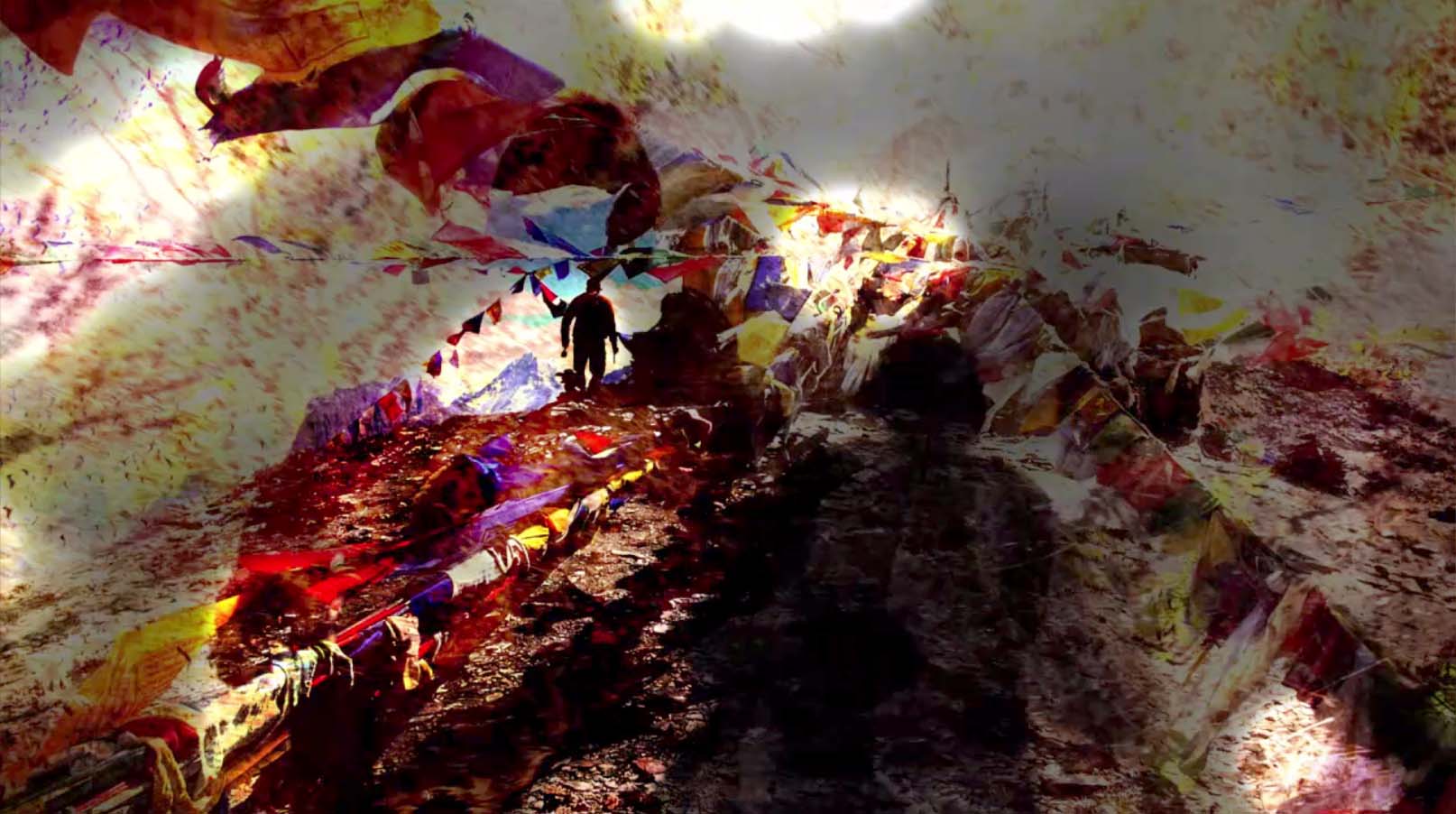
Eva Lee, "Betwixt," video, 2014
Still from Betwixt (05:06), 2014

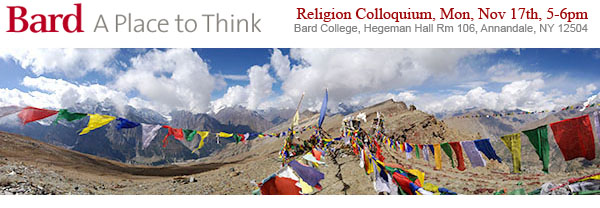
At invitation of Asian Studies, Art, and Religion Departments, artist and experimental filmmaker Eva Lee presents at Bard College, Religion Colloquium, Monday, November 17th, 2014, 5-6pm. Hegeman Hall, Room 106. Open to the public.

Upcoming Fulbright Artist Talk

My climb to a 15,000 foot Himalayan mountain top, gasping for beauty as much as for lack of oxygen, plus many more discoveries traipsing through Spiti, Lahaul, and Ladakh in this upcoming presentation.

Fulbright Artist Talk, Eva Lee

Thoughts on the Eve of Kalachakra in Ladakh 2014

July 2, 2014

Kalachakra will take place in Ladakh, India, near the city of Leh starting tomorrow July 3 – July 14. I wish I could be there this year, but alas, I will be here at home in the U.S. And on this, the eve of the event, I’m thinking about when I attended the Kalachakra Event for World Peace in Washington, D.C. held in July of 2011.

At that time, I had returned from my first trip to India where I happened to meet one of the organizers of this event. It was not long before he recruited me to help with video content for the large screens at Verizon Center, where the ritual was hosted.

Kalachakra in Washington DC

I helped design and produce material for projection onto the arena screens. Content included Kalachakra prayers, and video presentations of photographs which were shown in between ritual sessions during breaks. These were essentially images of Tibetan subjects by noted photographers such as Don Farber, Tenzin Choejor, Abhishek Madhukar, and many others.

In the process of creating the video material, I had the wonderful experience of working closely with an American Tibetan Buddhist nun named Ani Tenzin Lhamo-la. Her guidance was invaluable. I could not have made these videos for Kalachakra without her. What’s more, her friendship, moxie, and insight as a psychotherapist and monastic have been memorable and enduring.

dalai-lama-and-monks-at-kalachakra-2011-washington-d-c
The Dalai Lama with monastics on stage at Kalachakra Event for World Peace, Verizon Center, Washington, D.C., July, 2011. Photo: Tenzin Choejor/OHHDL

I felt most honored to have produced a video chronology of the Dalai Lama’s life in celebration of his 76th birthday, which occurred on the first day of Kalachakra, July 6, 2011.

While I am not at liberty to post the video because it was created exclusively for the birthday occasion, I am so pleased to have had the opportunity to work with archived images of His Holiness. Joining that day to help celebrate the Dalai Lama’s birthday were Mahatma Gandhi’s grandson, Arun, and Martin Luther King Jr.’s son, Martin. It was a historic appearance together.

kalachakra-2011-washington-d-c
Kalachakra Event for World Peace, Washington, D.C., July, 2011

I recently suddenly thought of the Dalai Lama sitting in the middle of the thekpu, the ritual platform on which the elaborate Kalachakra sand mandala is created. He does this on the first day of consecrating the ground where the sacred artform is performed, and again when the mandala is about to be dissolved.

I realized that for me, he is the real life version of the deity that resides in the middle of the mandala. Which is to say, I realized in my heart that he is a living example of compassion and wisdom united.

For all its elaborate ritual and complex symbolism, this is the basic goal of tantra—the union of compassion and wisdom. Wisdom of the ultimate nature of mind and reality. The mandala is the guide, the mnemonic image to aide a practitioner towards such enlightenment.

At the end of this ten-day-long event, the sand mandala was swept into a ritual vase to be taken to a nearby body of water and released after chanting and prayers were performed.

Pouring the sand mandala into the water is a way to release blessings out into the world. I was so happy to be part of the small group attending this final ritual act of Kalachakra.

Eva Lee and Andrew Lazarow, Kalachakra 2011, Washington DC
Backstage with Andrew Lazarow and his indispensable assistance, preparing a playlist.
Inside the Verizon Center media control room during Kalachakra Event for World Peace 2011, Washington, D.C.
Inside the media control room during Kalachakra Event for World Peace 2011
A cherished moment of receiving a blessing from the Dalai Lama. Photo: Tenzin Choejor

I send warm thoughts to all those who are now engaged in making Kalachakra happen in Ladakh, India! I hope it is blissful and awakening.

Lastly, I wish a hearty Happy Birthday to the Dalai Lama. Your Holiness, I will be thinking of you this weekend on the 6th!

Fulbright Artist Talk to Fellow Artists at EFA Studios, NYC

Eva Lee gives Fulbright Artist Talk at Elizabeth Foundation for the Arts (EFA) Studios, New York City

May 22, 2014

It was a pleasure to give my Fulbright “In Search of Mandalas” talk to fellow artists at Elizabeth Foundation for the Arts (EFA) Studios in New York City. There were familiar friends, old acquaintances, and new colleagues to meet. One artist was currently applying for a Fulbright to do research for 2014-2015. It’s always exciting to learn of others’ projects.

While I certainly enjoy presenting to all different audiences, I must say that because artists share a common visual language and practice, discussion can delve into the particulars of art research, process, and how it all results in the final artwork that is mutually enriching.

Many thanks to Natalia Nakazawa and Tamiko Kawata for organizing this event!

The Quality of Our Time: What is “Normal?”

While in India, I so appreciated the worldview that the individual is not an all-important master of the universe able to exert control over everything, an approach which I believe we in the West tend to adopt. The individual is instead one expression of vast lives that came before and vast lives that will come after. It is folly to think that there aren’t also vast circumstances at work in the human or natural environment which are beyond our control.

Contingency is therefore normal. Indians and Tibetans are very okay with last minute changes, unforeseen circumstances that present themselves and affect the course of your plans, without a great deal of anguish or sense of derailment or judgement, the way that we can be in America. I found this to be true day in and day out, on small and large matters.

Flexibility, openness to unplanned occurrences,  is considered a positive adaptive quality. One can go with the flow, with what presents itself, be aware of new or better potential solutions or outcomes than the one originally imagined. Make different decisions along the way. Sometimes it was maddening for my travel plans to have to accept this reality, but I learned to relinquish.

Here in the U.S., I’m thinking now of how we race around everywhere, internally and externally. Everything is precisely scheduled, and we expect results accordingly. We make lists to efficiently cross off when and what tasks are done. We think to ourselves that all these things have to be done, and done quickly, or we won’t get to where we need to be–to be successful, to be happy, to have the American Dream. We may feel often impatient, pressured, anxious, exhausted. We barely have time to have a meal when we are not multi-tasking or distracted. We run off here and there to the next meeting, to the next after-school event, the next appointment, the next workout at the gym, etc., in ever more and more compressed, appointed uses of time. Because there are always other things we also have to do.

What do we have to do? And what for?

Fulbright Artist Talk at Chuang Yen Monastery, Carmel, NY

Today, 2-4 pm, I will be presenting my Fulbright research at Chuang Yen Monastery in Carmel, NY, located on 225 acres of beautiful grounds, home of the Buddhist Association of the United States (BAUS). Come join us!

Below is the monastery’s flyer for the event.

Eva Lee Fulbright Artist Talk at Chuang Yen Monastery, New York
Eva Lee gives Fulbright Artist Talk at Chuang Yen Monastery, New York

Since the text is a bit small, I’ll repeat it here:

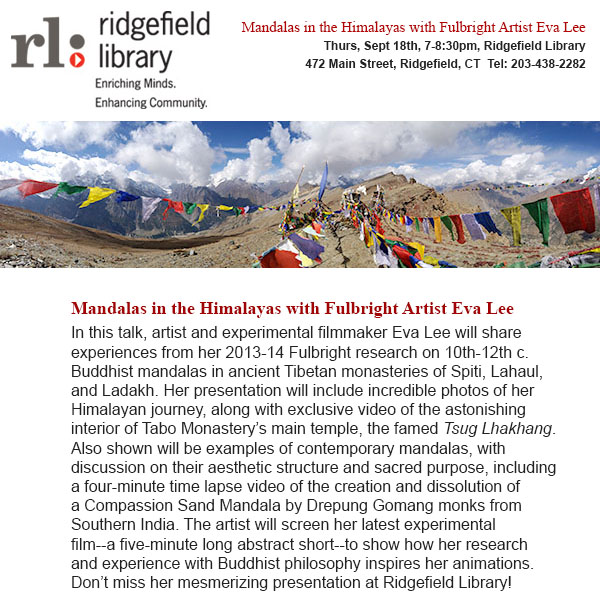
Artist and experimental filmmaker Eva Lee will share experiences from her 2013 Fulbright research on 10th-12th century Buddhist mandalas in ancient Tibetan monasteries of Spiti, Lahaul, and Ladakh. Her presentation will include:

  • incredible photos of Himalayan journey
  • examples of contemporary mandalas
  • several video clips including the astonishing interior of Tabo Monastery’s main temple, the famed Tsug Lhakhang, the creation and dissolution of a Compassion Sand Mandala by Drepung Gomang monks from Southern India, abstract work of how the research and experience with Buddhist philosophy inspires her work

Don’t miss her mesmerizing animations and documentaries, as she presents her latest work at Chuang Yen Monastery, Sunday, April 27, 2014, 2-4pm at Woo Ju Memorial Library, 2020 Route 301, Carmel, NY

So if you’re in the area, come to my presentation at Woo Ju Memorial Library. Mandalas– ancient and contemporary, their continued relevance today.

Plus, discover the grounds of this beautiful monastery!

First Fulbright Artist Talk, MacDowell Colony

I was thrilled to have been invited by The MacDowell Colony to give a talk at MacDowell Downtown this past week.  I presented “In Search of Mandalas: An Artist’s Journey through the Indian Himalayas.” What an awesome audience and first opportunity to share my Fulbright experience and research!

Fulbright Artist Eva Lee gives talk at MacDowell Downtown, Peterborough, NH
Fulbright artist Eva Lee gives MacDowell Downtown talk, “In Search of Mandalas: An Artist’s Journey through the Indian Himalayas,” Peterborough, NH

MacDowell is a renowned artist’s residency where writers, visual artists, composers, choreographers, and architects may go to have undisturbed time to work in their cabin studios in the beautiful woods of New Hampshire. It was wonderful to reconnect with the lovely MacDowell staff and local community, while also meeting the current fellows in residence.

Even though I’ve been back now from India for a few months, the experience is still very much percolating. I’m sure it will be for a long time to come. India was so rich with sights, sounds, customs, concepts, rituals, history, etc., that it will probably be an enduring seepage into my psyche here at home in the U.S. Articulating my research through presenting images and findings not only fulfills the cultural exchange portion of my grant, but also helps me to assimilate what I’ve learned on my journey.


Sherabling Monastery’s 3D Mandalas and Milarepa’s Redemption from Murder

October 23, 2013

Going to Palpung Sherabling Monastery in the foothills of the Indian Himalayas was a revelation. Three years ago, when I first visited I had happily stumbled upon resident monks rehearsing their famed Lama dances, held bi-annually in the courtyard. This time, however, I was riveted by another aspect of this Karma Kagyu lineage of Tibetan Buddhism which I had not seen before.

It was the treasure trove of 3D mandalas on its mezzanine level. Because they were not visible from the ground floor of the main temple, I missed them last time. This time, I traveled with a senior monk who asked for access to other areas of the temple with art interest, and was therefore taken up to the mezzanine. Wow, fourteen 3-dimensional mandalas of the tantras of Marpa! Usually, if one is lucky enough to come across any 3D wooden models, one sees only one or two of them at a time. Here were fourteen of them, of such variety and fine quality, too!

So allow me to walk you through how I saw these mandalas.

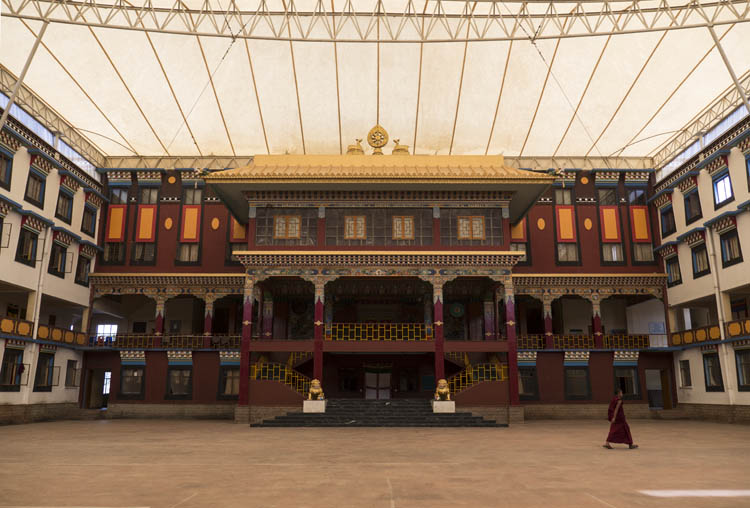
Here’s a view of Sherabling Main Temple and the inner courtyard. Very quiet that day, compared to the first time I saw it completely filled with monks dancing in organized circles.

Inner courtyard of Sherabling Main Temple complex, Himachal Pradesh, India.
Sherabling Main Temple complex, with inner courtyard, Himachal Pradesh, India.

Upon entering this well-appointed temple, you behold a 42-foot tall golden Maitreya, the future Buddha, seated on a throne beautifully gilded and elaborately decorated with filigree motifs.

Maitreya, the future Buddha, Sherabling Monastery main altar, Himachal Pradesh, India
Sherabling Main Temple, looking back towards front entrance and inner courtyard beyond, Himachal Pradesh, India

In fact, this whole main assembly hall is exceptionally ornate with its painted and gilded columns, cornices, thangkas and friezes.

What is not visible when you stand on the ground floor is the spacious and tall mezzanine level above that houses the exquisite Mandala Shrine Hall. Here are some views of it.

View of Maitreya statue from mezzanine level of Sherabling Monastery Main Temple, Himachal Pradesh, India
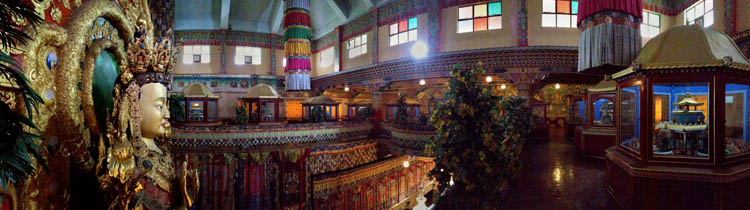
Panoramic view of Maitreya statue from mezzanine level of Sherabling Monastery Main Temple, Himachal Pradesh, India
Panoramic view of Maitreya statue from mezzanine level of Sherabling Monastery Main Temple. Visible on either side are 3-dimensional mandalas, part of the 14 tantras of Marpa, Himachal Pradesh, India

And here’s a full view of this magnificent, monumental statue of Maitreya.

Maitreya, the future Buddha, a 42-foot statue in Sherabling Monastery Main Temple, Himachal Pradesh, India
Maitreya, the future Buddha, a 42-foot statue in Sherabling Monastery Main Temple
Himachal Pradesh, India

Notice that at the foot of the statue are photos of His Holiness the 14th Dalai Lama on the left, and His Holiness the 17th Gyalwang Karmapa on the right. The Dalai Lama is the spiritual leader of Tibetans and all Tibetan Buddhist schools, of which there are mainly four–Nyingma, Kagyu, Sakya, and Gelug. The Karmapa is the spiritual leader of the Kagyu school.

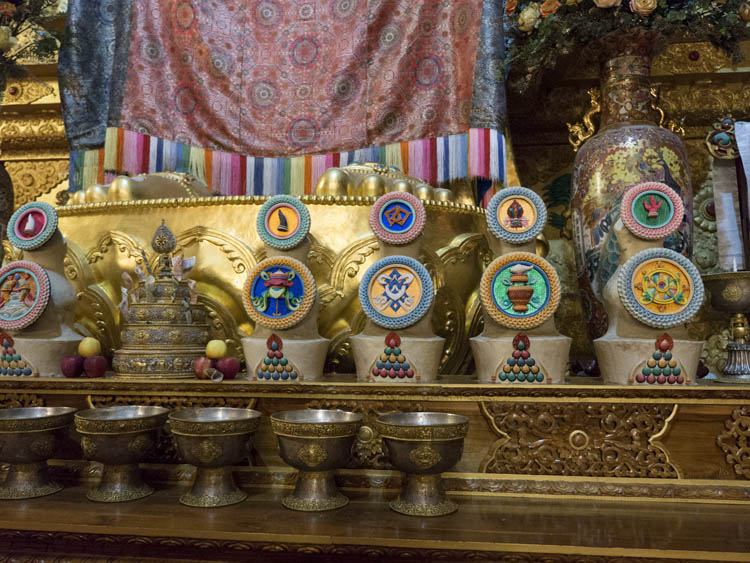
Detail of some of the Eight Auspicious Symbols of Buddhism, and other ritual objects, altar of Sherabling Monastery Main Temple
Detail of some of the Eight Auspicious Symbols of Buddhism, and other ritual objects, at the foot of the monumental Maitreya statue. Sherabling Monastery Main Temple

Now about the Mandala Shrine Hall, it displays wooden three-dimensional mandalas of the 14 tantras of Marpa. These are the main practices of the Palpung Sherabling (Kagyu) community.

Profile view of Maitreya statue from mezzanine level of Sherabling Monastery Main Temple

Marpa (1012-1097  CE) was a great teacher and translator. In fact, one of his students became the first Karmapa. This is no small deal since the present Kagyu school’s Karmapa is the 17th incarnation, an older lineage than the Gelug school’s 14 Dalai Lamas. But perhaps, arguably, Marpa’s most famous student was Jetsun Milarepa (ca. 1052—ca. 1135 CE). How Milarepa became enlightened is an inspiring story of redemption.

As a layman, Milarepa had a dark personal history. He learned sorcery and exacted revenge upon an aunt and uncle who mistreated and took all of his family’s wealth upon the death of his father. As a result, Milarepa killed dozens of people through conjuring devastating hailstorms. Later, remorseful for his black deeds, he sought a teacher for help. That teacher turned out to be the fearsome Marpa, whose gaze was said to bely such inner power that people found it difficult to look at or be near him.

The mahasiddha Marpa, always depicted with wide staring eyes, Lamayuru Monastery, Ladakh

Marpa was apparently the right teacher for the destructive Milarepa to atone himself. He put him through arduous tasks, such as instructing him to build buildings, each time promising to teach him if he completed his request. However, Marpa repeatedly anguished and disappointed his hapless student by refusing to teach him sacred Buddhist practices. Despite building and tearing down three whole structures, and suffering much physical pain, Milarepa still did not received a single tantric oral transmission.

The nine story tower that Milarepa single-handedly built, Sekhar Gutok, Lhodrag, Tibet.

Milarepa was then asked to build a multi-story tower by Marpa at Lhodrag, where to this day the 11th century tower still stands. For a detailed telling of Milarepa’s trials and tribulations, see this Kagyu site.

When at last Marpa bestowed the spiritual teachings on Milarepa, his dedicated student then left to practice. After twelve years, he attained the state of Vajradhara (complete enlightenment).

Milarepa became a renowned ascetic and poet, a mahasiddha who lived in a cave in Namdaking, Tibet near the border of present day Nepal. He was said to have survived on nettles, an herb which caused his complexion to turn green. He is often portrayed in paintings with green skin tones for this reason. The other identifying aspect is his hand held to his ear. While it looks like a gesture of listening, I learned from a Tibetan nun that it is a yogic posture for affecting subtle energies of the body.

"Milarepa Giving Teachings by Singing to Khyirarepa," watercolor on paper by Dru-gu Choegyal Rinpoche.
“Milarepa Giving Teachings by Singing to Khyirarepa,” watercolor on paper by Dru-gu Choegyal Rinpoche
© 2007, Dru-gu Choegyal Rinpoche.
View of some of the fourteen 3-dimensional mandalas of the tantras of Marpa, Karma Kagyu lineage of Tibetan Buddhism
View of some of the fourteen 3-dimensional mandalas of the tantras of Marpa, practices of Karma Kagyu lineage of Tibetan Buddhism

As for the Mandala Shrine Hall, it is an exceptional collection and display of the 14 tantras of Marpa. While most mandalas, such as the below Mahamaya mandala, follow the conventional form of a three-story palace with four gateways facing the cardinal directions, with the main deity residing at center, and associated deities in the surroundings, encompassed by ritual symbols and elements, only the initiated Kagyu practitioner would truly be familiar with the mandalas and their practices.

Mahamaya mandala, Sherabling Monastery Main Temple, Himachal Pradesh, India

Even for practitioners from other Tibetan schools, the mandalas may seem unusual, such as this one. I believe the below mandala is that of a Dakini.

Detail of one of the fourteen 3-dimensional mandalas of the tantras of Marpa, Karma Kagyu lineage of Tibetan Buddhism
7-IMG_3441
Panoramic view of Mandala Shrine Hall, Sherabling Monastery, Himachal Pradesh, India

All photos © 2013, Eva Lee.
Except where otherwise credited

A Look at the Art of Zigar Monastery, Chokyi Lodro, Deer Park Institute in Comparison to Their Indo-Tibetan Predecessors

October 21, 2013

At Rewalsar, visitors may circumambulate the famed Lotus Lake and see the many monasteries built around it today. It is a pilgrimage site for Tibetan Buddhists who revere Padmasambhava (Guru Rinpoche), the Indian tantric master who is said to have performed a miracle here which you can read about in my previous post, Miracle at Lotus Lake and the Secret Caves of Rewalsar.

View of Tso Pema (Lotus Lake) from Zigar Monastery, Rewalsar, India

The most noticeable monastery in Rewalsar these days is Zigar Orgyen Choekorling Monastery because of its 138 feet high golden statue of Guru Rinpoche.

Zigar Monastery features a monumental golden statue of Guru Rinpoche, Tso Pema/Rewalsar, India
Photo: Frederic Martin Duchamp
Zigar Monastery's 138 feet high statue of Guru Rinpoche, Rewalsar (Tso Pema), India
Zigar Monastery’s 138 feet high statue of Guru Rinpoche, Rewalsar (Tso Pema), India
Zigar Monastery's 138 feet high statue of Guru Rinpoche, Rewalsar (Tso Pema), India
Detail of Zigar Monastery’s 138 feet high statue of Guru Rinpoche, Rewalsar (Tso Pema), India
Panorama of Zigar Monastery's courtyard, Rewalsar (Tso Pema), India
Panorama of Zigar Monastery’s courtyard, Rewalsar (Tso Pema), India
Side view of Zigar Monastery's courtyard, Rewalsar (Tso Pema), India
Side view of Zigar Monastery’s courtyard, Rewalsar (Tso Pema), India
Interior of main temple, Zigar Monastery, Rewalsar (Tso Pema)

Quite unexpectedly, inside Zigar Monastery’s main temple this morning, I saw three large sculptures and was struck by how they had sculptural backgrounds attached to the wall highly reminiscent of Indo-Tibetan ones from the 11th century in ancient Western Tibet.

Detail of central altar with Shakyamuni Buddha, Zigar Monastery, Rewalsar (Tso Pema)
Photo: Frederic Martin Duchamp
Detail of central altar with Shakyamuni Buddha, Zigar Monastery, Rewalsar (Tso Pema)
Detail of central altar with Shakyamuni Buddha, and background reminiscent of Indo-Tibetan sculpture, Zigar Monastery, Rewalsar (Tso Pema)

I immediately saw these background sculptural reliefs as contemporary versions of the below artforms. The following are central altars of circa 11th century Lamayuru Monastery’s Senge Lhakhang in Ladakh, and Lhalung Monastery’s Serkhang (Golden Hall) in Spiti.

Detail of altar, Lamayuru Monastery Senge Lhakang, Ladakh, India

The first similarity was the use of relief sculptures attached to the wall. Other key similarities include central figures within a tri-lobed halo, surmounted by the Hindu mythical garuda, ornate scrollwork with figures and animals, in particular the Indian-derived makara, a crocodile-like sea creature. Both ancient and modern sculptures are all made of clay. The contemporary presentation as multi-colored wall reliefs is largely the same as the Indo-Tibetan, even while stylistic handling and some content are different.

Detail of central altar, Lhalung Monastery, Spiti, India
Detail of central altar, Lhalung Monastery Serkhang, Spiti, India

This is the second figure also in the main temple of Zigar Monastery, a Green Tara.

Green Tara, Zigar Monastery, Rewalsar (Tso pema)
Detail of Green Tara, Zigar Monastery, Rewalsar (Tso pema)

And lastly, the third figure, Shakyamuni Buddha in his earth-witness mudra.

Shakyamuni Buddha, Zigar Monastery, Rewalsar (Tso pema)
Detail of Shakyamuni Buddha, Zigar Monastery, Rewalsar (Tso pema)

Above the Zigar Monastery main temple is a smaller temple dedicated to Chenrezig, also known as Avalokiteshvara, deity of compassion.

Chenrezig (Avalokiteshvara), Zigar Monastery, Rewalsar (Tso Pema)

This sculpture, as are the three in the main temple, is by the same artist, beautifully painted and detailed.

Detail of Chenrezig (Avalokiteshvara), Zigar Monastery, Rewalsar (Tso Pema)

I learned that the master sculptor was named Tashi Norbu. I was able to contact him and visit him later in the day. Wow, it was total chance that he was in India and happened to be nearby. He would have been out of the country were it not for an unfortunate recent event which prevented him from going. I was so excited to be able to ask the artist technical and aesthetic questions!

Master sculptor Tashi Norbu
Photo: Frederic Martin Duchamp

Tashi Norbu is Bhutanese, as are many of the artists commissioned by monasteries today to create artwork. In Rinchen Zangpo’s time, 10th-11th centuries, it was Kashmiri artists who were considered the finest artists to give expression to Buddhist concepts, and they were largely the ones responsible for the art of 10th-12th century monasteries in the Himalayas during the Great Second Transmission of Buddhism from India to Tibet.

Main temple, Deer Park Institute, Bir, India

Tashi Norbu was invited to make numerous sculptures in the area. In addition to Zigar Monastery, he created works for Deer Park Institute in Bir, and Dzongsar Khyentse Chokyi Lodro Institute in Chaundra. We went together to visit these sites as I learned about his process.

His account about how Dzongsar Khyentse Rinpoche, who commissioned him for both Deer Park and Chokyi Lodro artwork, was so exacting about getting the face of the Deer Park Manjushri to look “right” (according to its original divined appearance) was so interesting. According to the artist, this required no less than eleven tries–that is, eleven fully sculpted, completed, then discarded heads–and many meditation retreats by the artist together with lamas in order to get it correct. Wow, this was the first time I’d ever heard of this working method.  Be in meditation communally for aesthetic guidance, in order to “see” the work together for the artist to create it.

Manjushri statue by Tashi Norbu, Deer Park Institute, Bir, India
Detail of Manjushri statue by Tashi Norbu, Deer Park Institute, Bir, India

Another rinpoche, on a later separate unrelated occasion, told me this same thing. He said, rather than strategize conceptually to create a “successful” work of art, as he believes many contemporary artists do, instead, an artist should use mindfulness to connect with inner realities and then create from that vision.

Main altar at Chokyi Lodro Institute, Bir, India
Main altar at Chokyi Lodro Institute, Chaundra, India, sculpture by Tashi Norbu

It would be interesting to see Tashi Norbu’s sculptures in progress, from beginning to end. As a painter who has never sculpted, I can’t fathom how one constructs monumental Tibetan Buddhist statues.

He said the underlying forms are wood and iron with wire mesh, concrete, and then final layers are clay.  The clay is made from Tibetan paper mixed with clay and water until the right consistency is achieved.  Then the work is air-dried, carved, primed, painted and gilded. The faces and hands are usually painted in a special pure gold paint made in Nepal.  You can burnish this to bring it up to a luster, but burnishing usually mars the clay surface a bit and affects the details, so this is not done on the faces and hands.

Monumental Buddha, main altar at Chokyi Lodro Institute, Bir, India
Monumental Buddha, main altar at Chokyi Lodro Institute, Chaundra, India

The finished statues have hollow interiors where prayers written on rolled paper and katas (ritual scarves) are placed.

Main temple at Chokyi Lodro Institute, Bir, India
Main temple at Dzongsar Khyentse Chokyi Lodro Institute, Chaundra, India.
Standing with me are Tashi Norbu and Venerable Tenzin
Panorama of Dzongsar Khyentse Chokyi Lodro Institute, Chaundra, India

When I returned to Dharamsala, I told my photographer friend Frederic Martin Duchamp about my trip to Tso Pema, and learned that he happened to have also met Tashi Norbu a few years ago when the artist was sculpting the now completed statues for Zigar Monastery. AND he had photographs of some of them in-progress. What serendipity–or, as the Tibetans say, auspicious coincidence!

So the following are before and after photos of all the main Zigar Monastery statues, thanks to Frederic who has generously shared them with me. Click here to see a short video transition of the first example.

Before and after, Shakyamuni Buddha, Zigar Monastery, Rewalsar, India
Before and after, Shakyamuni Buddha, Zigar Monastery, Rewalsar, India. Photo: Frederic Martin Duchamp
Before and after, Shakyamuni Buddha, Zigar Monastery, Rewalsar, India
Detailed before and after, Shakyamuni Buddha, Zigar Monastery, Rewalsar, India. Photos: Frederic Martin Duchamp
Before and after, Shakyamuni Buddha, Zigar Monastery, Rewalsar, India
Before and after, Green Tara, Zigar Monastery, Rewalsar, India. Photos: Frederic Martin Duchamp
Before and after, Shakyamuni Buddha, Zigar Monastery, Rewalsar, India
Before and after, Shakyamuni Buddha, Zigar Monastery, Rewalsar, India. Photos: Frederic Martin Duchamp
Before and after, Chenrezig, Zigar Monastery, Rewalsar, India
Before and after, Chenrezig, Zigar Monastery, Rewalsar, India. Photo: Frederic Martin Duchamp

All photos © 2013, Eva Lee.
Except where otherwise credited