Fulbright Pre-departure

I Don’t Know, it’s a Mystery

I just watched “Shakespeare in Love,” that feel-good movie starring Gwyneth Paltrow and (a very handsome) Joseph Fiennes. There is a line that repeats throughout it. It goes something like this: “It all turns out well…How?  I don’t know.  It’s a mystery.”

That’s how it is right now. I will be leaving soon.  Incredible India, here I come! Oh wait, after I set things in order here on the home front. Dozens of loose ends to tie up, to ease my absence upon family who will not be traveling with me. Then there are all kinds of details about travel, timing, how to meet someone, how to gain access, how to get permission, stay healthy, and so on…that I just simply can’t wrap my head around.  Ah well, maybe that’s the whole point, like in the chaos of the theater, you just have to let go and trust in the process.  Stay open to the moment, and let the players do their parts.

Some wonderful friends and acquaintances are stepping forward to help. Glad to have travel companions to ply with U.S. lotions, scotch, and chocolate. Also, so they can gently tease me not to worry so much about recent news of Sino-Indian border disputes, or crimes against women, or potential terrorist attacks in Himachal Pradesh where I will be traveling. Ok, it’s a bit worrisome, but also true that everywhere there are dangers to keep in perspective. Sadly, here on the home front, Sandy Hook happened, and even though that is not far from me, I would still encourage travelers to come visit.

I also met fellow Fulbrighters recently in New York City, and we new friends shared a meal and laughter over visa challenges, other logistical victories and curiosities. I was lucky I got my visa without a hitch, before the Indian Consulate changed over to a new visa outsourcing agency.  The changeover, and transitional pains that ensued, literally happened only a day or two after I secured my visa. An auspicious beginning? I hope so.

The door is open!  And I think it’s going to be quite a journey…

Bodhgaya & Terrorism

Statue of Buddha inside the Mahabodhi Temple, Bodhgaya, India

Bodhgaya and terrorism. I would never have put these two concepts together. That is, not until I heard about the bombings that occurred just a little over a week ago at this venerable holiest-of-the-holy site. The very place where Buddha became enlightened sitting under a bodhi tree. The place where thousands of pilgrims rich and poor alike travel to, to do full body prostrations, or make butter lamp offerings, meditate, circumambulate, chant songs and mantras, and other practices that cultivate one’s mind to turn towards wisdom, to enact compassion, to see the true nature of reality, the illusion of selfhood, amidst impermanence.

If you’ve ever been here, and experienced the electrifying devotion practitioners bring, you would be hard pressed to pair the scene with terror. It makes me feel sad for the perpetrators that they would harbor such contorted mentalities and ill plans among peaceful people.

Read some coverage of it here.

Fortunately, it seems there were no fatalities, and no serious structural damage done to the World Heritage site.

The Indian government today has however issued alert warnings for further possible terrorist strikes on Himachal Pradesh Buddhist monasteries.

This is discouraging and unwelcome news, to say the least, as I plan to travel to over a dozen such Himalayan sacred sites soon.

Green Light GO on India Reseach and Visa

It’s been a flurry of paperwork, and orientation, reading guides, asking questions, learning protocols and so forth, to move on to the next step of clearance by the Indian Consulate for Fulbright research and visa. What a lesson in following directions! After lastly traipsing through torrential rain, a fat stack of organized forms and documents with regulation passport photos in hand, to New York City where I applied in person, here I am with the green light GO!

Fulbright Guide for U.S. Scholars

Wow, this means that I will now be working on the nitty-gritty of travel plans.

Meanwhile, it’s been wonderful to “meet” the USIEF staff as well as other Fulbrighters traveling to India during the virtual orientation. Someone also set up a Google group so we can all chat with each other and perhaps connect when we’re abroad. It’s inspiring to hear about what others are doing. All different scholars, areas of expertise and research–Islamic intellectual and cultural history, Ragamala painting, management science and information systems, Indian philosophy and the Transcendentalists, ecology and the environment, recovery from serious mental disorders and why India does better than other countries in this area, climate change and energy efficiency, Holocaust refugees in India during WWII, Indian public pension and health system, Indian and American portrayals of democracy, Tamil poetry, Ayurvedic medicine, ancient rock-cut monuments, deployment and commercialization of renewable energy in villages, Hindu-Jewish encounters, ethnography of divorce, domestic violence, courts and marriage, national parks. The list goes on…

Getting to the Land of Snows in Time

I am so pleased to hear that my documents for visa application are on their way from India! Having a relatively small window of travel before the snow arrives in October in the high Himalayas means that timely visa approval will be critical to my research. Otherwise, major roads close and there is no access or travel until they reopen in about May of 2014! Spiti, Lahaul, and Ladakh regions were once-upon-a-time part of Tibet, and there is good reason for why they call it the Land of Snows! It is, by golly, snowy there for the majority of the year.

Yosemite National Park

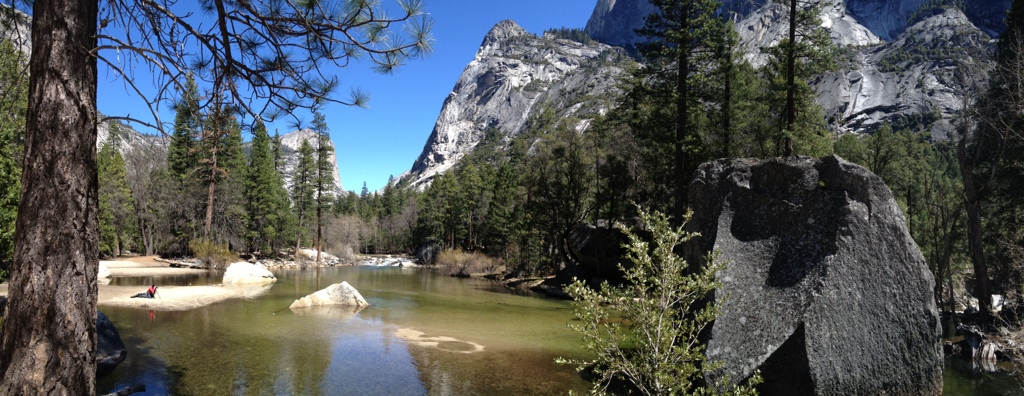
If the weather in the Himalayas in summer is anything like the weather in Yosemite National Park in spring, then I think I’ll be all right with what to wear for trekking to monasteries. What hiking it’s been here in California with sun, vistas, rainbows, waterfalls, and snow! Exhilarating.

Mirror Lake, Yosemite National Park

Of course, altitude figures as a large difference. The scale of even the highest of Yosemite’s mountains pales in comparison to the Himalayas. Yet a taste of such grandeur truly makes me look forward to being present in Spiti, Lahaul, and Ladakh. Below is a view of Yosemite Falls, one of the world’s tallest waterfalls.

Yosemite Falls, Yosemite National Park
Yosemite Falls, one of the world’s tallest waterfalls, Yosemite National Park

The Great Translator Rinchen Zangpo

I’m currently reading David Snellgrove’s “Indo-Tibetan Buddhism: Indian Buddhists & Their Tibetan Successors.” It concentrates on the tantric period of Buddhist theory and practice, from the 8th to the 13th centuries. This was a fertile time of the transmission of Buddhism from India to Tibet. I’m particularly interested in the prodigious legacy of The Great Translator Rinchen Zangpo (958–1055 C.E.) who translated voluminous original Sanskrit sutras into Tibetan, and therefore helped preserve the doctrines and teachings. These original Sanskrit sources are now largely lost in India.

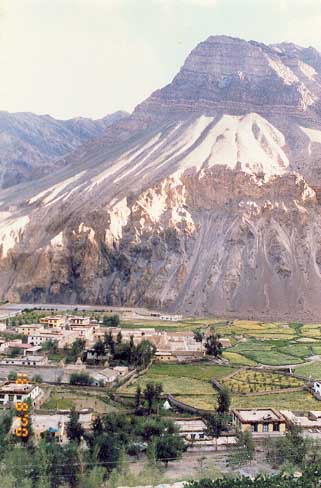
Tabo Monastery, Spiti, Himachal Pradesh, India
Photo: Tabo Monastery

Rinchen Zangpo is also credited with building over one hundred monasteries in Western Tibet, many still existing now in modern day Indian Himalayas, including the famous Tabo Monastery in Spiti, Himachal Pradesh.

I really look forward to seeing Tabo’s murals. They are extensive and among the best preserved from Rinchen Zangpo’s time. In addition to the art, its architecture is an excellent example of mandala layout and structure, built in direct relationship to sutra descriptions. Founded in 996 C.E., Tabo is considered to be the oldest continuously functioning Buddhist monastery in India and the Himalayas.

Himalayas / hi-MAAL-yah

Learn something new every day. The correct pronunciation for Himalaya is “hi-MAAL-yah.”

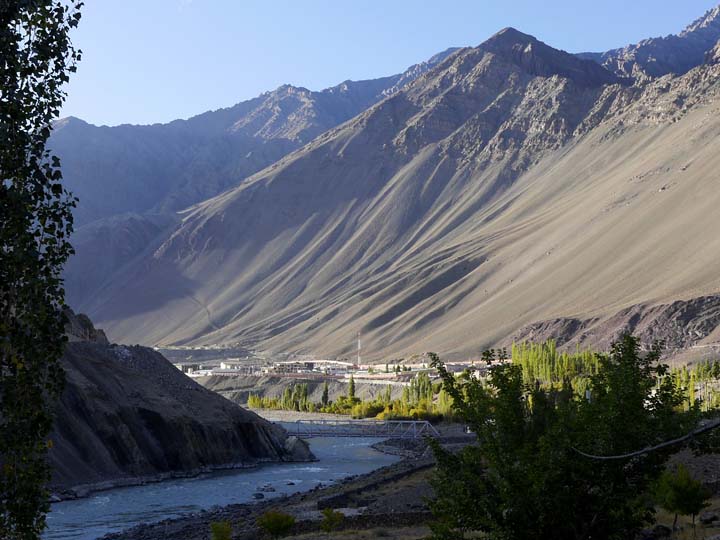
Mountains and the Indus River Valley as seen from Alchi Monastery circumambulatory, Himalayas.

I look forward to going there later this year to conduct research as an artist, made possible by a Fulbright-Nehru Scholar award. Excited and honored! Truly grateful for this opportunity! I will be researching murals of Indo-Tibetan monasteries in Lahaul, Spiti, and Ladakh districts, with a focus on mandalas as a blueprint for understanding the nature of mind and reality.

So while my departure is still months away, I’ve already begun traveling in my mind as I await further details from Fulbright.