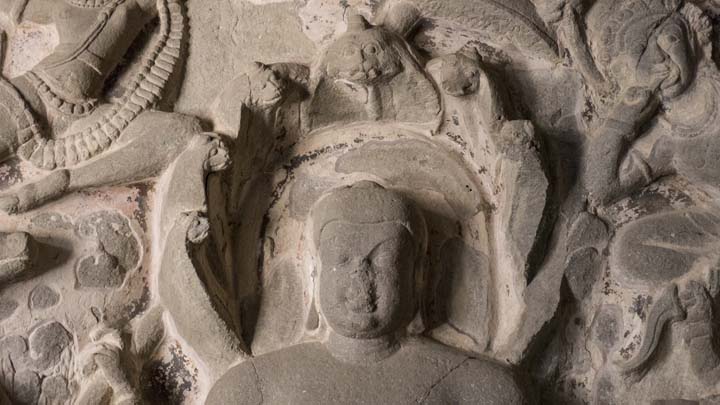
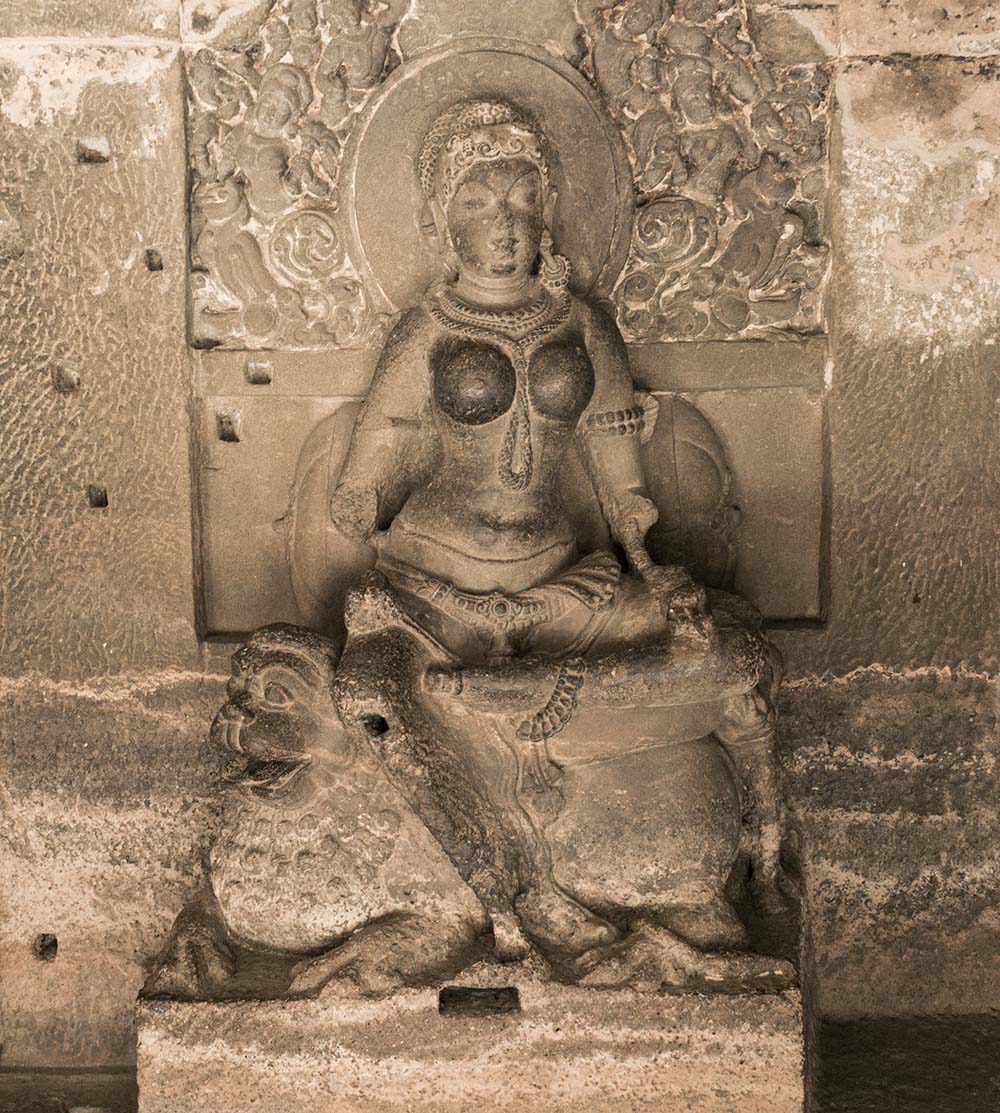
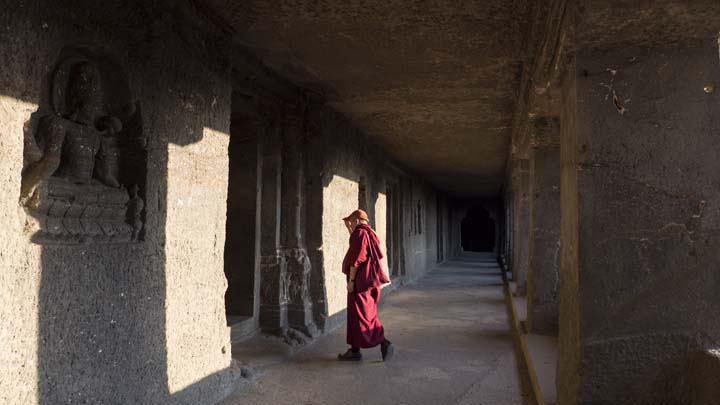
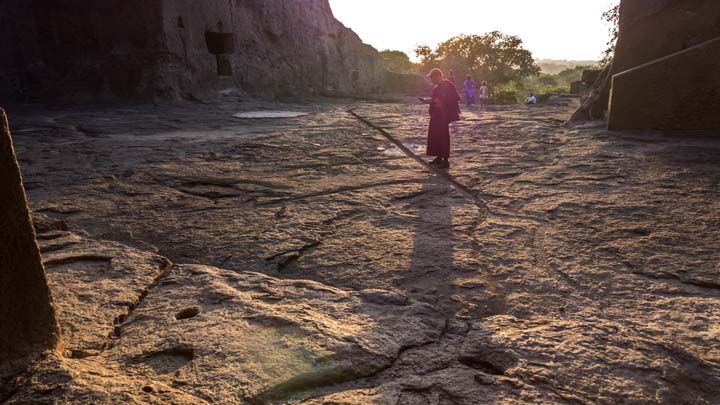
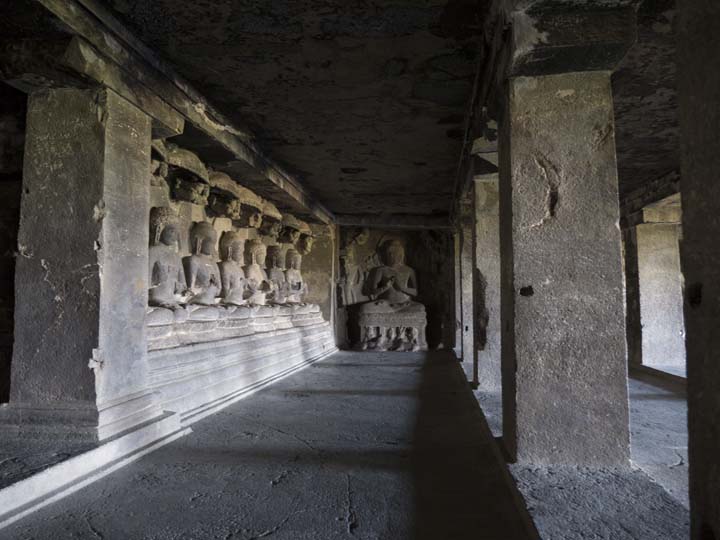
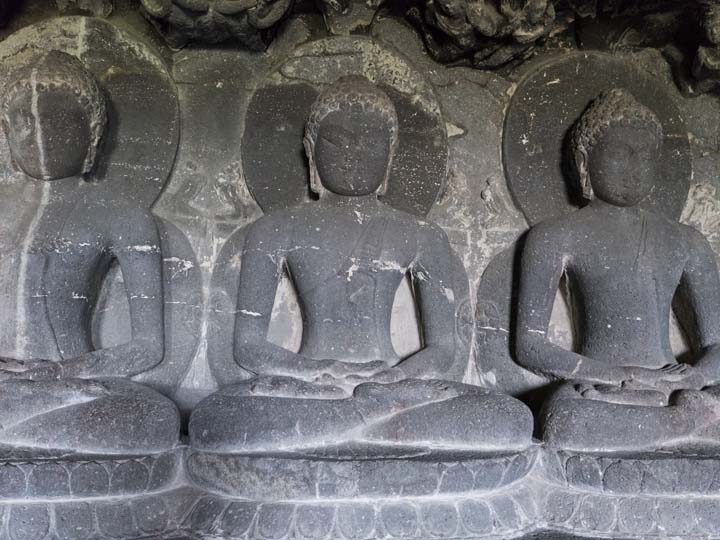
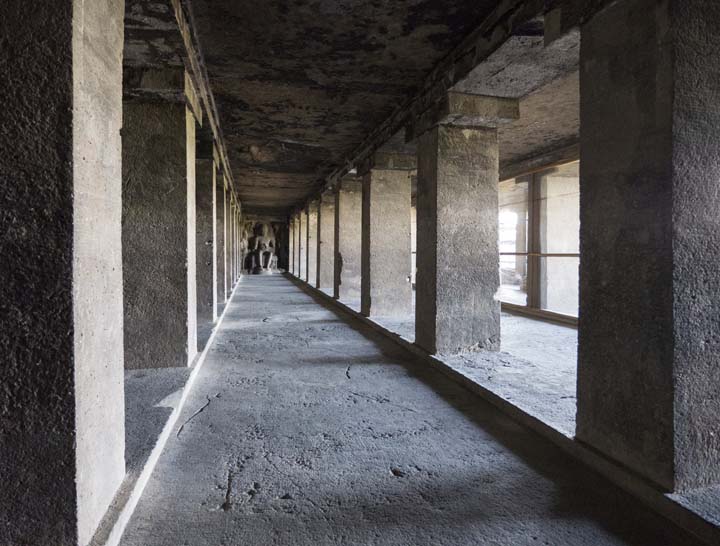
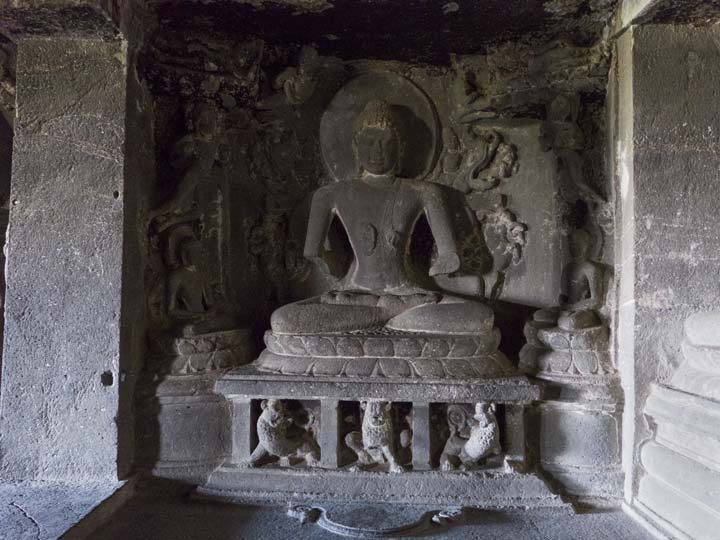
Here it is! Hemis Monastery Lhakhang Nyingma, Newly Completed Video Documentary
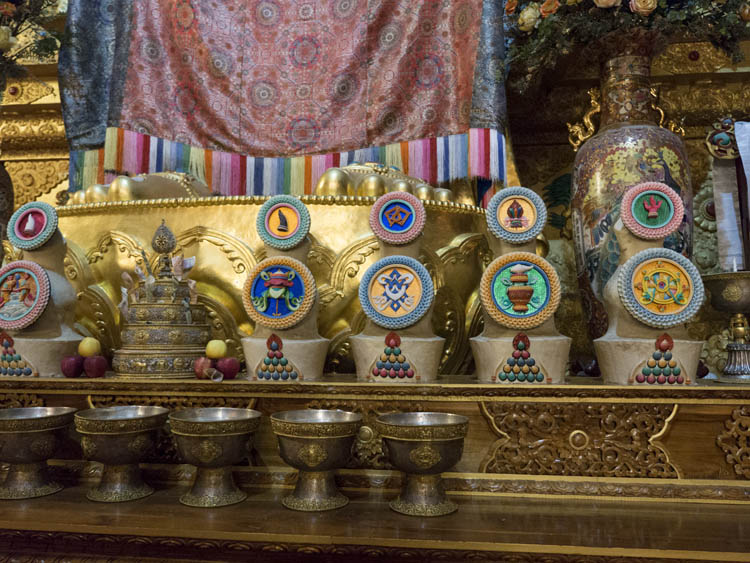
See the rare interior of Lhakhang Nyingma, oldest temple at Hemis Monastery, dating back to its 17th century founding in the high Western Himalayan mountains of Ladakh, India. Its wall murals and sculptures are considered among the finest examples of Buddhist art from this period.
Hemis Monastery Lhakhang Nyingma VIDEO 2021 (filmed 2013) 8 min. 45 sec
This footage was originally shot during my 2013-14 Fulbright-Nehru research fellowship when I traveled throughout the Spiti, Lahaul, and Ladakh regions in search of 10th-12th century Indo-Tibetan mandalas.
Hemis Monastery is the largest monastic institution in Ladakh and the main seat of the Drukpa Kagyu school of Tibetan Buddhism. The spiritual head is His Holiness the 12th Gyalwang Drukpa. The current monastery was founded in the 17th century by the revered Taktsang Repa (1574-1651) when King Sengge Namgyal ushered in the golden age of Ladakh, and the Drukpa tradition flourished under his reign. Today, Hemis Monastery continues to flourish, along with other affiliated monasteries such as Chemrey, Hanle, Timosgong, Shey, and Mulbek, among many others.
View of Hemis Monastery en route through Hemis National Park
Located in Hemis National Park, the largest national park in South Asia, Hemis is situated inside a gorge at 12,000 feet altitude. Built into a mountainside in Shang Valley, it is hidden until one gets close enough to see it. The stunning cold desert landscape is one of the most elevated and coldest regions on earth, with altitudes reaching as high as over 19,000 feet and temperatures as low as -30°C. When I visited in September, I was well aware that it was the last month advised for travel before the harsh climate begins. Roads are unpassable for half the year because of snow and remoteness. The understanding is, if you are stuck there when snow begins, you may in fact have to stay there until May when travel is possible again!
Hemis National Park is a protected home for rare species of animals, the most well-known one being the celebrated snow leopard. What a beautiful creature!
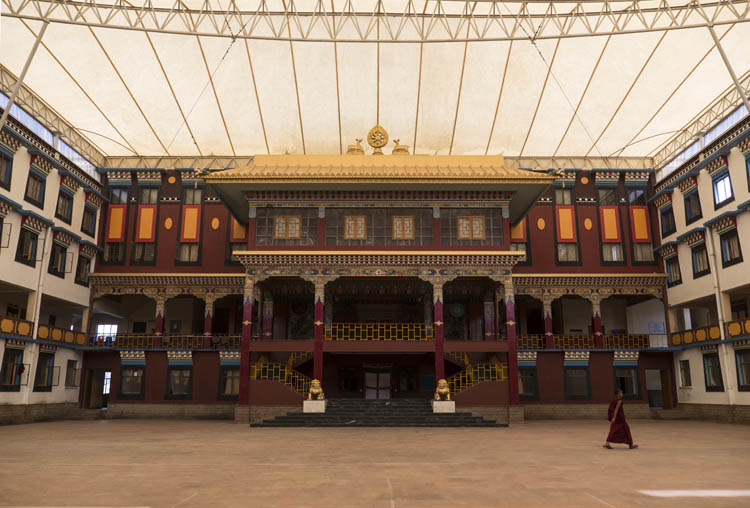
When one arrives at Hemis Monastery, one passes through a portal to enter a large rectangular outdoor courtyard formed on four sides by the main monastery with its two large dukhangs (assembly halls), the visitor’s gallery, a museum, and monk and administrative quarters. A distinctive feature is the Tibetan style of architecture with three tall prayer flags displayed in the center of the courtyard.
Hemis Monastery entranceHemis Monastery courtyard, with one of two dukhangs (assembly halls) on the left and visitor’s center on the right. Photo: Kishore Thukral.Hemis Monastery courtyard, with museum on the left and one of two dukhangs (assembly halls) on the right. Photo: Kishore Thukral
The oldest temple of the monastery, Lhakhang Nyingma, is tucked away behind the main structure of the monastery. It is hidden from view in the main courtyard and is usually not open to visitors.
In this small inner courtyard by the entrance to the lhakhang, there is a water spring seen here below the willow stumps.
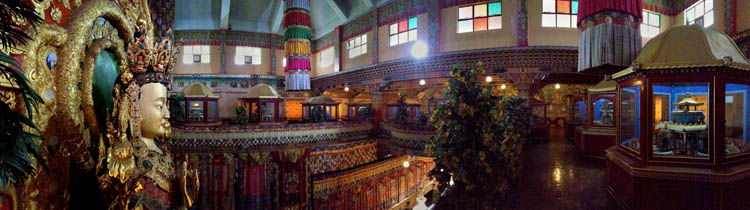
When one enters the lhakhang, the most noticeable sculptures are the two large, approximately life-size ones of Taktsang Repa, and the incarnate spiritual leader, the Gyalwang Drukpa.
Hemis Monastery Lhakhang Nyingma interior, originally built ca. mid-17th centuryTaktsang Repa Shamonath, gilded copperThe Gyalwang Drukpa (probably the Seventh incarnate, Thrinle Shingta), gilded copper
Acknowledgements:
With gratitude to the Office of His Holiness the Gyalwang Drukpa and Hemis Monastery. Many thanks to Tsunma Nawang Jinpa. Made possible in part by the support of Fulbright-Nehru Research Program, Council for the International Exchange of Scholars, and United States-India Education Foundation.
See other video documentaries of Tabo Monastery, Lamayuru Monastery, Lhalung Monastery, and Mangyu Monastery here.
To learn more about Tibetan Buddhist art and its relationship to 10th-12th century Indo-Tibetan predecessors, visit my Fulbright blog.
Fulbright Documentary Series at Columbia University and Library of Tibetan Works & Archives
Posted
Losar Tashi Delek! Happy Lunar New Year to all who celebrate!
I’m pleased to announce that five of my documentaries are now part of the Columbia University Tibetan Studies Library, one of the most extensive collections of Tibetan texts and archival material in the U.S.A. The documentaries are also in the Library of Tibetan Works & Archives, and may be viewed through their Multimedia Library.
The documentaries are:
Tabo Monastery Tsug Lhakhang (Main Assembly Hall) See the interior of this rare, Buddhist temple located in Spiti region of Western Himalayas, India. Famed Tabo Monastery is known as the oldest continually functioning Tibetan Buddhist monastery, the art of which the Dalai Lama said “delightfully expresses the vigor of the transmission of Buddhism from India to Tibet and the dynamic mingling of cultures.” Established in 996 C.E. by the Buddhist king of Guge in Western Tibet, Yeshe O’d, and the The Great Translator Rinchen Zangpo, it flourished in a golden epoch of Indo-Tibetan collaboration in spreading Buddhist culture.
Lamayuru Monastery Senge Lhakhang (Lion Temple) (00:03:24) Rare, medieval temple located in Ladakh region of Western Himalayas, India. Founded by The Great Translator Rinchen Zangpo and King Yeshe O’d of Guge, Western Tibet, circa late 11th century.
Mangyu Monastery Nangbarnangzad (0:03:03) Rare, medieval temple located in Ladakh region of Western Himalayas, India. Founded by The Great Translator Rinchen Zangpo and King Yeshe O’d of Guge, Western Tibet, circa late 11th century.
Lhalung Monastery Serkhang (Golden Hall)(00:01:45) Rare, medieval temple located in Spiti region of Western Himalayas, India. Founded by The Great Translator Rinchen Zangpo and King Yeshe O’d of Guge, Western Tibet, circa late 10th century.
Yamantaka (00:56:38) A candid view of an esoteric and complex Tibetan Buddhist highest yoga tantra held at Namgyal Monastery in Dharamsala, India. Monks create an elaborate sand mandala, ritual cakes and other sacred arts, offer prayers, chant, play ritual instruments, and meditate over the course of ten days. As one viewer said, “Beautiful, bizarre, and fascinating!”
Incidentally, many viewers have asked me about what is happening at around 42:14 in the Yamantaka video, where a young Caucasian man is in the Main Temple talking loudly and animatedly to a gathering of monks.This was a debate exam in session for students of the Institute of Buddhist Dialectics (which adjoins Namgyal Monastery), characterized by dramatic and distinctive hand clapping, body motions, and rhetoric. It was an event unrelated to Yamantaka, but which coincided with it. Tibetan Buddhists have a long and famed tradition of continuing the ancient Indian Buddhist practice of philosophical debate.
All documentaries filmed during Fulbright research on Indo-Tibetan mandalas of the 10th-12th century. With thanks and gratitude to Office of His Holiness the 14th Dalai Lama, Namgyal Monastery, and Nechung Monastery for their support in my quest to document these temples and Yamantaka ritual. Made possible in part by the support of Fulbright-Nehru Research Program, Council for the International Exchange of Scholars, and United States-India Education Foundation.
Yamantaka, the Documentary is Here!
Posted
At long last, I’ve finished editing this documentary! You can see it above or go to this Vimeo link where Yamantaka is uploaded.
Yamantaka, what an esoteric and complex practice. This candid view of a Tibetan Buddhist highest yoga tantra was filmed over the course of ten days at Namgyal Monastery in Dharamsala, India. You will see monks create an elaborate sand mandala, ritual cakes, and other sacred arts, offer prayers, chant, play ritual instruments, purify and meditate. On the last day, the sand mandala is swept into a vase and released into the world as a blessing for all. This is always the breathtaking but cringe-worthy part, for those of us who treasure and want to hold onto the beauty of a meticulously created mandala.
Ideally, I would have liked to complete and release this documentary last year, but I’ve learned that one simply cannot rush certain things. Especially when careful viewing and understanding of the footage is at stake. Add to this the required post-production magic of removing flickering segments, compensating for low lighting conditions, color adjustments, fixing sound challenges, and so forth, and you have an enduring, long workflow at hand.
Incidentally, many viewers have asked me about what is happening at around 42:14 in the Yamantaka video, where a young Caucasian man is in the Main Temple talking loudly and animatedly to a gathering of monks. This was a debate exam in session for students of the Institute of Buddhist Dialectics (which adjoins Namgyal Monastery), characterized by dramatic and distinctive hand clapping, body motions, and rhetoric. It was an event unrelated to Yamantaka, but which coincided with it.Tibetan Buddhists have a long and famed tradition of continuing the ancient Indian Buddhist practice of philosophical debate.
Eva Lee: Fulbright Artist in India, Mandala Research
Posted
Welcome! I am an artist and experimental filmmaker. This blog is about my travels in India on a Fulbright research project entitled, “Indo-Tibetan Mandalas: Blueprints for Discovering the Nature of Mind and Reality.” It documents the entire process, from pre-departure, through travels in the Himalayas for four months, my return to the US, and what I have done post-research. The purpose of this blog is educational, to share results of my work through presenting photographs, videos, writings, anecdotes, and other engaging discoveries that Fulbright made possible.
My project takes a look at the roots of Himalayan Buddhist art, from its Indian beginnings through its Tibetan transmission, and how such art functions as a guide for meditation. In this way, mandalas continue to have relevance today. Neuroscientific studies link meditation practice to beneficial changes in emotions as well as the structure and function of the brain. Increasingly, mindfulness practices are used in contemporary clinical, educational, and therapeutic settings to positive ends.
On trail up to Guru Ghantal (Gandhola) Monastery, Lahaul, India
During my time in India from late August to December, 2013, I spent September in the high Himalayan altitudes of Spiti, Lahaul, and Ladakh regions traveling to monasteries in search of 10th-12th century mandalas. I visited Tabo, Key, Dhangkar, and Lhalung monasteries in Spiti; Kardang, Guru Ghantal (Gandhola), Tayul, Shashur, Markul Devi, Phakpa, Poekar, Jabjes monasteries in Lahaul; Alchi, Mangyu, Likir, Lamayuru, Hemis, Shey, Thiksey monasteries in Ladakh. I’ve written about most of these sites here. You can see photographs and some videos of their incredible interiors. Oh, and I also trekked to the summit of Drilbu Ri Mountain, an exhilarating experience of what local Tibetans informed me was a living mandala at over 15,000 feet high. I still gasp when I think about it now! From remembering the amazing climb, and being out of breath in high altitude, to the incredible and enduring wonder this unexpected adventure indelibly inscribed in my heart.
After completing travels to the above places, I went down to the Himalayan foothills of Dharamsala, home of Tibetan spiritual leader His Holiness the 14th Dalai Lama and Namgyal Monastery. That was a lovely base to continue research from October to early December. I also observed a Mind & Life conference while there and wrote about it here, documented Yamantaka ritual, and traveled to local contemporary Tibetan Buddhist monasteries and institutes for comparative examples of modern mandalas and sacred art. These were Zigar, Sherabling, Dorzong, Khampagar monasteries, Dzongsar Khyentse Chokyi Lodro, and Deer Park institutes.
Lastly, later in December, I traveled south to Ajanta and Ellora Caves near the city of Aurangabad in Maharashtra to see Indian Buddhist art which preceded the 10th century. What an eye-opening trip! I’ll never think of the word “cave” the same again. These were not dark holes dug into cliffsides. They were sophisticated excavations with fully designed and carved architecture, elaborate wall paintings, bas reliefs, and sculptures.
Since my return to the US in late December, 2013, I have completed four short documentaries of the interiors of Tabo Monastery, Lamayuru Monastery, Mangyu Monastery, and Lhalung Monastery. I feel honored to have received permission to visually archive these historic, rare Tibetan sacred sites for research and educational purposes when ordinarily photography is prohibited. In addition, I completed a feature length documentary of Yamantaka, a ten-day-long annual ritual performed at Namgyal Monastery. This Fulbright documentary series is now part of the collection of Library of Tibetan Works and Archives in India, as well as Columbia University Tibetan Studies Collection of the C.V. Starr East Asian Library in New York City. The most current documentary completed is Hemis Monastery.
Additionally, I have continued creating new artwork inspired by my Fulbright research and enriching experiences in India, writing new entries for this blog, as well as giving Fulbright Artist Talks at art organizations, colleges, and community centers. These visual presentations have been wonderful opportunities for live discussions with audience members, and I have been so happy to fulfill the Fulbright mission of cultural exchange on the home side.
Thank you for visiting, and I hope you enjoy reading these pages!
Sherabling Monastery’s 3D Mandalas and Milarepa’s Redemption from Murder
Posted
October 23, 2013
Going to Palpung Sherabling Monastery in the foothills of the Indian Himalayas was a revelation. Three years ago, when I first visited I had happily stumbled upon resident monks rehearsing their famed Lama dances, held bi-annually in the courtyard. This time, however, I was riveted by another aspect of this Karma Kagyu lineage of Tibetan Buddhism which I had not seen before.
It was the treasure trove of 3D mandalas on its mezzanine level. Because they were not visible from the ground floor of the main temple, I missed them last time. This time, I traveled with a senior monk who asked for access to other areas of the temple with art interest, and was therefore taken up to the mezzanine. Wow, fourteen 3-dimensional mandalas of the tantras of Marpa! Usually, if one is lucky enough to come across any 3D wooden models, one sees only one or two of them at a time. Here were fourteen of them, of such variety and fine quality, too!
So allow me to walk you through how I saw these mandalas.
Here’s a view of Sherabling Main Temple and the inner courtyard. Very quiet that day, compared to the first time I saw it completely filled with monks dancing in organized circles.
Sherabling Main Temple complex, with inner courtyard, Himachal Pradesh, India.
Upon entering this well-appointed temple, you behold a 42-foot tall golden Maitreya, the future Buddha, seated on a throne beautifully gilded and elaborately decorated with filigree motifs.
Maitreya, the future Buddha, Sherabling Monastery main altar, Himachal Pradesh, India
Sherabling Main Temple, looking back towards front entrance and inner courtyard beyond, Himachal Pradesh, India
In fact, this whole main assembly hall is exceptionally ornate with its painted and gilded columns, cornices, thangkas and friezes.
What is not visible when you stand on the ground floor is the spacious and tall mezzanine level above that houses the exquisite Mandala Shrine Hall. Here are some views of it.
View of Maitreya statue from mezzanine level of Sherabling Monastery Main Temple, Himachal Pradesh, India
Panoramic view of Maitreya statue from mezzanine level of Sherabling Monastery Main Temple. Visible on either side are 3-dimensional mandalas, part of the 14 tantras of Marpa, Himachal Pradesh, India
And here’s a full view of this magnificent, monumental statue of Maitreya.
Maitreya, the future Buddha, a 42-foot statue in Sherabling Monastery Main Temple Himachal Pradesh, India
Detail of some of the Eight Auspicious Symbols of Buddhism, and other ritual objects, at the foot of the monumental Maitreya statue. Sherabling Monastery Main Temple
Now about the Mandala Shrine Hall, it displays wooden three-dimensional mandalas of the 14 tantras of Marpa. These are the main practices of the Palpung Sherabling (Kagyu) community.
Profile view of Maitreya statue from mezzanine level of Sherabling Monastery Main Temple
Marpa (1012-1097 CE) was a great teacher and translator. In fact, one of his students became the first Karmapa. This is no small deal since the present Kagyu school’s Karmapa is the 17th incarnation, an older lineage than the Gelug school’s 14 Dalai Lamas. But perhaps, arguably, Marpa’s most famous student was Jetsun Milarepa (ca. 1052—ca. 1135 CE). How Milarepa became enlightened is an inspiring story of redemption.
As a layman, Milarepa had a dark personal history. He learned sorcery and exacted revenge upon an aunt and uncle who mistreated and took all of his family’s wealth upon the death of his father. As a result, Milarepa killed dozens of people through conjuring devastating hailstorms. Later, remorseful for his black deeds, he sought a teacher for help. That teacher turned out to be the fearsome Marpa, whose gaze was said to bely such inner power that people found it difficult to look at or be near him.
The mahasiddha Marpa, always depicted with wide staring eyes, Lamayuru Monastery, Ladakh
Marpa was apparently the right teacher for the destructive Milarepa to atone himself. He put him through arduous tasks, such as instructing him to build buildings, each time promising to teach him if he completed his request. However, Marpa repeatedly anguished and disappointed his hapless student by refusing to teach him sacred Buddhist practices. Despite building and tearing down three whole structures, and suffering much physical pain, Milarepa still did not received a single tantric oral transmission.
The nine story tower that Milarepa single-handedly built, Sekhar Gutok, Lhodrag, Tibet.
Milarepa was then asked to build a multi-story tower by Marpa at Lhodrag, where to this day the 11th century tower still stands. For a detailed telling of Milarepa’s trials and tribulations, see this Kagyu site.
When at last Marpa bestowed the spiritual teachings on Milarepa, his dedicated student then left to practice. After twelve years, he attained the state of Vajradhara (complete enlightenment).
Milarepa became a renowned ascetic and poet, a mahasiddha who lived in a cave in Namdaking, Tibet near the border of present day Nepal. He was said to have survived on nettles, an herb which caused his complexion to turn green. He is often portrayed in paintings with green skin tones for this reason. The other identifying aspect is his hand held to his ear. While it looks like a gesture of listening, I learned from a Tibetan nun that it is a yogic posture for affecting subtle energies of the body.
View of some of the fourteen 3-dimensional mandalas of the tantras of Marpa, practices of Karma Kagyu lineage of Tibetan Buddhism
As for the Mandala Shrine Hall, it is an exceptional collection and display of the 14 tantras of Marpa. While most mandalas, such as the below Mahamaya mandala, follow the conventional form of a three-story palace with four gateways facing the cardinal directions, with the main deity residing at center, and associated deities in the surroundings, encompassed by ritual symbols and elements, only the initiated Kagyu practitioner would truly be familiar with the mandalas and their practices.
Mahamaya mandala, Sherabling Monastery Main Temple, Himachal Pradesh, India
Even for practitioners from other Tibetan schools, the mandalas may seem unusual, such as this one. I believe the below mandala is that of a Dakini.
Detail of one of the fourteen 3-dimensional mandalas of the tantras of Marpa, Karma Kagyu lineage of Tibetan Buddhism
Panoramic view of Mandala Shrine Hall, Sherabling Monastery, Himachal Pradesh, India
A Look at the Art of Zigar Monastery, Chokyi Lodro, Deer Park Institute in Comparison to Their Indo-Tibetan Predecessors
Posted
October 21, 2013
At Rewalsar, visitors may circumambulate the famed Lotus Lake and see the many monasteries built around it today. It is a pilgrimage site for Tibetan Buddhists who revere Padmasambhava (Guru Rinpoche), the Indian tantric master who is said to have performed a miracle here which you can read about in my previous post, Miracle at Lotus Lake and the Secret Caves of Rewalsar.
View of Tso Pema (Lotus Lake) from Zigar Monastery, Rewalsar, India
The most noticeable monastery in Rewalsar these days is Zigar Orgyen Choekorling Monastery because of its 138 feet high golden statue of Guru Rinpoche.
Zigar Monastery features a monumental golden statue of Guru Rinpoche, Tso Pema/Rewalsar, India Photo: Frederic Martin Duchamp
Zigar Monastery’s 138 feet high statue of Guru Rinpoche, Rewalsar (Tso Pema), India
Detail of Zigar Monastery’s 138 feet high statue of Guru Rinpoche, Rewalsar (Tso Pema), India
Panorama of Zigar Monastery’s courtyard, Rewalsar (Tso Pema), India
Side view of Zigar Monastery’s courtyard, Rewalsar (Tso Pema), India
Interior of main temple, Zigar Monastery, Rewalsar (Tso Pema)
Quite unexpectedly, inside Zigar Monastery’s main temple this morning, I saw three large sculptures and was struck by how they had sculptural backgrounds attached to the wall highly reminiscent of Indo-Tibetan ones from the 11th century in ancient Western Tibet.
Detail of central altar with Shakyamuni Buddha, Zigar Monastery, Rewalsar (Tso Pema) Photo: Frederic Martin Duchamp
Detail of central altar with Shakyamuni Buddha, and background reminiscent of Indo-Tibetan sculpture, Zigar Monastery, Rewalsar (Tso Pema)
I immediately saw these background sculptural reliefs as contemporary versions of the below artforms. The following are central altars of circa 11th century Lamayuru Monastery’s Senge Lhakhang in Ladakh, and Lhalung Monastery’s Serkhang (Golden Hall) in Spiti.
Detail of altar, Lamayuru Monastery Senge Lhakang, Ladakh, India
The first similarity was the use of relief sculptures attached to the wall. Other key similarities include central figures within a tri-lobed halo, surmounted by the Hindu mythical garuda, ornate scrollwork with figures and animals, in particular the Indian-derived makara, a crocodile-like sea creature. Both ancient and modern sculptures are all made of clay. The contemporary presentation as multi-colored wall reliefs is largely the same as the Indo-Tibetan, even while stylistic handling and some content are different.
Detail of central altar, Lhalung Monastery Serkhang, Spiti, India
This is the second figure also in the main temple of Zigar Monastery, a Green Tara.
Green Tara, Zigar Monastery, Rewalsar (Tso pema)
Detail of Green Tara, Zigar Monastery, Rewalsar (Tso pema)
This sculpture, as are the three in the main temple, is by the same artist, beautifully painted and detailed.
Detail of Chenrezig (Avalokiteshvara), Zigar Monastery, Rewalsar (Tso Pema)
I learned that the master sculptor was named Tashi Norbu. I was able to contact him and visit him later in the day. Wow, it was total chance that he was in India and happened to be nearby. He would have been out of the country were it not for an unfortunate recent event which prevented him from going. I was so excited to be able to ask the artist technical and aesthetic questions!
Master sculptor Tashi Norbu Photo: Frederic Martin Duchamp
Tashi Norbu is Bhutanese, as are many of the artists commissioned by monasteries today to create artwork. In Rinchen Zangpo’s time, 10th-11th centuries, it was Kashmiri artists who were considered the finest artists to give expression to Buddhist concepts, and they were largely the ones responsible for the art of 10th-12th century monasteries in the Himalayas during the Great Second Transmission of Buddhism from India to Tibet.
Main temple, Deer Park Institute, Bir, India
Tashi Norbu was invited to make numerous sculptures in the area. In addition to Zigar Monastery, he created works for Deer Park Institute in Bir, and Dzongsar Khyentse Chokyi Lodro Institute in Chaundra. We went together to visit these sites as I learned about his process.
His account about how Dzongsar Khyentse Rinpoche, who commissioned him for both Deer Park and Chokyi Lodro artwork, was so exacting about getting the face of the Deer Park Manjushri to look “right” (according to its original divined appearance) was so interesting. According to the artist, this required no less than eleven tries–that is, eleven fully sculpted, completed, then discarded heads–and many meditation retreats by the artist together with lamas in order to get it correct. Wow, this was the first time I’d ever heard of this working method. Be in meditation communally for aesthetic guidance, in order to “see” the work together for the artist to create it.
Manjushri statue by Tashi Norbu, Deer Park Institute, Bir, India
Detail of Manjushri statue by Tashi Norbu, Deer Park Institute, Bir, India
Detail of Manjushri statue by Tashi Norbu, Deer Park Institute, Bir, India
Another rinpoche, on a later separate unrelated occasion, told me this same thing. He said, rather than strategize conceptually to create a “successful” work of art, as he believes many contemporary artists do, instead, an artist should use mindfulness to connect with inner realities and then create from that vision.
Main altar at Chokyi Lodro Institute, Chaundra, India, sculpture by Tashi Norbu
It would be interesting to see Tashi Norbu’s sculptures in progress, from beginning to end. As a painter who has never sculpted, I can’t fathom how one constructs monumental Tibetan Buddhist statues.
He said the underlying forms are wood and iron with wire mesh, concrete, and then final layers are clay. The clay is made from Tibetan paper mixed with clay and water until the right consistency is achieved. Then the work is air-dried, carved, primed, painted and gilded. The faces and hands are usually painted in a special pure gold paint made in Nepal. You can burnish this to bring it up to a luster, but burnishing usually mars the clay surface a bit and affects the details, so this is not done on the faces and hands.
Monumental Buddha, main altar at Chokyi Lodro Institute, Chaundra, India
The finished statues have hollow interiors where prayers written on rolled paper and katas (ritual scarves) are placed.
Main temple at Dzongsar Khyentse Chokyi Lodro Institute, Chaundra, India. Standing with me are Tashi Norbu and Venerable Tenzin
Panorama of Dzongsar Khyentse Chokyi Lodro Institute, Chaundra, India
When I returned to Dharamsala, I told my photographer friend Frederic Martin Duchamp about my trip to Tso Pema, and learned that he happened to have also met Tashi Norbu a few years ago when the artist was sculpting the now completed statues for Zigar Monastery. AND he had photographs of some of them in-progress. What serendipity–or, as the Tibetans say, auspicious coincidence!
So the following are before and after photos of all the main Zigar Monastery statues, thanks to Frederic who has generously shared them with me. Click here to see a short video transition of the first example.
Before and after, Shakyamuni Buddha, Zigar Monastery, Rewalsar, India. Photo: Frederic Martin Duchamp
Detailed before and after, Shakyamuni Buddha, Zigar Monastery, Rewalsar, India. Photos: Frederic Martin Duchamp
Before and after, Green Tara, Zigar Monastery, Rewalsar, India. Photos: Frederic Martin Duchamp
Before and after, Shakyamuni Buddha, Zigar Monastery, Rewalsar, India. Photos: Frederic Martin Duchamp
Before and after, Chenrezig, Zigar Monastery, Rewalsar, India. Photo: Frederic Martin Duchamp
Miracle at Lotus Lake and the Secret Caves of Rewalsar
Posted
October 21, 2013
Now that I’m back in Dharamsala, with eyes fresh from seeing 10th-12th century Indo-Tibetan mandalas in monasteries of Spiti, Lahaul, and Ladakh, I made local trips through these lower Himalayas to see contemporary Tibetan monasteries.
Rewalsar, also known as Tso Pema (Lotus Lake) to Tibetans, Himachal Pradesh, India. The monumental golden statue of Padmasambhava (Guru Rinpoche) atop Zigar Orgyen Choekorling Monastery can be seen upper right on the hillside Photo: bharatdiscovery.org
First stop was Rewalsar, or Tso Pema (Lotus Lake) as Tibetans call it. It is the site of a legendary miracle by Padmasambhava. Also known as Guru Rinpoche, this Indian sage brought Buddhism to Tibet in the 8th century, and is said to have subdued the people and the local blood-thirsty spirits through demonstrations of his magical powers as an adept practitioner. Padmasambhava is especially revered by the Tibetan Buddhist Nyingma school who regard him as the Second Buddha, the First Buddha being Shakyamuni.
The legend of the lake is that Guru Rinpoche was teaching Princess Mandarava tantra in local secret caves, and she became his consort. Her father the King of Zahor was greatly displeased and attempted to burn them both in the valley below. But Guru Rinpoche turned the pyre into water, and the fire became a lake. Thus, Lotus Lake miraculously came into being and is revered by Tibetan Buddhists.
View of Tso Pema/Lotus Lake near the famed Guru Rinpoche secret caves up the hills, Rewalsar
Incidentally, it is also revered by Hindus, who regard the area as Hanuman’s land. Punjabis, as well, because Padmasambhava is one of their ten holy teachers.
After driving up to the hills above Tso Pema, one must go on foot up to the caves. Most of the way is fairly well paved and with stairs.
Pathway up to secret caves of Guru Rinpoche, Rewalsar
It is a pleasant scramble through some rocky but grassy areas, hung with plenty of Tibetan prayer flags.
Tibetan prayer flags on the continued pathway up to Rewalsar caves
At the top, there is a nunnery with small temples, a cafe for visitors, and dotting the hillside are numerous modest stone huts and cave entrances currently in use by nuns and other retreatants.
Retreat huts and caves used today by nuns and retreatants, Rewalsar, India
Entrances to meditation caves currently in use, Rewalsar. I like how this is one is called “Cave No. 4,” very practical.
Retreat hut, Rewalsar, India
The landscape is punctuated by crags and boulders.
More abundant Tibetan prayer flags on the hillside of Rewalsar caves
When we finally came upon the secret cave of Guru Rinpoche, the entrance was this steep decline down, which today has cement steps, a doorway, and lighting. I tried to imagine it as the dark natural crack it must have been originally, getting darker as you descended into the cave.
Entrance to Guru Rinpoche’s meditation caves, Rewalsar, India
The stairway leads to a small antechamber which then leads to this section of the cave underground.
Guru Rinpoche meditation cave, Rewalsar
I tried to imagine this cave in Guru Rinpoche’s day, without the flooring, ritual objects and electricity. It must have been a mysterious womb-like place to practice meditation, to contemplate existence in pitch blackness, to truly face nothingness in the subterranean absence of stimuli.
Panorama of Guru Rinpoche meditation cave, Rewalsar
Altar inside Guru Rinpoche meditation cave, Rewalsar
In another cave is this large statue of Guru Rinpoche, built into a nook where above his head is a natural opening revealing daylight.
Statue of Guru Rinpoche (Padmasambhava), Rewalsar caves
A monk says prayers before a statue of Guru Rinpoche (Padmasambhava), Rewalsar caves
Just beyond this section is a smaller connected cave dedicated to his consort, Princess Mandarava.
Statue of Princess Mandarava in cave dedicated to Guru Rinpoche’s consort, Rewalsar cave
Cave of Princess Mandarava, looking back out towards larger section containing statue of Guru Rinpoche, Rewalsar cave
It is said that pilgrimage to sacred sites where realized masters practiced meditation, such as these caves, imparts blessings to its visitors.
Rewalsar is also considered an auspicious place to be on retreat. The two Chodpractitioners (chodpas) I met in Dharmasala (whom I wrote a bit about here) are currently on a few months’ retreat here.
They invited me to visit with them in their cabin near the caves. So I had planned to be in town when they were on a brief break from their hermitage. I learned that there are two short times of the month, according to the Tibetan lunar calendar, that retreatants may come out of isolation to tend to things outside.
These chodpas are lay tantric practitioners not only working towards enlightenment through Chod rituals (serious esoteric stuff, as one Zen practitioner friend of mine commented, “These guys are hardcore!”) but they are also shamanic healers. As traveling mendicants, they may be invited by community members to conduct prayers for the deceased, the living, and those believed to be wandering spirits.
Panorama of Rewalsar area from chodpa retreat cabin, with Tso Pema (Lotus Lake) visible in distance
Interior of chodpa’s retreat hut, Rewalsar
Chod ritual objects made out of flour and water
Pictured above is the one-room cabin of a chodpa. On the long table against the back wall are ritual offerings made from colored flour and water.
During my visit, it so happened that the chodpas recently conducted healing prayers for a child I was acquainted with who suffered from a neurological brain disorder. They showed me some of the ritual objects created and used for this purpose.
I heard separately later that this child, who was located hours away from Rewalsar, demonstrated some unusual and extended calm behavior the day after the Chod treatment. Coincidence? Maybe. Go figure. Nothing in modern science can currently explain such phenomena as Chod healing.
Chod ritual objects made out of flour and water
Over a thousand years later, with the thriving nunnery, occupied caves, retreat huts and monasteries of Rewalsar, it certainly seems to me that Guru Rinpoche’s legacy is alive and well here.
My next post is about Rewalsar’s Zigar Monastery in which I first encounter contemporary sacred arts a lot like their Indo-Tibetan predecessors of 11th century Spiti and Ladakh. What’s more, I then met the master artist responsible and learned some insightful things about his art process! Stay tuned…
I find myself steeped in good memories of McLeod Ganj, Dharamsala, where I lived and continued research for over two months after I finished traveling through Spiti, Lahaul, and Ladakh.
Early morning at Temple Square, near Dalai Lama’s Namgyal Monastery, McLeod Ganj, Dharamsala, India
Jogibara Road in monsoon season, McLeod Ganj, Dharamsala, India
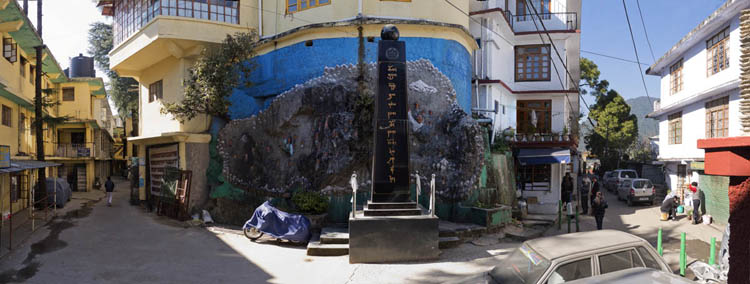
Home of His Holiness the 14th Dalai Lama, Namgyal Monastery, the Tibetan government-in-exile, and a Tibetan and Indian community, this former British hill station in the foothills of the Himalayas attracts visitors from far and wide. They come to attend teachings, events, study, volunteer, get involved. There are a large number of Western expats living here, too.
I descended from the high altitudes and arrived in McLeod Ganj (approx. 6000 feet altitude) end of September. It was surprisingly still monsoon season, which is usually over by mid-month. But 2013 was a particularly long and relentless monsoon. Everyone agreed. It lasted well into October, and I was drenched many times mistakenly thinking I could quickly go from point A to point B and not get too wet.
The area is one of the wettest in the state of Himachal Pradesh, with up to 120 inches of rain from July to mid-September. 120 inches! In six weeks. That’s 20 inches a week, almost 3 inches a day! You gird yourself for constant moisture, fog, mold, and mildew. Hanging laundry takes close to two days to dry. Resident friends warned me to safeguard all my electronics by putting them in a closet with hot lamps shining on them. It’s practically a whiteout at times, dangerous for driving because you can’t see beyond 10 or 12 feet in front of you on mountainous hairpin turns.
Downpours pelt you like sheets of water performing a sports arena wave (you know, where sports fans get up from their seats and raise their arms overhead in succession). No really, you can actually see this phenomena of denser sheets of rain cascading across less dense ones over the valleys and on the streets. An umbrella is futile. I used one anyway out of stubborn habit, and I was almost always ruefully muttering to myself when I arrived some place with clothing stuck to me like I had put them on straight out of a washing machine with a broken spin cycle. I finally learned that when a Dharamsala monsoon rain starts, you WILL be drenched unless you duck for cover. I started carrying a poncho. And there is a reason why locals wear flip flops and brave the wet streets open-toed. It’s because normal shoes become spongy, perpetually dank and musty.
And then, one day, it’s over! The clouds and mist clear up. The horizon expands and Dharamsala, or Dasa as it is fondly called for short, looks like this.
Post-monsoon season, sunshine galore in Dharamsala
Glorious and crisp, far as your eye can see. Warm and sunny.
View of McLeod Ganj near Namgyal Monastery, Dharamsala, India
View of McLeod Ganj from Ashoka Restaurant rooftop, Dharamsala, India
View of McLeod Ganj, near Namgyal Monastery
The street vendors no longer have to cover their wares from rain and mud with tarp.
Upper Temple Road, McLeod Ganj, Dharamsala, India
People enjoy outdoor dining and cafes again.
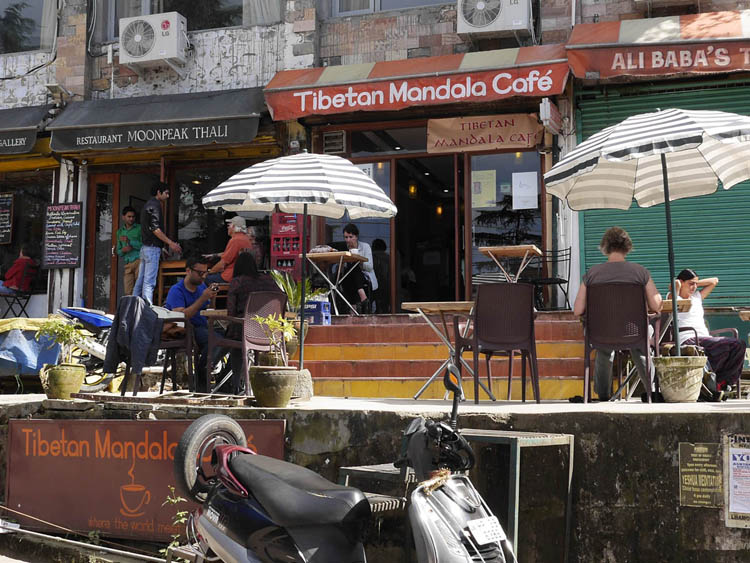
Cafe row on Temple Road, McLeod Ganj, Dharamsala, India
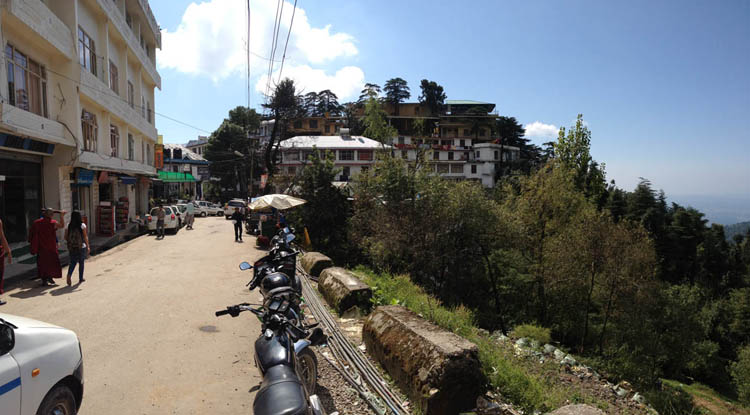
This was my usual walk on Temple Road back to where I was staying, near Namgyal Monastery.
Lower Temple Road, heading towards Namgyal Monastery, McLeod Ganj, Dharamsala, India
Namgyal Monastery visible here through the trees. The upper yellow buildings are open to the public where the main temples are located. Lower white buildings are monks quarters and other private areas.
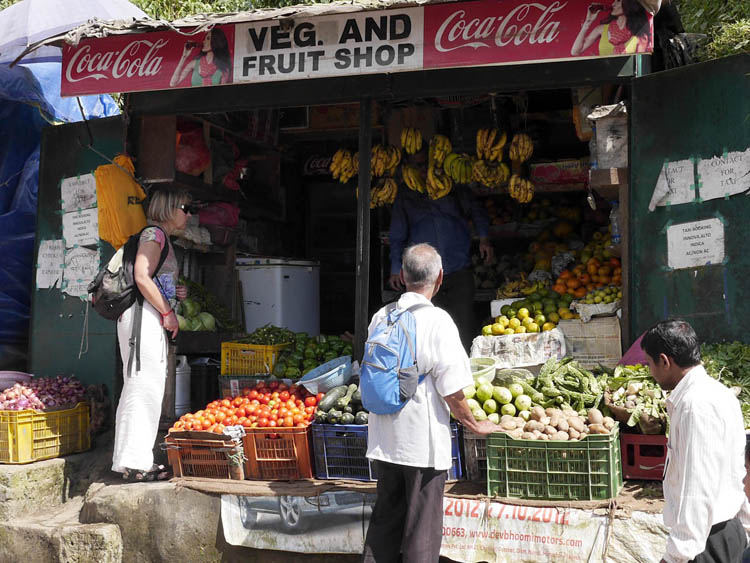
Stores that I became acquainted with along the way.
A typical fruit and vegetable stand, McLeod Ganj, Dharamsala, India
I was a regular at this stationary store. Go figure, I just never had enough pens or pads or envelopes, or superglue. I bought paper clasps here which served as clothespins or toothpaste tube holders, or food clips. Travel makes me look at objects more resourcefully.
Local stationary supply store on Temple Road, McLeod Ganj, Dharamsala, India
This shop always caught my eye with its colorful display.
Clothing store with Western fashions and trekking gear, Temple Road, McLeod Ganj, Dharamsala
At left, the location of a trusty ATM machine! Very important. I was grateful that it always worked, which is not always the case elsewhere in India.
Continuation of Temple Road heading towards the main chowk or square, McLeod Ganj, Dharamsala, India
This is the raucous main square of McLeod Ganj, where several main roads converge. Where buses, taxis, and tourists depart and arrive. Where there is sure to be traffic jams throughout the day caused by congestion, narrow roads, crossing people animals.
The raucous main chowk or square, always a busy meeting place, McLeod Ganj
During my time in Dasa, I had the fortune of attending no less than three of the Dalai Lama’s teachings at Namgyal Monastery, including a Mind & Life conference, which I wrote about here. I also had the honor of audience with local rinpoches, geshes, monks and administrators, as well as observing and documenting the annual Yamantaka highest yoga tantra ritual.
Panorama of entrance to Namgyal Monastery, McLeod Ganj
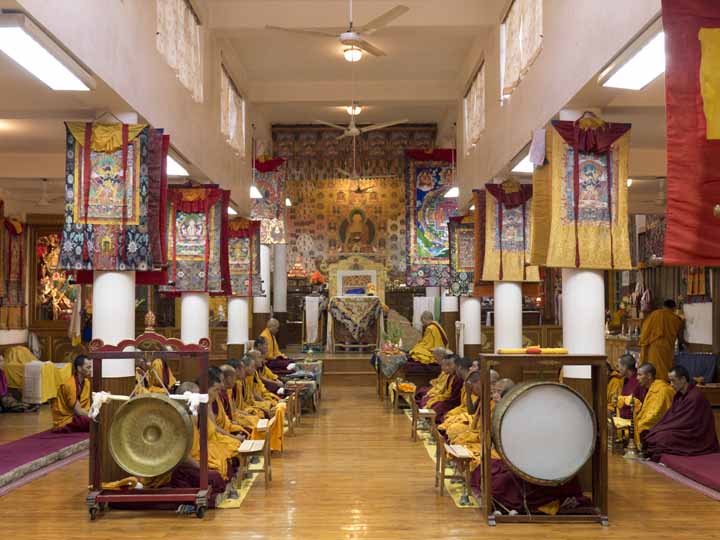
Assembly for Yamantaka morning ritual, Namgyal Monastery, McLeod Ganj
Lunch hour outdoor performances during Tibetan Film Festival 2013, held at Tibetan Institute of Performing Arts (TIPA), McLeod Ganj
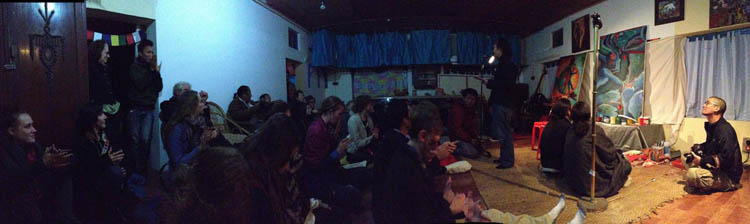
Plus, a number of music-poetry-art fusion events staged by local artists. Poetry would be read during live musical performances, while a painter begins and completes a painting on canvas in one evening.
Music-poetry-art fusion event, Dharamsala, India
There was a revolving door of gatherings, which I’m grateful to Dasa friends for inviting me to. Diwali celebrations, dinners, movie nights, artist meetings, music jams, salons, fundraisers. Truly warm, good times.
A welcome daily visitor
When not out and about, I was in my apartment, which incidentally came with a kitty. She showed up on my terrace one day.
I must say she was a welcome visitor. Although she left a lot of nose smears looking in through my newly cleaned window, she did accompany me many days as I sat indoors editing footage, photo-correcting, researching, and writing.
Evidence of looking in on me a few too many times
Which reminds me of a story I heard about the Dalai Lama, who once had two cats as pets. After they spent their last days with him in his palace, he decided he would not have pets anymore–too much attachment!
Yes, indeed, I was sad to leave this little one, but happy to learn that she actually belonged to my neighbor.
On my last day in Dharamsala, I left a bag of cat food at their doorstep, then went for a final koraaround the monastery complex on this fine, scintillating morning.
Panorama of Namgyal Monastery circumambulatory, McLeod Ganj, Dharamsala
Panorama of Namgyal Monastery circumambulatory, McLeod Ganj
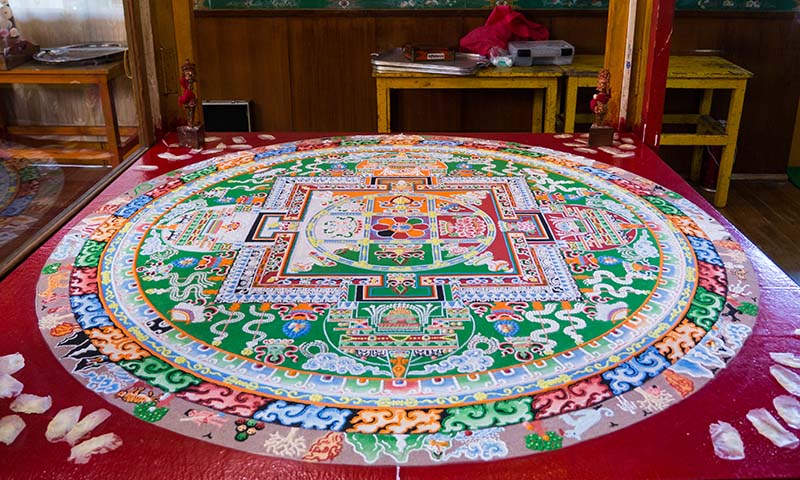
I’ve gone about it all backwards. Backwards in time, in pursuit of mandalas. It all started when I heard that a sand mandala was going to be made at Namgyal Monastery in Dharamsala, India, in 2010. So I went there, and found out that it was a Yamantaka mandala, part of a ten-day-long highest yoga tantra ritual which occurs annually at the Dalai Lama‘s personal monastery. My previous post here describes what little I knew then as I observed and documented the creation and dissolution of it. The resultant film and photographs can be seen here.
When I came back to the U.S., it was as if a floodgate had opened. I needed to learn more. No, not just more, but all I could about Tibetan mandalas–about their variety, their purpose, their history, the meditation practices they engendered, and so forth. What did it all really mean? What modern significance did it have?
My bookshelves began to fill up with writings about tantra and Buddhist philosophy, written by the first Tibetan teachers to venture into the Western world, post-1959 exodus from Tibet. Titles by the Dalai Lama, Chogyam Trungpa Rinpoche, Lama Thubten Yeshe, Dilgo Khentse Rinpoche, as a few examples, abounded. I also read works by contemporary lamas like Dzogchen Ponlop Rinpoche, Pema Choedron, Tsoknyi Rinpoche, Tenzin Palmo. Tibetan scholars and historians David Snellgrove, Robert Thurman, Deborah Klimburg-Salter, Martin Brauen, and others figured in there, too.
All this, in addition to my previous discoveries of well-respected meditation teachers from other Buddhist traditions–Sharon Salzberg, Joseph Goldstein, Jack Kornfeld, B. Allan Wallace. I followed the writing of neuroscientists and clinicians, too, who studied or used meditation in their work. They were also involved with fascinating Mind & Life Institute research or conferences–Richard Davidson, Jon Kabat-Zinn, Paul Ekman, Daniel Goleman.
It was a mindfulness-neuro-tantric-philoso-fest that poured forth!
Meanwhile, in 2011, the ritual experiences continued. I attended the Dalai Lama’s Kalachakra event for World Peace in Washington D.C., and witnessed the Kalachakra Mandala.
In 2012, I was at the Dalai Lama’s talk at Western Connecticut State University at which time I encountered a Compassion Mandala.
At both events, I had the wonderful opportunity of befriending and working with monks, nuns, plus other Buddhist practitioners and followers.
It was a steady flow. The waters at the floodgates just did not tire out. Answers came, and new questions arose.
Thus, on the heels of this, last year in 2013 I arrived back to India to experience and research rare Indo-Tibetan mandalas in Himalayan monasteries of Spiti, Lahaul, and Ladakh. How might they have evolved into Tibetan forms that we know today? What was this Indo-Tibetan 10th to 12th century period called the Second Great Transmission of Buddhism from India to Tibet? What did the sacred art look like? What did it mean?
At the end of my travels through the Himalayan high altitudes, I then thought, let’s reel back in time some more. What came before the Indo-Tibetan era?
The answer was, Indian Buddhism, which could be seen at Ajanta and Ellora Caves where there are remains of elaborate 2nd to 8th century C.E. wall paintings, sculptures, and architecture. Such purely Indian Buddhist art is still preserved at these South Indian sites in the state of Maharashtra.
Finally, what might have come even before this in India? I mean in B.C.E. times. When I searched further, it seems that the Buddhist art historical record stops here. According to historians, not much still exists before the 1st century C.E. Little is known in India archeologically prior to this time.
So what’s it all about? Why would an artist go for all this? New artwork from my Fulbright experience does beckon me in the studio.
I guess I’m just driven by the big questions about mind and reality, which Buddhist philosophy seems to address best. And moreover, that largely works within a Western scientific paradigm. It doesn’t hurt, either, that an affable spiritual leader like the Dalai Lama continues to inspire and exemplify how one can be intellectually sharp, existentially awake, and compassionately engaged in the world. Despite being a keeper of complex Tibetan rituals and esoteric tantric teachings, he can still keep it simple and distill wisdom down to these words: “There is no need for temples, no need for complicated philosophies. My brain and my heart are my temples. My philosophy is kindness.”
Wow! The Kailash Temple of Ellora Caves, Plus Indra Sabha, Nudity, and the Dalai Lama
Posted
December 12-13, 2013
The Kailash Temple (Cave 16) is arguably the most famous one of all 34 caves at Ellora Caves. My previous post was about the marvelous Buddhist ones, but wow, this Hindu site is remarkable!
Base of the main temple, Ellora Cave 16
Built in the 8th century by the Rashtrakuta king Krishna I, 756-783 C.E., it is the most advanced excavation. An enormous Brahmanical complex, its most unrivaled feature is the free standing main temple in the center.
Did you read that right? Yes, you did! This “cave” has an open courtyard with a free-standing centerpiece, which entailed an ambitious, massive vertical excavation of incalculable tons of rock by approximately, I read, 17,000 laborers over the course of about 100 years. Vertical means that the structure was created by carving from top to bottom to realize this multi-level Dravidian-styled temple. What a feat! This magnificent cave is probably the largest excavation in the world measuring 276 feet long x 154 feet wide x 107 feet high.
What’s more, the complex is surrounded on three sides by colonnaded walkways three stories high with extensive overhang. There are huge carved panels there and alcoves with enormous sculptures of Brahman deities.
Panoramic view of Kailash Temple from the colonnaded walkway, Ellora Cave 16, Hindu
View of colonnade walkway near back of Kailash Temple. Visible at right is the extended overhang.
View down the length of colonnaded walkway, Ellora Cave 16, Hindu
Kailash Temple, as its name suggests, is intended to recall the sacred Mount Kailash. This Himalayan mountain is an abode of Lord Shiva, and Ellora Cave 16 is dedicated to him.
Kailash is incidentally located in Tibet, and is one of holiest of the holy mountains for both Hindus and Buddhists alike. A pilgrimage there and circumambulating its base earns one great spiritual merit.
Left: Mount Kailash north face. Right: Mount Kailash south face, Tibet. Kailash Temple, as its name suggests, is intended to recall the sacred Mount Kailash. This Himalayan mountain is an abode of Lord Shiva, and Ellora Cave 16 is dedicated to him.
In my earlier Fulbright travels, I went to three other places in the Lahaul region of the Indian Himalayas that were also revered by both Hindus and Buddhists–Drilbu Ri Mountain, which I climbed to reach its 15,000 foot summit, Phakba, and Markul Devi Temple. I really admire that there has been a long history of mutual respect and shared reverence between these two indigenous major religions in India.
In addition to the expansive colonnaded walkways, within the courtyard of Ellora Cave 16 there are two other main structures. As is traditional in Shiva temples, the first is the Nandi Temple at the entrance. I actually missed seeing the sacred bull within in because I was mesmerized by the rest of the “cave” and just kept walking on!
The entrance and two-storied Nandi Mantapa or pavilion, Ellora Cave 16, Hindu
Side santuary within the courtyard near entrance of Ellora Cave 16. To its right is the beginning of the arcade that surrounds three sides of the complex
Upon entering through the Nandi paviion, you are greeted by Gajalakshmi, the goddess Lakshmi surrounded by elephants on a lotus pond, Ellora Cave 16
The second structure is the main Kailash temple. Its base is carved with graceful life-sized elephants, lions, and mythological figures.
Graceful elephants standing at attention appear to uphold the base of Kailash Temple, Ellora Cave 16, Hindu
Visitors circumambulate the main temple, Ellora Cave 16, Hindu
Walking up to main temple, Ellora Cave 16. Traces of a formerly painted ceiling are visible.
Entrance to main temple, Ellora Cave 16. Traces of painted facade can be seen on pilaster and elsewhere.
Upon entering, I feasted my eyes on the impressive intricacy of its interior. The central hall was richly carved. Everything, from its niches, pilasters, deities, figures, columns, etc., are ornamented. Most of the deities at the left of the entrance are Shaivaite (followers of Shiva) while on the right hand side the deities are Vaishnavaites (followers of Vishnu).
Interior of main temple looking towards the inner sanctum, Ellora Cave 16, Hindu
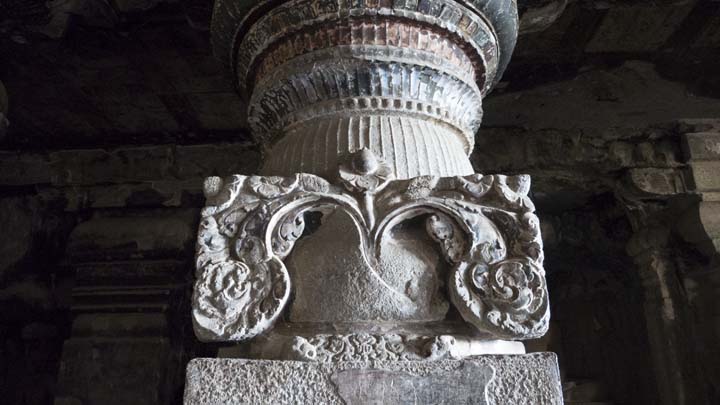
Detail of carved column, main temple, Ellora Cave 16, Hindu
The inner sanctum contains a large lingam, representative of Lord Shiva. Devotees leave offerings of flowers, money, candles and other objects.
Lastly, there is a significant sculpture at Ellora Cave 16 of Ravana, principle antagonist in the Hindu epic Ramayana, attempting to lift the abode of Lord Shiva, Mount Kailash, with all his might. It’s an unusual and expressive composition.
The Jain group of caves number 30-34, and they were the last to be excavated, circa 800-100 C.E. I was struck by Cave 32, also known as Indra Sabha, because it’s similar to Cave 16. It also features a central free-standing temple inside a courtyard, as well as Dravidian gate, and monolithic elephant sculpture by the entrance . Though smaller in scale, there are details of this cave that surpass its predecessor.
Ellora Cave 32, Jain temple, India
For example, the carved details and the unique designs of the columns on the second floor of the main temple truly outdo even the ornately decorated columns of Kailash Temple. They are massive in size and are carved in high relief. Some look like urns with draped garlands.
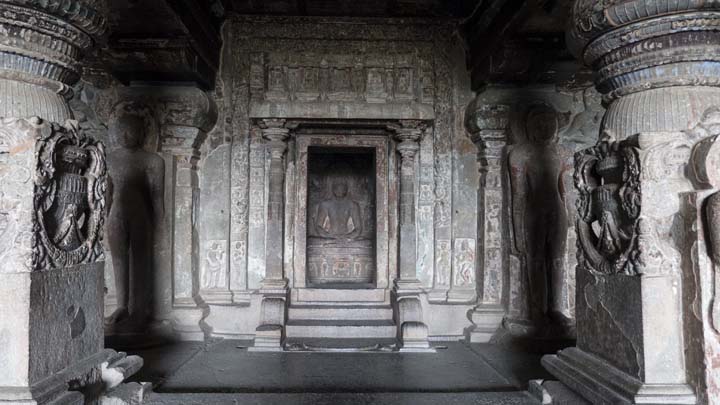
Ellora Cave 32, Jain temple, second floor, looking towards inner sanctum
Detail of column, Ellora Cave 32, Jain temple, second floor
Detail of column, Ellora Cave 32, Jain temple, second floor, India
Indra Sabha is actually a collection of shrines dedicated to the revered Mahavira, the 23rd tirthankara.
Inner sanctum with Mahavira statue, Ellora Cave 32, second floor, India
Mahavira (ca. 540-468 B.C.E.) was a contemporary of Buddha. The two had remarkably similar experiences and teachings. Like Buddha, Mahavira was born into a royal family. At the age of 30, he left his home in pursuit of spiritual awakening. Through ascetic practices for over twelve years, he achieved enlightenment. He traveled all over India for another 30 years to teach his philosophy, based on ahimsa (causing no injury through one’s deeds, words, or thoughts–which corresponds to Buddhist notions of body, speech, and mind); satya (absolute truth, like Buddhist right view); asteya (not stealing, or as Buddhists phrase it, not taking what is not freely given); brahmacharya (spiritual study, practice, and abstinence, similar to Buddhist monastic vows); and aparigraha (non-grasping or non-possessiveness, which forms part of the Buddhist idea of non-attachment and egolessness.) Mahavira attained nirvana after his physical death at the age of 72.
Mahavira, Ellora Cave 32
Jain depictions of Mahavira are also remarkably similar in appearance to Buddhist images of Buddha. With one key difference: Jain deities of the Digambara sect are nude.
When I saw Mahavira in an inner sanctum, I must admit that I was a bit surprised by the anatomical accuracy of his nudity. (The sacred art tells it like it is!)
But it’s not only Jain deities. The yogis, too. It reminded me of an anecdote the Dalai Lama told, and it goes something like this:
Once, at a ceremony in India, he found himself seated next to a Jain yogi who was stark naked. The Dalai Lama, shocked, had looked him up and down. “He just showed—everything! All of his things were right there!” He couldn’t help but keep looking at the yogi, but not because of his “thing.” Because he was so impressed with the intensity and forthrightness of this man’s practice! And so, the Dalai Lama got down on his knees and touched his forehead to the yogi’s knee as a sign of respect for him and his dedication to contemplative practice.
Gomateshwara, Ellora Cave 32
Pictured above is the revered Gomateshwara, also known as Bahubali.
Detail of Gomateshwara, Ellora Cave 32
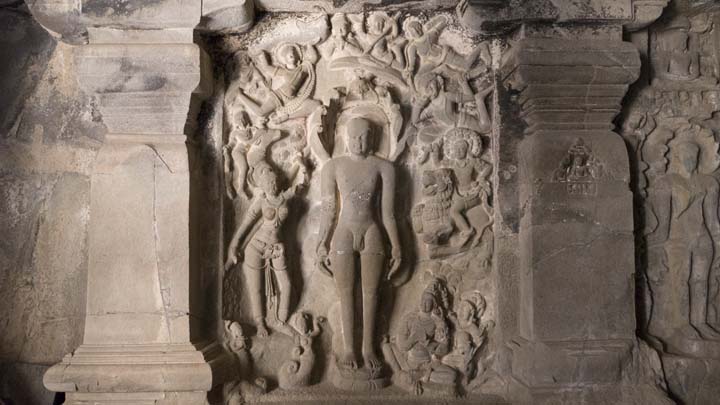
Below is the 23rd tirthankara,Parsvanatha, with his characteristic snake hood.
Parsvanatha, the 23rd tirthankara of Jainism, side wall, Ellora Cave 32
Parsvanatha, the 23rd tirthankara of Jainism, with his characteristic snake hood, side wall, Ellora Cave 32, Jain temple
Mahavira is usually flanked by his attendant deities, Indra on an elephant and Ambika on a lion. I found these two carvings especially well done.
Indra riding on an elephant, Ellora Cave 32, Jain temple, India
Ambika riding on a lion, Ellora Cave 32, Jain temple, India
So there you have it…Ellora Caves–what a revelation in artistic and architectural excavation!
Ellora Caves: Buddhist, Hindu, and Jain Coexistence
Posted
December 12-13, 2013
After seeing Ajanta Caves–which were amazing and beyond my imagination of what carved and decorated ancient Buddhist caves would look like–I visited Ellora Caves, which stunned me further because of the elaborate artistic and architectural feats!
Panorama view of Ellora Caves, founded 600-100 C.E., near Aurangabad, India
Ellora Cave 32, featuring a free-standing temple in center courtyard
Founded after Ajanta from about 600 to 1000 C.E., this complex of 34 caves has some breathtaking sanctuaries of unbelievably grand scale, and free-standing temples. Yes, that’s right, freely standing buildings that were carved out of once solid rock cliff!
Besides the monolithic bravado, the Ellora complex, about 106 kilometers away from Ajanta, is also unique because it consists of Buddhist, Hindu, and Jain caves. The approximately two kilometer stretch of Deccan Traps in which these caves are excavated side by side testify to the peaceful ancient coexistence of these three major Indian religions.
The first twelve caves are Buddhist and appear to be the oldest, dating circa 600 to 800 C.E. They comprise monasteries and one chaityaor temple. The Hindu ones are Caves 13 to 29, perhaps the best known being Cave 16, the Kailash Temple. These were built between 600 to 900 C.E. The Jain group of caves are 30 to 34, and were the last to be excavated, circa 800 to 1000 C.E.
Ellora Cave 11 facade, Buddhist monastery, ca. 600-800 C.E.
Buddhist Caves 11 and 12 went to the next level—literally. Compared to their Ajanta predecessors, these three-storied monasteries are impressive, surpassing the Ajanta two-storied excavations in terms of number of floors and scale. What struck me immediately about both cave facades were their architectural simplicity. They looked modern to me, and I was surprised by what it called to mind. The austere repetition of columns and openings, the lack of carved adornment, and the same feeling of monumentality as one walks up to their courtyards strangely reminded me of the experience I had seeing Italian EUR architecture, in particular the Palazzo della Civilta Italiana, built in Rome between 1938 and 1943.
The space and time of day I was there also created very much the still and surreal feeling of Giorgio de Chirico’s paintings.
Ellora Cave 11 facade, Buddhist monastery, ca. 8th century C.E.
Delights of the Poet, Giorgio de Chirico, 1913, oil on canvas
Facade of Ellora Cave 12. Photo: Indiaing.zening.info
The plain facades of Caves 11 and 12 give no hint of the richly carved sculptures within. I had assumed from the exterior that the interiors would be simple, probably cells for a large number of devotees. From my modern mentality, the buildings looked like they were ancient boarding rooms with shared veranda on each floor.
Ellora Cave 11 veranda
Little did I know that the rooms on each floor of Cave 11, the first one I saw, would house sanctums.
Stairway at end of second floor veranda leading to lower level, Ellora Cave 11
Each one would be a variation of the below sanctum. They were so plentiful that I can’t remember how many I saw. Typically, the central figure was a massive Buddha, flanked symmetrically by large-scaled Avalokiteshvara and Vajrapani, life-sized standing bodhisattvas, seated small buddhas, and flying divine figures.
Massive Buddha statue flanked by Vajrapani, bodhisattvas, seated small buddhas, and flying figures in sanctum of Ellora Cave 11
Massive Buddha statue flanked by Avalokiteshvara, bodhisattvas, seated small buddhas, and flying figures on opposite side of Ellora Cave 11 sanctum
Standing life-sized statues of bodhisattvas, sanctum of Ellora Cave 11
Standing life-sized statues of bodhisattvas on opposite side, sanctum of Ellora Cave 11
Courtyard of Ellora Cave 11 curiously marked by intersecting small channels which I can only surmise were chiseled out for drainage.
Cave 12 dates to circa 8th century C.E., and is known as “Teen Tal” because of its three floors. The first and second floors have a pillared halls, antechambers and sanctums with cells. The third floor, while similar in plan has extensive sculptures along the perimeters of a great colonnaded hall.
View along right front wall with figure of seated Buddha at end of side wall, Ellora Cave 12 third floor
The front wall has Buddhas seated on double lotuses with foliage and umbrellas projecting overhead.
View along left front wall with figure of seated Buddha at end of side wall, Ellora Cave 12 third floor
Detail of seated Buddhas in meditation pose, front wall of Ellora Cave 12 third floor
View of front and side walls, Ellora Cave 12 third floor
Visible above on the left is Buddha seated on a lion throne with fly-whisk attendants.
Pictured below is the antechamber, which has large sculptures of Padmapani and Vajrapani flanking the sanctum entrance and twelve goddesses seated on lotus thrones. There is evidence that these were once painted.
In fact, based on the preceding Ajanta practices, I assume that most of the carvings in the Ellora caves were also plastered and painted. So when you look at these images, imagine that the columns, statues, and other architectural elements were adorned with colors and designs, painted faces, and other details. What rich interiors!
Antechamber, with front wall of seated buddhas visible on right, entrance to sanctum has modern protective screen door which helps to reduce bat nesting, Ellora Cave 12 third floor
Looking down towards right side wall, Ellora Cave 12 third floor
View of one of the many Buddhas seated on lion thrones, side walls of Ellora Cave 12 third floor
View of one of the many Buddhas seated on lion thrones, side walls of Ellora Cave 12 third floor
If you find the scale of this Buddhist cave impressive, how about Cave 5? It measures 53.28 x 36.63 meters, or 175 feet deep x 120 feet wide.
Panorama view of Cave 5, Buddhist monastery, Ellora, India
Panorama view of Cave 5 looking back towards the valley, Buddhist monastery, Ellora, India
Inner sanctum with seated Buddha, Ellora Cave 5
Cave 10 is a really lovely chaitya, similar to the apsidal plans of Ajanta Caves 19 and 26, but its facade is more ornate, featuring a wraparound pillared veranda and side porticos that lead to chambers.
Facade of Ellora Cave 10
Panoramic view of Ellora Cave 10 facade
Panoramic view of Ellora Cave 10 facade from second level
Colossal statue of seated Buddha on a lion throne flanked by Padmapani and Vajrapani, Ellora Cave 10
Detail of colossal statue of seated Buddha on a lion throne flanked by Padmapani and Vajrapani, Ellora Cave 1
Back wall of Ellora Cave 10
Detail of Gallery on back wall of Ellora Cave 10
These are the highlights of the Buddhist caves at Ellora. I hope that, like me, you will now never think of the word “cave” the same again! Instead of conjuring up only oddly shaped, naturally formed, sooty rock shelters, the word will hereon also bring to mind colonnaded halls, monumental sculptures, carved friezes, painted barrel vaulted ceilings and other graceful elements of the ancient excavated architecture of India.
Next up will be the best of Ellora’s Hindu and Jain caves!
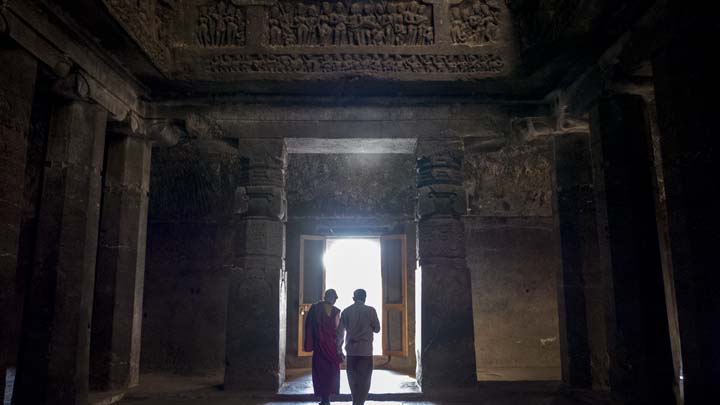
When I first heard about the paintings of Ajanta Caves, I had an updated version of Lascaux on my mind. You know, natural shelters in rock, which have rough and organic interior surfaces painted with images of, well, in this case, Buddhist motifs. Even though I had later seen some photos online, nothing, I tell you, nothing prepared me for experiencing the mind-boggling architectural sophistication that is Ajanta. Hewn out of the solid volcanic rock of the Deccan Plateau in South India, these 30 caves consist of verandas, courtyards, ambulatories, colonnaded walkways, apses, antechambers, shrine rooms, sanctums, stupas, and so forth. Many are two stories or more.
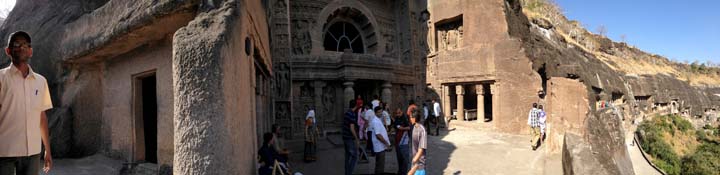
Ajanta Cave 19 facade, with courtyard, porch, arched window, adjacent shrine rooms. Near Aurangabad, India
The caves are unbelievable feats of engineering, excavated in one piece from top to bottom. All of the elements named above, including statuary and shrines, bar-reliefs, every detail from pillars to doorjambs and window frames, are carved from single, solid rock! No kidding, they are purely constructed by the removal of material. From an artist’s point of view, this is dealing with negative space as much as positive space. Think of what’s not there in order to see what is there.
Panoramic view of Ajanta Cave 26, India
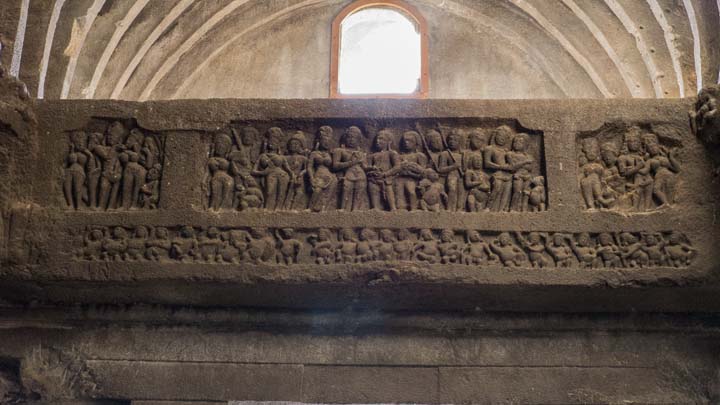
Apse and barrel vaulted ceiling, carved details on frieze, columns, capitals, and stupa. Ajanta Cave 19, India
Now add to this the fact that in many of the caves, every surface, nook and cranny, was carefully plastered and sanded to a smooth sheen, then exquisitely painted with refined colors to depict scenes of Buddha’s life, Jataka tales, bodhisattvas, entourages, and decorative patterns.
A testimony of skill and artistry, and considered to be the beginning of classical Indian art, no wonder Ajanta Caves is a UNESCO World Heritage site.
Detail of scenes from Life of Buddha, wall paintings, Ajanta Cave 1
Birds-eye view, model of Ajanta Caves, Waghora stream
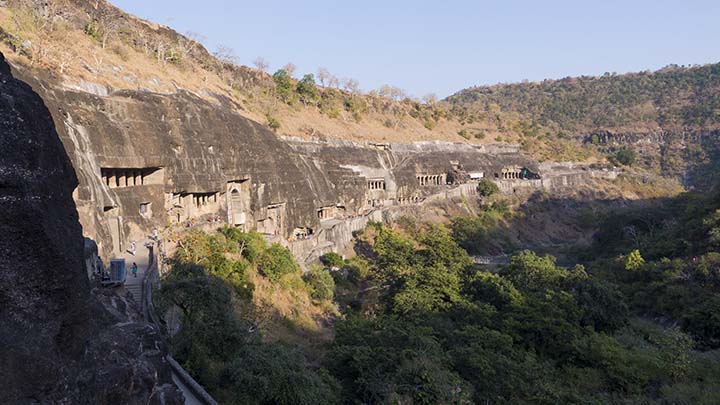
All this is nestled in a peaceful wending river valley with flowering trees. It must have been quite a place of devotion for the monastic community who lived here intermittently between the 2nd century B.C.E. to 5th or 6th century C.E.
Today, access is by road midway along the cliff, but in its day, one can imagine the serene seclusion of the site, accessed only by stairways leading from the valley floor up to the caves.
Entrance to Ajanta Caves, a UNESCO World Heritage site located in a horse-shoe shaped river valley, circa 2nd century B.C.E to 5th century C.E. Buddhist caves, near Aurangabad, India
Ajanta Caves, a UNESCO World Heritage site located in a horse-shoe shaped river valley, circa 2nd century B.C.E to 5th century C.E. Buddhist caves, near Aurangabad, India
Of the thirty caves, five are chaityasor temples housing a stupa. These are Caves 9, 10, 19, 26, and 29, with Caves 9 and 10 being the oldest, dating to 2nd century B.C.E.
Ajanta Cave 10, the oldest chaitya or temple, 2nd century B.C.E. After centuries of abandonment, in 1819, British officer John Smith noticed its arch in the overgrown landscape while out on a hunting expedition. This led to the discovery of Ajanta Caves.
According to inscriptions, this Cave 10 was excavated with the sponsorship of Vasisthiputra Katahadi, Kanahaka of Bhada, and monk Dharmadeva. The paintings on the pillars, ceiling, and walls, rare extant examples of ancient Indian painting, were created by various devotees. Traces of Buddhist themes, designs, and Jataka Tales survive, but little remains of the chaitya’s full glory. This temple originally had a wooden interior, probably a reproduction of the interiors of freestanding wooden structures of its time. The stupa is the largest one at Ajanta.
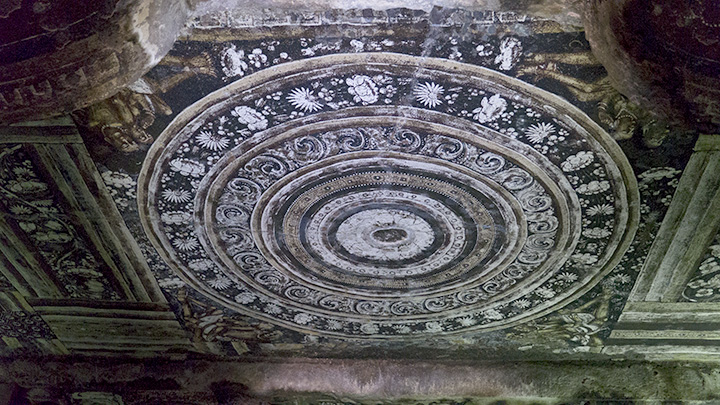
Detail of painted ceiling at Ajanta Cave 10, the oldest chaitya
Detail of painted column at Ajanta Cave 10, the oldest chaitya
Beside the chaityas, the other caves are viharas, which were monasteries with a central colonnaded gathering hall facing an inner sanctum, flanked by rows of small simple cells that were monks’ quarters. These caves were created at a later date. By scholar Walter Spink’s account, they were excavated predominantly during the Vakataka Dynasty, under King Harishena’s rule, circa 475-500. Other scholars, however, believe the viharas were built over a much longer time span than 25 years.
This later period of 5th to 6th century architecture is marked by elaborate detail, such as seen in Caves 1 and 2 (images to follow below). My favorite is Cave 26.
Panorama of Ajanta Cave 26 exterior
Cave 26 is similar to the above Cave 19, but far more richly carved and decorated. It is also larger. This chaitya consists of a central hall with colonnaded walkway or side aisles and beautifully carved walls. An inscription dated 450-525 C.E. attributes the founding of it to a monk named Buddhabhadra.
Panorama of Ajanta Cave 26 interior, chaitya with colonnaded walkway in which one can circumambulate the stupa, India
Ajanta Cave 26 carved stupa with seated Buddha
Detail of carved stupa with seated Buddha on a lion throne, Ajanta Cave 26
I really love this graceful sculpture of Buddha in parinirvana, carved into the side wall of Cave 26.
Panorama of Buddha in parinirvana, carved on left side wall of Ajanta Cave 26
View of Buddha in parinirvana along left side wall of Ajanta Cave 26
Upon entry into the left aisle, one encounters it. Here is another view of it looking back towards the entrance. Also carved here is Mara’s assault on Buddha.
Left side wall of Ajanta Cave 26, Buddha in parinirvana is seen next to the side entrance
The below right side aisle is also amply carved.
View of right side wall, Ajanta Cave 26
Looking back on main entrance, Ajanta Cave 26
Cave 1 shown below is famous for its extensive and refined paintings which date circa 6th-7th centuries. Literally every inch of its interior was originally painted. The structure consists of a large gathering hall with fourteen cells on the sides, a vestibule, and inner sanctum with antechamber. Its ceiling is a massive expanse for a hypostylar hall of this type, and it is ornately decorated with colorful flora, fauna, figures, and geometric designs. As mentioned earlier, the wall paintings depict Buddha’s life, Jataka tales, bodhisattvas, and royal entourages.
Panorama of Ajanta Cave 1 facade
Panorama of Ajanta Cave 1, famed for its extensive and refined paintings, including an enormous painted ceiling
View of Ajanta Cave 1 looking towards the inner sanctum from its central entrance
View of Buddha statue in preaching pose located in inner sanctum with antechamber, Ajanta Cave 1.
The below detail shows Buddha in his preaching mudra (hand gesture). While the carved deer facing each other on the base of the throne does not show the typical frontal view of an 8-spoked wheel of dharma (teachings) between them, this is likely a reference to Buddha’s first sermon at Sarnath, also known as the First Turning of the Wheel.
Detail of Buddha statue in inner sanctum, Ajanta Cave 1
Here is the famous Ajanta painting of Vajrapani, a bodhisattvawho represents Buddha’s power. He is usually one of the three protectors pictured on temples or monasteries. The other two are Manjushri, bodhisattva of transcendent wisdom, and Padmapani also known as Avalokiteshvara, bodhisattva of compassion.
Famed painting of Vajrapani to the right of inner sanctum antechamber, Ajanta Cave 1
Vajrapani’s elaborate headdress reminds me of the ones I saw on bodhisattvas in Tabo Monastery’s inner sanctum shown here in a previous post. Ajanta predates Tabo by about 300-400 years.
Detail of Vajrapani whose name means “holder of the thunderbolt or diamond wisdom,” Ajanta Cave 1
And here is the other renowned image, Padmapani, the bodhisattva of compassion who is featured on the other side of the inner sanctum at Cave 1.
Famed painting of Padmapani whose name means “holder of the lotus,” located to left of inner sanctum antechamber, Ajanta Cave 1
Detail of Padmapani whose name means “holder of the lotus,”Ajanta Cave 1
Scenes from Life of Buddha, wall painting, Ajanta Cave 1
Detail of scenes from Life of Buddha, wall paintings, Ajanta Cave 1
Really richly painted, one can only imagine how vibrant and clear all the images were over 1400 years ago when they were freshly made! And what an impact they must have made on those living here in quiet seclusion contemplating the teachings so beautifully and abundantly expressed.
Panorama view of wall painting, Ajanta Cave 1
Carved capitals with animals and figures, also visible is painted ceiling, Ajanta Cave 1
Detail of deer on carved capital, Ajanta Cave 1. Traces of smooth plaster can be seen. It once covered all surfaces because this was the prepared ground on which all painting was done .
I really appreciate that the artists dedicated themselves to creating fine work everywhere. The vast ceiling of Cave 1 is painstakingly executed with the same level of refinement and delicacy found in the wall paintings. Despite being rather high, and considering that most viewers would not be able to discern the details in low lighting, the artists did not slacken their skills.
Detail of painted ceiling with flora, fauna, figures, and geometric designs, Ajanta Cave 1
I like the grace of this delightful small ceiling panel. It probably only measures 5 x 8 inches at most. Everything from its lyrical design to colors and brushwork, its play on symmetry, form, line, composition, contrast, is so well done. And this is just one example of excellence from an entire ceiling that covers easily an estimated 70 x 70 feet, 1400 square feet in total area! That is a lot of space to paint on this level.
Detail of painted ceiling panel with animals, Ajanta Cave 1
I also found it interesting that similar to the ceilings of later 10th century Indo-Tibetan monasteries, the imagery is non-religious. At Lhalung Monastery, for example, where I visited and wrote about here, the coffered ceiling of its Golden Temple is entirely painted in geometric designs. Perhaps artists followed a precedent set here at Ajanta.
Detail of painted ceiling with flora, fauna, figures, and geometric designs, Ajanta Cave 1
Ajanta Cave 2 is the other one well-known for its well-preserved murals. I’ll only show a few details here to give an idea of it. Truly, one has to go to Ajanta in person to experience the eye-popping ancient wonder of it!
Panorama view of Ajanta Cave 2
Painted ceiling, Ajanta Cave 2
Detail of ceiling painting, Ajanta Cave 2
Inner sanctum and antechamber with unusually carved asymmetric capitals, Ajanta Cave 2
Detail of inner sanctum and antechamber, Ajanta Cave 2
Detail of unusually carved, asymmetric capital on this inner sanctum antechamber column, Ajanta Cave 2
The Vakataka Dynasty, Buddhist devotees who predominantly sponsored the creation of the Ajanta Caves, overlapped with the great Gupta Empire. According to UNESCO World Heritage website, the “decoration attained at this time an unequalled splendor…the statuary is numerous…the wall painting, profuse and sensitive, constitutes, no doubt, the most striking artistic achievement of Ajanta. Under the impulse of the Gupta dynasty, Indian art in effect reached its apogee…The refined lightness of the decoration, the balance of the compositions, the marvelous beauty of the feminine figures place the paintings of Ajanta among the major achievements of the Gupta and post-Gupta style and confer on them the ranking of a masterpiece of universal pictorial art.”
I’ve highlighted some of the best caves at Ajanta, though many were left unfinished. It is said by scholar Walter Spink that this was due to the political interruption and unrest that followed when Vakataka King Harisena suddenly died in 500 C.E.
View from entrance of the incomplete Ajanta Cave 24. Its floor was not yet leveled out before abandonment.
What followed was relatively quick and permanent abandonment of Ajanta Caves not long afterwards. When social and political conditions favored once again the sponsorship and excavation of devotional caves, new ones were created at Ellora about 106 kilometers away. Yes, I went there, too! Coming soon will be incredible photos from this site!
The unfinished Cave 24 was fascinating to see because it gave insight on how the caves were excavated. This is a view looking down what would have been the left side aisle of the vihara. The columns are only partway hewn and the depth of the floor is still to be determined, whereas the ceiling appears smooth and complete. This is strong evidence that building a cave at Ajanta was indeed done from top to bottom.
View from what would be the left side aisle of the incomplete Ajanta Cave 24
Talk about positive and negative space! It’s so plain to see here what has to still be taken away in order to “build” the remaining architecture. The columns and their capitals are in process here, as is the floor of the main hall.
View of right side columns in process of excavation at the incomplete Ajanta Cave 24
Chisels marks can clearly be seen on this column in-the-making.
Detail of right side column in process of excavation at the incomplete Ajanta Cave 24. Its capital and final shape are yet to be defined and chisel marks are clearly seen.
When you think about this being the early state of Ajanta caves before they are completed into their finely carved and painted glory, it’s humbling. So much ancient skill and artistry, so much vision and dedication!
This is not an official U.S. Department of State website. The views and information presented here are solely those of the artist, and do not represent the Fulbright Program, the Department of State, or any other entity.