I loved seeing Tenzing Rigdol’s current art installation, Biography of a Thought, at the Metropolitan Museum of Art. Continue reading
Post-Fulbright
Fulbright NY Whitney Museum Gathering
Starting out the day with a smile is such a great thing. I was just catching up on email and came across this newsletter update by the Fulbright NY alumni group. What a great gathering of fellows at the Whitney Museum to see the Edward Hopper show. It was a celebration of New York visually and in-person. Did someone say in-person? Now THAT is a welcome thing coming out of the pandemic!

Opening Night for RECIPROCATION: American Artists and India Connections
Opening night for RECIPROCATION: American Artists and India Connections was a lovely event. This exhibition, on view at Ojas Art in Delhi, India, Nov 12–Dec. 15, 2021, curated by Kathryn Myers, is a celebration of the United States–India Educational Foundation’s 70th anniversary and coincides with the Fulbright program’s 75th anniversary. Yes, a dual celebration!
The exhibition showcases the work of ten American Fulbright alumni artists who have nurtured their connections with Indian artists through new and ongoing creative projects, collaborations, and dialogue. Each American artist was invited to select an Indian artist for the exhibition.

Originally scheduled to open in March 2020, this show was a long-awaited event. Happily, the pandemic has subsided to now permit its exhibition and public opening. Pictured above from left to right are Anubhav Nath, Director of Ojas Art; Misha Pradosh, Professor and Head of History of Art Department at Banaras Hindu University; and Adam Grotsky, Executive Director of USIEF.

Celebrating the successful ongoing cultural exchange of Fulbright and USIEF included attendance by the US Ambassador and local officials in a lovely outdoor, candle-lit gathering.
Of course, I myself wished I could have gone to the event in India! I am thrilled to see photos of how well-attended it was.
With generous support from the U.S. Embassy in New Delhi, the exhibiting artist pairs include Alan Teller & Jerri Zibral with Prabir Purkayastha, Annu Palakunnathu Matthew with Adira Thekkuveettil, Christine Rogers with Cop Shiva, Eva Lee with Karma Sichoe, Kathryn Myers with Rajesh Sagara, Marcia Neblett with Lakshmi Priya Daniel, Margaret Lanzetta with Gigi Scaria, Michael Richardson with Priti Samyuktha, Pawel Wojtasik with Gautam Chaterje, and Tanya Gill with Priya Ravish Mehra. This unique exhibition presents paintings, photography, video art and print making.

My Fulbright research on Indo-Tibetan mandalas, conducted in 2013-2014, examined the roots of Himalayan Buddhist art, from its Indian beginnings through its Tibetan transmission. I was interested in how mandalas function today as a guide for meditation and mental training based on a Buddhist philosophy of mind. I observed and visually archived the interiors of 10th to 11th century monasteries in Spiti, Lahaul, and Ladakh regions. As a result, I created a new experimental animation and six documentaries. Included here in this exhibition are two examples.

Above is an installation view of my videos Betwixt and Tabo Monastery paired with Karma Sichoe’s paintings.
I chose Karma for this exhibition because our deeper connection as artists was really made possible by Fulbright. The grant allowed me to spend extended time in Dharmsala where he is based. Karma and I have stayed in touch online and in-person. We have seen each other in the United States when he travelled there as an artist-in-residence, and most recently we saw each other in India during my travels in December 2019.

Adam Grotsky, Executive Director of the United States India Educational Foundation (USIEF) shares, “The Fulbright Scholarship Program has played a significant role in fostering artistic exchanges between the U.S. and India over the last 70 years. I am thrilled to see the result of Kathryn’s brilliant curatorial skills at Ojas Art Gallery, bringing forth the best of talent from these two countries.”
For further information, visit:
RECIPROCATION: American Fulbright Artists and India Connections
@1AQ near Qutab Minar
Mehrauli, Delhi, INDIA
Reciprocation: American Fulbright Artists and India Connections at OJAS ART Exhibition
What a celebration to have Reciprocation: American Fulbright Artists and India Connections finally on view at Ojas Art in Delhi, India! This exhibition features American and Indian artists, highlighting how the Fulbright Program has fostered enduring friendships and collaborations. Curated by Kathryn Myers, it is an art show that coincides with Fulbright’s 75th Anniversary and celebrates United States-India Educational Foundation’s 70th Anniversary, on view Nov 12 – Dec 8, 2021, at 1AQ near Qutab Minar, Mehrauli, Delhi, with opening reception on Friday, Nov 12, 2021, 6pm-9pm.
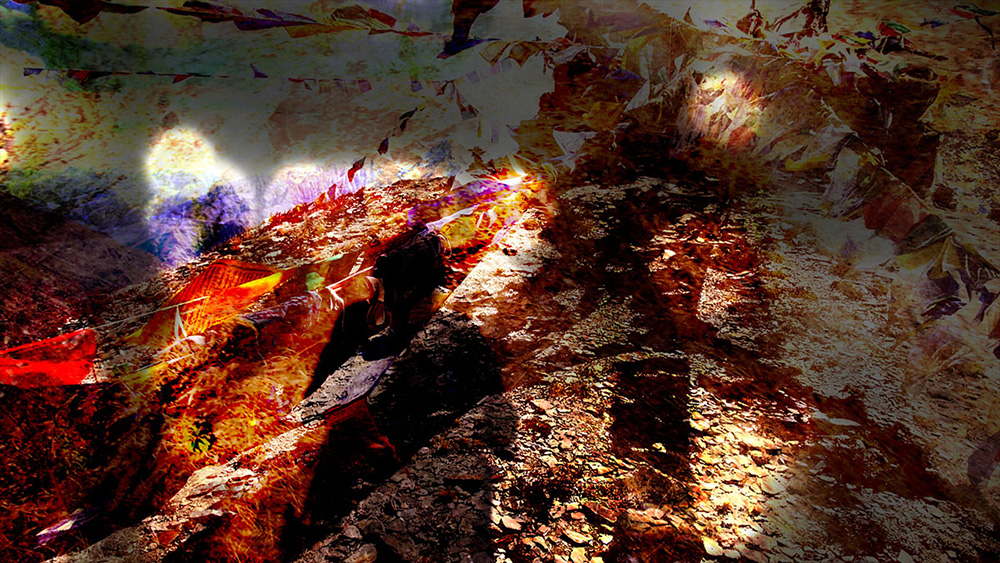
I feel honored to be part of this celebration. On view is my experimental video Betwixt and Tabo Monastery Tsug Lhakhang, one of 6 documentaries I created from my Fulbright time in India (learn more here). International exchange is so vital. I am grateful for the positive ways it has changed my life. The friends I have made in India continue to enrich my outlook on the world.
One such friend is Karma Sichoe, who also has artwork in Reciprocation. Karma is a Thangka painter and contemporary artist who lives in Dharamsala, India. Born an orphan-refugee, Karma was raised and educated in Tibetan Children’s Village School in Dharamsala. He received his formal thangka painting training at the Centre for Tibetan Arts and Crafts in Dharamshala (now part of Norbulingka Cultural Institute) under the guidance of renowned thangka painter master Rinzin Paljor, who was one of the main Potala court painters in Tibet, and while in exile continued working directly for His Holiness the Dalai Lama.
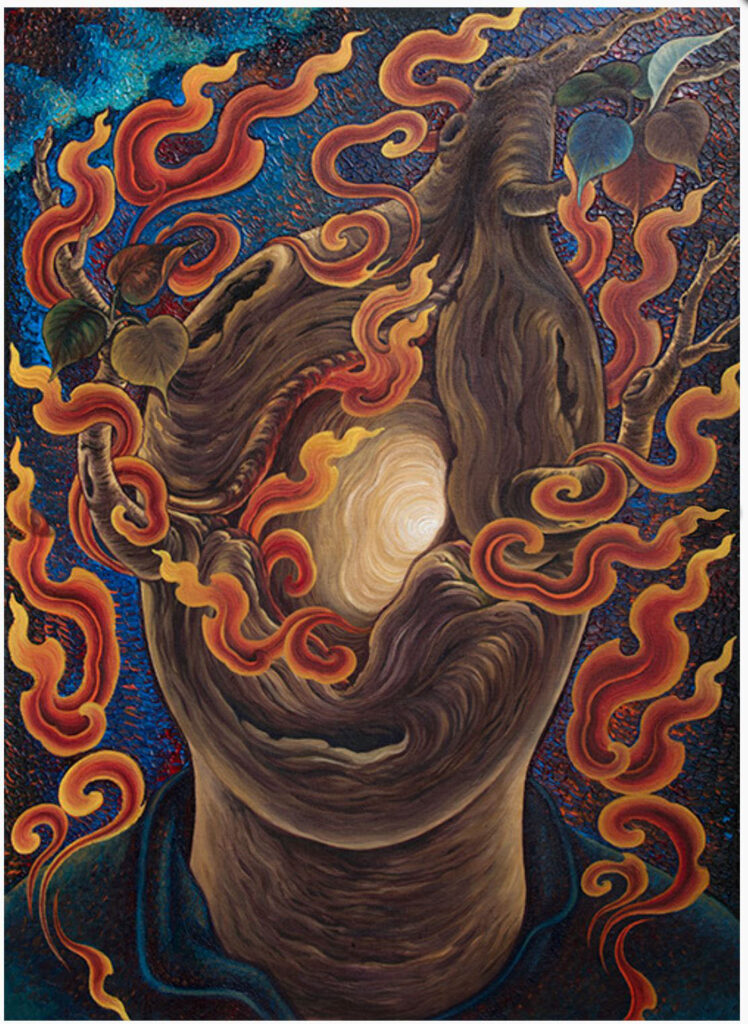
Participating artists in Reciprocation: American Fulbright Artists and India Connections include Alan Teller & Jerri Zbiral, Prabir Purkayastha, Annu Palakunnathu Matthew, Adira Thekkuveettil, Christine Rogers, Cop Shiva, Eva Lee, Karma Sichoe, Kathryn Myers, Rajesh Sagara, Marcia Neblett, Lakshmi Priya Daniel, Margart Lanzetta, Gigi Scaria, Michael Richardson, Priti Samyuktha, Pawel Wojtasik, Gautam Chatterjee, Tanya Gill, Priya Ravish Mehra. With generous support from the U.S. Embassy in New Delhi.
Circling Back Around: Artist Talk on Dual Brains at Buddhist Association of the U.S.
I feel like I’ve circled back around again to my Fulbright research, “Indo-Tibetan Mandalas: Blueprints for Discovering the Nature of Mind and Reality,” with my latest project, Dual Brains. Only the blueprint I’m interested in today is the one being created in artificial intelligence.
Here’s an account of how a recent Artist Talk on Dual Brains went:
Artist Talk on Dual Brains: Dialogues on the Future of Technology
Fulbright Documentary Series at Columbia University and Library of Tibetan Works & Archives
Losar Tashi Delek! Happy Lunar New Year to all who celebrate!
I’m pleased to announce that five of my documentaries are now part of the Columbia University Tibetan Studies Library, one of the most extensive collections of Tibetan texts and archival material in the U.S.A. The documentaries are also in the Library of Tibetan Works & Archives, and may be viewed through their Multimedia Library.
The documentaries are:
Tabo Monastery Tsug Lhakhang (Main Assembly Hall) See the interior of this rare, Buddhist temple located in Spiti region of Western Himalayas, India. Famed Tabo Monastery is known as the oldest continually functioning Tibetan Buddhist monastery, the art of which the Dalai Lama said “delightfully expresses the vigor of the transmission of Buddhism from India to Tibet and the dynamic mingling of cultures.” Established in 996 C.E. by the Buddhist king of Guge in Western Tibet, Yeshe O’d, and the The Great Translator Rinchen Zangpo, it flourished in a golden epoch of Indo-Tibetan collaboration in spreading Buddhist culture.
Lamayuru Monastery Senge Lhakhang (Lion Temple) (00:03:24) Rare, medieval temple located in Ladakh region of Western Himalayas, India. Founded by The Great Translator Rinchen Zangpo and King Yeshe O’d of Guge, Western Tibet, circa late 11th century.
Mangyu Monastery Nangbarnangzad (0:03:03) Rare, medieval temple located in Ladakh region of Western Himalayas, India. Founded by The Great Translator Rinchen Zangpo and King Yeshe O’d of Guge, Western Tibet, circa late 11th century.
Lhalung Monastery Serkhang (Golden Hall)(00:01:45) Rare, medieval temple located in Spiti region of Western Himalayas, India. Founded by The Great Translator Rinchen Zangpo and King Yeshe O’d of Guge, Western Tibet, circa late 10th century.
Yamantaka (00:56:38) A candid view of an esoteric and complex Tibetan Buddhist highest yoga tantra held at Namgyal Monastery in Dharamsala, India. Monks create an elaborate sand mandala, ritual cakes and other sacred arts, offer prayers, chant, play ritual instruments, and meditate over the course of ten days. As one viewer said, “Beautiful, bizarre, and fascinating!”
Incidentally, many viewers have asked me about what is happening at around 42:14 in the Yamantaka video, where a young Caucasian man is in the Main Temple talking loudly and animatedly to a gathering of monks.This was a debate exam in session for students of the Institute of Buddhist Dialectics (which adjoins Namgyal Monastery), characterized by dramatic and distinctive hand clapping, body motions, and rhetoric. It was an event unrelated to Yamantaka, but which coincided with it. Tibetan Buddhists have a long and famed tradition of continuing the ancient Indian Buddhist practice of philosophical debate.
All documentaries filmed during Fulbright research on Indo-Tibetan mandalas of the 10th-12th century. With thanks and gratitude to Office of His Holiness the 14th Dalai Lama, Namgyal Monastery, and Nechung Monastery for their support in my quest to document these temples and Yamantaka ritual. Made possible in part by the support of Fulbright-Nehru Research Program, Council for the International Exchange of Scholars, and United States-India Education Foundation.
The Sand in Sand Mandalas

Many readers have asked me about the sand used in creating sand mandalas. What is it? Where does it come from? Is it store-bought? If not, how is it made? How is it colored? Is it colored with natural dyes?
So I asked a monk friend of mine, who resides at Namgyal Monastery in Dharamsala, India, and here’s what he told me.
There in India, the colored sand is handmade. Special white stones are picked from the banks of rivers located in the nearby larger towns of Manali or Rewalsar. After transporting these stones back to the monastery, junior monks crush the stones manually in a “thick iron pot.” Gee, are you thinking what I’m thinking? A gigantic mortar and pestle? Wow, can you imagine the labor?!
When the stone is finally crushed into a sandy powder, they then wash it over and over again, adding natural fabric dyes purchased from local markets. Finally, the sand is put in the sun to dry.
The monks make a variety of sand, from courser to more refined. The quality used depends on the design element of the mandalas. For example, fine quality sand must be used for details, such as the faces of deities and animal figures, or the delicate ornamentation of architecture.
When monks travel, such as for example those in Sacred Arts Tour who create mandalas in America, they may buy pre-made colored sand in the U.S. However, they often still have to custom-make certain colors because not all store-bought ones are suitable for the specific symbolic colors of mandalas.
Dale Borglum & Robert Thurman on Death and Deathlessness
This past weekend, I attended a retreat on death. Yes, I did.
You may think, what a bummer, why would anyone want to do that?
I chuckle thinking about the statement, “none of us are going to get out of this alive!” It’s the subtext in a thriller ethical moment of a novel or movie when a heroine or hero must make a death-defying sacrificial choice. A choice that will save the people in the story, and by viewer extension, that will ensure our own enduring survival. Live!
But seriously, setting drama aside, the truth is none of us are going to get out of this alive. When you truly think about the certainty of your own death and the death of everything around you, things change in proportion. Being alive and conscious seems miraculous and precious. It takes on a new landscape of awareness, possibilities, priorities, gratitudes, choices, etc. It’s like eating your same old favorite cake, which suddenly has a different flavor. It tastes lighter, and every time you sample it you enjoy it more. Not only that, you notice it looks amazing, you feel touched your thoughtful friend made it for you, or that the local shop had it on the shelf and you’re thankful you could buy it.

So I went to this retreat because the timing was right. I had realized very consciously that my own demise would come someday. I don’t know when (and I hope it will be when I’ve happily lived a long and fruitful life) but I decided I needed to sweep into some action and learn more about this mystery. What did wisdom traditions have to tell us?
“Death and Deathlessness: Buddhist Insights and Practices for Life, Death & the In-Between” was led by Columbia Professor Robert Thurman and Living/Dying Project Director Dale Borglum at Menla Mountain Retreat in Phoenicia, NY. It was based on Thurman’s translation of The Tibetan Book of the Dead, also known as The Great Book of Natural Liberation Through Understanding in the Between, and on Borglum’s work with the dying and their families.
Menla’s description was, “In this retreat we will explore what happens at the moment of death and beyond according to Tibetan Buddhist wisdom. This understanding will prepare us for a smooth transition, so that we may travel without fear to our next destination. This knowledge will also enable us to positively transform and uplift our day to day lives, infusing us with greater vitality as we approach the world.” Whoa, well, alright then!
So what did I learn? Here’s my takeaway summary. It all boils down to this: If you opt out of habitual ignorance and you recognize that all is impermanence through mindfulness practice, you come to intellectually know emptiness or selflessness–which may be called Buddha nature, or Christ mind, or Kingdom of God, Allah, Yahweh, Oneness, Pure Energy, and so forth, depending on your background. Then with great motivation developed, because you see and feel the preciousness of having been born with human consciousness in this life, you then work on kindness and serving others according to your abilities. This accomplishes cutting further at the root of self-attachment/cherishing/fixation/delusion so that you can realize consciously and sustainably more of who you really are in this life and beyond—Buddha nature or Clear Light. The dazzling, blissful light at the end of the tunnel which near death survivors often report seeing and are drawn towards is none other than your essence fully revealed.
So conscious living and dying go hand in hand.
Fascinating. Thurman says the Buddhist adepts were scientists at this. Tibetans are unique in preserving the original Indian teachings as well as continuing to empirically study, develop, refine, document, and create how-tos in support of this great transition from life to death to rebirth. He calls adventurers of the inner cosmos “psychonauts.” I like Thurman’s humor, scholarship, and insight. Psychonauts are analogous to the adventurers of the outer cosmos, Western astronauts. Both are heroic, daring discoverers of infinite realms—consciousness and outer space, respectively.
On the subject of in-between, this is the state commonly understood as the Tibetan idea of bardo, which is after physical death but before reincarnation. However, as The Tibetan Book of the Dead clarifies, it’s actually all in-between. There are six in-between states, which in plain language are: 1. Life, 2. Dream state, 3. Studying/deep meditation state, 4. Death, 5. Bardo, 6. Rebirth.
One should want to be prepared for dying, because it is inevitable, and life does not end with death. One would naturally want to have an auspicious rebirth, or as Thurman says, auspicious spiritual evolution. The deathlessness part is that consciousness endures, not as personality per se, but it endures, experienced in the dying process as great luminance, positive energy. Additionally, it is always present in all the other in-between states. It’s just that we don’t ordinarily experience or recognize it due to our habitual, conditioned minds which perceive conventional reality more saliently than Clear Light. The way to enlightenment therefore is to train our minds through meditation in combination with cultivating and enacting compassion in the world.
Thurman and Borglum complemented each other well in their presentations. Borglum’s sensitive teachings included sharing practices to live well and die well, how to help others through their deaths, incredible near death experiences by his clients, knowledge of current research on the dying process, as well as his own thoughtful and discerning meditation practice. Thurman read and commented on passages from The Tibetan Book of the Dead, first explaining its important historical context and the audience for whom it was originally written before launching into key excerpts and their meaning as understood in a contemporary context. As he himself said in a warm joking manner, Borglum’s on the ground experientially working with the dying and their families, and he’s in the academic tower working with philosophical and textual clarifications. I would say, however, that both teachers illuminated theory, as well as practical methods for living more fully and preparing for death.

If you have not read Robert Thurmans’ translation of The Tibetan Book of the Dead, I recommend you do. It is, no kidding, a how-to guide on the subjective stages of the dying process, what one will experience, the pitfalls to avoid as you evolve towards your next state or form. Better yet, attend a talk such as this one to get deeper into and beyond the words.
I must say, I did so enjoy Thurman’s engaging humor and sharp mind. Anecdotes included why he loved “The Matrix” movie because it showed Neo’s mirror image melding into his physical body such as may be the experience of dissolution in bardo; the account of a monk who was upset about Miss Piggy’s archetypal appeal to children due to its reincarnation implications, that they may be reborn as an animal, a lower self-directing consciousness; and that Yoda’s appearance and character was based on a Tibetan lama. He had a keen way of describing refined Tibetan connotations compared with Western orientations and mindsets. For example, he said karma is evolutionary causation, more radical than Darwin’s idea. That is to say, Darwinian evolution is driven by random genetic mutation, whereas Buddhist reincarnation or evolution is driven by karma, spiritual genetics at work. How we will be reborn depends on our aptitude, on ethical, mental, emotional, and other levels–permitting a great deal more complexity and possibility than chance or meaningless accident according to a materialist view.

So, Robert Thurman said, there is no other sensible purpose to this life but to open to the luminosity of life, i.e., letting go of material things opens you, being ethical and helping others opens you, forgiving and letting go of hurt opens you, meditation and critical thinking opens you…
I left the retreat feeling elated from not only the vital teachings but also from the warm friendship I found with the other attendees and staff. This kind of experience is the real deal! With people who don’t skirt around the big issues–birth, life, death and beyond–but analyze, critique, deconstruct to experience for themselves whether Buddhist philosophy and teachings hold up. Mealtimes were golden opportunities to connect and ask questions more casually and individually of Thurman and Borglum, or Bob and Dale as we came to know them.

Learn more about these two incredible and insightful teachers:
Dale Borglum is the Executive Director of the Living/Dying Project in Santa Fe and since 1986 in the San Francisco Bay Area. He is the co-author with Ram Dass, Daniel Goleman and Dwarka Bonner of Journey of Awakening: A Meditators Guidebook, Bantam Books and has taught meditation since 1974. Dale lectures and gives workshops on the topics of meditation, healing, and spiritual support for those with life-threatening illness, and on caregiving as spiritual practice. He has taught with Ram Dass, Stephen Levine, Joan Halifax, Joanna Macy, Jack Kornfield, Annie Lamott, Jai Uttal and many others. He has a doctorate degree from Stanford University.
Support Living/Dying Project, their worthy and much needed work by donating or training to become a volunteer. For more information, please visit http://livingdying.org/.
Living/Dying Project, P.O. Box 357, Fairfax, CA 94978 Tel: 415.456.3915 info@livingdying.org
Robert Thurman is Professor of Indo-Tibetan Studies at Columbia University, President of Tibet House U.S., a popular lecturer on Tibetan Buddhism, the translator of many philosophical treatises and sutras, and author of numerous books including the national bestseller, Inner Revolution: Life, Liberty, and the Pursuit of Real Happiness; Anger, the fifth book from a series on the Seven Deadly Sins, offered by The New York Public Library and Oxford University Press. His most recent book is titled Why the Dalai Lama Matters: His Act of Truth as the Solution for China, Tibet, and the World, published by Atria Books/Beyond Words.
Support Tibet House in preserving Tibet’s unique culture by becoming a member, donating, or volunteering. Please see www.tibethouse.us. Or visit Tibet House’s Menla Mountain Retreat for its teaching programs and healing spa services.
Tibet House, 22 West 15th Street, 2nd Floor, New York, NY 10011 Tel: (212) 807-0563 Menla Mountain Retreat, 375 Pantherkill Road, Phoenicia, NY 12464 Tel: (845) 688-6897

Yamantaka, the Documentary is Here!
At long last, I’ve finished editing this documentary! You can see it above or go to this Vimeo link where Yamantaka is uploaded.
Yamantaka, what an esoteric and complex practice. This candid view of a Tibetan Buddhist highest yoga tantra was filmed over the course of ten days at Namgyal Monastery in Dharamsala, India. You will see monks create an elaborate sand mandala, ritual cakes, and other sacred arts, offer prayers, chant, play ritual instruments, purify and meditate. On the last day, the sand mandala is swept into a vase and released into the world as a blessing for all. This is always the breathtaking but cringe-worthy part, for those of us who treasure and want to hold onto the beauty of a meticulously created mandala.
I would like to say I am grateful to the Office of His Holiness the Dalai Lama and Namgyal Monastery for the opportunity to document this event. This feature length video was also made possible in part by the support of Fulbright-Nehru Research Program, Council for the International Exchange of Scholars, and United States-India Education Foundation.
Ideally, I would have liked to complete and release this documentary last year, but I’ve learned that one simply cannot rush certain things. Especially when careful viewing and understanding of the footage is at stake. Add to this the required post-production magic of removing flickering segments, compensating for low lighting conditions, color adjustments, fixing sound challenges, and so forth, and you have an enduring, long workflow at hand.
But, hey, slack must be cut for the fact that the intervening mini-documentaries on Tabo, Lamayuru, Lhalung, and Mangyu Monasteries were also in simultaneous production. See the interiors of these rare, medieval Buddhist temples here, said to be founded by The Great Translator Rinchen Zangpo and King Yeshe O’d of Guge, Western Tibet, circa late 10th to 11th century, located in Spiti and Ladakh regions of the Western Himalayas, India. Read more about them here.
Incidentally, many viewers have asked me about what is happening at around 42:14 in the Yamantaka video, where a young Caucasian man is in the Main Temple talking loudly and animatedly to a gathering of monks. This was a debate exam in session for students of the Institute of Buddhist Dialectics (which adjoins Namgyal Monastery), characterized by dramatic and distinctive hand clapping, body motions, and rhetoric. It was an event unrelated to Yamantaka, but which coincided with it.Tibetan Buddhists have a long and famed tradition of continuing the ancient Indian Buddhist practice of philosophical debate.
New Video Documentaries: Interior Views of Indo-Tibetan Temples at Tabo, Lamayuru, Lhalung and Mangyu Monasteries

At long last, I have completed four short video documentaries of the interiors of Indo-Tibetan monasteries that flourished during the 10th to 12th centuries. I feel so very honored to have had the opportunity to visit, research, and document these incredible temples.
The temples are:
- Tabo Monastery’s Tsug Lhakhang, the Main Assembly Hall, renowned as the oldest continually functioning Tibetan Buddhist monastery, the art of which the Dalai Lama said “delightfully expresses the vigor of the transmission of Buddhism from India to Tibet and the dynamic mingling of cultures.” Established in 996 C.E. in ancient Western Tibet, now Spiti, India
- Lamayuru Monastery’s Senge Lhakhang, or Lion Temple, established in the 11th century on a plateau in what is now Ladakh, India. Ca. 11th century, the oldest temple at Yamayuru Monastery. Contains well-preserved and rare Indo-Tibetan clay sculptures of Vairocana, Dhyani (Supreme) Buddhas, and Vajradhatu mandalas, including Gonkhang with protector deities, Ladakh, India
- Lhalung Monastery’s Serkhang, the Golden Hall, founded in the early 11th century and located in present-day Spiti, India.
- Mangyu Monastery’s Nambarnangze, its Vairocana Temple, built circa 11th century and located in modern Ladakh, India.
All four sites are among the rare Indo-Tibetan temples still found today with extant, fairly well-preserved, poly-chromed clay sculptures which depict the Five Supreme or Dhyani Buddhas, along with their associated 32 deities. These sculptures form a distinctive sacred art of this period.
After viewing these videos, which show the visual expression of Buddhism, I hope you will find inspiration to learn more about the philosophy and practice of Buddhism.
The wealth of empirical knowledge gathered through millenia by Buddhist meditation practitioners not only benefits those seeking spiritual development, but also those looking for less stress and more happiness. Who wouldn’t want that?
I believe this tradition offers a tremendously positive impact on contemporary society.
Look further, and see for yourself how psychology, health, and medical fields have made advances in treatments based on meditation. For example, neuroscientists in their research on the human brain have garnered great insights in studies on meditation and its effects on cognition and emotional regulation. A pioneer on this Dr. Richard Davidson of The Center for Healthy Minds. One result is the development of Mindfulness Based Stress Reduction (MBSR) pioneered by Dr. John Kabat-Zinn which has been applied with great success as a non-pharmaceutical approach to coping with pain and emotional challenges.
Less stress, more happiness. Again, who wouldn’t want that?
I wish you all the best in your curiosity, and your journey towards learning about mind and well-being, hallmarks of Buddhist practice.
Ajanta Caves called “The Greatest Ancient Picture Gallery” by William Dalrymple

Excerpt from “The Greatest Picture Gallery” Read this captivating article by the excellent writer and historian William Dalrymple here at The New York Review of Books.
“[I]n 1819, a British hunting party in the jungles of the Western Ghats had followed a tiger into a remote river valley and stumbled onto what was soon recognized as one of the great wonders of India: the painted caves of Ajanta. On the walls of a line of thirty-one caves dug into an amphitheater of solid rock lay the most beautiful and ancient paintings in Buddhist art, the oldest of which dated from the second century BC—an otherwise lost golden age of Indian painting. In time it became clear that Ajanta contained probably the greatest picture gallery to survive from the ancient world, and along with the frescoes of Pompeii, the fabulous murals of Livia’s Garden House outside Rome, and the encaustic wax portraits of the Egyptian Fayyum, Ajanta’s walls represented perhaps the most comprehensive depiction of civilized life to survive from antiquity.”
This article brought back wonderful memories of visiting Ajanta Caves during my 2013-2014 Fulbright research and travels!
Read about Ajanta Caves here in this post.
Read also this related post about the nearby Ellora Caves.
Betwixt: New Animation and Experimental Film by Eva Lee
Found adventures and forgotten homes, dreams of departures and arrivals. Yes, that is the description for “Betwixt,” my latest new animation and experimental film.
You want to see a sneak peek, you say? Why not! Click on the image below.
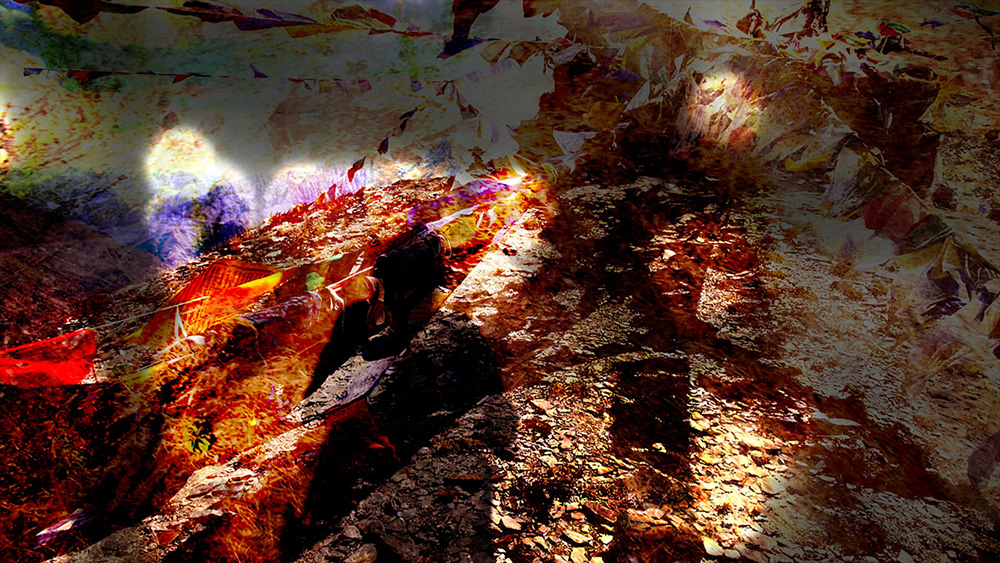
Inspired by research on Tibetan Buddhist mandalas in Indian Himalayas. Made possible in part by support from Fulbright Scholar Program.