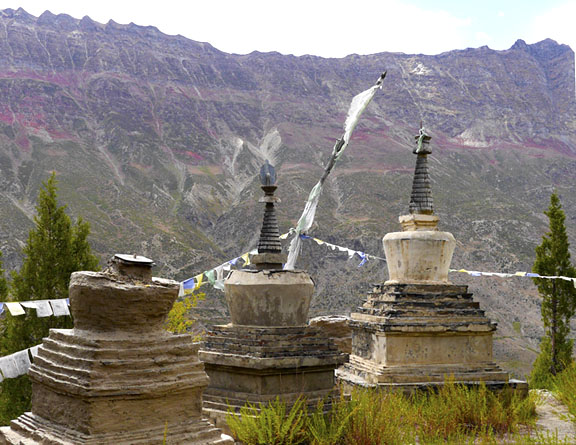
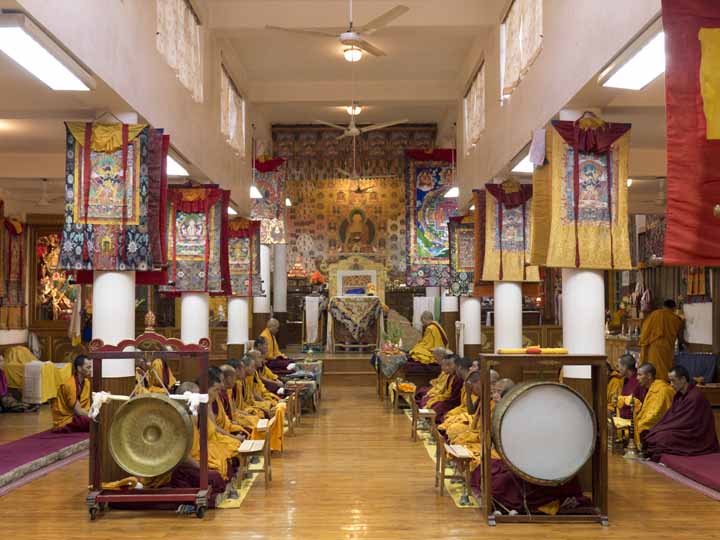
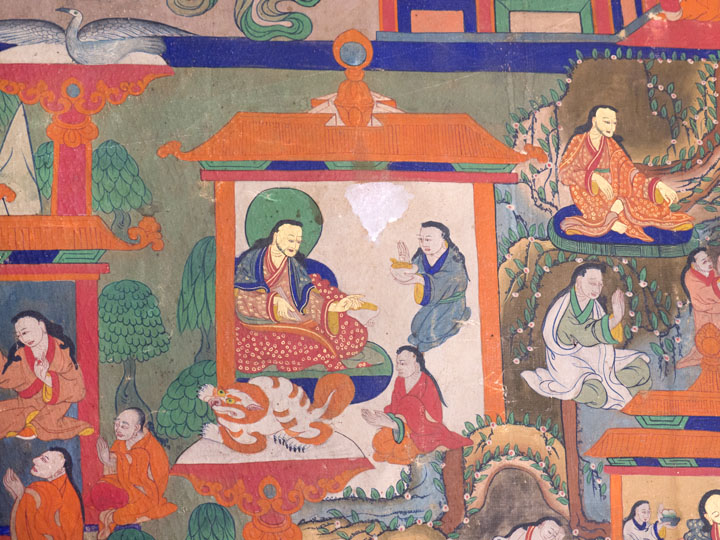
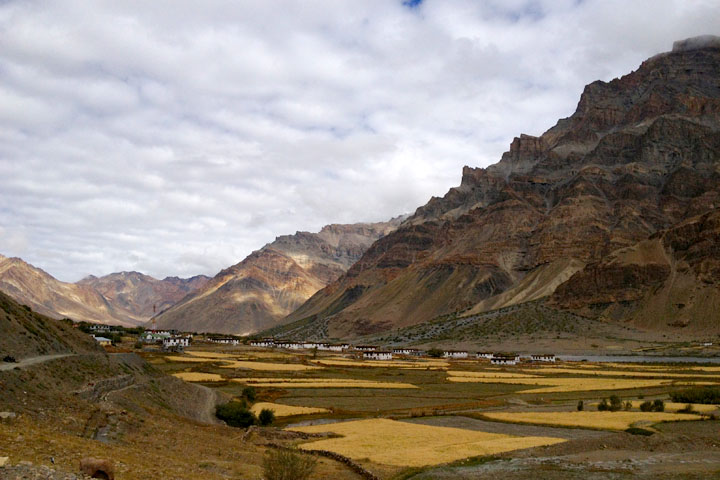
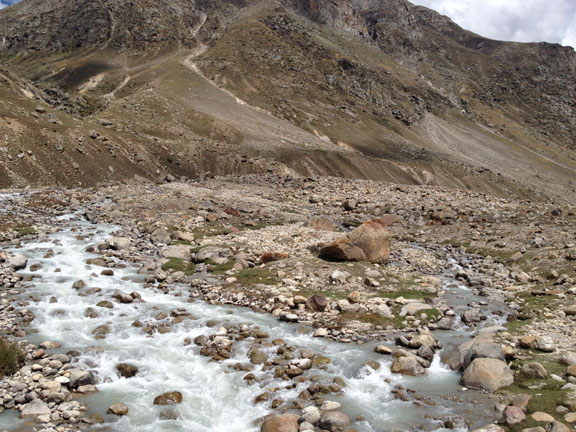
Today was Shashur and Tayul Monasteries. Both are not far from Keylong, just several kilometers away. Tayul Monastery was founded in the 17th century, but like Kardang Monastery, little appears to remain from its original period. The current main temple was renovated in the 19th century. Probably the oldest objects to be seen are the ancient stupas one encounters en route, on the hike up to the site.
Ancient stupas on walking trail en route to Tayul Monastery, opposite Drilbu Ri Mountain, Lahaul
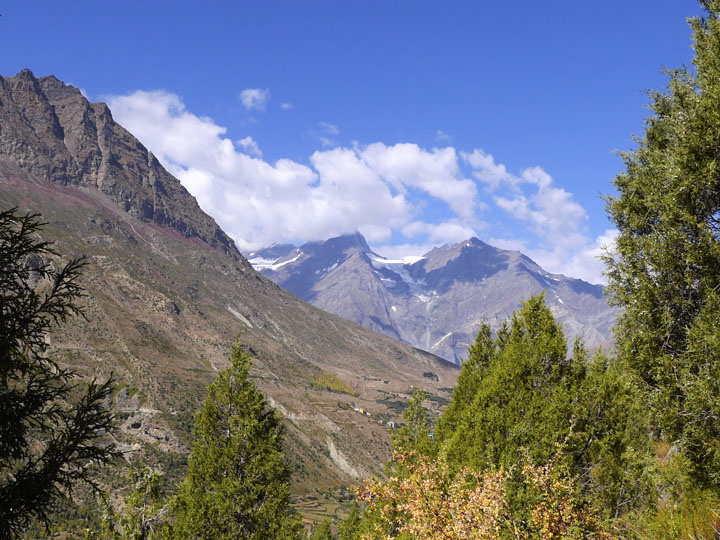
It must be reached on foot because there is no motorable road off the main road. The hike up is beautiful, of course, for its vistas. I was glad driver D accompanied me up because the trail is not so clear in some places. Locals do always advise having a guide. I still get winded doing the slightest incline up but hopefully each day will get better as I continue to acclimate to high altitude.
View across Bhaga Valley amid pine trees on trail to Tayul Monastery, Lahaul
Directly opposite is sacred Drilbu Ri mountain. You can always spot it by looking for those seven little peaks in a row that lead to a notched area where one treks up and over to reach the summit.
Drilbu Ri Mountain seen from across Bhaga Valley, easily identifiable by its seven peaks and the notch just to the right, where trail to its summit proceedsStatue possibly of founder and yogi Serzang Rinchen. Tayul Monastery,Lahaul
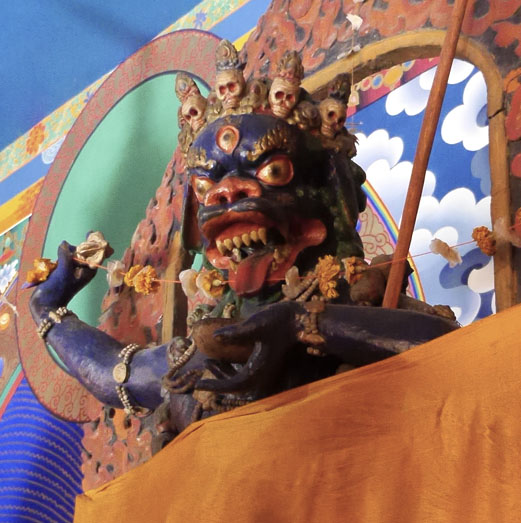
In fact, the story goes that Tayul, which means “chosen place,” was a location noticed by founder and Drukpa yogi Serzang Rinchen when he made his pilgrimage up Drilbu Ri. From across the Bhaga Valley, after a meritorious kora around the mountain, he saw the site and decided to build a hermitage there which became Tayul Monastery. Upon entering the main temple, one sees the 12 foot statue of Padmasambhava (Guru Rinpoche), revered as a great sage and living Buddha by Tibetans for introducing Buddhism to Tibet in the 8th century, displaying miraculous feats in taming local spirits in the process. Flanking him at the altar are statues of Dakini Singha Mukha, and the wrathful emanation of the guru.
Altar with Padmasambhava (Guru Rinpoche) in center, flanked by Dakini Singha Mukha and wrathful emanation of guruStatue of Singha Mukha, Tayul Monastery, LahaulWrathful emanation of Guru Rinpoche, Tayul Monastery, Lahaul
The original wall paintings from the 19th century by Lama Tashi Temphel, who stayed there and helped expand the monastery, are no longer extant. In its place are new paintings. Unfortunately, I found these contemporary-styled depictions rather stiff in execution, and less refined than older wall paintings I have seen to date in previous monasteries. Lama Temphel also made sacred images at Guru Ghantal Monastery, which happily can still be seen there. It had been suggested to me that Lahaul is not so much a place to find ancient Indo-Tibetan artwork, nor exquisite old wall paintings or mandalas even, as it is a place to be experienced physically as a land of yogi training, legend, and pilgrimage. So far, so true.
View of new wall paintings, Tayul Monastery, LahaulDetail of new wall paintings, Chakrasamvara in center with Guru Rinpoche above and surrounded by dakinis, Tayul Monastery, LahaulDetail of new wall paintings, featuring Drukpa lineage masters, Tayul Monastery, Lahaul
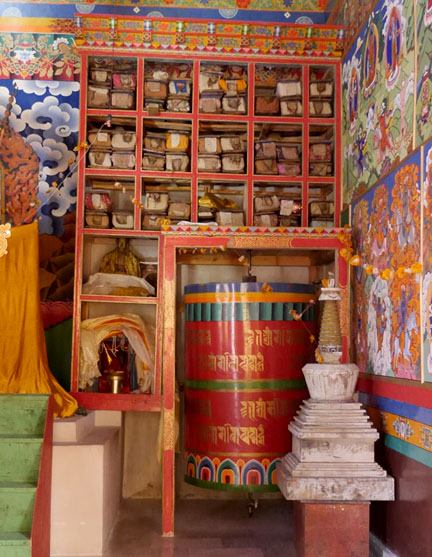
Tayul Monastery contains a complete Kangyur library and a large mani wheel that contains thousands of prayers. When spun, its blessings are activated and multiplies. According to its lamas, this wheel has been known to spin by itself on certain special occasions.
Kangyur library, and mani wheel known to rotate on its own on auspicious Buddhist days, Tayul Monastery, Lahaul
The British-born Tibetan Buddhist nun Tenzin Palmo was one of the first Westerners to encounter high Tibetan lamas in the early 1960s when she first arrived in India. She lived at Tayul for six years before retreating to a cave above it for twelve years. I read her biography Cave in the Snow like it was a suspense-thriller. I found her story and existential experiences riveting. It was a page-turner. Her retreat was abruptly interrupted by immigration authorities. Thus began her exit from solitary yogic practice to being a teacher in the world, a living example of Western and female accomplishment on the dharma path.
I always think that one beneficial outcome of the Tibet situation post-1959 is the creation of a diaspora which has lead to the spread of Buddhism in the Western world.
I saw Shashur Monastery the same day as Tayul. More to come!
I’ve been furiously writing here to get up-to-date, and even though I’m still working on September things seen and heard, I must now share that it’s Yamantaka time! I am currently documenting this highest yoga tantra performed annually at Namgyal Monastery here in Dharamsala.
Highest yoga tantra ritual, Yamantaka, begins pre-dawn at Namgyal Monastery, DharamsalaThe moon shines over Dharamsala Valley as Namgyal monks begin pre-dawn prayers for Yamantaka ritual. This highest yoga tantra occurs annually over the course of about ten days at Namgyal Monastery.
Yamantaka began four days ago before dawn’s light with earth ritual prayers to prepare the ground for this sacred art.
Offerings are made in the thekpu during earth ritual prayers to prepare the ground for the creating a sand mandala
Then came three days of intensive work for the monks to rasp colored sand through metal funnels to create intricate designs symbolizing the main deity and his retinue of associated deities within the palace. For more info on mandalas and tantric, see this earlier post.
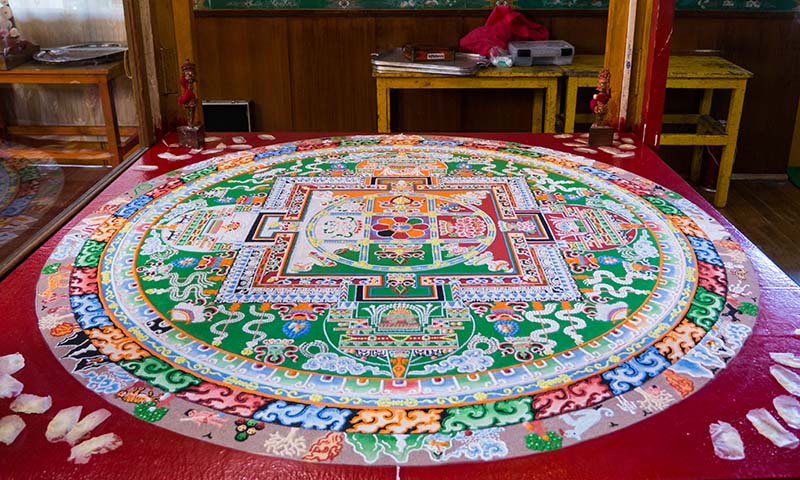
Day one involves marking out the eight directions in white, and then monks draw the basic structure of the mandala in black ink before beginning with colored sand.The sand mandala begins with symbolic depiction of Yamantaka deity who resides in the center. A mandala is a two-dimensional representation of a thee-dimensional palace, used as an aide in tantric meditation practice.Day one of creating Yamantaka sand mandala continues, Namgyal Monastery, DharamsalaThe mandala after the first day’s completionDay two of creating sand mandala. This monk is scribing a floral design with a pencil into the background sand, after which he will create it on top in other different gradated colors.Day two of making Yamantaka sand mandala, Namgyal Monastery, Dharamsala. The four gateways to the palace can now clearly be seen outlined in black, flanked by black-and-white cornice design.Day two of making Yamantaka sand mandala. The gateways are further elaborated as the green background color is begun for the next section. The monks began early morning and will work well into the night to ensure progress and completion of the mandala within three days.Day three of making Yamantaka sand mandala, with completed gateways, banner designs, vases, and other symbols that are mnemonic devices for tantric meditation, Namgyal Monastery, DharamsalaWorking on the outer borders, day three of making Yamantaka sand mandala, Namgyal Monastery, DharamsalaThe sand is gradated on this outer border, day three of making Yamantaka sand mandala, Namgyal Monastery, DharamsalaWorking on the final outer border which represents the charnel grounds, day three of making Yamantaka sand mandala, Namgyal Monastery, Dharamsala
The sand mandala was just finished yesterday.
The completed Yamantaka sand mandala, Namgyal Monastery, Dharamsala
With the completion of the mandala, today was the generation stage of the ritual. The monks chanted while visualizing themselves arise as Yamantaka. Tomorrow begins three days of consecration, followed by fire puja, then dissolution of the mandala.
I love this bittersweet last part where the beautiful mandala is swept away. As George Harrison sang, all things must pass. It’s a lesson in the truth of impermanence and the wisdom of letting go. Some of the sand is given to visitors who come witness the event. Most of it is swept into a ritual vase that is then taken to a nearby body of water and poured into it. I think of it as sending good wishes and energy out into the world.
I look forward to seeing it again. It was a wonderful experience here three years ago. It will be a welcome deja vu.
Today was spent going to Poekar Monastery, known partly for where Apho Rinpoche had commissioned Bhutanese artists to create a giant Guru Rinpoche statue. One can say that the Bhutanese are present-day masters of sublime Buddhist art. Their style and techniques are favored by Tibetans. I have seen their work grace many contemporary monasteries.
Poeker Monastery on upper right (yes, that little cluster of white above the other little cluster of white which is the village below), Lahaul Valley
While Poekar was not originally on my radar for visiting, J had learned yesterday at a meeting in Manali with one of Apho Rinpoche’s sons, Jampal-la, that he was heading to Keylong for Tara puja (prayer), to be followed by Guru Rinpochepuja the day after. She immediately called to inform me that I should join them. That is to say, in her irrepressible and talented role of what Malcolm Gladwell calls a “connector,” she invited me to join them at her behest and on their behalf! Right, then, another unforeseen opportunity to observe and experience. So, I said OK, thank you!
Statue of Guru Rinpoche, Poekar Monastery, Lahaul. It doesn’t look that big at this angle but this is one-and-a-half stories high. Also known as Padmasambhava, he was the sage who introduced Tibet to Buddhism in the 8th century.
I planned to stay overnight (because J said it was fine to) and brought all my camera equipment and some clothing, all jammed in my wheeling suitcase. But when I got there with the driver, I couldn’t reach Jampal-la on his phone for details, and found while searching for the monastery that it was a good steep half hour hike up! So much for wheeling in my suitcase. It became clear that unless I hoisted my rather heavy suitcase up, the only other option was to go back to my Keylong hotel. Driver D, who had climbed up to the monastery with me to ensure that I was safely escorted, was kind enough to offer to go back down to the car to fetch it, but I didn’t feel good about him doing that!
Anyway, perhaps one day was enough. Maybe better to get to Shashur and Tayul, or Guru Ghantal the next day. These were planned destinations and I wanted to make sure I had enough time to document them. Jampal-la suggested also Phakpa Monastery in Triloknath, a sacred site of Avalokiteshvara, and Markula Devi Temple in Udaipur, sacred site of Vajrvahari.
The Tara puja was an annual event that Poekar Monastery’s American sponsor requests. The resident monks and nuns are yogi retreatants, as most are in Lahaul. Together, they conducted the prayers, chanting in refreshing cross-gender unison, something one doesn’t experience very much since monks and nuns are usually living separate monastic lives.
In fact, Tara as a tantric deity has contemporary feminist appeal. She is referred to in the Perfection of Wisdom (Prajnaparamita) sutra, a very key Mahayana text, and is considered the female form of Avalokiteshvara, the deity of infinite compassion. With these two strong combinations of wisdom and compassion, she embodies powerful aspects of the practitioner’s own Buddha-nature. She has 21 forms or emanations in all, each associated with certain colors and psycho-physical energies.
Green Tara surrounded by her other enamations
During Tara puja, we all sat cross-legged on the floor as is customary. I was flanked by two nuns who would hand me grains of rice to toss in the air at intervals during prayer. Jampal and his wife were guests of honor.
It was nice talking to them both in between prayer sessions. We talked about how the West seems to the East and vice versa. I shared my observations of what I thought was positive and negative about each social order, their apparent outlooks on life, and expectations of how things should be. Jampal-la and his wife shared theirs. I learned from him that, even though he comes from a line of great traditional solitary practitioners, his view is unexpectedly open to contemporary and Western exposure, and it is this:
Begin on the secular level with teachings about how to simply be a good, moral person before getting to the more esoteric and higher teachings. Let individuals develop and choose whether they want to be Buddhist or not. Then if they do, higher teachings can always come later. He has helped to sponsor a group of young girls by sending them to school and working on exactly this approach. In this way, he is aligned with the Dalai Lama’s initiative on secular ethics.
What’s more, their teen is in the U.S. now attending university through the generosity of a sponsor. They feel strongly that young Tibetans should experience what the West has to offer, and then decide for themselves whether to follow that life or come back to the East. Otherwise, they will always feel doubt or curiosity that the (democratic/ materialist/capitalist/etc.) grass is greener on the other side. Eye-opening to chance the risks of the world, coming from a family and lineage legacy of hermitic existence.
The day passed so seamlessly from breakfast to morning prayers, to lunch and afternoon conversation, with such friendliness exuding from everyone at Poekar.
Poekar Monastery nuns, Lahaul
Sadly, when I learned that the next prayer session would continue in a different temple an hour’s ascent further up the mountain (surprise once again) I decided it was too late in the day, and time for me to travel back. Upon hearing this, the nuns and monks, who by now were spread willy-nilly on the hillside climbing up, began to wave and smile and utter lovely goodbyes. They repeatedly implored me to stay over. Truly, their sincerity warmed me so much, I found myself walking away hand clasped to heart.
Poekar Monastery monks, LahaulView of Lahaul Valley from Poekar Monastery village
Ah, a great night’s sleep at Kardang Monastery, dreaming of sweet friendships. Then a rainbow appeared during morning sunshowers and breakfast with Ani-la! I mean, gee, how much more welcomed can one feel?
Rainbow over Lahaul Valley during morning sunshowers, Kardang Monastery
Later I went to talk with Lama Paljor-la, and found him in his house with his two Russian disciples. They politely excused themselves so I could speak with him. We shared a truly warm conversation about spiritual outlook and concerns.
It turns out that one of his disciples was in great pain from kidney stones, so Lama Paljor-la rushed out to drive him to Keylong. I was supposed to ride in with them (having had second thoughts about walking back by myself) but due to the emergency, I reverted to my original plan of returning on foot.
Looking towards Keylong from Kardang Monastery courtyard, Lahaul
This poor fellow’s unfortunate circumstance became my fortunate one.
View up the Bhaga River Valley from on trail from Kardang Monastery to Keylong, Lahaul
It was lovely. I only saw one person on the long trail back. I had a most wonderful time alone.
View of Lahaul Valley on trail from Kardang Monastery to Keylong, Lahaul
At one point, I filmed the rushing waters of the Bhaga River, sat on a big rock catching my breath (gasping was more like it!) and suddenly felt…um, absolutely content.
Crossing the footbridge over the Bhaga River on the trail from Kardang Monastery to Keylong, Lahaul
Looking around me at the grand nature, feeling physically and mentally comfortable, at that moment, everything was so fine.
Contentment on the trail to Keylong from Kardang Monastery, Lahaul
It is said that Garsha can have that effect. I guess it was my day to experience it.
Along the trail to Keylong from Kardang Monastery, Lahaul ValleyEmerging into lower Keylong village from the cliffside trail back from Kardang Monastery, Lahaul
Yesterday, J and I came to Kardang Monastery to meet resident yogi and monastery head Lama Paljor-la. After learning about my project, he generously shared stories with us about the murals, objects, and photos in the main temple. J knows quite a lot about the Drukpa Lineage so they both had much to discuss.
Kardang Monastery as seen from across the Bhaga River, Lahaul
Kardang today is perhaps the best known monastery in Keylong owing to its association with the Shakya Shri Drukpa Lineage. Lineage is of terrific importance in Tibetan Buddhism because tantra is a living spiritual tradition transmitted orally in teachings from master to disciple. In this way, there is a connection from generation to generation which can be traced back to the Buddha himself.
Drubwang Shakya Shri (1983-1919) was an exceptional yogi who started out as a cook in a Drukpa monastery in Tibet. His lineage is unique because, through deep, whole-hearted practice, it is said he received his enlightenment directly from Vajradhara, the primordial Buddha. He was widely recognized as an incredible adept by other masters, including His Holiness the 14thDalai Lama. With pure connections going back only a few generations, Shakya Shri lineage is known for its effective master-to-disciple teachings which guide practitioners swiftly along the Buddhist spiritual path. Shakya Shri mastered Mahamudra in the Drukpa Kagyu tradition, and also Dzogchen through the Nyingma lineage. He was later known for being involved with the Ri-me (non-sectarian) movement.
It was Shakya Shri’s disciple Jetsun Norbu Rinpoche, who returned to Lahaul from Tibet after his master had passed away. As holder of his teachings, and in particular of the Six Yogas of Naropa and Mahamudra, he soon attracted 2000 followers from all over the Western Himalayas. Though his hermitage was thriving, he preferred to live in a cave above Kardang Monastery. In time, Kardang became known as a yogic training center.
Cave dwelling above Kardang Monastery, possibly like one that Norbu Rinpoche lived in
As I mentioned in an earlier post, you may have heard of Tibetan Buddhist practitioners who can do unusual physical things. It was some of Shakya Shri’s lineage yogis whom Harvard scientists studied in the 1980s doing tummo practice, in which they can raise the temperature of parts of their body by as much as 17 degrees! One study involved the yogis scantily clothed spending a Himalayan winter’s night outdoors on a rocky ledge at 15000 feet altitude where temperatures reached freezing. The yogis demonstrated they could remain warm and slept through the night without incident. I think most of us would have suffered hypothermia! It occurs to me that Lama Paljor-la could have been one of these yogis.
Kardang Monastery is believed to have been founded about 800 years ago, but nothing seems to remain of its original temple. The current main temple was first built by Norbu Rinpoche in the 1930s, but was rebuilt several years ago by Lama Paljor-la, a disciple of lineage holder and former monastery head Apho Rinpoche. I have had the pleasure of meeting three of Apho Rinpoche’s children in Manali en route to Spiti and coming back from Lahaul: lineage holder Sey Rinpoche, his brother Jampal who is also a recognized reincarnate but prefers to live a quiet life with his family, and Khandro Thrinlay whom I wrote about previously here.
Kardong Monastery, Lahaul
Kardang Monastery is situated directly opposite Keylong on the other side of Bhaga River. See this 360 degree video view below.
[vimeo 145002351 w=600 h=331]
When one enters the main temple, one sees a mixture of old and new murals on the walls. The older ones, possibly no older than the 1930s, were painted originally on canvas so they were removed and reinstalled. They collage the walls alongside newly painted scenes.
Interior of main temple at Kardang Monastery, Lahaul, with lama performing Mahakala prayers
At the altar are Buddha Shakyamuni statue on the middle, Vajradhara on the left and Padmasambhava on the right (also known as Guru Rinpoche, who introduced Buddhism to Tibet in the 8th century).
Vajrdhara on left, Buddha Shakyamuni in center, Padmasambhava on right, altar at Kardang Monastery, LahaulInterior view of Kardang Monastery where older and newer paintings collage the walls, LahaulOlder and newer paintings collage the walls of Kardang Monastery, LahaulInterior view of main temple, Kardang Monastery, LahaulDetail of an older painting depicting a scene from the Life of Buddha, Kardang Monastery, LahaulDetail of an older painting depicting Chenrezig, Kardang Monastery, LahaulDetail of an older painting depicting Padmasambhava with consort, surrounded by protector deities Kardang Monastery, Lahaul
The monastery has a large library which includes the complete Kangyur, given to Norbu Rinpoche by the king of Bhutan, and the complete collection of the Wisdom Words of His Holiness the 4th Gyalwang Drukpa, the spiritual leader of the Drukpa Lineage.
Kardang Monastery has an extensive library of Kangyur scripture and other complete texts. Also seen here are sculptures and relics of lineage mastersGegen Rinpoche on left, His Holiness the 12th (current) Gyalwang Drukpa on right, on altar of Kardang Monastery, LahaulA newly painted guru-yoga mandala on the ceiling, Kardang Monastery, Lahaul
Above the main temple is a room that had belonged to Apho Rinpoche. On the walls are paintings depicting Milarepa’s story that were originally painted on canvas and reinstalled in this new temple.
Apho Rinpoche’s former room above main temple, Kardang MonasteryScenes from Life of Milarepa, older wall paintings from Apho Rinpoche’s former room above main temple Kardang Monastery. Above right are newer paintings.Detail from Life of Milarepa, wall paintings, Kardang Monastery
I’m spending the night here tonight in one of the monastery guest rooms. There’s an Ani-la (nun) who has kindly cooked for me, but mostly Kandang’s community of eight monks and seven nuns are lone retreatants living in simple huts and cooking for themselves.
Detail from Life of Milarepa wall paintings, Kardang Monastery, Lahaul
J left this morning, and took the bus back to Manali. It was wonderful traveling with her, and I’ll miss her company to share travel discoveries with. Yes, so I’ll be here for several days on my own devices, until my next travel companion K arrives and we drive together to Ladakh. On my list of things to do here are to see Shashur and Tayul Monasteries.
View of Keylong from the courtyard of Kardang Monastery on the other side of the Bhaga River, Lahaul
Tomorrow I plan to walk back to Keylong via trail and footbridge across Bhaga River. I hope the paths are clearly visible and I don’t get lost! There’s no taxi to be had here unless I call for one from Keylong. And as Khandro-la’s assistant had told me, Lahaul does not have so much in the way of Indo-Tibetan mandalas, but is rather itself considered a Chakrasamvara mandala manifest, one should experience it on foot. Even though we are at over 11,000 feet altitude, it seems not too hard to go downhill and not terribly far to walk perhaps 5-8 kilometers, so I think I should follow this advice and experience Garsha. After all, I am over the worst of altitude adjustments. I had vice-grip headaches at night which made it hard to sleep, but the head pain progressively improved, and by the end of the first week, went away. So while I’m a bit short of breath sometimes exerting uphill, it’s not a hardship.
This story has proven staying power on my mind. I was going to write about Kardang Monastery, the first site I visited in Lahaul, but I have been thinking about this other content, so must share it here, now.
What if you were in a situation where you had to choose between your freedom from prison, or bringing a great spiritual teacher to your country to enlighten its citizens? Yeshe O’d, the 11th century Buddhist King of Guge in Western Tibet was faced with this choice.
During his lifetime (967-1040 C.E.), he had inherited a kingdom in a confused and degenerate era of Buddhism, a condition that followed its religious repression by previous King Langdarma (863-906 C.E.) To counter dissolute Buddhist practices and ideas, Yeshe O’d aimed to restore pure teachings in a variety of educational and development initiatives.
He sent young scholars to India to study Sanskrit, the original language of Buddhist scriptures. He imported and had faithfully translated Sanskrit sutras, tantras, and commentaries into Tibetan. He built monasteries all over his vast kingdom, and brought a team of inspired artists from Kashmir, where Buddhism had long flourished, to help illustrate the fundamentals of tantric practice. If you have been following this blog, you know then that this involved depictions of the deity Vairocana, the Dhyanibuddhas (Five Buddha families) and their associated cycle of deities in a Vajradhatu mandala order of art and architecture. It resulted in a distinctive period of Indo-Tibetan sacred art which can still be seen today in late 10th and 11th century sites such as Tabo and Lhalung monasteries in Spiti; Alchi, Lamayuru, Mangyu, and Sumda Chun monasteries in Ladakh. Finally, Yeshe O’d also searched for and invited a great Indian master to teach in Tibet.
Of the twenty-one individuals he sent to India to study Sanskrit, only two survived to return from the arduous journey to inform him of the great master Atisha.
One of these students later became The Great Translator Rinchen Zangpo who, through his scholarly excellence and dharma dedication together with the king’s support, helped effect what is known as the Second Great Transmission of Buddhism from India to Tibet. It spanned the late 10th to 12th centuries C.E.
Upon learning of Atisha, Yeshe O’d proceeded to commission a second party armed with gold offerings to request the master to come to Tibet. Of the nine people sent, only one survived, but he was unable to persuade the scholar to leave the learned monastic university center of Vikramashila where he was teaching Indian disciples.
Undeterred, and collecting more gold to offer, the king decided to go personally in a third expedition to meet Atisha. However, along the way he was captured by a rival King of Garlog near Nepal who imprisoned him for ransom. With the intention of deterring the spread of Buddhism, this king demanded Yeshe O’d’s weight in gold for his release, or that he give up his mission to go to India.
By now, many years had passed since the first initiative of sending students to India to study Sanskrit, and Yeshe O’d was an older man. When his nephew Changchub O’d arrived with a large sum of gold collected from throughout Western Tibet, it was not the full Guge king’s body weight. It is said that the gold remaining still required was equal to his head. So the Garlog ruler refused to release his hostage.
Changchub O’d then met with his uncle, who was chained in his dark prison cell, vowing to redouble his efforts to get more gold for his release. Yeshe O’d, however, then instructed him to offer the gold thus far collected instead to Atisha. He said, “I have died countless times in previous lives, but I am sure I have never before sacrificed myself for the Buddha’s Dharma. Now I am very happy to do so. Whomever you send to India, please have him tell Atisha that I have given my life for the welfare of my subjects and the Dharma so that he could be brought to Tibet. Although I have not had the fortune to meet him this lifetime, I have fervent hopes that I can in the future.” In great grief, Changjub O’d agreed to follow his wishes.
And so, Yeshe O’d died in prison for the sake of benefiting others. This story sticks with me for its selflessness and model example of bodhicitta, great generosity. Buddhist history has proven its profundity.
Atisha, upon hearing the circumstances, felt moved by enormous compassion, and he then finally did come to Tibet at the age of 53, sometime in the first half of the 11th century C.E. Along the way, he wrote his masterpiece Lamp for the Path to Enlightenment, a short text in 67 verses which lays out the entire Buddhist path in terms of the three vehicles: Hinayana, Mahayana, and Vajrayana, and became the model for later texts in Stages of the Path.
He remained in Tibet for the rest of his life where he successfully taught and propagated pure teachings that amounted to an illustrious reform within the Second Great Transmission of Buddhism to Tibet. And much to his gratitude, Atisha even showed the very learned Lotsawa Rinchen Zangpo, who was by now aged in his 80s, how to properly practice tantra. Atisha is further credited for laying the groundwork for Je Tsongkhapa’s 14th century seminal teachings.
Lahaul: Garsha Khandroling, Land of the Dakinis
Posted
Dancing Dakini, Tibet, ca.18th century
Lahaul is known by Tibetan meditation practitioners and adepts as Garsha Khandroling, Land of the Dakinis. Dakinis are energetic female spiritual guides often depicted as blissful and fierce dancers.
Lahaul has an illustrious Drukpa Kagyu lineage of highly realized yogis and yoginis who do the Six Yogas of Naropa, esoteric methods bestowed by master to disciple in direct teachings. These are the meditators who go into seclusion in caves or simple dwellings for years or decades in order to realize spiritual liberation–that is to say, Buddha-nature through tantric wisdom and compassion practices.
As I mentioned in my last post, I have heard about some of the mind-over-matter feats that yogis demonstrate which confound conventional explanations, such as levitation, miraculous healing of the sick, making snow fall, taking bad karma upon oneself for the benefit of another. Another perplexing thing, upon death, the bodies of many advanced practitioners do not decay according to the normal time frame of most people. They are believed to be fully aware in the bardo state, the intermediate stage between death and rebirth.
Well, I’ve learned that while it’s difficult to wrap one’s rational mind around such reported phenomena, sitting on the I-don’t-know fence is a flexible and open-minded place to be. After all, outside of spiritual matters we can’t explain, for example, quantum entanglement or what Albert Einstein called “spooky action at a distance,” but it appears to happen!
The great yogi Shakya Shri
Garsha has attracted and hosted countless masters and disciples in pursuit of enlightenment for over 2000 years in unbroken continuity. Inspirations for pilgrims include the sacred abodes of Chakrasamvara at Drilbu Ri Mountain opposite Keylong; Avalokiteshvara at Phakba Temple in Triloknath; and Varjavahari at Markula Devi Temple in Udaipur.
Keylong, Lahaul’s largest village, has several important monasteries only a few kilometers away. These were flourishing Buddhist centers centuries ago, such as Kardang, Shashur and Tayul Monasteries. The oldest one, Gandhola (Guru Ghantal) dates to 1st century C.E. according to archeological evidence. I visited each of these places and to come will be posts featuring them.
View of Gandhola (Guru Ghantal) Monastery, way upper left, with Thupcholing Monastery below on the plateau. Those green-roofed structures are meditation huts for retreatants. Both sites overlook Tandi bridge where the mighty Chandra and Bagha Rivers join in what is considered by Buddhists and Hindus alike as a sacred union.
The delight to be found in Lahaul is that over time, masters have left legends, relics, shrines, stupas, sacred paintings, sculptures, and other spiritual encounters that dot the landscape awaiting discovery by travelers and seekers. The more you look, the more you will see, but it takes some uncovering. For example, what looks unimpressive on the outside may contain a treasure on the inside, such as Jabjes Monastery in Kardang Village. Or one has to do a bit of breathless hiking up a mountain to see some of these old monasteries, hidden meditation caves, and charnel grounds.
Jabjes Monastery located in Kardang Village was built around a legendary rock with the miraculous imprints of yogi Gyalwa Gotsangpa’s knees and genitalia, which formed in the stone as he passionately chased and tried to embrace a dakini who disappeared into it. The rock may be seen today inside the temple, Lahaul, India.
However, I’m told by locals that most visitors just pass through Lahaul, heading to the more tourist traveled and trekked sites in Ladakh or Spiti. What a pity!
More readily noticeable and understood by travelers is that Keylong stretches along the main trade route between the Rohtang and Baralacha passes above the Bhaga River. Besides being a thoroughfare between Ladakh, Kullu and Spiti regions, it is also the district headquarters of Lahaul and Spiti, with strategic military presence. In addition, above and below the village one sees lush farmlands growing barley, peas, potatoes, corn, cabbage, mustard greens, squash, and much more. Apples and other fruit orchards are plentiful. My local driver D told me that agriculture is the economic mainstay of Lahaul, and judging from some of the mansions built by some farming families, the wealth of this abundant agrarian heartland is evident. The food harvested is transported all over India. I would not have guessed that at an altitude of over 10,000 feet there would be such a cornucopia!
View of Keylong on hiking trail from Kardang Monastery to Keylong
D’s ancestral farmland is in the Manali area of Kullu Valley, but he lives and works in Keylong to service the tourist industry as an extension of the family business. Indeed, it’s all in the family. I’ve learned from Lahaulis and Spitians I met that relatives live and work together. This was always the tradition, and it largely continues today.
Another thing I learned was that unlike Tibetans, Lahaulis, Spitians and Ladakhis, while culturally and historically part of Tibet, are indigenous to their regions, and as such are not refugees in India but full citizens. In addition, they have their own language and customs. In fact, the Indian government recognizes them as ethnic “tribals,” who may therefore qualify for certain affirmative action positions or opportunities.
It isn’t only just the passerby tourist who may miss the treasure to be found in Lahaul. I realized that my driver, while he probably identifies himself as a Buddhist, is fairly uninformed about the great legacy of his roots. At one point in our travels, he asked me how much I knew about the Dalai Lama and Buddhism. I thought it was a prompt for me to in turn ask him what he knew and be enlightened by his local knowledge, but it was not a segue way to that at all! He told me he tried to find books on Buddhism in Hindi, but could not. It pained me to hear this–that someone looking for knowledge could not access it.
D said that Lahaulis are educated in Indian schools, are fluent in Hindi but not Tibetan, and frequently not English, either. I noticed this is especially true of the women, who largely live domestic lives caring for family and have little contact with others. English is spoken mainly to communicate with foreigners. Feeling affinity for Indian culture and language, many Lahaulis have assimilated to a large extent in recent generations. Most cannot read the readily available contemporary books in Tibetan on Tibetan Buddhism to fill in on the lack of local education on this topic. Books in English are plenty, but nor can they read these since the written language is “too deep” to understand. It was an exquisite and sad irony that I, a foreigner from the other side of the world, knew more about his spiritual roots than he did. That he, a resident in the incredible Garsha, a descendent of the local culture, could not find one book he could read to study Buddhism deeper!
Farm land and orchards above and below Keylong Village in the fertile valley of Bagha River, Lahaul
It’s a double whammy of cultural distance and spiritual loss. Without being able to study Buddhist philosophy and learn about its unique teachings on dependent origination, one runs the risk of meaningless ritual practice with no or limited realization of freedom from life’s delusions and sufferings.
What’s more, Tibetan Buddhists have a marvelous literary and scholarly tradition, founded on the translation and study of original source materials. Lotsawa Rinchen Zangpo’s translations of Buddhist scriptures from Sanskrit to Tibetan has not only preserved a written heritage now lost in India but produced a renaissance of tantric study and practice. This was during the late 10th to 11th centuries, a flourishing period referred to as the second great propagation of Buddhism. It is the Indo-Tibetan history I’ve been trailing through the sacred art of mandalas, monastery murals, and sculptures.
Garsha: Heartland of the Dakinis
In fact, a (French) Tibetan Buddhist nun, while living in Keylong, discovered the very same thing–that Lahaulis did not know much about the dharma history of their own land. Furthermore, part of why Lahaul’s Buddhist legacy is little known is due to a dearth of literature on it. So she wrote the book Garsha: Heartland of the Dakinis in 2011, published by the Garsha Young Drukpa Association. I have a copy in English, the language it was originally written in. Currently, it needs to be translated into Hindi for local readers.
It is a remarkable small book, jam-packed with a wealth of information about Garsha’s ancient history, the Drukpa lineage masters, dakinis, the founding of monasteries, anecdotes, local legends, descriptions of sacred sites, miracles, reliquaries, carved stones, and much more. It is probably the most, and perhaps only, comprehensive account of Lahaul’s history from the Buddhist perspective. Because it is written by a monastic with open access to living lineage teachers, and unpublished historic materials in Bhoti/Tibetan, the book is a treasure trove of knowledge.
I learned about the book and purchased it from Khandro Thrinlay la when I met her in Manali en route to Spiti (see earlier post here). She is a lama and direct descendent of the Drukpa Kagyu Shakya Shri lineage, with very close spiritual ties to Lahaul. My travel companion J was happy to find it available for sale later in Keylong because she wanted to buy it and donate copies to Tabo Monastery Library in Spiti and The Library of Tibetan Works and Archives in Dharamsala. Funny thing, though, she did not find it in a book store but at a small travel agency/internet cafe establishment run by a lovely Lahauli man keen on the book. You see what I mean? The more you look, the more you will find around here!
Sept 9, 2013 Spiti adventure continues…on to Lahaul, India
After a jaunty jiggly jeep ride of over 10 hours from Kaza back through the magnificent giant boulder rubble of Spiti Valley, Kunzum-la Pass (this time populated by yaks grazing and loafing!) and getting stuck fording a glacial melt waterfall that flooded the rocky road, we arrived in Keylong, Lahaul.
View of farmland in early morning Spiti Valley, en route to Keylong, LahaulSpiti Valley in the marbled early morning sun. As dry and desolate as Spiti may seem, there is always the play of light and colorful vistasApproaching the stupas of Kunzum la pass, the high point of the road at about 15000 ft altitude. This time there was a herd of yak grazing and resting. Glaciers can be seen within relatively close range.Kunzum la pass, where I circumambulated the stupas and got a close look at yaks gathered there. Glaciers can be seen at above left.Herd of yaks dotting Kunzum la pass, at about 15000 feet altitude, the highest point of the road through Spiti ValleyYak grazing, this one looks like he’s molting or has been shavedYaks grazing and resting at Kunzum la pass, seen en route from Spiti to LahaulTibetan Buddhist stupas at Kunzum la pass, monuments in honor of this high point of the road through Spiti ValleyAt this time of year in September, there are streams of glacial melt such as this one which frequently cross the road. They can be as small as trickles or as large as river flows, and it’s wise to travel as much as possible in the morning before the hot afternoon sun increases the flow of these waters that you have to cross with your vehicle.Huge boulder piles along the road from Kaza, Spiti, to Keylong, Lahaul. It’s difficult to judge the monumental scale from just a photo, but to give you an idea, this foreground rock is as tall as a person.Huge boulder piles along the road from Kaza, Spiti, to Keylong, Lahaul
Magnificent and desolate…
Our jeep on the road through the dry desert terrain of Spiti Valley, India
Once you experience the vast scale of the Himalayas, you can readily understand why the environment induces existential concerns and spiritual development. There’s nothing like realizing our small duration as human beings in the context of gigantic geological time and space, and beyond this, the grand cosmos to put human desires and expectations into a completely different focus.
A large Tibetan Buddhist stupa is dwarfed by the magnificent scale of the Himalayan mountains
Here is our jeep stuck on rocks while attempting to ford the rapidly flowing waterfall that flooded the road in the afternoon. We had patiently waited while the vehicle before us was stuck and finally managed to get out. In that 45 minutes or so, unfortunately, the water flow started increasing as the hot afternoon sun melted more glaciers! We got out eventually though with the help of others waiting to pass, including military men and a monk who moved earth and rubble, pushed and rocked the car, as our driver revved forward.
Our jeep stuck on rocks while attempting to ford the rapidly flowing waterfall that floods the road in the afternoon in Spiti Valley.The said rapidly flowing waterfall which created a river across the road, Spiti Valley, India
In contrast, as you approach and enter Lahaul Valley, high waterfalls are plenty but do not flood the roads. Lahaul is also a welcoming green landscape with grass, shrubbery, trees, and evergreens. The region is also well known for its delicious potatoes, as well as crops of barley, peas, cabbage, apple and other fruit orchards. Even here in high altitude, it is a heartland for growing food to be transported throughout India.
One sees many high waterfalls throughout the more verdant Lahaul Valley
With arrival in Keylong, Lahaul, in late afternoon we spent the rest of the day trying to get some logistics done. For my part, it was to get (yet another) SIM card that will get a cell signal here in the high Himalayas, and hopefully maintain a signal when I later travel to Ladakh further north. After the last week in Kaza, Spiti, without any cell phone coverage by my existing SIM card to communicate with family or arrange meetings or call for travel, etc., I decided to get another with a different carrier. Here in India, there is no single carrier that can provide national coverage, so one gets used to swapping out SIM cards and switching providers as the need arises when you travel from area to area. I have three SIMs now. The last one took so long to do—don’t ask the maddening details about how it took well over two hours to buy the SIM in one place and take it to another place to cut down. Around here you get used to relatively simple things taking an inordinate amount of time to accomplish, in this case, out of lack of coordination and know-how on merchants’ part. I’ve learned to smile a lot, shake my head, and say to myself, “It’s India…” Trust me, even Indians say this!
I never got to treat my very dry leather shoes as I had promised myself. They look like they’re going to crack from the dust-pounding they get in this high desert climate and unpaved roads. Nor did I get to download from the internet café the software plug-in I desperately need to manage my photographs. I couldn’t do it in Spiti because my download was too big for the internet café’s monthly ration of data permitted. Who knew an internet cafe would be rationed for data?! But, ok, lack of resources…I shook my head and smiled, it’s India.
But what India lacks, it definitely makes up for in its sublime experiences!
View of Keylong nestled in the Bhagha River Valley, Lahaul
Which brings me to Lahaul, also known by Buddhists as Garsha Khandroling, a region with a deep history of highly realized yogis. These are the practitioners who spend many years or decades in seclusion meditating in caves. You may have heard about adepts who can demonstrate astounding practices of mind over matter, such as levitate or dry wet sheets in the snow with heat generated from their bodies, confounding the scientists who studied this phenomena. Or you may have heard of Jetsunma Tenzin Palmo, the American Tibetan Buddhist nun and her Cave in the Snow. In any case, more on Garsha in the next post…
In the book The Forgotten Gods of Tibet: Early Buddhist Art in the Western Himalayas, published in 1997, authors Peter van Ham and Aglaja Stirn wrote about Tabo Monastery‘s Tsug Lhakhang: “Unfortunately many of the paintings, especially in the lower register, are badly damaged. In fact the northern wall has a large area where nothing except for the grey wall can be made out. Some of these gaps were painted over in recent times–enhancing the impression of the high artistic merit of the old paintings since these newer additions only show a mediocre level of execution.”
Perhaps this may be an example (see image below). Notice how the figure to the left of the central Buddha is stylistically so different from the one on the right. As a trained fine arts painter as well as decorative painter, I must agree with authors van Ham and Stirn.
Stylistic inconsistency in repainted figure on left, Tabo Monastery Tsug Lhakhang
This below example of stylistic continuity is what the above example should look like.
Stylistic consistency in these three figures, Tabo Monastery Tsug Lhakhang
Here is a view of a comparable original painting on the left and the one in question on the right. Stiff and simplistic in appearance, the repainted one bears little resemblance to the refined and delightfully detailed original.
An example of original painting on left and repainted version on right, Tabo Monastery Tsug Lhakhang
Here, above the doorway, is another example of repainting in the chevron border and the two figures underneath.
Repainted areas in Tabo Monastery Tsug Lhakhang
Presented above are only a couple of examples. In person onsite at Tabo’s Tsug Lhakhang, one finds upon scrutiny numerous incidences of such inpainting and overpainting. I fear that if this kind of “restoration” continues, over time, the temple’s extraordinary original murals will be obliterated rather than preserved. That would be an immeasurable loss for India, art history, and world posterity.
Experience the interior of Tabo Monastery’s Tsug Lhakhang by watching this video walk-through here.
Tabo Monastery is under the protection of the Archeological Survey of India, but it is unclear to me who is doing the painting.
The book Architectural Heritage: Ladakh by The Indian National Trust for Art and Cultural Heritage, published in 2003, says it is often the monastics who do not realize the need for proper conservation, being more concerned with the religious content of the murals and not the art historical significance.
“In the great temples, the execution of wall paintings is carried out by monks and scholars whose canonical knowledge is profound…Most wall paintings are done on perishable mud plaster, and as these begin to disintegrate, these are either removed to draw fresh paintings or retraced and retouched to maintain their vibrancy and freshness. This way it is sometimes painful to witness a ruthless operation in which centuries old paintings are lost along with the structure by eager lamas to construct new structure and, consequently, draw another set of wall paintings…As soon as the walls begin to crack, or paintings fade, they are at once repainted.”
While it appears that at times the goals of Tabo Monastery and Archeological Survey of India may be at cross-purposes with one another, there seems to be great effort for mutual respect. After all, Tabo is a functioning Tibetan Buddhist religious site. At the same time, it is a rare Indo-Tibetan historical site under ASI’s charge. The question is, how are these two establishments proceeding forward?
Repainting, however, is only one of the man-made challenges to the preservation of Indo-Tibetan murals. There are also issues involving structural changes to historical buildings (see this earlier post regarding repairs to the roof of Tabo’s Great Assembly Hall), vandalism, and the effects of tourism, to name some others. Then there are the natural challenges such as wet conditions caused by snow or rainfall, and movement caused by earthquakes.
Partial repair and rudimentary inpainting in the Thousand Buddhas inner wall of Tabo Monastery Tsug Lhakhang inner sanctum, Spiti, India
I heard that it’s possible ASI may have applied for UNESCO World Heritage status for Tabo Monastery. In terms of conservation and preservation, this would be wonderful if it were to come about! I understand that the Ajanta Caves in Southern India, which contain stunning, well-preserved, ancient Buddhist paintings as old as 2nd century B.C.E., is a World Heritage site.
Thoughts on Craving, Desire, and Addiction in Dharamsala
Posted
I just spent the past week attending Mind & Life Conference which was held with the Dalai Lama at his residence here in Dharamsala, India. Well, that is, I attended the live broadcast of it at the adjacent Namgyal Monastery. I wish I had been able to be at the conference in person!
I’ve been to public ones in the U.S. and India in the past and they are always thought-provoking, authentically open dialogues between scientists, scholars, and contemplative practitioners. I absolutely love these conferences because exciting interdisciplinary ideas emerge and unexpected conversations evolve about, well, what mind is and how we can work with our minds to live skillfully and beneficially.
Organized around a chosen topic, invited presenters speak about their research or practice, then open it up to questions and discussions. In the process, paradigms, assumptions, and philosophical traditions are examined. Issues are raised for how we can improve or solve humanity’s contemporary problems.
The topic of this one was “Craving, Desire, and Addiction.” Check out the Program and Schedule of Events. Mind & Life Institute assembled a remarkable group of participants–neuroscientists, clinicians, a sociologist, a Christian mystical scholar, monks, and others–who brought first-person perspectives to the table. One neuroscientist, Mark Lewis, had been an addict himself and talked about his subjective experience of the craving cycle, and his objective one as a researcher working on identifying the neurological structures of the brain involved in and affected by substance abuse.
Some eye-opening things I learned from research findings include the idea of the “erosion of free will” in addiction. Dopamine and serotonin structures in the brain involved in thinking, restraint, and projected rewards are actually altered and “hijacked” by addiction so that addicts are, in fact, biochemically disadvantaged in breaking the cycle of craving-imagining-planning-taking the substance, as opposed to non-addicts. Studies indicate that addiction recurs even though addicts no longer find pleasure in the substance and know that it will cause them and others harm.
One anthropologist presented some stunning statistics about the regulation of addictive substances as a program of prevention. In the U.S., criminalization of drugs has resulted in disproportionate incarceration. The American population is 5% of the world population, but is 25% of the world’s incarcerated! African-Americans form 13% of the U.S. population, but are 45% of those jailed for non-violent drug offense! There seems to be a serious bias in the implementation of drug laws. Another example, in New York City, more white people use marijuana, but more black people are arrested for it.
These facts, and many other compelling ones on prevention, intervention, and treatment were discussed. Incidentally, Mind & Life will be posting videos of the conference soon on its website. So if you missed the live webcasts, you can watch them archived online. I highly recommend it if you are or you know someone who is affected by substance abuse and addiction.
The conference was profound in scope. Key discussions centered on definitions and experiences of desire and craving, and how they can be met and transformed. It was insightful not only for illuminating root causes of suffering for addicts but for all of us living in contemporary materialistic culture where craving things becomes the norm for excessive consumption. I read recently that acquiring more than what you need was considered by many pre-industrialized indigenous cultures as pathological. What prescience!
It makes a lot of sense when you consider the suffering of anxiety, depression, neuroses, and suicides in the U.S. among young people who are desperately stressed, competing with each other towards educational goals aimed ultimately at attaining material wealth. The documentary Race to Nowhere is a disturbing and sad account of this phenomena. It illustrates a basis for the alarming disconnection between emotional health and well-being, and what is defined as “success” in American life. See the trailer here.
And while I’m on this topic, the book Teach Your Children Well: Parenting for Authentic Success also takes an insightful look at how we are raising and educating kids. The New York Times writes, “It would be easy, on first glance, to dismiss [psychologist] Madeline Levine’s Teach Your Children Well as yet another new arrival in a long line of books that have urged us…to push back and just say no to the pressures of perfectionistic, high-performance parenting. But to give in to first impressions would be a mistake. Levine works with teenagers who are depleted, angry and sad…so lost are they in the pursuit of goals that have drained their lives of pleasure, contentment and connection. ‘Our current version of success is a failure,’ she writes. It’s a damning, and altogether accurate, clinical diagnosis.”
And how much of this cultural milieu might drive people to substance use and abuse in an unfortunate attempt to alleviate suffering? It is known that the harmful patterns of addiction take a profound toll on both the individual and society. According to Mind & Life, addiction to alcohol, tobacco, and illicit drugs, for example, is estimated to cost the United States $600 billion per year. Did you just read that correctly? Yes, you did, $600 BILLION. On the emotional level, it’s immeasurable how deeply it traumatizes families and friends, sometimes for generations.
At this Mind & Life conference, as part of the discussion on effective treatment for addiction, the Dalai Lama advocated prevention through new initiatives in education that increases self-awareness and connection to others through the practice of kindness. Because many social ills come from the hyper-individualism championed by the contemporary industrialized world, such excessive self-focus, he said, ultimately produces separation and unhappiness. It gives rise to an “us and them” mentality which makes aggression, greed, and war possible. Instead, we need to develop not only our thinking skills but our emotional ones as well.
If you’re an educator, counselor, or parent, take a look at this nascent movement and see what you can do to make a difference.
See an example of how incorporating kindness in children’s education works in this PBS video. Groundbreaking studies of children learning through mindfulness and kindness curricula currently under way and developed by University of Wisconsin Center for Investigating Healthy Minds are yielding increases in positive social behavior. See here for further information on this and similar programs.
Tabo Monastery Tsug Lhakhang, with meditation caves in the cliffs beyond, Spiti, India
Six-o’clock morning puja for the recently deceased beloved abbot at Tabo Monastery was quite beautiful. I wasn’t fully awake for it, and drifted through listening to each monk use his voice artfully to express himself through prayer. Very nice. I found out later from a lama that while they all learn the basic rhythm, it is up to each individual monk to say the prayer as he wishes. In other words, they all chant the same prayer, but some go out and come in on certain parts, using their voices to inflect sound, create variety, meld, or syncopate, etc.
Afterwards I was able to do some documenting at Tabo today! Limited time, however, permitted only doing the interior of the Tsug Lhakhang, the Great Assembly Hall. I was thrilled because it was the most significant temple in terms of its Vajradhatu mandala arrangement and my research project.
Experience the interior of Tabo Monastery’s Tsug Lhakhang or Main Assembly Hall by watching this video walk-through.
Entering the Great Assembly Hall from its antechamber, Tabo Monastery
Wow, what a place! Dark and dramatic, with rays of light coming in through small ceiling windows, shining brilliantly on the main altar and then fading out towards the periphery of the assembly hall. I was stunned by the large number of statues and paintings to feast my eyes on! In a space that envelopes you in semi-darkness, it took some time to realize that just about every inch of wall and ceiling had been richly decorated.
With over a thousand years of continuous use as a meditation hall, I soaked in the sense of countless generations of monks who have spent their days here in peaceful meditation. I tried to fathom the devotion that Tabo’s Tsug Lhakhang has seen and sheltered. The overall impression is that of quiet yet teeming spiritual beauty.
Founded in 996 C.E. by the Guge (Western Tibet) king Yeshe O’d, the temple and statues are viewed clockwise in a Buddhist kora or circumambulation.
According to scholars, Kashmiri artists were responsible for the refined style of the statues and paintings. At the time, Buddhism had flourished in Kashmir and the region’s art was aesthetically sophisticated in expression and detail. Most of the art was executed circa 1042 C.E. during the renovation of the interior by Jangchub O’d, Yeshe O’d’s grand nephew.
The main altar features a gilded Vairocana. What a sight this tantric deity is with its larger-than-life four bodies, seated back to back, its serene faces looking out in the four cardinal directions. Distinctly Indian features include Indo-style trousers, painted red palms, procession carriage structure, and naga/garuda mount at top.
There are 32 multi-colored, graceful clay sculptures of Vairocana’s associated deities that line the assembly hall walls in Vajradhatu mandala order. Each is seated on a lotus pedestal, and cantilevers out of an attached sculpted halo background. Situated above eye-level, the figures look kindly and seem to lean towards you. Surrounding these deities on the wall are elaborate, colorful fresco paintings—scenes of Prince Sudhana’s pilgrimage and Buddha’s life on the lower frieze area; buddhas, bodhisattvas, other tantric deities and Bon goddesses in the upper area.
Clay statues of tantric deities in Vajradhatu mandala arrangement, Tabo Monastery
Sudhana’s pilgrimage on lower frieze, Tabo Monastery Tsug Lhakhang. Much of it is too deteriorated to see clearly.
Guardian deity at far left, painted buddhas and bodhisattvas on upper areas of Tabo Monastery Tsug Lhakhang
Vairocana statue, main altar, Tabo Monastery Tsug Lhakhang, Spiti, India Distinctly Indian features include Indo-style trousers, painted red palms, procession carriage structure, and naga/garuda mount at top.
View of gilded Vairocana statue from inner sanctum, Tabo Monastery Tsug Lhakhang, Spiti, India
Detail of gold Vairocana, Tabo Monastery Great Assembly Hall altar, Spiti, India
Tabo’s Main Assembly Hall, and in fact, the whole monastic complex was originally built according to a mandala concept as set forth by the Sarva-tathāgata-tattva-samgraha Tantra, practically a literal translation of it which distinguished this monastery. To the practitioner, therefore, Tabo’s interior and exterior order symbolized his sacred inner and outer realities. (More on this topic in previous post But Wait, A Bit About Mandalas.)
“The main temple, Tsug Lhakhang, was at the center of the whole complex. The center of the temple was also the center of the compound along the east-west axis, having its major statue, Saravid Vairocana, placed in the central spot [now moved to the altar] not only of its surrounding 32 statues but also of the whole complex….Later additions have diluted the concept, but temples from Tabo’s heyday, together with stupas or chorten, form a simple but clearly visible mandala in the architectural layout-plan.” (The Forgotten Gods of Tibet: Early Buddhist Art in the Western Himalayas by Peter van Ham and Aglaja Stirn. See also this book for excellent descriptions and further details on Tabo’s iconography)
Vajradhatu mandala arrangement of Vairocana and 32 associated deities, Tabo Monastery, Spiti, India.
Above is the floor plan of the Main Assembly Hall showing the Vajradhatu mandala arrangement of the Five Buddha Families: Vairocana, Amitabha, Amoghasiddhi, Akshobya, and Ratnasambhava, with their associated deities. These represent aspects of Buddha-nature that guide a practitioner to attain enlightenment according to the lower yoga tantras. Tibetan Buddhists today generally practice highest yoga tantra or Annutarayoga.
Side view of Vairocana statue, main altar, Tabo Monastery, Spiti, India. The statue is built in the tradition of an Indian procession carriage, used for carrying the god around the temple or outside for blessing.
For photography and viewing, I came prepared with flashlights. Thank goodness they were fully charged, and that our current guesthouse has power! We would not have been able to see most of these dark interiors without them.
Vajrahasa statue, part of the Gem family of Ratnasambhava, Tabo Monastery
What a challenge it’s been to ensure my equipment is all charged and ready to go. Sadly, I am told by locals that Spiti in general lacks electricity because the Indian government is remiss in providing good infrastructure to all its citizens, and particularly to those communities that are remote, less populated, and lack political clout. As you can imagine this makes Spiti’s growing tourism especially difficult when hotel and restaurant owners, cyber cafes, etc., must routinely apologize to their clientele for not being able to meet their needs due to lack of power. I got creative with calculating how long my cell phone, laptop and camera equipment would last before finding the next feasible charging place.
Vajrakarma statue, part of the Action family of Amoghasiddhi Tabo Monastery Tsug Lhakhang
Vajrayaksa statue, part of the Action family of Amogasiddhi Tabo Monastery Tsug Lhakhang
Akshobya statue, Vajra family Tabo Monastery Tsug Lhakhang
Behind the main altar is a small inner sanctum or cella that contains a 13th century statue of Amitabha in an elevated niche, flanked by two crowned statues of bodhisattvas, Padmapani on the left and Mahashtamaprapta on the right. Above him are figures identified as Apsaras or minor gods in the act of homage, and painted on his left and right are female attendants.
Amitabha statue, inner sanctum, Tabo Monastery Tsug Lhakhang Stylistically different from the statues in the main hall, it looks like a later addition or replacement.
Padmapani statue, inner sanctum, Tabo Monastery Tsug Lhakhang. Visible on the left are some of the Thousand Buddhas that are painted on the circumambulatory inner walls.
A narrow corridor for circumambulation surrounds Amitabha. Its inner walls are richly painted from floor to ceiling with Thousand Buddhas, manifestations of the enlightened one in splendid iteration of the five colors, different robes, lotus pedestals, and haloes.
Buddhas in a Thousand Buddha depiction on inner sanctum circumambulatory walls, Tabo Monastery
On the outer walls are magnificent bodhisattvas and Supreme Buddhas (Tathagatas). These are my favorites! I really appreciate the mastery of these paintings in the inner sanctum. The below bodhisattva is an example of one of sixteen that symbolize aspects of Buddhahood stemming from Vairocana.
Bodhisattva, from outer circumambulatory wall of Tabo Monastery Tsug Lhakhang
The bodhisattva figures literally took my breath away when I saw them revealed by my flashlight! Every brushstroke showed ease, delicacy and variety in execution. The highly inventive and detailed jewelry, as well as the fabric patterns, was a pleasure to discover. In addition, these paintings are well-preserved and dated 1042 C.E. when the temple was renovated. In other words, they appear as they were first created, untouched by other painters or conservators since then. What an incredible indication of the original quality of work that existed!
These inner sanctum figures look different from the ones on the upper register of the Tsug Lhakhang in that they are far more elaborate and refined. Additionally, Indo-Tibetan paintings show a freedom of composition not found in later Tibetan artworks where proportions and poses are more defined by convention.
The Supreme Buddhas were also delightfully painted, exhibiting a similar level of refinement and delicacy but painted at a much larger scale, about life-size.
Supreme Buddha dressed in unusual pleated robe, painted on outer wall of circumambulatory, Tabo Monastery Tsug Lhakhang inner sanctum
I particularly like the sense of ease yet energy that this below Buddha expresses. His face and gaze are sublime, his hands in graceful repose. But his unusual robe depicts rhythm and movement in the undulating sleeves and neckline detail. Coupled with the artist’s use of primary colors and radiating spirals in the halo, the overall effect of this painting is vibrant immediacy.
Supreme Buddha on outer wall, inner sanctum of Tabo Monastery Tsug Lhakhang
Detail of Supreme Buddha on outer wall, inner sanctum of Tabo Monastery Tsug Lhakhang
Okay, I know I promised to post Part Two of Tabo Monastery next, but as I’ve been writing, I’ve found it necessary to do a lot of explaining. In fact, so much explaining in between the photos of Tabo’s interior that it’s a bit interrupting. So I’ve decided to get the explaining done with first. All right with you? Great, read on!
When I first came to Namgyal Monastery in 2010 to observe and document a highest yoga tantra ritual Yamantaka, I knew precious little about the vast world of Tibetan Buddhist tantric deities. What I knew was that an elaborate sand mandala would be made by the Dalai Lama’s monks in their temple in McLeod Ganj, India. I did not know at that time, for example, that this intricate 2-dimensional Yamantaka design represented a 3-dimensional palace, in which the deity resides at the center.
Yamantaka Sand Mandala, Namgyal Monastery, India
I learned that as a sacred art, whether made of sand, cloth, or metal, its purpose is to be a meditation aid to a tantric practitioner. A sort of blueprint, a sand mandala usually depicts a square multi-storied abode with four gates centered within a circle. Every element, from color, dots, vases, banners, letters, animals, etc., represents an essential part of the deity, his or her teachings, and Buddhist philosophy. Each deity in turn has a retinue of associated deities, which are also depicted. A person contemplating the mandala imagines entering into its palace and encountering all these elements, which is to say, meditates on the qualities and teachings they symbolize. To a devout practitioner, a mandala ultimately represents the mind of the Buddha.
An esoteric and advanced practice, Tibetan Buddhist tantra (also known as Vajrayana) is intended for the properly receptive initiate, with guidance from a qualified teacher or lama. It is an accelerated, experiential way to realize the Buddhist wisdom of the ultimate nature of mind and reality, and great compassion. First taught by the historical Shakyamuni Buddha over 2500 years ago, it has been passed through oral tradition by lineage teachers. Its goal is enlightenment of the practitioner for the benefit of all sentient beings. And, believe me, this means all. One of my favorite little prayers is one I learned on a meditation retreat, and it goes like this:
May all beings, large or small
or middling, near or far,
visible or invisible,
born or yet to be born,
May all beings be happy and content.
Let no one deceive another.
Let no one despise another,
whether out of greed, hatred, or ignorance.
And as a mother would risk her life
to save her only child,
let us cultivate this feeling
of loving friendliness towards one another.
Quite a vast scope! And speaking of scope, there are literally hundreds of tantric deities, each with unique mandalas representing different sets of details and qualities specific to his or her teachings and practice. All varieties transmit fundamentally the same Buddhist wisdom and compassion, but each deity provides a different identity with which practitioners, according to their particular personality, can relate to or find affinity with. It is important to note that it is understood in tantra that none of these deities are real in the conventional sense. They do not exist, but are symbols, visualized in their mandala in a specific and procedural meditation practice.
This multiplicity is something Buddhism shares with its Hindu beginnings. Prince Siddhartha, after all, was born and raised a Hindu before his ascetic wanderings led him to enlightenment as Shakyamuni Buddha. I really appreciate India’s cultural acceptance of many-paths-to-the-same-truth. I understand that Hindu deities are so vast they number in the millions. This acknowledgement of relativity, even acceptance of the co-existence of apparent contradiction, is truly an admirable hallmark of Hinduism, and in particular, Buddhist non-duality.
Although intricate, aesthetically compelling, and often mysterious to the non-practitioner, mandalas are meant for religious use and are not intended as works of art for museum or private collection. In fact, I had occasion recently to discuss this very topic with a Buddhist nun. Her position was that tantra is a secret and profound practice, the art of which should only be for the eyes of practitioners. What would it serve to reveal what is not meant for the uninitiated? While I can understand her viewpoint, I believe that since the Tibetan diaspora has led to the spread of Buddhist teachings, and the increasingly ubiquitous access to seeing tantric mandalas, it is better for the sake of education to reveal some things about them accurately rather than risk erroneous speculation and misunderstanding.
In 1988, the Dalai Lama permitted the first public construction of a mandala in the West as a means of teaching about and preserving Tibetan culture. This was the Kalachakra Mandala, an example of which can be seen here, constructed in sand at the Museum of Natural History in New York City by Namgyal monks from Dharamsala, India. He also felt that it would be a benefit because a mandala is thought to bring peace and harmony to the area where it is being created. Even viewing a mandala is believed by Buddhists to be enough to effect positive change for greater compassion, awareness, and a better sense of well-being.
Since the construction of this first mandala in the West, many have been created all over the world. Drepung Gomang Monastery in Southern India has a group of monks who come to the United States annually to demonstrate their arts through the Sacred Arts Tour. Last year, I had the privilege to witness and document a Compassion Sand Mandala which these monks made as an offering to the Dalai Lama on the occasion of his talks on Compassion and Creativity at Western Connecticut State University.
Beyond the artistic representation of a mandala, there is the mandala principle, which I believe was first clearly articulated and taught in the U.S. by Chogyam Trungpa Rinpoche. (See his book Orderly Chaos: The Mandala Principle) From a philosophical point of view, everything is dependently interrelated, the seeming order and chaos are one and the same, the joy and the suffering, and so forth. The apparent dualities abound, and yet they are all constituently the same.
In real life situations, I think of mandala principle as Buddhism-in-action in the sense that your immediate surroundings is your mandala, and all the people you encounter are part of it, too. You have Buddha-nature within you, and so do they. With awareness and practice that comes from meditation, you have at every moment the potential to actualize compassion and wisdom in what you think, what you say, and what you do.
This is not an official U.S. Department of State website. The views and information presented here are solely those of the artist, and do not represent the Fulbright Program, the Department of State, or any other entity.