Ajanta Caves called “The Greatest Ancient Picture Gallery” by William Dalrymple
Posted
A statue of the Buddha in one of the Ajanta Caves, India
Excerpt from “The Greatest Picture Gallery” Read this captivating article by the excellent writer and historian William Dalrymple here at The New York Review of Books.
“[I]n 1819, a British hunting party in the jungles of the Western Ghats had followed a tiger into a remote river valley and stumbled onto what was soon recognized as one of the great wonders of India: the painted caves of Ajanta. On the walls of a line of thirty-one caves dug into an amphitheater of solid rock lay the most beautiful and ancient paintings in Buddhist art, the oldest of which dated from the second century BC—an otherwise lost golden age of Indian painting. In time it became clear that Ajanta contained probably the greatest picture gallery to survive from the ancient world, and along with the frescoes of Pompeii, the fabulous murals of Livia’s Garden House outside Rome, and the encaustic wax portraits of the Egyptian Fayyum, Ajanta’s walls represented perhaps the most comprehensive depiction of civilized life to survive from antiquity.”
This article brought back wonderful memories of visiting Ajanta Caves during my 2013-2014 Fulbright research and travels!
When I first heard about the paintings of Ajanta Caves, I had an updated version of Lascaux on my mind. You know, natural shelters in rock, which have rough and organic interior surfaces painted with images of, well, in this case, Buddhist motifs. Even though I had later seen some photos online, nothing, I tell you, nothing prepared me for experiencing the mind-boggling architectural sophistication that is Ajanta. Hewn out of the solid volcanic rock of the Deccan Plateau in South India, these 30 caves consist of verandas, courtyards, ambulatories, colonnaded walkways, apses, antechambers, shrine rooms, sanctums, stupas, and so forth. Many are two stories or more.
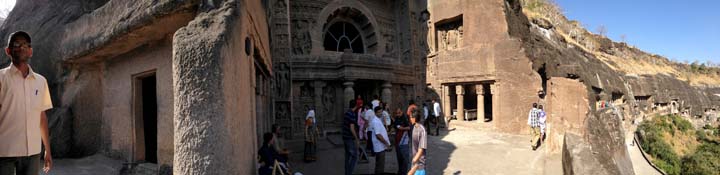
Ajanta Cave 19 facade, with courtyard, porch, arched window, adjacent shrine rooms. Near Aurangabad, India
The caves are unbelievable feats of engineering, excavated in one piece from top to bottom. All of the elements named above, including statuary and shrines, bar-reliefs, every detail from pillars to doorjambs and window frames, are carved from single, solid rock! No kidding, they are purely constructed by the removal of material. From an artist’s point of view, this is dealing with negative space as much as positive space. Think of what’s not there in order to see what is there.
Panoramic view of Ajanta Cave 26, IndiaApse and barrel vaulted ceiling, carved details on frieze, columns, capitals, and stupa. Ajanta Cave 19, India
Now add to this the fact that in many of the caves, every surface, nook and cranny, was carefully plastered and sanded to a smooth sheen, then exquisitely painted with refined colors to depict scenes of Buddha’s life, Jataka tales, bodhisattvas, entourages, and decorative patterns.
A testimony of skill and artistry, and considered to be the beginning of classical Indian art, no wonder Ajanta Caves is a UNESCO World Heritage site.
Detail of scenes from Life of Buddha, wall paintings, Ajanta Cave 1Birds-eye view, model of Ajanta Caves, Waghora stream
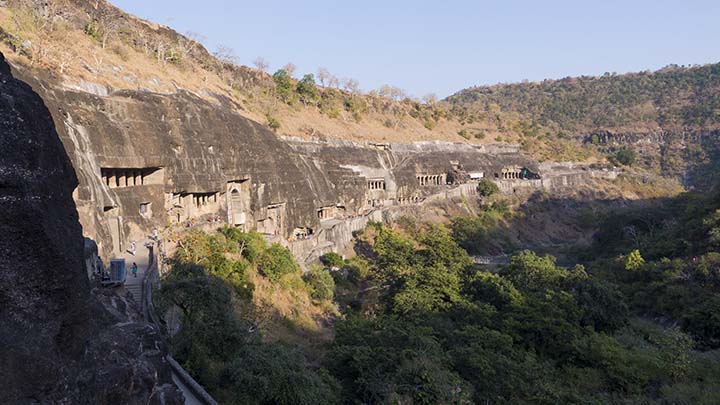
All this is nestled in a peaceful wending river valley with flowering trees. It must have been quite a place of devotion for the monastic community who lived here intermittently between the 2nd century B.C.E. to 5th or 6th century C.E.
Today, access is by road midway along the cliff, but in its day, one can imagine the serene seclusion of the site, accessed only by stairways leading from the valley floor up to the caves.
Entrance to Ajanta Caves, a UNESCO World Heritage site located in a horse-shoe shaped river valley, circa 2nd century B.C.E to 5th century C.E. Buddhist caves, near Aurangabad, IndiaAjanta Caves, a UNESCO World Heritage site located in a horse-shoe shaped river valley, circa 2nd century B.C.E to 5th century C.E. Buddhist caves, near Aurangabad, India
Of the thirty caves, five are chaityasor temples housing a stupa. These are Caves 9, 10, 19, 26, and 29, with Caves 9 and 10 being the oldest, dating to 2nd century B.C.E.
Ajanta Cave 10, the oldest chaitya or temple, 2nd century B.C.E. After centuries of abandonment, in 1819, British officer John Smith noticed its arch in the overgrown landscape while out on a hunting expedition. This led to the discovery of Ajanta Caves.
According to inscriptions, this Cave 10 was excavated with the sponsorship of Vasisthiputra Katahadi, Kanahaka of Bhada, and monk Dharmadeva. The paintings on the pillars, ceiling, and walls, rare extant examples of ancient Indian painting, were created by various devotees. Traces of Buddhist themes, designs, and Jataka Tales survive, but little remains of the chaitya’s full glory. This temple originally had a wooden interior, probably a reproduction of the interiors of freestanding wooden structures of its time. The stupa is the largest one at Ajanta.
Detail of painted ceiling at Ajanta Cave 10, the oldest chaityaDetail of painted column at Ajanta Cave 10, the oldest chaitya
Beside the chaityas, the other caves are viharas, which were monasteries with a central colonnaded gathering hall facing an inner sanctum, flanked by rows of small simple cells that were monks’ quarters. These caves were created at a later date. By scholar Walter Spink’s account, they were excavated predominantly during the Vakataka Dynasty, under King Harishena’s rule, circa 475-500. Other scholars, however, believe the viharas were built over a much longer time span than 25 years.
This later period of 5th to 6th century architecture is marked by elaborate detail, such as seen in Caves 1 and 2 (images to follow below). My favorite is Cave 26.
Panorama of Ajanta Cave 26 exterior
Cave 26 is similar to the above Cave 19, but far more richly carved and decorated. It is also larger. This chaitya consists of a central hall with colonnaded walkway or side aisles and beautifully carved walls. An inscription dated 450-525 C.E. attributes the founding of it to a monk named Buddhabhadra.
Panorama of Ajanta Cave 26 interior, chaitya with colonnaded walkway in which one can circumambulate the stupa, IndiaAjanta Cave 26 carved stupa with seated BuddhaDetail of carved stupa with seated Buddha on a lion throne, Ajanta Cave 26
I really love this graceful sculpture of Buddha in parinirvana, carved into the side wall of Cave 26.
Panorama of Buddha in parinirvana, carved on left side wall of Ajanta Cave 26View of Buddha in parinirvana along left side wall of Ajanta Cave 26
Upon entry into the left aisle, one encounters it. Here is another view of it looking back towards the entrance. Also carved here is Mara’s assault on Buddha.
Left side wall of Ajanta Cave 26, Buddha in parinirvana is seen next to the side entrance
The below right side aisle is also amply carved.
View of right side wall, Ajanta Cave 26Looking back on main entrance, Ajanta Cave 26
Cave 1 shown below is famous for its extensive and refined paintings which date circa 6th-7th centuries. Literally every inch of its interior was originally painted. The structure consists of a large gathering hall with fourteen cells on the sides, a vestibule, and inner sanctum with antechamber. Its ceiling is a massive expanse for a hypostylar hall of this type, and it is ornately decorated with colorful flora, fauna, figures, and geometric designs. As mentioned earlier, the wall paintings depict Buddha’s life, Jataka tales, bodhisattvas, and royal entourages.
Panorama of Ajanta Cave 1 facadePanorama of Ajanta Cave 1, famed for its extensive and refined paintings, including an enormous painted ceilingView of Ajanta Cave 1 looking towards the inner sanctum from its central entranceView of Buddha statue in preaching pose located in inner sanctum with antechamber, Ajanta Cave 1.
The below detail shows Buddha in his preaching mudra (hand gesture). While the carved deer facing each other on the base of the throne does not show the typical frontal view of an 8-spoked wheel of dharma (teachings) between them, this is likely a reference to Buddha’s first sermon at Sarnath, also known as the First Turning of the Wheel.
Detail of Buddha statue in inner sanctum, Ajanta Cave 1
Here is the famous Ajanta painting of Vajrapani, a bodhisattvawho represents Buddha’s power. He is usually one of the three protectors pictured on temples or monasteries. The other two are Manjushri, bodhisattva of transcendent wisdom, and Padmapani also known as Avalokiteshvara, bodhisattva of compassion.
Famed painting of Vajrapani to the right of inner sanctum antechamber, Ajanta Cave 1
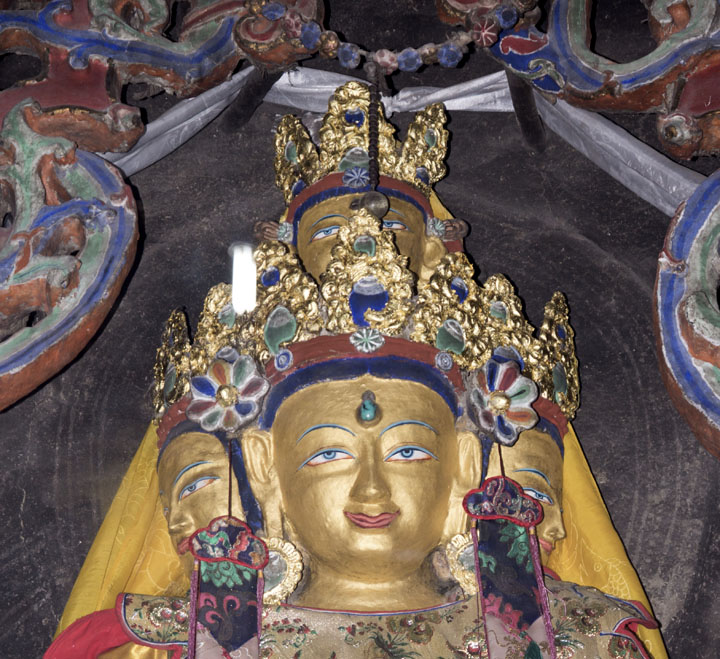
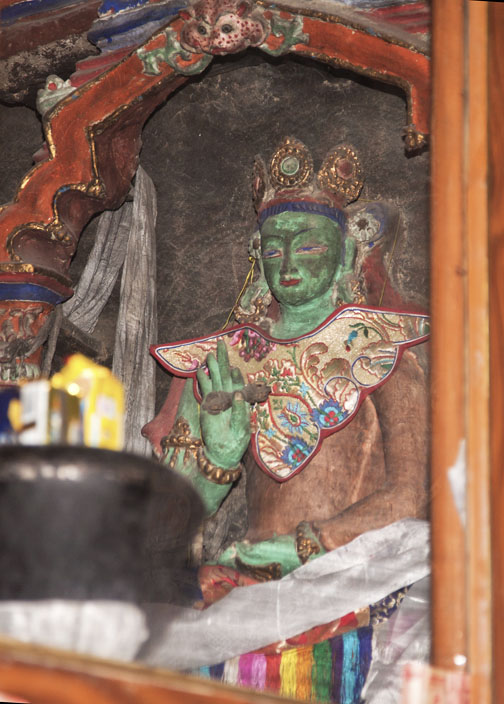
Vajrapani’s elaborate headdress reminds me of the ones I saw on bodhisattvas in Tabo Monastery’s inner sanctum shown here in a previous post. Ajanta predates Tabo by about 300-400 years.
Detail of Vajrapani whose name means “holder of the thunderbolt or diamond wisdom,” Ajanta Cave 1
And here is the other renowned image, Padmapani, the bodhisattva of compassion who is featured on the other side of the inner sanctum at Cave 1.
Famed painting of Padmapani whose name means “holder of the lotus,” located to left of inner sanctum antechamber, Ajanta Cave 1Detail of Padmapani whose name means “holder of the lotus,”Ajanta Cave 1Scenes from Life of Buddha, wall painting, Ajanta Cave 1Detail of scenes from Life of Buddha, wall paintings, Ajanta Cave 1
Really richly painted, one can only imagine how vibrant and clear all the images were over 1400 years ago when they were freshly made! And what an impact they must have made on those living here in quiet seclusion contemplating the teachings so beautifully and abundantly expressed.
Panorama view of wall painting, Ajanta Cave 1Carved capitals with animals and figures, also visible is painted ceiling, Ajanta Cave 1Detail of deer on carved capital, Ajanta Cave 1. Traces of smooth plaster can be seen. It once covered all surfaces because this was the prepared ground on which all painting was done .
I really appreciate that the artists dedicated themselves to creating fine work everywhere. The vast ceiling of Cave 1 is painstakingly executed with the same level of refinement and delicacy found in the wall paintings. Despite being rather high, and considering that most viewers would not be able to discern the details in low lighting, the artists did not slacken their skills.
Detail of painted ceiling with flora, fauna, figures, and geometric designs, Ajanta Cave 1
I like the grace of this delightful small ceiling panel. It probably only measures 5 x 8 inches at most. Everything from its lyrical design to colors and brushwork, its play on symmetry, form, line, composition, contrast, is so well done. And this is just one example of excellence from an entire ceiling that covers easily an estimated 70 x 70 feet, 1400 square feet in total area! That is a lot of space to paint on this level.
Detail of painted ceiling panel with animals, Ajanta Cave 1
I also found it interesting that similar to the ceilings of later 10th century Indo-Tibetan monasteries, the imagery is non-religious. At Lhalung Monastery, for example, where I visited and wrote about here, the coffered ceiling of its Golden Temple is entirely painted in geometric designs. Perhaps artists followed a precedent set here at Ajanta.
Detail of painted ceiling with flora, fauna, figures, and geometric designs, Ajanta Cave 1
Ajanta Cave 2 is the other one well-known for its well-preserved murals. I’ll only show a few details here to give an idea of it. Truly, one has to go to Ajanta in person to experience the eye-popping ancient wonder of it!
Panorama view of Ajanta Cave 2Painted ceiling, Ajanta Cave 2Detail of ceiling painting, Ajanta Cave 2Inner sanctum and antechamber with unusually carved asymmetric capitals, Ajanta Cave 2Detail of inner sanctum and antechamber, Ajanta Cave 2Detail of unusually carved, asymmetric capital on this inner sanctum antechamber column, Ajanta Cave 2
The Vakataka Dynasty, Buddhist devotees who predominantly sponsored the creation of the Ajanta Caves, overlapped with the great Gupta Empire. According to UNESCO World Heritage website, the “decoration attained at this time an unequalled splendor…the statuary is numerous…the wall painting, profuse and sensitive, constitutes, no doubt, the most striking artistic achievement of Ajanta. Under the impulse of the Gupta dynasty, Indian art in effect reached its apogee…The refined lightness of the decoration, the balance of the compositions, the marvelous beauty of the feminine figures place the paintings of Ajanta among the major achievements of the Gupta and post-Gupta style and confer on them the ranking of a masterpiece of universal pictorial art.”
I’ve highlighted some of the best caves at Ajanta, though many were left unfinished. It is said by scholar Walter Spink that this was due to the political interruption and unrest that followed when Vakataka King Harisena suddenly died in 500 C.E.
View from entrance of the incomplete Ajanta Cave 24. Its floor was not yet leveled out before abandonment.
What followed was relatively quick and permanent abandonment of Ajanta Caves not long afterwards. When social and political conditions favored once again the sponsorship and excavation of devotional caves, new ones were created at Ellora about 106 kilometers away. Yes, I went there, too! Coming soon will be incredible photos from this site!
The unfinished Cave 24 was fascinating to see because it gave insight on how the caves were excavated. This is a view looking down what would have been the left side aisle of the vihara. The columns are only partway hewn and the depth of the floor is still to be determined, whereas the ceiling appears smooth and complete. This is strong evidence that building a cave at Ajanta was indeed done from top to bottom.
View from what would be the left side aisle of the incomplete Ajanta Cave 24
Talk about positive and negative space! It’s so plain to see here what has to still be taken away in order to “build” the remaining architecture. The columns and their capitals are in process here, as is the floor of the main hall.
View of right side columns in process of excavation at the incomplete Ajanta Cave 24
Chisels marks can clearly be seen on this column in-the-making.
Detail of right side column in process of excavation at the incomplete Ajanta Cave 24. Its capital and final shape are yet to be defined and chisel marks are clearly seen.
When you think about this being the early state of Ajanta caves before they are completed into their finely carved and painted glory, it’s humbling. So much ancient skill and artistry, so much vision and dedication!
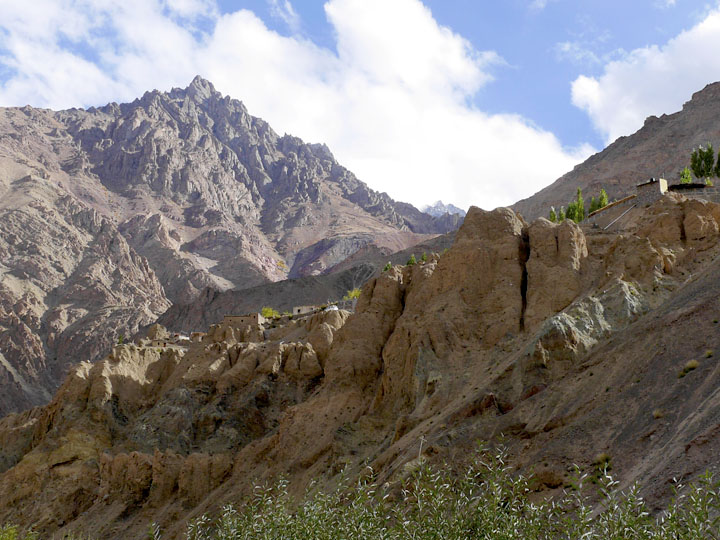
View of Mangyu Village, Ladakh, India. To get there, one drives through narrow valley gorges. The village remains hidden until you drive practically right up to it.
Like Lamayuru Monastery’s Indo-Tibetan Senge Lhakhang, Mangyu Monastery’s Vairocana temple is also a small intimate place. Classic, pre-13th century, early period architecture, the site is nestled in and integrated with a village as opposed to fortified and atop on a hill from the community.
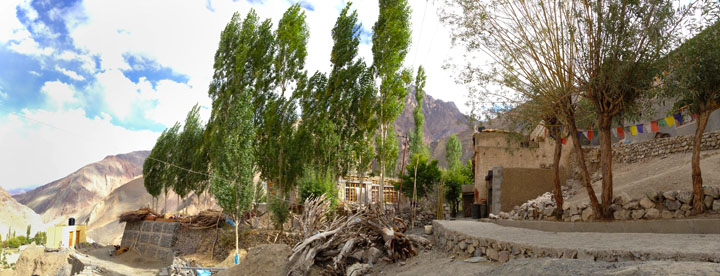
Beginning of Mangyu Village, Ladakh, India
I believe that up till fairly recently, let’s say last twenty years, there was no motorable road up to Mangyu Village, which means it was largely isolated and unknown by travelers. We parked a little below the village and walked up to the monastery, passing by small grocery stores that had countertop service for a simple meal of packaged and flavored maggi noodles (what we call ramen noodles in the U.S.) I was starving and grateful to be served one! When traveling around these more remote parts, one never knows where and what the next meal may be. This village had no restaurants or dhabas, nor did I see guesthouses. This is lovely because it indicates that tourism hasn’t bloomed here. Mangyu is pristine for this reason.
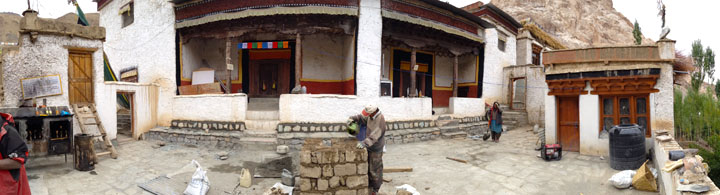
Panorama of Mangyu Monastery with Chenrezig Lhakhang on left, Nambarnangze (Vairocana temple) on right, together flanked by Chamba Lhakhangs of Maitreya and Jambeyang sculptures, Ladakh. Workers are making repairs under the auspices of INTACH, the Indian National Trust for Art and Cultural Heritage.
Tourism is a challenge to local and modest communities here in the Himalayas. While it brings income, it also brings ecological stress. And ecological stress is no small thing to cope with when the land is semi-arid and mountainous, the people mostly poor, the government ill-equipped to provide adequate infrastructure. The need for food and water sources, sewage, sanitation, and modern transportation to serve tourists often ravage the natural beauty here.
Especially if it brings non-biodegradable garbage like plastic. It’s very upsetting to see packaging or other plastic objects thrown over the side of a Himalayan mountain or floating through the streams, stuck in rocks. Indeed, the Himalayan areas I’ve traveled to have dumps located on the mountain side. You can often see them along the road while driving on the highways. It will be a sudden burst of packaging color en masse among the earthy rocks and otherwise scenic beauty. It’s either this or shopkeepers and townsfolk simply burn the garbage. Yes, they burn it, open-air, in front of their shops or homes, frequently plastic and all.
Plastic bottles and those plastic carton drink containers, potato chip and candy wrappers are the most noticeable litter in the streets. I sadly think, these things will never degrade into anything that can be absorbed properly here. Nor anywhere on Earth for that matter, but since we are here on the topic of the Himalayas, my point is that tourism causes environmental strain and damage. I always ask for boiled water at hotels to cut down on the plastic, and carry a thermos with me. Of course, on some occasions, I can’t avoid it and will guiltily buy water in a plastic bottle.
But my visit to Mangyu Monastery was not one of these occasions, I’m happy to report!
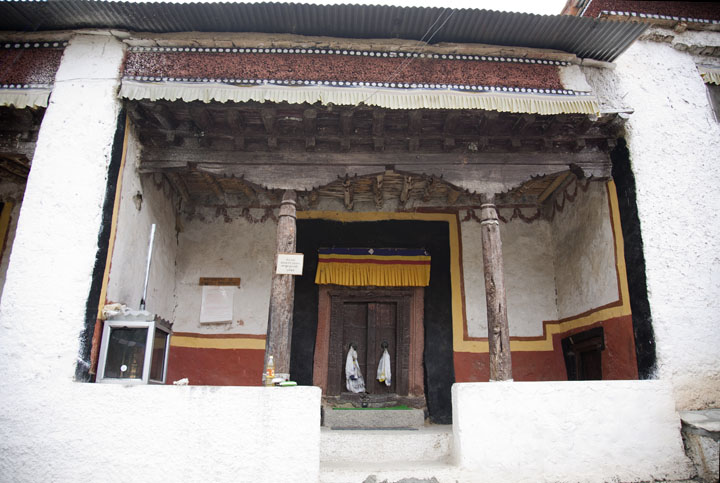
Entrance to Nambarnangze (Vairocana temple), ca. 11th century Indo-Tibetan early monastic architecture, Mangyu Monastery, Ladakh. Photo: Kishore Thukral
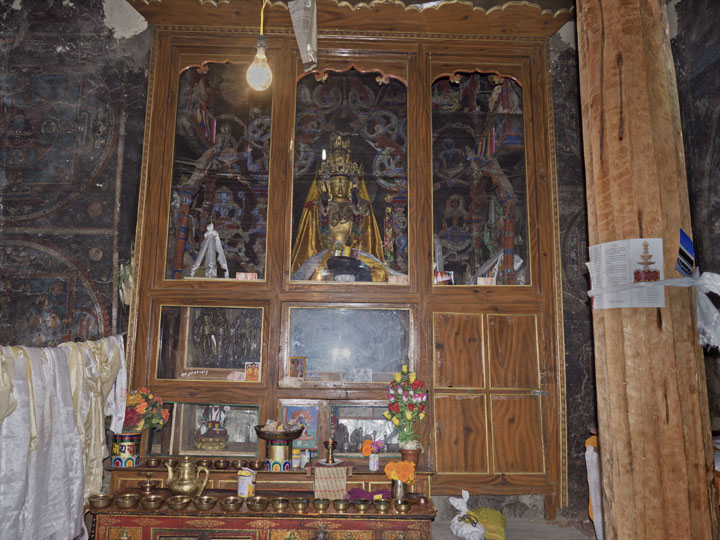
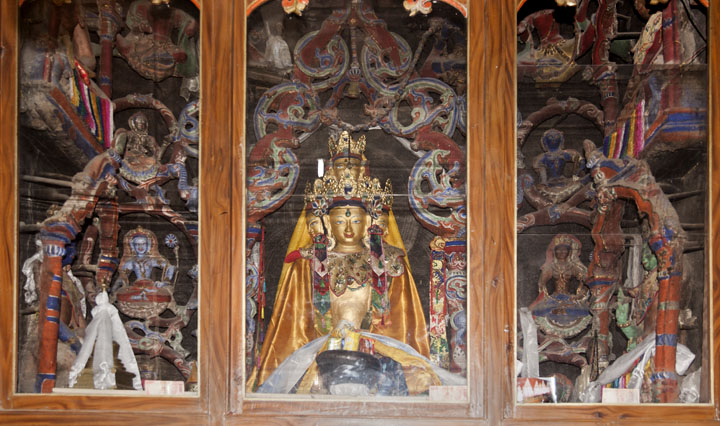
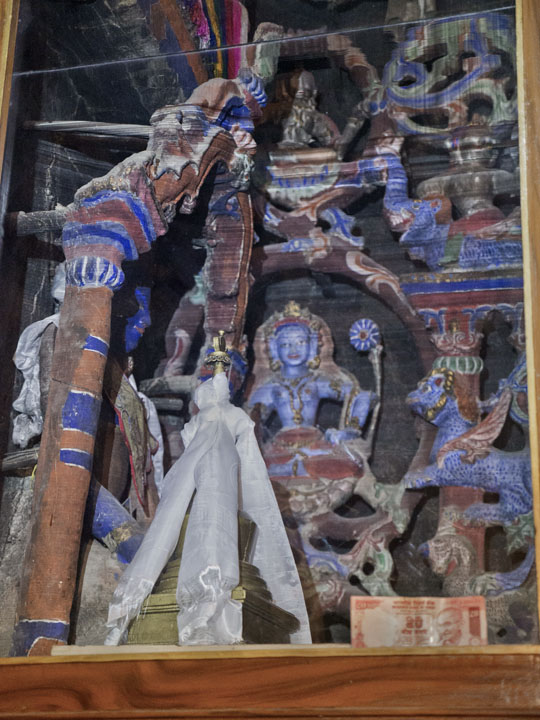
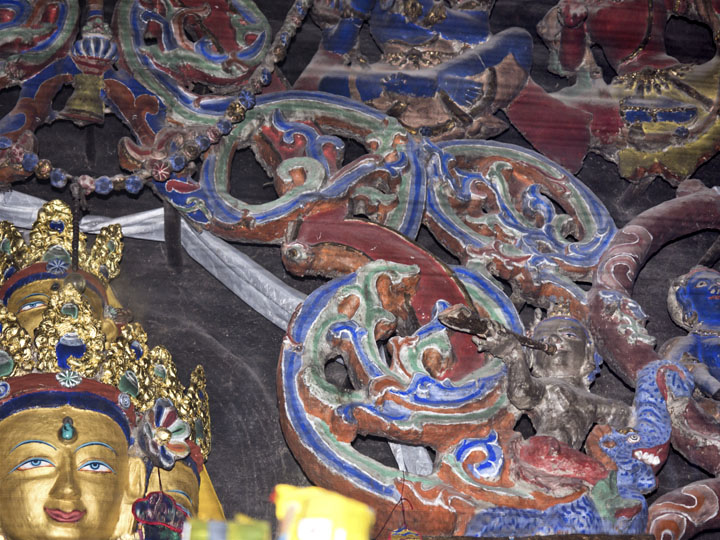
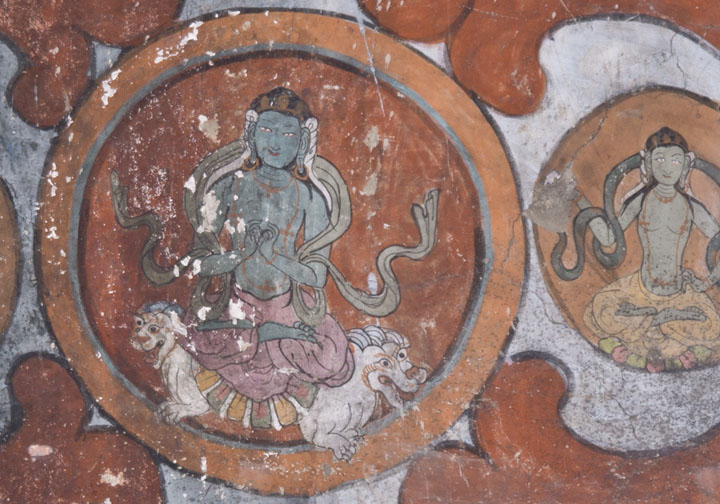
In the 11th century Indo-Tibetan tradition of The Great Translator Rinchen Zangpo, this altar in Nambarnangze once again features Vairocana in the center, surrounded by the Dhyani Buddhas, offering goddesses, animals, and ornate scrollwork, topped by a garuda. See floor plan here.
Experience the interior of this rare, medieval Vairocana temple by seeing a walk-through video here.
View of Nambarnangze interior, with Indo-Tibetan clay sculptures and wall paintings. The altar is now unfortunately encased by glass making it difficult to see the fine craftsmanship of Kashmiri artists, ca. early 11th century, LadakhIndo-Tibetan clay sculptures of Vairocana and Dhyani Buddhas of altar, Nambarnangze, Mangyu Monastery, Ladakh. Now unfortunately encased by glass, making it difficult to see the fine craftsmanship of Kashmiri artists, ca. early 11th century, Photo: Kishore Thukral
For further info on Vajradhatu Mandala structure upon which early monasteries of this period were based, see this post on Lamayuru Monastery’s Senge Lhakhang and this one on the celebrated Tabo Monastery’s Tsug Lhakhang.
Detail of Vairocana Buddha sculpture, ca. 11th century, altar of Nambarnangze, Mangyu Monastery, LadakhDetail of ornate scrollwork, animals and offering goddesses, rare 11th century Indo-Tibeta clay sculptures, altar of Nambarnangze, Mangyu Monastery, Ladakh, IndiaDetail of Vairocana Buddha, with ornate scrollwork, animals and offering goddesses, rare 11th century Indo-Tibetan clay sculptures, altar of Nambarnangze, Mangyu Monastery, LadakhDetail of Amoghasiddha, a Dhyani (Supreme) Buddha, rare 11th century Indo-Tibetan clay sculpture, altar of Nambarnangze, Mangyu Monastery, Ladakh. Photo: Kishore Thukral
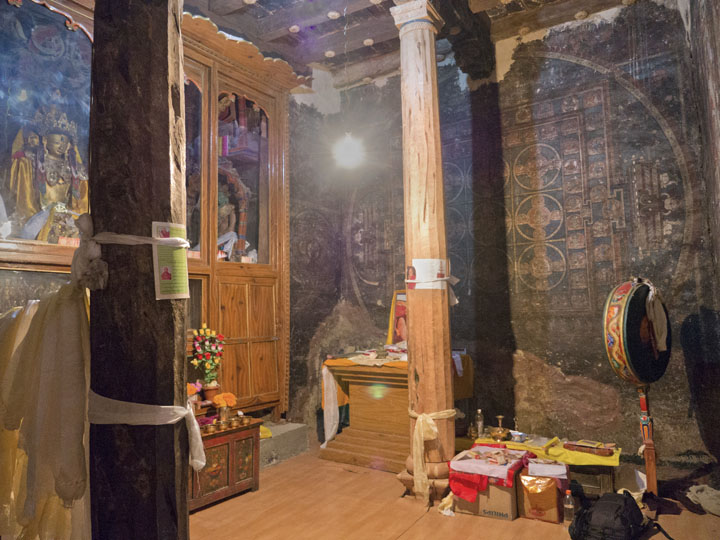
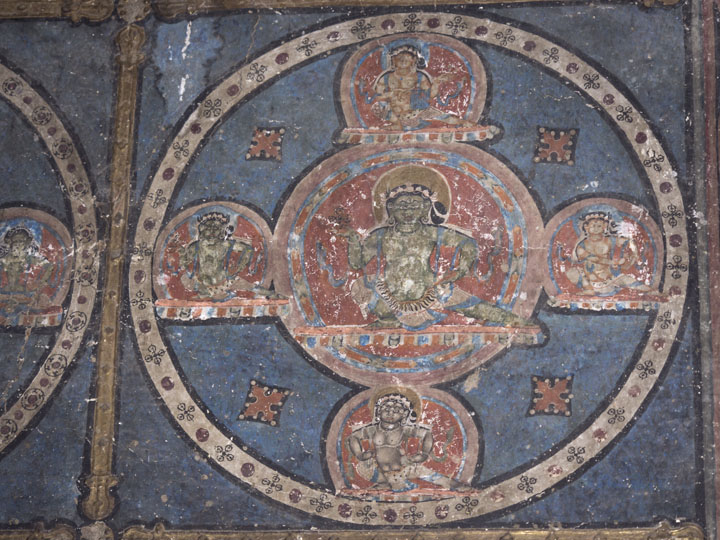
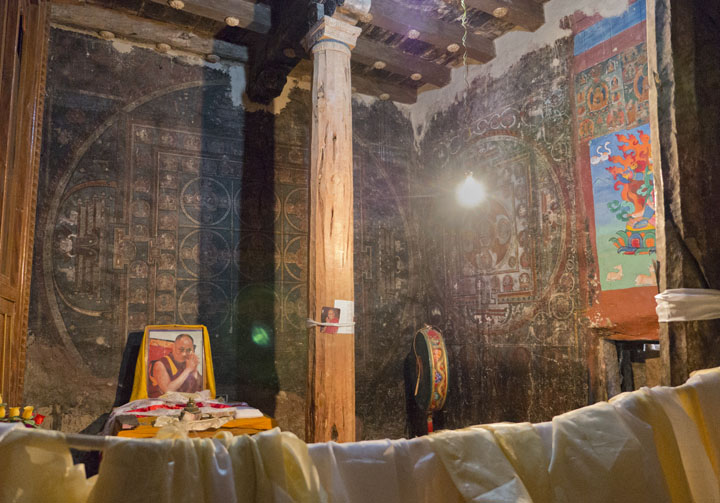
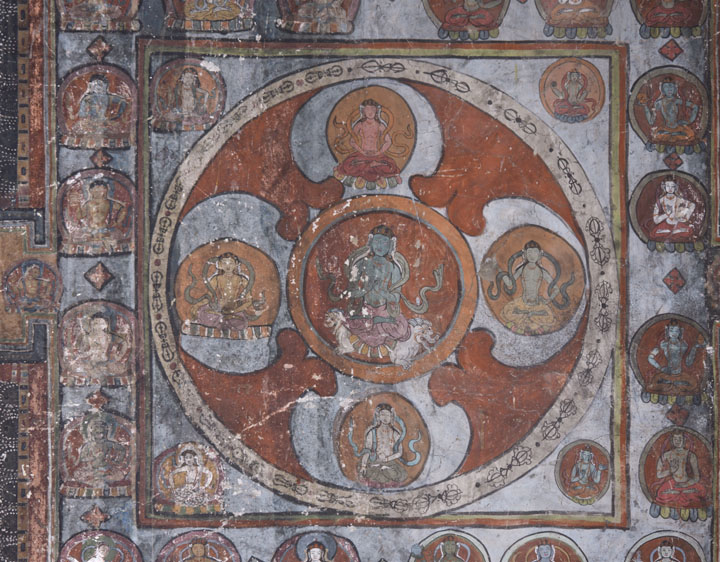
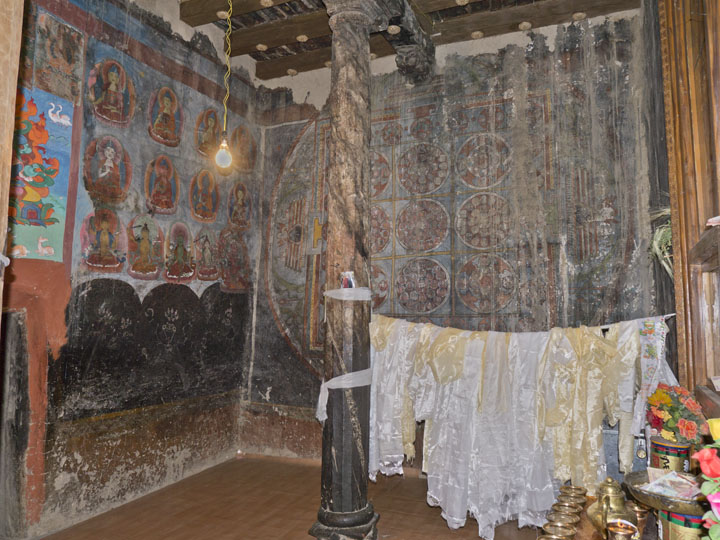
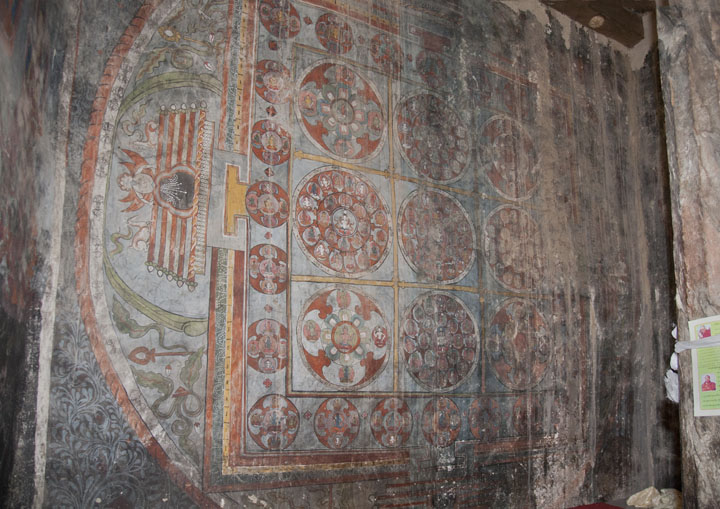
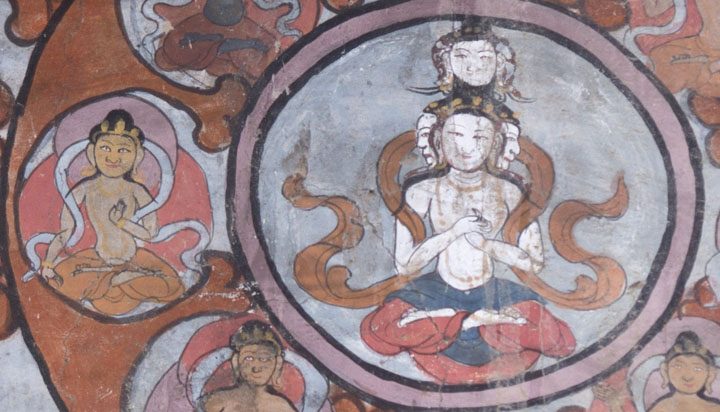
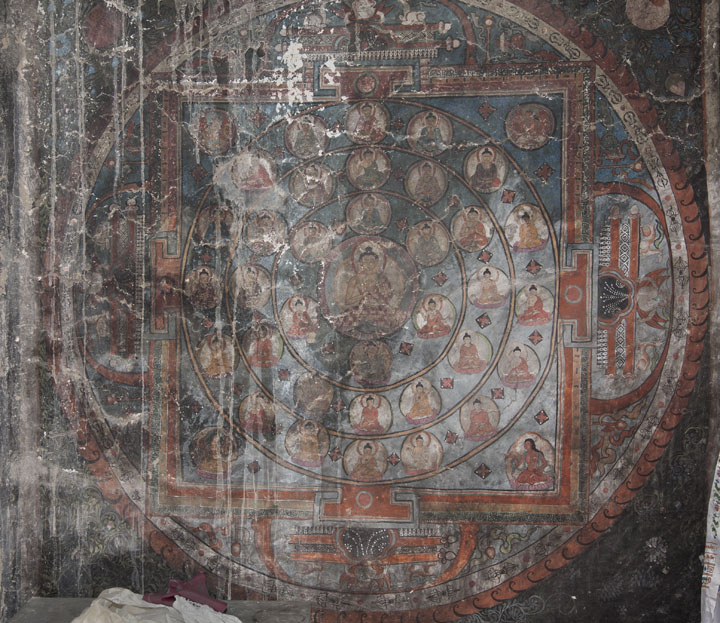
The small Vairocana temple is symmetrically painted on its left and right side walls with one large central Vajradhatu mandala each, flanked by smaller mandalas of related divinities or protectors. On the right side wall, the paintings look like well-conserved oe well-preserved original Indo-Tibetan.
Interior of Nambarnangze, Mangyu Monastery, with ca. 11th century Indo-Tibetan sculptures and wall paintings, Ladakh. Visible on right is Vajradhatu Mandala.Detail from Vajradhatu mandala, Indo-Tibetan ca. 11th century right side wall painting, Nambarnangze (Vairocana temple) of Mangyu Monastery, Ladakh, IndiaDetail from Vajradhatu mandala, Indo-Tibetan ca. 11th century right side wall painting, Nambarnangze (Vairocana temple) of Mangyu Monastery, Ladakh, IndiaInterior view of Nambarnangze, right side wall adjoining entrance wall, Mangyu Monastery, with ca. 11th century Indo-Tibetan wall paintings, Ladakh
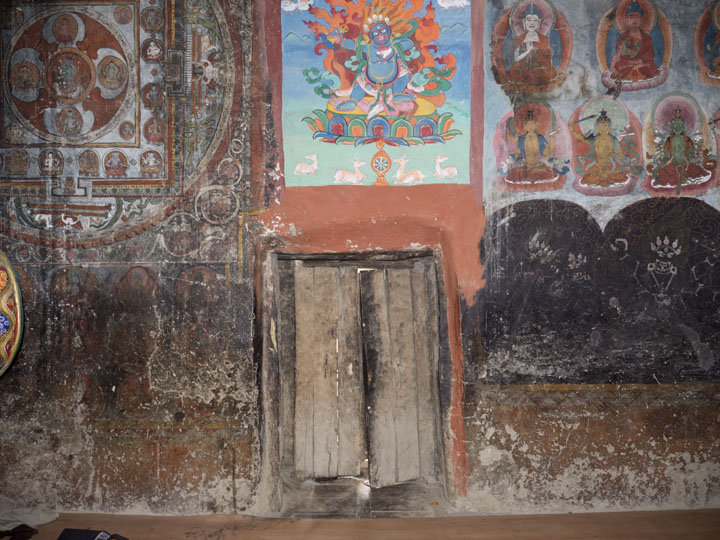
On this entrance wall, however, most everything has been repainted. Peter van Ham in his book Heavenly Himalayas: The Murals of Mangyu and other Discoveries in Ladakh, published recently in 2010, gives a very different description of the state of the protector deity painting above the door.
The entrance wall of Nambarnangze, Mangyu Monastery, Ladakh. Wall paintings here are mostly repainted over ca.11th century originals.
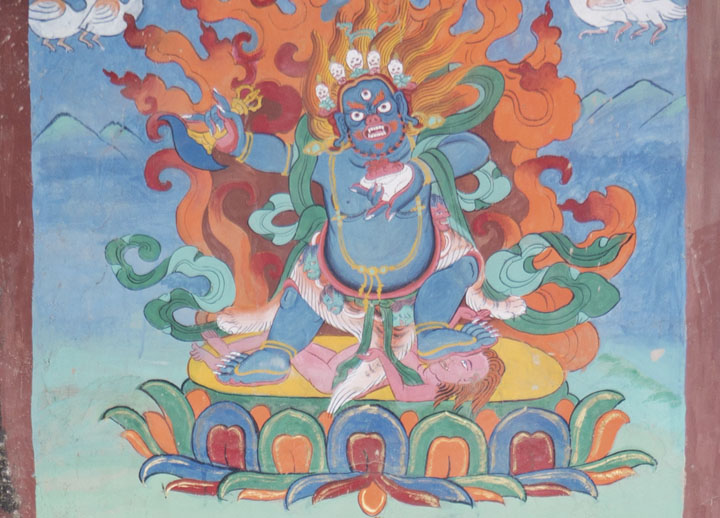
He writes, “The entrance…is protected by a wrathful blue deity, painted above the door. Only the right half of the painting has been preserved, the rest has been washed away by water leakage through the roof…As two peculiarities the protector is adorned with beautiful shawls displaying typical Ladakhi tie-dye patterns and in his right hand he holds a knife with an interesting blade of Indo-Iranian shape, the tip of which is equipped with a vajra-like structure.”
Repainted Mahakala above entrance door of Vairocana Temple, Mangyu Monastery, Ladakh.
The discrepancy between van Ham’s description and the above photo shows that this Mahakala was certainly repainted in the last few years. As we can see, absent are the shawls with Ladakhi patterns. This evidence, along with mismatched colors and less refined execution, leaves me shocked and deeply saddened over the handling of Mangyu Monastery preservation.
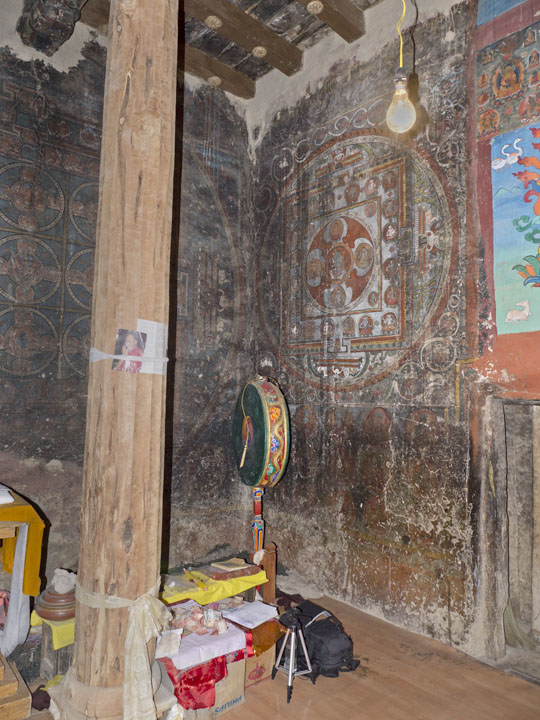
While the colors in this repainted mandala on the left of this entrance wall are more in keeping with extant original murals, the execution looks nothing at all like the sophisticated, skillful, and expressive handling of Indo-Tibetan artists.
Interior view of Nambarnangze, Mangyu Monastery, with Indo-Tibetan wall paintings, LadakhDetail of repainted mandala on left side of entrance wall, Nambarnangze, Mangyu Monastery, LadakhDetail of repainted mandala on left side of entrance wall, Mangyu Monastery, Ladakh. Stylistically different, this was probably repainted in recent years.Detail of repainted mandala, Nambarnangze, Mangyu Monastery, Ladakh. Stylistically different and lacking in refinement, this is strong evidence of repainting over original Indo-Tibetan art.
The same is true for the left side wall. What van Ham describes of the 11.5 foot diameter mandala that dominates this wall does not match what currently exists. This must also be a recently repainted mandala.
View of Vajradhatu mandala on left side wall, adjacent to a variety of wall paintings that post-date the Indo-Tibetan period, another example of repainting that threatens the survival and art-historical importance of the originalsView of Vajradhatu mandala, also repainted, Nambarnangze, Mangyu Monastery, Ladakh. Photo: Kishore Thukral
When this is what an example of original quality and style looks like (click on second image on the bottom) the quality and style of this repainted example pales in comparison.
Detail of repainted Vajradhatu mandala, Nambarnangze, Mangyu Monastery, Ladakh. Once again, stylistic and quality differences indicate repainting over Indo-Tibetan originals.
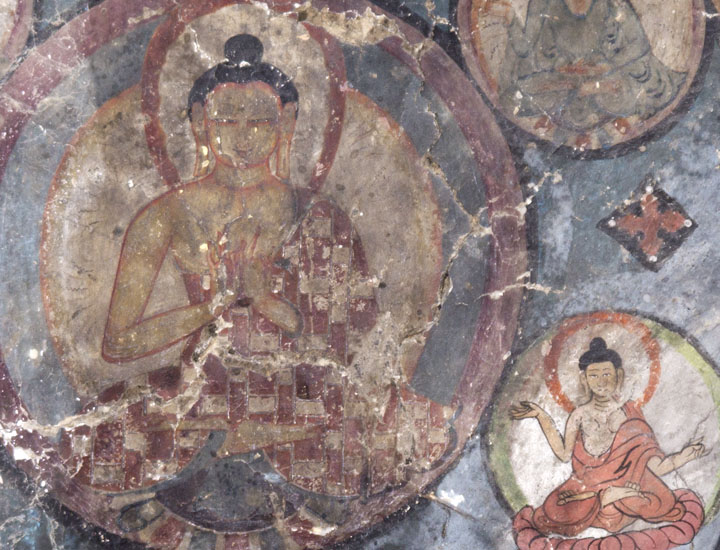
This small Buddha mandala is on the left of the altar wall. It contains some original and repainted areas.
Buddha mandala, Nambarnangze, Mangyu Monastery, Ladakh. Stylistic and quality differences indicate repainting over Indo-Tibetan originals. Photo: Kishore Thukral
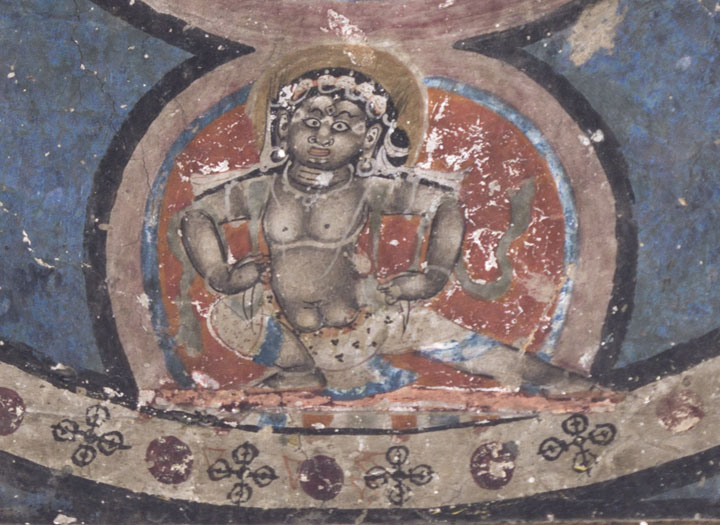
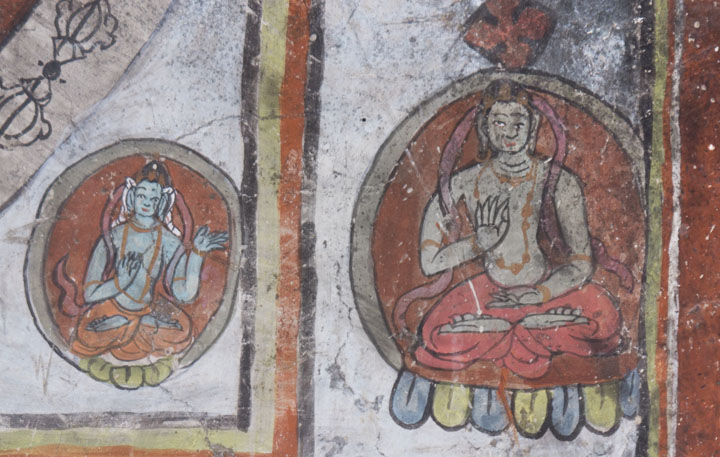
Here is a side-by-side view of what appears to be an original Indo-Tibetan Buddha in center next to a contemporary repainted one.
Detail of Buddha mandala, Nambarnangze, Mangyu Monastery, Ladakh. The central Buddha looks original, but at lower left, stylistic and quality differences indicate repainting over Indo-Tibetan originals.
The historian David Snellgrove wrote in Indo-Tibetan Buddhism: Indian Buddhists and their Tibetan Successors, “The absence of all Buddhist wall-painting in India apart from the Ajanta Caves represents an enormous loss for the history of Indian art. Some deductions can be made from fragmentary remains in Central Asia and especially from the earliest surviving Tibetan murals from about A.D. 1000 onward, and from miniature paintings on Pala manuscripts of about that date.”
While Mangyu may still be pristine from a tourist/environmental point of view, it is less so from an art-historical one. Like I fear for Tabo, Alchi, and other remaining monasteries that have Indo-Tibetan significance, these beautiful, rare wall paintings are disappearing not only through age and exposure to natural elements, but also through the unexpected hands of man. The resultant replacement paintings, lacking in comparable quality, style, etc., are functionally erasing historical records. The originals are thus disappearing over time due to lack of proper conservation and restoration.
Tabo Monastery: Himalayan Setting and Meditation Caves
Posted
Sept 6th, Tabo Village, the Spiti adventure continues…
Tabo Village, where Tabo Monastery is nestled in Spiti Valley unlike other Buddhist monasteries that were built as fortress-like compounds on hilltops
Well, here we are in Tabo! The famed Tabo Monastery is known as the oldest continually functioning Tibetan Buddhist monastery, the art of which the Dalai Lama said “delightfully expresses the vigor of the transmission of Buddhism from India to Tibet and the dynamic mingling of cultures.” Established in 996 C.E. by the Buddhist king of Guge in Western Tibet, Yeshe O’d, and the The Great Translator Rinchen Zangpo, it flourished in a golden epoch of Indo-Tibetan collaboration in spreading Buddhist culture.
Tabo Monastery complex behind stone walls in Tabo Village, Spiti Valley, India
Tabo’s existing sacred artwork and architecture have unique historical significance, not only for the aesthetic evidence of such cultural exchange, but also for its rarity. Due to the enormous destruction during the Chinese Cultural Revolution, where over 6000 monasteries and their artworks were destroyed between 1959-61, practically none of the early examples of Buddhist culture have survived in Tibet. Consequently, the monasteries of the Western Himalayan border areas of Spiti, Lahaul, and Ladakh, once part of Tibet, is of great importance for its legacy of early Tibetan Buddhist culture, and in particular, its connection with India.
Street view of entrance to Tabo Choskhor,Spiti, with the museum and library in building on rightUpon entering Tabo Monastery complex, the first building one sees is Tsug Lhakhang, the grand main assembly hallThe Tsug Lhakhang, Tabo Monastery, Spiti
Of the monasteries I’ll visit, Tabo, Alchi, Mangyu, Lamayuru, and Lhalung strike me as being of special importance. These have exceptional murals, unusual in cross-cultural style and depiction, executed in astounding refinement, with ornate clay sculptures that are cantilevered off the walls in Vajradhatu mandala arrangement of sacred space (more on this in the next post!) This type of work is specific to the area and is not found in any other Buddhist temples in the world. These monasteries also date back to that fertile period of Buddhist philosophical exchange and revitalization from India to Tibet beginning in the 10th century during The Great Translator Rinchen Zangpo’s time.
Documenting the extant artwork and architecture of these sites is essential because they are remarkable, and extreme Himalayan winters and potential earthquakes, such as the one that occurred in 1975, continue to threaten their survival. Proper conservation and restoration is critical for art history and posterity. Of immediate concern is the effects of climate change and increased rainfall in the normally more arid Spiti that has damaged Tabo’s murals and architecture. This 2010 article entitled “A Monastery’s Fading Colours,” published in The Indian Express, is about the challenging circumstances facing the monastery’s care under the maintenance of the Archeological Survey of India (ASI). The Times of India recently questioned the national organization’s general efficacy in its article, “92 ASI-protected Monuments Missing.”
Rear view of Tsug Lhakhang with workers currently repairing the mud exterior. Its back walls are as thick as 2.5 meters!Workers currently repairing the mud exterior of Tabo Monastery, Spiti
I find myself wishing these monasteries were designated UNESCO World Heritage sites, such as the early Buddhist Ajanta Caves are in India, or considered World Monuments. Perhaps this would bring more international attention and expertise to help hasten the appropriate preservation and protection against man-made as well as environmental challenges.
Fortunately, I was able to arrive in Tabo with all my equipment fully charged because the electrical power was mostly on during my previous night in Kaza, Spiti. But unfortunately, I was unable to photograph due to administrative details still to iron out. Perhaps by tomorrow, after the special 6:00 a.m. morning prayers for the recently deceased and venerated abbot of Tabo which will be performed as part the traditional 49 days’ observance. Despite not being able to photograph, the monk in charge of the monastery kindly showed me most of the temples in the complex.
What is so immediately striking is the contrast between the simple exterior architecture of mud brick and the resplendent interiors. Wow, the ornate interiors leave you speechless, what treasures of Indo-Tibetan art, history, and philosophy! Especially the dramatic, dark, moody, pensive main assembly hall (Tsug Lha-khang); the older Dromton Temple (Brom-ston Lha-khang), founded by the main disciple of the great teacher and adept Atisha; Initiation Temple (dKyil-kHor-khang), where monks are initiated; BodhisattvaMaitreya Temple (Byams-Pa Chen-po Lha-khang), with a 20 foot high painted mural of the future Buddha Maitreya; and the Golden Temple (gSer-khang).
View of Tabo Monastery complex showing Dromton Temple on far right and Bodhisattva Maitreya Temple left of it, Spiti, India
Oh, news flash! For incredible floor plans of these temples, including elevations, sections, 3D models, photo montages, and more, see this excellent website of an Austrian research team at Graz University of Technology that has been studying the architectural heritage of the Western Himalayas.
And did I mention caves? Yes, caves on a steep cliff above Tabo Monastery and village where, according to archeological evidence, monks had lived and practiced meditation since the 11th century. Now it is an ASI protected site. Most caves are open spaces showing evidence of ancient occupation–sooty interior walls and carved out niches, etc., as well as perhaps picnic use by modern visitors. But while exploring with my flashlight, I peered into an opening of a small closed door of a dark cave only to find a blanched seated figure looking back at me! Startled and flustered, realizing this was a real person and not a phantom, I muttered a quick, deepest apology, and left in a hurry! Well, I guess today there are still some practitioners who retreat to these caves. Whether this was a tourist trying it out, or a yogi, I have no idea.
Path to numerous caves above Tabo Monastery and village, Spiti, IndiaOne of numerous caves carved into the cliffs above Tabo Monastery, used by monks from the 11th century on, SpitiView of Tabo Monastery from inside a cave, Spiti
Have a virtual walk-through here of the insides of some of these caves:
View of the inside of the above Tabo cave, SpitiView of Tabo caves located on a steep cliffside above Tabo Monastery, SpitiView of Tabo Village from cave sites, Spiti, India
Ok, I hope I have a headache-less night’s sleep tonight. Day four at high altitude and I’m still adjusting, but Tabo is at about 10,000 feet high, 2000 feet lower than Kaza, so it should be better. Need to get up early to make it to 6am puja!
This is not an official U.S. Department of State website. The views and information presented here are solely those of the artist, and do not represent the Fulbright Program, the Department of State, or any other entity.