Alchi Monastery

Breathtaking Alchi Monastery

September 24, 2013

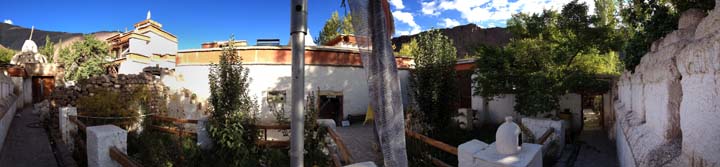
Panorama of Alchi Monastery, Ladakh, India

And what about Alchi? Famous Alchi Monastery, which contains some of the most beautiful and beguiling Buddhist art and iconography from the Indo-Tibetan world.

Indeed, I did visit Alchi, said to be founded by the legendary Great Translator Rinchen Zangpo (958-1055 C.E.) However, I was unable to get permission to study its interiors more closely and document. Despite having some strong letters of support, time and other circumstances conspired against the process when I arrived with only a small window of opportunity to work. After all, it takes time to sort these things out. One Indian friend of mine quipped, “I.S.T.,” which he said stands for Indian Stretchable Time as opposed to Indian Standard Time.

So, I will here share what I have–mostly vignettes of Alchi, some exterior photographs, along with interior images from others who have studied and accessed Alchi.

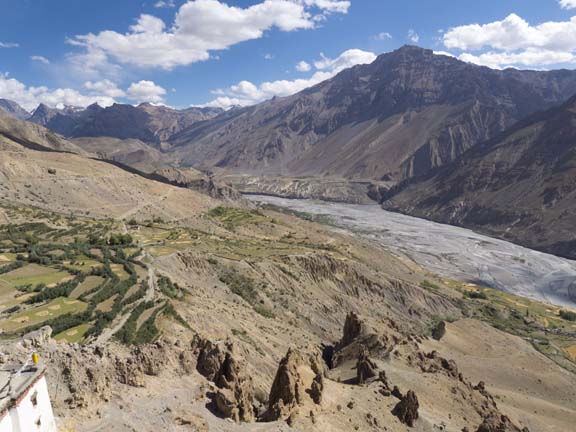
Like Tabo Monastery, Alchi Monastery’s complex is located in a river valley, integrated with its village. This is typical of earlier phase Himalayan monastic architecture, versus the later phase post 12th century, in which monasteries were fortified and built up on a hill.

Located about 67 kilometers west of Leh in Ladakh region, at 10,500 feet altitude, Alchi contains six temples as well as three painted gateway stupas.

Gateway stupa, Alchi Monastery, Ladakh, India
Gateway stupa, an unusual feature of Alchi Monastery, Ladakh, India

The three oldest temples are the Assembly Hall or Dukhang, also known as the Vairocana Temple; the Sumtsek, named for its recognizable three-storied building; and the Manjushri Temple. These buildings are dated from approximately mid-12th to early 13th century. In addition, there are other chörten and temples built during the 13th and 14th century. Many of these are visible along the circumambulatory surrounding the complex.

Floor plan of Alchi Monastery complex, Ladakh, India
Site map of Alchi Monastery complex, Ladakh, India

As you can see from the above site map and aerial photos, the temples are built close together, basically along a single axis, with other structures surrounding them in proximity. Narrow views are generally all one can photograph because it is difficult to get enough distance onsite.

More gateway stupas with a view of Sumtsek Temple in rear, Alchi Monastery, Ladakh, India

As it turns out, I was only able to visit the Sumtsek and the Vairocana Temple. The other temples and spaces were closed to the general public that morning.

Sumtsek Temple, Alchi Monastery, Ladakh, India
Facade of Sumtsek Temple, Alchi Monastery, Ladakh, India

The Sumtsek facade is distinguished by its carved wooden porch.

Another view of Sumtsek Temple, Alchi Monastery, Ladakh, India
Another view of Sumtsek Temple, named for its three stories, Alchi Monastery, Ladakh, India
Detail of Sumtsek Temple, Alchi Monastery, Ladakh, India
Detail of Sumtsek carved wood facade, Alchi Monastery, Ladakh, India. Photo: Kishore Thukral
Detail of Sumtsek Temple facade, Alchi Monastery, Ladakh, India
Detail of Sumtsek facade with view of second story terrace roof, Alchi Monastery, Ladakh, India
Detail of Sumtsek Temple facade, Alchi Monastery, Ladakh, India
Detail of Sumtsek carved wooden facade, Alchi Monastery, Ladakh, India

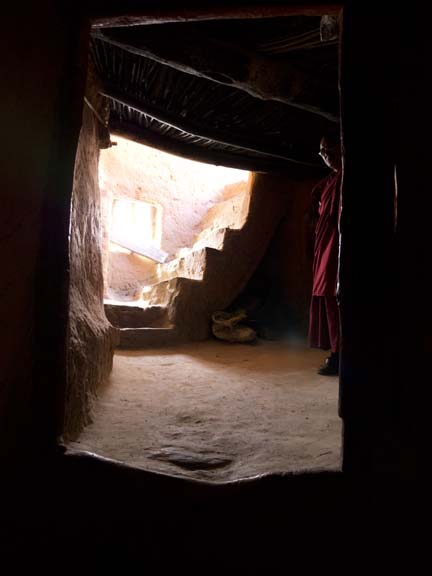
As with most other temples of this time period, one must bend down in order to enter through the small, short doorway. When you are inside the ground floor of the Sumtsek, you see three monumental sculptures in niches. They are Maitreya, Avalokiteshvara and Manjushri. See images here created by the team of researchers at Graz University.

They stand so tall at about 14 1/2 feet high in the interior architecture that their heads, in fact, reach the second floor and seem to look out at the viewer from their niches. Shown in the above link is the head of Manjushri on the second floor of the Sumtsek. A beautifully painted and richly adorned Tara stands above him, flanked by two mandalas.

I wish that I had been able to access the second floor to see this in person! Only the ground floor was open to the general public.

Judging from these photos, the upper levels had numerous mandalas, the subject of my research. One cannot see these well from the ground level given the limited sight lines .

What a pity! I was there, but could not quite get there! So close and yet so far…

This third level cupola with its mandalas would have been so golden to see.

I had to settle instead for seeing most of Alchi’s Sumtsek paintings in reproduction two months later in photographer Aditya Arya’s studios. I had the occasion to meet with him in New Delhi to discuss his project photographing “every inch” of Alchi’s interiors.

Alchi’s iconography is truly delightful to scrutinize, with its delicate drawings and imaginative compositions. I recommend you visit Arya’s website here to see some images.

I also recommend the book “Alchi: The Living Heritage of Ladakh,” a catalogue published on the occasion of The National Museum’s exhibition of Arya’s Alchi photographs in New Delhi. In it are extensive photographs and details of Alchi paintings.

I must say, however, that what I saw in his documentation of the first floor of the Sumtsek, which he photographed about five years ago, did not match a lot of what I saw onsite. As a trained painter in fine arts as well as decorative arts, I can say without doubt that alot of the apparently recent restoration work at Alchi does not do the original artwork justice. These areas are painted in a different hand and style. There is cause for concern about such results. Like I discussed in this post on Mangyu Monastery and this one on Tabo Monastery, similarly, I fear that Alchi paintings will slowly disappear by virtue of ill-conceived “restoration.”

According to the Smithsonian Magazine article Glimpses of the Lost World of Alchi, written in 2010, the concern about conserving Alchi’s murals and buildings is not new. In 1990, German art historian Roger Goepper, photographer Jaroslav Poncar and art conservators from Cologne, Germany, launched the Save Alchi Project. Some work was done, but it ended two years later due to what Goepper referred to as “growing confusion over administrative responsibility.” Or, some say, between religious and national interests.

According to the article, although “tourists now far outnumber worshipers, Alchi is still a living temple under religious control of the nearby Likir Monastery…Monks from Likir serve as Alchi’s caretakers, collecting entrance fees and enforcing a prohibition on photography inside the temples…At the same time, responsibility for preserving Alchi as a historic site rests with the [Indian] government’s Archaeological Survey of India (ASI). Relations between the ASI and the Likir monks have long been fraught. The monks are wary of government intrusion into religious matters; the ASI worries the monks will undertake restorations that damage the Alchi murals. The result is a stalemate that has thwarted conservation efforts.” Since the publication of this article, I hope the stalemate is in the process of being sorted out.

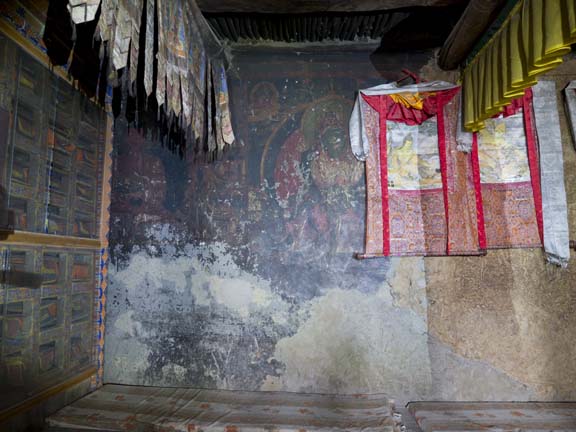
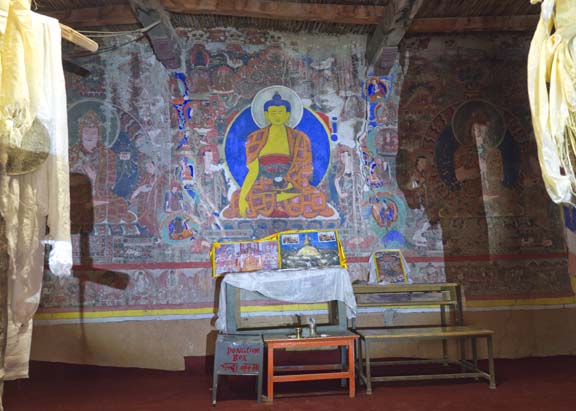
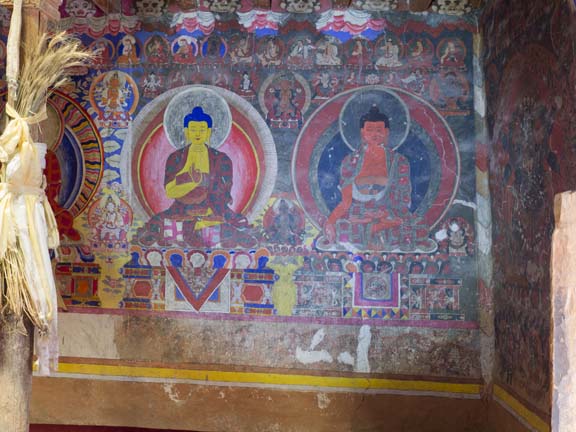
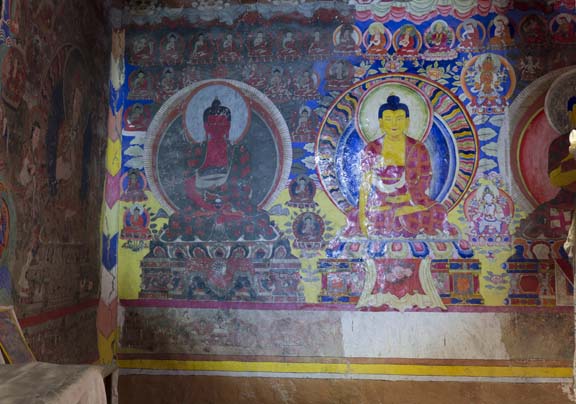
I can happily report that the wall paintings of the Vairocana Temple, which included massive mandalas, were breathtaking and well-preserved. They appeared untouched by questionable conservation efforts. OR, better yet, they are a testimony to conservation well done! I hope so.

Vairocana Temple, Alchi Monastery, Ladakh, India
Panorama of Vairocana Temple and its courtyard. At far right is the doorway to the courtyard of Manjushri and Lotsava temples, Alchi Monastery, Ladakh, India

Unfortunately, I do not have images to share here of the exquisite interior of the Vairocana Temple.

Side view of Vairocana Temple with its mountainous surroundings, Alchi Monastery, Ladakh, India

But I have a better idea. Consider getting an airline ticket to fly here and see Alchi for yourself. It’s best to experience the Himalayas in person anyway!

Truly, it’s ineffable. There are no words or images that can convey the exhilaration and revelation of being in the grandeur of the Himalayas.

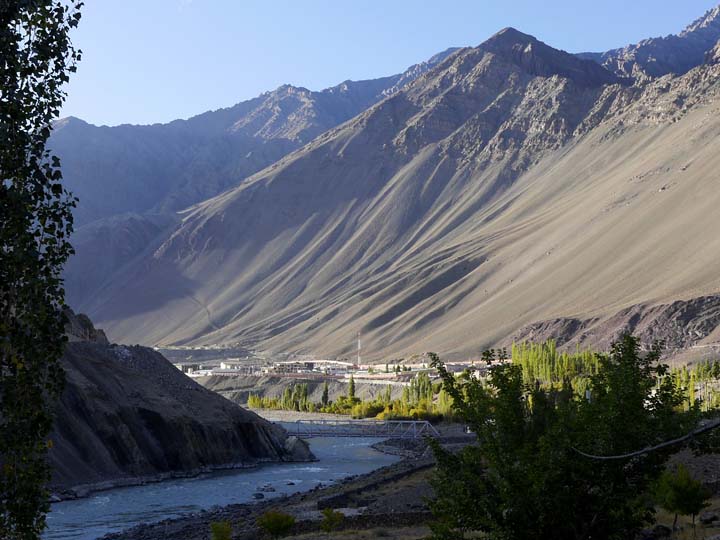
View of Alchi Monastery circumambulatory by the Indus River, Ladakh, India
View of Alchi Monastery circumambulatory with prayer flags by the Indus River in early morning light, Ladakh.
Himalayan mountains and the Indus River Valley as seen from Alchi Monastery circumambulatory, Ladakh, India
Himalayan mountains and the Indus River Valley as seen from Alchi Monastery circumambulatory. A border area, Ladakh has high military presence, such as this military compound in the distance.

All photos © 2013, Eva Lee.

Tabo Monastery: Himalayan Setting and Meditation Caves

Sept 6th, Tabo Village, the Spiti adventure continues…

Tabo Monastery within Tabo Village
Tabo Village, where Tabo Monastery is nestled in Spiti Valley unlike other Buddhist monasteries that were built as fortress-like compounds on hilltops

Well, here we are in Tabo! The famed Tabo Monastery is known as the oldest continually functioning Tibetan Buddhist monastery, the art of which the Dalai Lama said “delightfully expresses the vigor of the transmission of Buddhism from India to Tibet and the dynamic mingling of cultures.” Established in 996 C.E. by the Buddhist king of Guge in Western Tibet, Yeshe O’d, and the The Great Translator Rinchen Zangpo, it flourished in a golden epoch of Indo-Tibetan collaboration in spreading Buddhist culture.

Tabo Monastery complex behind stone walls in Tabo Village
Tabo Monastery complex behind stone walls in Tabo Village, Spiti Valley, India

Tabo’s existing sacred artwork and architecture have unique historical significance, not only for the aesthetic evidence of such cultural exchange, but also for its rarityDue to the enormous destruction during the Chinese Cultural Revolution, where over 6000 monasteries and their artworks were destroyed between 1959-61, practically none of the early examples of Buddhist culture have survived in Tibet. Consequently, the monasteries of the Western Himalayan border areas of Spiti, Lahaul, and Ladakh, once part of Tibet, is of great importance for its legacy of early Tibetan Buddhist culture, and in particular, its connection with India.

Street view of Tabo Chokhor
Street view of entrance to Tabo Choskhor,Spiti, with the museum and library in building on right
Upon entering Tabo Monastery complex, the first building one sees is Tsug Lhakhang, the grand main assembly hall
The Tsug Lhakhang, TAbo Monastery, Spiti
The Tsug Lhakhang, Tabo Monastery, Spiti

Of the monasteries I’ll visit, Tabo, Alchi, Mangyu, Lamayuru, and Lhalung strike me as being of special importance. These have exceptional murals, unusual in cross-cultural style and depiction, executed in astounding refinement, with ornate clay sculptures that are cantilevered off the walls in Vajradhatu mandala arrangement of sacred space (more on this in the next post!) This type of work is specific to the area and is not found in any other Buddhist temples in the world. These monasteries also date back to that fertile period of Buddhist philosophical exchange and revitalization from India to Tibet beginning in the 10th century during The Great Translator Rinchen Zangpo’s time.

Documenting the extant artwork and architecture of these sites is essential because they are remarkable, and extreme Himalayan winters and potential earthquakes, such as the one that occurred in 1975, continue to threaten their survival. Proper conservation and restoration is critical for art history and posterity. Of immediate concern is the effects of climate change and increased rainfall in the normally more arid Spiti that has damaged Tabo’s murals and architecture. This 2010 article entitled “A Monastery’s Fading Colours,” published in The Indian Express, is about the challenging circumstances facing the monastery’s care under the maintenance of the Archeological Survey of India (ASI).  The Times of India recently questioned the national organization’s general efficacy in its article, “92 ASI-protected Monuments Missing.”

Rear view of Tsug Lhakhang, Tabo Monastery, Spiti
Rear view of Tsug Lhakhang with workers currently repairing the mud exterior. Its back walls are as thick as 2.5 meters!
Workers repairing the mud exterior of Tabo Monastery
Workers currently repairing the mud exterior of Tabo Monastery, Spiti

I find myself wishing these monasteries were designated UNESCO World Heritage sites, such as the early Buddhist Ajanta Caves are in India, or considered World Monuments. Perhaps this would bring more international attention and expertise to help hasten the appropriate preservation and protection against man-made as well as environmental challenges.

Fortunately, I was able to arrive in Tabo with all my equipment fully charged because the electrical power was mostly on during my previous night in Kaza, Spiti. But unfortunately, I was unable to photograph due to administrative details still to iron out. Perhaps by tomorrow, after the special 6:00 a.m. morning prayers for the recently deceased and venerated abbot of Tabo which will be performed as part the traditional 49 days’ observance. Despite not being able to photograph, the monk in charge of the monastery kindly showed me most of the temples in the complex.

What is so immediately striking is the contrast between the simple exterior architecture of mud brick and the resplendent interiors. Wow, the ornate interiors leave you speechless, what treasures of Indo-Tibetan art, history, and philosophy! Especially the dramatic, dark, moody, pensive main assembly hall (Tsug Lha-khang); the older Dromton Temple (Brom-ston Lha-khang), founded by the main disciple of the great teacher and adept Atisha; Initiation Temple (dKyil-kHor-khang), where monks are initiated; Bodhisattva Maitreya Temple (Byams-Pa Chen-po Lha-khang), with a 20 foot high painted mural of the future Buddha Maitreya; and the Golden Temple (gSer-khang).

3_OtherVws (10)
View of Tabo Monastery complex showing Dromton Temple on far right and Bodhisattva Maitreya Temple left of it, Spiti, India

Oh, news flash! For incredible floor plans of these temples, including elevations, sections, 3D models, photo montages, and more, see this excellent website of an Austrian research team at Graz University of Technology that has been studying the architectural heritage of the Western Himalayas.

And did I mention caves? Yes, caves on a steep cliff above Tabo Monastery and village where, according to archeological evidence, monks had lived and practiced meditation since the 11th century. Now it is an ASI protected site. Most caves are open spaces showing evidence of ancient occupation–sooty interior walls and carved out niches, etc., as well as perhaps picnic use by modern visitors. But while exploring with my flashlight, I peered into an opening of a small closed door of a dark cave only to find a blanched seated figure looking back at me! Startled and flustered, realizing this was a real person and not a phantom, I muttered a quick, deepest apology, and left in a hurry! Well, I guess today there are still some practitioners who retreat to these caves. Whether this was a tourist trying it out, or a yogi, I have no idea.

Path to Tabo caves
Path to numerous caves above Tabo Monastery and village, Spiti, India
Tabo caves
One of numerous caves carved into the cliffs above Tabo Monastery, used by monks from the 11th century on, Spiti
View of Tabo Monastery from inside cave
View of Tabo Monastery from inside a cave, Spiti

Have a virtual walk-through here of the insides of some of these caves:

View inside a Tabo cave
View of the inside of the above Tabo cave, Spiti
View of Tabo caves
View of Tabo caves located on a steep cliffside above Tabo Monastery, Spiti
View of Tabo Village from cave sites, Spiti, India

Ok, I hope I have a headache-less night’s sleep tonight.  Day four at high altitude and I’m still adjusting, but Tabo is at about 10,000 feet high, 2000 feet lower than Kaza, so it should be better.  Need to get up early to make it to 6am puja!

All photos © 2013, Eva Lee.

Key Monastery: Marauding Monastics and the Western Himalayas

September 8th     A Return to Key Monastery

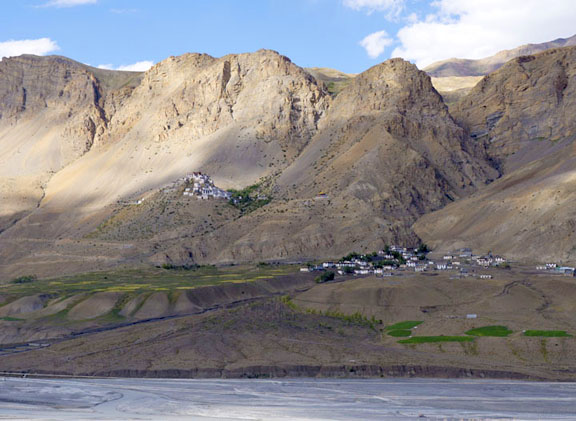
View of Key Monastery from across the Spiti River Valley

A second try today to document the ancient interiors of Key Monastery, whose abbot had in the 11th century been none other than The Great Translator Rinchen Zangpo himself, proved to be a challenge. However, in a nice turn of events, we discovered upon arrival that a special demonstration of sacred dances was in progress. The occasion was the visit of an important official from Shimla.

Entrance to Key Monastery, Spiti

The main interior courtyard was filled with visitors and administrators, with the monastery abbot presiding over the ceremony, as junior and senior monks looked on.

Key Monastery monks demonstrate ritual dance, with abbott presiding over the ceremony, Spiti
Key Monastery monks demonstrate the Black Hat cham dance, with abbott presiding over the ceremony as young ones watch

Key Monastery monks demonstrate ritual dance, with abbott presiding over the ceremony as young monks look on, Spiti

Young monks attending a ritual dance demonstration performed by more senior monks

A word about the architecture of Key…Built on a hilltop with a fortress appearance, this reflects typical Western Himalayan monastic architecture after circa 12th century, influenced by the development of invaders.

Key Monastery built atop a hill, characteristic of the later period of post-12th century Buddhist architectural development, Spiti
Key Monastery built atop a hill, characteristic of the later period of post-12th century Buddhist architectural development

Earlier period structures such as late 10th century nearby Tabo Monastery and Alchi Monastery (in Ladakh) are located in the valley on flat open land, integrated with their villages. Invaders were oftentimes rival Buddhist sects supported by the might of the Mongolian military, such as the Sakya sect who headed Key Monastery in the 14th century, and the Gelugpa sect who headed it in the 17th century. The latter came to dominate the majority of monasteries in Spiti.

In fact, most of us don’t associate monastics with marauding, but post-12th century onwards, the region saw inter-sectarian clashes, conquering by bloodshed, innumerable invasions by Chinese and Mongolian forces, shifting power structures, and political unrest throughout the Western Himalayas. Thus, that illustrious period of refined Indo-Tibetan art and architecture under the guidance of Lotsawa Rinchen Zangpo and the collaboration of Kashmiri artists eventually came to an end.

View of Spiti en route to Key Monastery, with a village nestled in its valley
_1010360_yes_72
Vast and dynamic view of Spiti River Valley

All photos © 2013, Eva Lee.

Dhangkar and Lhalung Monasteries in Spiti

Image
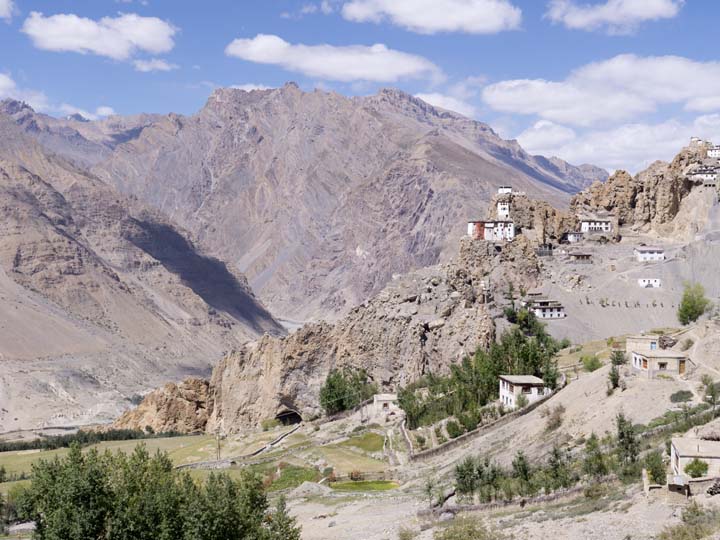
Dhangkar Monastery is seen on the ridge in the upper right. It consists of multi-storeyed buildings perched together, containing five different devotional halls.

September 4th

Our first day out to photograph was at Dhangkhar and Lhalung Monasteries. Both places granted permission because of local and monastic support. I was on my first documenting journey, and how positive an experience it was!

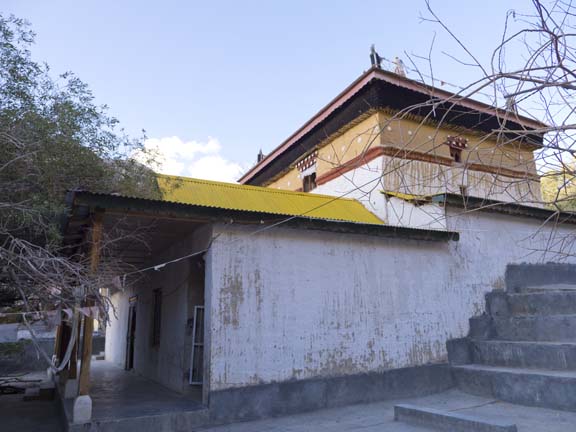
Dhangkar Monastery's Lha O-pa Gompa
Entering Dhangkar Monastery’s Lha O-pa Gompa.
Dhangkar Monastery
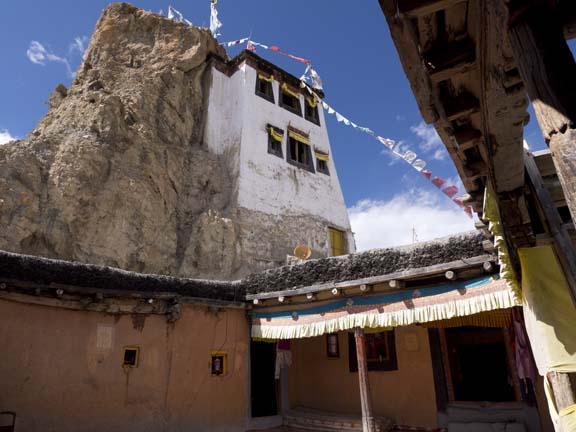
Dhangkar Monastery clings to its rocky outcrops. Shown here is the level in which the Dukhang and Lhakang Gongma may be accessed.

I’ll let the images speak for themselves, but it bears saying that Dhangkar was an original home of the ruling Spitian kings over a thousand years ago, built on a ridge and rock outcrop as a fortress. It clings to the mountain with its whitewashed buildings and traditional thatched roofs. Some buildings seem to be built one on top of the other.

Dhangkar Monastery narrow passageways

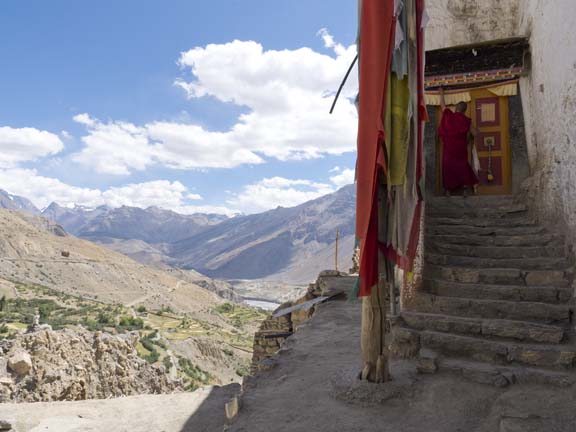
The interiors are navigated by narrow stairs (more like ladders, they’re so steep) and often low-ceilinged passageways. And when you scramble higher and higher, some stairs lead to the rooftops where you climb some more, on gravelly footpaths next to sheer cliff drops, in order to get into other adjacent buildings. Whenever you step outside, you are stunned by the incredible panorama of Spiti Valley in its splendor before you, dotted by the verdant, partitioned farmlands below, and the rigor of the sun casting impressive shadows across the mountain ridges.

View of Spiti Valley from rooftop of Lha O-pa Gompa, Dhangkar Monastery

Inside the Dukhang, which was the former assembly hall for monks before the new one was built a few years ago, sits a life-sized statue of Vajradhara, the “Diamond Being” who sees the ultimate nature of reality. One who does so is said to have wisdom, or right view.

Vajradhara statue, Dhangkar Monastery, Spiti

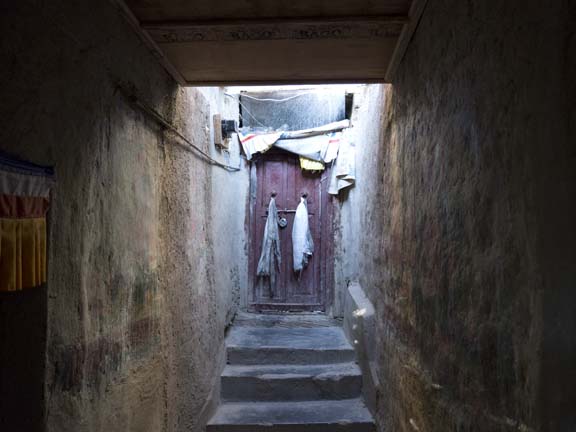
Kanjur Lhakang, library, Dhangkar Monastery

In the lower level Kanjur Lhakang (library containing Buddhist scriptures) are three wooden figures: Lama Chodrag, Shakyamuni, the historical Buddha, and Maitreya, the future Buddha. On the walls are faded and sooty murals, which one can barely see. It’s easy to understand from these murals alone why in 2006 Dhangkar Monastery was named by World Monuments Fund as one of the 100 most endangered sites in the world.
Kanjur Lhakang, library, Dhangkar Monastery
Kanjur Lhakang library of Buddhist scriptures, Dhangkar Monastery, Spiti, India

In the uppermost building of Lha O-pa Gompa is Lhakang Gongma, which has the most to see in terms of murals. Its central back wall dominates with Shakyamuni, Je Tsongkhapa (the reformer and Gelugpa founder of the 14th century), and Lama Chodrag.

Lhakang Gongma murals, Dhangkar Monastery
View of murals on the back central wall of Lhakang Gongma, Dhangkar Monastery, Spiti

The adjacent walls depict various manifestations of Buddha. I was struck in general by how varied the paintings are in terms of color, style, and deterioration. It’s clear evidence of selective repainting over the centuries. In the back central wall, for example, Shakyamuni is obviously brighter and more saturated in color than the other two figures. According to Peter van Ham’s book, The Forgotten Gods of Tibet: Early Buddhist Art of the Western Himalayas, only a few of the paintings have been left untouched. The rest stylistically suggest a date of around 17th century.

Buddha murals, Lhakang Gongma, Dhankar Monastery
Buddha murals, Lhakang Gongma, Dhankar Monastery, Spiti
Buddha murals showing evidence of repainting over the centuries, Lhakang Gongma, Dharkar Monastery
Buddha murals showing evidence of repainting over the centuries, Lhakang Gongma, Dhangkar Monastery

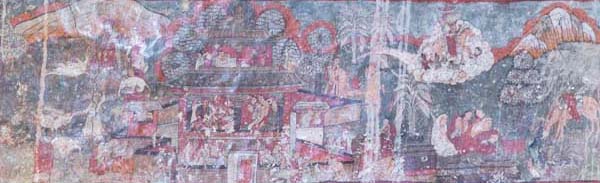
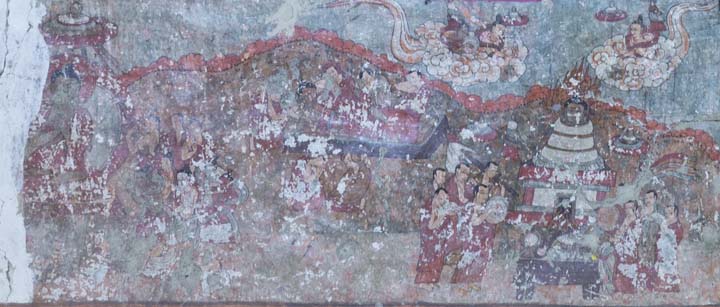
Of note in the murals is the frieze below the main figures, which largely depicts the life of Prince Siddartha, who became the historical Buddha, Shakyamuni. Tabo Monastery has a similar frieze in its Tsug Lhakang, the main assembly hall. Much of it is faded but the below two images are readily identifiable as the life of Siddartha at the palace of Kapilavastu, and the death of Buddha.

Dhangkar_Lhakang Gongma frieze
Life of Prince Siddartha at the palace of Kapilavastu, painted frieze at Lhakang Gongma, Dhangkar Monastery
Death and cremation of Buddha, painted frieze at Lhakang Gongma, Dhangkar Monastery

We were told by locals that Dhangkar is older than the famous Tabo Monastery because, as the ancient home of indigenous kings, it contained a private temple from before the time of The Great Translator Rinchen Zangpo, pre-dating 10th century. Indeed, at the very top of the Dhangkar citadel are the remains of the palace, which you climb up to through a sleepy and steep quaint village that looks like it has maintained its same way of life for millenia.

Later in the day, we went to Lhalung Monastery. I really loved this small temple pictured below.

Lhalung Monastery, Spiti
Lhalung Monastery’s Serkhang or Golden Hall, Spiti

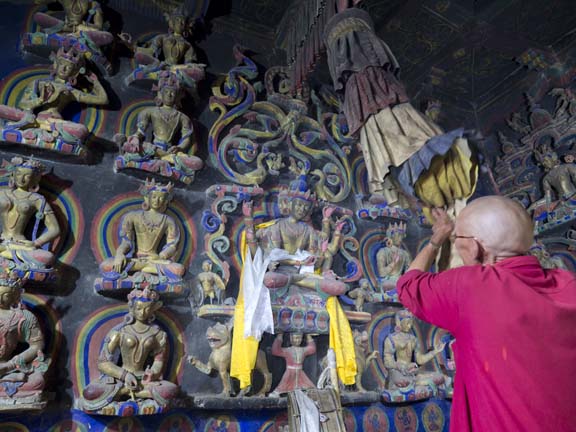
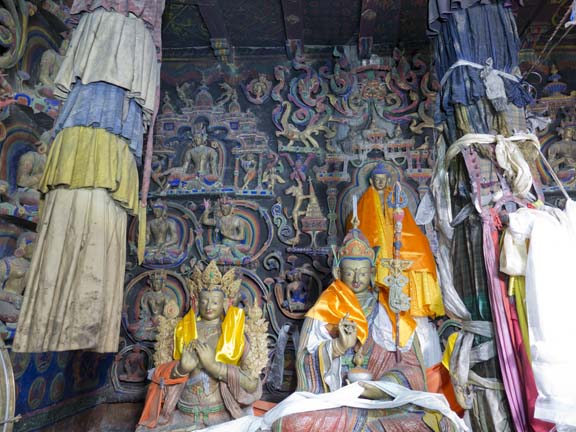
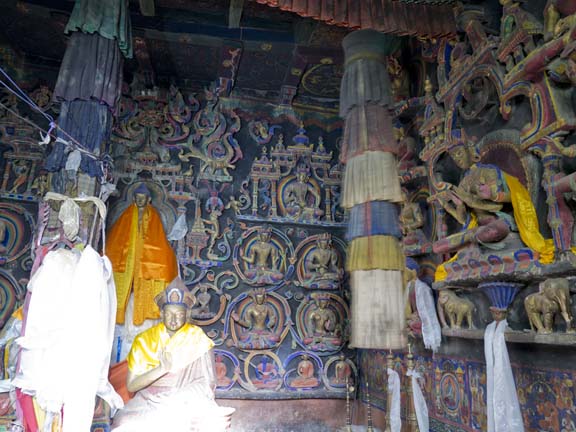
Lhalung Monastery, believed to be founded by The Great Translator Rinchen Zangpo, late 10th century C.E., was quite impressive. You enter through a narrow passageway to get to its Serkhang, which means literally House of Gold, but more often referred to as Golden Hall. Attached to its walls are sculptures of deities and other Buddhist personages. Three-dimensional figures in relief against the interior architecture of Buddhist temples are a distinctive feature of Indo-Tibetan artistry in Spiti and Ladakh areas. Similar ones are found at Tabo, Alchi, and Mangyu Monasteries.
Experience the rare and beautiful interior of Lhalung Monastery’s Serkhang by seeing a walk-through video here.

Entrance to Lhalung Monastery's Serkhang or Golden Hall
Entrance to Lhalung Monastery’s Serkhang or Golden Hall

Once inside, the splendor of the ornately gilded and polychromed clay figures strikes you. The sculptures fill the temple practically from floor to ceiling. There are over 51 figures mounted on the walls or placed in the temple, arranged in mandala formations on each wall. Geshe-la said that these types of cantilevered relief sculptures are specific to the Trans-Himalayan region and are not found in Buddhist temples anywhere else.

On the central wall is Shakyamuni in the middle, flanked by two elaborate groups of five figures, each dominated by a deity–identified as Dharmadhatu Vagishvara, a complex form of Manjushri on the left, and Vajrasattva on the right. These figures are set in architectural alcoves, while the others are contained within lotus motif scrollwork, accented by decorative animals and dancers.

Serkhang, Golden Hall, Lhalung Monastery
Maitreya, Guru Rinpoche, and Rinchen Zangpo (partly visible on right behind the column) form a trinity in the Serkhang altar of Lhalung Monastery, Spiti

Visible below is the right wall with sculptures arranged in a Prajnaparamita mandala, with Vairocana in the center surrounded by four Dyanibuddhas or Buddha-families: Ratnasambbhava, Akshobhya, Amoghasiddhi, and Amitabha, and their female attendants.

Serkhang, Lhalung Monastery, Spiti
Rinchen Zangpo statue among a pantheon of sculpted deities, Serkhang (Golden Hall), Lhalung Monastery

On the left wall (photo below) is a Vajradhatu mandala arrangement around the three-faced and eight-armed Saravid Vairocana. Around him are the 16 deities in his cycle, including once again the Buddha families of Ratnasambhava, Akshobya, Amitabha, and Amoghasiddhi.

Vajradhatu Mandala, Serkhang of Lhalung Monastery, Spiti
Left wall with Vajradhatu Mandala, Serkhang of Lhalung Monastery, Spiti

So now, that’s a lot of deities in one small temple! Their plethora really conveys not only aesthetic richness but also the complexity of Tibetan Buddhist tantric practice. What do all these deities represent in these mandala arrangements? Put simply, mandalas are visual guides for a practitioner in their meditation. They are aids in the realization of the true nature of mind and reality. As an oral and esoteric tradition, one needs a lineage teacher. Experiential understanding of this leads to liberation from conditioned existence–that is to say, leads to enlightenment or nirvana. Here is a succinct description of what the Five Buddha Families represent.

Geshe-la had said that the temples in these areas really demonstrate only the lower three tantras, not highest yoga tantra, which is mainly what Tibetan Buddhists practice today. The lower three are more concerned with purification, whereas the fourth level is actualizing self and deity, and therefore, enacting profound experience and understanding of emptiness. In The Great Translator Rinchen Zangpo’s time, late 10th century, focusing on the three lower tantras was a way to go back to roots and revitalize/reform tantric practice in Tibet which had grown distorted. This was partly the reason for the enormous interest in the original texts and their teachings, translating them from Sanskrit to Tibetan.

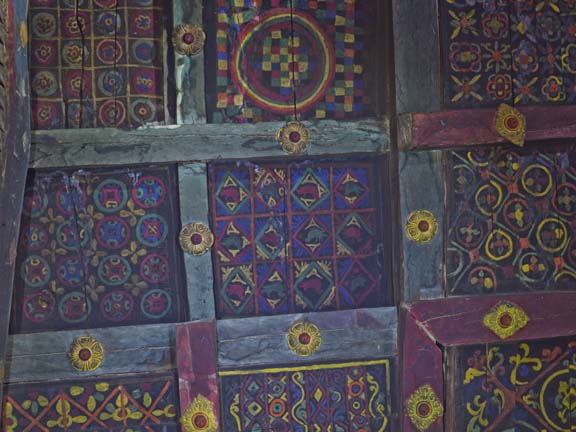
Lastly, the coffered ceilings were painted with delightful and folk-looking decorative motifs. Now I know what scholars mean when they speculate that these must reflect 10th century Kashmiri–influenced textiles.

Coffered ceiling of Serkhang, Lhalung Monastery, Spiti
Coffered ceiling of Serkhang, Lhalung Monastery, decorated with Kashmiri-influenced patterns that scholars believe reflect 10th century textile designs.

All photos © 2013, Eva Lee.