Avalokiteshvara

Breathtaking Alchi Monastery

September 24, 2013

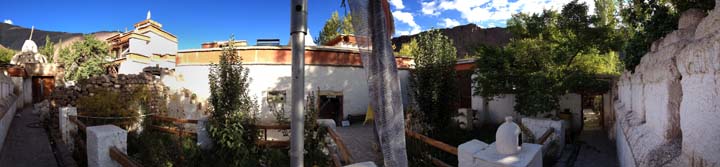
Panorama of Alchi Monastery, Ladakh, India

And what about Alchi? Famous Alchi Monastery, which contains some of the most beautiful and beguiling Buddhist art and iconography from the Indo-Tibetan world.

Indeed, I did visit Alchi, said to be founded by the legendary Great Translator Rinchen Zangpo (958-1055 C.E.) However, I was unable to get permission to study its interiors more closely and document. Despite having some strong letters of support, time and other circumstances conspired against the process when I arrived with only a small window of opportunity to work. After all, it takes time to sort these things out. One Indian friend of mine quipped, “I.S.T.,” which he said stands for Indian Stretchable Time as opposed to Indian Standard Time.

So, I will here share what I have–mostly vignettes of Alchi, some exterior photographs, along with interior images from others who have studied and accessed Alchi.

Like Tabo Monastery, Alchi Monastery’s complex is located in a river valley, integrated with its village. This is typical of earlier phase Himalayan monastic architecture, versus the later phase post 12th century, in which monasteries were fortified and built up on a hill.

Located about 67 kilometers west of Leh in Ladakh region, at 10,500 feet altitude, Alchi contains six temples as well as three painted gateway stupas.

Gateway stupa, Alchi Monastery, Ladakh, India
Gateway stupa, an unusual feature of Alchi Monastery, Ladakh, India

The three oldest temples are the Assembly Hall or Dukhang, also known as the Vairocana Temple; the Sumtsek, named for its recognizable three-storied building; and the Manjushri Temple. These buildings are dated from approximately mid-12th to early 13th century. In addition, there are other chörten and temples built during the 13th and 14th century. Many of these are visible along the circumambulatory surrounding the complex.

Floor plan of Alchi Monastery complex, Ladakh, India
Site map of Alchi Monastery complex, Ladakh, India

As you can see from the above site map and aerial photos, the temples are built close together, basically along a single axis, with other structures surrounding them in proximity. Narrow views are generally all one can photograph because it is difficult to get enough distance onsite.

More gateway stupas with a view of Sumtsek Temple in rear, Alchi Monastery, Ladakh, India

As it turns out, I was only able to visit the Sumtsek and the Vairocana Temple. The other temples and spaces were closed to the general public that morning.

Sumtsek Temple, Alchi Monastery, Ladakh, India
Facade of Sumtsek Temple, Alchi Monastery, Ladakh, India

The Sumtsek facade is distinguished by its carved wooden porch.

Another view of Sumtsek Temple, Alchi Monastery, Ladakh, India
Another view of Sumtsek Temple, named for its three stories, Alchi Monastery, Ladakh, India
Detail of Sumtsek Temple, Alchi Monastery, Ladakh, India
Detail of Sumtsek carved wood facade, Alchi Monastery, Ladakh, India. Photo: Kishore Thukral
Detail of Sumtsek Temple facade, Alchi Monastery, Ladakh, India
Detail of Sumtsek facade with view of second story terrace roof, Alchi Monastery, Ladakh, India
Detail of Sumtsek Temple facade, Alchi Monastery, Ladakh, India
Detail of Sumtsek carved wooden facade, Alchi Monastery, Ladakh, India

As with most other temples of this time period, one must bend down in order to enter through the small, short doorway. When you are inside the ground floor of the Sumtsek, you see three monumental sculptures in niches. They are Maitreya, Avalokiteshvara and Manjushri. See images here created by the team of researchers at Graz University.

They stand so tall at about 14 1/2 feet high in the interior architecture that their heads, in fact, reach the second floor and seem to look out at the viewer from their niches. Shown in the above link is the head of Manjushri on the second floor of the Sumtsek. A beautifully painted and richly adorned Tara stands above him, flanked by two mandalas.

I wish that I had been able to access the second floor to see this in person! Only the ground floor was open to the general public.

Judging from these photos, the upper levels had numerous mandalas, the subject of my research. One cannot see these well from the ground level given the limited sight lines .

What a pity! I was there, but could not quite get there! So close and yet so far…

This third level cupola with its mandalas would have been so golden to see.

I had to settle instead for seeing most of Alchi’s Sumtsek paintings in reproduction two months later in photographer Aditya Arya’s studios. I had the occasion to meet with him in New Delhi to discuss his project photographing “every inch” of Alchi’s interiors.

Alchi’s iconography is truly delightful to scrutinize, with its delicate drawings and imaginative compositions. I recommend you visit Arya’s website here to see some images.

I also recommend the book “Alchi: The Living Heritage of Ladakh,” a catalogue published on the occasion of The National Museum’s exhibition of Arya’s Alchi photographs in New Delhi. In it are extensive photographs and details of Alchi paintings.

I must say, however, that what I saw in his documentation of the first floor of the Sumtsek, which he photographed about five years ago, did not match a lot of what I saw onsite. As a trained painter in fine arts as well as decorative arts, I can say without doubt that alot of the apparently recent restoration work at Alchi does not do the original artwork justice. These areas are painted in a different hand and style. There is cause for concern about such results. Like I discussed in this post on Mangyu Monastery and this one on Tabo Monastery, similarly, I fear that Alchi paintings will slowly disappear by virtue of ill-conceived “restoration.”

According to the Smithsonian Magazine article Glimpses of the Lost World of Alchi, written in 2010, the concern about conserving Alchi’s murals and buildings is not new. In 1990, German art historian Roger Goepper, photographer Jaroslav Poncar and art conservators from Cologne, Germany, launched the Save Alchi Project. Some work was done, but it ended two years later due to what Goepper referred to as “growing confusion over administrative responsibility.” Or, some say, between religious and national interests.

According to the article, although “tourists now far outnumber worshipers, Alchi is still a living temple under religious control of the nearby Likir Monastery…Monks from Likir serve as Alchi’s caretakers, collecting entrance fees and enforcing a prohibition on photography inside the temples…At the same time, responsibility for preserving Alchi as a historic site rests with the [Indian] government’s Archaeological Survey of India (ASI). Relations between the ASI and the Likir monks have long been fraught. The monks are wary of government intrusion into religious matters; the ASI worries the monks will undertake restorations that damage the Alchi murals. The result is a stalemate that has thwarted conservation efforts.” Since the publication of this article, I hope the stalemate is in the process of being sorted out.

I can happily report that the wall paintings of the Vairocana Temple, which included massive mandalas, were breathtaking and well-preserved. They appeared untouched by questionable conservation efforts. OR, better yet, they are a testimony to conservation well done! I hope so.

Vairocana Temple, Alchi Monastery, Ladakh, India
Panorama of Vairocana Temple and its courtyard. At far right is the doorway to the courtyard of Manjushri and Lotsava temples, Alchi Monastery, Ladakh, India

Unfortunately, I do not have images to share here of the exquisite interior of the Vairocana Temple.

Side view of Vairocana Temple with its mountainous surroundings, Alchi Monastery, Ladakh, India

But I have a better idea. Consider getting an airline ticket to fly here and see Alchi for yourself. It’s best to experience the Himalayas in person anyway!

Truly, it’s ineffable. There are no words or images that can convey the exhilaration and revelation of being in the grandeur of the Himalayas.

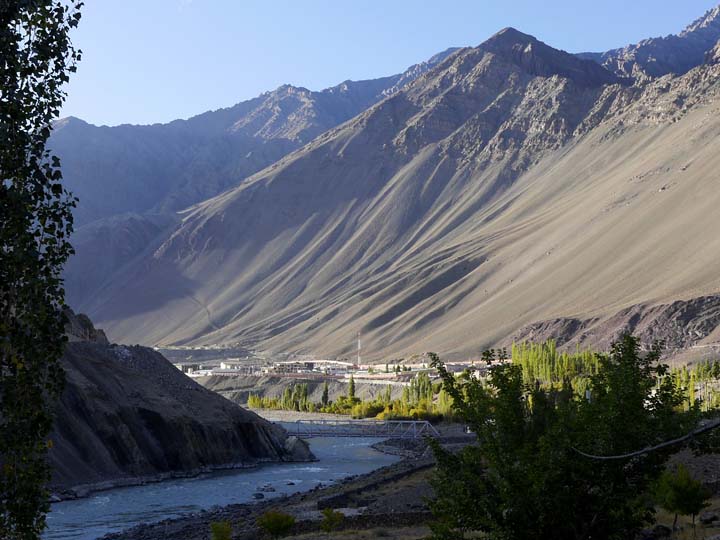
View of Alchi Monastery circumambulatory by the Indus River, Ladakh, India
View of Alchi Monastery circumambulatory with prayer flags by the Indus River in early morning light, Ladakh.
Himalayan mountains and the Indus River Valley as seen from Alchi Monastery circumambulatory, Ladakh, India
Himalayan mountains and the Indus River Valley as seen from Alchi Monastery circumambulatory. A border area, Ladakh has high military presence, such as this military compound in the distance.

All photos © 2013, Eva Lee.

The Monumental Buddhas of Mangyu Monastery

September 23, 2013

Mangyu Monastery, Ladakh, India
Panorama of Mangyu Monastery. At center are Chenrezig and Vairocana temples, flanked by Chamba Lhakhangs. Local workers take a break from repairing the stonework, Ladakh, India.

Mangyu Monastery’s  side temples, also known as Chamba Lhakhangs, are practically hidden right out in the open. With unassuming, in fact rather miniscule, entrances such as this barely 3-foot-high doorway,

Small entrance to Chamba Lhakang, Mangyu Monastery, Ladakh, India
Approximately 3-foot-tall doorway entrance to Chamba Lhakang, Mangyu Monastery, Ladakh, India

one does not expect to see this grandeur within!

Four-armed Maitreya Buddha, Mangyu Monastery Chamba Lhakang, Ladakh, India

Upon entering, a monumental Maitreya Buddha greets you. You see this four-armed future Buddha once you straighten up to standing position and your eyes adjust to the darkened space. Because it’s so small inside (the temple is perhaps only 6 x 8 feet), you are all the more impacted by the scale of the two-story statue.

Detail of four-armed Maitreya Buddha, Mangyu Monastery Chamba Lhakang, Ladakh, India

Like the clay sculptures of Mangyu Monastery’s Vairocana Temple, it is painted and gilded in Indo-Tibetan fashion, with characteristic Indian-influenced red palms.

The walls are covered with small buddhas. Unfortunately they are mostly faded with time, and missing their details.

Wall paintings of small buddhas, Chamba Lhakhang, Mangyu Monastery, Ladakh, India
Mangyu Monastery, Ladakh, India
Looking back towards entrance, visible on right is doorway of Nambarnangze or Vairocana Temple, Mangyu Monastery

The other Chamba Lhakhang, which flanks the left side of the Chenrezig Temple, has a larger doorway, but one must still stoop over to get in.

Chamba Lhakhang, Mangyu Monastery, Ladakh, India

When you enter, you encounter a monumental two-armed Maitreya inside.

Chamba Lhakhang, Mangyu Monastery, Ladakh, India

This temple is a bit more spacious, with larger walls for paintings. Behind Maitreya are some delightful extant examples of  Indo-Tibetan period work.

Chenrezig, or Avalokiteshvara, god of compassion, wall painting in Chamba Lhakhang of Mangyu Monastery, Ladakh, India
Detail of Chenrezig, or Avalokiteshvara, god of compassion, wall painting in Chamba Lhakhang of Mangyu Monastery, Ladakh, India
Detail of wall paintings behind Maitreya statue of Chamba Lhakhang, Mangyu Monastery, Ladakh, India
Detail of wall paintings behind Maitreya statue of Chamba Lhakhang, Mangyu Monastery

However, sadly, most of the rare paintings in this temple are in sore need of proper conservation and restoration. As you can see below, this Vajradhatu mandala is largely faded. There are cracks and other structural damage.

View of Vajadhatu mandala wall painting, Chamba Lhakhang, Mangyu Monastery
View of faded and delaminated Vajadhatu mandala wall painting, Chamba Lhakhang, Mangyu Monastery
Detail of Vajadhatu mandala wall painting, Chamba Lhakhang, Mangyu Monastery
Detail of faded and delaminated Vajadhatu mandala wall painting, with Vairocana pictured in center, Chamba Lhakhang, Mangyu Monastery

The mandala on the opposite wall fares a bit better but is also in need of proper care.

Detail of mandala wall painting, Chamba Lhakhang, Mangyu Monastery

I value these art historical examples of our collective past. Paintings are vital visual expressions of the beliefs, ideals, and aesthetics of human culture. One of the findings of my research as a Fulbright artist is that these remaining examples of 10th-12th century Indo-Tibetan murals are truly rare. They hardly exist anywhere else in the world outside of Spiti, Lahaul, and Ladakh areas in the Indian Himalayas, and they are fast disappearing. It is not only time and the ravages of harsh high altitude winters, but also recent climate change has introduced more rain and water damage to these areas. Then there are the man-made challenges, such as ill-conceived restoration efforts which I wrote about in a previous post on Mangyu Monastery here, Tabo Monastery here, and Alchi Monastery here.

In an ideal world, the best efforts and partnership of contemporary monastics and conservators can lead to the preservation of the beautiful and unique legacy of the great Second Transmission of Buddhism from India to Tibet. I hope this can be the case moving forward. And if you, dear reader, are a conservator or someone who can make a difference, I hope you are inspired to do so!

All photos © 2013, Eva Lee.

Collective Gasps at Lamayuru’s Temples

September 22nd     Lamayuru Monastery – Part Two

Lamayuru Monastery, Ladakh
View of Himalayan valley from stairs to main temple just before entering courtyard, Lamayuru Monastery, Ladakh

To continue where I left off in my last post, I found Lamayuru Monastery really charming. Not only did the architectural spaces seem personal and intimate, but the experience of them was diverse and unexpected. One temple to the next seemed different in character and time.

The Dukhang, or main temple, is hidden behind a stairway façade, the doors of which open to reveal a fully enclosed courtyard, open only to the sky above. From here there is access to temples located on higher levels.

Courtyard of Dukhang, main temple, Lamayuru Monastery, Ladakh
Courtyard of Dukhang, main temple, Lamayuru Monastery, Ladakh. Intimacy within the grandeur of the Himalayas just right outside the entry doors.
Entrance to Dukhang, main temple, Lamayuru Monasetery, Ladakh

The Dukhang’s interior has an enclosed two-story atrium surrounded by colonnade. It was dramatically lit from skylights above, the main source of lighting in this semi-dark hall.

Interior of Dukhang, Lamayuru Monastery, Ladakh
Interior of Dukhang, main temple, Lamayuru Monastery, Ladakh

Lining the walls are a library of scriptures and a rich collection of statuary honoring the Kagyu lineage, including such luminaries as the masters Tilopa, Naropa, Marpa, and Milarepa.

Interior of Dukhang, Lamayuru Monastery, Ladakh
Interior of Dukhang, main temple, Lamayuru Monastery, Ladakh

Along this same wall, K and I did a collective gasp when our monk guide opened a small door to reveal a cave where the amazing Naropa had meditated in the 11th century. Visiting caves that have been graced by enlightened masters is not merely a curiosity. It is considered a blessing. Lay persons and adepts alike seek these places to meditate in the presence of greatness achieved.

Now incorporated into the temple, Naropa’s cave must have been at one time a separate and secret retreat. He is the mahasiddha who developed the yogi practice known as the Six Yogas of Naropa, which has been in continual use by practitioners since he introduced it. This is predominantly the method yogis at Kardang Monastery, for example, utilize in attaining their feats of mind over matter. To learn more, see this earlier post.

Cave where Indian master Naropa meditated in 11th century, Lamayuru Monastery, Ladakh
Statues placed in small cave where Indian master Naropa (in back) meditated in 11th century, Lamayuru Monastery, Ladakh. In front on left is most likely Taktsang Repa and on right Milarepa

This next small temple off the same courtyard as the main temple is dedicated to reliquaries.

9_1050046_yes_72
Temple with reliquaries, Lamayuru Monastery, Ladakh
10_1050040_yes_72
Detail of reliquaries with colorful tormas, ritual offerings made out of butter and flour, Lamayuru Monastery, Ladakh
11_1050058_yes_72
A collection of statues also in this temple, Lamayuru Monastery, Ladakh
13_1050066_yes_Marpa_72
The mahasiddha Marpa, always depicted with wide staring eyes, Lamayuru Monastery, Ladakh
14_1050067_yes_72
Vajradhara, the Primordial Buddha, Lamayuru Monastery, Ladakh

Marpa was a famously tough master with his disciple Milarepa, whom he refused to teach when the latter came repeatedly to seek his guidance. Instead he asked Milarepa thrice to single-handedly construct him a building–then tear it down! That is to say, he made the hapless disciple build something, then destroy it, on three different occasions. In a sense, Milarepa needed such profound purification for his prior spiteful and mass-murderous deeds.

15_1050068_yes_72
Milarepa, disciple of Marpa, usually depicted with hand to ear engaged in a special yogi practice. He is the famously angry and spiteful practitioner who was able to transcend his evil deeds through dedicated asceticism and meditation in cave retreat. He is said to have had calluses on his rear from his years of unrelenting practice!
16_1050050_yes_72
Mural in same temple depicting protector deities and royal warriors, Lamayuru Monastery, Ladakh
17_1050051_yes_72
Mural depicitng protector deities at center and lineage masters at right, Lamayuru Monastery, Ladakh
17_MG_8626_yes_72
Detail of  female protector Tsering-ma riding a snow lion. Wall painting, Lamayuru Monastery, Ladakh. I like the graceful movement of this figure, and judging from the more Chinese influence in style, the murals in this temple post-date Indo-Tibetan period.

Next up was seeing the Avalokiteshvara temple, where my breath was taken away again by the exquisite sculpture there.

Enrance to Avalokiteshvara temple, Lamayuru Monastery, Ladakh
Entrance to Avalokiteshvara temple, Lamayuru Monastery, Ladakh
Avalokiteshvara temple, Lamayuru Monastery, Ladakh
Interior of Avalokiteshvara temple, Lamayuru Monastery, Ladakh

I really loved this temple for its beautiful Avalokiteshvara statue, bodhisattva of compassion, also known as Chenrezig–thousand-armed and eleven-headed, all the better to see, hear, and lend a helping hand to the suffering. It was located in an inner sanctum behind the altar.

Inner sanctum, Avalokiteshvara temple, Lamayuru Monastery, Ladakh
Avalokiteshvara statue, Lamayuru Monastery, Ladakh
Avalokiteshvara statue, really beautiful! Lamayuru Monastery, Ladakh
Detail of Avalokiteshvara statue, Lamayuru Monastery, Ladakh

While the wall paintings in the Avalokiteshvara temple probably date from a later period judging from stylistic differences, it is possible that this statue dates to the earlier Indo-Tibetan period. Purely conjecture, but I was comparing the similarities in the face of Avalokiteshvara with this Vairocana from Sumda Chun, a remote and largely untouched monastery from the 11th century. These statues have more formal affinity with each other than do the Avalokiteshvara with the painting of one from the same Lamayuru temple.

Comparison of Sumda Chun Vairocana with Lamayuru Avalokiteshvara
On left is Vairocana sculpture from 11th century Sumda Chun Monastery, on right is Avalokiteshvara. The facial features have strong similarities in style and execution, as compared to the below painting of Avalokiteshvara from the same Lamayuru temple
Painting of Avalokiteshvara, Lamayuru Monastery, Ladakh, India
Painting of thousand-armed Avalokiteshvara in its dedicated temple, Lamayuru Monastery, Ladakh. Bearing more Chinese influence in style, the face is softer and rounder, less typical of Kashmiri-influenced art of Indo-Tibetan period

It looks to me that this painting shows more Chinese influence, which would indicate it was created later than Indo-Tibetan period, probably post-13th century.

I heard a story that the goddess Tara emanated from Avalokiteshvara when, upon realizing the magnitude of the samsaric condition for all sentient beings, he shed tears. One tear became White Tara, and the other Green Tara.

Green Tara
Green Tara, surrounded by her 21 emanations which are mostly peaceful versions but some are wrathful forms. Contemporary sculpture, Namgyal Monastery, Dharamsala

Today, Tara retreats are one of the more common kriya tantras taught. She has contemporary feminist appeal as a female buddha. She is also an empowering figure in being regarded as Mother of All Buddhas. Additionally, as a bodhisattva who, seeing the gender bias of the male-dominated precinct of enlightenment in Buddhist religious order, vows to be reborn life after life in order to attain enlightenment in female form. I am reminded of what I have read about Jetsunma Tenzin Palmo, the British-born Tibetan Buddhist nun who spent twelve years in solitary meditation in a cave in Lahaul above Tayul Monastery, and who experienced such gender-bias in monastic orders.

Offerings, Avalokiteshvara temple, Lamayuru Monastery, Ladakh
Offerings, Avalokiteshvara temple, Lamayuru Monastery, Ladakh. The large center chalice is a butter lamp.
Interior of Avalokiteshvara temple, Lamayuru Monastery, Ladakh
Interior of Avalokiteshvara temple with old woman who had just finished her full body prostrations here
Lamayuru Monastery, Ladakh
Interior of Avalokiteshvara temple, Lamayuru Monastery, Ladakh
Interior of Avalokiteshvara temple looking back towards entrance, Lamayuru Monastery, Ladakh
Interior of Avalokiteshvara temple, Lamayuru Monastery, Ladakh
View of Dukhang courtyard from second level, Lamayuru Monastery, Ladakh
Lamayuru monk making tormas, ritual butter cake offerings, in the kitchen
Kagyu monk making tormas, ritual butter cake offerings, in the kitchen on second floor above Dukhang courtyard, Lamayuru Monastery, Ladakh

Lamayuru Monastery–what an experience, and it’s grown fonder in my memory…

All photos © 2013, Eva Lee.