Bhutan

Smacked Dumb with Awe and Miraculous Flying Hats

September 14th continued…Shashur Monastery…

By now, it should come as no surprise that the grandeur of the view at every monastery is a given, but I promise you, nature still just smacks you dumb with awe like the nicest bully you’ve ever had the fortune to meet!

View of Bhaga River Valley en route to Shashur Monastery, Lahaul

The magnificent scale of the Himalayan landscape, the distance as far as your eye can see but which your mind can’t fathom, the lighting! You can see the same view over and over, and yet at different times of day, it’s as if you’re facing a new expanse, a different space. And while you’re in a car traveling, the changing vantage points as you wend your way on hairpin turns and switchback roads just leaves you idiotic with glee as you inhale all the sights to full capacity.

Shashur Monastery, like Tayul, is just a few kilometers away from Keylong. That’s why it was doable to see both on the same day.

Shashur Monastery amidst its namesake of blue pines, Lahaul
Shashur Monastery amidst its namesake of junipers, the needles of which lamas burn for purification, Lahaul
Panoramic view of Shashur Monastery, Lahaul, India
Panoramic view of Shashur Monastery, Lahaul

Shashur and its contemporary flourishing Tayul and Gemur monasteries were part of a 17th to 18th century height of new Drukpa centers of Zanskar, Ladakh, and Druk Yul state of Southeastern Tibet (what is now Bhutan, the Buddhist country with a gross national happiness index.) This period was a spiritual revival of Drukpa masters coming to Lahaul on pilgrimage, such as Dewa Gyatso, Taktsang Repa, who founded the great Hemis Monastery (Ladakh), Rangrik Repa, and Serzang Rinchen who built Tayul.

The monastery has three floors and as you enter the ground level temple, you find a shrine with numerous spiritual personages. Front and center is the great Mahasiddha Drubchen Dewa Gyatso, revered founder of Shashur in early 17th century. He was from Zanskar.

Ground floor shrine, Shashur Monastery, Lahaul
Shashur Monastery’s ground floor shrine, Lahaul. Yes, that’s me in the reflection, the statue doesn’t have legs like that!

Now there is this little holy statue of him that has a miraculous hat. It is said that monks on occasion come into the temple in the morning to find the guru’s hat mysteriously lying on the floor many feet away.

Statue of the revered founder Dewa Gyatso, Shashur Monastery, Lahaul
Statue of the revered founder Dewa Gyatso and his miraculous hat, Shashur Monastery, Lahaul

This is understood as a warning sign of trouble to come, issued out of the master’s compassionate spirit. Images of master Taktsang Repa have also been separated from his hat by virtue of this same phenomena. Similar miracles reported in Tibet were also taken as alerts to disasters such as famine, war, or epidemic.

Dubchen Nawang Tsering, left rear in yellow, and Shabdrung Nawang Namgyal on right in pink, Shashur Monastery, Lahaul
Dubchen Nawang Tsering, disciple of Rangrik Repa (left rear in yellow), and Shabdrung Nawang Namgyal on right in pink. The contemporary framed photograph at right is the current Gyalwang Drukpa spiritual leader. Shashur Monastery, Lahaul

There is also Shabdrung Ngawang Namgyal (1594-1651), great lineage holder, 2nd incarnation of 4th Gyalwang Drukpa, and founder of Druk Yul state in the 1640s. In the 1670s lamas of Shashur and Gandhola built relationships with this new Drukpa state which had enduring effects on Lahaul. To this day, there are deep spiritual ties between Garsha and Bhutan. Gandhola is still administered through Bhutanese lineage. It is Khandro Thrinlay, whom I met in Manali (see earlier post) who is presently looking after the preservation of Guru Ghantal. She holds the dual distinction of hailing from the Shakya Shri lineage as well as being the widow of the royal Bhutanese Drukpa spiritual leader, His Holiness the 9th Shabdrung Ngawang Jigme.

Whew, so much discussion about lineage holders often leaves a Westerner cross-eyed with provenance, but one has to remember that in esoteric spiritual teachings, the guru-disciple relationship is key because it’s transmitted orally and personally. Genuine teachings must come from authentic masters who can trace their roots back to prior authentic masters. It’s the branches-stemming-from-the-trunk idea.

While the sculptures in the shrines are carefully tended to, the paintings on canvas in this temple are rather loosely tacked onto the walls. It appears that some have become sooty, probably from years of incense burning, and attempts to clean them have left a number of the paintings smudged.

Mural on canvas loosely tacked to wall, Shashur Monastery first floor temple, Lahaul
Detail of mural on canvas, Shashur Monastery first floor temple, Lahaul
Detail of above wall mural with evidence of soot and attempt to clean leaving facial details marred, Shashur Monastery first floor temple, Lahaul
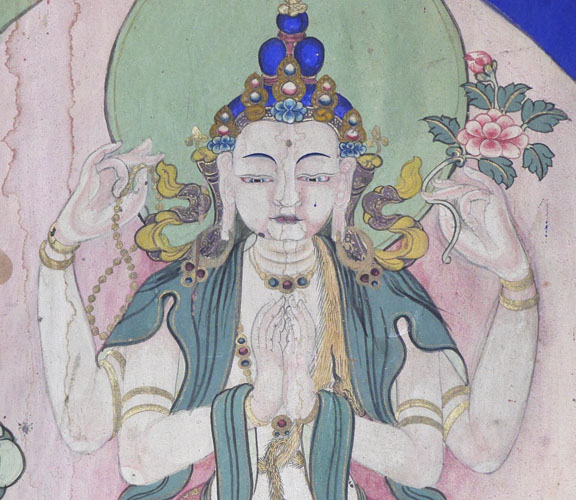
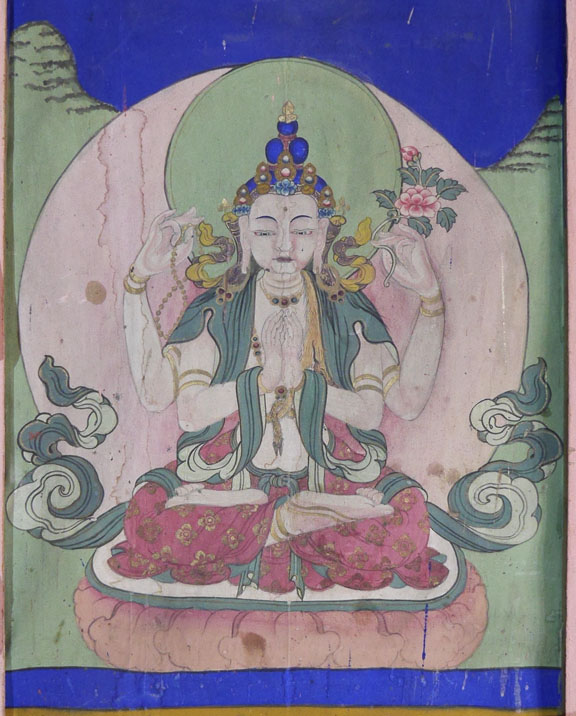
Avalokiteshvara, deity of compassion, from wall mural of Shashur Monastery, Lahaul
Detail of Avalokiteshvara, deity of compassion, from wall mural of Shashur Monastery, Lahaul. From stylistic similarities to an Avalokiteshvara painted at Guru Ghantal, this was possibly painted by Lama Tashi Temphel circa 1860, known to have painted at Shashur in addition to Gandhola.
Avalokiteshvara, deity of compassion, from wall mural of Shashur Monastery, Lahaul
Avalokiteshvara, deity of compassion, from wall mural of Shashur Monastery, Lahaul. Possibly painted by Lama Tashi Temphel circa 1860.

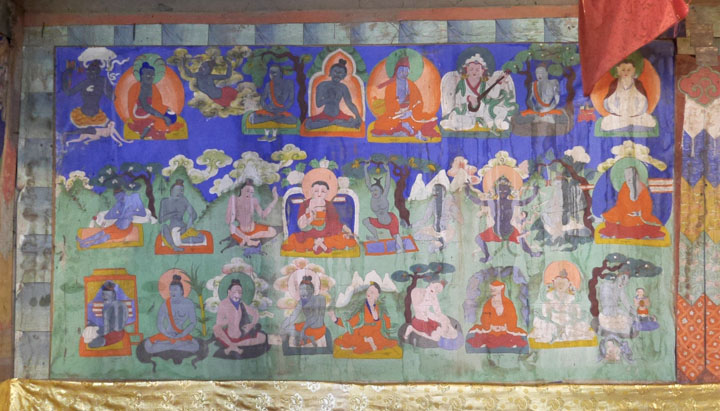
On the second floor of Shashur is a larger shrine room with statue of Vajradhara, the primordial Buddha, and paintings of the 84 Indian Mahasiddhas, main mahasiddhas of the Drukpa lineage, and great gurus and yidams.

11_1030619_yes_2nd Fl-Vajradhara_72
Center statue of Vajradhara, the Primordial Buddha, second floor temple of Shashur Monastery, Lahaul
Portion of 84 Mahasiddhas paintings, second floor temple of Shashur Monastery, Lahaul
Portion of 84 Mahasiddhas paintings,  second floor temple of Shashur Monastery, Lahaul
Detail of 84 Mahasiddhas paintings, second floor temple of Shashur Monastery, Lahaul
Portion of 84 Mahasiddhas paintings,  second floor temple of Shashur Monastery, Lahaul
Detail of 84 Mahasiddhas paintings, second floor temple of Shashur Monastery, Lahaul
This is likely Guru Rinpoche with consort in center surrounded by protector deities, wall painting on second floor temple of Shashur Monastery, Lahaul
This is likely Padmasambhava (Guru Rinpoche) with consort in center surrounded by protector deities, wall painting on second floor temple of Shashur Monastery, Lahaul

With full respect for the content, I’m sad to say that as a visual artist I find the wall paintings in Shashur (as well as Tayul) aesthetically unremarkable. Well, as I was forewarned by a local, Lahaul is not really a place for incredible paintings or visual depictions of mandalas as it is for visceral yogic experience in the land and spiritual centers.

Much more interesting than the painted mahasiddhas on the second floor walls were the statues flanking Vajradhara. One was Chakrasamvara and consort Vajrayogini or Vajavahari, and the other identified as Red Chakrasamvara. Both were most unusual in style and completely unconventional in terms of proportion. They do not look like Tibetan renditions of the deities and their consorts.

Possibly Mahadev and consort Uma, an unusual statue for its exceptionally different style from most Tibetan sculpture, notably its lack of conventional proportion, Shashur Monastery, Lahaul
Detail of Red Chakrasavara, an unusual statue for its exceptionally different style from most Tibetan sculpture, notably its lack of conventional proportion, Shashur Monastery, Lahaul
Possibly Mahadev and consort Uma, an unusual statue for its exceptionally different style from most Tibetan sculpture, notably its lack of conventional proportion, Shashur Monastery, Lahaul
Red Chakrasamvara, an unusual statue for its exceptionally different style from most Tibetan sculpture, notably its lack of conventional proportion, Shashur Monastery, Lahaul
Chakrasamvara and consort Vajravahari, an unusual statue for its exceptionally different style from most Tibetan sculpture, notably its lack of conventional proportion, Shashur Monastery, Lahaul
Detail of Chakrasamvara and consort Vajravahari, an unusual statue for its exceptionally different style from most Tibetan sculpture, notably its lack of conventional proportion, Shashur Monastery, Lahaul
Chakrasamvara and consort Vajravahari, an usual statue for its exceptionally different style from most Tibetan sculpture, Shashur Monastery, Lahaul
Chakrasamvara and consort Vajravahari, an unusual statue for its exceptionally different style from most Tibetan sculpture, notably its lack of conventional proportion, Shashur Monastery, Lahaul

Shashur’s third floor temple was built by Lama Sonam, a disciple of Shakya Shri, in the 20th century during a spiritual revival of the time. Its altar features a statue of Padmasambhava.

Central statue of Padmasambhava, third floor altar of Shashur Monastery, Lahaul

While it was not happening during my visit, it bears mentioning that Shashur is well-known for its annual sacred cham dance which occurs in June or July. Visitors come from all over to witness the three-day rituals that culminate in cham performance. As a ritual, it is not to be seen and received as entertainment but rather as spiritual elevations transmitted to the audience as movement and gesture. Here is one that was performed when I visited Key Monastery in Spiti.

Key Monastery monks demonstrate ritual dance, with abbott presiding over the ceremony, Spiti
Key Monastery monks demonstrate The Black Hat cham dance, with abbott presiding over the ceremony
View of Bhaga Valley, Lahaul, in the late afternoon sun
View of Bhaga Valley, Lahaul, in the late afternoon sun driving back to Keylong from Shashur Monastery

All photos © 2013, Eva Lee.

Poekar Monastery Surprises

Sept. 13, 2013     Lahaul adventure continues…

Today was spent going to Poekar Monastery, known partly for where Apho Rinpoche had commissioned Bhutanese artists to create a giant Guru Rinpoche statue. One can say that the Bhutanese are present-day masters of sublime Buddhist art. Their style and techniques are favored by Tibetans. I have seen their work grace many contemporary monasteries.

Poekar Monastery, Lahaul, India
Poeker Monastery on upper right (yes, that little cluster of white above the other little cluster of white which is the village below), Lahaul Valley

While Poekar was not originally on my radar for visiting, J had learned yesterday at a meeting in Manali with one of Apho Rinpoche’s sons, Jampal-la, that he was heading to Keylong for Tara puja (prayer), to be followed by Guru Rinpoche puja the day after. She immediately called to inform me that I should join them. That is to say, in her irrepressible and talented role of what Malcolm Gladwell calls a “connector,” she invited me to join them at her behest and on their behalf! Right, then, another unforeseen opportunity to observe and experience. So, I said OK, thank you!

Statue of Guru Rinpoche, Poekar Monastery, Lahaul
Statue of Guru Rinpoche, Poekar Monastery, Lahaul. It doesn’t look that big at this angle but this is one-and-a-half stories high. Also known as Padmasambhava, he was the sage who introduced Tibet to Buddhism in the 8th century.

I planned to stay overnight (because J said it was fine to) and brought all my camera equipment and some clothing, all jammed in my wheeling suitcase.  But when I got there with the driver, I couldn’t reach Jampal-la on his phone for details, and found while searching for the monastery that it was a good steep half hour hike up!  So much for wheeling in my suitcase.  It became clear that unless I hoisted my rather heavy suitcase up, the only other option was to go back to my Keylong hotel. Driver D, who had climbed up to the monastery with me to ensure that I was safely escorted, was kind enough to offer to go back down to the car to fetch it, but I didn’t feel good about him doing that!

Anyway, perhaps one day was enough. Maybe better to get to Shashur and Tayul, or Guru Ghantal the next day. These were planned destinations and I wanted to make sure I had enough time to document them. Jampal-la suggested also Phakpa Monastery in Triloknath, a sacred site of Avalokiteshvara, and Markula Devi Temple in Udaipur, sacred site of Vajrvahari.

The Tara puja was an annual event that Poekar Monastery’s American sponsor requests.  The resident monks and nuns are yogi retreatants, as most are in Lahaul. Together, they conducted the prayers, chanting in refreshing cross-gender unison, something one doesn’t experience very much since monks and nuns are usually living separate monastic lives.

In fact, Tara as a tantric deity has contemporary feminist appeal. She is referred to in the Perfection of Wisdom (Prajnaparamita) sutra, a very key Mahayana text, and is considered the female form of Avalokiteshvara, the deity of infinite compassion. With these two strong combinations of wisdom and compassion, she embodies powerful aspects of the practitioner’s own Buddha-nature. She has 21 forms or emanations in all, each associated with certain colors and psycho-physical energies.

Green Tara
Green Tara surrounded by her other enamations

During Tara puja, we all sat cross-legged on the floor as is customary. I was flanked by two nuns who would hand me grains of rice to toss in the air at intervals during prayer. Jampal and his wife were guests of honor.

It was nice talking to them both in between prayer sessions.  We talked about how the West seems to the East and vice versa.  I shared my observations of what I thought was positive and negative about each social order, their apparent outlooks on life, and expectations of how things should be. Jampal-la and his wife shared theirs. I learned from him that, even though he comes from a line of great traditional solitary practitioners, his view is unexpectedly open to contemporary and Western exposure, and it is this:

Begin on the secular level with teachings about how to simply be a good, moral person before getting to the more esoteric and higher teachings. Let individuals develop and choose whether they want to be Buddhist or not. Then if they do, higher teachings can always come later. He has helped to sponsor a group of young girls by sending them to school and working on exactly this approach. In this way, he is aligned with the Dalai Lama’s initiative on secular ethics.

What’s more, their teen is in the U.S. now attending university through the generosity of a sponsor. They feel strongly that young Tibetans should experience what the West has to offer, and then decide for themselves whether to follow that life or come back to the East.  Otherwise, they will always feel doubt or curiosity that the (democratic/ materialist/capitalist/etc.) grass is greener on the other side. Eye-opening to chance the risks of the world, coming from a family and lineage legacy of hermitic existence.

The day passed so seamlessly from breakfast to morning prayers, to lunch and afternoon conversation, with such friendliness exuding from everyone at Poekar.

Poekar Monastery nuns, Lahaul, India
Poekar Monastery nuns, Lahaul

Sadly, when I learned that the next prayer session would continue in a different temple an hour’s ascent further up the mountain (surprise once again) I decided it was too late in the day, and time for me to travel back. Upon hearing this, the nuns and monks, who by now were spread willy-nilly on the hillside climbing up, began to wave and smile and utter lovely goodbyes. They repeatedly implored me to stay over. Truly, their sincerity warmed me so much, I found myself walking away hand clasped to heart.

Poekar Monastery monks, Lahaul, India
Poekar Monastery monks, Lahaul
View of Lahaul Valley from Poekar Monastery village, India
View of Lahaul Valley from Poekar Monastery village

All photos © 2013, Eva Lee.