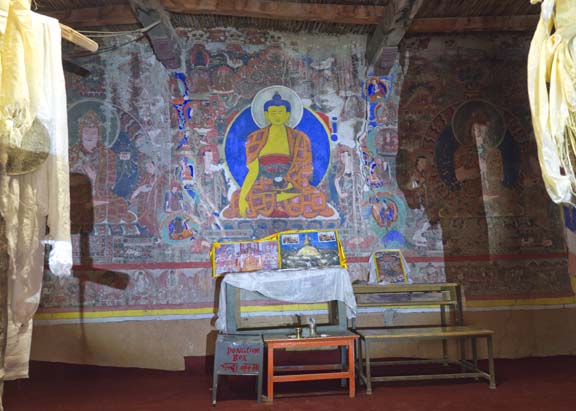
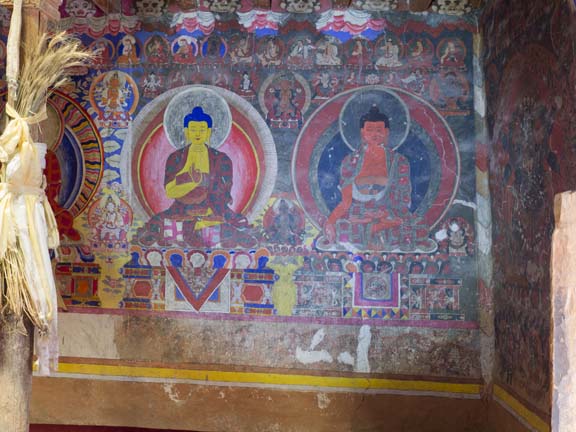
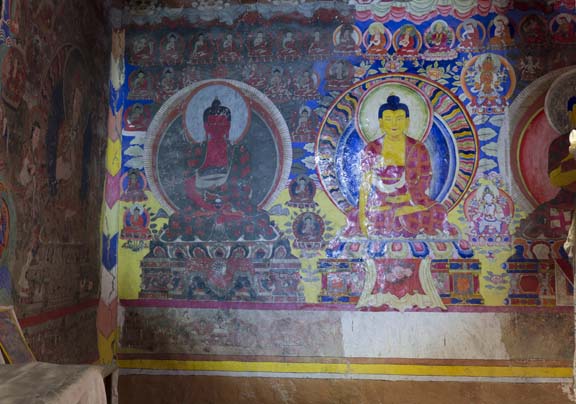
Buddha

The Positive and Negative Spaces of Ajanta Caves

December 11-12, 2013

When I first heard about the paintings of Ajanta Caves, I had an updated version of Lascaux on my mind. You know, natural shelters in rock, which have rough and organic interior surfaces painted with images of, well, in this case, Buddhist motifs. Even though I had later seen some photos online, nothing, I tell you, nothing prepared me for experiencing the mind-boggling architectural sophistication that is Ajanta. Hewn out of the solid volcanic rock of the Deccan Plateau in South India, these 30 caves consist of verandas, courtyards, ambulatories, colonnaded walkways, apses, antechambers, shrine rooms, sanctums, stupas, and so forth. Many are two stories or more.
Ajanta Cave 19, India
Ajanta Cave 19 facade, with courtyard, porch, arched window, adjacent shrine rooms.
Near Aurangabad, India

The caves are unbelievable feats of engineering, excavated in one piece from top to bottom. All of the elements named above, including statuary and shrines, bar-reliefs, every detail from pillars to doorjambs and window frames, are carved from single, solid rock! No kidding, they are purely constructed by the removal of material. From an artist’s point of view, this is dealing with negative space as much as positive space. Think of what’s not there in order to see what is there. 

Ajanta Cave 26, India
Panoramic view of Ajanta Cave 26, India
Ajanta Cave 19, India
Apse and barrel vaulted ceiling, carved details on frieze, columns, capitals, and stupa. Ajanta Cave 19, India

Now add to this the fact that in many of the caves, every surface, nook and cranny, was carefully plastered and sanded to a smooth sheen, then exquisitely painted with refined colors to depict scenes of Buddha’s life, Jataka tales, bodhisattvas, entourages, and decorative patterns.

A testimony of skill and artistry, and considered to be the beginning of classical Indian art, no wonder Ajanta Caves is a UNESCO World Heritage site.

Detail of scenes from Life of Buddha, wall paintings, Ajanta Cave 1
Birds-eye view of Ajanta Caves
Birds-eye view, model of Ajanta Caves, Waghora stream

All this is nestled in a peaceful wending river valley with flowering trees. It must have been quite a place of devotion for the monastic community who lived here intermittently between the 2nd century B.C.E. to 5th or 6th century C.E.

Today, access is by road midway along the cliff, but in its day, one can imagine the serene seclusion of the site, accessed only by stairways leading from the valley floor up to the caves.

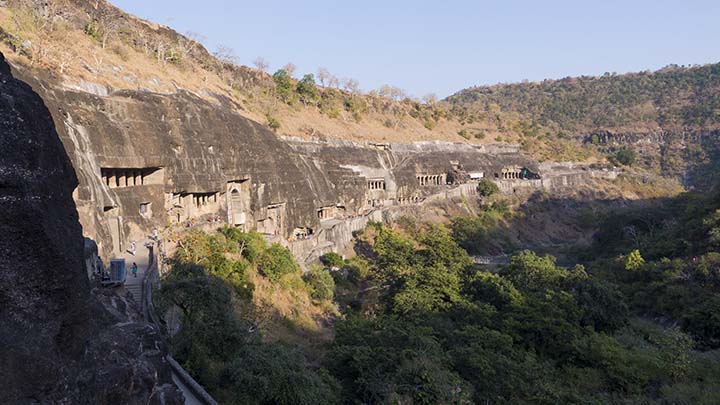
IMG_3857
Entrance to Ajanta Caves, a UNESCO World Heritage site located in a horse-shoe shaped river valley, circa 2nd century B.C.E to 5th century C.E. Buddhist caves, near Aurangabad, India
Ajanta Caves, a UNESCO World Heritage site, India
Ajanta Caves, a UNESCO World Heritage site located in a horse-shoe shaped river valley, circa 2nd century B.C.E to 5th century C.E. Buddhist caves, near Aurangabad, India

Of the thirty caves, five are chaityas or temples housing a stupa. These are Caves 9, 10, 19, 26, and 29, with Caves 9 and 10 being the oldest, dating to 2nd century B.C.E.

Ajanta Cave 10, the oldest chaitya
Ajanta Cave 10, the oldest chaitya or temple, 2nd century B.C.E. After centuries of abandonment, in 1819, British officer John Smith noticed its arch in the overgrown landscape while out on a hunting expedition. This led to the discovery of Ajanta Caves.

According to inscriptions, this Cave 10 was excavated with the sponsorship of Vasisthiputra Katahadi, Kanahaka of Bhada, and monk Dharmadeva. The paintings on the pillars, ceiling, and walls, rare extant examples of ancient Indian painting, were created by various devotees. Traces of Buddhist themes, designs, and Jataka Tales survive, but little remains of the chaitya’s full glory. This temple originally had a wooden interior, probably a reproduction of the interiors of freestanding wooden structures of its time. The stupa is the largest one at Ajanta. 

Detail of ceiling at Ajanta Cave 10, the oldest chaitya
Detail of painted ceiling at Ajanta Cave 10, the oldest chaitya
Detail of Ajanta Cave 10, the oldest chaitya
Detail of painted column at Ajanta Cave 10, the oldest chaitya

Beside the chaityas, the other caves are viharas, which were monasteries with a central colonnaded gathering hall facing an inner sanctum, flanked by rows of small simple cells that were monks’ quarters. These caves were created at a later date. By scholar Walter Spink’s account, they were excavated predominantly during the Vakataka Dynasty, under King Harishena’s rule, circa 475-500. Other scholars, however, believe the viharas were built over a much longer time span than 25 years.

This later period of 5th to 6th century architecture is marked by elaborate detail, such as seen in Caves 1 and 2 (images to follow below). My favorite is Cave 26. 

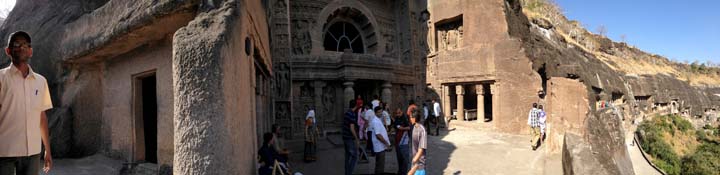
Ajanta Cave 26 exterior
Panorama of Ajanta Cave 26 exterior

Cave 26 is similar to the above Cave 19, but far more richly carved and decorated. It is also larger. This chaitya consists of a central hall with colonnaded walkway or side aisles and beautifully carved walls. An inscription dated 450-525 C.E. attributes the founding of it to a monk named Buddhabhadra.

Ajanta Cave 26, India
Panorama of Ajanta Cave 26 interior, chaitya with colonnaded walkway in which one can circumambulate the stupa, India
Ajanta Cave 26
Ajanta Cave 26 carved stupa with seated Buddha
Detail of carved stupa with seated Buddha, Ajanta Cave 26
Detail of carved stupa with seated Buddha on a lion throne, Ajanta Cave 26

I really love this graceful sculpture of Buddha in parinirvana, carved into the side wall of Cave 26.

Panorama of Buddha in parinirvana, carved on left side wall of Ajanta Cave 26
Parinirvana, Gautama Buddha upon his death, carved into the left sidewall of Ajanta Cave 26
View of Buddha in parinirvana along left side wall of Ajanta Cave 26

Upon entry into the left aisle, one encounters it. Here is another view of it looking back towards the entrance. Also carved here is Mara’s assault on Buddha.

Left side wall of Ajanta Cave 26
Left side wall of Ajanta Cave 26, Buddha in parinirvana is seen next to the side entrance

The below right side aisle is also amply carved.

View of right aisle, Ajanta Cave 26
View of right side wall, Ajanta Cave 26
View of entrance wall, Ajanta Cave 26
Looking back on main entrance, Ajanta Cave 26

Cave 1 shown below is famous for its extensive and refined paintings which date circa 6th-7th centuries. Literally every inch of its interior was originally painted. The structure consists of a large gathering hall with fourteen cells on the sides, a vestibule, and inner sanctum with antechamber. Its ceiling is a massive expanse for a hypostylar hall of this type, and it is ornately decorated with colorful flora, fauna, figures, and geometric designs. As mentioned earlier, the wall paintings depict Buddha’s life, Jataka tales, bodhisattvas, and royal entourages.

Panorama of Ajanta Cave 1
Panorama of Ajanta Cave 1 facade
Panorama of Ajanta Cave 1, famed for its extensive paintings
Panorama of Ajanta Cave 1, famed for its extensive and refined paintings,
including an enormous painted ceiling
View of Ajanta Cave 1 looking towards the inner sanctum from the entranceway
View of Ajanta Cave 1 looking towards the inner sanctum from its central entrance
View of Buddha statue in preaching pose located in inner sanctum with antechamber, Ajanta Cave 1
View of Buddha statue in preaching pose located in inner sanctum with antechamber, Ajanta Cave 1.

The below detail shows Buddha in his preaching mudra (hand gesture). While the carved deer facing each other on the base of the throne does not show the typical frontal view of an 8-spoked wheel of dharma (teachings) between them, this is likely a reference to Buddha’s first sermon at Sarnath, also known as the First Turning of the Wheel.

Buddha statue in inner sanctum, Ajanta Cave 1
Detail of Buddha statue in inner sanctum, Ajanta Cave 1

Here is the famous Ajanta painting of Vajrapani, a bodhisattva who represents Buddha’s power. He is usually one of the three protectors pictured on temples or monasteries. The other two are Manjushri, bodhisattva of transcendent wisdom, and Padmapani also known as Avalokiteshvara, bodhisattva of compassion.

Famed painting of Vajrapani to the right of inner sanctum antechamber, Ajanta Cave 1

Vajrapani’s elaborate headdress reminds me of the ones I saw on bodhisattvas in Tabo Monastery’s inner sanctum shown here in a previous post. Ajanta predates Tabo by about 300-400 years.

Detail of Vajrapani, Ajanta Cave 1
Detail of Vajrapani whose name means “holder of the thunderbolt or diamond wisdom,” Ajanta Cave 1

And here is the other renowned image, Padmapani, the bodhisattva of compassion who is featured on the other side of the inner sanctum at Cave 1.

Famed painting of Padmapani, Ajanta Cave 1
Famed painting of Padmapani whose name means “holder of the lotus,”
located to left of inner sanctum antechamber, Ajanta Cave 1
Detail of Padmapani, Ajanta Cave 1
Detail of Padmapani whose name means “holder of the lotus,”Ajanta Cave 1
Scenes from Life of Buddha, wall painting, Ajanta Cave 1
Detail of scenes from Life of Buddha, wall paintings, Ajanta Cave 1

Really richly painted, one can only imagine how vibrant and clear all the images were over 1400 years ago when they were freshly made! And what an impact they must have made on those living here in quiet seclusion contemplating the teachings so beautifully and abundantly expressed.

Panorama view of wall painting, Ajanta Cave 1
Carved capitals with animals, also visible is painted ceiling, Ajanta Cave 1
Carved capitals with animals and figures, also visible is painted ceiling, Ajanta Cave 1
Detail of deer on carved capital, Ajanta Cave 1
Detail of deer on carved capital, Ajanta Cave 1. Traces of smooth plaster can be seen. It once covered all surfaces because this was the prepared ground on which all painting was done .

I really appreciate that the artists dedicated themselves to creating fine work everywhere. The vast ceiling of Cave 1 is painstakingly executed with the same level of refinement and delicacy found in the wall paintings. Despite being rather high, and considering that most viewers would not be able to discern the details in low lighting, the artists did not slacken their skills.

Painted ceiling, Ajanta Cave 1
Detail of painted ceiling with flora, fauna, figures, and geometric designs, Ajanta Cave 1

I like the grace of this delightful small ceiling panel. It probably only measures 5 x 8 inches at most. Everything from its lyrical design to colors and brushwork, its play on symmetry, form, line, composition, contrast, is so well done. And this is just one example of excellence from an entire ceiling that covers easily an estimated  70 x 70 feet, 1400 square feet in total area! That is a lot of space to paint on this level.

Detail of painted ceiling with animals, Ajanta Cave 1
Detail of painted ceiling panel with animals, Ajanta Cave 1

I also found it interesting that similar to the ceilings of later 10th century Indo-Tibetan monasteries, the imagery is non-religious. At Lhalung Monastery, for example, where I visited and wrote about here, the coffered ceiling of its Golden Temple is entirely painted in geometric designs. Perhaps artists followed a precedent set here at Ajanta.

Detail of painted ceiling with flora, Ajanta Cave 1
Detail of painted ceiling with flora, fauna, figures, and geometric designs, Ajanta Cave 1

Ajanta Cave 2 is the other one well-known for its well-preserved murals. I’ll only show a few details here to give an idea of it. Truly, one has to go to Ajanta in person to experience the eye-popping ancient wonder of it!

Panorama view of Ajanta Cave 2, India
Panorama view of Ajanta Cave 2
Painted ceiling, Ajanta Cave 2, India
Painted ceiling, Ajanta Cave 2
Detail of ceiling painting, Ajanta Cave 2, India
Detail of ceiling painting, Ajanta Cave 2
Inner sanctum and antechamber, Ajanta Cave 2, India
Inner sanctum and antechamber with unusually carved asymmetric capitals, Ajanta Cave 2
Detail of inner sanctum and antechamber, Ajanta Cave 2, India
Detail of inner sanctum and antechamber, Ajanta Cave 2
An unusually carved and asymmetric capital on this antechamber column, Ajanta Cave 2
Detail of unusually carved, asymmetric capital on this inner sanctum antechamber column, Ajanta Cave 2

The Vakataka Dynasty, Buddhist devotees who predominantly sponsored the creation of the Ajanta Caves, overlapped with the great Gupta Empire. According to UNESCO World Heritage website, the “decoration attained at this time an unequalled splendor…the statuary is numerous…the wall painting, profuse and sensitive, constitutes, no doubt, the most striking artistic achievement of Ajanta. Under the impulse of the Gupta dynasty, Indian art in effect reached its apogee…The refined lightness of the decoration, the balance of the compositions, the marvelous beauty of the feminine figures place the paintings of Ajanta among the major achievements of the Gupta and post-Gupta style and confer on them the ranking of a masterpiece of universal pictorial art.”

I’ve highlighted some of the best caves at Ajanta, though many were left unfinished. It is said by scholar Walter Spink that this was due to the political interruption and unrest that followed when Vakataka King Harisena suddenly died in 500 C.E.

Ajanta Cave 24, India
View from entrance of the incomplete Ajanta Cave 24. Its floor was not yet leveled out before abandonment.

What followed was relatively quick and permanent abandonment of Ajanta Caves not long afterwards. When social and political conditions favored once again the sponsorship and excavation of devotional caves, new ones were created at Ellora about 106 kilometers away. Yes, I went there, too! Coming soon will be incredible photos from this site!

The unfinished Cave 24 was fascinating to see because it gave insight on how the caves were excavated. This is a view looking down what would have been the left side aisle of the vihara. The columns are only partway hewn and the depth of the floor is still to be determined, whereas the ceiling appears smooth and complete. This is strong evidence that building a cave at Ajanta was indeed done from top to bottom.

Ajanta Cave 24, India
View from what would be the left side aisle of the incomplete Ajanta Cave 24

Talk about positive and negative space! It’s so plain to see here what has to still be taken away in order to “build” the remaining architecture. The columns and their capitals are in process here, as is the floor of the main hall.

Ajanta Cave 24
View of right side columns in process of excavation at the incomplete Ajanta Cave 24

Chisels marks can clearly be seen on this column in-the-making.

Ajanta Cave 24, India
Detail of right side column in process of excavation at the incomplete Ajanta Cave 24. Its capital and final shape are yet to be defined and chisel marks are clearly seen.

When you think about this being the early state of Ajanta caves before they are completed into their finely carved and painted glory, it’s humbling. So much ancient skill and artistry, so much vision and dedication!

All photos © 2013, Eva Lee.

Tabo Monastery and “The Forgotten Gods of Tibet”

In the book The Forgotten Gods of Tibet: Early Buddhist Art in the Western Himalayas,  published in 1997, authors Peter van Ham and Aglaja Stirn wrote about Tabo Monastery‘s Tsug Lhakhang: “Unfortunately many of the paintings, especially in the lower register, are badly damaged. In fact the northern wall has a large area where nothing except for the grey wall can be made out. Some of these gaps were painted over in recent times–enhancing the impression of the high artistic merit of the old paintings since these newer additions only show a mediocre level of execution.”

Perhaps this may be an example (see image below). Notice how the figure to the left of the central Buddha is stylistically so different from the one on the right. As a trained fine arts painter as well as decorative painter, I must agree with authors van Ham and Stirn.

Stylistic inconsistency in repainted figure on left, Tabo Monastery Tsug Lhakhang

This below example of stylistic continuity is what the above example should look like.

Stylistic continuity in these three figures, Tabo Monastery Tsug Lhakhang
Stylistic consistency in these three figures, Tabo Monastery Tsug Lhakhang

Here is a view of a comparable original painting on the left and the one in question on the right.  Stiff and simplistic in appearance, the repainted one bears little resemblance to the refined and delightfully detailed original.

Example of original painting on left and repainted version on right, Tabo Monastery tsug Lhakhang
An example of original painting on left and repainted version on right, Tabo Monastery Tsug Lhakhang

Here, above the doorway, is another example of repainting in the chevron border and the two figures underneath.

inpainting_bkWall1
Repainted areas in Tabo Monastery Tsug Lhakhang

Presented above are only a couple of examples. In person onsite at Tabo’s Tsug Lhakhang, one finds upon scrutiny numerous incidences of such inpainting and overpainting. I fear that if this kind of “restoration” continues, over time, the temple’s extraordinary original murals will be obliterated rather than preserved. That would be an immeasurable loss for India, art history, and world posterity.

Experience the interior of Tabo Monastery’s Tsug Lhakhang by watching this video walk-through here.

Tabo Monastery – Tsug Lhakhang (Main Assembly Hall) from Eva Lee on Vimeo.

Tabo Monastery is under the protection of the Archeological Survey of India, but it is unclear to me who is doing the painting.

The book Architectural Heritage: Ladakh by The Indian National Trust for Art and Cultural Heritage, published in 2003, says it is often the monastics who do not realize the need for proper conservation, being more concerned with the religious content of the murals and not the art historical significance.

“In the great temples, the execution of wall paintings is carried out by monks and scholars whose canonical knowledge is profound…Most wall paintings are done on perishable mud plaster, and as these begin to disintegrate, these are either removed to draw fresh paintings or retraced and retouched to maintain their vibrancy and freshness. This way it is sometimes painful to witness a ruthless operation in which centuries old paintings are lost along with the structure by eager lamas to construct new structure and, consequently, draw another set of wall paintings…As soon as the walls begin to crack, or paintings fade, they are at once repainted.”

While it appears that at times the goals of Tabo Monastery and Archeological Survey of India may be at cross-purposes with one another, there seems to be great effort for mutual respect. After all, Tabo is a functioning Tibetan Buddhist religious site. At the same time, it is a rare Indo-Tibetan historical site under ASI’s charge. The question is, how are these two establishments proceeding forward?

Repainting, however, is only one of the man-made challenges to the preservation of Indo-Tibetan murals. There are also issues involving structural changes to historical buildings (see this earlier post regarding repairs to the roof of Tabo’s Great Assembly Hall), vandalism, and the effects of tourism, to name some others. Then there are the natural challenges such as wet conditions caused by snow or rainfall, and movement caused by earthquakes.

Partial repair and rudimentary inpainting in the Thousand Buddhas inner wall of Tabo Monastery Tsug Lhakhang inner sanctum, Spiti, India
Partial repair and rudimentary inpainting in the Thousand Buddhas inner wall of
Tabo Monastery Tsug Lhakhang inner sanctum, Spiti, India

I heard that it’s possible ASI may have applied for UNESCO World Heritage status for Tabo Monastery. In terms of conservation and preservation, this would be wonderful if it were to come about! I understand that the Ajanta Caves in Southern India, which contain stunning, well-preserved, ancient Buddhist paintings as old as 2nd century B.C.E., is a World Heritage site.

For further information about the Indo-Tibetan significance of this site, see Tabo Monastery: Vajradhatu Mandala Spendor.

All photos © 2013, Eva Lee.
But Wait, a Bit about Mandalas

Okay, I know I promised to post Part Two of Tabo Monastery next, but as I’ve been writing, I’ve found it necessary to do a lot of explaining.  In fact, so much explaining in between the photos of Tabo’s interior that it’s a bit interrupting. So I’ve decided to get the explaining done with first. All right with you? Great, read on!

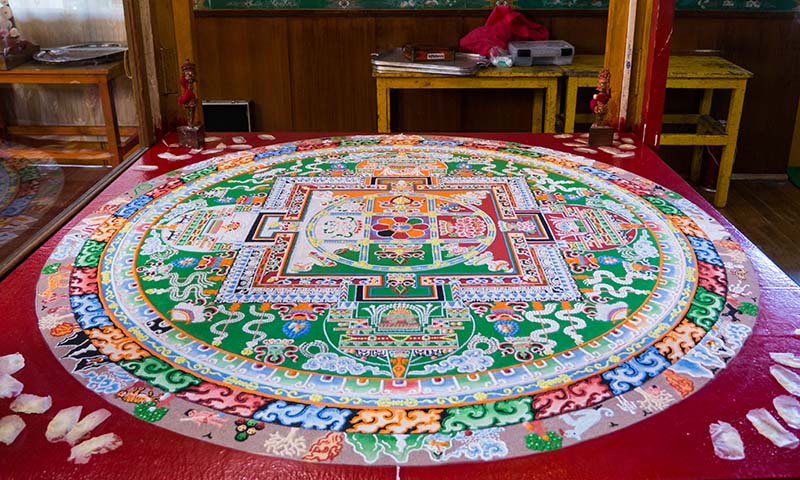
When I first came to Namgyal Monastery in 2010 to observe and document a highest yoga tantra ritual Yamantaka, I knew precious little about the vast world of Tibetan Buddhist tantric deities. What I knew was that an elaborate sand mandala would be made by the Dalai Lama’s monks in their temple in McLeod Ganj, India. I did not know at that time, for example, that this intricate 2-dimensional Yamantaka design represented a 3-dimensional palace, in which the deity resides at the center.

Yamantaka Sand Mandala
Yamantaka Sand Mandala, Namgyal Monastery, India

I learned that as a sacred art, whether made of sand, cloth, or metal, its purpose is to be a meditation aid to a tantric practitioner. A sort of blueprint, a sand mandala usually depicts a square multi-storied abode with four gates centered within a circle. Every element, from color, dots, vases, banners, letters, animals, etc., represents an essential part of the deity, his or her teachings, and Buddhist philosophy. Each deity in turn has a retinue of associated deities, which are also depicted. A person contemplating the mandala imagines entering into its palace and encountering all these elements, which is to say, meditates on the qualities and teachings they symbolize. To a devout practitioner, a mandala ultimately represents the mind of the Buddha.

An esoteric and advanced practice, Tibetan Buddhist tantra (also known as Vajrayana) is intended for the properly receptive initiate, with guidance from a qualified teacher or lama. It is an accelerated, experiential way to realize the Buddhist wisdom of the ultimate nature of mind and reality, and great compassion.  First taught by the historical Shakyamuni Buddha over 2500 years ago, it has been passed through oral tradition by lineage teachers. Its goal is enlightenment of the practitioner for the benefit of all sentient beings. And, believe me, this means all.  One of my favorite little prayers is one I learned on a meditation retreat, and it goes like this:

May all beings, large or small
or middling, near or far,
visible or invisible,
born or yet to be born,
May all beings be happy and content.
Let no one deceive another.
Let no one despise another,
whether out of greed, hatred, or ignorance.
And as a mother would risk her life
to save her only child,
let us cultivate this feeling
of loving friendliness towards one another.

Quite a vast scope!  And speaking of scope, there are literally hundreds of tantric deities, each with unique mandalas representing different sets of details and qualities specific to his or her teachings and practice. All varieties transmit fundamentally the same Buddhist wisdom and compassion, but each deity provides a different identity with which practitioners, according to their particular personality, can relate to or find affinity with. It is important to note that it is understood in tantra that none of these deities are real in the conventional sense. They do not exist, but are symbols, visualized in their mandala in a specific and procedural meditation practice.

This multiplicity is something Buddhism shares with its Hindu beginnings.  Prince Siddhartha, after all, was born and raised a Hindu before his ascetic wanderings led him to enlightenment as Shakyamuni Buddha.  I really appreciate India’s cultural acceptance of many-paths-to-the-same-truth.  I understand that Hindu deities are so vast they number in the millions.  This acknowledgement of relativity, even acceptance of the co-existence of apparent contradiction, is truly an admirable hallmark of Hinduism, and in particular, Buddhist non-duality.

Although intricate, aesthetically compelling, and often mysterious to the non-practitioner, mandalas are meant for religious use and are not intended as works of art for museum or private collection. In fact, I had occasion recently to discuss this very topic with a Buddhist nun.  Her position was that tantra is a secret and profound practice, the art of which should only be for the eyes of practitioners.  What would it serve to reveal what is not meant for the uninitiated? While I can understand her viewpoint, I believe that since the Tibetan diaspora has led to the spread of Buddhist teachings, and the increasingly ubiquitous access to seeing tantric mandalas, it is better for the sake of education to reveal some things about them accurately rather than risk erroneous speculation and misunderstanding.

In 1988, the Dalai Lama permitted the first public construction of a mandala in the West as a means of teaching about and preserving Tibetan culture. This was the Kalachakra Mandala, an example of which can be seen here, constructed in sand at the Museum of Natural History in New York City by Namgyal monks from Dharamsala, India. He also felt that it would be a benefit because a mandala is thought to bring peace and harmony to the area where it is being created. Even viewing a mandala is believed by Buddhists to be enough to effect positive change for greater compassion, awareness, and a better sense of well-being.

Since the construction of this first mandala in the West, many have been created all over the world. Drepung Gomang Monastery in Southern India has a group of monks who come to the United States annually to demonstrate their arts through the Sacred Arts Tour.  Last year, I had the privilege to witness and document a Compassion Sand Mandala which these monks made as an offering to the Dalai Lama on the occasion of his talks on Compassion and Creativity at Western Connecticut State University.

Beyond the artistic representation of a mandala, there is the mandala principle, which I believe was first clearly articulated and taught in the U.S. by Chogyam Trungpa Rinpoche.  (See his book Orderly Chaos: The Mandala Principle) From a philosophical point of view, everything is dependently interrelated, the seeming order and chaos are one and the same, the joy and the suffering, and so forth.  The apparent dualities abound, and yet they are all constituently the same.

In real life situations, I think of mandala principle as Buddhism-in-action in the sense that your immediate surroundings is your mandala, and all the people you encounter are part of it, too.  You have Buddha-nature within you, and so do they.  With awareness and practice that comes from meditation, you have at every moment the potential to actualize compassion and wisdom in what you think, what you say, and what you do.

Dhangkar and Lhalung Monasteries in Spiti

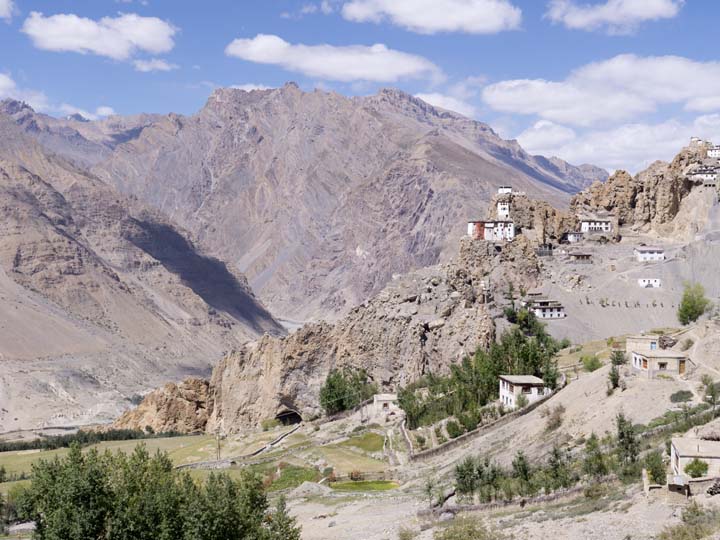
Image
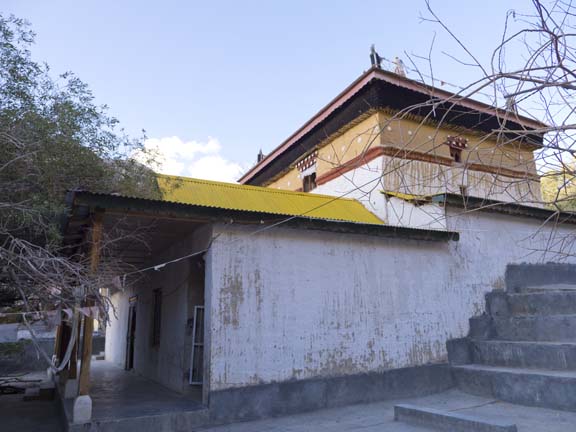
Dhangkar Monastery is seen on the ridge in the upper right. It consists of multi-storeyed buildings perched together, containing five different devotional halls.

September 4th

Our first day out to photograph was at Dhangkhar and Lhalung Monasteries. Both places granted permission because of local and monastic support. I was on my first documenting journey, and how positive an experience it was!

Dhangkar Monastery's Lha O-pa Gompa
Entering Dhangkar Monastery’s Lha O-pa Gompa.

Dhangkar Monastery
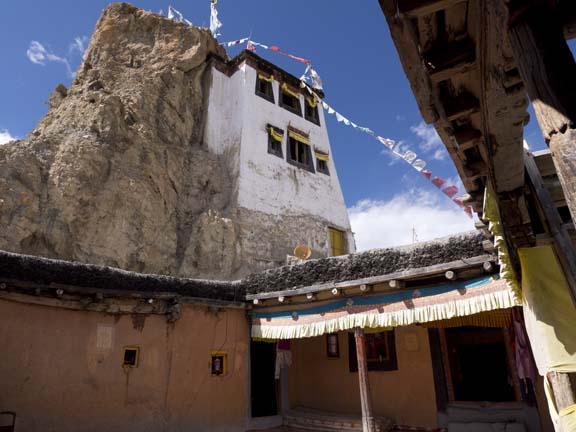
Dhangkar Monastery clings to its rocky outcrops. Shown here is the level in which the Dukhang and Lhakang Gongma may be accessed.

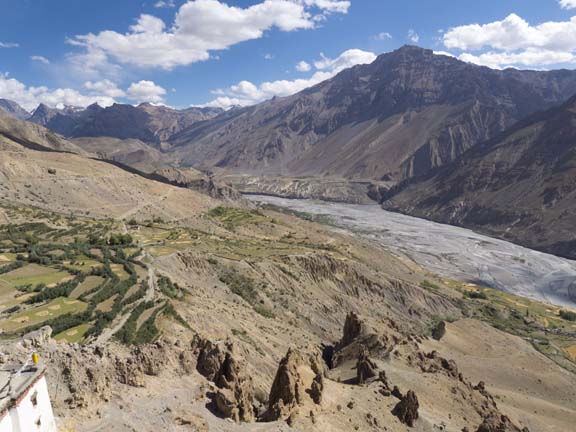
I’ll let the images speak for themselves, but it bears saying that Dhangkar was an original home of the ruling Spitian kings over a thousand years ago, built on a ridge and rock outcrop as a fortress. It clings to the mountain with its whitewashed buildings and traditional thatched roofs. Some buildings seem to be built one on top of the other.

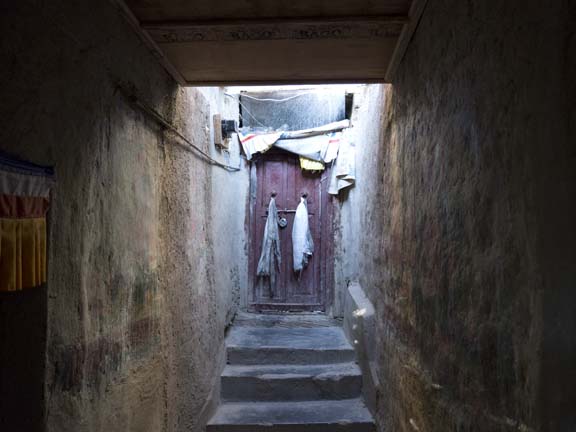
Dhangkar Monastery narrow passageways

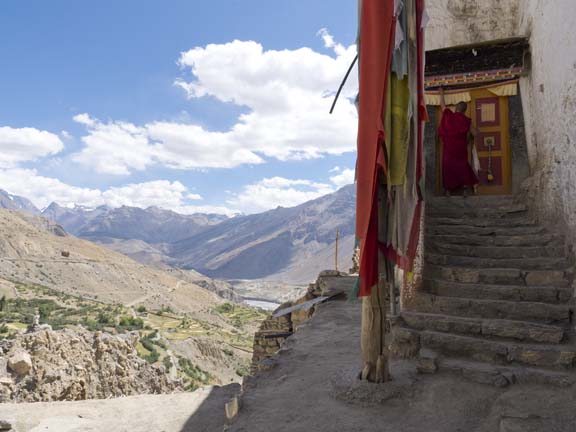
The interiors are navigated by narrow stairs (more like ladders, they’re so steep) and often low-ceilinged passageways. And when you scramble higher and higher, some stairs lead to the rooftops where you climb some more, on gravelly footpaths next to sheer cliff drops, in order to get into other adjacent buildings. Whenever you step outside, you are stunned by the incredible panorama of Spiti Valley in its splendor before you, dotted by the verdant, partitioned farmlands below, and the rigor of the sun casting impressive shadows across the mountain ridges.

View of Spiti Valley from rooftop of Lha O-pa Gompa, Dhangkar Monastery

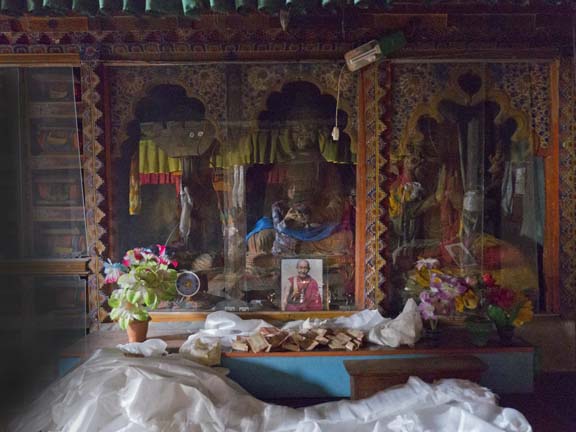
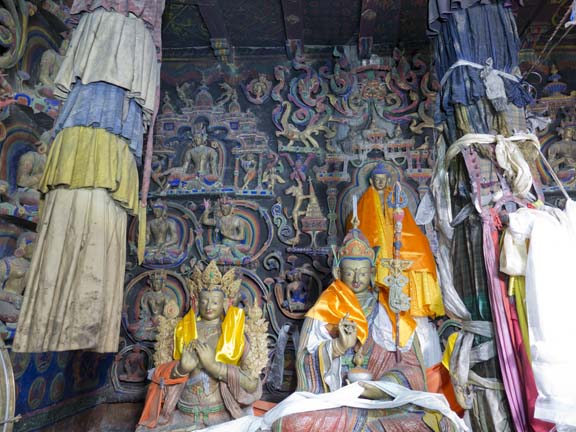
Inside the Dukhang, which was the former assembly hall for monks before the new one was built a few years ago, sits a life-sized statue of Vajradhara, the “Diamond Being” who sees the ultimate nature of reality. One who does so is said to have wisdom, or right view.

Vajradhara statue, Dhangkar Monastery, Spiti

Kanjur Lhakang, library, Dhangkar Monastery

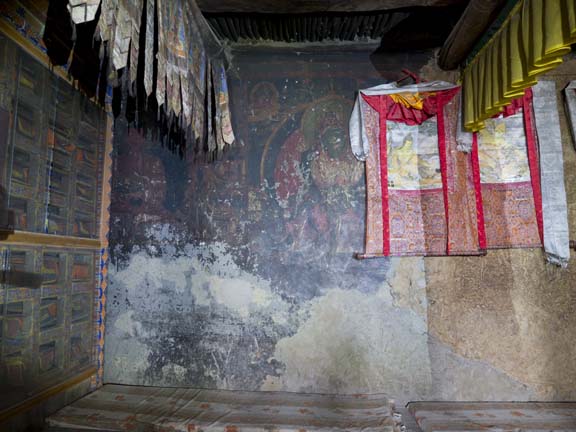
In the lower level Kanjur Lhakang (library containing Buddhist scriptures) are three wooden figures: Lama Chodrag, Shakyamuni, the historical Buddha, and Maitreya, the future Buddha. On the walls are faded and sooty murals, which one can barely see. It’s easy to understand from these murals alone why in 2006 Dhangkar Monastery was named by World Monuments Fund as one of the 100 most endangered sites in the world.

Kanjur Lhakang, library, Dhangkar Monastery
Kanjur Lhakang library of Buddhist scriptures, Dhangkar Monastery, Spiti, India

In the uppermost building of Lha O-pa Gompa is Lhakang Gongma, which has the most to see in terms of murals. Its central back wall dominates with Shakyamuni, Je Tsongkhapa (the reformer and Gelugpa founder of the 14th century), and Lama Chodrag.

Lhakang Gongma murals, Dhangkar Monastery
View of murals on the back central wall of Lhakang Gongma, Dhangkar Monastery, Spiti

The adjacent walls depict various manifestations of Buddha. I was struck in general by how varied the paintings are in terms of color, style, and deterioration. It’s clear evidence of selective repainting over the centuries. In the back central wall, for example, Shakyamuni is obviously brighter and more saturated in color than the other two figures. According to Peter van Ham’s book, The Forgotten Gods of Tibet: Early Buddhist Art of the Western Himalayas, only a few of the paintings have been left untouched. The rest stylistically suggest a date of around 17th century.

Buddha murals, Lhakang Gongma, Dhankar Monastery
Buddha murals, Lhakang Gongma, Dhankar Monastery, Spiti

Buddha murals showing evidence of repainting over the centuries, Lhakang Gongma, Dharkar Monastery
Buddha murals showing evidence of repainting over the centuries, Lhakang Gongma, Dhangkar Monastery

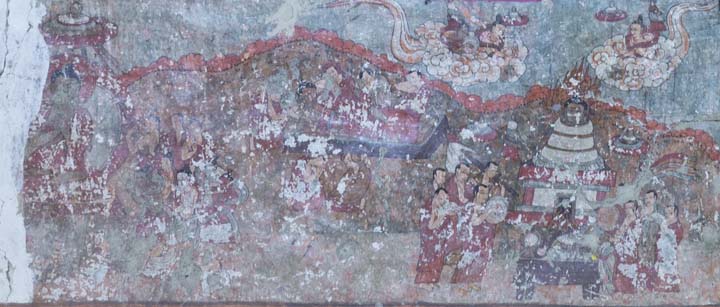
Of note in the murals is the frieze below the main figures, which largely depicts the life of Prince Siddartha, who became the historical Buddha, Shakyamuni. Tabo Monastery has a similar frieze in its Tsug Lhakang, the main assembly hall. Much of it is faded but the below two images are readily identifiable as the life of Siddartha at the palace of Kapilavastu, and the death of Buddha.

Dhangkar_Lhakang Gongma frieze
Life of Prince Siddartha at the palace of Kapilavastu, painted frieze at Lhakang Gongma, Dhangkar Monastery

Life of Prince Siddartha at the palace of Kapilavastu, painted frieze at Lhakang Gongma, Dhangkar Monastery
Death and cremation of Buddha, painted frieze at Lhakang Gongma, Dhangkar Monastery

We were told by locals that Dhangkar is older than the famous Tabo Monastery because, as the ancient home of indigenous kings, it contained a private temple from before the time of The Great Translator Rinchen Zangpo, pre-dating 10th century. Indeed, at the very top of the Dhangkar citadel are the remains of the palace, which you climb up to through a sleepy and steep quaint village that looks like it has maintained its same way of life for millenia.

Later in the day, we went to Lhalung Monastery. I really loved this small temple pictured below.

Lhalung Monastery, Spiti
Lhalung Monastery’s Serkhang or Golden Hall, Spiti

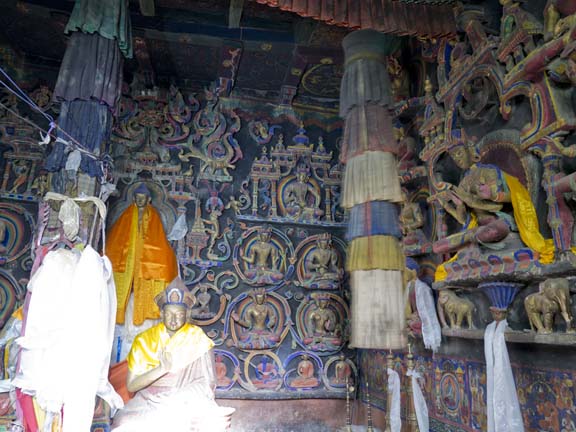
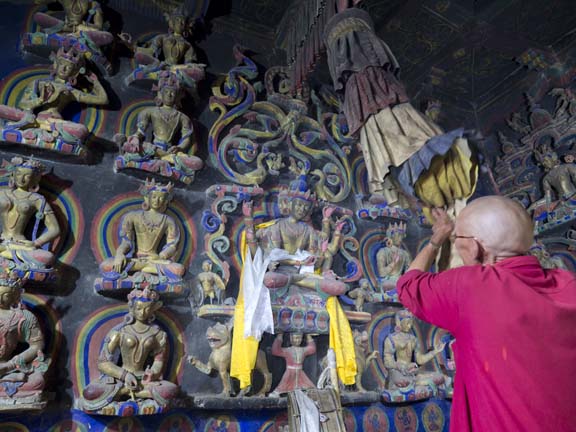
Lhalung Monastery, believed to be founded by The Great Translator Rinchen Zangpo, late 10th century C.E., was quite impressive. You enter through a narrow passageway to get to its Serkhang, which means literally House of Gold, but more often referred to as Golden Hall. Attached to its walls are sculptures of deities and other Buddhist personages. Three-dimensional figures in relief against the interior architecture of Buddhist temples are a distinctive feature of Indo-Tibetan artistry in Spiti and Ladakh areas. Similar ones are found at Tabo, Alchi, and Mangyu Monasteries.

Experience the rare and beautiful interior of Lhalung Monastery’s Serkhang by seeing a walk-through video here.

Entrance to Lhalung Monastery's Serkhang or Golden Hall
Entrance to Lhalung Monastery’s Serkhang or Golden Hall

Once inside, the splendor of the ornately gilded and polychromed clay figures strikes you. The sculptures fill the temple practically from floor to ceiling. There are over 51 figures mounted on the walls or placed in the temple, arranged in mandala formations on each wall. Geshe-la said that these types of cantilevered relief sculptures are specific to the Trans-Himalayan region and are not found in Buddhist temples anywhere else.

On the central wall is Shakyamuni in the middle, flanked by two elaborate groups of five figures, each dominated by a deity–identified as Dharmadhatu Vagishvara, a complex form of Manjushri on the left, and Vajrasattva on the right. These figures are set in architectural alcoves, while the others are contained within lotus motif scrollwork, accented by decorative animals and dancers.

Serkhang, Golden Hall, Lhalung Monastery
Maitreya, Guru Rinpoche, and Rinchen Zangpo (partly visible on right behind the column) form a trinity in the Serkhang altar of Lhalung Monastery, Spiti

Visible below is the right wall with sculptures arranged in a Prajnaparamita mandala, with Vairocana in the center surrounded by four Dyanibuddhas or Buddha-families: Ratnasambbhava, Akshobhya, Amoghasiddhi, and Amitabha, and their female attendants.

Serkhang, Lhalung Monastery, Spiti
Rinchen Zangpo statue among a pantheon of sculpted deities, Serkhang (Golden Hall), Lhalung Monastery

On the left wall (photo below) is a Vajradhatu mandala arrangement around the three-faced and eight-armed Saravid Vairocana. Around him are the 16 deities in his cycle, including once again the Buddha families of Ratnasambhava, Akshobya, Amitabha, and Amoghasiddhi.

Vajradhatu Mandala, Serkhang of Lhalung Monastery, Spiti
Left wall with Vajradhatu Mandala, Serkhang of Lhalung Monastery, Spiti

So now, that’s a lot of deities in one small temple! Their plethora really conveys not only aesthetic richness but also the complexity of Tibetan Buddhist tantric practice. What do all these deities represent in these mandala arrangements? Put simply, mandalas are visual guides for a practitioner in their meditation. They are aids in the realization of the true nature of mind and reality. As an oral and esoteric tradition, one needs a lineage teacher. Experiential understanding of this leads to liberation from conditioned existence–that is to say, leads to enlightenment or nirvana. Here is a succinct description of what the Five Buddha Families represent.

Geshe-la had said that the temples in these areas really demonstrate only the lower three tantras, not highest yoga tantra, which is mainly what Tibetan Buddhists practice today. The lower three are more concerned with purification, whereas the fourth level is actualizing self and deity, and therefore, enacting profound experience and understanding of emptiness. In The Great Translator Rinchen Zangpo’s time, late 10th century, focusing on the three lower tantras was a way to go back to roots and revitalize/reform tantric practice in Tibet which had grown distorted. This was partly the reason for the enormous interest in the original texts and their teachings, translating them from Sanskrit to Tibetan.

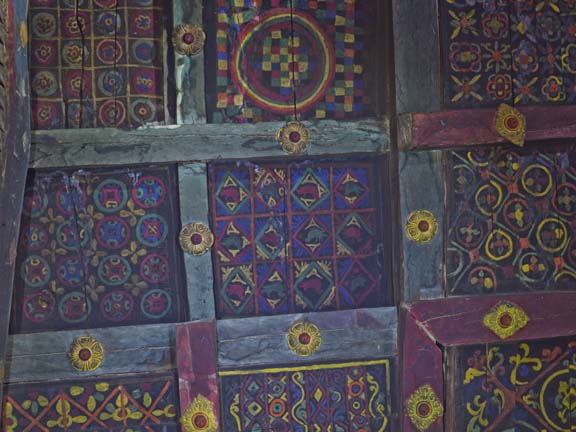
Lastly, the coffered ceilings were painted with delightful and folk-looking decorative motifs. Now I know what scholars mean when they speculate that these must reflect 10th century Kashmiri–influenced textiles.

Coffered ceiling of Serkhang, Lhalung Monastery, Spiti
Coffered ceiling of Serkhang, Lhalung Monastery, decorated with Kashmiri-influenced patterns that scholars believe reflect 10th century textile designs.

All photos © 2013, Eva Lee.