chod

Miracle at Lotus Lake and the Secret Caves of Rewalsar

October 21, 2013

Now that I’m back in Dharamsala, with eyes fresh from seeing 10th-12th century Indo-Tibetan mandalas in monasteries of Spiti, Lahaul, and Ladakh, I made local trips through these lower Himalayas to see contemporary Tibetan monasteries.

Rewalsar, also known as Tso Pema to Tibetans, Himachal Pradesh, India
Rewalsar, also known as Tso Pema (Lotus Lake) to Tibetans, Himachal Pradesh, India. The monumental golden statue of Padmasambhava (Guru Rinpoche) atop Zigar Orgyen Choekorling Monastery can be seen upper right on the hillside
Photo: bharatdiscovery.org

First stop was Rewalsar, or Tso Pema (Lotus Lake) as Tibetans call it. It is the site of a legendary miracle by Padmasambhava. Also known as Guru Rinpoche, this Indian sage brought Buddhism to Tibet in the 8th century, and is said to have subdued the people and the local blood-thirsty spirits through demonstrations of his magical powers as an adept practitioner.  Padmasambhava is especially revered by the Tibetan Buddhist Nyingma school who regard him as the Second Buddha, the First Buddha being Shakyamuni.

The legend of the lake is that Guru Rinpoche was teaching Princess Mandarava tantra in local secret caves, and she became his consort.  Her father the King of Zahor was greatly displeased and attempted to burn them both in the valley below.  But Guru Rinpoche turned the pyre into water, and the fire became a lake.  Thus, Lotus Lake miraculously came into being and is revered by Tibetan Buddhists.

View of Tso Pema/Lotus Lake near the famed Guru Rinpoche secret caves, Rewalsar
View of Tso Pema/Lotus Lake near the famed Guru Rinpoche secret caves up the hills, Rewalsar

Incidentally, it is also revered by Hindus, who regard the area as Hanuman’s land. Punjabis, as well, because Padmasambhava is one of their ten holy teachers.

After driving up to the hills above Tso Pema, one must go on foot up to the caves. Most of the way is fairly well paved and with stairs.

Pathway up to secret caves of Guru Rinpoche, Rewalsar, India
Pathway up to secret caves of Guru Rinpoche, Rewalsar

It is a pleasant scramble through some rocky but grassy areas, hung with plenty of Tibetan prayer flags.

Tibetan prayer flags on the hillside of Rewalsar caves
Tibetan prayer flags on the continued pathway up to Rewalsar caves

At the top, there is a nunnery with small temples, a cafe for visitors, and dotting the hillside are numerous modest stone huts and cave entrances currently in use by nuns and other retreatants.

Retreat huts and caves used today by nuns and retreatants, Rewalsar, India
Entrances to meditation caves currently in use, Rewalsar
Entrances to meditation caves currently in use, Rewalsar. I like how this is one is called “Cave No. 4,” very practical.
Retreat hut, Rewalsar, India

The landscape is punctuated by crags and boulders.

More abundant Tibetan prayer flags on the hillside of Rewalsar caves, India
More abundant Tibetan prayer flags on the hillside of Rewalsar caves

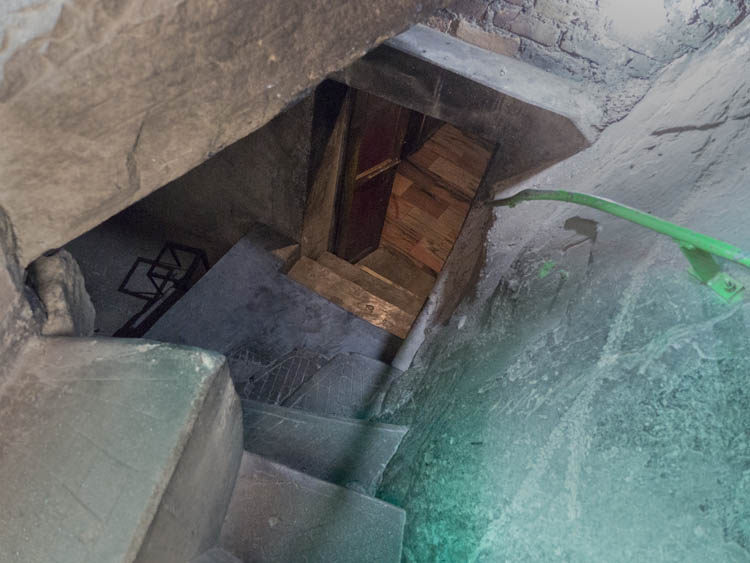
When we finally came upon the secret cave of Guru Rinpoche, the entrance was this steep decline down, which today has cement steps, a doorway, and lighting. I tried to imagine it as the dark natural crack it must have been originally, getting darker as you descended into the cave.
Entrance to Guru Rinpoche's meditation caves, Rewalsar, India
Entrance to Guru Rinpoche’s meditation caves, Rewalsar, India

The stairway leads to a small antechamber which then leads to this section of the cave underground.

Guru Rinpoche meditation cave, Rewalsar, India
Guru Rinpoche meditation cave, Rewalsar

I tried to imagine this cave in Guru Rinpoche’s day, without the flooring, ritual objects and electricity. It must have been a mysterious womb-like place to practice meditation, to contemplate existence in pitch blackness, to truly face nothingness in the subterranean absence of stimuli.

Panorama of Guru Rinpoche meditation cave, Rewalsar, India
Panorama of Guru Rinpoche meditation cave, Rewalsar
Altar inside Guru Rinpoche meditation cave, Rewalsar, India
Altar inside Guru Rinpoche meditation cave, Rewalsar

In another cave is this large statue of Guru Rinpoche, built into a nook where above his head is a natural opening revealing daylight.

Statue of Guru Rinpoche (Padmasambhava), Rewalsar caves, India
Statue of Guru Rinpoche (Padmasambhava), Rewalsar caves
Statue of Guru Rinpoche (Padmasambhava), Rewalsar caves, India
A monk says prayers before a statue of Guru Rinpoche (Padmasambhava), Rewalsar caves

Just beyond this section is a smaller connected cave dedicated to his consort, Princess Mandarava.

Statue of Princess Mandarava, Rewalsar cave
Statue of Princess Mandarava in cave dedicated to Guru Rinpoche’s consort, Rewalsar cave
Cave of Princess Mandarava, looking back out towards larger section containing statue of Guru Rinpoche, Rewalsar cave

It is said that pilgrimage to sacred sites where realized masters practiced meditation, such as these caves, imparts blessings to its visitors.

Rewalsar is also considered an auspicious place to be on retreat. The two Chod practitioners (chodpas) I met in Dharmasala (whom I wrote a bit about here) are currently on a few months’ retreat here.

They invited me to visit with them in their cabin near the caves. So I had planned to be in town when they were on a brief break from their hermitage. I learned that there are two short times of the month, according to the Tibetan lunar calendar, that retreatants may come out of isolation to tend to things outside.

These chodpas are lay tantric practitioners not only working towards enlightenment through Chod rituals (serious esoteric stuff, as one Zen practitioner friend of mine commented, “These guys are hardcore!”) but they are also shamanic healers. As traveling mendicants, they may be invited by community members to conduct prayers for the deceased, the living, and those believed to be wandering spirits.

Panorama of Rewalsar area from chodpa retreat cabin
Panorama of Rewalsar area from chodpa retreat cabin, with Tso Pema (Lotus Lake) visible in distance
Interior of chodpa's retreat hut, Rewalsar
Interior of chodpa’s retreat hut, Rewalsar
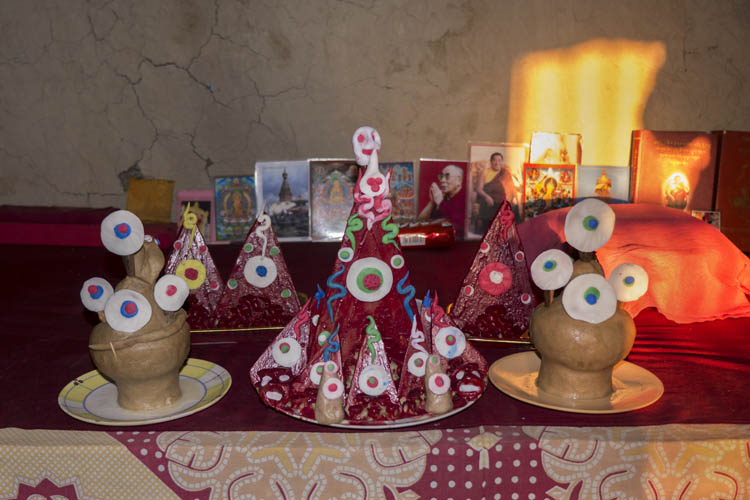
Chod ritual objects made out of flour and water

Pictured above is the one-room cabin of a chodpa. On the long table against the back wall are ritual offerings made from colored flour and water.

During my visit, it so happened that the chodpas recently conducted healing prayers for a child I was acquainted with who suffered from a neurological brain disorder. They showed me some of the ritual objects created and used for this purpose.

I heard separately later that this child, who was located hours away from Rewalsar, demonstrated some unusual and extended calm behavior the day after the Chod treatment. Coincidence? Maybe. Go figure. Nothing in modern science can currently explain such phenomena as Chod healing.

Chod ritual objects made out of flour and water

Over a thousand years later, with the thriving nunnery, occupied caves, retreat huts and monasteries of Rewalsar, it certainly seems to me that Guru Rinpoche’s legacy is alive and well here.

My next post is about Rewalsar’s Zigar Monastery in which I first encounter contemporary sacred arts a lot like their Indo-Tibetan predecessors of 11th century Spiti and Ladakh. What’s more, I then met the master artist responsible and learned some insightful things about his art process! Stay tuned…

All photos © 2013, Eva Lee.

Dharamsala Return, Monsoon Mist, and Midst

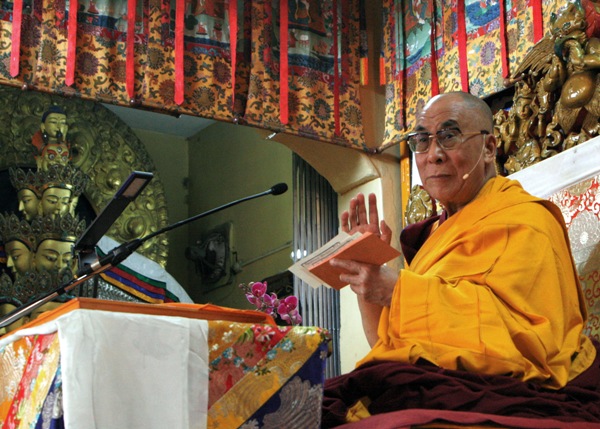
His Holiness the Dalai Lama giving teachings at Namgyal Monastery. Photo by Abhishek Madhukar

I loved that last week I happened to get back to Dharamsala just in time again for the Dalai Lama’s teachings. This one was on Nagarjuna and Tsongkhapa‘s writings, at the request of a Taiwanese group. Great bookend that I arrived Dharamsala first in August to attend a teaching before leaving for the High Himalayas, and then arrived again to attend a teaching after my journey! This one was four days long, and included an initiation for Vairocana tantra. The town swells with visitors and cars during these times, and then very quickly shrinks back when the teachings end.

I was so happy also to return to my little home-away-from-home here. Very grateful to a friend for helping me find this place, in prime location close to Namgyal Monastery, with wraparound terrace, mountain view, morning sun streaming in. It’s clean, no bad mildew or mold odors like many spaces here are stricken by because of monsoon.

Speaking of monsoon, it is still raining here! Locals said it not only began early this year and would normally be over by mid-September, but is still lingering. I have been caught in it again and totally drenched, thinking rueful thoughts to myself as my pants were soaked and my shoes like wet squishy sponges that would take days to dry. I had expected that by my return in October the rainy season would be over. But, well, who am I to complain? I haven’t even had to live through months of this!

And let me quickly add, it’s better. Did I mention the sun? Yes, many mornings it does come streaming into my room. Such a joy to wake up to! The weather pattern currently is, some sun in the morning, and then by afternoon or evening the mist and clouds roll in. The whiteout this creates make the visibility of the switchback roads about 12 feet ahead.

Sunny view, Dharamsala
Monsoon mist view, Dharamsala
Monsoon whiteout mist view, Dharamsala

Upon my return, I met with two geshes for further guidance on research resources and references. I’ve now got thousands of photos and image management to do, and will be spending time identifying what I’ve shot.

I think I will be frequenting the Tibetan Library & Archives a lot. Oh, and what a sight to see when I toured it! It has been, and is still, undergoing renovations since I was last here three years ago. The director is commendably bringing it into the 21st century! I’m thrilled to see that the old museum, previously saddled by poor lighting and exhibition conditions, is now newly expanded and nearing completion. There will be proper track lighting, display cases, and descriptive placards to do its fine collection of paintings and sculptures justice. The library stacks are newly organized in archival and accessible contemporary shelving. Their collection of sacred texts, which are tens of thousands of leaves of text traditionally bundled and kept tied together in fabric, is now being digitally scanned and stored.  What else…Oh, a New Media Department! A room with computer monitors dedicated to storing and presenting its new collection of videos and other digital media on Tibetan subjects. Lastly, soon to come will be a new floor of offices and administrative space.

Meanwhile, J organized a film night in which my work was featured along with an American documentary filmmaker, Ronny Novick. In attendance were two chodpas, lay tantric practitioners who do special meditation practices at cemetaries in order to cut through ego and realize emptiness, and who were interested in my latest animation Into the Midst because they said it’s just like what they visualize when they practice Chod. Wow. The conversation that ensued with these Kagyu yogis about some of their inner experiences was eye-opening.

Chodpas are also spiritual healers, and as traveling mendicants, may be invited by community members to conduct prayers for the deceased, the living, and those believed to be wandering spirits.  See them in a Chod prayer session here.

Tibetan Buddhist chodpas, Dharamsala, India
Two chodpas, Tibetan Buddhist mendicants who live by travelling and receiving alms for their prayer services, engaged in a Chod session. Tibetans have a strong tradition of welcoming chodpas to stay at their home for a day or two to say prayers for the deceased, the living, and wandering spirits.
Photo by Tenzin Tsundue.