Chogyam Trungpa Rinpoche

Backwards in Time for the Sake of Mandalas

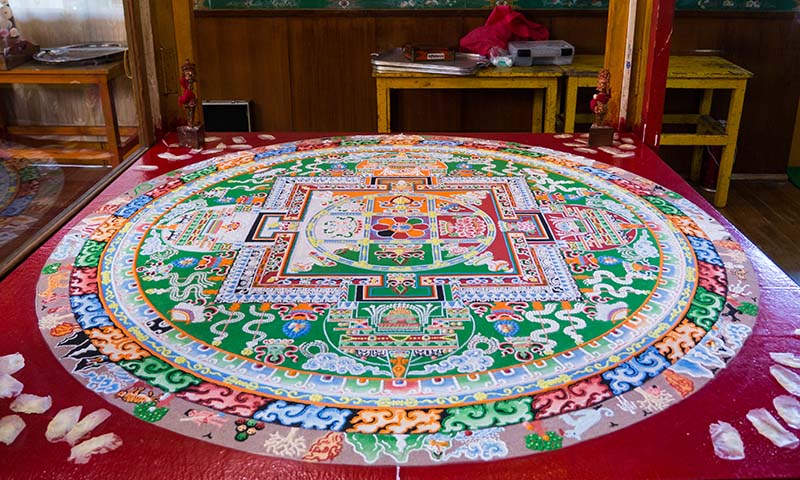
Yamantaka Sand Mandala
Yamantaka Sand Mandala, Namgyal Monastery, India. © 2010, Eva Lee.

I’ve gone about it all backwards. Backwards in time, in pursuit of mandalas. It all started when I heard that a sand mandala was going to be made at Namgyal Monastery in Dharamsala, India, in 2010. So I went there, and found out that it was a Yamantaka mandala, part of a ten-day-long highest yoga tantra ritual which occurs annually at the Dalai Lama‘s personal monastery. My previous post here describes what little I knew then as I observed and documented the creation and dissolution of it. The resultant film and photographs can be seen here.

When I came back to the U.S., it was as if a floodgate had opened. I needed to learn more. No, not just more, but all I could about Tibetan mandalas–about their variety, their purpose, their history, the meditation practices they engendered, and so forth. What did it all really mean? What modern significance did it have?

My bookshelves began to fill up with writings about tantra and Buddhist philosophy, written by the first Tibetan teachers to venture into the Western world, post-1959 exodus from Tibet. Titles by the Dalai Lama, Chogyam Trungpa Rinpoche, Lama Thubten Yeshe, Dilgo Khentse Rinpoche, as a few examples, abounded. I also read works by contemporary lamas like Dzogchen Ponlop Rinpoche, Pema Choedron, Tsoknyi Rinpoche, Tenzin Palmo. Tibetan scholars and historians David Snellgrove, Robert Thurman, Deborah Klimburg-Salter, Martin Brauen, and others figured in there, too.

All this, in addition to my previous discoveries of well-respected meditation teachers from other Buddhist traditions–Sharon Salzberg, Joseph Goldstein, Jack Kornfeld, B. Allan Wallace. I followed the writing of neuroscientists and clinicians, too, who studied or used meditation in their work. They were also involved with fascinating Mind & Life Institute research or conferences–Richard Davidson, Jon Kabat-Zinn, Paul Ekman, Daniel Goleman.

It was a mindfulness-neuro-tantric-philoso-fest that poured forth!

Meanwhile, in 2011, the ritual experiences continued. I attended the Dalai Lama’s Kalachakra event for World Peace in Washington D.C., and witnessed the Kalachakra Mandala.

Compassion Mandala created by Drepung Gomang Monks at Western Connecticut State University on the occasion of the Dalai Lama's talk on Creativity and Compassion, October, 2012.
Compassion Mandala created by Drepung Gomang Monks at Western Connecticut State University on the occasion of the Dalai Lama’s talk on Creativity and Compassion, October, 2012. © 2012, Eva Lee.

In 2012, I was at the Dalai Lama’s talk at Western Connecticut State University at which time I encountered a Compassion Mandala.

At both events, I had the wonderful opportunity of befriending and working with monks, nuns, plus other Buddhist practitioners and followers.

It was a steady flow. The waters at the floodgates just did not tire out. Answers came, and new questions arose.

Thus, on the heels of this, last year in 2013 I arrived back to India to experience and research rare Indo-Tibetan mandalas in Himalayan monasteries of Spiti, Lahaul, and Ladakh. How might they have evolved into Tibetan forms that we know today? What was this Indo-Tibetan 10th to 12th century period called the Second Great Transmission of Buddhism from India to Tibet? What did the sacred art look like? What did it mean?

View of mandala wall painting, Nangbarnangzad, Mangyu Monastery, Ladakh
View of mandala wall painting, Nangbarnangzad, Mangyu Monastery, Ladakh. © 2013, Eva Lee.


At the end of my travels through the Himalayan high altitudes, I then thought, let’s reel back in time some more. What came before the Indo-Tibetan era?

The answer was, Indian Buddhism, which could be seen at Ajanta and Ellora Caves where there are remains of elaborate 2nd to 8th century C.E. wall paintings, sculptures, and architecture. Such purely Indian Buddhist art is still preserved at these South Indian sites in the state of Maharashtra.
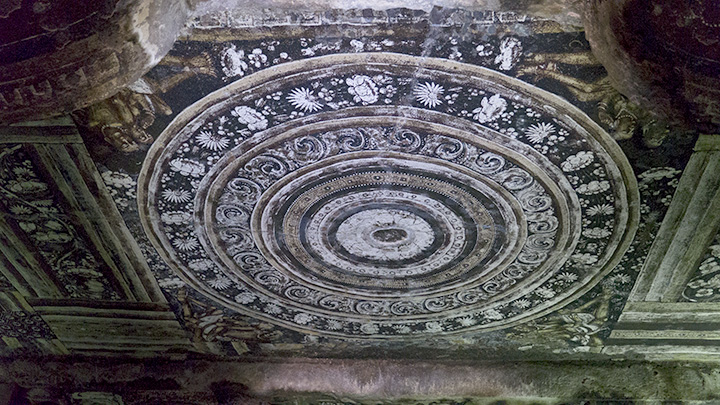
Ceiling painting, Ajanta Cave 2, near Aurangabad, India
Ceiling painting, Ajanta Cave 2, near Aurangabad, India. © 2013, Eva Lee.


Finally, what might have come even before this in India? I mean in B.C.E. times. When I searched further, it seems that the Buddhist art historical record stops here. According to historians, not much still exists before the 1st century C.E. Little is known in India archeologically prior to this time.

So what’s it all about? Why would an artist go for all this? New artwork from my Fulbright experience does beckon me in the studio.

I guess I’m just driven by the big questions about mind and reality, which Buddhist philosophy seems to address best. And moreover, that largely works within a Western scientific paradigm. It doesn’t hurt, either, that an affable spiritual leader like the Dalai Lama continues to inspire and exemplify how one can be intellectually sharp, existentially awake, and compassionately engaged in the world. Despite being a keeper of complex Tibetan rituals and esoteric tantric teachings, he can still keep it simple and distill wisdom down to these words: “There is no need for temples, no need for complicated philosophies. My brain and my heart are my temples. My philosophy is kindness.”
But Wait, a Bit about Mandalas

Okay, I know I promised to post Part Two of Tabo Monastery next, but as I’ve been writing, I’ve found it necessary to do a lot of explaining.  In fact, so much explaining in between the photos of Tabo’s interior that it’s a bit interrupting. So I’ve decided to get the explaining done with first. All right with you? Great, read on!

When I first came to Namgyal Monastery in 2010 to observe and document a highest yoga tantra ritual Yamantaka, I knew precious little about the vast world of Tibetan Buddhist tantric deities. What I knew was that an elaborate sand mandala would be made by the Dalai Lama’s monks in their temple in McLeod Ganj, India. I did not know at that time, for example, that this intricate 2-dimensional Yamantaka design represented a 3-dimensional palace, in which the deity resides at the center.

Yamantaka Sand Mandala
Yamantaka Sand Mandala, Namgyal Monastery, India

I learned that as a sacred art, whether made of sand, cloth, or metal, its purpose is to be a meditation aid to a tantric practitioner. A sort of blueprint, a sand mandala usually depicts a square multi-storied abode with four gates centered within a circle. Every element, from color, dots, vases, banners, letters, animals, etc., represents an essential part of the deity, his or her teachings, and Buddhist philosophy. Each deity in turn has a retinue of associated deities, which are also depicted. A person contemplating the mandala imagines entering into its palace and encountering all these elements, which is to say, meditates on the qualities and teachings they symbolize. To a devout practitioner, a mandala ultimately represents the mind of the Buddha.

An esoteric and advanced practice, Tibetan Buddhist tantra (also known as Vajrayana) is intended for the properly receptive initiate, with guidance from a qualified teacher or lama. It is an accelerated, experiential way to realize the Buddhist wisdom of the ultimate nature of mind and reality, and great compassion.  First taught by the historical Shakyamuni Buddha over 2500 years ago, it has been passed through oral tradition by lineage teachers. Its goal is enlightenment of the practitioner for the benefit of all sentient beings. And, believe me, this means all.  One of my favorite little prayers is one I learned on a meditation retreat, and it goes like this:

May all beings, large or small
or middling, near or far,
visible or invisible,
born or yet to be born,
May all beings be happy and content.
Let no one deceive another.
Let no one despise another,
whether out of greed, hatred, or ignorance.
And as a mother would risk her life
to save her only child,
let us cultivate this feeling
of loving friendliness towards one another.

Quite a vast scope!  And speaking of scope, there are literally hundreds of tantric deities, each with unique mandalas representing different sets of details and qualities specific to his or her teachings and practice. All varieties transmit fundamentally the same Buddhist wisdom and compassion, but each deity provides a different identity with which practitioners, according to their particular personality, can relate to or find affinity with. It is important to note that it is understood in tantra that none of these deities are real in the conventional sense. They do not exist, but are symbols, visualized in their mandala in a specific and procedural meditation practice.

This multiplicity is something Buddhism shares with its Hindu beginnings.  Prince Siddhartha, after all, was born and raised a Hindu before his ascetic wanderings led him to enlightenment as Shakyamuni Buddha.  I really appreciate India’s cultural acceptance of many-paths-to-the-same-truth.  I understand that Hindu deities are so vast they number in the millions.  This acknowledgement of relativity, even acceptance of the co-existence of apparent contradiction, is truly an admirable hallmark of Hinduism, and in particular, Buddhist non-duality.

Although intricate, aesthetically compelling, and often mysterious to the non-practitioner, mandalas are meant for religious use and are not intended as works of art for museum or private collection. In fact, I had occasion recently to discuss this very topic with a Buddhist nun.  Her position was that tantra is a secret and profound practice, the art of which should only be for the eyes of practitioners.  What would it serve to reveal what is not meant for the uninitiated? While I can understand her viewpoint, I believe that since the Tibetan diaspora has led to the spread of Buddhist teachings, and the increasingly ubiquitous access to seeing tantric mandalas, it is better for the sake of education to reveal some things about them accurately rather than risk erroneous speculation and misunderstanding.

In 1988, the Dalai Lama permitted the first public construction of a mandala in the West as a means of teaching about and preserving Tibetan culture. This was the Kalachakra Mandala, an example of which can be seen here, constructed in sand at the Museum of Natural History in New York City by Namgyal monks from Dharamsala, India. He also felt that it would be a benefit because a mandala is thought to bring peace and harmony to the area where it is being created. Even viewing a mandala is believed by Buddhists to be enough to effect positive change for greater compassion, awareness, and a better sense of well-being.

Since the construction of this first mandala in the West, many have been created all over the world. Drepung Gomang Monastery in Southern India has a group of monks who come to the United States annually to demonstrate their arts through the Sacred Arts Tour.  Last year, I had the privilege to witness and document a Compassion Sand Mandala which these monks made as an offering to the Dalai Lama on the occasion of his talks on Compassion and Creativity at Western Connecticut State University.

Beyond the artistic representation of a mandala, there is the mandala principle, which I believe was first clearly articulated and taught in the U.S. by Chogyam Trungpa Rinpoche.  (See his book Orderly Chaos: The Mandala Principle) From a philosophical point of view, everything is dependently interrelated, the seeming order and chaos are one and the same, the joy and the suffering, and so forth.  The apparent dualities abound, and yet they are all constituently the same.

In real life situations, I think of mandala principle as Buddhism-in-action in the sense that your immediate surroundings is your mandala, and all the people you encounter are part of it, too.  You have Buddha-nature within you, and so do they.  With awareness and practice that comes from meditation, you have at every moment the potential to actualize compassion and wisdom in what you think, what you say, and what you do.