Dharamsala

Dharamsala Home Sweet Home

I find myself steeped in good memories of McLeod Ganj, Dharamsala, where I lived and continued research for over two months after I finished traveling through Spiti, Lahaul, and Ladakh.

Temple square, near Dalai Lama's Namgyal Monastery, McLeod Ganj, Dharamsala, India
Early morning at Temple Square, near Dalai Lama’s Namgyal Monastery, McLeod Ganj, Dharamsala, India
McLeod Ganj street in monsoon
Jogibara Road in monsoon season, McLeod Ganj, Dharamsala, India

Home of His Holiness the 14th Dalai Lama, Namgyal Monastery, the Tibetan government-in-exile, and a Tibetan and Indian community, this former British hill station in the foothills of the Himalayas attracts visitors from far and wide. They come to attend teachings, events, study, volunteer, get involved. There are a large number of Western expats living here, too.

I descended from the high altitudes and arrived in McLeod Ganj (approx. 6000 feet altitude) end of September. It was surprisingly still monsoon season, which is usually over by mid-month. But 2013 was a particularly long and relentless monsoon. Everyone agreed. It lasted well into October, and I was drenched many times mistakenly thinking I could quickly go from point A to point B and not get too wet.

The area is one of the wettest in the state of Himachal Pradesh, with up to 120 inches of rain from July to mid-September. 120 inches! In six weeks. That’s 20 inches a week, almost 3 inches a day! You gird yourself for constant moisture, fog, mold, and mildew. Hanging laundry takes close to two days to dry. Resident friends warned me to safeguard all my electronics by putting them in a closet with hot lamps shining on them. It’s practically a whiteout at times, dangerous for driving because you can’t see beyond 10 or 12 feet in front of you on mountainous hairpin turns.

Monsoon mist view, Dharamsala
Whiteout monsoon mist view, McLeod Ganj, Dharamsala

Downpours pelt you like sheets of water performing a sports arena wave (you know, where sports fans get up from their seats and raise their arms overhead in succession). No really, you can actually see this phenomena of denser sheets of rain cascading across less dense ones over the valleys and on the streets. An umbrella is futile. I used one anyway out of stubborn habit, and I was almost always ruefully muttering to myself when I arrived some place with clothing stuck to me like I had put them on straight out of a washing machine with a broken spin cycle. I finally learned that when a Dharamsala monsoon rain starts, you WILL be drenched unless you duck for cover. I started carrying a poncho. And there is a reason why locals wear flip flops and brave the wet streets open-toed. It’s because normal shoes become spongy, perpetually dank and musty.

And then, one day, it’s over! The clouds and mist clear up. The horizon expands and Dharamsala, or Dasa as it is fondly called for short, looks like this.

Post-monsoon season, sunshine galore in Dharamsala

Glorious and crisp, far as your eye can see. Warm and sunny.

View of McLeod Ganj, Dharamsala, India
View of McLeod Ganj near Namgyal Monastery, Dharamsala, India
View of McLeod Ganj, Dharamsala, India, from rooftop restaurant
View of McLeod Ganj from Ashoka Restaurant rooftop, Dharamsala, India
View of McLeod Ganj, near Namgyal Monastery

The street vendors no longer have to cover their wares from rain and mud with tarp.

Temple Road, McLeod Ganj, Dharamsala, India
Upper Temple Road, McLeod Ganj, Dharamsala, India

People enjoy outdoor dining and cafes again.
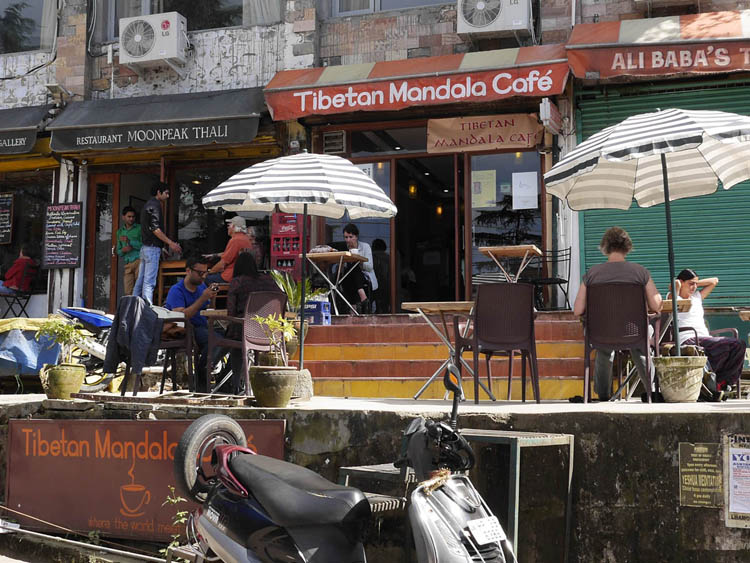
Cafes on Temple Road, McLeod Ganj, Dharamsala, India
Cafe row on Temple Road, McLeod Ganj, Dharamsala, India

This was my usual walk on Temple Road back to where I was staying, near Namgyal Monastery.
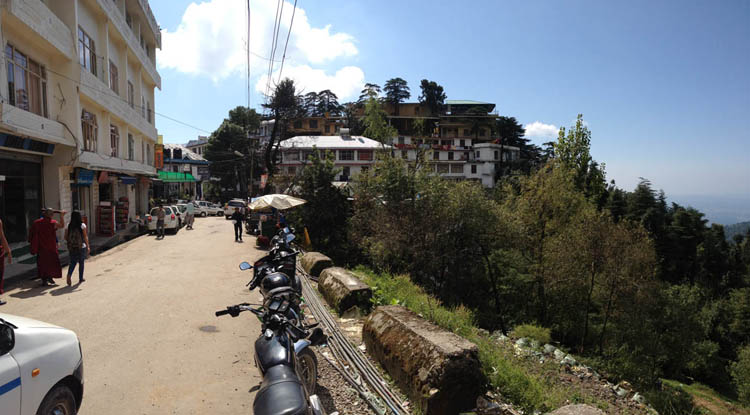
Temple Road, McLeod Ganj, Dharamsala, India
Lower Temple Road, heading towards Namgyal Monastery, McLeod Ganj, Dharamsala, India
Namgyal Monastery complex visible here through the trees
Namgyal Monastery visible here through the trees. The upper yellow buildings are open to the public where the main temples are located. Lower white buildings are monks quarters and other private areas.

Stores that I became acquainted with along the way.
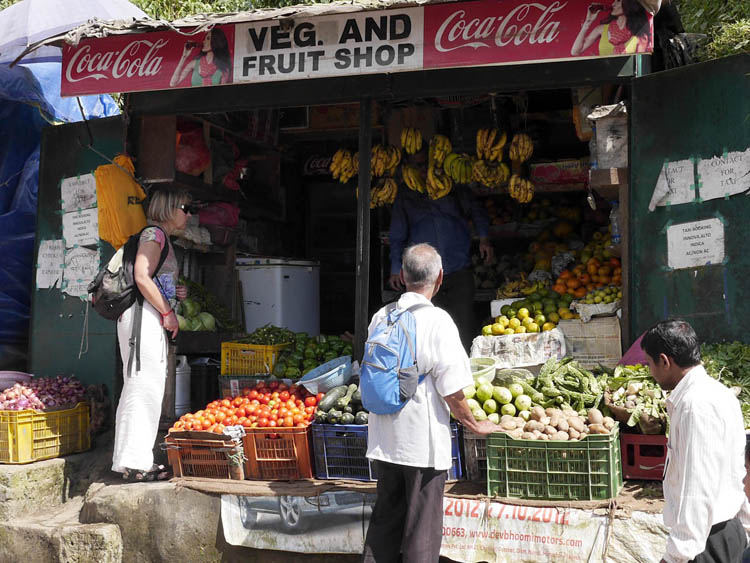
A typical fruit and vegetable stand, McLeod Ganj, Dharamsala, India

I was a regular at this stationary store. Go figure, I just never had enough pens or pads or envelopes, or superglue. I bought paper clasps here which served as clothespins or toothpaste tube holders, or food clips. Travel makes me look at objects more resourcefully.

My local stationary supply store on Temple Road, McLeod Ganj, Dharamsala, India
Local stationary supply store on Temple Road, McLeod Ganj, Dharamsala, India

This shop always caught my eye with its colorful display.

Clothing store with Western fashions and trekking gear, Temple Road, McLeod Ganj, Dharamsala

At left, the location of a trusty ATM machine! Very important. I was grateful that it always worked, which is not always the case elsewhere in India.

Jogibara Road, McLeod Ganj, Dharamsala, India
Continuation of Temple Road heading towards the main chowk or square, McLeod Ganj, Dharamsala, India

This is the raucous main square of McLeod Ganj, where several main roads converge. Where buses, taxis, and tourists depart and arrive. Where there is sure to be traffic jams throughout the day caused by congestion, narrow roads, crossing people animals.

The raucous main chowk or square, always a busy meeting place, McLeod Ganj

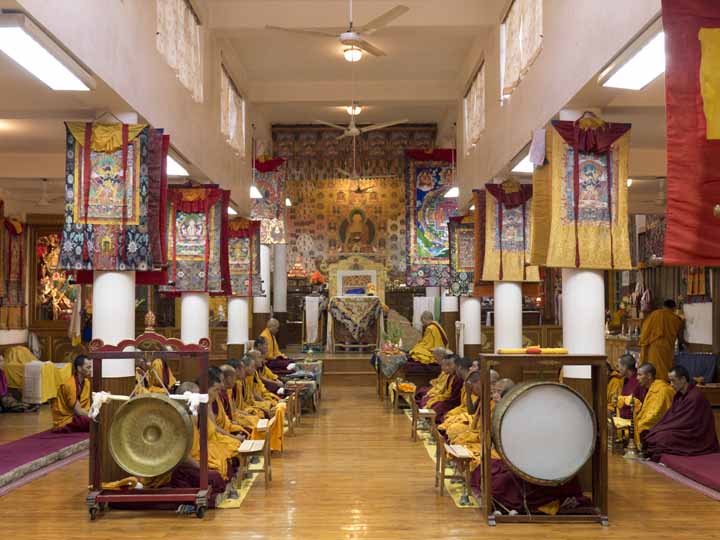
During my time in Dasa, I had the fortune of attending no less than three of the Dalai Lama’s teachings at Namgyal Monastery, including a Mind & Life conference, which I wrote about here. I also had the honor of audience with local rinpoches, geshes, monks and administrators, as well as observing and documenting the annual Yamantaka highest yoga tantra ritual.
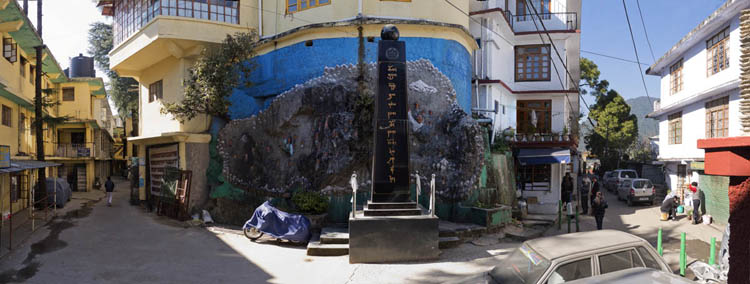
Panorama of entrance to Namgyal Monastery, McLeod Ganj
Yamantaka morning rituals, Namgyal Monastery, McLeod Ganj
Assembly for Yamantaka morning ritual, Namgyal Monastery, McLeod Ganj

In addition, I attended the Tibetan Film Festival, as well as the Dharamsala International Film Festival, both held at Tibetan Institute for Performing Arts (TIPA).

Tibetan Film Festival 2013 at Tibetan Institute of Performing Arts (TIPA), McLeod Ganj
Lunch hour outdoor performances during Tibetan Film Festival 2013,
held at Tibetan Institute of Performing Arts (TIPA), McLeod Ganj

Plus, a number of music-poetry-art fusion events staged by local artists. Poetry would be read during live musical performances, while a painter begins and completes a painting on canvas in one evening.
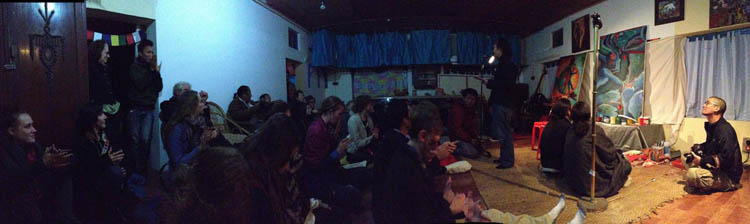
Music-poetry-art fusion event, Dharamsala, India

There was a revolving door of gatherings, which I’m grateful to Dasa friends for inviting me to. Diwali celebrations, dinners, movie nights, artist meetings, music jams, salons, fundraisers. Truly warm, good times.

1-Dasa (25)
A welcome daily visitor

When not out and about, I was in my apartment, which incidentally came with a kitty. She showed up on my terrace one day.

I must say she was a welcome visitor. Although she left a lot of nose smears looking in through my newly cleaned window, she did accompany me many days as I sat indoors editing footage, photo-correcting, researching, and writing.

Verma House, a lovely place to stay, McLeod Ganj
Evidence of looking in on me a few too many times

Which reminds me of a story I heard about the Dalai Lama, who once had two cats as pets. After they spent their last days with him in his palace, he decided he would not have pets anymore–too much attachment!

Yes, indeed, I was sad to leave this little one, but happy to learn that she actually belonged to my neighbor.

On my last day in Dharamsala, I left a bag of cat food at their doorstep, then went for a final kora around the monastery complex on this fine, scintillating morning.

Panorama of Namgyal Monastery circumambulatory, McLeod Ganj, Dharamsala
Panorama of Namgyal Monastery circumambulatory, McLeod Ganj

All photos © 2013, Eva Lee.

Transitions Back to the U.S.

Gee, I’ve so far recounted only the September travels through Spiti, Lahaul, and Ladakh. There’s also October, November, and December to cover. Keeping this travelogue about my Fulbright experiences is taking longer than I anticipated!  Editing photos (lots) and video (much) take time. So does research and writing.

And guess what? Now I have completed my Fulbright in India! Yes, that’s right, I’m back in the U.S.! It’s unbelievable how time flew by. I arrived just before Christmas holidays to rejoin family and friends, and rang in 2014 at home.

But, dear reader, there is much more to come. This blog is not over yet. After I finished traveling through the Himalayan high altitudes, I went to the lower altitude areas of Dharamsala, Bir, and Rewalsar (Tso Pema) to see the artwork of contemporary monasteries.

Plus, I also went to see the Buddhist carvings and frescoes of Ajanta, Ellora, and Aurangabad Caves in Southern India. These date from 2nd century B.C.E. to 8th century C.E., preceding the Indo-Tibetan period that I have been concentrating on in the Spiti, Lahaul, and Ladakh areas.  After researching the sacred artwork of 10th century monasteries such as Tabo, Lamayuru, Lhalung, Mangyu, and Alchi, I felt compelled to see what came before. 

Ajanta coming up next! Here is a sneak peak. I promise you’ll never think of the word “cave” the same way again! 

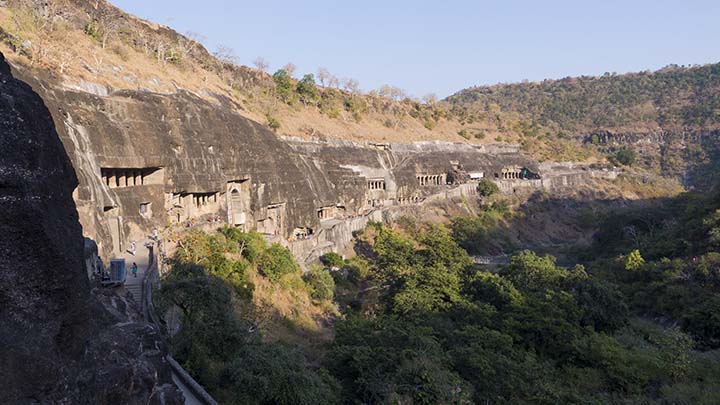
Ajanta Caves, a UNESCO World Heritage site, India
Ajanta Caves, a UNESCO World Heritage site located in a horse-shoe shaped river valley, approximately 30 elaborately carved and painted rock-cut caves dating circa 2nd century B.C.E to 480 or 650 C.E. Buddhist caves, near Aurangabad, India
Ajanta Cave 26, India
Ajanta Cave 26, a chaitya hall with stupa, colonnade walkway, and carved relief sculptures. Seen on left wall is Buddha in his parinirvana pose, India

All photos © 2013, Eva Lee.

It’s Yamantaka Time

I’ve been furiously writing here to get up-to-date, and even though I’m still working on September things seen and heard, I must now share that it’s Yamantaka time! I am currently documenting this highest yoga tantra performed annually at Namgyal Monastery here in Dharamsala.

2_1080803_72
Highest yoga tantra ritual, Yamantaka, begins pre-dawn at Namgyal Monastery, Dharamsala
1_1070590_yes_72
The moon shines over Dharamsala Valley as Namgyal monks begin pre-dawn prayers for Yamantaka ritual. This highest yoga tantra occurs annually over the course of about ten days at Namgyal Monastery.

Yamantaka began four days ago before dawn’s light with earth ritual prayers to prepare the ground for this sacred art.

3_1070714_yes_72
Offerings are made in the thekpu during earth ritual prayers to prepare the ground for the creating a sand mandala

Then came three days of intensive work for the monks to rasp colored sand through metal funnels to create intricate designs symbolizing the main deity and his retinue of associated deities within the palace. For more info on mandalas and tantric, see this earlier post.

4_1070825_1
Day one involves marking out the eight directions in white, and then monks draw the basic structure of the mandala in black ink before beginning with colored sand.
5_1070914_yes_1
The sand mandala begins with symbolic depiction of Yamantaka deity who resides in the center. A mandala is a two-dimensional representation of a thee-dimensional palace, used as an aide in tantric meditation practice.
6_1080037_yes_1
Day one of creating Yamantaka sand mandala continues, Namgyal Monastery, Dharamsala
7_1080107_yes_1
The mandala after the first day’s completion
8_1080149_yes
Day two of creating sand mandala. This monk is scribing a floral design with a pencil into the background sand, after which he will create it on top in other different gradated colors.
Day two of making Yamantaka sand mandala, Namgyal Monastery, Dharamsala
Day two of making Yamantaka sand mandala, Namgyal Monastery, Dharamsala. The four gateways to the palace can now clearly be seen outlined in black, flanked by black-and-white cornice design.
Day two of making Yamantaka sand mandala, Namgyal Monastery, Dharamsala
Day two of making Yamantaka sand mandala. The gateways are further elaborated as the green background color is begun for the next section. The monks began early morning and will work well into the night to ensure progress and completion of the mandala within three days.
Day two of making Yamantaka sand mandala, Namgyal Monastery, Dharamsala
Day three of making Yamantaka sand mandala, with completed gateways, banner designs, vases, and other symbols that are mnemonic devices for tantric meditation, Namgyal Monastery, Dharamsala
Day two of making Yamantaka sand mandala, Namgyal Monastery, Dharamsala
Working on the outer borders, day three of making Yamantaka sand mandala, Namgyal Monastery, Dharamsala
Day three of making Yamantaka sand mandala, Namgyal Monastery, Dharamsala
The sand is gradated on this outer border, day three of making Yamantaka sand mandala, Namgyal Monastery, Dharamsala
Day three of making Yamantaka sand mandala, Namgyal Monastery, Dharamsala
Working on the final outer border which represents the charnel grounds, day three of making Yamantaka sand mandala, Namgyal Monastery, Dharamsala

The sand mandala was just finished yesterday.

The completed Yamantaka sand mandala, Namgyal Monastery, Dharamsala

With the completion of the mandala, today was the generation stage of the ritual. The monks chanted while visualizing themselves arise as Yamantaka. Tomorrow begins three days of consecration, followed by fire puja, then dissolution of the mandala.

I love this bittersweet last part where the beautiful mandala is swept away. As George Harrison sang, all things must pass. It’s a lesson in the truth of impermanence and the wisdom of letting go. Some of the sand is given to visitors who come witness the event. Most of it is swept into a ritual vase that is then taken to a nearby body of water and poured into it. I think of it as sending good wishes and energy out into the world.

I look forward to seeing it again. It was a wonderful experience here three years ago. It will be a welcome deja vu. 

All photos © 2013, Eva Lee.

Dharamsala Return, Monsoon Mist, and Midst

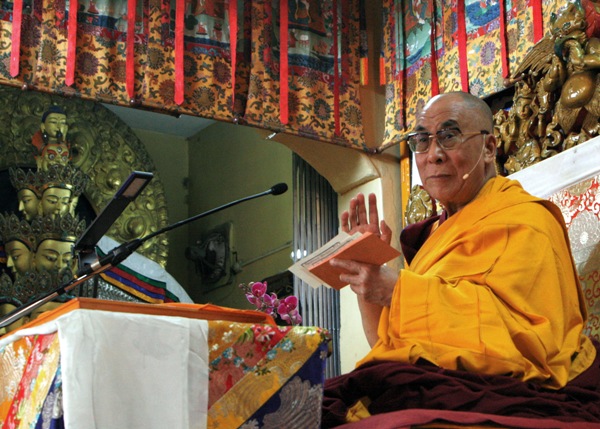
His Holiness the Dalai Lama giving teachings at Namgyal Monastery. Photo by Abhishek Madhukar

I loved that last week I happened to get back to Dharamsala just in time again for the Dalai Lama’s teachings. This one was on Nagarjuna and Tsongkhapa‘s writings, at the request of a Taiwanese group. Great bookend that I arrived Dharamsala first in August to attend a teaching before leaving for the High Himalayas, and then arrived again to attend a teaching after my journey! This one was four days long, and included an initiation for Vairocana tantra. The town swells with visitors and cars during these times, and then very quickly shrinks back when the teachings end.

I was so happy also to return to my little home-away-from-home here. Very grateful to a friend for helping me find this place, in prime location close to Namgyal Monastery, with wraparound terrace, mountain view, morning sun streaming in. It’s clean, no bad mildew or mold odors like many spaces here are stricken by because of monsoon.

Speaking of monsoon, it is still raining here! Locals said it not only began early this year and would normally be over by mid-September, but is still lingering. I have been caught in it again and totally drenched, thinking rueful thoughts to myself as my pants were soaked and my shoes like wet squishy sponges that would take days to dry. I had expected that by my return in October the rainy season would be over. But, well, who am I to complain? I haven’t even had to live through months of this!

And let me quickly add, it’s better. Did I mention the sun? Yes, many mornings it does come streaming into my room. Such a joy to wake up to! The weather pattern currently is, some sun in the morning, and then by afternoon or evening the mist and clouds roll in. The whiteout this creates make the visibility of the switchback roads about 12 feet ahead.

Sunny view, Dharamsala
Monsoon mist view, Dharamsala
Monsoon whiteout mist view, Dharamsala

Upon my return, I met with two geshes for further guidance on research resources and references. I’ve now got thousands of photos and image management to do, and will be spending time identifying what I’ve shot.

I think I will be frequenting the Tibetan Library & Archives a lot. Oh, and what a sight to see when I toured it! It has been, and is still, undergoing renovations since I was last here three years ago. The director is commendably bringing it into the 21st century! I’m thrilled to see that the old museum, previously saddled by poor lighting and exhibition conditions, is now newly expanded and nearing completion. There will be proper track lighting, display cases, and descriptive placards to do its fine collection of paintings and sculptures justice. The library stacks are newly organized in archival and accessible contemporary shelving. Their collection of sacred texts, which are tens of thousands of leaves of text traditionally bundled and kept tied together in fabric, is now being digitally scanned and stored.  What else…Oh, a New Media Department! A room with computer monitors dedicated to storing and presenting its new collection of videos and other digital media on Tibetan subjects. Lastly, soon to come will be a new floor of offices and administrative space.

Meanwhile, J organized a film night in which my work was featured along with an American documentary filmmaker, Ronny Novick. In attendance were two chodpas, lay tantric practitioners who do special meditation practices at cemetaries in order to cut through ego and realize emptiness, and who were interested in my latest animation Into the Midst because they said it’s just like what they visualize when they practice Chod. Wow. The conversation that ensued with these Kagyu yogis about some of their inner experiences was eye-opening.

Chodpas are also spiritual healers, and as traveling mendicants, may be invited by community members to conduct prayers for the deceased, the living, and those believed to be wandering spirits.  See them in a Chod prayer session here.

Tibetan Buddhist chodpas, Dharamsala, India
Two chodpas, Tibetan Buddhist mendicants who live by travelling and receiving alms for their prayer services, engaged in a Chod session. Tibetans have a strong tradition of welcoming chodpas to stay at their home for a day or two to say prayers for the deceased, the living, and wandering spirits.
Photo by Tenzin Tsundue.