Gandhola Monastery

Drilbu Ri Mountain Mandala

Sept 16th Drilbu Ri Mountain kora (circumambulation)

5 a.m. with flashlight in hand and some provisions in a backpack, I started out in the dark to meet my guide S at a spot on the Drilbu Ri trail marked by a large barren tree.

Beginning of trekking trail of Drilbu Ri kora (circumambulation) from Kardang Monastery, Lahaul
Beginning of trekking trail for Drilbu Ri kora (circumambulation) from Kardang Monastery, Lahaul. The destination is the top of the mountain near where those seven peaks appear at upper left.

I had spent the night at Kardang Monastery, and once again had the pleasure of the company of nuns. It’s remarkable how details of one’s life narrative can be dispensed with when there is just mutual warmth felt between people. We chatted with whatever English they had (and for my part, zero Tibetan) and with mutual hand gestures. They cooked thukpa noodles in a delicious vegetable soup. I hadn’t eaten much that day having worked through lunch shooting photos at Guru Ghantal, so I was happy to carb-up for the next day’s trek.

Lovely Kardang Monastery nuns making thukpa noodles for dinner
Drilbu Ri mountain as seen from across the Bhaga River, Lahaul

Drilbu Ri kora—my gosh, what can I say? Getting to the summit whooped me! At almost 15,000 feet (4400 meters) altitude, I was short of breath at the start, and then later gasping for breath every 10 to 15 paces of steep uphill climbing. We reached the top shortly before 10 a.m. My guide, bless him, was so patient, calm, and encouraging with the words, “Slowly, slowly…” which he repeated like a mantra, each time with a gentle head tilt, the infamous Indian bobble.

Drilbu Ri trek, Lahaul
About two hours into trekking with guide S, Keylong is seen below (looks like thin line) on the opposite mountain across the valley.
Drilbu Ri Mountain, Lahaul
Ascent further up takes you into an area filled with a kind of red grassy plant that colors the mountain side
Drilbu Ri Mountain, Lahaul
As we climbed higher the mountain curved more and changed to rocky terrain
Drilbu Ri Mountain, Lahaul
Further up, the mountain is steeper, more angled, and here is where we hit the snow line, snow visible on right

The last part was the steepest and most difficult. I marveled that I was still going on only half a Nutella sandwich, some pieces of chocolate, and two mango juices. Hardly nutritious, but then again, hunger becomes more of a concept, given the altitude and level of exertion.

Looking up towards the summit, Drilbu Ri Mountain kora, Lahaul
Looking up towards the summit of Drilbu Ri Mountain, the top being where those prayer flags look like a dotted line. At this point more snow on the ground. Yes, it looks steep and then got even steeper!
Drlbu Ri Mountain, Lahaul
Still looking up at the summit, the ascent gets more vertical and narrower!
Finally at the top, you arrive through this narrow notch in Drilbu Ri Mountain
Finally arrival at the summit of Drilbu Ri by scrambing through this narrow and angled pass

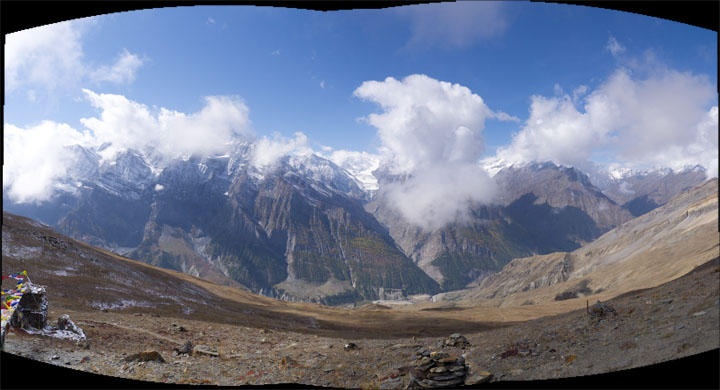
Well, it was worth being reduced to crying “uncle.” When we got to Drilbu Ri’s summit, it was indeed a living mandala as the locals promised. 360-degree panorama of magnificent glacial mountains that take your breath away–literally and figuratively! No wonder the Himalayas is called “the roof of the world.” As you stand stuck in awe, the amazing height and expanse somehow melds with your inner sense of worldy, or maybe otherwordly, home. Yes, you, small and insignificant in this vast geological time and space, still get to be part of it all.

View of Keylong down in Bhaga River Valley from the summit for Dribu Ri Mountain
Dribu Ri Mountain on other side, Lahaul
Unbelievable immensity, view of the other side of the Drilbu Ri Mountain looking down towards Gondhala Village. This is where you begin the descent down, a lot less steep but looks deceptively smooth and “easy.”
View of Keylong down in Bhaga River Valley from the summit for Dribu Ri Mountain, Lahaul
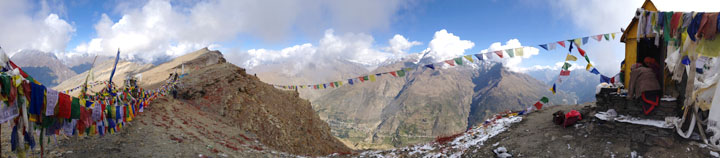
View of Keylong down in Bhaga River Valley from the summit of Dribu Ri Mountain, Lahaul. On right is a Buddhist shrine housed in a small yellow structure in which Lahauli pilgrims are lighting butter lamps and incense as offerings. Hidden under many kata offering scarves further to the right is also a small Hindu shrine dedicated to the sacred union of Shiva and Parvati.
Butter lamps and other offerings in Buddhist shrine on top of Drilbu Ri Mountain, Lahaul. Hindus also consider this a sacred site and there is a shrine, too, dedicated to the sacred union of Shiva and Parvati
Butter lamps and other offerings in Buddhist shrine on top of Drilbu Ri Mountain, Lahaul. Hindus also consider this a sacred site and there is a separate shrine dedicated to the sacred union of Shiva and Parvati.

In fact, Drilbu Ri is sacred to Tibetan Buddhists as Chakrasamvara’s abode. It is important to understand here that none of the Buddhist tantric deities are believed to exist externally. Rather, they represent the ultimate and profound state of mind which sees that self and phenomena are empty of inherent existence. If this is an intriguing idea for you, then you may want to learn more about the distinctive Buddhist philosophy of dependent origination.

Chakrasamvara, wall painting, Gandhola Monastery, Lahaul, India
Chakrasamvara, wall painting, Gandhola Monastery, Lahaul

Chakrasambava is understood as a wrathful manifestation of Buddha for combating the compelling mental condition of perceiving things as concretely existing. Tantric yoga practices are essentially visualizations of the deity that enact illusion and dissolution of self through identifying with the deity’s Buddha-nature. With the initiation and guidance of a qualified teacher, the practitioner gains the benefit of seeing things as they really are—that is, illusory and empty of inherent existence. This is what’s called wisdom. Cultivating wisdom together with compassion form the complementary two wings for full flight to enlightenment.

Tibetan Buddhists believe that pilgrimage to sacred sites like Drilbu Ri is a great purification of self-centered concerns in order to adopt more expansive mental states that are conducive for wisdom. Overcoming hardships and challenges on a kora can act as a propeller on one’s spiritual path, especially if the site has been graced by the spiritual energies of realized practitioners. Masters such as Nagajuna, Ghantapa, Gotsangpa, Orgyenpa, Taktsang and Rangrik Repas have come to meditate on Drilbu Ri over the past millennia.
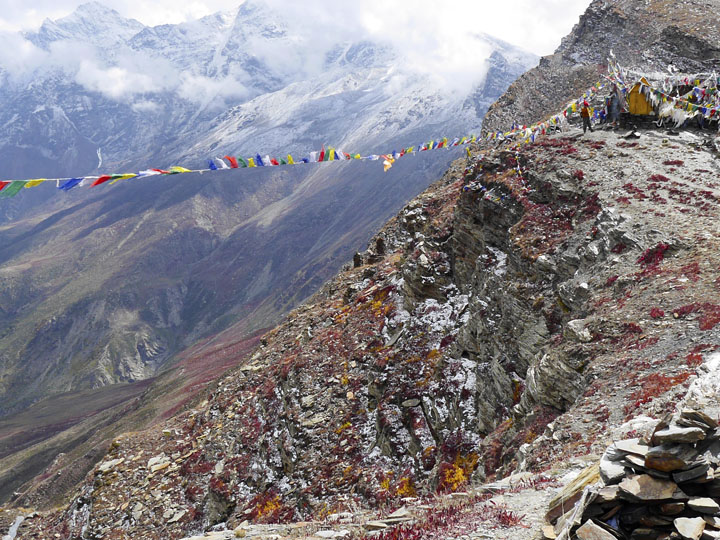
View of Keylong side of Drilbu Ri Mountain, Lahaul
View of Keylong side of Drilbu Ri Mountain, looking towards the shrines and my guide S. It’s hard to imagine how people manage to string up these long expanses of prayer flags over the terrain!

Traditionally, Tibetans have traveled hundreds or even thousands of kilometers, often in full body prostration, to complete such pilgrimages. I understand that Drilbu Ri and Mount Kailash are two of the foremost sites for kora. It is said that the completion of such circumambulations bring manifold results, multiplying divine merit.

Tibetan Buddhist prayer flags, summit of Drilbu Ri Mouuntain, Lahaul
More expanses of prayer flags at the summit of Drilbu Ri Mountain. On the left side is the descent down to Gondhala and on the right side was the ascent up from Kardang Monastery/Keylong side, Lahaul

As for me, I came here to research Indo-Tibetan mandalas as a visual artist. Then found, as I was told, that Lahaul does not have so much in the way of drawn images of mandalas. Rather, the land itself is a mandala which one should experience physically. I’m glad I did.

View of Keylong side of Drilbu Ri Mountain
Numerous stupas are found all along the top ridge of Drilbu Ri Mountain, like sentinels holding up prayer flags, Lahaul
Top of Drilbu Ri Mountain, Lahaul
Exhilaration, okay, maybe augmented by some oxygen deprivation at the summit of Drilbu Ri Mountain, about 15,000 feet (4400 meters) altitude.

The weather was such a wonderful wide range all that day. Dawn began with some overcast clouds, which then gradually lifted later in the morning to give way to wholesome, crystal clear sunshine by late morning when we reached the top. After a picnic brunch of omelette sandwiches with Indian pickles which S brought with him, a light snowfall came to herald our time to pack up and start the hike down the other side of Drilbu Ri Mountain. The destination was Gondhala Village, where we would then get a bus or taxi back to Keylong.

Oh, and by the way, I thought making it to the top of Drilbu Ri meant the hard part was over. Not so. The return on the other side of the mountain was less steep, more graduated but MUCH longer distance. It was also colder and so windy at times that you literally had to resist being blown over a decline. I was so grateful S had brought me an extra jacket to wear.

Where the descent on the other side of Drilbu Ri Mountain begins, looking towards Gondhala Village, Lahaul
Where the descent on the other side of Drilbu Ri Mountain begins, looking towards Gondhala Village, Lahaul. The clouds were surreal, at once looking like huge chunks but then moving like ethereal wisps across the mountains.

Descending was a different stamina test, for the knees and thighs instead of the breath.

The descent on the other side of Drilbu Ri Mountain begins, looking towards Gondhala Village, Lahaul

Later, I felt like my eyes were playing tricks on me because Gondhala never seemed to come any closer no matter how long and how far we walked! The village visually seemed like it stayed the same distance away.

The continued descent on the other side of Drilbu Ri Mountain begins, looking towards Gondhala Village, Lahaul
13-Drilbu Ri_72
Thumbs up for completion of Drilbu Ri kora by one experienced trekking guide, and one unsuspecting but game novice.

I finally did get exhausted and waved the white flag. S could see that I indeed had had enough, so instead he lead me to the closest point on the road, and then called trusty ol’ driver D (thank you! thank you!) to pick us up for the ride back to Keylong. I was never so happy before to see a road—wonderful, smooth, FLAT road!

The continued descent on the other side of Drilbu Ri Mountain begins, looking towards Gondhala Village, Lahaul
At last, reaching the road on the other side of Drilbu Ri Mountain. Gondhala Village still seemed far around the bend!

All photos © 2013, Eva Lee.

Guru Ghantal’s Unusual Mandalas and Hairy Mystery

Sept. 15, 2013     Lahauli adventure continues…

2_IMG_2739_yes_72
Guru Ghantal (Gandhola) Monastery on Drilbu Ri mountain slope, oldest existing monastery in Lahaul

Today was Guru Ghantal. Magnificent! Also known as Gandhola, it is the oldest of the existing monasteries in Lahaul with archeological evidence dating to 1st century C.E. What a place of tremendous significance for its location, history of great masters and activities, and having an ancient charnel ground considered one of the eight sacred ones in the Buddhist world. It is said that the unparalleled 2nd century C.E. Buddhist scholar and meditation master Nagarjuna, founder of Madhyamaka (“Middle Way”) school of thought and considered one of the most important philosophers second only to the historical Buddha himself, spent time in retreat here.

Guru Ghantal on Drilbu Ri mountain slope on upper left, as seen from across Bhaga Valley. Thupcholing Monastery is below on the plateau. The green roofs are retreat huts for practitioners, Lahaul
Guru Ghantal on Drilbu Ri mountain slope on upper left, as seen from across Bhaga Valley. Thupcholing Monastery which administers Gandhola is below on the plateau. The green roofs are retreat huts for practitioners. Below is Tandi bridge which crosses the Bhaga River where it joins the Chandra River, Lahaul.

Driver D dropped me off, and after ensuring that the nearby Thupcholing Monastery monk who is associated with Guru Ghantal was going to take the hike up with me, he waited at the bottom rather than accompany us. It’s a pretty steep climb up overgrown paths and sandy trails. The young monk, of course, not only being young but not challenged by high altitude like I was, darted up and would wait patiently for me to catch up, meanwhile chatting about Sino-Indian relations and asking enthusiastically about Western thought. I thought to myself, a veritable 21st century monk right here before me!

On the hike up to Guru Ghantal Monastery with monk guide, Lahaul

Guru Ghantal’s namesake comes from another celebrated master named Drilbupa Guru Ghantapa. He hailed from Nalanda originally as a Brahmin prince who later became a Buddhist scholar monk, and then a yogi. He is revered for introducing a highest yoga tantra, Chakrasamvara, and for attaining full enlightenment by meditating on Drilbu Ri. This mountain also gained its name from him and has since been considered the sacred abode of the deity. Indeed there is little in Lahaul that does not owe its spiritual allegiance to Guru Ghantapa since the area is believed to be charged with the profoundness of his enlightenment and Chakrasamvara’s energy.

As for the monastery’s sacred location, it is not only situated on the slopes of Drilbu Ri, for centuries a pilgrimage site as important as Mount Kailash, it also overlooks the confluence of the mighty Bhaga and Chandra Rivers. Hindus and Buddhists alike consider this an auspicious, powerful junction physically and symbolically, a holy place to cremate the deceased and spread their ashes.

The sacred triangle formed by the confluence of Bhaga and Chandra Rivers, Lahaul
Gandhola as it looks today, in need of preservation, Lahaul
Gandhola as it is today, with corrugated tin roof and in need of preservation, Lahaul. Photo: Kishore Thukral

Today, Guru Ghantal is largely empty and needs preservation. In its heyday over the past millennium, the complex of hermitage, meditation caves, and stupas garnered the presence of great Indian and Tibetan masters such as the ones mentioned, as well as Gyalwa Gotsangpa (whose imprints in stone I’ve written about here) and the Siddha Orgyenpa. When Indian Buddhism declined in about the 13th century, Tibetan Buddhism of the Drukpa lineage continued to flourish here, with Gandhola as the central monastery in Lahaul.

Ground floor of main temple, Gandhola, Lahaul, India
Ground floor of main temple, Gandhola, with statues of Avalokiteshvara, Guru Rinpoche, Lama Temphel, Lahaul

In the latter half of the 19th century, Drukpa spiritual leaders of Bhutan sent Lama Tashi Temphel to Gandhola to guide and teach Lahaulis. He was not only an accomplished lama but he was an artist and physician as well. This brought about a revitalization, because at his leadership, monasteries were restored, rituals improved, and temples beautified with paintings he himself did or trained others to do.

Second floor of Gandhola where there are adjoining monks quarters, Lahaul
Second floor of Gandhola where there are adjoining monks quarters, the walls were likely painted with Buddhist imagery at one time but today are completely undecorated, Lahaul
Another view of second floor, Gandhola Monastery, Lahaul
View of third floor from second floor looking up into ornate coffered ceiling, Gandhola Monastery, Lahaul
Painted coffered ceiling, Gandhola Monastery, Lahaul
The painted coffered ceiling with unusual mandalas, Gandhola Monastery, Lahaul. Photo: Kishore Thukral

According to the book Garsha (see this post for further info), all the sacred deities, mandalas, and Drukpa lineage holders at Guru Ghantal were painted by Lama Tashi Temphel circa 1870.  He also painted images at Tayul around this time during its expansion. He built Thupcholing for novices, who would spend three years there before moving on to practice at Guru Ghantal or other monastery. All ancient statues that were originally at Gandhola now reside there.

Center of ceiling with what was likely Chakrasambava mandala, Guru Ghantal Monastery, Lahaul
Center of ceiling with what was likely Chakrasamvara mandala, Guru Ghantal Monastery, Lahaul

Upon reviewing recently with a geshe the photographs I took of the ceiling, he remarked that the mandalas were unusual. The center one, which is rather damaged, is very likely a Chakrasamvara mandala. He believes all smaller ones, though their designs are unconventional, are dakini mandalas.

Very likely a dakini mandala, unconventional design, Guru Ghantal Monastery, Lahaul

The ceiling designs all appear to have been painted on paper and then installed. Although there are signs of water damage and disintegration, the overall state is quite intact and still vibrant. The detailed scrollwork is particularly fine and delightfully detailed.

Very likely a dakini mandala, unconventional design, Guru Ghantal Monastery, Lahaul
Very likely a dakini mandala, unconventional design, Guru Ghantal Monastery, Lahaul. Of note in this one are the stupas at each of the four gateways which are not painted in conventional proportions.
Very likely a dakini mandala, unconventional design, Guru Ghantal Monastery, Lahaul
Very likely a dakini mandala, unconventional design, Guru Ghantal Monastery, Lahaul.
The mantra Om Mani Padme Hum, ceiling of Guru Ghantal Monastery, Lahaul

On the beams appear lineage masters.

Guru Ghantapa, from ceiling of Guru Ghantal Monastery, Lahaul
Drukpa lineage masters on beams of ceiling, Guru Ghantal Monastery, Lahaul

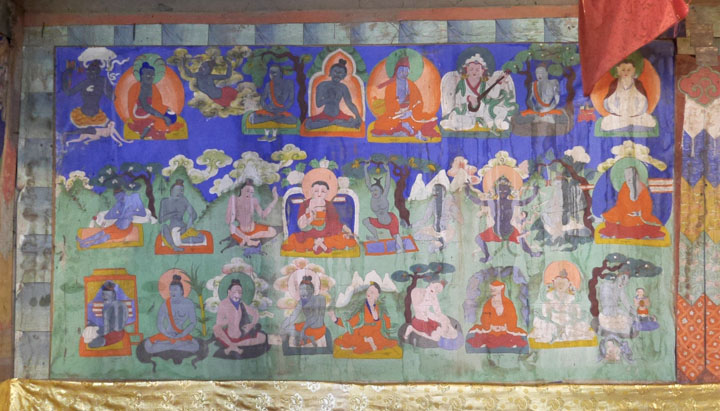
On the walls of the third floor are paintings of deities on canvas.

Panorama of third floor wall paintings, Guru Ghantal Monastery, Lahaul
Possibly Guhyasamaja, wall painting, Guru Ghantal Monastery, Lahaul
Yamantaka, wall painting, Gandhola Monastery, Lahaul
Chakrasamvara, wall painting, Gandhola Monastery, Lahaul, India
Marlug Hevajra. wall painting, Gandhola Monastery, Lahaul
Chakrasamvara, wall painting, Gandhola Monastery, Lahaul
Wall paintings on third floor of Guru Ghantal Monastery, Lahaul

As it turned out, my driver should have come up to see Gandhola. I saw a special thing in the gonkhang (chapel usually dedicated to guardian deities) off the main hall of the temple which D was interested in and had never seen.  It was dreadlocks of human hair that is supposed to be endowed with spiritual power.

Human hair hanging from beam of gonkhang, Guru Ghantal Monastery, Lahaual

According to legend, hundreds of years ago, a lama was sitting in retreat meditating in this prayer room when he was accosted by a spirit.  He managed to grab the spirit by the hair, and hence, this is the miraculous proof of it. D said that encounters with the hair can impart energies, positive or negative, depending on whether your heart is good or not. Gee, does it make a difference that I thought it was yak hair at first? But indeed on closer examination, it looked like human hair, which effects a weird feeling to see such a fetish of unknown origin and purpose.

I heard an alternative suggestion. In the 12th century, revered scholar Sakya Pandita was famous for defeating masters of other religions in debates. In those days, religious debates were taken very seriously. The loser had to adopt the victor’s religion, and in the case of the loser adopting Buddhism, s/he must cut their hair. The loser’s hair therefore symbolized victory for Buddhist philosophy and debate. Perhaps it’s possible that the hair at Guru Ghantal is related to such a debate outcome.

Gonkhang, Guru Ghantal Monastery, Lahaul

The gonkang also contained a standing chest that had two protector deity masks hidden inside. These are typically used in Tibetan Buddhist cham dances. Lama Temphel is credited with improving the cham dances of Shashur Monastery. These ritual are usually created through visionary means. Danced by monks, they are said to be able to transmit profound Buddhist states to the beholder because they are meditative performances.

View of Lahaul Valley from Guru Ghantal (Gandhola) Monastery, where its sacred charnel grounds--one of the eight in the Buddhist world--are marked by an ancient stupa, Lahaul.
View of Lahaul Valley from Guru Ghantal (Gandhola) Monastery, where its sacred charnel grounds–one of the eight in the Buddhist world–are marked by an ancient stupa, Lahaul.
Majestic view of Himalayan mountains on trail to Guru Ghantal Monastery, Lahaul, India
Majestic view of Himalayan mountains on hiking trail to Guru Ghantal Monastery, Lahaul
On trail up to Guru Ghantal (Gandhola) Monastery, Lahaul, India
On trail heading back down to the main road from Guru Ghantal (Gandhola) Monastery, Lahaul

So today, with all the photography done at the monasteries I intended to visit in Lahaul–Shashur, Tayul, Kardang, and Guru Ghantal–I arranged to do the Drilbu Ri kora with a guide. Yes, I’m going to do it! The Thupcholing monk told me that climbing Drilbu Ri is no steeper than climbing up to Gandhola, just that it’s much longer, of course. What he said, together with the fact that I’ve now down mini-treks all around Keylong getting to monasteries and the one from Kardang back to town, emboldened me to go for it!

After all, in Garsha there is more to be found in the space and landscape than there is in paintings, so I was told correctly, and now I know. Even though the monastic sites here date at least to the 10th century if not before, there are no Indo-Tibetan murals to be seen here as there were in Spiti. I was advised along the way that Lahaul is to be experienced physically as a sacred location. All right, then, so what better way than to do the pilgrimage circumambulation of Drilbu Ri mountain, right?

Drilbu Ri Mountain seen from across Bhaga Valley, easily identifiable by its seven peaks and the notch just to the right, where trail to its summit proceeds

All photos © 2013, Eva Lee.

Smacked Dumb with Awe and Miraculous Flying Hats

September 14th continued…Shashur Monastery…

By now, it should come as no surprise that the grandeur of the view at every monastery is a given, but I promise you, nature still just smacks you dumb with awe like the nicest bully you’ve ever had the fortune to meet!

View of Bhaga River Valley en route to Shashur Monastery, Lahaul

The magnificent scale of the Himalayan landscape, the distance as far as your eye can see but which your mind can’t fathom, the lighting! You can see the same view over and over, and yet at different times of day, it’s as if you’re facing a new expanse, a different space. And while you’re in a car traveling, the changing vantage points as you wend your way on hairpin turns and switchback roads just leaves you idiotic with glee as you inhale all the sights to full capacity.

Shashur Monastery, like Tayul, is just a few kilometers away from Keylong. That’s why it was doable to see both on the same day.

Shashur Monastery amidst its namesake of blue pines, Lahaul
Shashur Monastery amidst its namesake of junipers, the needles of which lamas burn for purification, Lahaul
Panoramic view of Shashur Monastery, Lahaul, India
Panoramic view of Shashur Monastery, Lahaul

Shashur and its contemporary flourishing Tayul and Gemur monasteries were part of a 17th to 18th century height of new Drukpa centers of Zanskar, Ladakh, and Druk Yul state of Southeastern Tibet (what is now Bhutan, the Buddhist country with a gross national happiness index.) This period was a spiritual revival of Drukpa masters coming to Lahaul on pilgrimage, such as Dewa Gyatso, Taktsang Repa, who founded the great Hemis Monastery (Ladakh), Rangrik Repa, and Serzang Rinchen who built Tayul.

The monastery has three floors and as you enter the ground level temple, you find a shrine with numerous spiritual personages. Front and center is the great Mahasiddha Drubchen Dewa Gyatso, revered founder of Shashur in early 17th century. He was from Zanskar.

Ground floor shrine, Shashur Monastery, Lahaul
Shashur Monastery’s ground floor shrine, Lahaul. Yes, that’s me in the reflection, the statue doesn’t have legs like that!

Now there is this little holy statue of him that has a miraculous hat. It is said that monks on occasion come into the temple in the morning to find the guru’s hat mysteriously lying on the floor many feet away.

Statue of the revered founder Dewa Gyatso, Shashur Monastery, Lahaul
Statue of the revered founder Dewa Gyatso and his miraculous hat, Shashur Monastery, Lahaul

This is understood as a warning sign of trouble to come, issued out of the master’s compassionate spirit. Images of master Taktsang Repa have also been separated from his hat by virtue of this same phenomena. Similar miracles reported in Tibet were also taken as alerts to disasters such as famine, war, or epidemic.

Dubchen Nawang Tsering, left rear in yellow, and Shabdrung Nawang Namgyal on right in pink, Shashur Monastery, Lahaul
Dubchen Nawang Tsering, disciple of Rangrik Repa (left rear in yellow), and Shabdrung Nawang Namgyal on right in pink. The contemporary framed photograph at right is the current Gyalwang Drukpa spiritual leader. Shashur Monastery, Lahaul

There is also Shabdrung Ngawang Namgyal (1594-1651), great lineage holder, 2nd incarnation of 4th Gyalwang Drukpa, and founder of Druk Yul state in the 1640s. In the 1670s lamas of Shashur and Gandhola built relationships with this new Drukpa state which had enduring effects on Lahaul. To this day, there are deep spiritual ties between Garsha and Bhutan. Gandhola is still administered through Bhutanese lineage. It is Khandro Thrinlay, whom I met in Manali (see earlier post) who is presently looking after the preservation of Guru Ghantal. She holds the dual distinction of hailing from the Shakya Shri lineage as well as being the widow of the royal Bhutanese Drukpa spiritual leader, His Holiness the 9th Shabdrung Ngawang Jigme.

Whew, so much discussion about lineage holders often leaves a Westerner cross-eyed with provenance, but one has to remember that in esoteric spiritual teachings, the guru-disciple relationship is key because it’s transmitted orally and personally. Genuine teachings must come from authentic masters who can trace their roots back to prior authentic masters. It’s the branches-stemming-from-the-trunk idea.

While the sculptures in the shrines are carefully tended to, the paintings on canvas in this temple are rather loosely tacked onto the walls. It appears that some have become sooty, probably from years of incense burning, and attempts to clean them have left a number of the paintings smudged.

Mural on canvas loosely tacked to wall, Shashur Monastery first floor temple, Lahaul
Detail of mural on canvas, Shashur Monastery first floor temple, Lahaul
Detail of above wall mural with evidence of soot and attempt to clean leaving facial details marred, Shashur Monastery first floor temple, Lahaul
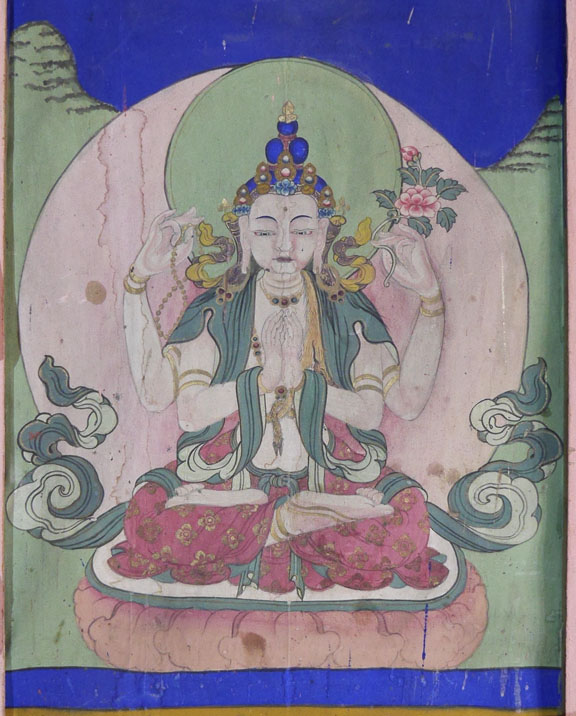
Avalokiteshvara, deity of compassion, from wall mural of Shashur Monastery, Lahaul
Detail of Avalokiteshvara, deity of compassion, from wall mural of Shashur Monastery, Lahaul. From stylistic similarities to an Avalokiteshvara painted at Guru Ghantal, this was possibly painted by Lama Tashi Temphel circa 1860, known to have painted at Shashur in addition to Gandhola.
Avalokiteshvara, deity of compassion, from wall mural of Shashur Monastery, Lahaul
Avalokiteshvara, deity of compassion, from wall mural of Shashur Monastery, Lahaul. Possibly painted by Lama Tashi Temphel circa 1860.

On the second floor of Shashur is a larger shrine room with statue of Vajradhara, the primordial Buddha, and paintings of the 84 Indian Mahasiddhas, main mahasiddhas of the Drukpa lineage, and great gurus and yidams.

11_1030619_yes_2nd Fl-Vajradhara_72
Center statue of Vajradhara, the Primordial Buddha, second floor temple of Shashur Monastery, Lahaul
Portion of 84 Mahasiddhas paintings, second floor temple of Shashur Monastery, Lahaul
Portion of 84 Mahasiddhas paintings,  second floor temple of Shashur Monastery, Lahaul
Detail of 84 Mahasiddhas paintings, second floor temple of Shashur Monastery, Lahaul
Portion of 84 Mahasiddhas paintings,  second floor temple of Shashur Monastery, Lahaul
Detail of 84 Mahasiddhas paintings, second floor temple of Shashur Monastery, Lahaul
This is likely Guru Rinpoche with consort in center surrounded by protector deities, wall painting on second floor temple of Shashur Monastery, Lahaul
This is likely Padmasambhava (Guru Rinpoche) with consort in center surrounded by protector deities, wall painting on second floor temple of Shashur Monastery, Lahaul

With full respect for the content, I’m sad to say that as a visual artist I find the wall paintings in Shashur (as well as Tayul) aesthetically unremarkable. Well, as I was forewarned by a local, Lahaul is not really a place for incredible paintings or visual depictions of mandalas as it is for visceral yogic experience in the land and spiritual centers.

Much more interesting than the painted mahasiddhas on the second floor walls were the statues flanking Vajradhara. One was Chakrasamvara and consort Vajrayogini or Vajavahari, and the other identified as Red Chakrasamvara. Both were most unusual in style and completely unconventional in terms of proportion. They do not look like Tibetan renditions of the deities and their consorts.

Possibly Mahadev and consort Uma, an unusual statue for its exceptionally different style from most Tibetan sculpture, notably its lack of conventional proportion, Shashur Monastery, Lahaul
Detail of Red Chakrasavara, an unusual statue for its exceptionally different style from most Tibetan sculpture, notably its lack of conventional proportion, Shashur Monastery, Lahaul
Possibly Mahadev and consort Uma, an unusual statue for its exceptionally different style from most Tibetan sculpture, notably its lack of conventional proportion, Shashur Monastery, Lahaul
Red Chakrasamvara, an unusual statue for its exceptionally different style from most Tibetan sculpture, notably its lack of conventional proportion, Shashur Monastery, Lahaul
Chakrasamvara and consort Vajravahari, an unusual statue for its exceptionally different style from most Tibetan sculpture, notably its lack of conventional proportion, Shashur Monastery, Lahaul
Detail of Chakrasamvara and consort Vajravahari, an unusual statue for its exceptionally different style from most Tibetan sculpture, notably its lack of conventional proportion, Shashur Monastery, Lahaul
Chakrasamvara and consort Vajravahari, an usual statue for its exceptionally different style from most Tibetan sculpture, Shashur Monastery, Lahaul
Chakrasamvara and consort Vajravahari, an unusual statue for its exceptionally different style from most Tibetan sculpture, notably its lack of conventional proportion, Shashur Monastery, Lahaul

Shashur’s third floor temple was built by Lama Sonam, a disciple of Shakya Shri, in the 20th century during a spiritual revival of the time. Its altar features a statue of Padmasambhava.

Central statue of Padmasambhava, third floor altar of Shashur Monastery, Lahaul

While it was not happening during my visit, it bears mentioning that Shashur is well-known for its annual sacred cham dance which occurs in June or July. Visitors come from all over to witness the three-day rituals that culminate in cham performance. As a ritual, it is not to be seen and received as entertainment but rather as spiritual elevations transmitted to the audience as movement and gesture. Here is one that was performed when I visited Key Monastery in Spiti.

Key Monastery monks demonstrate ritual dance, with abbott presiding over the ceremony, Spiti
Key Monastery monks demonstrate The Black Hat cham dance, with abbott presiding over the ceremony
View of Bhaga Valley, Lahaul, in the late afternoon sun
View of Bhaga Valley, Lahaul, in the late afternoon sun driving back to Keylong from Shashur Monastery

All photos © 2013, Eva Lee.

Poekar Monastery Surprises

Sept. 13, 2013     Lahaul adventure continues…

Today was spent going to Poekar Monastery, known partly for where Apho Rinpoche had commissioned Bhutanese artists to create a giant Guru Rinpoche statue. One can say that the Bhutanese are present-day masters of sublime Buddhist art. Their style and techniques are favored by Tibetans. I have seen their work grace many contemporary monasteries.
Poekar Monastery, Lahaul, India
Poeker Monastery on upper right (yes, that little cluster of white above the other little cluster of white which is the village below), Lahaul Valley

While Poekar was not originally on my radar for visiting, J had learned yesterday at a meeting in Manali with one of Apho Rinpoche’s sons, Jampal-la, that he was heading to Keylong for Tara puja (prayer), to be followed by Guru Rinpoche puja the day after. She immediately called to inform me that I should join them. That is to say, in her irrepressible and talented role of what Malcolm Gladwell calls a “connector,” she invited me to join them at her behest and on their behalf! Right, then, another unforeseen opportunity to observe and experience. So, I said OK, thank you!

Statue of Guru Rinpoche, Poekar Monastery, Lahaul
Statue of Guru Rinpoche, Poekar Monastery, Lahaul. It doesn’t look that big at this angle but this is one-and-a-half stories high. Also known as Padmasambhava, he was the sage who introduced Tibet to Buddhism in the 8th century.

I planned to stay overnight (because J said it was fine to) and brought all my camera equipment and some clothing, all jammed in my wheeling suitcase.  But when I got there with the driver, I couldn’t reach Jampal-la on his phone for details, and found while searching for the monastery that it was a good steep half hour hike up!  So much for wheeling in my suitcase.  It became clear that unless I hoisted my rather heavy suitcase up, the only other option was to go back to my Keylong hotel. Driver D, who had climbed up to the monastery with me to ensure that I was safely escorted, was kind enough to offer to go back down to the car to fetch it, but I didn’t feel good about him doing that!

Anyway, perhaps one day was enough. Maybe better to get to Shashur and Tayul, or Guru Ghantal the next day. These were planned destinations and I wanted to make sure I had enough time to document them. Jampal-la suggested also Phakpa Monastery in Triloknath, a sacred site of Avalokiteshvara, and Markula Devi Temple in Udaipur, sacred site of Vajrvahari.

The Tara puja was an annual event that Poekar Monastery’s American sponsor requests.  The resident monks and nuns are yogi retreatants, as most are in Lahaul. Together, they conducted the prayers, chanting in refreshing cross-gender unison, something one doesn’t experience very much since monks and nuns are usually living separate monastic lives.

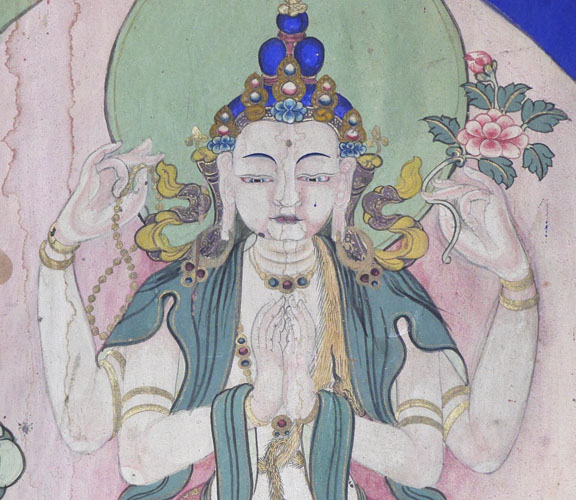
In fact, Tara as a tantric deity has contemporary feminist appeal. She is referred to in the Perfection of Wisdom (Prajnaparamita) sutra, a very key Mahayana text, and is considered the female form of Avalokiteshvara, the deity of infinite compassion. With these two strong combinations of wisdom and compassion, she embodies powerful aspects of the practitioner’s own Buddha-nature. She has 21 forms or emanations in all, each associated with certain colors and psycho-physical energies.

Green Tara
Green Tara surrounded by her other enamations

During Tara puja, we all sat cross-legged on the floor as is customary. I was flanked by two nuns who would hand me grains of rice to toss in the air at intervals during prayer. Jampal and his wife were guests of honor.

It was nice talking to them both in between prayer sessions.  We talked about how the West seems to the East and vice versa.  I shared my observations of what I thought was positive and negative about each social order, their apparent outlooks on life, and expectations of how things should be. Jampal-la and his wife shared theirs. I learned from him that, even though he comes from a line of great traditional solitary practitioners, his view is unexpectedly open to contemporary and Western exposure, and it is this:

Begin on the secular level with teachings about how to simply be a good, moral person before getting to the more esoteric and higher teachings. Let individuals develop and choose whether they want to be Buddhist or not. Then if they do, higher teachings can always come later. He has helped to sponsor a group of young girls by sending them to school and working on exactly this approach. In this way, he is aligned with the Dalai Lama’s initiative on secular ethics.

What’s more, their teen is in the U.S. now attending university through the generosity of a sponsor. They feel strongly that young Tibetans should experience what the West has to offer, and then decide for themselves whether to follow that life or come back to the East.  Otherwise, they will always feel doubt or curiosity that the (democratic/ materialist/capitalist/etc.) grass is greener on the other side. Eye-opening to chance the risks of the world, coming from a family and lineage legacy of hermitic existence.

The day passed so seamlessly from breakfast to morning prayers, to lunch and afternoon conversation, with such friendliness exuding from everyone at Poekar.

Poekar Monastery nuns, Lahaul, India
Poekar Monastery nuns, Lahaul

Sadly, when I learned that the next prayer session would continue in a different temple an hour’s ascent further up the mountain (surprise once again) I decided it was too late in the day, and time for me to travel back. Upon hearing this, the nuns and monks, who by now were spread willy-nilly on the hillside climbing up, began to wave and smile and utter lovely goodbyes. They repeatedly implored me to stay over. Truly, their sincerity warmed me so much, I found myself walking away hand clasped to heart.

Poekar Monastery monks, Lahaul, India
Poekar Monastery monks, Lahaul
View of Lahaul Valley from Poekar Monastery village, India
View of Lahaul Valley from Poekar Monastery village

All photos © 2013, Eva Lee.