My travel companion K and I left Keylong at 5:00 a.m. to head to Leh. The wonderful and inspired Lahauli adventure had come to an end, and it was now time for Ladakh!
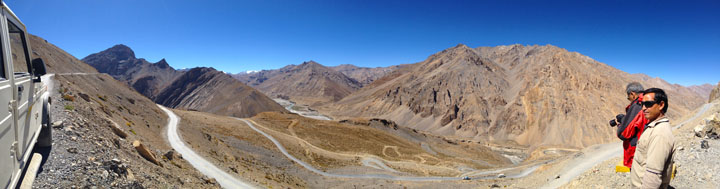
It was a long drive of about 11-12 hours on the Manali-Leh Highway, with stops for photos, breakfast and lunch. Unbelievable rugged terrain that seems to endlessly unfurl its textural vistas as you drive along hour after hour. Empty, cold, semi-arid desert across vast mountain ranges.
Rugged terrain of Manali-Leh Highway, en route to Ladakh
Like the road trip from Spiti to Lahaul, the land is at once austere and captivating. Fortunately, unlike the jagged, unpaved highway from Spiti to Lahaul, this one was rather well-paved and maintained. Besides tourists, it’s well-used by the military guarding the Sino-Indian border, and there are checkpoints along the way where all vehicles must stop and register passing through.
En route, one passes places with quaint names like Zingzingbar and Lachulung-la, ascending ever higher. From our starting point at Keylong, it’s 3349 meters altitude going up to the high point of Tanglang-la of 5328 meters. I felt short of breath at times, but thank goodness I’m long over altitude adjustments (the first week in Spiti was vice-grip-like, headache-filled nights in addition to shortness of breath), though it is no joke to continue to take precautions and be aware of the dangers of high altitude sickness. People can die from it, and pretty quickly, too.
Roadside tent dhabas (eateries) and basic dormitory accommodations are set up for the summer season from about June to September, Manali-Leh Highway
There are no villages or towns the whole stretch of road from Keylong to Leh, only roadside stops for food or overnight stays. These are makeshift temporary seasonal tents that offer cots for travelers to sleep in and a basic menu of dishes such as paranthas, rice and dahl, chow mein. Breakfast was at one of these places.
Interior of a roadside dhaba (eatery) with cots for overnight stays, Manali-Leh Highway, Ladakh
Shortly after taking off on the road again after breakfast, we saw this. Can you spot the little guy in the below photo?
Manali-Leh Highway
Didn’t see him? Okay, then look here…
Marmot out in morning sun, Manali-Leh Highway, en route to Ladakh
Marmots were poking their heads out of rock crevices, or walking out in the open like this one, presumably searching for breakfast. Cute pudgy little things, they reminded me of our local American groundhogs.
Driver G was really nice, good conversationalist, great driver. He is a trekking guide and luxury tent campsite owner in Manali who conducts Himalayan adventure trips. He is also an old friend of K’s. K said G saved his life once on a mountaineering trip.
With his four wheel drive flatbed truck, he would deftly take uphill shortcuts connecting switchback roads, such as here at the Gata Loops, the part of the highway famed for its 21 hairpin turns.
The part of Manali-Leh Highway famed for its 21 hairpin turns on the road, en route to LadakhGate Loops on Manali-Leh Highway, en route to LadakhTurquoise water offset against the pinks of the mountain range and red-siena ground cover. Yes, it really looks like this on parts of the Manali-Leh Highway heading to Ladakh!
Kangla Jal trekking pass point and India Gate reminds me of out West in Zion or Bryce Canyons in the U.S.
Near Kangla Jal trekking pass, Manali-Leh Highway, en route to LadakhIndia Gate, near Kangla Jal trekking pass, Manali-Leh Highway, en route to Ladakh
Lunch was at another tent site, where people really make do with little water and toilets are open air. One gets good at finding large rocks to befriend!
Lunch en route to Ladakh on Manali-Leh Highway
Not long after leaving the lunch site, we came upon the plateau portion of the trip called Morey Plains. Instead of traveling through passageways and valleys, this section was a wide open flat expanse of land.
Morey Plains, Manali-Leh Highway, en route to LadakhBeginning of Morey Plains, Manali-Leh Highway, en route to LadakhJust straight road! Morey Plains, Manali-Leh Highway, en route to Ladakh
The Himalayan mountains along the way are diverse in colors and shapes. Some are more black like these below, and others more pink and warm flesh tones gradating into earth reds as you see more of as you get closer to Leh.
Natures sculpts some stunning shapes and presents here nuanced gray and black tones along the Manali-Leh HighwayThe Himalayas, as far as your eye can see…Large cars are just specks on the thready-looking roads
When we reached Tangla-la, the high point with an altitude of over 17,500 feet, it was marked by a large shrine and elaborate prayer flags. Other travelers stopped for a gander and to marvel that they, too, had made it to this point on the road to Leh. Inside the shrine there were Hindu and Buddhist deities.
Tanglang-la Pass with shrine and prayer flags, the highest point on the Manali-Leh Highway at 5328 meters (over 17500 feet), en route to Ladakh, IndiaShrine at Tanglang-la Pass, the highest point on the Manali-Leh Highway at 5328 meters (over 17500 feet)Hindu and Buddhist deities, inside shrine at Tanglang-la Pass, the highest point on the Manali-Leh Highway en route to Ladakh, India
How did people in ancient times manage traveling through this rough barren terrain? Actually many of them didn’t and perished along the way. I’m thinking of Rinchen Zangpo’s party of 21, whom King Yeshe O’d sent from Guge, Western Tibet, to India in the late 10th century, only 2 of whom made it back alive.
IS IT NOT? Khardung-la is the first highest pass in India.
As you get closer to the city of Leh on the highway, you begin to see stupas and chortens in the landscape. This little monastery is among the first signs of permanent dwellings as you come out of the hinterlands and approach civilization, still about two hours’ drive before reaching the outer monasteries of Leh, such as Stakna.
The scenic view of Stagna Monastery as you come out of the remoteness of the Manali-Leh Highway and reach outskirts of Leh, Ladakh, IndiaMuch of Leh looks like this combination of vast dry flatlands adjacent to mountains with villages nestled in the valleys.
This story has proven staying power on my mind. I was going to write about Kardang Monastery, the first site I visited in Lahaul, but I have been thinking about this other content, so must share it here, now.
What if you were in a situation where you had to choose between your freedom from prison, or bringing a great spiritual teacher to your country to enlighten its citizens? Yeshe O’d, the 11th century Buddhist King of Guge in Western Tibet was faced with this choice.
During his lifetime (967-1040 C.E.), he had inherited a kingdom in a confused and degenerate era of Buddhism, a condition that followed its religious repression by previous King Langdarma (863-906 C.E.) To counter dissolute Buddhist practices and ideas, Yeshe O’d aimed to restore pure teachings in a variety of educational and development initiatives.
He sent young scholars to India to study Sanskrit, the original language of Buddhist scriptures. He imported and had faithfully translated Sanskrit sutras, tantras, and commentaries into Tibetan. He built monasteries all over his vast kingdom, and brought a team of inspired artists from Kashmir, where Buddhism had long flourished, to help illustrate the fundamentals of tantric practice. If you have been following this blog, you know then that this involved depictions of the deity Vairocana, the Dhyanibuddhas (Five Buddha families) and their associated cycle of deities in a Vajradhatu mandala order of art and architecture. It resulted in a distinctive period of Indo-Tibetan sacred art which can still be seen today in late 10th and 11th century sites such as Tabo and Lhalung monasteries in Spiti; Alchi, Lamayuru, Mangyu, and Sumda Chun monasteries in Ladakh. Finally, Yeshe O’d also searched for and invited a great Indian master to teach in Tibet.
Of the twenty-one individuals he sent to India to study Sanskrit, only two survived to return from the arduous journey to inform him of the great master Atisha.
One of these students later became The Great Translator Rinchen Zangpo who, through his scholarly excellence and dharma dedication together with the king’s support, helped effect what is known as the Second Great Transmission of Buddhism from India to Tibet. It spanned the late 10th to 12th centuries C.E.
Upon learning of Atisha, Yeshe O’d proceeded to commission a second party armed with gold offerings to request the master to come to Tibet. Of the nine people sent, only one survived, but he was unable to persuade the scholar to leave the learned monastic university center of Vikramashila where he was teaching Indian disciples.
Undeterred, and collecting more gold to offer, the king decided to go personally in a third expedition to meet Atisha. However, along the way he was captured by a rival King of Garlog near Nepal who imprisoned him for ransom. With the intention of deterring the spread of Buddhism, this king demanded Yeshe O’d’s weight in gold for his release, or that he give up his mission to go to India.
By now, many years had passed since the first initiative of sending students to India to study Sanskrit, and Yeshe O’d was an older man. When his nephew Changchub O’d arrived with a large sum of gold collected from throughout Western Tibet, it was not the full Guge king’s body weight. It is said that the gold remaining still required was equal to his head. So the Garlog ruler refused to release his hostage.
Changchub O’d then met with his uncle, who was chained in his dark prison cell, vowing to redouble his efforts to get more gold for his release. Yeshe O’d, however, then instructed him to offer the gold thus far collected instead to Atisha. He said, “I have died countless times in previous lives, but I am sure I have never before sacrificed myself for the Buddha’s Dharma. Now I am very happy to do so. Whomever you send to India, please have him tell Atisha that I have given my life for the welfare of my subjects and the Dharma so that he could be brought to Tibet. Although I have not had the fortune to meet him this lifetime, I have fervent hopes that I can in the future.” In great grief, Changjub O’d agreed to follow his wishes.
And so, Yeshe O’d died in prison for the sake of benefiting others. This story sticks with me for its selflessness and model example of bodhicitta, great generosity. Buddhist history has proven its profundity.
Atisha, upon hearing the circumstances, felt moved by enormous compassion, and he then finally did come to Tibet at the age of 53, sometime in the first half of the 11th century C.E. Along the way, he wrote his masterpiece Lamp for the Path to Enlightenment, a short text in 67 verses which lays out the entire Buddhist path in terms of the three vehicles: Hinayana, Mahayana, and Vajrayana, and became the model for later texts in Stages of the Path.
He remained in Tibet for the rest of his life where he successfully taught and propagated pure teachings that amounted to an illustrious reform within the Second Great Transmission of Buddhism to Tibet. And much to his gratitude, Atisha even showed the very learned Lotsawa Rinchen Zangpo, who was by now aged in his 80s, how to properly practice tantra. Atisha is further credited for laying the groundwork for Je Tsongkhapa’s 14th century seminal teachings.
Tabo Monastery Tsug Lhakhang, with meditation caves in the cliffs beyond, Spiti, India
Six-o’clock morning puja for the recently deceased beloved abbot at Tabo Monastery was quite beautiful. I wasn’t fully awake for it, and drifted through listening to each monk use his voice artfully to express himself through prayer. Very nice. I found out later from a lama that while they all learn the basic rhythm, it is up to each individual monk to say the prayer as he wishes. In other words, they all chant the same prayer, but some go out and come in on certain parts, using their voices to inflect sound, create variety, meld, or syncopate, etc.
Afterwards I was able to do some documenting at Tabo today! Limited time, however, permitted only doing the interior of the Tsug Lhakhang, the Great Assembly Hall. I was thrilled because it was the most significant temple in terms of its Vajradhatu mandala arrangement and my research project.
Experience the interior of Tabo Monastery’s Tsug Lhakhang or Main Assembly Hall by watching this video walk-through.
Entering the Great Assembly Hall from its antechamber, Tabo Monastery
Wow, what a place! Dark and dramatic, with rays of light coming in through small ceiling windows, shining brilliantly on the main altar and then fading out towards the periphery of the assembly hall. I was stunned by the large number of statues and paintings to feast my eyes on! In a space that envelopes you in semi-darkness, it took some time to realize that just about every inch of wall and ceiling had been richly decorated.
With over a thousand years of continuous use as a meditation hall, I soaked in the sense of countless generations of monks who have spent their days here in peaceful meditation. I tried to fathom the devotion that Tabo’s Tsug Lhakhang has seen and sheltered. The overall impression is that of quiet yet teeming spiritual beauty.
Founded in 996 C.E. by the Guge (Western Tibet) king Yeshe O’d, the temple and statues are viewed clockwise in a Buddhist kora or circumambulation.
According to scholars, Kashmiri artists were responsible for the refined style of the statues and paintings. At the time, Buddhism had flourished in Kashmir and the region’s art was aesthetically sophisticated in expression and detail. Most of the art was executed circa 1042 C.E. during the renovation of the interior by Jangchub O’d, Yeshe O’d’s grand nephew.
The main altar features a gilded Vairocana. What a sight this tantric deity is with its larger-than-life four bodies, seated back to back, its serene faces looking out in the four cardinal directions. Distinctly Indian features include Indo-style trousers, painted red palms, procession carriage structure, and naga/garuda mount at top.
There are 32 multi-colored, graceful clay sculptures of Vairocana’s associated deities that line the assembly hall walls in Vajradhatu mandala order. Each is seated on a lotus pedestal, and cantilevers out of an attached sculpted halo background. Situated above eye-level, the figures look kindly and seem to lean towards you. Surrounding these deities on the wall are elaborate, colorful fresco paintings—scenes of Prince Sudhana’s pilgrimage and Buddha’s life on the lower frieze area; buddhas, bodhisattvas, other tantric deities and Bon goddesses in the upper area.
Clay statues of tantric deities in Vajradhatu mandala arrangement, Tabo MonasterySudhana’s pilgrimage on lower frieze, Tabo Monastery Tsug Lhakhang. Much of it is too deteriorated to see clearly.Guardian deity at far left, painted buddhas and bodhisattvas on upper areas of Tabo Monastery Tsug LhakhangVairocana statue, main altar, Tabo Monastery Tsug Lhakhang, Spiti, India Distinctly Indian features include Indo-style trousers, painted red palms, procession carriage structure, and naga/garuda mount at top.View of gilded Vairocana statue from inner sanctum, Tabo Monastery Tsug Lhakhang, Spiti, IndiaDetail of gold Vairocana, Tabo Monastery Great Assembly Hall altar, Spiti, India
Tabo’s Main Assembly Hall, and in fact, the whole monastic complex was originally built according to a mandala concept as set forth by the Sarva-tathāgata-tattva-samgraha Tantra, practically a literal translation of it which distinguished this monastery. To the practitioner, therefore, Tabo’s interior and exterior order symbolized his sacred inner and outer realities. (More on this topic in previous post But Wait, A Bit About Mandalas.)
“The main temple, Tsug Lhakhang, was at the center of the whole complex. The center of the temple was also the center of the compound along the east-west axis, having its major statue, Saravid Vairocana, placed in the central spot [now moved to the altar] not only of its surrounding 32 statues but also of the whole complex….Later additions have diluted the concept, but temples from Tabo’s heyday, together with stupas or chorten, form a simple but clearly visible mandala in the architectural layout-plan.” (The Forgotten Gods of Tibet: Early Buddhist Art in the Western Himalayas by Peter van Ham and Aglaja Stirn. See also this book for excellent descriptions and further details on Tabo’s iconography)
Vajradhatu mandala arrangement of Vairocana and 32 associated deities, Tabo Monastery, Spiti, India.
Above is the floor plan of the Main Assembly Hall showing the Vajradhatu mandala arrangement of the Five Buddha Families: Vairocana, Amitabha, Amoghasiddhi, Akshobya, and Ratnasambhava, with their associated deities. These represent aspects of Buddha-nature that guide a practitioner to attain enlightenment according to the lower yoga tantras. Tibetan Buddhists today generally practice highest yoga tantra or Annutarayoga.
Side view of Vairocana statue, main altar, Tabo Monastery, Spiti, India. The statue is built in the tradition of an Indian procession carriage, used for carrying the god around the temple or outside for blessing.
For photography and viewing, I came prepared with flashlights. Thank goodness they were fully charged, and that our current guesthouse has power! We would not have been able to see most of these dark interiors without them.
Vajrahasa statue, part of the Gem family of Ratnasambhava, Tabo Monastery
What a challenge it’s been to ensure my equipment is all charged and ready to go. Sadly, I am told by locals that Spiti in general lacks electricity because the Indian government is remiss in providing good infrastructure to all its citizens, and particularly to those communities that are remote, less populated, and lack political clout. As you can imagine this makes Spiti’s growing tourism especially difficult when hotel and restaurant owners, cyber cafes, etc., must routinely apologize to their clientele for not being able to meet their needs due to lack of power. I got creative with calculating how long my cell phone, laptop and camera equipment would last before finding the next feasible charging place.
Vajrakarma statue, part of the Action family of Amoghasiddhi Tabo Monastery Tsug LhakhangVajrayaksa statue, part of the Action family of Amogasiddhi Tabo Monastery Tsug LhakhangAkshobya statue, Vajra family Tabo Monastery Tsug Lhakhang
Behind the main altar is a small inner sanctum or cella that contains a 13th century statue of Amitabha in an elevated niche, flanked by two crowned statues of bodhisattvas, Padmapani on the left and Mahashtamaprapta on the right. Above him are figures identified as Apsaras or minor gods in the act of homage, and painted on his left and right are female attendants.
Amitabha statue, inner sanctum, Tabo Monastery Tsug Lhakhang Stylistically different from the statues in the main hall, it looks like a later addition or replacement.Padmapani statue, inner sanctum, Tabo Monastery Tsug Lhakhang. Visible on the left are some of the Thousand Buddhas that are painted on the circumambulatory inner walls.Vajrapasa statue guarding entrance to inner sanctum, Tabo Monastery Tsug Lhakhang
A narrow corridor for circumambulation surrounds Amitabha. Its inner walls are richly painted from floor to ceiling with Thousand Buddhas, manifestations of the enlightened one in splendid iteration of the five colors, different robes, lotus pedestals, and haloes.
Buddhas in a Thousand Buddha depiction on inner sanctum circumambulatory walls, Tabo Monastery
On the outer walls are magnificent bodhisattvas and Supreme Buddhas (Tathagatas). These are my favorites! I really appreciate the mastery of these paintings in the inner sanctum. The below bodhisattva is an example of one of sixteen that symbolize aspects of Buddhahood stemming from Vairocana.
Bodhisattva, from outer circumambulatory wall of Tabo Monastery Tsug Lhakhang
The bodhisattva figures literally took my breath away when I saw them revealed by my flashlight! Every brushstroke showed ease, delicacy and variety in execution. The highly inventive and detailed jewelry, as well as the fabric patterns, was a pleasure to discover. In addition, these paintings are well-preserved and dated 1042 C.E. when the temple was renovated. In other words, they appear as they were first created, untouched by other painters or conservators since then. What an incredible indication of the original quality of work that existed!
These inner sanctum figures look different from the ones on the upper register of the Tsug Lhakhang in that they are far more elaborate and refined. Additionally, Indo-Tibetan paintings show a freedom of composition not found in later Tibetan artworks where proportions and poses are more defined by convention.
The Supreme Buddhas were also delightfully painted, exhibiting a similar level of refinement and delicacy but painted at a much larger scale, about life-size.
Supreme Buddha dressed in unusual pleated robe, painted on outer wall of circumambulatory, Tabo Monastery Tsug Lhakhang inner sanctum
I particularly like the sense of ease yet energy that this below Buddha expresses. His face and gaze are sublime, his hands in graceful repose. But his unusual robe depicts rhythm and movement in the undulating sleeves and neckline detail. Coupled with the artist’s use of primary colors and radiating spirals in the halo, the overall effect of this painting is vibrant immediacy.
Supreme Buddha on outer wall, inner sanctum of Tabo Monastery Tsug LhakhangDetail of Supreme Buddha on outer wall, inner sanctum of Tabo Monastery Tsug Lhakhang
This is not an official U.S. Department of State website. The views and information presented here are solely those of the artist, and do not represent the Fulbright Program, the Department of State, or any other entity.


 Marmots were poking their heads out of rock crevices, or walking out in the open like this one, presumably searching for breakfast. Cute pudgy little things, they reminded me of our local American groundhogs.


