Himalaya

Pristine Mangyu

Sept. 23, 2013

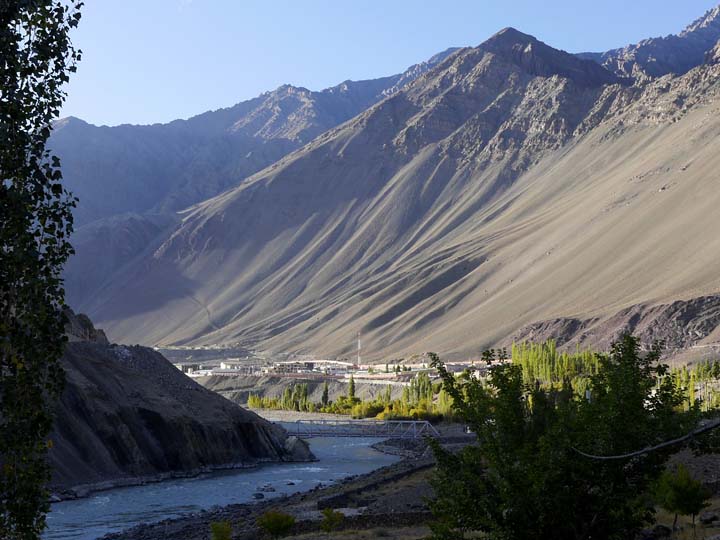
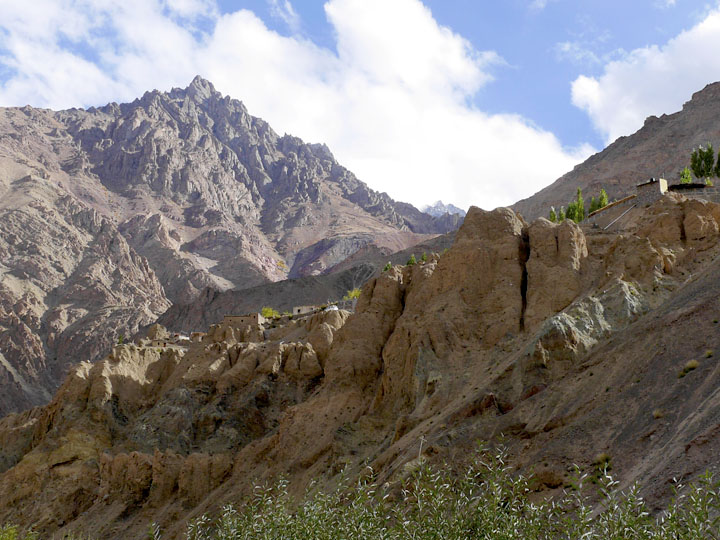
View of Mangyu Monastery village, Ladakh, India
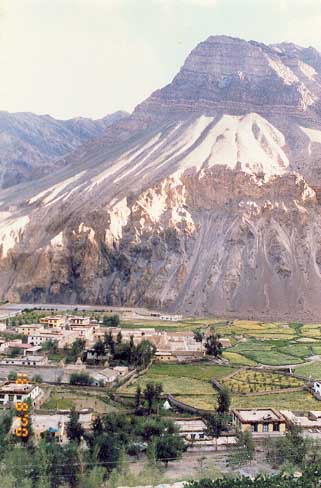
View of Mangyu Village, Ladakh, India. To get there, one drives through narrow valley gorges. The village remains hidden until you drive practically right up to it.

Like Lamayuru Monastery’s Indo-Tibetan Senge Lhakhang, Mangyu Monastery’s Vairocana temple is also a small intimate place. Classic, pre-13th century, early period architecture, the site is nestled in and integrated with a village as opposed to fortified and atop on a hill from the community.
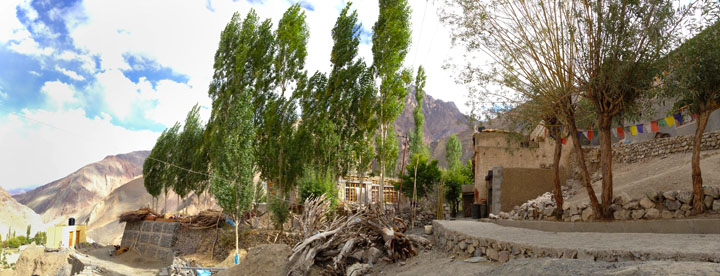
Beginning of Mangyu Monastery village, Ladakh, India
Beginning of Mangyu Village, Ladakh, India

I believe that up till fairly recently, let’s say last twenty years, there was no motorable road up to Mangyu Village, which means it was largely isolated and unknown by travelers. We parked a little below the village and walked up to the monastery, passing by small grocery stores that had countertop service for a simple meal of packaged and flavored maggi noodles (what we call ramen noodles in the U.S.) I was starving and grateful to be served one! When traveling around these more remote parts, one never knows where and what the next meal may be. This village had no restaurants or dhabas, nor did I see guesthouses. This is lovely because it indicates that tourism hasn’t bloomed here. Mangyu is pristine for this reason.
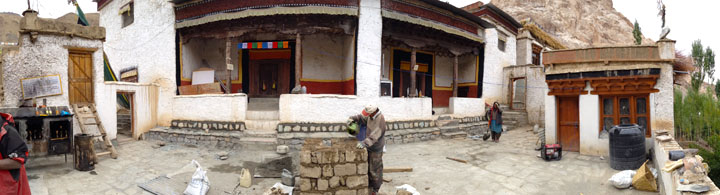
Panorama of Mangyu Monastery with Chenrezig Lhakhang on left, Nangbarnangzad (Vairocana temple) on right, together flanked by Chamba Lhakhangs of Maitreya and Jambeyang sculptures, Ladakh
Panorama of Mangyu Monastery with Chenrezig Lhakhang on left, Nambarnangze (Vairocana temple) on right, together flanked by Chamba Lhakhangs of Maitreya and Jambeyang sculptures, Ladakh. Workers are making repairs under the auspices of INTACH, the Indian National Trust for Art and Cultural Heritage.

Tourism is a challenge to local and modest communities here in the Himalayas. While it brings income, it also brings ecological stress. And ecological stress is no small thing to cope with when the land is semi-arid and mountainous, the people mostly poor, the government ill-equipped to provide adequate infrastructure. The need for food and water sources, sewage, sanitation, and modern transportation to serve tourists often ravage the natural beauty here.

Especially if it brings non-biodegradable garbage like plastic. It’s very upsetting to see packaging or other plastic objects thrown over the side of a Himalayan mountain or floating through the streams, stuck in rocks. Indeed, the Himalayan areas I’ve traveled to have dumps located on the mountain side. You can often see them along the road while driving on the highways. It will be a sudden burst of packaging color en masse among the earthy rocks and otherwise scenic beauty. It’s either this or shopkeepers and townsfolk simply burn the garbage. Yes, they burn it, open-air, in front of their shops or homes, frequently plastic and all.

Plastic bottles and those plastic carton drink containers, potato chip and candy wrappers are the most noticeable litter in the streets. I sadly think, these things will never degrade into anything that can be absorbed properly here. Nor anywhere on Earth for that matter, but since we are here on the topic of the Himalayas, my point is that tourism causes environmental strain and damage. I always ask for boiled water at hotels to cut down on the plastic, and carry a thermos with me. Of course, on some occasions, I can’t avoid it and will guiltily buy water in a plastic bottle.

But my visit to Mangyu Monastery was not one of these occasions, I’m happy to report!
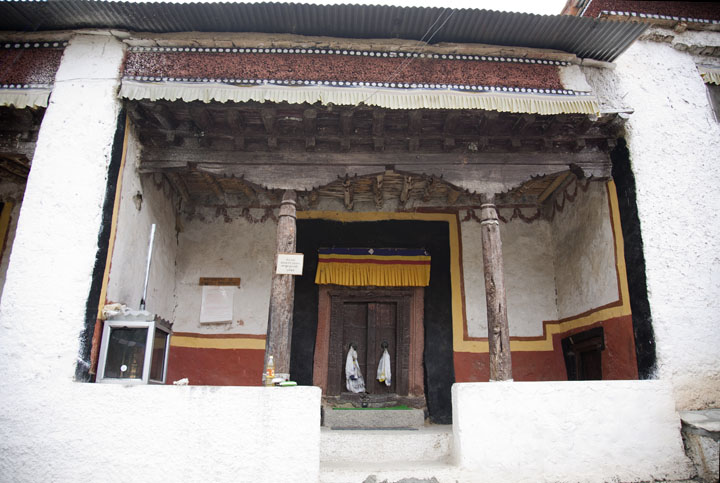
Entrance to Nangbarnangzad (Vairocana temple), ca. 11th century Indo-Tibetan early monastic architecture, Mangyu Monastery, Ladakh
Entrance to Nambarnangze (Vairocana temple), ca. 11th century Indo-Tibetan early monastic architecture, Mangyu Monastery, Ladakh. Photo: Kishore Thukral

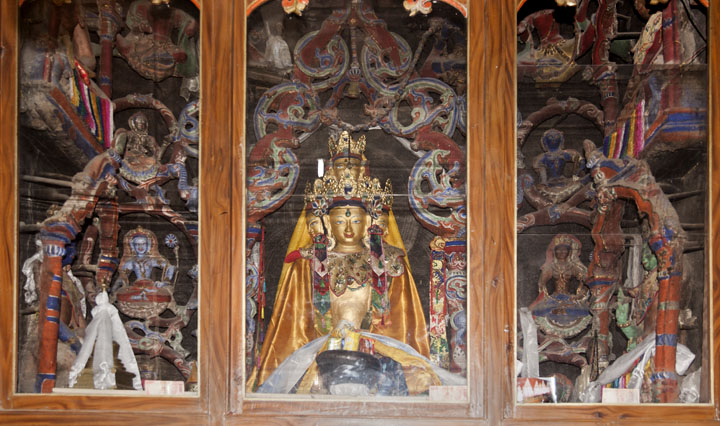
In the 11th century Indo-Tibetan tradition of The Great Translator Rinchen Zangpo, this altar in Nambarnangze once again features Vairocana in the center, surrounded by the Dhyani Buddhas, offering goddesses, animals, and ornate scrollwork, topped by a garuda. See floor plan here.

Experience the interior of this rare, medieval Vairocana temple by seeing a walk-through video here.

Mangyu Monastery Nangbarnangzad
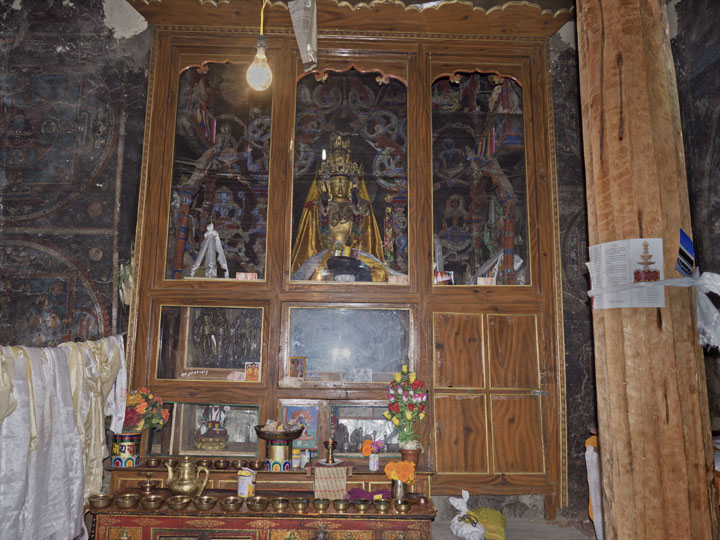
View of Nangbarnangzad interior, with Indo-Tibetan clay sculptures and wall paintings. The altar is now unfortunately encased by glass making it difficult to see the fine craftsmanship of Kashmiri artists, ca. early 11th century, Ladakh
View of Nambarnangze interior, with Indo-Tibetan clay sculptures and wall paintings. The altar is now unfortunately encased by glass making it difficult to see the fine craftsmanship of Kashmiri artists, ca. early 11th century, Ladakh
View of Indo-Tibetan clay sculptures of altar, now unfortunately encased by glass making it difficult to see the fine craftsmanship of Kashmiri artists, ca. early 11th century, Mangyu Monastery, Ladakh
Indo-Tibetan clay sculptures of Vairocana and Dhyani Buddhas of altar, Nambarnangze, Mangyu Monastery, Ladakh. Now unfortunately encased by glass, making it difficult to see the fine craftsmanship of Kashmiri artists, ca. early 11th century, Photo: Kishore Thukral

For further info on Vajradhatu Mandala structure upon which early monasteries of this period were based, see this post on Lamayuru Monastery’s Senge Lhakhang and this one on the celebrated Tabo Monastery’s Tsug Lhakhang.
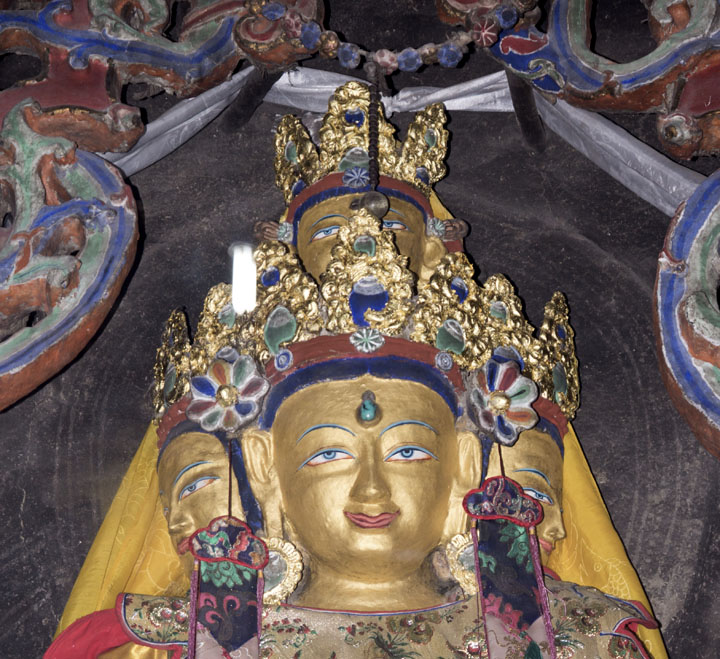
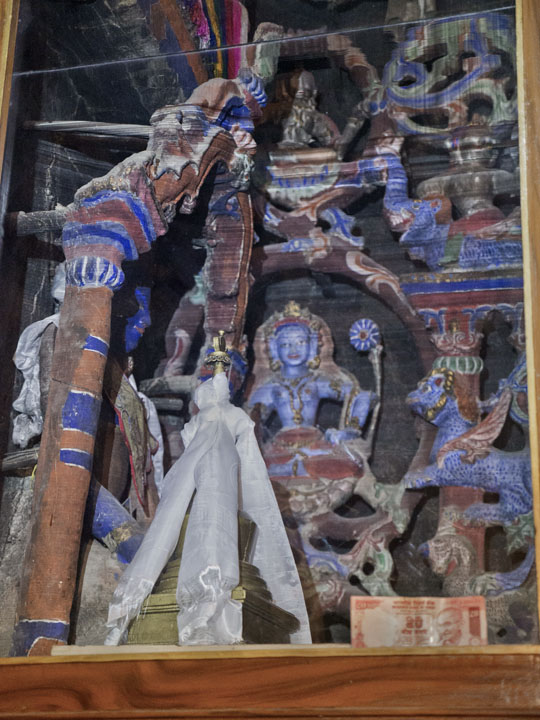
Detail of Vairocana Buddha, altar of Nangbarnangzad, Mangyu Monastery, Ladakh
Detail of Vairocana Buddha sculpture, ca. 11th century, altar of Nambarnangze, Mangyu Monastery, Ladakh
Detail of ornate scrollwork, animals and figurines, rare 11th century Indo-Tibeta clay sculptures, altar of Nangbarnangzad, Mangyu Monastery, Ladakh
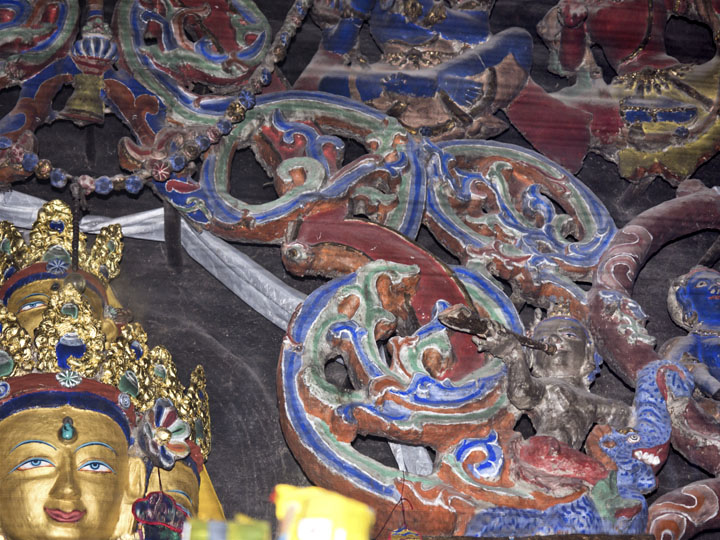
Detail of ornate scrollwork, animals and offering goddesses, rare 11th century Indo-Tibeta clay sculptures, altar of Nambarnangze, Mangyu Monastery, Ladakh, India
Detail of Vairocana Buddha, with ornate scrollwork, animals and figurines, rare 11th century Indo-Tibeta clay sculptures, altar of Nangbarnangzad, Mangyu Monastery, Ladakh
Detail of Vairocana Buddha, with ornate scrollwork, animals and offering goddesses, rare 11th century Indo-Tibetan clay sculptures, altar of Nambarnangze, Mangyu Monastery, Ladakh
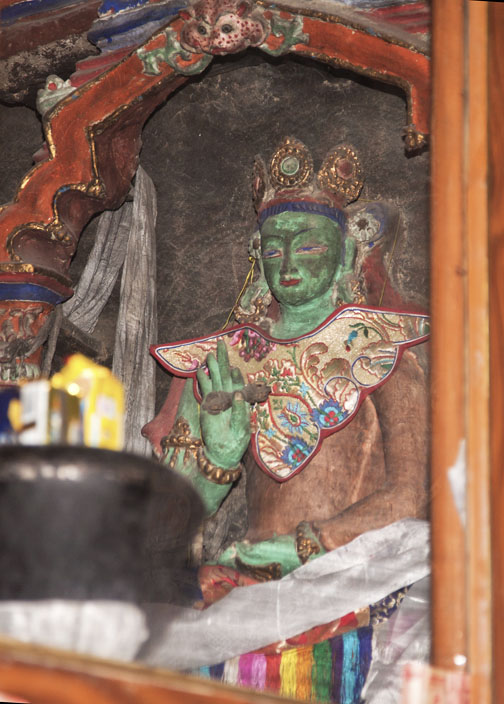
Detail of Amoghasiddha, a Dhyani (Supreme) Buddha, rare 11th century Indo-Tibetan clay sculpture, altar of Nangbarnangzad, Mangyu Monastery, Ladakh
Detail of Amoghasiddha, a Dhyani (Supreme) Buddha, rare 11th century Indo-Tibetan clay sculpture, altar of Nambarnangze, Mangyu Monastery, Ladakh. Photo: Kishore Thukral

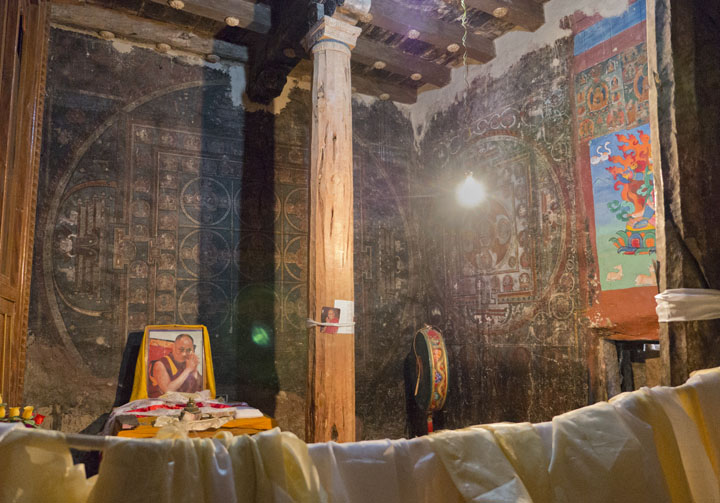
The small Vairocana temple is symmetrically painted on its left and right side walls with one large central Vajradhatu mandala each, flanked by smaller mandalas of related divinities or protectors. On the right side wall, the paintings look like well-conserved oe well-preserved original Indo-Tibetan.
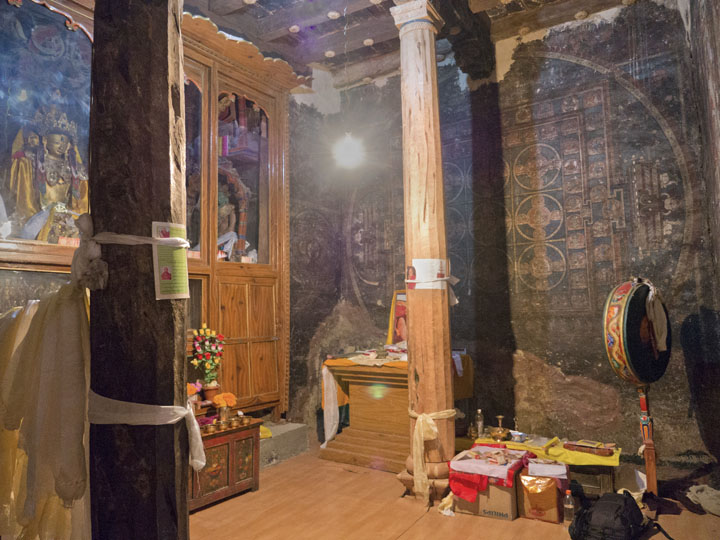
Interior of Nangbarnangzad, Mangyu Monastery, with Indo-Tibetan sculptures and wall paintings, Ladakh. Visible on right is Vajradhatu Mandala.
Interior of Nambarnangze, Mangyu Monastery, with ca. 11th century Indo-Tibetan sculptures and wall paintings, Ladakh. Visible on right is Vajradhatu Mandala.
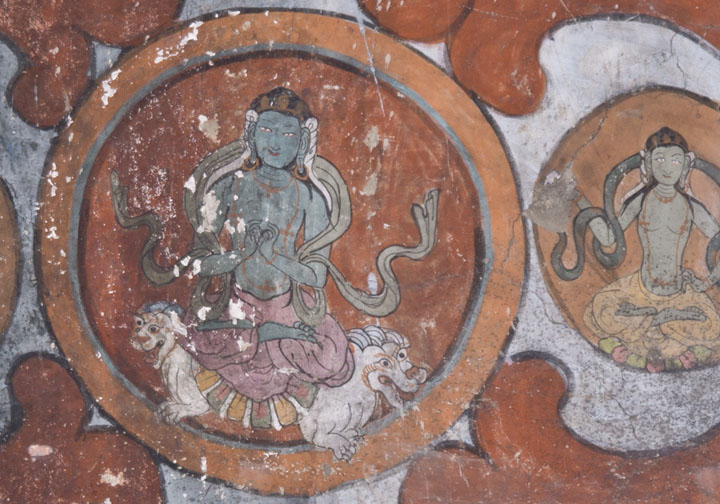
Detail from Vajradhatu mandala, Indo-Tibetan ca. 11th century wall painting, Nanbarnangad (Vairocana temple) of Mangyu Monastery, Ladakh, India
Detail from Vajradhatu mandala, Indo-Tibetan ca. 11th century right side wall painting, Nambarnangze (Vairocana temple) of Mangyu Monastery, Ladakh, India
Detail from Vajradhatu mandala, Indo-Tibetan ca. 11th century wall painting, Nanbarnangad (Vairocana temple) of Mangyu Monastery, Ladakh, India
Detail from Vajradhatu mandala, Indo-Tibetan ca. 11th century right side wall painting, Nambarnangze (Vairocana temple) of Mangyu Monastery, Ladakh, India
Interior view of Nanbarnangzad, Mangyu Monastery, with Indo-Tibetan wall paintings, Ladakh
Interior view of Nambarnangze, right side wall adjoining entrance wall, Mangyu Monastery, with ca. 11th century Indo-Tibetan wall paintings, Ladakh

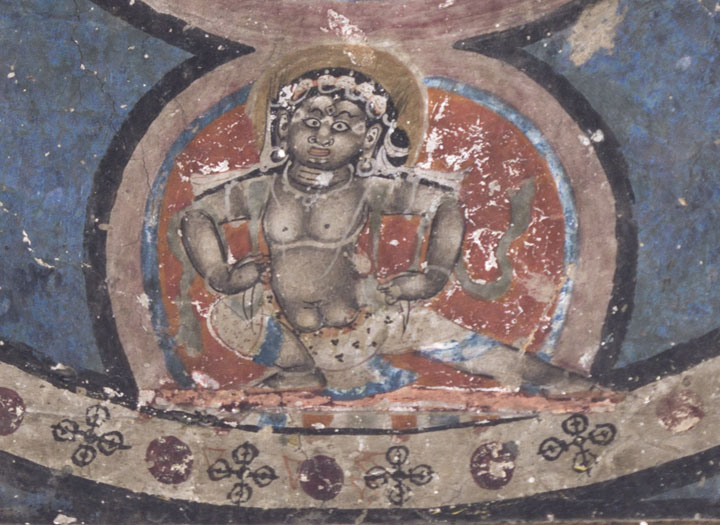
On this entrance wall, however, most everything has been repainted. Peter van Ham in his book Heavenly Himalayas: The Murals of Mangyu and other Discoveries in Ladakh, published recently in 2010, gives a very different description of the state of the protector deity painting above the door.
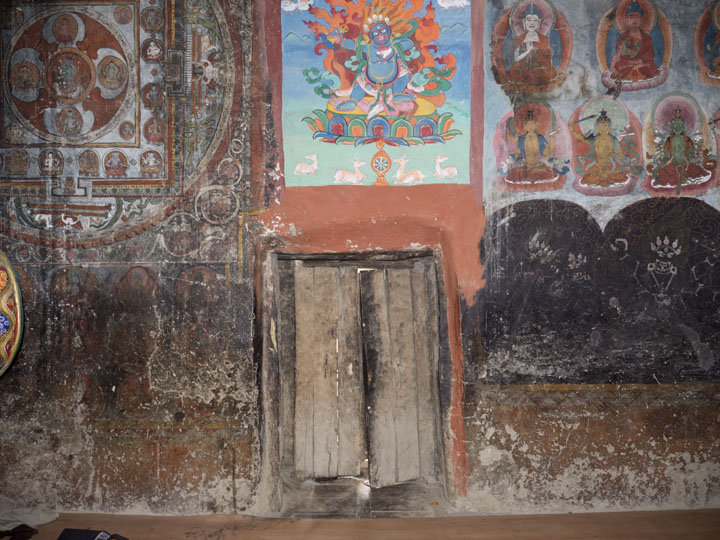
The entrance wall of Nangbarnangzad, Mangyu Monastery, Ladakh. Wall paintings here are mostly repainted over ca.11th century originals.
The entrance wall of Nambarnangze, Mangyu Monastery, Ladakh. Wall paintings here are mostly repainted over ca.11th century originals.

He writes, “The entrance…is protected by a wrathful blue deity, painted above the door. Only the right half of the painting has been preserved, the rest has been washed away by water leakage through the roof…As two peculiarities the protector is adorned with beautiful shawls displaying typical Ladakhi tie-dye patterns and in his right hand he holds a knife with an interesting blade of Indo-Iranian shape, the tip of which is equipped with a vajra-like structure.”
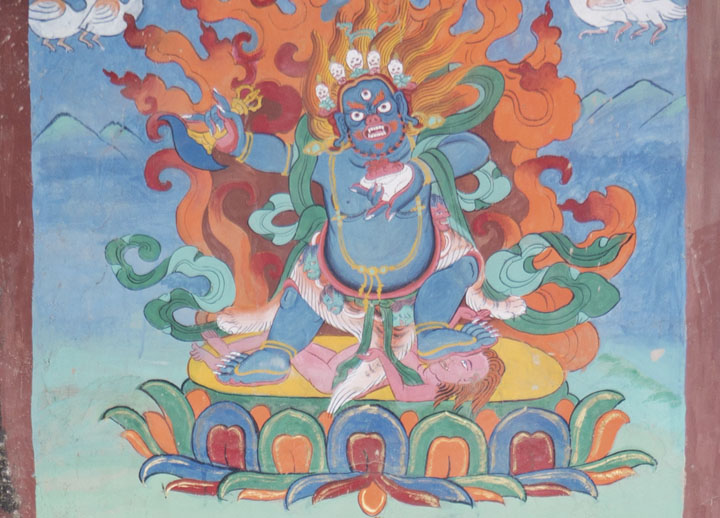
Repainted Mahakala above entrance door of Vairocana Temple, Mangyu Monastery, Ladakh.

The discrepancy between van Ham’s description and the above photo shows that this Mahakala was certainly repainted in the last few years. As we can see, absent are the shawls with Ladakhi patterns. This evidence, along with mismatched colors and less refined execution, leaves me shocked and deeply saddened over the handling of Mangyu Monastery preservation.

While the colors in this repainted mandala on the left of this entrance wall are more in keeping with extant original murals, the execution looks nothing at all like the sophisticated, skillful, and expressive handling of Indo-Tibetan artists.
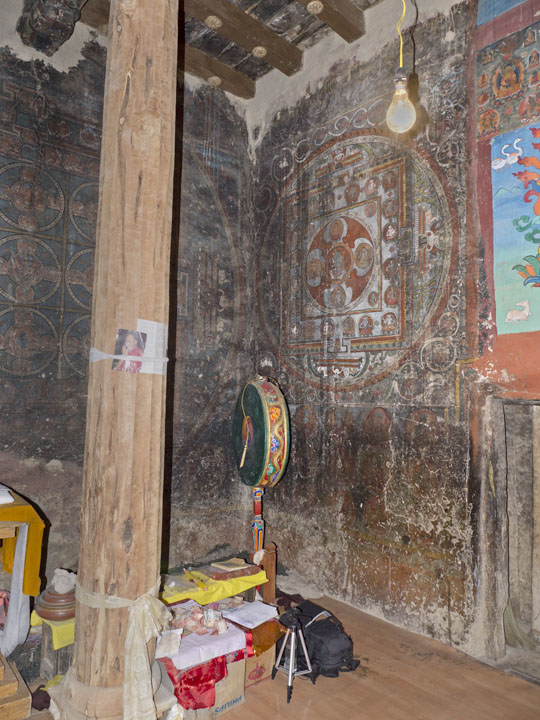
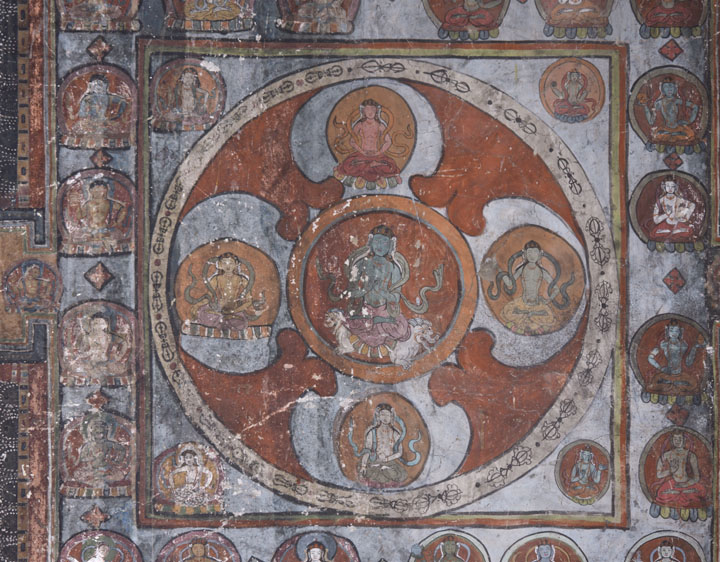
Interior view of Nanbarnangzad, Mangyu Monastery, with Indo-Tibetan wall paintings, Ladakh
Interior view of Nambarnangze, Mangyu Monastery, with Indo-Tibetan wall paintings, Ladakh
Detail of Vajradhatu mandala, Mangyu Monastery, Ladakh, India
Detail of  repainted mandala on left side of entrance wall, Nambarnangze, Mangyu Monastery, Ladakh
Detail of Vajradhatu mandala, Mangyu Monastery, Ladakh. Stylistically different, this was probably repainted over the ca. 11th century original Indo-Tibetan work by Kashmiri artists.
Detail of repainted mandala on left side of entrance wall, Mangyu Monastery, Ladakh. Stylistically different, this was probably repainted in recent years.
Detail of Vajradhatu mandala, Mangyu Monastery, Ladakh. Stylistically different and lacking in refinement, this is strong evidence of repainting over original Indo-Tibetan art.
Detail of repainted mandala, Nambarnangze, Mangyu Monastery, Ladakh. Stylistically different and lacking in refinement, this is strong evidence of repainting over original Indo-Tibetan art.

The same is true for the left side wall. What van Ham describes of the 11.5 foot diameter mandala that dominates this wall does not match what currently exists. This must also be a recently repainted mandala.
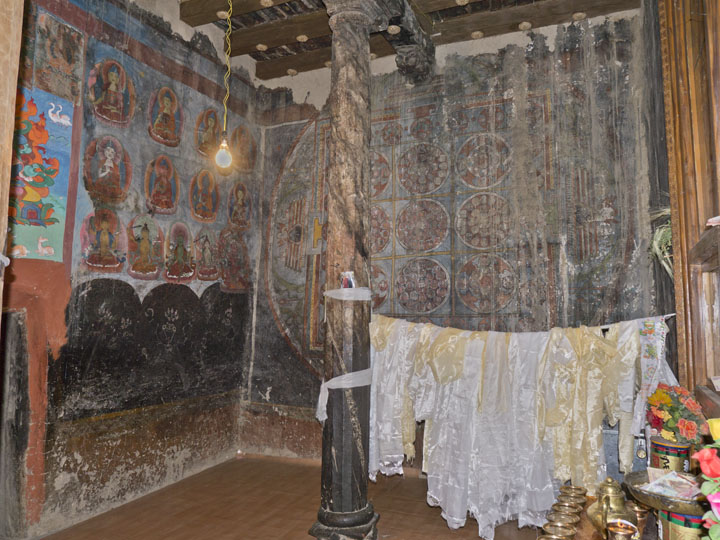
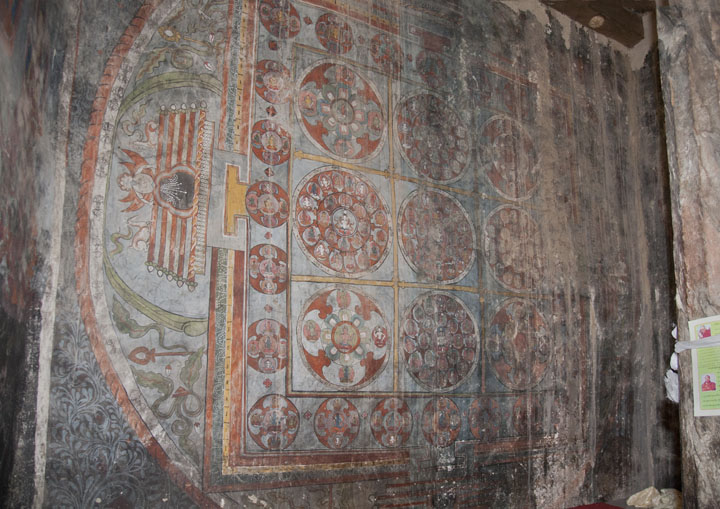
View of Vajradhatu mandala on back wall, adjacent to a variety of wall paintings that post-date the Indo-Tibetan period, another example of repainting that threatens the survival of the originals
View of Vajradhatu mandala on left side wall, adjacent to a variety of wall paintings that post-date the Indo-Tibetan period, another example of repainting that threatens the survival and art-historical importance of the originals
View of Vajradhatu mandala, Nangbarnangzad, Mangyu Monastery, Ladakh
View of Vajradhatu mandala, also repainted, Nambarnangze, Mangyu Monastery, Ladakh. Photo: Kishore Thukral

When this is what an example of original quality and style looks like (click on second image on the bottom) the quality and style of this repainted example pales in comparison.
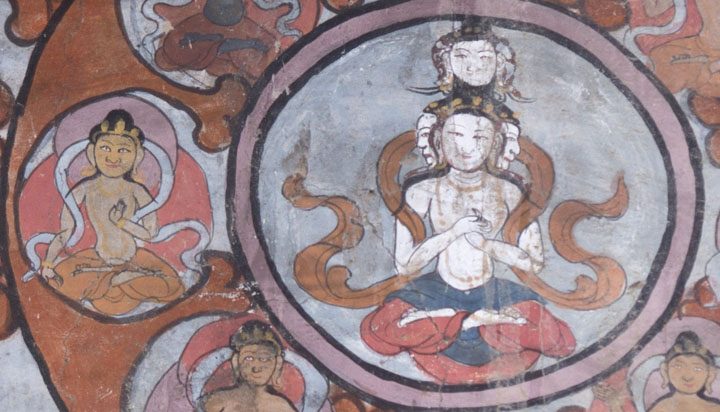
Detail of Vajradhatu mandala, Nangbarnangzad, Mangyu Monastery, Ladakh. Once again, stylistic and quality differences indicate repainting over Indo-Tibetan originals.
Detail of repainted Vajradhatu mandala, Nambarnangze, Mangyu Monastery, Ladakh. Once again, stylistic and quality differences indicate repainting over Indo-Tibetan originals.

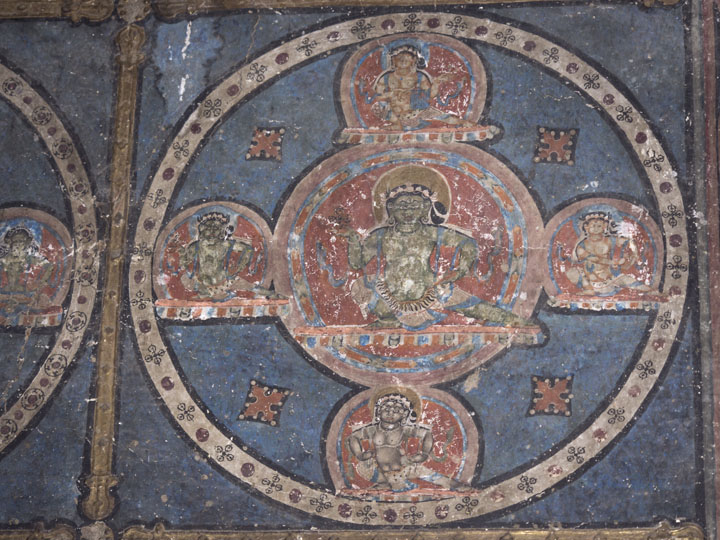
This small Buddha mandala is on the left of the altar wall. It contains some original and repainted areas.
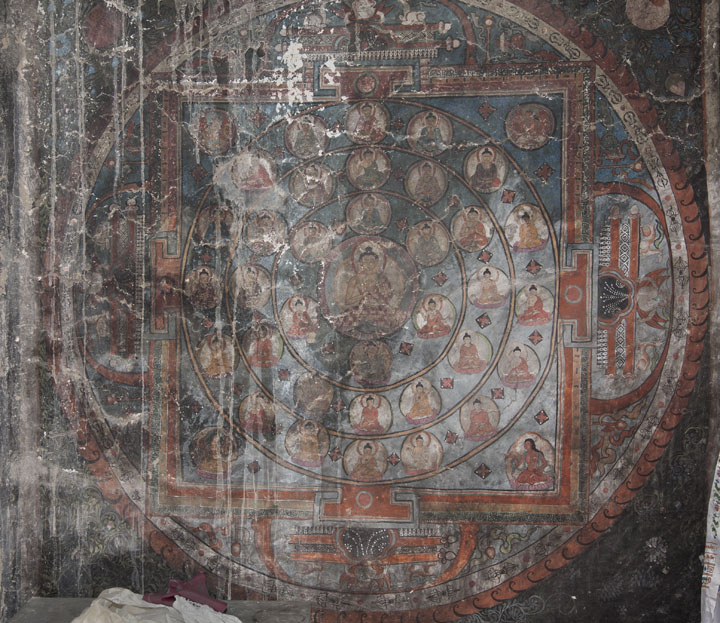
Buddha mandala, Nangbarnangzad, Mangyu Monastery, Ladakh. Stylistic and quality differences indicate repainting over Indo-Tibetan originals.
Buddha mandala, Nambarnangze, Mangyu Monastery, Ladakh. Stylistic and quality differences indicate repainting over Indo-Tibetan originals. Photo: Kishore Thukral

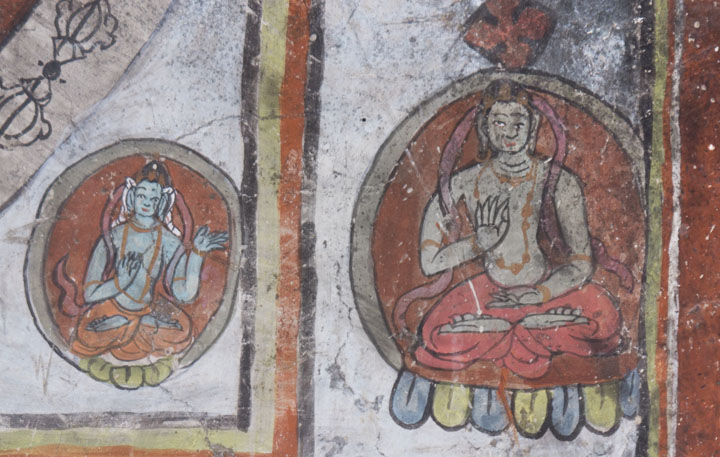
Here is a side-by-side view of what appears to be an original Indo-Tibetan Buddha in center next to a contemporary repainted one.
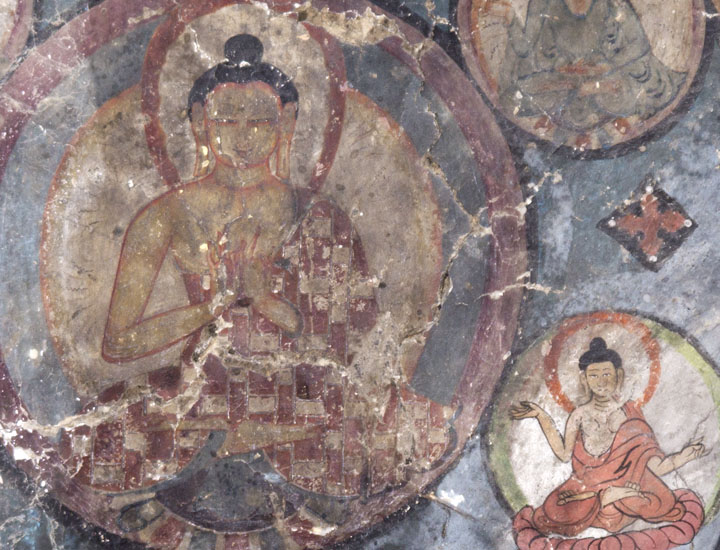
Detail of Buddha mandala, Nangbarnangzad, Mangyu Monastery, Ladakh. The central Buddha looks original, but at lower left, stylistic and quality differences indicate repainting over Indo-Tibetan originals.
Detail of Buddha mandala, Nambarnangze, Mangyu Monastery, Ladakh. The central Buddha looks original, but at lower left, stylistic and quality differences indicate repainting over Indo-Tibetan originals.

The historian David Snellgrove wrote in Indo-Tibetan Buddhism: Indian Buddhists and their Tibetan Successors, “The absence of all Buddhist wall-painting in India apart from the Ajanta Caves represents an enormous loss for the history of Indian art. Some deductions can be made from fragmentary remains in Central Asia and especially from the earliest surviving Tibetan murals from about A.D. 1000 onward, and from miniature paintings on Pala manuscripts of about that date.”

While Mangyu may still be pristine from a tourist/environmental point of view, it is less so from an art-historical one. Like I fear for Tabo, Alchi, and other remaining monasteries that have Indo-Tibetan significance, these beautiful, rare wall paintings are disappearing not only through age and exposure to natural elements, but also through the unexpected hands of man. The resultant replacement paintings, lacking in comparable quality, style, etc., are functionally erasing historical records. The originals are thus disappearing over time due to lack of proper conservation and restoration.

All photos © 2013, Eva Lee.

Drilbu Ri Mountain Mandala

Sept 16th Drilbu Ri Mountain kora (circumambulation)

5 a.m. with flashlight in hand and some provisions in a backpack, I started out in the dark to meet my guide S at a spot on the Drilbu Ri trail marked by a large barren tree.

Beginning of trekking trail of Drilbu Ri kora (circumambulation) from Kardang Monastery, Lahaul
Beginning of trekking trail for Drilbu Ri kora (circumambulation) from Kardang Monastery, Lahaul. The destination is the top of the mountain near where those seven peaks appear at upper left.

I had spent the night at Kardang Monastery, and once again had the pleasure of the company of nuns. It’s remarkable how details of one’s life narrative can be dispensed with when there is just mutual warmth felt between people. We chatted with whatever English they had (and for my part, zero Tibetan) and with mutual hand gestures. They cooked thukpa noodles in a delicious vegetable soup. I hadn’t eaten much that day having worked through lunch shooting photos at Guru Ghantal, so I was happy to carb-up for the next day’s trek.

Lovely Kardang Monastery nuns making thukpa noodles for dinner
Drilbu Ri mountain as seen from across the Bhaga River, Lahaul

Drilbu Ri kora—my gosh, what can I say? Getting to the summit whooped me! At almost 15,000 feet (4400 meters) altitude, I was short of breath at the start, and then later gasping for breath every 10 to 15 paces of steep uphill climbing. We reached the top shortly before 10 a.m. My guide, bless him, was so patient, calm, and encouraging with the words, “Slowly, slowly…” which he repeated like a mantra, each time with a gentle head tilt, the infamous Indian bobble.

Drilbu Ri trek, Lahaul
About two hours into trekking with guide S, Keylong is seen below (looks like thin line) on the opposite mountain across the valley.
Drilbu Ri Mountain, Lahaul
Ascent further up takes you into an area filled with a kind of red grassy plant that colors the mountain side
Drilbu Ri Mountain, Lahaul
As we climbed higher the mountain curved more and changed to rocky terrain
Drilbu Ri Mountain, Lahaul
Further up, the mountain is steeper, more angled, and here is where we hit the snow line, snow visible on right

The last part was the steepest and most difficult. I marveled that I was still going on only half a Nutella sandwich, some pieces of chocolate, and two mango juices. Hardly nutritious, but then again, hunger becomes more of a concept, given the altitude and level of exertion.

Looking up towards the summit, Drilbu Ri Mountain kora, Lahaul
Looking up towards the summit of Drilbu Ri Mountain, the top being where those prayer flags look like a dotted line. At this point more snow on the ground. Yes, it looks steep and then got even steeper!
Drlbu Ri Mountain, Lahaul
Still looking up at the summit, the ascent gets more vertical and narrower!
Finally at the top, you arrive through this narrow notch in Drilbu Ri Mountain
Finally arrival at the summit of Drilbu Ri by scrambing through this narrow and angled pass

Well, it was worth being reduced to crying “uncle.” When we got to Drilbu Ri’s summit, it was indeed a living mandala as the locals promised. 360-degree panorama of magnificent glacial mountains that take your breath away–literally and figuratively! No wonder the Himalayas is called “the roof of the world.” As you stand stuck in awe, the amazing height and expanse somehow melds with your inner sense of worldy, or maybe otherwordly, home. Yes, you, small and insignificant in this vast geological time and space, still get to be part of it all.

View of Keylong down in Bhaga River Valley from the summit for Dribu Ri Mountain
Dribu Ri Mountain on other side, Lahaul
Unbelievable immensity, view of the other side of the Drilbu Ri Mountain looking down towards Gondhala Village. This is where you begin the descent down, a lot less steep but looks deceptively smooth and “easy.”
View of Keylong down in Bhaga River Valley from the summit for Dribu Ri Mountain, Lahaul
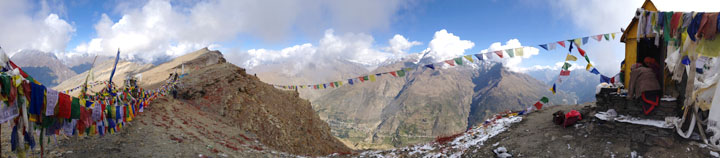
View of Keylong down in Bhaga River Valley from the summit of Dribu Ri Mountain, Lahaul. On right is a Buddhist shrine housed in a small yellow structure in which Lahauli pilgrims are lighting butter lamps and incense as offerings. Hidden under many kata offering scarves further to the right is also a small Hindu shrine dedicated to the sacred union of Shiva and Parvati.
Butter lamps and other offerings in Buddhist shrine on top of Drilbu Ri Mountain, Lahaul. Hindus also consider this a sacred site and there is a shrine, too, dedicated to the sacred union of Shiva and Parvati
Butter lamps and other offerings in Buddhist shrine on top of Drilbu Ri Mountain, Lahaul. Hindus also consider this a sacred site and there is a separate shrine dedicated to the sacred union of Shiva and Parvati.

In fact, Drilbu Ri is sacred to Tibetan Buddhists as Chakrasamvara’s abode. It is important to understand here that none of the Buddhist tantric deities are believed to exist externally. Rather, they represent the ultimate and profound state of mind which sees that self and phenomena are empty of inherent existence. If this is an intriguing idea for you, then you may want to learn more about the distinctive Buddhist philosophy of dependent origination.

Chakrasamvara, wall painting, Gandhola Monastery, Lahaul, India
Chakrasamvara, wall painting, Gandhola Monastery, Lahaul

Chakrasambava is understood as a wrathful manifestation of Buddha for combating the compelling mental condition of perceiving things as concretely existing. Tantric yoga practices are essentially visualizations of the deity that enact illusion and dissolution of self through identifying with the deity’s Buddha-nature. With the initiation and guidance of a qualified teacher, the practitioner gains the benefit of seeing things as they really are—that is, illusory and empty of inherent existence. This is what’s called wisdom. Cultivating wisdom together with compassion form the complementary two wings for full flight to enlightenment.

Tibetan Buddhists believe that pilgrimage to sacred sites like Drilbu Ri is a great purification of self-centered concerns in order to adopt more expansive mental states that are conducive for wisdom. Overcoming hardships and challenges on a kora can act as a propeller on one’s spiritual path, especially if the site has been graced by the spiritual energies of realized practitioners. Masters such as Nagajuna, Ghantapa, Gotsangpa, Orgyenpa, Taktsang and Rangrik Repas have come to meditate on Drilbu Ri over the past millennia.

View of Keylong side of Drilbu Ri Mountain, Lahaul
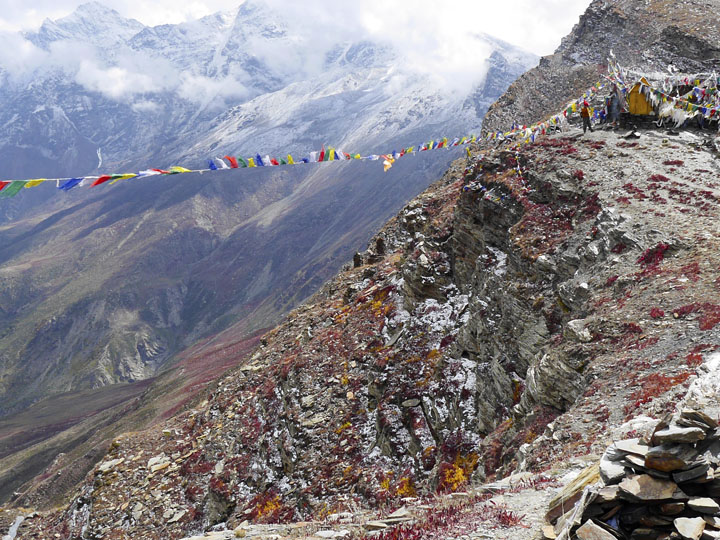
View of Keylong side of Drilbu Ri Mountain, looking towards the shrines and my guide S. It’s hard to imagine how people manage to string up these long expanses of prayer flags over the terrain!

Traditionally, Tibetans have traveled hundreds or even thousands of kilometers, often in full body prostration, to complete such pilgrimages. I understand that Drilbu Ri and Mount Kailash are two of the foremost sites for kora. It is said that the completion of such circumambulations bring manifold results, multiplying divine merit.

Tibetan Buddhist prayer flags, summit of Drilbu Ri Mouuntain, Lahaul
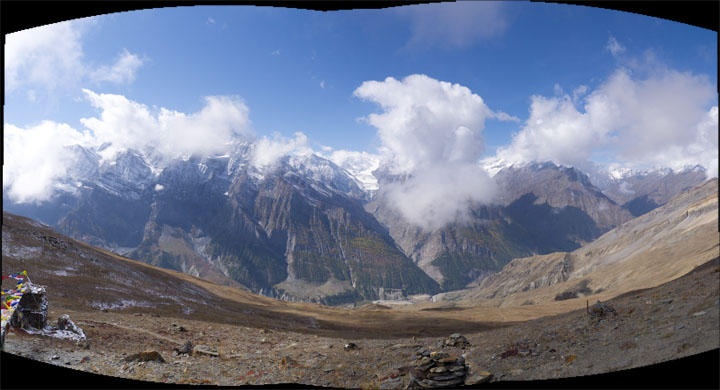
More expanses of prayer flags at the summit of Drilbu Ri Mountain. On the left side is the descent down to Gondhala and on the right side was the ascent up from Kardang Monastery/Keylong side, Lahaul

As for me, I came here to research Indo-Tibetan mandalas as a visual artist. Then found, as I was told, that Lahaul does not have so much in the way of drawn images of mandalas. Rather, the land itself is a mandala which one should experience physically. I’m glad I did.

View of Keylong side of Drilbu Ri Mountain
Numerous stupas are found all along the top ridge of Drilbu Ri Mountain, like sentinels holding up prayer flags, Lahaul
Top of Drilbu Ri Mountain, Lahaul
Exhilaration, okay, maybe augmented by some oxygen deprivation at the summit of Drilbu Ri Mountain, about 15,000 feet (4400 meters) altitude.

The weather was such a wonderful wide range all that day. Dawn began with some overcast clouds, which then gradually lifted later in the morning to give way to wholesome, crystal clear sunshine by late morning when we reached the top. After a picnic brunch of omelette sandwiches with Indian pickles which S brought with him, a light snowfall came to herald our time to pack up and start the hike down the other side of Drilbu Ri Mountain. The destination was Gondhala Village, where we would then get a bus or taxi back to Keylong.

Oh, and by the way, I thought making it to the top of Drilbu Ri meant the hard part was over. Not so. The return on the other side of the mountain was less steep, more graduated but MUCH longer distance. It was also colder and so windy at times that you literally had to resist being blown over a decline. I was so grateful S had brought me an extra jacket to wear.

Where the descent on the other side of Drilbu Ri Mountain begins, looking towards Gondhala Village, Lahaul
Where the descent on the other side of Drilbu Ri Mountain begins, looking towards Gondhala Village, Lahaul. The clouds were surreal, at once looking like huge chunks but then moving like ethereal wisps across the mountains.

Descending was a different stamina test, for the knees and thighs instead of the breath.

The descent on the other side of Drilbu Ri Mountain begins, looking towards Gondhala Village, Lahaul

Later, I felt like my eyes were playing tricks on me because Gondhala never seemed to come any closer no matter how long and how far we walked! The village visually seemed like it stayed the same distance away.

The continued descent on the other side of Drilbu Ri Mountain begins, looking towards Gondhala Village, Lahaul
13-Drilbu Ri_72
Thumbs up for completion of Drilbu Ri kora by one experienced trekking guide, and one unsuspecting but game novice.

I finally did get exhausted and waved the white flag. S could see that I indeed had had enough, so instead he lead me to the closest point on the road, and then called trusty ol’ driver D (thank you! thank you!) to pick us up for the ride back to Keylong. I was never so happy before to see a road—wonderful, smooth, FLAT road!

The continued descent on the other side of Drilbu Ri Mountain begins, looking towards Gondhala Village, Lahaul
At last, reaching the road on the other side of Drilbu Ri Mountain. Gondhala Village still seemed far around the bend!

All photos © 2013, Eva Lee.

Tabo Monastery and “The Forgotten Gods of Tibet”

In the book The Forgotten Gods of Tibet: Early Buddhist Art in the Western Himalayas,  published in 1997, authors Peter van Ham and Aglaja Stirn wrote about Tabo Monastery‘s Tsug Lhakhang: “Unfortunately many of the paintings, especially in the lower register, are badly damaged. In fact the northern wall has a large area where nothing except for the grey wall can be made out. Some of these gaps were painted over in recent times–enhancing the impression of the high artistic merit of the old paintings since these newer additions only show a mediocre level of execution.”

Perhaps this may be an example (see image below). Notice how the figure to the left of the central Buddha is stylistically so different from the one on the right. As a trained fine arts painter as well as decorative painter, I must agree with authors van Ham and Stirn.

Stylistic inconsistency in repainted figure on left, Tabo Monastery Tsug Lhakhang

This below example of stylistic continuity is what the above example should look like.

Stylistic continuity in these three figures, Tabo Monastery Tsug Lhakhang
Stylistic consistency in these three figures, Tabo Monastery Tsug Lhakhang

Here is a view of a comparable original painting on the left and the one in question on the right.  Stiff and simplistic in appearance, the repainted one bears little resemblance to the refined and delightfully detailed original.

Example of original painting on left and repainted version on right, Tabo Monastery tsug Lhakhang
An example of original painting on left and repainted version on right, Tabo Monastery Tsug Lhakhang

Here, above the doorway, is another example of repainting in the chevron border and the two figures underneath.

inpainting_bkWall1
Repainted areas in Tabo Monastery Tsug Lhakhang

Presented above are only a couple of examples. In person onsite at Tabo’s Tsug Lhakhang, one finds upon scrutiny numerous incidences of such inpainting and overpainting. I fear that if this kind of “restoration” continues, over time, the temple’s extraordinary original murals will be obliterated rather than preserved. That would be an immeasurable loss for India, art history, and world posterity.

Experience the interior of Tabo Monastery’s Tsug Lhakhang by watching this video walk-through here.

Tabo Monastery – Tsug Lhakhang (Main Assembly Hall) from Eva Lee on Vimeo.

Tabo Monastery is under the protection of the Archeological Survey of India, but it is unclear to me who is doing the painting.

The book Architectural Heritage: Ladakh by The Indian National Trust for Art and Cultural Heritage, published in 2003, says it is often the monastics who do not realize the need for proper conservation, being more concerned with the religious content of the murals and not the art historical significance.

“In the great temples, the execution of wall paintings is carried out by monks and scholars whose canonical knowledge is profound…Most wall paintings are done on perishable mud plaster, and as these begin to disintegrate, these are either removed to draw fresh paintings or retraced and retouched to maintain their vibrancy and freshness. This way it is sometimes painful to witness a ruthless operation in which centuries old paintings are lost along with the structure by eager lamas to construct new structure and, consequently, draw another set of wall paintings…As soon as the walls begin to crack, or paintings fade, they are at once repainted.”

While it appears that at times the goals of Tabo Monastery and Archeological Survey of India may be at cross-purposes with one another, there seems to be great effort for mutual respect. After all, Tabo is a functioning Tibetan Buddhist religious site. At the same time, it is a rare Indo-Tibetan historical site under ASI’s charge. The question is, how are these two establishments proceeding forward?

Repainting, however, is only one of the man-made challenges to the preservation of Indo-Tibetan murals. There are also issues involving structural changes to historical buildings (see this earlier post regarding repairs to the roof of Tabo’s Great Assembly Hall), vandalism, and the effects of tourism, to name some others. Then there are the natural challenges such as wet conditions caused by snow or rainfall, and movement caused by earthquakes.

Partial repair and rudimentary inpainting in the Thousand Buddhas inner wall of Tabo Monastery Tsug Lhakhang inner sanctum, Spiti, India
Partial repair and rudimentary inpainting in the Thousand Buddhas inner wall of
Tabo Monastery Tsug Lhakhang inner sanctum, Spiti, India

I heard that it’s possible ASI may have applied for UNESCO World Heritage status for Tabo Monastery. In terms of conservation and preservation, this would be wonderful if it were to come about! I understand that the Ajanta Caves in Southern India, which contain stunning, well-preserved, ancient Buddhist paintings as old as 2nd century B.C.E., is a World Heritage site.

For further information about the Indo-Tibetan significance of this site, see Tabo Monastery: Vajradhatu Mandala Spendor.

All photos © 2013, Eva Lee.

Tabo Monastery: Vajradhatu Mandala Splendor

September 7th     Tabo Monastery Part Two…here it is!

Tabo Monastery Tsug Lhakhang, Spiti, India
Tabo Monastery Tsug Lhakhang, with meditation caves in the cliffs beyond, Spiti, India

Six-o’clock morning puja for the recently deceased beloved abbot at Tabo Monastery was quite beautiful. I wasn’t fully awake for it, and drifted through listening to each monk use his voice artfully to express himself through prayer. Very nice. I found out later from a lama that while they all learn the basic rhythm, it is up to each individual monk to say the prayer as he wishes. In other words, they all chant the same prayer, but some go out and come in on certain parts, using their voices to inflect sound, create variety, meld, or syncopate, etc.

Afterwards I was able to do some documenting at Tabo today! Limited time, however, permitted only doing the interior of the Tsug Lhakhang, the Great Assembly Hall. I was thrilled because it was the most significant temple in terms of its Vajradhatu mandala arrangement and my research project.

Experience the interior of Tabo Monastery’s Tsug Lhakhang  or Main Assembly Hall by watching this video walk-through.

Tabo Monastery – Tsug Lhakhang (Main Assembly Hall)

Entering the Great Assembly Hall, Tabo Monastery
Entering the Great Assembly Hall from its antechamber, Tabo Monastery

Wow, what a place! Dark and dramatic, with rays of light coming in through small ceiling windows, shining brilliantly on the main altar and then fading out towards the periphery of the assembly hall. I was stunned by the large number of statues and paintings to feast my eyes on! In a space that envelopes you in semi-darkness, it took some time to realize that just about every inch of wall and ceiling had been richly decorated.

See floor plan here.

With over a thousand years of continuous use as a meditation hall, I soaked in the sense of countless generations of monks who have spent their days here in peaceful meditation. I tried to fathom the devotion that Tabo’s Tsug Lhakhang has seen and sheltered. The overall impression is that of quiet yet teeming spiritual beauty.

Founded in 996 C.E. by the Guge (Western Tibet) king Yeshe O’d, the temple and statues are viewed clockwise in a Buddhist kora or circumambulation.

According to scholars, Kashmiri artists were responsible for the refined style of the statues and paintings. At the time, Buddhism had flourished in Kashmir and the region’s art was aesthetically sophisticated in expression and detail. Most of the art was executed circa 1042 C.E. during the renovation of the interior by Jangchub O’d, Yeshe O’d’s grand nephew.

The main altar features a gilded Vairocana. What a sight this tantric deity is with its larger-than-life four bodies, seated back to back, its serene faces looking out in the four cardinal directions. Distinctly Indian features include Indo-style trousers, painted red palms, procession carriage structure, and naga/garuda mount at top.

There are 32 multi-colored, graceful clay sculptures of Vairocana’s associated deities that line the assembly hall walls in Vajradhatu mandala order. Each is seated on a lotus pedestal, and cantilevers out of an attached sculpted halo background. Situated above eye-level, the figures look kindly and seem to lean towards you. Surrounding these deities on the wall are elaborate, colorful fresco paintings—scenes of Prince Sudhana’s pilgrimage and Buddha’s life on the lower frieze area; buddhas, bodhisattvas, other tantric deities and Bon goddesses in the upper area.

Clay statues of tantric deities, Tabo Monastery
Clay statues of tantric deities in Vajradhatu mandala arrangement, Tabo Monastery

Sudhana's pilgrimage depicted on lower frieze, Tabo Monastery Tsug Lhakhang
Sudhana’s pilgrimage on lower frieze, Tabo Monastery Tsug Lhakhang.  Much of it is too deteriorated to see clearly.

Painted buddhas and bodhisattvas on upper areas of TAbo Monastery Tsug Lhakhang
Guardian deity at far left, painted buddhas and bodhisattvas on upper areas of Tabo Monastery Tsug Lhakhang

Tabo Monastery Tsug Lhakhang altar, Spiti, India
Vairocana statue, main altar, Tabo Monastery Tsug Lhakhang, Spiti, India
Distinctly Indian features include Indo-style trousers, painted red palms, procession carriage structure, and naga/garuda mount at top.

Gilded Vairocana statue, Tabo Monastery Tsug Lhakhang altar, Spiti, India
View of gilded Vairocana statue from inner sanctum, Tabo Monastery Tsug Lhakhang, Spiti, India

Detail of gold Vairocana, Tabo Monastery Great Assembly Hall altar, Spiti, India

Tabo’s Main Assembly Hall, and in fact, the whole monastic complex was originally built according to a mandala concept as set forth by the Sarva-tathāgata-tattva-samgraha Tantrapractically a literal translation of it which distinguished this monastery. To the practitioner, therefore, Tabo’s interior and exterior order symbolized his sacred inner and outer realities. (More on this topic in previous post But Wait, A Bit About Mandalas.)

“The main temple, Tsug Lhakhang, was at the center of the whole complex.  The center of the temple was also the center of the compound along the east-west axis, having its major statue, Saravid Vairocana, placed in the central spot [now moved to the altar] not only of its surrounding 32 statues but also of the whole complex….Later additions have diluted the concept, but temples from Tabo’s heyday, together with stupas or chorten, form a simple but clearly visible mandala in the architectural layout-plan.” (The Forgotten Gods of Tibet: Early Buddhist Art in the Western Himalayas by Peter van Ham and Aglaja Stirn.  See also this book for excellent descriptions and further details on Tabo’s iconography)

Vajradhatu mandala arrangement of Vairocana and 32 associated deities, Tabo Monastery, Spiti, India.

Above is the floor plan of the Main Assembly Hall showing the Vajradhatu mandala arrangement of the Five Buddha Families: Vairocana, Amitabha, Amoghasiddhi, Akshobya, and Ratnasambhava, with their associated deities. These represent aspects of Buddha-nature that guide a practitioner to attain enlightenment according to the lower yoga tantras. Tibetan Buddhists today generally practice highest yoga tantra or Annutarayoga.

Vairocana, main altar, Tabo Monastery, Spiti, IndiaSide view of Vairocana statue, main altar, Tabo Monastery, Spiti, India.  The statue is built in the tradition of an Indian procession carriage, used for carrying the god around the temple or outside for blessing. 

For photography and viewing, I came prepared with flashlights. Thank goodness they were fully charged, and that our current guesthouse has power! We would not have been able to see most of these dark interiors without them.

Vajrahasa statue, Tabo Monastery
Vajrahasa statue, part of the Gem family of Ratnasambhava, Tabo Monastery

What a challenge it’s been to ensure my equipment is all charged and ready to go. Sadly, I am told by locals that Spiti in general lacks electricity because the Indian government is remiss in providing good infrastructure to all its citizens, and particularly to those communities that are remote, less populated, and lack political clout. As you can imagine this makes Spiti’s growing tourism especially difficult when hotel and restaurant owners, cyber cafes, etc., must routinely apologize to their clientele for not being able to meet their needs due to lack of power. I got creative with calculating how long my cell phone, laptop and camera equipment would last before finding the next feasible charging place.

Vajrakarma statue, Tabo Monastery Tsug Lhakhang
Vajrakarma statue, part of the Action family of Amoghasiddhi
Tabo Monastery Tsug Lhakhang

Vajrayaksa statue, Tabo Monastery Tsug Lhakhang
Vajrayaksa statue, part of the Action family of Amogasiddhi
Tabo Monastery Tsug Lhakhang

Akshobya statue,Tabo Monastery Tsug Lhakhang
Akshobya statue, Vajra family
Tabo Monastery Tsug Lhakhang

Behind the main altar is a small inner sanctum or cella that contains a 13th century statue of Amitabha in an elevated niche, flanked by two crowned statues of bodhisattvas, Padmapani on the left and Mahashtamaprapta on the right. Above him are figures identified as Apsaras or minor gods in the act of homage, and painted on his left and right are female attendants.

Amitbha statue, inner sanctum, Tabo Monastery Tsug Lhakhang
Amitabha statue, inner sanctum, Tabo Monastery Tsug Lhakhang
Stylistically different from the statues in the main hall, it looks like a later addition or replacement.

Mahasthanaprata statue, inner sanctum, Tabo Monastery Tsug Lhakhang
Padmapani statue, inner sanctum, Tabo Monastery Tsug Lhakhang. Visible on the left are some of the Thousand Buddhas that are painted on the circumambulatory inner walls.

Vajrapasa statue, Tabo Monastery Tsug Lhakhang
Vajrapasa statue guarding entrance to inner sanctum, Tabo Monastery Tsug Lhakhang

A narrow corridor for circumambulation surrounds Amitabha. Its inner walls are richly painted from floor to ceiling with Thousand Buddhas, manifestations of the enlightened one in splendid iteration of the five colors, different robes, lotus pedestals, and haloes.

Small buddhas on inner sanctum walls, Tabo Monastery Tsug Lhakhang
Buddhas in a Thousand Buddha depiction on inner sanctum circumambulatory walls, Tabo Monastery

On the outer walls are magnificent bodhisattvas and Supreme Buddhas (Tathagatas). These are my favorites! I really appreciate the mastery of these paintings in the inner sanctum. The below bodhisattva is an example of one of sixteen that symbolize aspects of Buddhahood stemming from Vairocana.

Bodhisattva, from outer circumambulatory wall of Tabo Monastery Tsug Lhakhang

The bodhisattva figures literally took my breath away when I saw them revealed by my flashlight! Every brushstroke showed ease, delicacy and variety in execution.  The highly inventive and detailed jewelry, as well as the fabric patterns, was a pleasure to discover. In addition, these paintings are well-preserved and dated 1042 C.E. when the temple was renovated. In other words, they appear as they were first created, untouched by other painters or conservators since then. What an incredible indication of the original quality of work that existed!

These inner sanctum figures look different from the ones on the upper register of the Tsug Lhakhang in that they are far more elaborate and refined. Additionally, Indo-Tibetan paintings show a freedom of composition not found in later Tibetan artworks where proportions and poses are more defined by convention.

The Supreme Buddhas were also delightfully painted, exhibiting a similar level of refinement and delicacy but painted at a much larger scale, about life-size.

Supreme Buddha, outer wall of circumambulatory, inner sanctum Tabo Monastery Tsug Lhakhang
Supreme Buddha dressed in unusual pleated robe, painted on outer wall of circumambulatory,
Tabo Monastery Tsug Lhakhang inner sanctum

I particularly like the sense of ease yet energy that this below Buddha expresses.  His face and gaze are sublime, his hands in graceful repose. But his unusual robe depicts rhythm and movement in the undulating sleeves and neckline detail. Coupled with the artist’s use of primary colors and radiating spirals in the halo, the overall effect of this painting is vibrant immediacy.

Supreme Buddha on outer wall, inner sanctum of Tabo Monastery Tsug Lhakhang

Detail of Supreme Buddha on outer wall, inner sanctum of Tabo Monastery Tsug Lhakhang

All photos © 2013, Eva Lee.

The Great Translator Rinchen Zangpo

I’m currently reading David Snellgrove’s “Indo-Tibetan Buddhism: Indian Buddhists & Their Tibetan Successors.” It concentrates on the tantric period of Buddhist theory and practice, from the 8th to the 13th centuries. This was a fertile time of the transmission of Buddhism from India to Tibet. I’m particularly interested in the prodigious legacy of The Great Translator Rinchen Zangpo (958–1055 C.E.) who translated voluminous original Sanskrit sutras into Tibetan, and therefore helped preserve the doctrines and teachings. These original Sanskrit sources are now largely lost in India.

Tabo Monastery, Spiti, Himachal Pradesh, India
Photo: Tabo Monastery

Rinchen Zangpo is also credited with building over one hundred monasteries in Western Tibet, many still existing now in modern day Indian Himalayas, including the famous Tabo Monastery in Spiti, Himachal Pradesh.

I really look forward to seeing Tabo’s murals. They are extensive and among the best preserved from Rinchen Zangpo’s time. In addition to the art, its architecture is an excellent example of mandala layout and structure, built in direct relationship to sutra descriptions. Founded in 996 C.E., Tabo is considered to be the oldest continuously functioning Buddhist monastery in India and the Himalayas.

Himalayas / hi-MAAL-yah

Learn something new every day. The correct pronunciation for Himalaya is “hi-MAAL-yah.”

Mountains and the Indus River Valley as seen from Alchi Monastery circumambulatory, Himalayas.

I look forward to going there later this year to conduct research as an artist, made possible by a Fulbright-Nehru Scholar award. Excited and honored! Truly grateful for this opportunity! I will be researching murals of Indo-Tibetan monasteries in Lahaul, Spiti, and Ladakh districts, with a focus on mandalas as a blueprint for understanding the nature of mind and reality.

So while my departure is still months away, I’ve already begun traveling in my mind as I await further details from Fulbright.