My travel companion K and I left Keylong at 5:00 a.m. to head to Leh. The wonderful and inspired Lahauli adventure had come to an end, and it was now time for Ladakh!
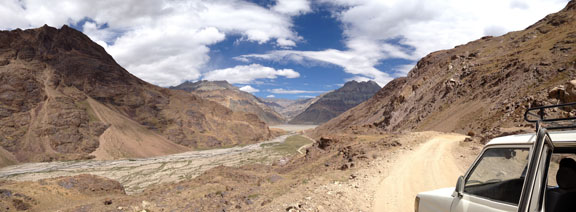
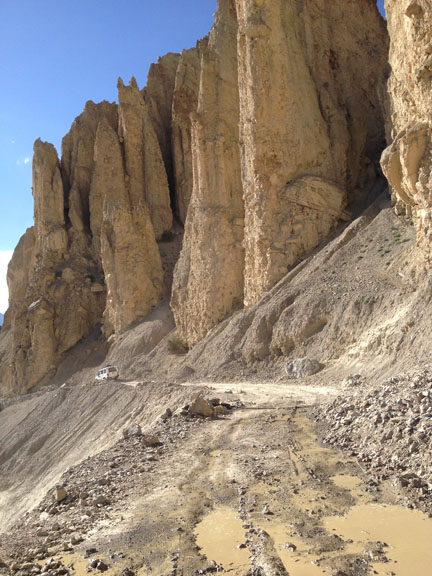
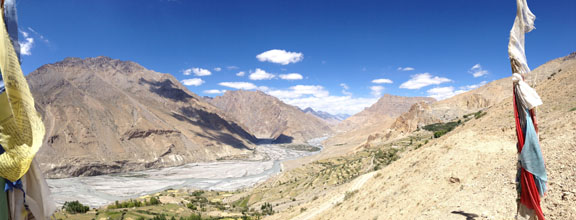
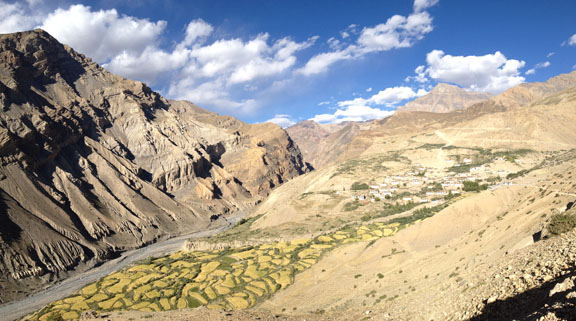
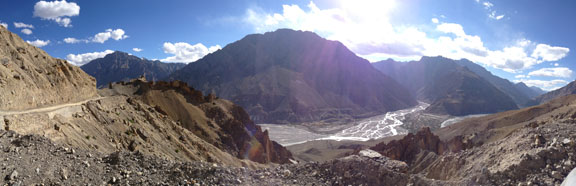
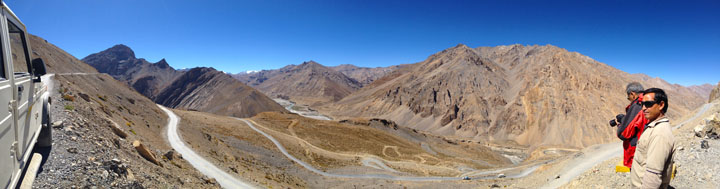
It was a long drive of about 11-12 hours on the Manali-Leh Highway, with stops for photos, breakfast and lunch. Unbelievable rugged terrain that seems to endlessly unfurl its textural vistas as you drive along hour after hour. Empty, cold, semi-arid desert across vast mountain ranges.
Rugged terrain of Manali-Leh Highway, en route to Ladakh
Like the road trip from Spiti to Lahaul, the land is at once austere and captivating. Fortunately, unlike the jagged, unpaved highway from Spiti to Lahaul, this one was rather well-paved and maintained. Besides tourists, it’s well-used by the military guarding the Sino-Indian border, and there are checkpoints along the way where all vehicles must stop and register passing through.
En route, one passes places with quaint names like Zingzingbar and Lachulung-la, ascending ever higher. From our starting point at Keylong, it’s 3349 meters altitude going up to the high point of Tanglang-la of 5328 meters. I felt short of breath at times, but thank goodness I’m long over altitude adjustments (the first week in Spiti was vice-grip-like, headache-filled nights in addition to shortness of breath), though it is no joke to continue to take precautions and be aware of the dangers of high altitude sickness. People can die from it, and pretty quickly, too.
Roadside tent dhabas (eateries) and basic dormitory accommodations are set up for the summer season from about June to September, Manali-Leh Highway
There are no villages or towns the whole stretch of road from Keylong to Leh, only roadside stops for food or overnight stays. These are makeshift temporary seasonal tents that offer cots for travelers to sleep in and a basic menu of dishes such as paranthas, rice and dahl, chow mein. Breakfast was at one of these places.
Interior of a roadside dhaba (eatery) with cots for overnight stays, Manali-Leh Highway, Ladakh
Shortly after taking off on the road again after breakfast, we saw this. Can you spot the little guy in the below photo?
Manali-Leh Highway
Didn’t see him? Okay, then look here…
Marmot out in morning sun, Manali-Leh Highway, en route to Ladakh
Marmots were poking their heads out of rock crevices, or walking out in the open like this one, presumably searching for breakfast. Cute pudgy little things, they reminded me of our local American groundhogs.
Driver G was really nice, good conversationalist, great driver. He is a trekking guide and luxury tent campsite owner in Manali who conducts Himalayan adventure trips. He is also an old friend of K’s. K said G saved his life once on a mountaineering trip.
With his four wheel drive flatbed truck, he would deftly take uphill shortcuts connecting switchback roads, such as here at the Gata Loops, the part of the highway famed for its 21 hairpin turns.
The part of Manali-Leh Highway famed for its 21 hairpin turns on the road, en route to LadakhGate Loops on Manali-Leh Highway, en route to LadakhTurquoise water offset against the pinks of the mountain range and red-siena ground cover. Yes, it really looks like this on parts of the Manali-Leh Highway heading to Ladakh!
Kangla Jal trekking pass point and India Gate reminds me of out West in Zion or Bryce Canyons in the U.S.
Near Kangla Jal trekking pass, Manali-Leh Highway, en route to LadakhIndia Gate, near Kangla Jal trekking pass, Manali-Leh Highway, en route to Ladakh
Lunch was at another tent site, where people really make do with little water and toilets are open air. One gets good at finding large rocks to befriend!
Lunch en route to Ladakh on Manali-Leh Highway
Not long after leaving the lunch site, we came upon the plateau portion of the trip called Morey Plains. Instead of traveling through passageways and valleys, this section was a wide open flat expanse of land.
Morey Plains, Manali-Leh Highway, en route to LadakhBeginning of Morey Plains, Manali-Leh Highway, en route to LadakhJust straight road! Morey Plains, Manali-Leh Highway, en route to Ladakh
The Himalayan mountains along the way are diverse in colors and shapes. Some are more black like these below, and others more pink and warm flesh tones gradating into earth reds as you see more of as you get closer to Leh.
Natures sculpts some stunning shapes and presents here nuanced gray and black tones along the Manali-Leh HighwayThe Himalayas, as far as your eye can see…Large cars are just specks on the thready-looking roads
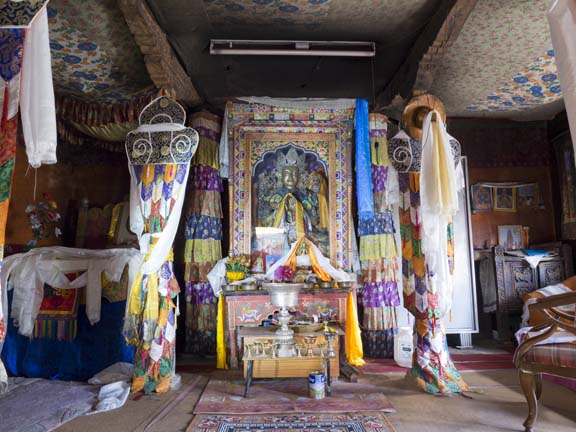
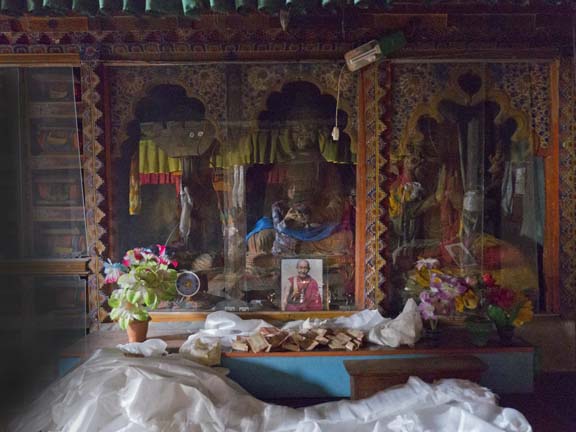
When we reached Tangla-la, the high point with an altitude of over 17,500 feet, it was marked by a large shrine and elaborate prayer flags. Other travelers stopped for a gander and to marvel that they, too, had made it to this point on the road to Leh. Inside the shrine there were Hindu and Buddhist deities.
Tanglang-la Pass with shrine and prayer flags, the highest point on the Manali-Leh Highway at 5328 meters (over 17500 feet), en route to Ladakh, IndiaShrine at Tanglang-la Pass, the highest point on the Manali-Leh Highway at 5328 meters (over 17500 feet)Hindu and Buddhist deities, inside shrine at Tanglang-la Pass, the highest point on the Manali-Leh Highway en route to Ladakh, India
How did people in ancient times manage traveling through this rough barren terrain? Actually many of them didn’t and perished along the way. I’m thinking of Rinchen Zangpo’s party of 21, whom King Yeshe O’d sent from Guge, Western Tibet, to India in the late 10th century, only 2 of whom made it back alive.
IS IT NOT? Khardung-la is the first highest pass in India.
As you get closer to the city of Leh on the highway, you begin to see stupas and chortens in the landscape. This little monastery is among the first signs of permanent dwellings as you come out of the hinterlands and approach civilization, still about two hours’ drive before reaching the outer monasteries of Leh, such as Stakna.
The scenic view of Stagna Monastery as you come out of the remoteness of the Manali-Leh Highway and reach outskirts of Leh, Ladakh, IndiaMuch of Leh looks like this combination of vast dry flatlands adjacent to mountains with villages nestled in the valleys.
Sept 9, 2013 Spiti adventure continues…on to Lahaul, India
After a jaunty jiggly jeep ride of over 10 hours from Kaza back through the magnificent giant boulder rubble of Spiti Valley, Kunzum-la Pass (this time populated by yaks grazing and loafing!) and getting stuck fording a glacial melt waterfall that flooded the rocky road, we arrived in Keylong, Lahaul.
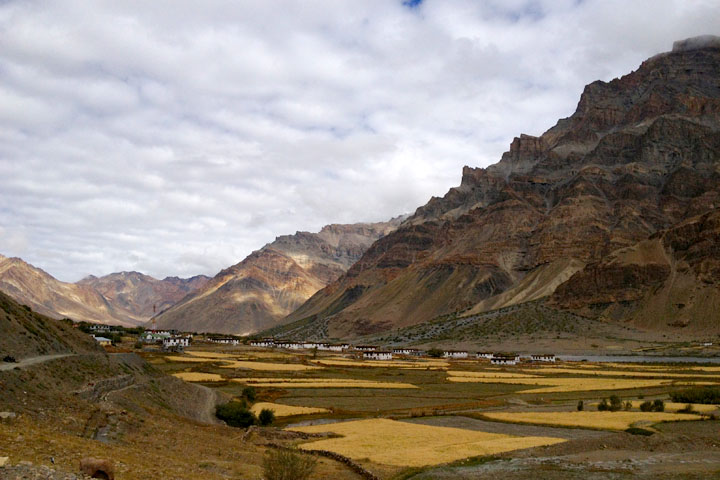
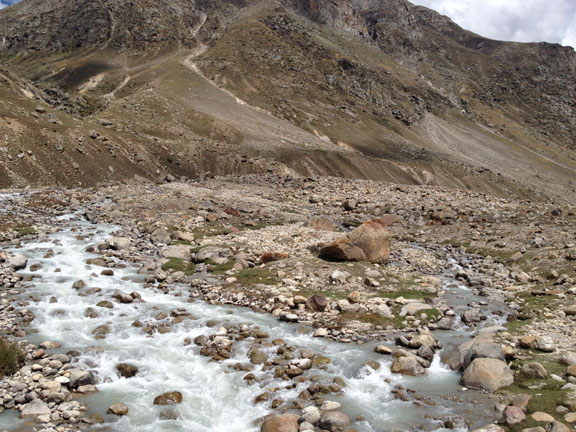
View of farmland in early morning Spiti Valley, en route to Keylong, LahaulSpiti Valley in the marbled early morning sun. As dry and desolate as Spiti may seem, there is always the play of light and colorful vistasApproaching the stupas of Kunzum la pass, the high point of the road at about 15000 ft altitude. This time there was a herd of yak grazing and resting. Glaciers can be seen within relatively close range.Kunzum la pass, where I circumambulated the stupas and got a close look at yaks gathered there. Glaciers can be seen at above left.Herd of yaks dotting Kunzum la pass, at about 15000 feet altitude, the highest point of the road through Spiti ValleyYak grazing, this one looks like he’s molting or has been shavedYaks grazing and resting at Kunzum la pass, seen en route from Spiti to LahaulTibetan Buddhist stupas at Kunzum la pass, monuments in honor of this high point of the road through Spiti ValleyAt this time of year in September, there are streams of glacial melt such as this one which frequently cross the road. They can be as small as trickles or as large as river flows, and it’s wise to travel as much as possible in the morning before the hot afternoon sun increases the flow of these waters that you have to cross with your vehicle.Huge boulder piles along the road from Kaza, Spiti, to Keylong, Lahaul. It’s difficult to judge the monumental scale from just a photo, but to give you an idea, this foreground rock is as tall as a person.Huge boulder piles along the road from Kaza, Spiti, to Keylong, Lahaul
Magnificent and desolate…
Our jeep on the road through the dry desert terrain of Spiti Valley, India
Once you experience the vast scale of the Himalayas, you can readily understand why the environment induces existential concerns and spiritual development. There’s nothing like realizing our small duration as human beings in the context of gigantic geological time and space, and beyond this, the grand cosmos to put human desires and expectations into a completely different focus.
A large Tibetan Buddhist stupa is dwarfed by the magnificent scale of the Himalayan mountains
Here is our jeep stuck on rocks while attempting to ford the rapidly flowing waterfall that flooded the road in the afternoon. We had patiently waited while the vehicle before us was stuck and finally managed to get out. In that 45 minutes or so, unfortunately, the water flow started increasing as the hot afternoon sun melted more glaciers! We got out eventually though with the help of others waiting to pass, including military men and a monk who moved earth and rubble, pushed and rocked the car, as our driver revved forward.
Our jeep stuck on rocks while attempting to ford the rapidly flowing waterfall that floods the road in the afternoon in Spiti Valley.The said rapidly flowing waterfall which created a river across the road, Spiti Valley, India
In contrast, as you approach and enter Lahaul Valley, high waterfalls are plenty but do not flood the roads. Lahaul is also a welcoming green landscape with grass, shrubbery, trees, and evergreens. The region is also well known for its delicious potatoes, as well as crops of barley, peas, cabbage, apple and other fruit orchards. Even here in high altitude, it is a heartland for growing food to be transported throughout India.
One sees many high waterfalls throughout the more verdant Lahaul Valley
With arrival in Keylong, Lahaul, in late afternoon we spent the rest of the day trying to get some logistics done. For my part, it was to get (yet another) SIM card that will get a cell signal here in the high Himalayas, and hopefully maintain a signal when I later travel to Ladakh further north. After the last week in Kaza, Spiti, without any cell phone coverage by my existing SIM card to communicate with family or arrange meetings or call for travel, etc., I decided to get another with a different carrier. Here in India, there is no single carrier that can provide national coverage, so one gets used to swapping out SIM cards and switching providers as the need arises when you travel from area to area. I have three SIMs now. The last one took so long to do—don’t ask the maddening details about how it took well over two hours to buy the SIM in one place and take it to another place to cut down. Around here you get used to relatively simple things taking an inordinate amount of time to accomplish, in this case, out of lack of coordination and know-how on merchants’ part. I’ve learned to smile a lot, shake my head, and say to myself, “It’s India…” Trust me, even Indians say this!
I never got to treat my very dry leather shoes as I had promised myself. They look like they’re going to crack from the dust-pounding they get in this high desert climate and unpaved roads. Nor did I get to download from the internet café the software plug-in I desperately need to manage my photographs. I couldn’t do it in Spiti because my download was too big for the internet café’s monthly ration of data permitted. Who knew an internet cafe would be rationed for data?! But, ok, lack of resources…I shook my head and smiled, it’s India.
But what India lacks, it definitely makes up for in its sublime experiences!
View of Keylong nestled in the Bhagha River Valley, Lahaul
Which brings me to Lahaul, also known by Buddhists as Garsha Khandroling, a region with a deep history of highly realized yogis. These are the practitioners who spend many years or decades in seclusion meditating in caves. You may have heard about adepts who can demonstrate astounding practices of mind over matter, such as levitate or dry wet sheets in the snow with heat generated from their bodies, confounding the scientists who studied this phenomena. Or you may have heard of Jetsunma Tenzin Palmo, the American Tibetan Buddhist nun and her Cave in the Snow. In any case, more on Garsha in the next post…
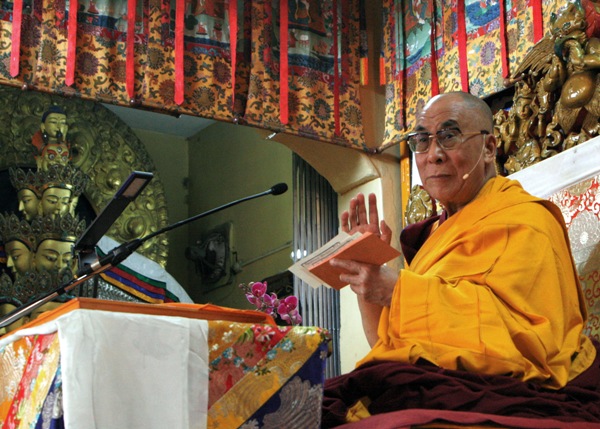
His Holiness the Dalai Lama giving teachings at Namgyal Monastery. Photo by Abhishek Madhukar
I loved that last week I happened to get back to Dharamsala just in time again for the Dalai Lama’s teachings. This one was on Nagarjuna and Tsongkhapa‘s writings, at the request of a Taiwanese group. Great bookend that I arrived Dharamsala first in August to attend a teaching before leaving for the High Himalayas, and then arrived again to attend a teaching after my journey! This one was four days long, and included an initiation for Vairocana tantra. The town swells with visitors and cars during these times, and then very quickly shrinks back when the teachings end.
I was so happy also to return to my little home-away-from-home here. Very grateful to a friend for helping me find this place, in prime location close to Namgyal Monastery, with wraparound terrace, mountain view, morning sun streaming in. It’s clean, no bad mildew or mold odors like many spaces here are stricken by because of monsoon.
Speaking of monsoon, it is still raining here! Locals said it not only began early this year and would normally be over by mid-September, but is still lingering. I have been caught in it again and totally drenched, thinking rueful thoughts to myself as my pants were soaked and my shoes like wet squishy sponges that would take days to dry. I had expected that by my return in October the rainy season would be over. But, well, who am I to complain? I haven’t even had to live through months of this!
And let me quickly add, it’s better. Did I mention the sun? Yes, many mornings it does come streaming into my room. Such a joy to wake up to! The weather pattern currently is, some sun in the morning, and then by afternoon or evening the mist and clouds roll in. The whiteout this creates make the visibility of the switchback roads about 12 feet ahead.
Upon my return, I met with two geshes for further guidance on research resources and references. I’ve now got thousands of photos and image management to do, and will be spending time identifying what I’ve shot.
I think I will be frequenting the Tibetan Library & Archives a lot. Oh, and what a sight to see when I toured it! It has been, and is still, undergoing renovations since I was last here three years ago. The director is commendably bringing it into the 21st century! I’m thrilled to see that the old museum, previously saddled by poor lighting and exhibition conditions, is now newly expanded and nearing completion. There will be proper track lighting, display cases, and descriptive placards to do its fine collection of paintings and sculptures justice. The library stacks are newly organized in archival and accessible contemporary shelving. Their collection of sacred texts, which are tens of thousands of leaves of text traditionally bundled and kept tied together in fabric, is now being digitally scanned and stored. What else…Oh, a New Media Department! A room with computer monitors dedicated to storing and presenting its new collection of videos and other digital media on Tibetan subjects. Lastly, soon to come will be a new floor of offices and administrative space.
Meanwhile, J organized a film night in which my work was featured along with an American documentary filmmaker, Ronny Novick. In attendance were two chodpas, lay tantric practitioners who do special meditation practices at cemetaries in order to cut through ego and realize emptiness, and who were interested in my latest animation Into the Midst because they said it’s just like what they visualize when they practice Chod. Wow. The conversation that ensued with these Kagyu yogis about some of their inner experiences was eye-opening.
Chodpas are also spiritual healers, and as traveling mendicants, may be invited by community members to conduct prayers for the deceased, the living, and those believed to be wandering spirits. See them in a Chod prayer session here.
Two chodpas, Tibetan Buddhist mendicants who live by travelling and receiving alms for their prayer services, engaged in a Chod session. Tibetans have a strong tradition of welcoming chodpas to stay at their home for a day or two to say prayers for the deceased, the living, and wandering spirits. Photo by Tenzin Tsundue.
Dhangkar and Lhalung Monasteries in Spiti
Posted
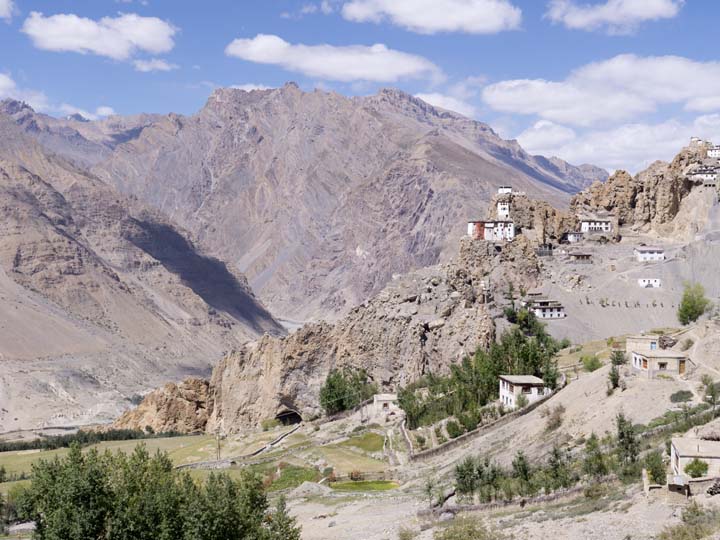
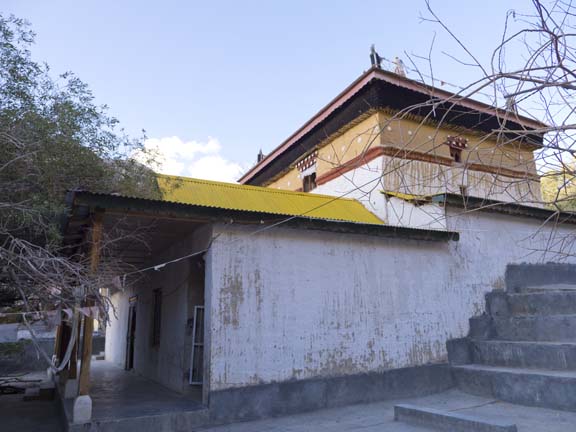
Dhangkar Monastery is seen on the ridge in the upper right. It consists of multi-storeyed buildings perched together, containing five different devotional halls.
September 4th
Our first day out to photograph was at Dhangkhar and Lhalung Monasteries. Both places granted permission because of local and monastic support. I was on my first documenting journey, and how positive an experience it was!
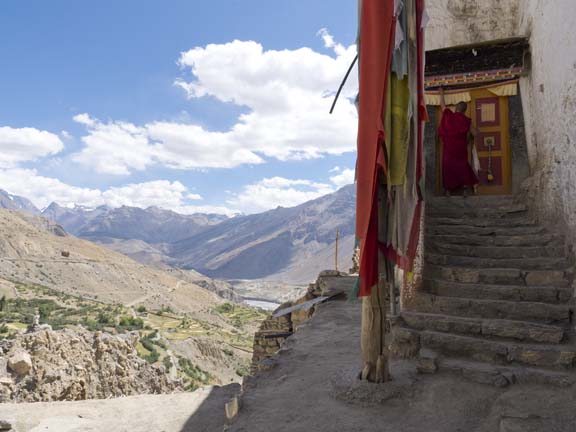
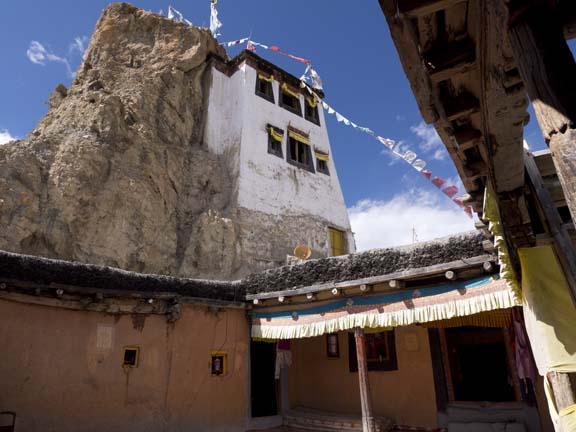
Entering Dhangkar Monastery’s Lha O-pa Gompa.Dhangkar Monastery clings to its rocky outcrops. Shown here is the level in which the Dukhang and Lhakang Gongma may be accessed.
I’ll let the images speak for themselves, but it bears saying that Dhangkar was an original home of the ruling Spitian kings over a thousand years ago, built on a ridge and rock outcrop as a fortress. It clings to the mountain with its whitewashed buildings and traditional thatched roofs. Some buildings seem to be built one on top of the other.
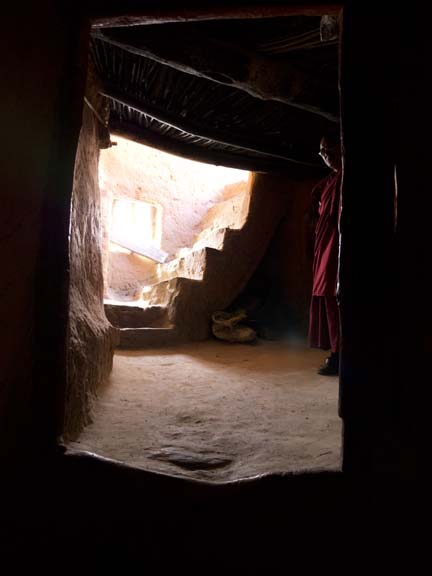
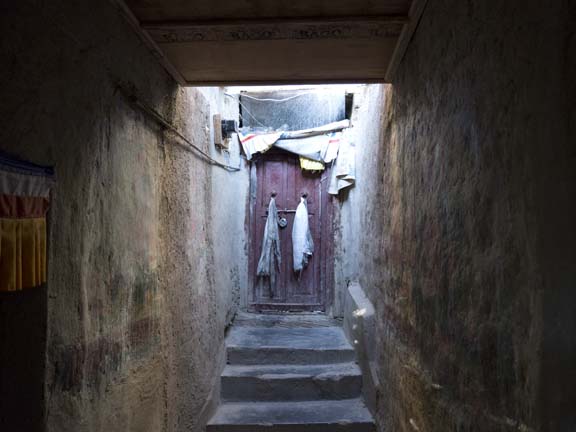
Dhangkar Monastery narrow passageways
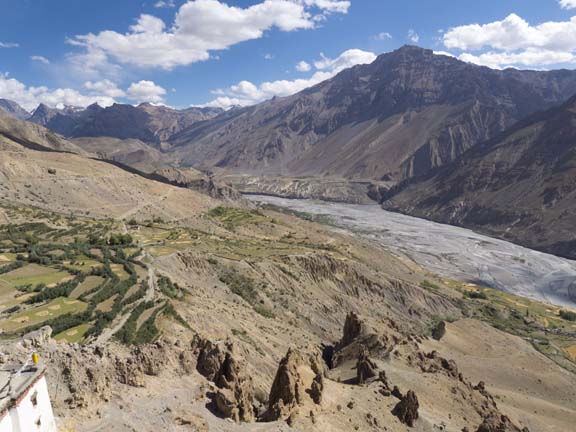
The interiors are navigated by narrow stairs (more like ladders, they’re so steep) and often low-ceilinged passageways. And when you scramble higher and higher, some stairs lead to the rooftops where you climb some more, on gravelly footpaths next to sheer cliff drops, in order to get into other adjacent buildings. Whenever you step outside, you are stunned by the incredible panorama of Spiti Valley in its splendor before you, dotted by the verdant, partitioned farmlands below, and the rigor of the sun casting impressive shadows across the mountain ridges.
View of Spiti Valley from rooftop of Lha O-pa Gompa, Dhangkar Monastery
Inside the Dukhang, which was the former assembly hall for monks before the new one was built a few years ago, sits a life-sized statue of Vajradhara, the “Diamond Being” who sees the ultimate nature of reality. One who does so is said to have wisdom, or right view.
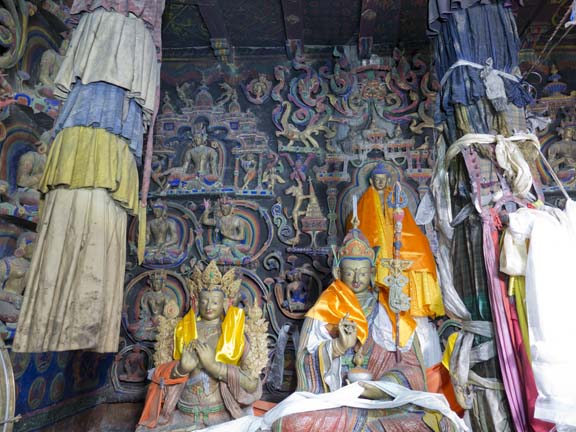
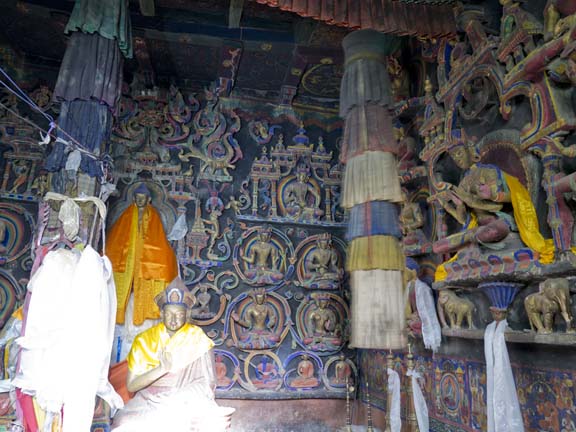
In the lower level Kanjur Lhakang (library containing Buddhist scriptures) are three wooden figures: Lama Chodrag, Shakyamuni, the historical Buddha, and Maitreya, the future Buddha. On the walls are faded and sooty murals, which one can barely see. It’s easy to understand from these murals alone why in 2006 Dhangkar Monastery was named by World Monuments Fund as one of the 100 most endangered sites in the world.
Kanjur Lhakang library of Buddhist scriptures, Dhangkar Monastery, Spiti, India
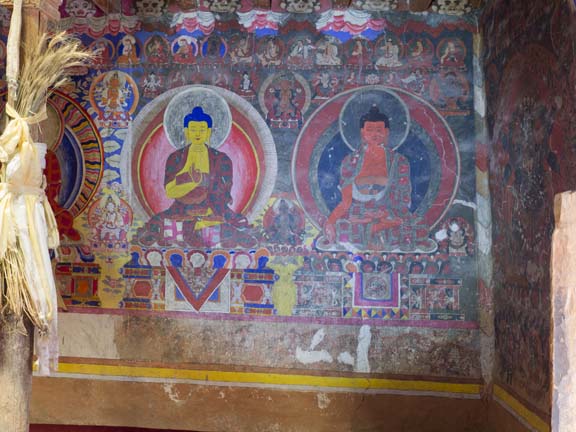
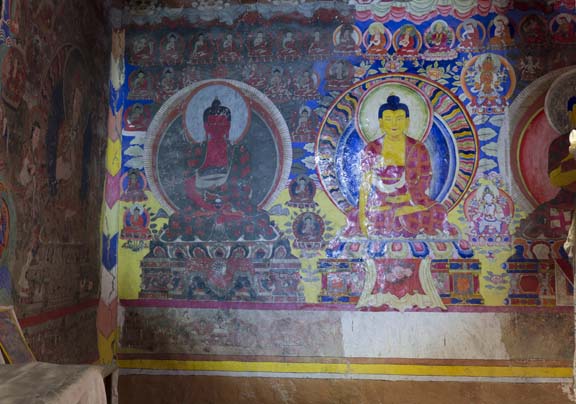
In the uppermost building of Lha O-pa Gompa is Lhakang Gongma, which has the most to see in terms of murals. Its central back wall dominates with Shakyamuni, Je Tsongkhapa (the reformer and Gelugpa founder of the 14th century), and Lama Chodrag.
View of murals on the back central wall of Lhakang Gongma, Dhangkar Monastery, Spiti
The adjacent walls depict various manifestations of Buddha. I was struck in general by how varied the paintings are in terms of color, style, and deterioration. It’s clear evidence of selective repainting over the centuries. In the back central wall, for example, Shakyamuni is obviously brighter and more saturated in color than the other two figures. According to Peter van Ham’s book, The Forgotten Gods of Tibet: Early Buddhist Art of the Western Himalayas, only a few of the paintings have been left untouched. The rest stylistically suggest a date of around 17th century.
Buddha murals, Lhakang Gongma, Dhankar Monastery, SpitiBuddha murals showing evidence of repainting over the centuries, Lhakang Gongma, Dhangkar Monastery
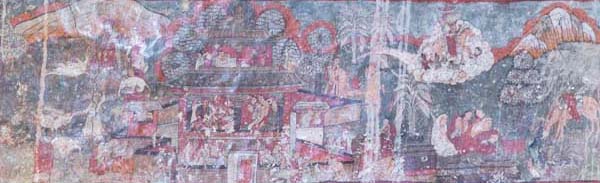
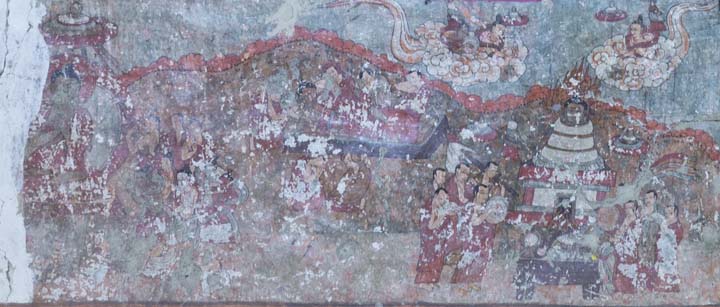
Of note in the murals is the frieze below the main figures, which largely depicts the life of Prince Siddartha, who became the historical Buddha, Shakyamuni. Tabo Monastery has a similar frieze in its Tsug Lhakang, the main assembly hall. Much of it is faded but the below two images are readily identifiable as the life of Siddartha at the palace of Kapilavastu, and the death of Buddha.
Life of Prince Siddartha at the palace of Kapilavastu, painted frieze at Lhakang Gongma, Dhangkar MonasteryDeath and cremation of Buddha, painted frieze at Lhakang Gongma, Dhangkar Monastery
We were told by locals that Dhangkar is older than the famous Tabo Monastery because, as the ancient home of indigenous kings, it contained a private temple from before the time of The Great Translator Rinchen Zangpo, pre-dating 10th century. Indeed, at the very top of the Dhangkar citadel are the remains of the palace, which you climb up to through a sleepy and steep quaint village that looks like it has maintained its same way of life for millenia.
Later in the day, we went to Lhalung Monastery. I really loved this small temple pictured below.
Lhalung Monastery’s Serkhang or Golden Hall, Spiti
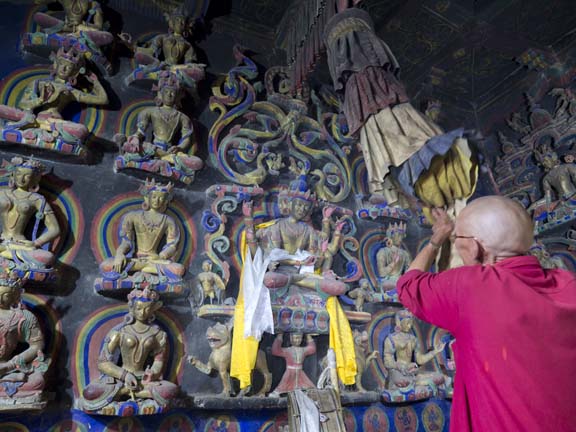
Lhalung Monastery, believed to be founded by The Great Translator Rinchen Zangpo, late 10th century C.E., was quite impressive. You enter through a narrow passageway to get to its Serkhang, which means literally House of Gold, but more often referred to as Golden Hall. Attached to its walls are sculptures of deities and other Buddhist personages. Three-dimensional figures in relief against the interior architecture of Buddhist temples are a distinctive feature of Indo-Tibetan artistry in Spiti and Ladakh areas. Similar ones are found at Tabo, Alchi, and Mangyu Monasteries.
Experience the rare and beautiful interior of Lhalung Monastery’s Serkhang by seeing a walk-through videohere.
Entrance to Lhalung Monastery’s Serkhang or Golden Hall
Once inside, the splendor of the ornately gilded and polychromed clay figures strikes you. The sculptures fill the temple practically from floor to ceiling. There are over 51 figures mounted on the walls or placed in the temple, arranged in mandala formations on each wall. Geshe-la said that these types of cantilevered relief sculptures are specific to the Trans-Himalayan region and are not found in Buddhist temples anywhere else.
On the central wall is Shakyamuni in the middle, flanked by two elaborate groups of five figures, each dominated by a deity–identified as Dharmadhatu Vagishvara, a complex form of Manjushri on the left, and Vajrasattva on the right. These figures are set in architectural alcoves, while the others are contained within lotus motif scrollwork, accented by decorative animals and dancers.
Maitreya, Guru Rinpoche, and Rinchen Zangpo (partly visible on right behind the column) form a trinity in the Serkhang altar of Lhalung Monastery, Spiti
Visible below is the right wall with sculptures arranged in a Prajnaparamita mandala, with Vairocana in the center surrounded by four Dyanibuddhas or Buddha-families: Ratnasambbhava, Akshobhya, Amoghasiddhi, and Amitabha, and their female attendants.
Rinchen Zangpo statue among a pantheon of sculpted deities, Serkhang (Golden Hall), Lhalung Monastery
On the left wall (photo below) is a Vajradhatu mandala arrangement around the three-faced and eight-armed Saravid Vairocana. Around him are the 16 deities in his cycle, including once again the Buddha families of Ratnasambhava, Akshobya, Amitabha, and Amoghasiddhi.
Left wall with Vajradhatu Mandala, Serkhang of Lhalung Monastery, Spiti
So now, that’s a lot of deities in one small temple! Their plethora really conveys not only aesthetic richness but also the complexity of Tibetan Buddhist tantric practice. What do all these deities represent in these mandala arrangements? Put simply, mandalas are visual guides for a practitioner in their meditation. They are aids in the realization of the true nature of mind and reality. As an oral and esoteric tradition, one needs a lineage teacher. Experiential understanding of this leads to liberation from conditioned existence–that is to say, leads to enlightenment or nirvana. Here is a succinct description of what the Five Buddha Families represent.
Geshe-la had said that the temples in these areas really demonstrate only the lower three tantras, not highest yoga tantra, which is mainly what Tibetan Buddhists practice today. The lower three are more concerned with purification, whereas the fourth level is actualizing self and deity, and therefore, enacting profound experience and understanding of emptiness. In The Great Translator Rinchen Zangpo’s time, late 10th century, focusing on the three lower tantras was a way to go back to roots and revitalize/reform tantric practice in Tibet which had grown distorted. This was partly the reason for the enormous interest in the original texts and their teachings, translating them from Sanskrit to Tibetan.
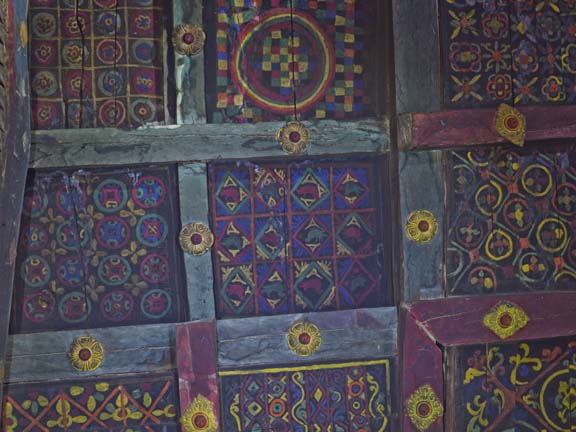
Lastly, the coffered ceilings were painted with delightful and folk-looking decorative motifs. Now I know what scholars mean when they speculate that these must reflect 10th century Kashmiri–influenced textiles.
Coffered ceiling of Serkhang, Lhalung Monastery, decorated with Kashmiri-influenced patterns that scholars believe reflect 10th century textile designs.
My home corner in Dharamsala, with Namgyal Monastery entrance at right.
September 1st
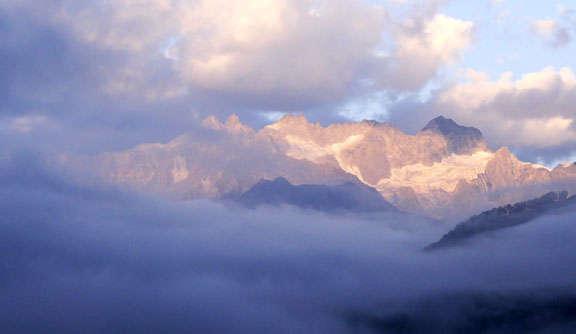
J and I started off for Manali 6am from Dharamsala, watching the sun rise along the way. At a certain altitude, the sun in full array, we saw a veritable Roerich painting before our eyes. It was snow-peaked mountains appearing to float above a thick, solid, fluffy white cloud bank. I always thought the man took artistic license with his imagery, but sure enough, the chiseled facets cast by morning light on the Himalayas were in orange and purple-gray displays, the base of the mountains nestled in airy clouds. The scene looked like a fairytale setting.
My first encounter with Nicholas Roerich-like scenery. I always thought the painter used artistic license to enhance colors and compositions of his Himalayan scenes, but they in fact look this dreamy and stunning
The main road where Rohtang pass is looks by our standards like a single lane dirt road. There is no railing at the irregular precipitous edge, and passing the slow trucks that ply the road means a lot of honking on the driver’s part and then a wing and a prayer to get back in lane without encountering oncoming traffic. Might makes right on Indian roads so trucks have the de facto right of way. Somehow it all works out, amazing.
I got a bit carsick from the descent, switchbacks all the way, the driver taking them maybe a bit faster, with blind passing, than my stomach could take. The diesel fumes and road dust was killing me. The smell of diesel alone is enough to nauseate me. Fortunately, there was AC which I asked for halfway through. We arrived around 1pm, with pitstop for breakfast at cheesy hotel bar/dining hall (J said she’d have to work on the driver to get him to choose better stops). Well, anyway, the aloo parathas (potato-filled flatbreads) were tasty and it was good to use the bathroom. Otherwise, it’s a roadside affair of finding a large rock or bush to go behind when nature calls!
We stayed at a place called Leela Huts after finding that J’s fave old Johnson’s Lodge, with English-styled cottage accommodations, was under renovation and closed. Leela Huts has a hilarious website: www.leelahuts.com. The sentence that had us in tears with laughter was, “Leela Huts swear sheer solitude to that tired man who has retired to the valley for a bracing vacation, away from the irksome crowd.” Now there’s some florid Indian English for you! But anyway, it was a well-kept, walled off little oasis with two and three-bedroom houses with full kitchen and baths. We opted for just the hut with single large room.
We hightailed it to Manali because Khandro Thrinlay-la was in town for the afternoon before needing to leave for her next teaching engagement, and she invited J and I to come for a visit. OK, so here is one bit of convoluted family history. Her older brother is Sey Rinpoche, their father a great Drukpa Kagyu practitioner named Apho Rinpoche, who descended from the great grandfather Shakya Shri, who began this special lineage of masters in the Six Yogas of Naropa, a Milarepa tradition. These are the accomplished meditators who retreat for three years, three months, and three days to practice the secret tummo and other methods which develop, I am told, levitation skills and various abilities that defy convention. You would never know who was a great practitioner usually because they can look like any humble villager, and they never reveal their abilities normally.
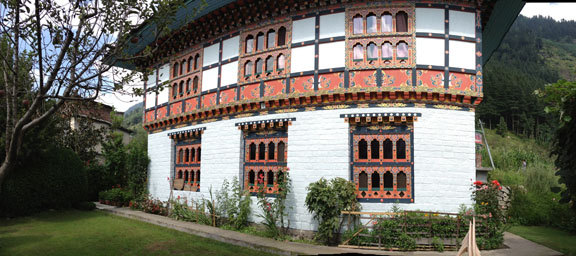
Khandro-la’s Bhutanese-style temple, Manali
Sey Rinpoche was supposed to be in Manali upon our arrival to meet with us, and make arrangements for access to monasteries in Lahoul where the family hails from, but we found he had left for Pangi where he is building a new retreat center. Instead, his sister Khandro-la (www.khachodling.org) was at home briefly, a lovely Bhutanese-styled house with colorful painted motifs on the crown and windows. She received us in her prayer room where she was doing prayers for safe travels, since it is the astrological snake year, and by Tibetan beliefs an obstacle year for those born in snake years. I thought snake year was auspicious for snakes, but this must be the Chinese thinking. We discovered we all three are snakes.
Khandro-la has an international following which includes a lot of Australians, and women. She has a feminist approach, and is educated in the U.S., with MA in psychology, completed by the advice of none other than His Holiness the Dalai Lama. I find her interesting and contemporary. After learning about my Fulbright project, she asked me to photograph the murals at Gandhola, which turns out to be Guru Ghantal where I had planned to visit and document. She said it’s the oldest temple in Lahaul and she is interested in preserving its heritage properly.
We went back late in the afternoon to see Khandro-la’s assistant, and her younger brother who runs Druk Expeditions. He gave suggestions on places to visit in Lahaul, and so did Khandro-la’s assistant. It turns out that there is not so much to see in the way of murals of mandalas in Lahaul, but rather, Lahauli temples and area are structured spatially like a mandala. The suggestion was to go for a kora (a clockwise circumambulation around a sacred location) of Drilbu Ri Mountain, a holy site of the tantric deity Chakrasambhava, near where Guru Ghantal is, and experience the mandala physically, but to hire a guide so as not to get lost, and also to help carry things. Sounds like a nice idea, but we’ll see how I adjust to high altitude by then! I have so far been suffering from night headaches (like having a vice grip around my head!) and shortness of breath, bit of loss of appetite.
Often the road in Spiti is nothing more than rocky terrain in which one must ford a glacial stream.
Next morning 5am we were off to Spiti. Aaah, at last the journey to high Himalayas truly begins! Our driver was a nice man, very good careful driver, and not as aggressive as some others. He drove a Toyota Qualis which J remarked didn’t look like the most comfortable car, but it was a tanker, and boy, I was happy about that. You wouldn’t believe how parts of the road were like fording small rivers and waterfalls, with large rocks and vertiginous drops! These are areas where glacial melts can wash out the road by afternoon. After a couple of particularly nerve-wracking spots, we cheered our driver for his skillful driving! J said many a car or truck has been caught stuck in these. One has to be on the road early enough to pass these before the water starts rushing down in the warmest part of day.
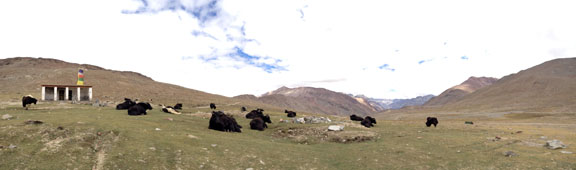
Kunzum la with herd of yaks, altitude of about 15,000 feet
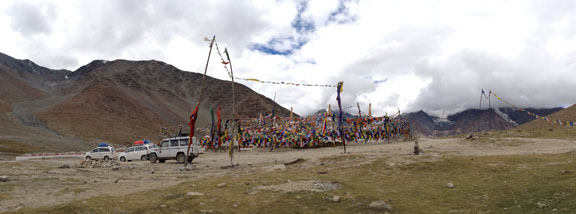
I took a lot of photos en route, what spectacular vistas! We had also many pit stops at big rocks where we could hide and relieve ourselves by the side of the road. Kunzum-la was quite windy. It’s a high point at about 15,000 ft altitude, and marked by three stupas and small shrines to the Dalai Lama and Karmapa and other lamas. J and I made incense offering here as a Geshe-la (title of a learned Tibetan Buddhist scholar akin to a PhD) suggested was an auspicious thing to do en route. I was feeling the shortness of breath by now, and when the wind blew the incense into my face, the odor caused me to feel nauseous. However, I totally loved seeing the wildly billowing and plentiful, layered, colored prayer flags blowing in the wind. We ended up not picnicking at the Nechung stupa as originally planned because J thought it was too windy and cold. She was mindful not to be exposed too much in case of causing illness. We instead ate in a large, flat valley, which was also windy, but at least less so.
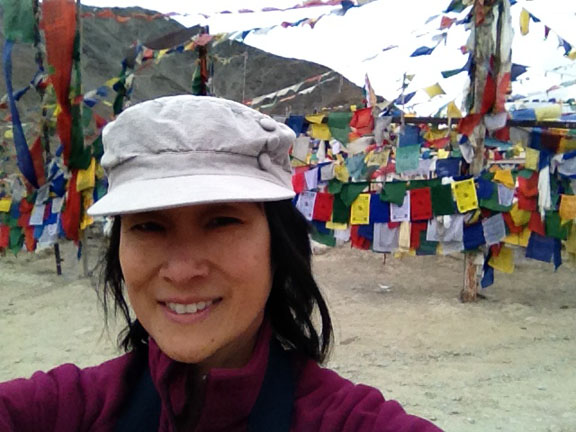
Tibetan prayer flags and stupas mark Kunzum la passExhilarated and a bit short of breath at Kunzum la pass, altitude approximately 15,000 feet
The Spiti Valley is grand beyond belief! While passing Kullu Valley earlier was stunning, too, for its lush steep landscape, cascading, tall waterfalls that put Yosemite National Park ones in the kids’ playground, grazing sheep and goats, impossibly tall and regal pine trees, Spiti land looks like gigantic rock and sand slides of barren beauty, with a wide river valley that equally shocks one with its scale. The river rushes in what looks like silver rivulets wending its way within the valley from the road high above, but any of its strands would dwarf a normal inland river. J said this is what is characteristic about Spiti, and at every switchback turn on the road, another great Roerich-like view is to be had. If I had stopped the car every time I wanted to take a photograph, we never would have arrived in time. Manali to Kaza was about a 10-12 hour jaunty, bumpy car ride.
En route to Kaza, Spiti, a high altitude desert landscapeMagnificent rock structures, nature’s sculptures, en route to Dhangkar Monastery, SpitiSpiti Valley heading towards Dhangkar Monastery. The grandeur of scale is stunning!Himalayan scale is overwhelming. What looks here like squiggly bits of green is actually massive farmland. En route to Dhangkar MonasteryEn route to Dhangkar Monastery. Spiti Valley in any lighting is stunning.
I always marvel when I travel that it isn’t all that difficult to change one’s reality. Here I am! India! Landed three days ago. United Airlines, Newark to Delhi direct, I highly recommend it. Smooth flight, quiet fellow passengers, seats have personal touchscreens for entertainment, and more importantly, power! You can plug in your device for charging. I was relieved to find this because I wanted to at least be able to text home that I’d arrived, and call a local if I needed help.
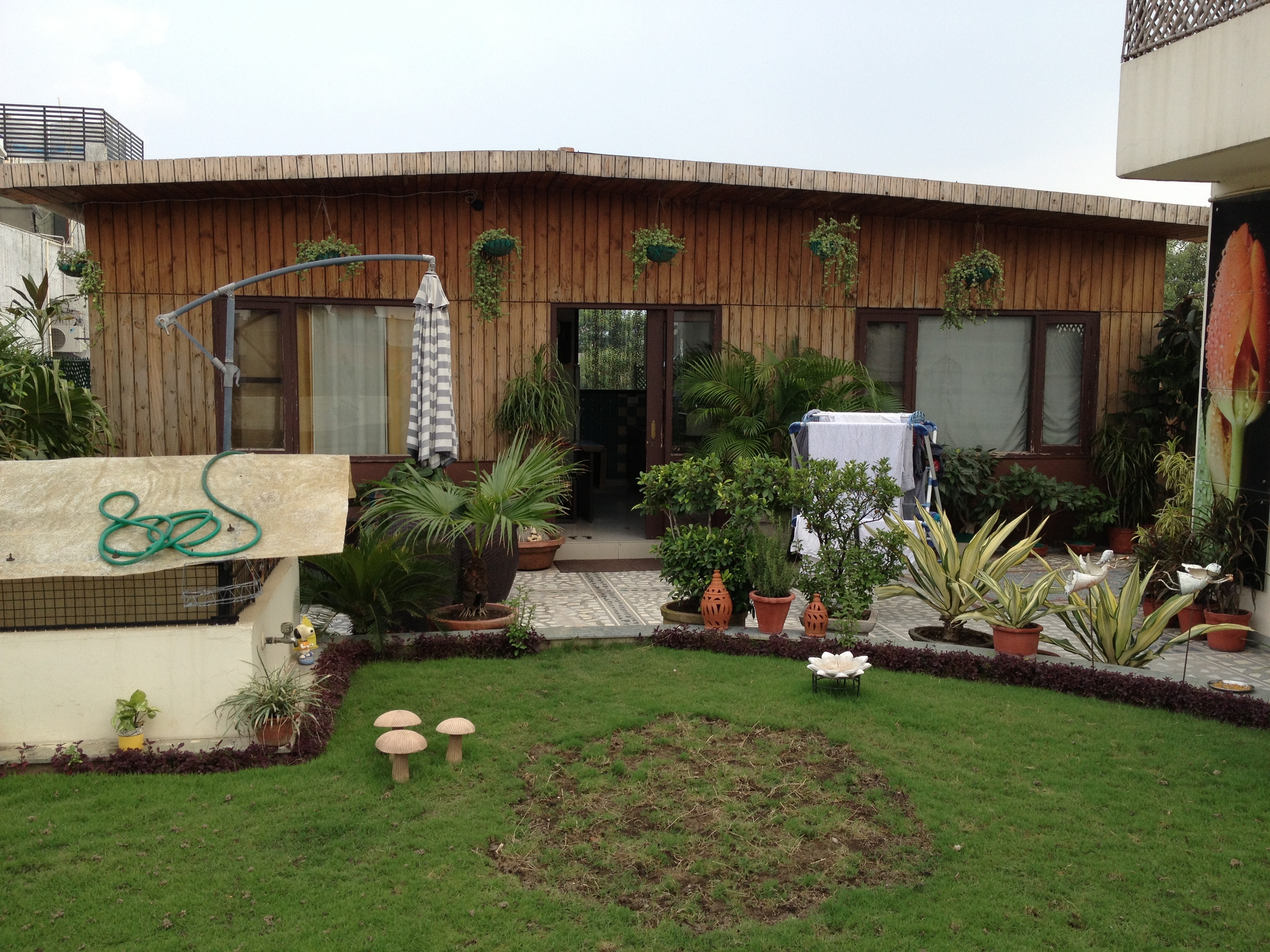
Vandana’s Guest House rooftop garden rooms, Delhi, India
Speaking of this, I’m thankful for help from others who look out for me! Fulbright sent a driver to pick me up at the airport. It was fantastic because after a long flight you emerge with jetlagged fuzziness. I found myself equally concerned with whether I could still purchase duty-free, as I was with completing an accurate customs form. Then later, there’s the confusing ruckus of countless drivers looking for passengers, holding placards or not, congested by the exit where travelers are also wending their way with loaded luggage carts. As it turns out, I couldn’t find my driver because I was standing in the wrong place, but he found me by looking in this wrong place!
The ubiquitous tuktuk or auto rickshaw
They also prearranged my weeklong stay at lovely Vandana’s Guest House. It’s home away from home for now, run by a warm, helpful family who live here, too. My garden rooftop room with adjoining kitchen which I share with the next door Fulbrighter is perfect because I can stow away my PBJ fixings. Don’t laugh, those sandwiches, which I make and pack for the day as emergency snacks, have proved to be vital in our face-paced quest to complete paperwork as quickly as possible so I can get to the Himalayas in time. Yesterday we didn’t have time for lunch all day, shuttling to and fro in tuktuks from USIEF to University of Delhi where I am affiliated, to Connaught Place for errands, to Archeological Survey of India from whom I’m seeking permission to photograph the interiors of monasteries under its jurisdiction. This glycemically-challenged traveler was happy to think straight after snarfing my PBJ on the run!
Fulbright also offered a ‘Facilitator’ to help with the initial transition. Thank goodness! He has been an enormous guide through Delhi these past two days, fording me through congested traffic, bureaucracy, electronic logistics, and procedures! Yes, i need an ATM machine, Citibank is great. Oh and yes, an Indian SIM card please, micro chip with reception in the Himalayas. Yes, I will definitely take that surge protection power strip with universal plugs!
To top it off, he has been a great conversationalist–interested, approachable, frank. Bustling with vision and ideas. We even discussed caste, a subject often considered delicate and charged in this nation’s changing order.
Today’s largest agenda: complete registration at FRRO, the Foreigners Regional Registration Office. Quite an exercise in following directions. Three copies of this, originals only of that, retrieve this signed form from here, fill out (or ‘fill up’ as Indians say) this form online, etc. One fellow Fulbrighter quipped, carry lots of extra passport photos and copies of your passport, they love them here. Indeed! For example, for a foreigner to get a SIM card, you need to supply both.
Yosemite National Park
Posted
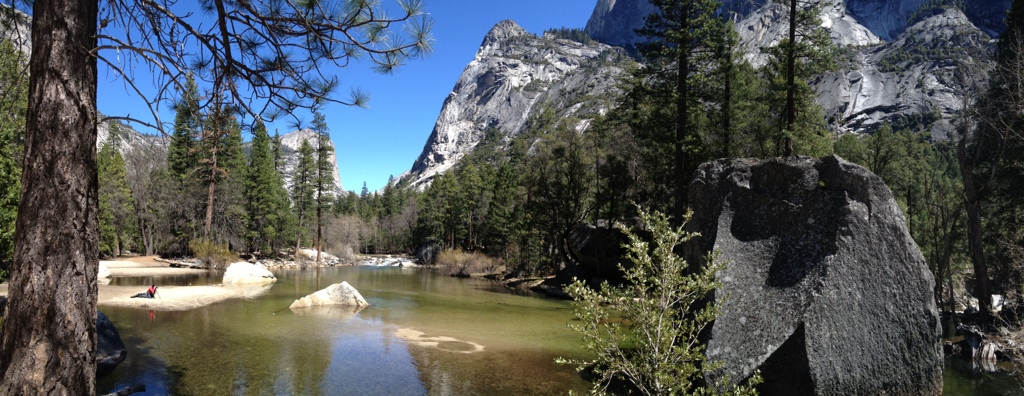
If the weather in the Himalayas in summer is anything like the weather in Yosemite National Park in spring, then I think I’ll be all right with what to wear for trekking to monasteries. What hiking it’s been here in California with sun, vistas, rainbows, waterfalls, and snow! Exhilarating.
Mirror Lake, Yosemite National Park
Of course, altitude figures as a large difference. The scale of even the highest of Yosemite’s mountains pales in comparison to the Himalayas. Yet a taste of such grandeur truly makes me look forward to being present in Spiti, Lahaul, and Ladakh. Below is a view of Yosemite Falls, one of the world’s tallest waterfalls.
Yosemite Falls, one of the world’s tallest waterfalls, Yosemite National Park
Himalayas / hi-MAAL-yah
Posted
Learn something new every day. The correct pronunciation for Himalaya is “hi-MAAL-yah.”
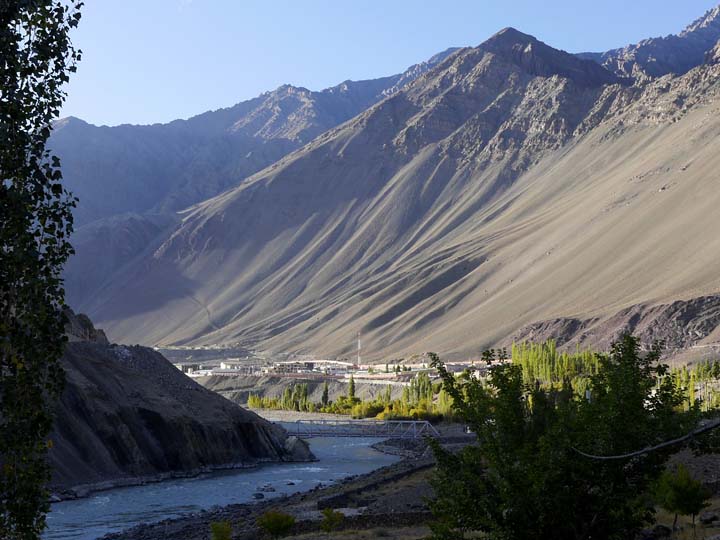
Mountains and the Indus River Valley as seen from Alchi Monastery circumambulatory, Himalayas.
I look forward to going there later this year to conduct research as an artist, made possible by a Fulbright-Nehru Scholar award. Excited and honored! Truly grateful for this opportunity! I will be researching murals of Indo-Tibetan monasteries in Lahaul, Spiti, and Ladakh districts, with a focus on mandalas as a blueprint for understanding the nature of mind and reality.
So while my departure is still months away, I’ve already begun traveling in my mind as I await further details from Fulbright.
This is not an official U.S. Department of State website. The views and information presented here are solely those of the artist, and do not represent the Fulbright Program, the Department of State, or any other entity.


 Marmots were poking their heads out of rock crevices, or walking out in the open like this one, presumably searching for breakfast. Cute pudgy little things, they reminded me of our local American groundhogs.