india

Tabo Monastery: Himalayan Setting and Meditation Caves

Sept 6th, Tabo Village, the Spiti adventure continues…

Tabo Monastery within Tabo Village
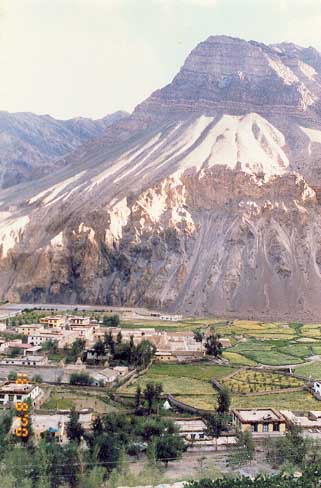
Tabo Village, where Tabo Monastery is nestled in Spiti Valley unlike other Buddhist monasteries that were built as fortress-like compounds on hilltops

Well, here we are in Tabo! The famed Tabo Monastery is known as the oldest continually functioning Tibetan Buddhist monastery, the art of which the Dalai Lama said “delightfully expresses the vigor of the transmission of Buddhism from India to Tibet and the dynamic mingling of cultures.” Established in 996 C.E. by the Buddhist king of Guge in Western Tibet, Yeshe O’d, and the The Great Translator Rinchen Zangpo, it flourished in a golden epoch of Indo-Tibetan collaboration in spreading Buddhist culture.

Tabo Monastery complex behind stone walls in Tabo Village
Tabo Monastery complex behind stone walls in Tabo Village, Spiti Valley, India

Tabo’s existing sacred artwork and architecture have unique historical significance, not only for the aesthetic evidence of such cultural exchange, but also for its rarityDue to the enormous destruction during the Chinese Cultural Revolution, where over 6000 monasteries and their artworks were destroyed between 1959-61, practically none of the early examples of Buddhist culture have survived in Tibet. Consequently, the monasteries of the Western Himalayan border areas of Spiti, Lahaul, and Ladakh, once part of Tibet, is of great importance for its legacy of early Tibetan Buddhist culture, and in particular, its connection with India.

Street view of Tabo Chokhor
Street view of entrance to Tabo Choskhor,Spiti, with the museum and library in building on right
Upon entering Tabo Monastery complex, the first building one sees is Tsug Lhakhang, the grand main assembly hall
The Tsug Lhakhang, TAbo Monastery, Spiti
The Tsug Lhakhang, Tabo Monastery, Spiti

Of the monasteries I’ll visit, Tabo, Alchi, Mangyu, Lamayuru, and Lhalung strike me as being of special importance. These have exceptional murals, unusual in cross-cultural style and depiction, executed in astounding refinement, with ornate clay sculptures that are cantilevered off the walls in Vajradhatu mandala arrangement of sacred space (more on this in the next post!) This type of work is specific to the area and is not found in any other Buddhist temples in the world. These monasteries also date back to that fertile period of Buddhist philosophical exchange and revitalization from India to Tibet beginning in the 10th century during The Great Translator Rinchen Zangpo’s time.

Documenting the extant artwork and architecture of these sites is essential because they are remarkable, and extreme Himalayan winters and potential earthquakes, such as the one that occurred in 1975, continue to threaten their survival. Proper conservation and restoration is critical for art history and posterity. Of immediate concern is the effects of climate change and increased rainfall in the normally more arid Spiti that has damaged Tabo’s murals and architecture. This 2010 article entitled “A Monastery’s Fading Colours,” published in The Indian Express, is about the challenging circumstances facing the monastery’s care under the maintenance of the Archeological Survey of India (ASI).  The Times of India recently questioned the national organization’s general efficacy in its article, “92 ASI-protected Monuments Missing.”

Rear view of Tsug Lhakhang, Tabo Monastery, Spiti
Rear view of Tsug Lhakhang with workers currently repairing the mud exterior. Its back walls are as thick as 2.5 meters!
Workers repairing the mud exterior of Tabo Monastery
Workers currently repairing the mud exterior of Tabo Monastery, Spiti

I find myself wishing these monasteries were designated UNESCO World Heritage sites, such as the early Buddhist Ajanta Caves are in India, or considered World Monuments. Perhaps this would bring more international attention and expertise to help hasten the appropriate preservation and protection against man-made as well as environmental challenges.

Fortunately, I was able to arrive in Tabo with all my equipment fully charged because the electrical power was mostly on during my previous night in Kaza, Spiti. But unfortunately, I was unable to photograph due to administrative details still to iron out. Perhaps by tomorrow, after the special 6:00 a.m. morning prayers for the recently deceased and venerated abbot of Tabo which will be performed as part the traditional 49 days’ observance. Despite not being able to photograph, the monk in charge of the monastery kindly showed me most of the temples in the complex.

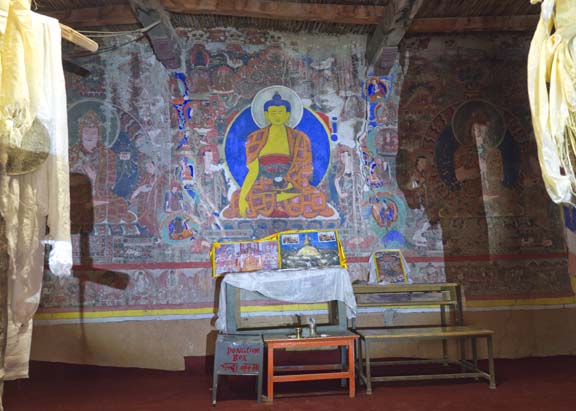
What is so immediately striking is the contrast between the simple exterior architecture of mud brick and the resplendent interiors. Wow, the ornate interiors leave you speechless, what treasures of Indo-Tibetan art, history, and philosophy! Especially the dramatic, dark, moody, pensive main assembly hall (Tsug Lha-khang); the older Dromton Temple (Brom-ston Lha-khang), founded by the main disciple of the great teacher and adept Atisha; Initiation Temple (dKyil-kHor-khang), where monks are initiated; Bodhisattva Maitreya Temple (Byams-Pa Chen-po Lha-khang), with a 20 foot high painted mural of the future Buddha Maitreya; and the Golden Temple (gSer-khang).

3_OtherVws (10)
View of Tabo Monastery complex showing Dromton Temple on far right and Bodhisattva Maitreya Temple left of it, Spiti, India

Oh, news flash! For incredible floor plans of these temples, including elevations, sections, 3D models, photo montages, and more, see this excellent website of an Austrian research team at Graz University of Technology that has been studying the architectural heritage of the Western Himalayas.

And did I mention caves? Yes, caves on a steep cliff above Tabo Monastery and village where, according to archeological evidence, monks had lived and practiced meditation since the 11th century. Now it is an ASI protected site. Most caves are open spaces showing evidence of ancient occupation–sooty interior walls and carved out niches, etc., as well as perhaps picnic use by modern visitors. But while exploring with my flashlight, I peered into an opening of a small closed door of a dark cave only to find a blanched seated figure looking back at me! Startled and flustered, realizing this was a real person and not a phantom, I muttered a quick, deepest apology, and left in a hurry! Well, I guess today there are still some practitioners who retreat to these caves. Whether this was a tourist trying it out, or a yogi, I have no idea.

Path to Tabo caves
Path to numerous caves above Tabo Monastery and village, Spiti, India
Tabo caves
One of numerous caves carved into the cliffs above Tabo Monastery, used by monks from the 11th century on, Spiti
View of Tabo Monastery from inside cave
View of Tabo Monastery from inside a cave, Spiti

Have a virtual walk-through here of the insides of some of these caves:

View inside a Tabo cave
View of the inside of the above Tabo cave, Spiti
View of Tabo caves
View of Tabo caves located on a steep cliffside above Tabo Monastery, Spiti
View of Tabo Village from cave sites, Spiti, India

Ok, I hope I have a headache-less night’s sleep tonight.  Day four at high altitude and I’m still adjusting, but Tabo is at about 10,000 feet high, 2000 feet lower than Kaza, so it should be better.  Need to get up early to make it to 6am puja!

All photos © 2013, Eva Lee.

Key Kye Kee Ki Monastery and the Fine Art of Imprecision

September 5th – Spiti adventure continues…

Key, Kye, Kee, Ki Monastery, Spiti

Spelling is a flexible art in India. One often finds multiple spellings for names, places, and in signs. Take Key Monastery, for instance. It is also known as Kye, Kee, and Ki Monastery. It’s all good, take your pick! I’ve even had one monk spell his own name twice for me because sometimes he goes by Tanzin and sometimes Tenzin.

For a stickler about spelling like I am, this is an interesting lesson in imprecision. Especially if you’re asking for directions to a certain street or hotel, and you find that it’s spelled differently by different people, and you can’t help but wonder if you’re talking about the same place. Well, it’s okay, you’ll just do what you have to do, which is, you’ll find out!

It seems to me there’s a kind of accepted uncertainty principle here. It even extends to what people say. If, for example, you ask someone for directions, and he doesn’t know where the place is, he will not say he doesn’t know. He will give you information about where it is. Yes, that’s right, he will tell you something about what he does not know. My Western mind with its penchant for exactness doesn’t get it at all, but let me take a stab and guess:  This fellow might think to himself, it may not be right, but it may be approximately right, so it will help.

I have noticed that when my Indian friends need directions, they will ask numerous people the same thing. One time, I was driving with a friend and we were looking for a particular site. He stopped to ask probably half a dozen people within only a half mile’s distance, a kind of cross-reference overkill. A precision begotten by statistical probability. The wider you cast your bets, the better your chances are to get the (flexible and imprecise) jackpot. At least, I think it’s something like that…

It seems to me that here in India, it’s implicitly understood that circumstances, and the world, and the universe, are not exact. And more importantly, we are not masters of these spheres, we are just part of the process. Everything is relative, everything changes, everything has the potential for uncertainty at any time. It is readily, deeply accepted and tolerated that things might or might not work out.

One Indian friend quipped, “I.S.T.–Indian Stretchable Time,” (instead of Indian Standard Time) when he told me a story about his friend who was supposed to come pick him up in a remote area by car, but arrived three days later than expected! Okay, so maybe that example is an extreme one, but the moral of the story is not that the friend let him down, but that he came despite the fact that he had deterring factors that prevented him from coming on time!

Oh, the power has just come back here at the hotel, praise be! So I’m quickly plugging everything in to charge. Spiti has been largely without electricity for the past eight months! And it is being doled out to different areas at the moment, so no power here until about 8 or 8:30pm, supposedly anyway, because the past two nights here have been powerless. I can’t understand the reason why exactly. I mean eight months is a long time to have a vital civic repair apparently unattended to, or not tangibly improved.  Not sure if it’s because of devastating natural disaster or simply government mishandling and bad infrastructure. Maybe both. I do know that the next state, Utterakand, has suffered devastating floods and landslides recently, so it’s perhaps spillover?

Today was a bit hard to get kickstarted since I had another headache-filled sleep last night—altitude adjustments still. It’s Day 3 at about 12,000 feet high. Hope tonight will be better. I woke up disoriented, not knowing the time because my iPhone was out of power, head splitting. But we ended up going to Key Monastery after I spent the morning charging at a nearby café. The owner is getting power from the petrol station’s generator across the street. Thank goodness for their help! Otherwise, I literally would not be able to continue my work without charged batteries for my camera, or power to backup files onto laptop!

En route to Key Monastery, Spiti, India
View of Spiti Valley en route to Key Monastery, India

Key Monastery’s current spiritual leader is Lochen Tulku, the 19th reincarnation of Losatwa Rinchen Zangpo, the Great Translator wand former abbott who was so instrumental in this area for revitalizing Buddhism, translating all the original Sanskrit sutras, and building new monasteries in the 10th-11th centuries.

It turned out to be difficult to get permission to photograph the older murals here, despite my having a Spitian connection to a high level administrative monk. The concession is I can photograph the new assembly hall, which is nice but not so interesting for my Indo-Tibetan mural and mandala project. Nonetheless, the day spent at the monastery was pleasant. The monks were kind and invited us to tea, showed us the older temples, and merely asked that we not photograph. J’s local Spitian friend has offered to do some further investigation on my behalf, and we will see if possibly in a couple of days, there may be an opportunity to shoot the older murals.

View of Key Monastery's new main temple, Spiti
View of Key Monastery’s new main temple and assembly hall, Spiti

All photos © 2013, Eva Lee.
Dhangkar and Lhalung Monasteries in Spiti

Image
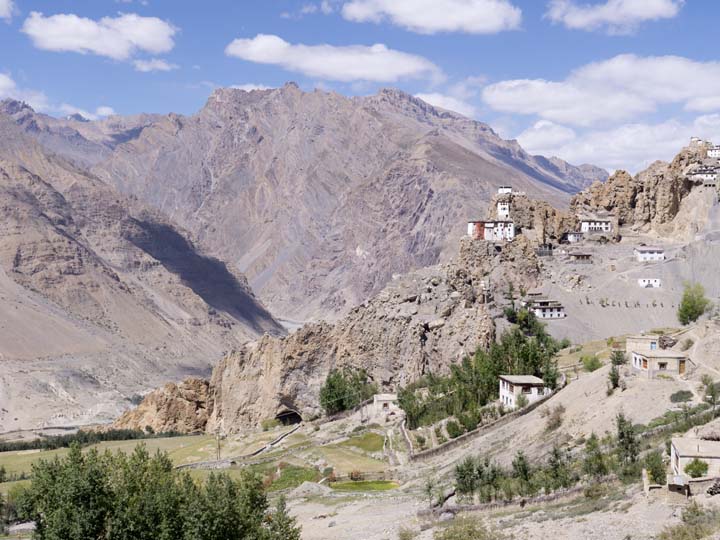
Dhangkar Monastery is seen on the ridge in the upper right. It consists of multi-storeyed buildings perched together, containing five different devotional halls.

September 4th

Our first day out to photograph was at Dhangkhar and Lhalung Monasteries. Both places granted permission because of local and monastic support. I was on my first documenting journey, and how positive an experience it was!

Dhangkar Monastery's Lha O-pa Gompa
Entering Dhangkar Monastery’s Lha O-pa Gompa.
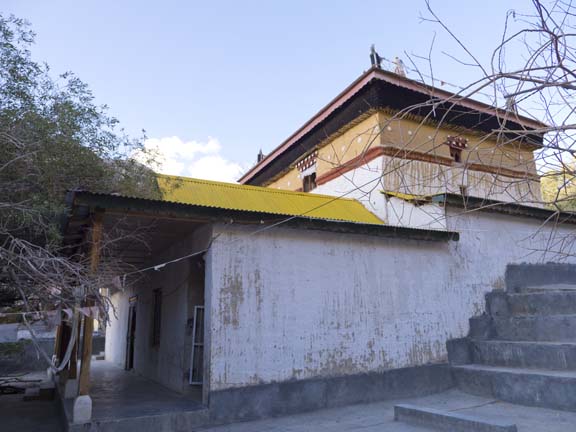
Dhangkar Monastery
Dhangkar Monastery clings to its rocky outcrops. Shown here is the level in which the Dukhang and Lhakang Gongma may be accessed.

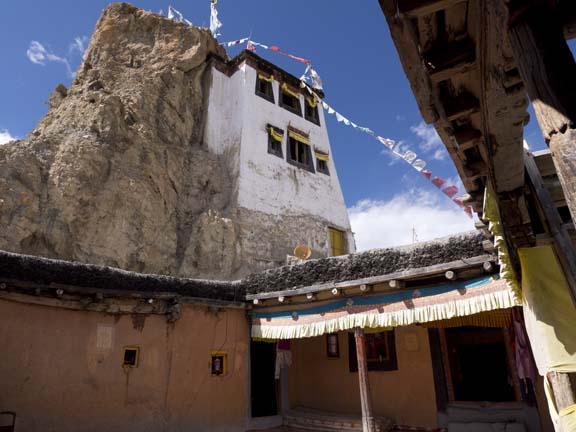
I’ll let the images speak for themselves, but it bears saying that Dhangkar was an original home of the ruling Spitian kings over a thousand years ago, built on a ridge and rock outcrop as a fortress. It clings to the mountain with its whitewashed buildings and traditional thatched roofs. Some buildings seem to be built one on top of the other.

Dhangkar Monastery narrow passageways

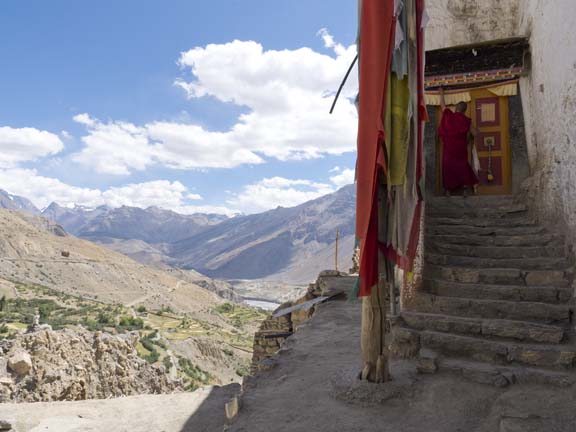
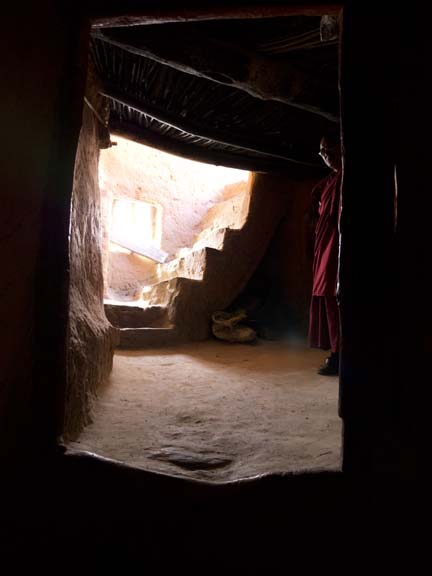
The interiors are navigated by narrow stairs (more like ladders, they’re so steep) and often low-ceilinged passageways. And when you scramble higher and higher, some stairs lead to the rooftops where you climb some more, on gravelly footpaths next to sheer cliff drops, in order to get into other adjacent buildings. Whenever you step outside, you are stunned by the incredible panorama of Spiti Valley in its splendor before you, dotted by the verdant, partitioned farmlands below, and the rigor of the sun casting impressive shadows across the mountain ridges.

View of Spiti Valley from rooftop of Lha O-pa Gompa, Dhangkar Monastery

Inside the Dukhang, which was the former assembly hall for monks before the new one was built a few years ago, sits a life-sized statue of Vajradhara, the “Diamond Being” who sees the ultimate nature of reality. One who does so is said to have wisdom, or right view.

Vajradhara statue, Dhangkar Monastery, Spiti

Kanjur Lhakang, library, Dhangkar Monastery

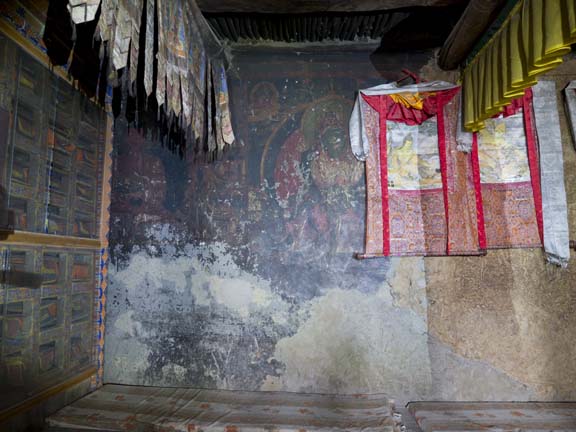
In the lower level Kanjur Lhakang (library containing Buddhist scriptures) are three wooden figures: Lama Chodrag, Shakyamuni, the historical Buddha, and Maitreya, the future Buddha. On the walls are faded and sooty murals, which one can barely see. It’s easy to understand from these murals alone why in 2006 Dhangkar Monastery was named by World Monuments Fund as one of the 100 most endangered sites in the world.

Kanjur Lhakang, library, Dhangkar Monastery
Kanjur Lhakang library of Buddhist scriptures, Dhangkar Monastery, Spiti, India

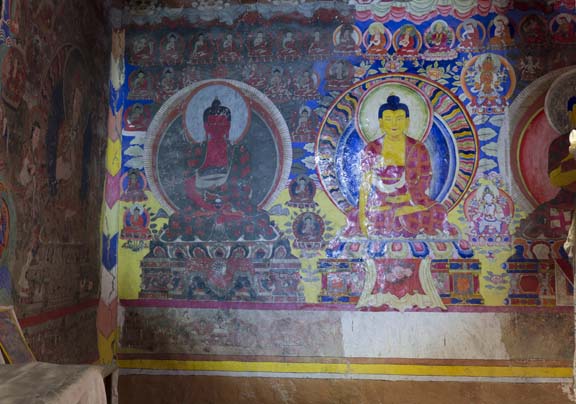
In the uppermost building of Lha O-pa Gompa is Lhakang Gongma, which has the most to see in terms of murals. Its central back wall dominates with Shakyamuni, Je Tsongkhapa (the reformer and Gelugpa founder of the 14th century), and Lama Chodrag.

Lhakang Gongma murals, Dhangkar Monastery
View of murals on the back central wall of Lhakang Gongma, Dhangkar Monastery, Spiti

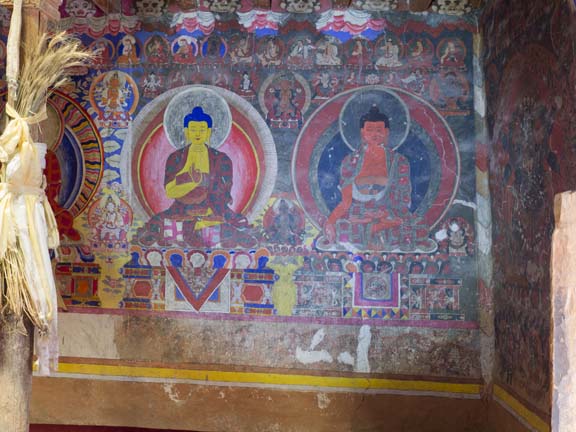
The adjacent walls depict various manifestations of Buddha. I was struck in general by how varied the paintings are in terms of color, style, and deterioration. It’s clear evidence of selective repainting over the centuries. In the back central wall, for example, Shakyamuni is obviously brighter and more saturated in color than the other two figures. According to Peter van Ham’s book, The Forgotten Gods of Tibet: Early Buddhist Art of the Western Himalayas, only a few of the paintings have been left untouched. The rest stylistically suggest a date of around 17th century.

Buddha murals, Lhakang Gongma, Dhankar Monastery
Buddha murals, Lhakang Gongma, Dhankar Monastery, Spiti
Buddha murals showing evidence of repainting over the centuries, Lhakang Gongma, Dharkar Monastery
Buddha murals showing evidence of repainting over the centuries, Lhakang Gongma, Dhangkar Monastery

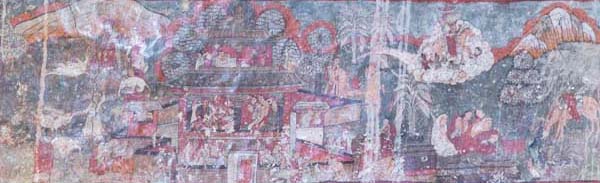
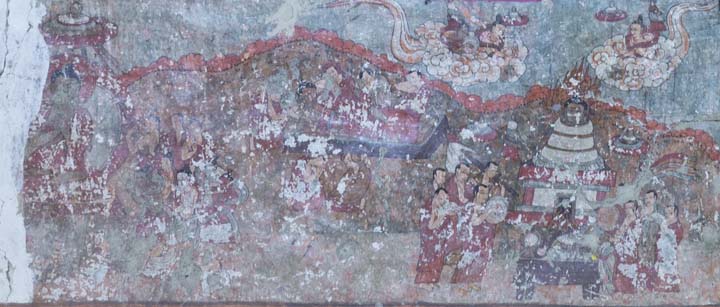
Of note in the murals is the frieze below the main figures, which largely depicts the life of Prince Siddartha, who became the historical Buddha, Shakyamuni. Tabo Monastery has a similar frieze in its Tsug Lhakang, the main assembly hall. Much of it is faded but the below two images are readily identifiable as the life of Siddartha at the palace of Kapilavastu, and the death of Buddha.

Dhangkar_Lhakang Gongma frieze
Life of Prince Siddartha at the palace of Kapilavastu, painted frieze at Lhakang Gongma, Dhangkar Monastery
Death and cremation of Buddha, painted frieze at Lhakang Gongma, Dhangkar Monastery

We were told by locals that Dhangkar is older than the famous Tabo Monastery because, as the ancient home of indigenous kings, it contained a private temple from before the time of The Great Translator Rinchen Zangpo, pre-dating 10th century. Indeed, at the very top of the Dhangkar citadel are the remains of the palace, which you climb up to through a sleepy and steep quaint village that looks like it has maintained its same way of life for millenia.

Later in the day, we went to Lhalung Monastery. I really loved this small temple pictured below.

Lhalung Monastery, Spiti
Lhalung Monastery’s Serkhang or Golden Hall, Spiti

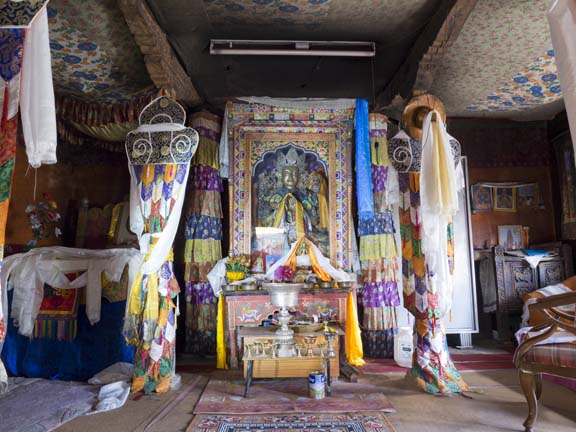
Lhalung Monastery, believed to be founded by The Great Translator Rinchen Zangpo, late 10th century C.E., was quite impressive. You enter through a narrow passageway to get to its Serkhang, which means literally House of Gold, but more often referred to as Golden Hall. Attached to its walls are sculptures of deities and other Buddhist personages. Three-dimensional figures in relief against the interior architecture of Buddhist temples are a distinctive feature of Indo-Tibetan artistry in Spiti and Ladakh areas. Similar ones are found at Tabo, Alchi, and Mangyu Monasteries.

Experience the rare and beautiful interior of Lhalung Monastery’s Serkhang by seeing a walk-through video here.

Entrance to Lhalung Monastery's Serkhang or Golden Hall
Entrance to Lhalung Monastery’s Serkhang or Golden Hall

Once inside, the splendor of the ornately gilded and polychromed clay figures strikes you. The sculptures fill the temple practically from floor to ceiling. There are over 51 figures mounted on the walls or placed in the temple, arranged in mandala formations on each wall. Geshe-la said that these types of cantilevered relief sculptures are specific to the Trans-Himalayan region and are not found in Buddhist temples anywhere else.

On the central wall is Shakyamuni in the middle, flanked by two elaborate groups of five figures, each dominated by a deity–identified as Dharmadhatu Vagishvara, a complex form of Manjushri on the left, and Vajrasattva on the right. These figures are set in architectural alcoves, while the others are contained within lotus motif scrollwork, accented by decorative animals and dancers.

Serkhang, Golden Hall, Lhalung Monastery
Maitreya, Guru Rinpoche, and Rinchen Zangpo (partly visible on right behind the column) form a trinity in the Serkhang altar of Lhalung Monastery, Spiti

Visible below is the right wall with sculptures arranged in a Prajnaparamita mandala, with Vairocana in the center surrounded by four Dyanibuddhas or Buddha-families: Ratnasambbhava, Akshobhya, Amoghasiddhi, and Amitabha, and their female attendants.

Serkhang, Lhalung Monastery, Spiti
Rinchen Zangpo statue among a pantheon of sculpted deities, Serkhang (Golden Hall), Lhalung Monastery

On the left wall (photo below) is a Vajradhatu mandala arrangement around the three-faced and eight-armed Saravid Vairocana. Around him are the 16 deities in his cycle, including once again the Buddha families of Ratnasambhava, Akshobya, Amitabha, and Amoghasiddhi.

Vajradhatu Mandala, Serkhang of Lhalung Monastery, Spiti
Left wall with Vajradhatu Mandala, Serkhang of Lhalung Monastery, Spiti

So now, that’s a lot of deities in one small temple! Their plethora really conveys not only aesthetic richness but also the complexity of Tibetan Buddhist tantric practice. What do all these deities represent in these mandala arrangements? Put simply, mandalas are visual guides for a practitioner in their meditation. They are aids in the realization of the true nature of mind and reality. As an oral and esoteric tradition, one needs a lineage teacher. Experiential understanding of this leads to liberation from conditioned existence–that is to say, leads to enlightenment or nirvana. Here is a succinct description of what the Five Buddha Families represent.

Geshe-la had said that the temples in these areas really demonstrate only the lower three tantras, not highest yoga tantra, which is mainly what Tibetan Buddhists practice today. The lower three are more concerned with purification, whereas the fourth level is actualizing self and deity, and therefore, enacting profound experience and understanding of emptiness. In The Great Translator Rinchen Zangpo’s time, late 10th century, focusing on the three lower tantras was a way to go back to roots and revitalize/reform tantric practice in Tibet which had grown distorted. This was partly the reason for the enormous interest in the original texts and their teachings, translating them from Sanskrit to Tibetan.

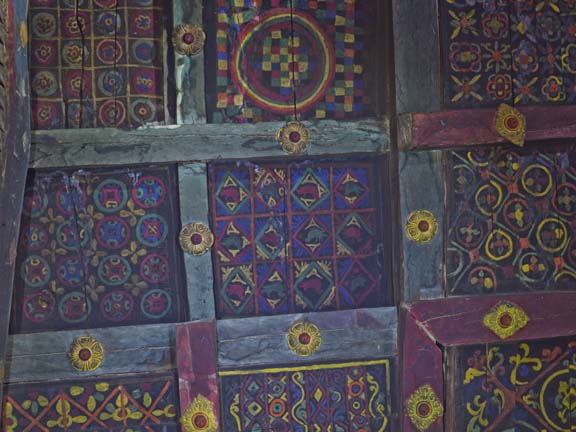
Lastly, the coffered ceilings were painted with delightful and folk-looking decorative motifs. Now I know what scholars mean when they speculate that these must reflect 10th century Kashmiri–influenced textiles.

Coffered ceiling of Serkhang, Lhalung Monastery, Spiti
Coffered ceiling of Serkhang, Lhalung Monastery, decorated with Kashmiri-influenced patterns that scholars believe reflect 10th century textile designs.

All photos © 2013, Eva Lee.
 

Vandana’s Guest House and PBJ

I always marvel when I travel that it isn’t all that difficult to change one’s reality. Here I am! India! Landed three days ago. United Airlines, Newark to Delhi direct, I highly recommend it. Smooth flight, quiet fellow passengers, seats have personal touchscreens for entertainment, and more importantly, power! You can plug in your device for charging. I was relieved to find this because I wanted to at least be able to text home that I’d arrived, and call a local if I needed help.

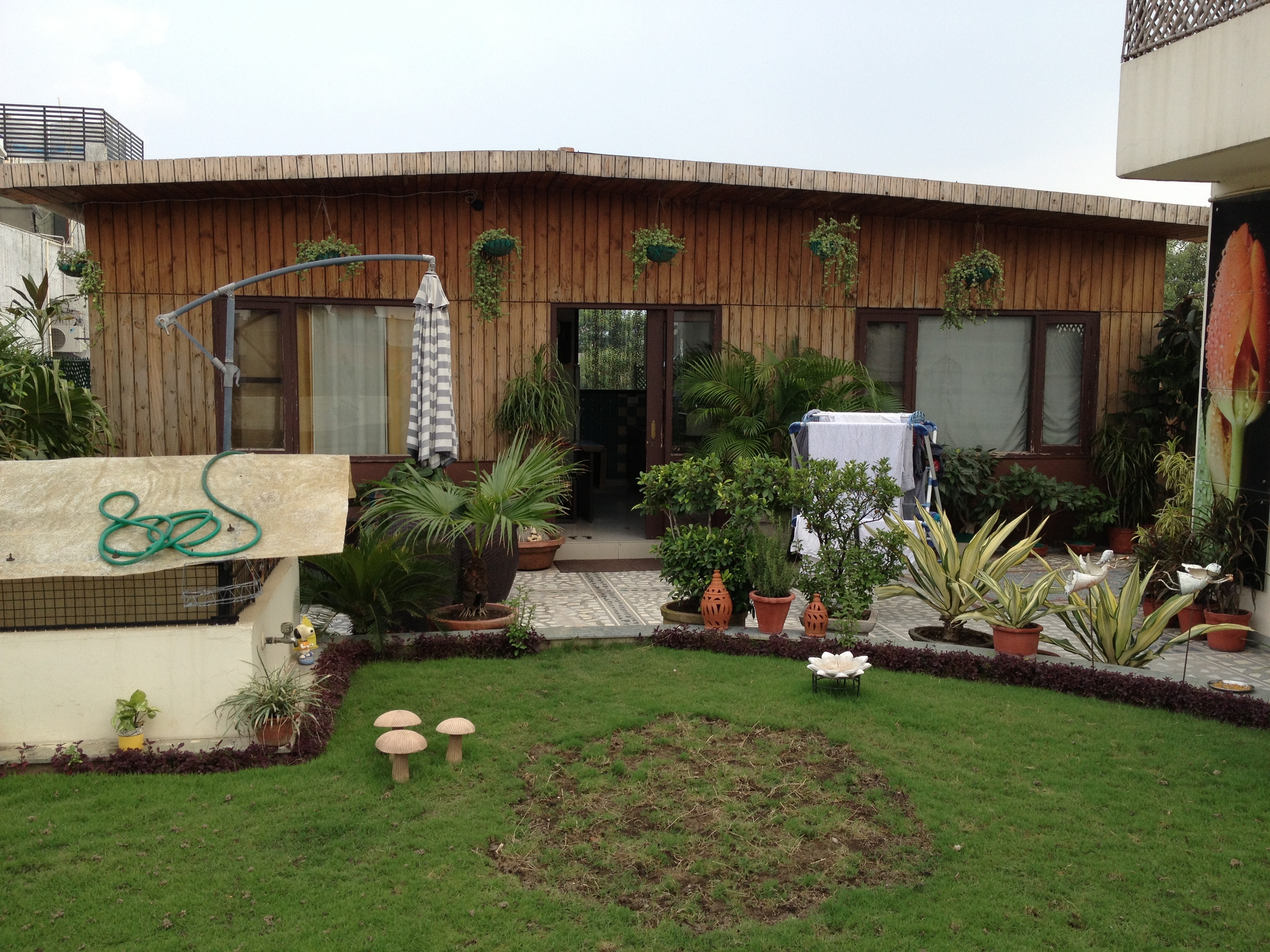
Vandana's Guest House rooftop garden rooms, Delhi, India
Vandana’s Guest House rooftop garden rooms, Delhi, India

Speaking of this, I’m thankful for help from others who look out for me! Fulbright sent a driver to pick me up at the airport. It was fantastic because after a long flight you emerge with jetlagged fuzziness. I found myself equally concerned with whether I could still purchase duty-free, as I was with completing an accurate customs form. Then later, there’s the confusing ruckus of countless drivers looking for passengers, holding placards or not, congested by the exit where travelers are also wending their way with loaded luggage carts. As it turns out, I couldn’t find my driver because I was standing in the wrong place, but he found me by looking in this wrong place!

The ubiquitous tuktuk or auto rickshaw

They also prearranged my weeklong stay at lovely Vandana’s Guest House. It’s home away from home for now, run by a warm, helpful family who live here, too. My garden rooftop room with adjoining kitchen which I share with the next door Fulbrighter is perfect because I can stow away my PBJ fixings. Don’t laugh, those sandwiches, which I make and pack for the day as emergency snacks, have proved to be vital in our face-paced quest to complete paperwork as quickly as possible so I can get to the Himalayas in time. Yesterday we didn’t have time for lunch all day, shuttling to and fro in tuktuks from USIEF to University of Delhi where I am affiliated, to Connaught Place for errands, to Archeological Survey of India from whom I’m seeking permission to photograph the interiors of monasteries under its jurisdiction. This glycemically-challenged traveler was happy to think straight after snarfing my PBJ on the run!

Fulbright also offered a ‘Facilitator’ to help with the initial transition. Thank goodness! He has been an enormous guide through Delhi these past two days, fording me through congested traffic, bureaucracy, electronic logistics, and procedures! Yes, i need an ATM machine, Citibank is great. Oh and yes, an Indian SIM card please, micro chip with reception in the Himalayas. Yes, I will definitely take that surge protection power strip with universal plugs!

To top it off, he has been a great conversationalist–interested, approachable, frank. Bustling with vision and ideas. We even discussed caste, a subject often considered delicate and charged in this nation’s changing order.

Today’s largest agenda: complete registration at FRRO, the Foreigners Regional Registration Office. Quite an exercise in following directions. Three copies of this, originals only of that, retrieve this signed form from here, fill out (or ‘fill up’ as Indians say) this form online, etc. One fellow Fulbrighter quipped, carry lots of extra passport photos and copies of your passport, they love them here. Indeed! For example, for a foreigner to get a SIM card, you need to supply both.

Bodhgaya & Terrorism

Statue of Buddha inside the Mahabodhi Temple, Bodhgaya, India

Bodhgaya and terrorism. I would never have put these two concepts together. That is, not until I heard about the bombings that occurred just a little over a week ago at this venerable holiest-of-the-holy site. The very place where Buddha became enlightened sitting under a bodhi tree. The place where thousands of pilgrims rich and poor alike travel to, to do full body prostrations, or make butter lamp offerings, meditate, circumambulate, chant songs and mantras, and other practices that cultivate one’s mind to turn towards wisdom, to enact compassion, to see the true nature of reality, the illusion of selfhood, amidst impermanence.

If you’ve ever been here, and experienced the electrifying devotion practitioners bring, you would be hard pressed to pair the scene with terror. It makes me feel sad for the perpetrators that they would harbor such contorted mentalities and ill plans among peaceful people.

Read some coverage of it here.

Fortunately, it seems there were no fatalities, and no serious structural damage done to the World Heritage site.

The Indian government today has however issued alert warnings for further possible terrorist strikes on Himachal Pradesh Buddhist monasteries.

This is discouraging and unwelcome news, to say the least, as I plan to travel to over a dozen such Himalayan sacred sites soon.

Green Light GO on India Reseach and Visa

It’s been a flurry of paperwork, and orientation, reading guides, asking questions, learning protocols and so forth, to move on to the next step of clearance by the Indian Consulate for Fulbright research and visa. What a lesson in following directions! After lastly traipsing through torrential rain, a fat stack of organized forms and documents with regulation passport photos in hand, to New York City where I applied in person, here I am with the green light GO!

Fulbright Guide for U.S. Scholars

Wow, this means that I will now be working on the nitty-gritty of travel plans.

Meanwhile, it’s been wonderful to “meet” the USIEF staff as well as other Fulbrighters traveling to India during the virtual orientation. Someone also set up a Google group so we can all chat with each other and perhaps connect when we’re abroad. It’s inspiring to hear about what others are doing. All different scholars, areas of expertise and research–Islamic intellectual and cultural history, Ragamala painting, management science and information systems, Indian philosophy and the Transcendentalists, ecology and the environment, recovery from serious mental disorders and why India does better than other countries in this area, climate change and energy efficiency, Holocaust refugees in India during WWII, Indian public pension and health system, Indian and American portrayals of democracy, Tamil poetry, Ayurvedic medicine, ancient rock-cut monuments, deployment and commercialization of renewable energy in villages, Hindu-Jewish encounters, ethnography of divorce, domestic violence, courts and marriage, national parks. The list goes on…

The Great Translator Rinchen Zangpo

I’m currently reading David Snellgrove’s “Indo-Tibetan Buddhism: Indian Buddhists & Their Tibetan Successors.” It concentrates on the tantric period of Buddhist theory and practice, from the 8th to the 13th centuries. This was a fertile time of the transmission of Buddhism from India to Tibet. I’m particularly interested in the prodigious legacy of The Great Translator Rinchen Zangpo (958–1055 C.E.) who translated voluminous original Sanskrit sutras into Tibetan, and therefore helped preserve the doctrines and teachings. These original Sanskrit sources are now largely lost in India.

Tabo Monastery, Spiti, Himachal Pradesh, India
Photo: Tabo Monastery

Rinchen Zangpo is also credited with building over one hundred monasteries in Western Tibet, many still existing now in modern day Indian Himalayas, including the famous Tabo Monastery in Spiti, Himachal Pradesh.

I really look forward to seeing Tabo’s murals. They are extensive and among the best preserved from Rinchen Zangpo’s time. In addition to the art, its architecture is an excellent example of mandala layout and structure, built in direct relationship to sutra descriptions. Founded in 996 C.E., Tabo is considered to be the oldest continuously functioning Buddhist monastery in India and the Himalayas.

Tips for Artists: How to Get a Fulbright Scholar Fellowship

Fulbright logoThis post is to pay it forward! I’m so grateful for the help that I’ve received from others. A few years ago, I didn’t even know artists could apply for a Fulbright Scholar fellowship, and now I have been awarded one to conduct research and create new work in India. I was emboldened to consider it thanks to a fellow artist who told me about her own Fulbright to India. I always thought it was for professors, students, and others associated with academia. NOT SO. Professionals “at-large,” that is, not associated with a college or university, may apply if they are of “recognized professional standing and have substantial professional accomplishments in their field.”

If you are an artist and interested in applying for the U.S. Core Fulbright Scholar program, now is the time to do so for 2014-2015. While the deadline is August 1st, 2013, I would advise you begin right away. It took about five months for me from beginning to end–from thoroughly reading the Fulbright website, understanding their mission, to researching at the library, drafting, writing, revising, revising, revising a good project statement. Your proposal should have quotes, footnotes, and bibliography, like a short research paper. It should be clear and concise. Be sure not to go over the number of pages allowed. Be sure your project is feasible and can be accomplished within the amount of time proposed.

Fulbright logoThese tips are intended to supplement Fulbright’s project statement guidelines. Please read and follow what’s on their website carefully. Here was my outline, using these subtitles:

  • Title and Intro – My first paragraph immediately said what my objective was and addressed these two key aspects:  Why I needed to conduct research in India that could not be done anywhere else, and how it is related to my work. Don’t make reviewers, who are reading hundreds of proposals, look around for what you propose to do! Say it right away.
  • Methodology – i.e., research and documentation, creative work and application
  • Academic and Professional Context – why I was interested in doing this, how my work is related to the research, fellow artists whose work have influenced mine, etc. Say why there is a worthy professional art context for your proposal.
  • Dissemination – My understanding was that some reviewers may not be familiar with how artists disseminate their research, so I was careful to be specific about how artists share ideas and their work through exhibitions, artist talks, lectures, workshops, etc. Do your homework and identify places abroad and in the U.S. where you could or would in fact be showing artwork, be on panel discussion, and so forth.
  • Significance of Research to My Discipline, My Development, and Host Country – I described how my research would contribute to contemporary art, what I envisioned my new creative work would be as a result of the fellowship experience, and how it would foster cross-cultural understanding.

Be sure to have helpful readers give you feedback as you work on your drafts.

I would recommend you have your project statement written two months in advance of the deadline so you can send it along to your referees for them to review and have time to write you letters of recommendations. You will also need to find an affiliation in your host country. Even though it is not required in India, it was highly recommended to me by other Fulbrighters. It took me 4-6 weeks to identify an Indian university faculty member with related interests, and secure his letter of invitation. I sent numerous emails, with my proposal attached, to different faculty I identified online. I also reached out to Indian and American friends with any connections or leads. Really appreciated their aid!

For the three letters of recommendation, I followed an artist Fulbright fellow’s advice. I asked the dean of my alma mater who was familiar with my work over the years since I graduated; a curator; and a Fulbright fellow. Even though I was applying as an at-large artist, Fulbright is still a scholarly program and having at least one academic referral strengthens one’s application.

For supplemental materials, which would be examples of your artwork, I recommend you include a list of works submitted, providing all the usual information (title, medium, dimensions, date) with short descriptions if necessary. Again, not all reviewers will be from your art discipline, so write for fellow professionals as well as layperson.

Fulbright also conducts webinars to provide further information and demystify the grant application process. I highly recommend these. There is a question-and-answer period at the end of the presentation. Webinar schedule for 2014-2015 application period can be found here.

I hope these are helpful tips. Good luck on your application!

________________________________________________________________

The Fulbright Program is the flagship international educational exchange program sponsored by the U.S. government and is designed to “increase mutual understanding between the people of the United States and the people of other countries.” With this goal as a starting point, the Fulbright Program has provided almost 310,000 participants—chosen for their academic merit and leadership potential — with the opportunity to study, teach and conduct research, exchange ideas and contribute to finding solutions to shared international concerns. —from Fulbright website

Himalayas / hi-MAAL-yah

Learn something new every day. The correct pronunciation for Himalaya is “hi-MAAL-yah.”

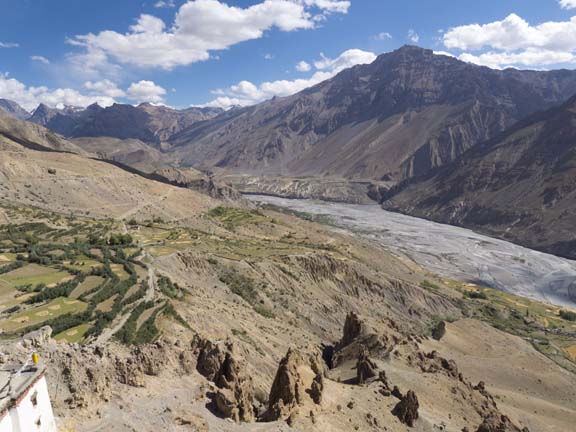
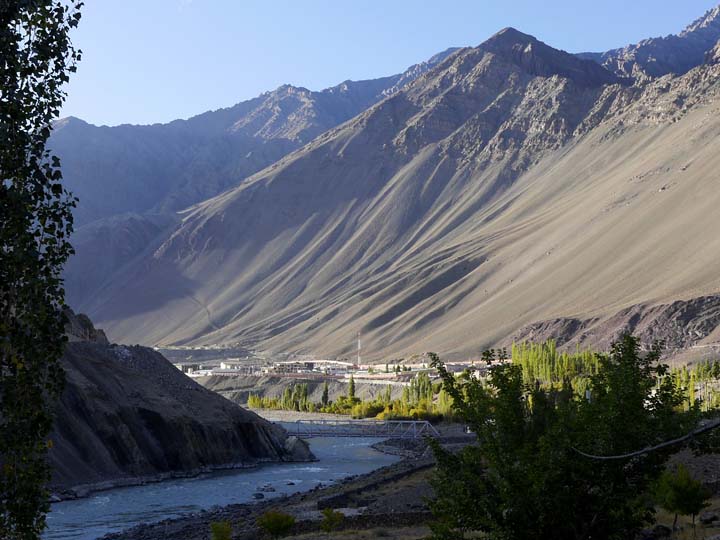
Mountains and the Indus River Valley as seen from Alchi Monastery circumambulatory, Himalayas.

I look forward to going there later this year to conduct research as an artist, made possible by a Fulbright-Nehru Scholar award. Excited and honored! Truly grateful for this opportunity! I will be researching murals of Indo-Tibetan monasteries in Lahaul, Spiti, and Ladakh districts, with a focus on mandalas as a blueprint for understanding the nature of mind and reality.

So while my departure is still months away, I’ve already begun traveling in my mind as I await further details from Fulbright.