Fulbright Documentary Series at Columbia University and Library of Tibetan Works & Archives
Posted
Losar Tashi Delek! Happy Lunar New Year to all who celebrate!
I’m pleased to announce that five of my documentaries are now part of the Columbia University Tibetan Studies Library, one of the most extensive collections of Tibetan texts and archival material in the U.S.A. The documentaries are also in the Library of Tibetan Works & Archives, and may be viewed through their Multimedia Library.
The documentaries are:
Tabo Monastery Tsug Lhakhang (Main Assembly Hall) See the interior of this rare, Buddhist temple located in Spiti region of Western Himalayas, India. Famed Tabo Monastery is known as the oldest continually functioning Tibetan Buddhist monastery, the art of which the Dalai Lama said “delightfully expresses the vigor of the transmission of Buddhism from India to Tibet and the dynamic mingling of cultures.” Established in 996 C.E. by the Buddhist king of Guge in Western Tibet, Yeshe O’d, and the The Great Translator Rinchen Zangpo, it flourished in a golden epoch of Indo-Tibetan collaboration in spreading Buddhist culture.
Lamayuru Monastery Senge Lhakhang (Lion Temple) (00:03:24) Rare, medieval temple located in Ladakh region of Western Himalayas, India. Founded by The Great Translator Rinchen Zangpo and King Yeshe O’d of Guge, Western Tibet, circa late 11th century.
Mangyu Monastery Nangbarnangzad (0:03:03) Rare, medieval temple located in Ladakh region of Western Himalayas, India. Founded by The Great Translator Rinchen Zangpo and King Yeshe O’d of Guge, Western Tibet, circa late 11th century.
Lhalung Monastery Serkhang (Golden Hall)(00:01:45) Rare, medieval temple located in Spiti region of Western Himalayas, India. Founded by The Great Translator Rinchen Zangpo and King Yeshe O’d of Guge, Western Tibet, circa late 10th century.
Yamantaka (00:56:38) A candid view of an esoteric and complex Tibetan Buddhist highest yoga tantra held at Namgyal Monastery in Dharamsala, India. Monks create an elaborate sand mandala, ritual cakes and other sacred arts, offer prayers, chant, play ritual instruments, and meditate over the course of ten days. As one viewer said, “Beautiful, bizarre, and fascinating!”
Incidentally, many viewers have asked me about what is happening at around 42:14 in the Yamantaka video, where a young Caucasian man is in the Main Temple talking loudly and animatedly to a gathering of monks.This was a debate exam in session for students of the Institute of Buddhist Dialectics (which adjoins Namgyal Monastery), characterized by dramatic and distinctive hand clapping, body motions, and rhetoric. It was an event unrelated to Yamantaka, but which coincided with it. Tibetan Buddhists have a long and famed tradition of continuing the ancient Indian Buddhist practice of philosophical debate.
All documentaries filmed during Fulbright research on Indo-Tibetan mandalas of the 10th-12th century. With thanks and gratitude to Office of His Holiness the 14th Dalai Lama, Namgyal Monastery, and Nechung Monastery for their support in my quest to document these temples and Yamantaka ritual. Made possible in part by the support of Fulbright-Nehru Research Program, Council for the International Exchange of Scholars, and United States-India Education Foundation.
Breathtaking Alchi Monastery
Posted
September 24, 2013
Panorama of Alchi Monastery, Ladakh, India
And what about Alchi? Famous Alchi Monastery, which contains some of the most beautiful and beguiling Buddhist art and iconography from the Indo-Tibetan world.
Indeed, I did visit Alchi, said to be founded by the legendary Great Translator Rinchen Zangpo (958-1055 C.E.) However, I was unable to get permission to study its interiors more closely and document. Despite having some strong letters of support, time and other circumstances conspired against the process when I arrived with only a small window of opportunity to work. After all, it takes time to sort these things out. One Indian friend of mine quipped, “I.S.T.,” which he said stands for Indian Stretchable Time as opposed to Indian Standard Time.
So, I will here share what I have–mostly vignettes of Alchi, some exterior photographs, along with interior images from others who have studied and accessed Alchi.
Like Tabo Monastery, Alchi Monastery’s complex is located in a river valley, integrated with its village. This is typical of earlier phase Himalayan monastic architecture, versus the later phase post 12th century, in which monasteries were fortified and built up on a hill.
Located about 67 kilometers west of Leh in Ladakh region, at 10,500 feet altitude, Alchi contains six temples as well as three painted gateway stupas.
Gateway stupa, an unusual feature of Alchi Monastery, Ladakh, India
The three oldest temples are the Assembly Hall or Dukhang, also known as the Vairocana Temple; the Sumtsek, named for its recognizable three-storied building; and the Manjushri Temple. These buildings are dated from approximately mid-12th to early 13th century. In addition, there are other chörtenand temples built during the 13th and 14th century. Many of these are visible along the circumambulatory surrounding the complex.
Site map of Alchi Monastery complex, Ladakh, India
As you can see from the above site map and aerial photos, the temples are built close together, basically along a single axis, with other structures surrounding them in proximity. Narrow views are generally all one can photograph because it is difficult to get enough distance onsite.
More gateway stupas with a view of Sumtsek Temple in rear, Alchi Monastery, Ladakh, India
As it turns out, I was only able to visit the Sumtsek and the Vairocana Temple. The other temples and spaces were closed to the general public that morning.
Facade of Sumtsek Temple, Alchi Monastery, Ladakh, India
The Sumtsek facade is distinguished by its carved wooden porch.
Another view of Sumtsek Temple, named for its three stories, Alchi Monastery, Ladakh, IndiaDetail of Sumtsek carved wood facade, Alchi Monastery, Ladakh, India. Photo: Kishore ThukralDetail of Sumtsek facade with view of second story terrace roof, Alchi Monastery, Ladakh, IndiaDetail of Sumtsek carved wooden facade, Alchi Monastery, Ladakh, India
As with most other temples of this time period, one must bend down in order to enter through the small, short doorway. When you are inside the ground floor of the Sumtsek, you see three monumental sculptures in niches. They are Maitreya, Avalokiteshvara and Manjushri. See images here created by the team of researchers at Graz University.
They stand so tall at about 14 1/2 feet high in the interior architecture that their heads, in fact, reach the second floor and seem to look out at the viewer from their niches. Shown in the above link is the head of Manjushri on the second floor of the Sumtsek. A beautifully painted and richly adorned Tara stands above him, flanked by two mandalas.
I wish that I had been able to access the second floor to see this in person! Only the ground floor was open to the general public.
Judging from these photos, the upper levels had numerous mandalas, the subject of my research. One cannot see these well from the ground level given the limited sight lines .
What a pity! I was there, but could not quite get there! So close and yet so far…
This third level cupola with its mandalas would have been so golden to see.
I had to settle instead for seeing most of Alchi’s Sumtsek paintings in reproduction two months later in photographer Aditya Arya’s studios. I had the occasion to meet with him in New Delhi to discuss his project photographing “every inch” of Alchi’s interiors.
Alchi’s iconography is truly delightful to scrutinize, with its delicate drawings and imaginative compositions. I recommend you visit Arya’s website here to see some images.
I also recommend the book “Alchi: The Living Heritage of Ladakh,” a catalogue published on the occasion of The National Museum’s exhibition of Arya’s Alchi photographs in New Delhi. In it are extensive photographs and details of Alchi paintings.
I must say, however, that what I saw in his documentation of the first floor of the Sumtsek, which he photographed about five years ago, did not match a lot of what I saw onsite. As a trained painter in fine arts as well as decorative arts, I can say without doubt that alot of the apparently recent restoration work at Alchi does not do the original artwork justice. These areas are painted in a different hand and style. There is cause for concern about such results. Like I discussed in this post on Mangyu Monastery and this one on Tabo Monastery, similarly, I fear that Alchi paintings will slowly disappear by virtue of ill-conceived “restoration.”
According to the Smithsonian Magazine article Glimpses of the Lost World of Alchi,written in 2010, the concern about conserving Alchi’s murals and buildings is not new. In 1990, German art historian Roger Goepper, photographer Jaroslav Poncar and art conservators from Cologne, Germany, launched the Save Alchi Project. Some work was done, but it ended two years later due to what Goepper referred to as “growing confusion over administrative responsibility.” Or, some say, between religious and national interests.
According to the article, although “tourists now far outnumber worshipers, Alchi is still a living temple under religious control of the nearby Likir Monastery…Monks from Likir serve as Alchi’s caretakers, collecting entrance fees and enforcing a prohibition on photography inside the temples…At the same time, responsibility for preserving Alchi as a historic site rests with the [Indian] government’s Archaeological Survey of India (ASI). Relations between the ASI and the Likir monks have long been fraught. The monks are wary of government intrusion into religious matters; the ASI worries the monks will undertake restorations that damage the Alchi murals. The result is a stalemate that has thwarted conservation efforts.” Since the publication of this article, I hope the stalemate is in the process of being sorted out.
I can happily report that the wall paintings of the Vairocana Temple, which included massive mandalas, were breathtaking and well-preserved. They appeared untouched by questionable conservation efforts. OR, better yet, they are a testimony to conservation well done! I hope so.
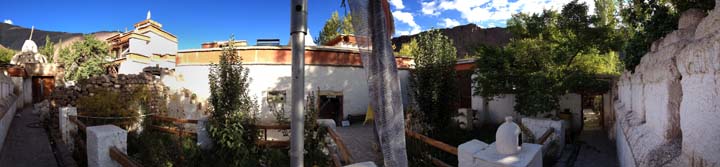
Panorama of Vairocana Temple and its courtyard. At far right is the doorway to the courtyard of Manjushri and Lotsava temples, Alchi Monastery, Ladakh, India
Unfortunately, I do not have images to share here of the exquisite interior of the Vairocana Temple.
Side view of Vairocana Temple with its mountainous surroundings, Alchi Monastery, Ladakh, India
But I have a better idea. Consider getting an airline ticket to fly here and see Alchi for yourself. It’s best to experience the Himalayas in person anyway!
Truly, it’s ineffable. There are no words or images that can convey the exhilaration and revelation of being in the grandeur of the Himalayas.
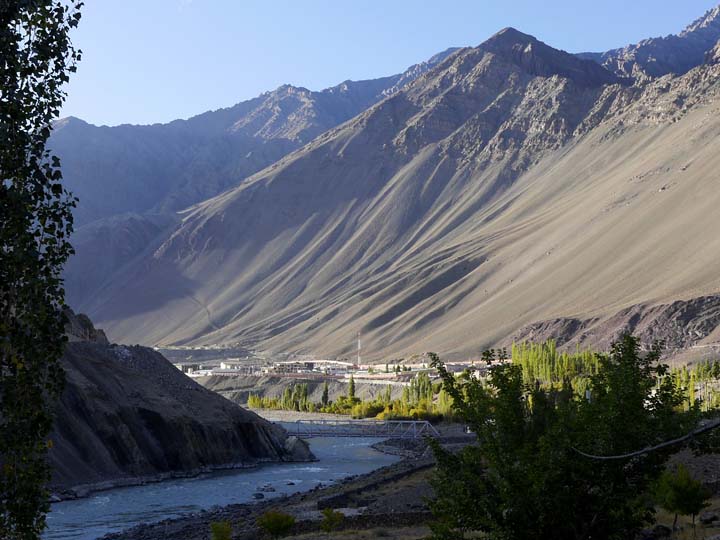
View of Alchi Monastery circumambulatory with prayer flags by the Indus River in early morning light, Ladakh.Himalayan mountains and the Indus River Valley as seen from Alchi Monastery circumambulatory. A border area, Ladakh has high military presence, such as this military compound in the distance.
This is not an official U.S. Department of State website. The views and information presented here are solely those of the artist, and do not represent the Fulbright Program, the Department of State, or any other entity.