kagyu

Sherabling Monastery’s 3D Mandalas and Milarepa’s Redemption from Murder

October 23, 2013

Going to Palpung Sherabling Monastery in the foothills of the Indian Himalayas was a revelation. Three years ago, when I first visited I had happily stumbled upon resident monks rehearsing their famed Lama dances, held bi-annually in the courtyard. This time, however, I was riveted by another aspect of this Karma Kagyu lineage of Tibetan Buddhism which I had not seen before.

It was the treasure trove of 3D mandalas on its mezzanine level. Because they were not visible from the ground floor of the main temple, I missed them last time. This time, I traveled with a senior monk who asked for access to other areas of the temple with art interest, and was therefore taken up to the mezzanine. Wow, fourteen 3-dimensional mandalas of the tantras of Marpa! Usually, if one is lucky enough to come across any 3D wooden models, one sees only one or two of them at a time. Here were fourteen of them, of such variety and fine quality, too!

So allow me to walk you through how I saw these mandalas.

Here’s a view of Sherabling Main Temple and the inner courtyard. Very quiet that day, compared to the first time I saw it completely filled with monks dancing in organized circles.
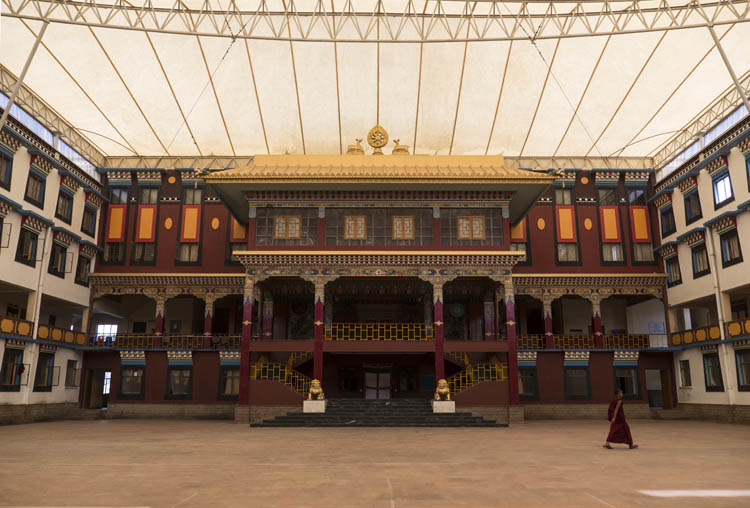
Inner courtyard of Sherabling Main Temple complex, Himachal Pradesh, India.
Sherabling Main Temple complex, with inner courtyard, Himachal Pradesh, India.

Upon entering this well-appointed temple, you behold a 42-foot tall golden Maitreya, the future Buddha, seated on a throne beautifully gilded and elaborately decorated with filigree motifs.

Maitreya, the future Buddha, Sherabling Monastery main altar, Himachal Pradesh, India
Sherabling Main Temple, looking back towards front entrance and inner courtyard beyond, Himachal Pradesh, India

In fact, this whole main assembly hall is exceptionally ornate with its painted and gilded columns, cornices, thangkas and friezes.

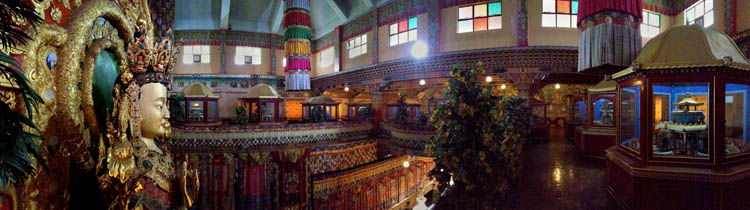
What is not visible when you stand on the ground floor is the spacious and tall mezzanine level above that houses the exquisite Mandala Shrine Hall. Here are some views of it.

View of Maitreya statue from mezzanine level of Sherabling Monastery Main Temple, Himachal Pradesh, India
Panoramic view of Maitreya statue from mezzanine level of Sherabling Monastery Main Temple, Himachal Pradesh, India
Panoramic view of Maitreya statue from mezzanine level of Sherabling Monastery Main Temple. Visible on either side are 3-dimensional mandalas, part of the 14 tantras of Marpa, Himachal Pradesh, India

And here’s a full view of this magnificent, monumental statue of Maitreya.

Maitreya, the future Buddha, a 42-foot statue in Sherabling Monastery Main Temple, Himachal Pradesh, India
Maitreya, the future Buddha, a 42-foot statue in Sherabling Monastery Main Temple
Himachal Pradesh, India

Notice that at the foot of the statue are photos of His Holiness the 14th Dalai Lama on the left, and His Holiness the 17th Gyalwang Karmapa on the right. The Dalai Lama is the spiritual leader of Tibetans and all Tibetan Buddhist schools, of which there are mainly four–Nyingma, Kagyu, Sakya, and Gelug. The Karmapa is the spiritual leader of the Kagyu school.
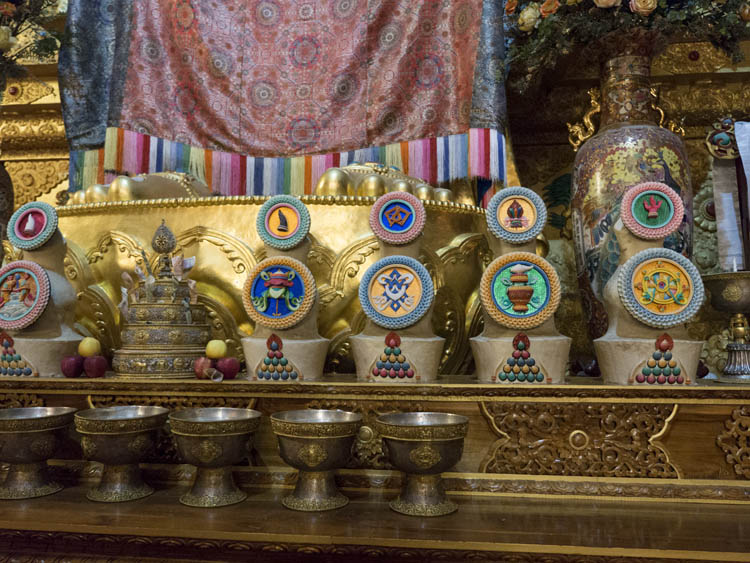
Detail of some of the Eight Auspicious Symbols of Buddhism, and other ritual objects, altar of Sherabling Monastery Main Temple
Detail of some of the Eight Auspicious Symbols of Buddhism, and other ritual objects, at the foot of the monumental Maitreya statue. Sherabling Monastery Main Temple

Now about the Mandala Shrine Hall, it displays wooden three-dimensional mandalas of the 14 tantras of Marpa. These are the main practices of the Palpung Sherabling (Kagyu) community.

Profile view of Maitreya statue from mezzanine level of Sherabling Monastery Main Temple

Marpa (1012-1097  CE) was a great teacher and translator. In fact, one of his students became the first Karmapa. This is no small deal since the present Kagyu school’s Karmapa is the 17th incarnation, an older lineage than the Gelug school’s 14 Dalai Lamas. But perhaps, arguably, Marpa’s most famous student was Jetsun Milarepa (ca. 1052—ca. 1135 CE). How Milarepa became enlightened is an inspiring story of redemption.

As a layman, Milarepa had a dark personal history. He learned sorcery and exacted revenge upon an aunt and uncle who mistreated and took all of his family’s wealth upon the death of his father. As a result, Milarepa killed dozens of people through conjuring devastating hailstorms. Later, remorseful for his black deeds, he sought a teacher for help. That teacher turned out to be the fearsome Marpa, whose gaze was said to bely such inner power that people found it difficult to look at or be near him.

The mahasiddha Marpa, always depicted with wide staring eyes, Lamayuru Monastery, Ladakh

Marpa was apparently the right teacher for the destructive Milarepa to atone himself. He put him through arduous tasks, such as instructing him to build buildings, each time promising to teach him if he completed his request. However, Marpa repeatedly anguished and disappointed his hapless student by refusing to teach him sacred Buddhist practices. Despite building and tearing down three whole structures, and suffering much physical pain, Milarepa still did not received a single tantric oral transmission.

The nine story tower that Milarepa single-handedly built, Sekhar Gutok, Lhodrag, Tibet.

Milarepa was then asked to build a multi-story tower by Marpa at Lhodrag, where to this day the 11th century tower still stands. For a detailed telling of Milarepa’s trials and tribulations, see this Kagyu site.

When at last Marpa bestowed the spiritual teachings on Milarepa, his dedicated student then left to practice. After twelve years, he attained the state of Vajradhara (complete enlightenment).

Milarepa became a renowned ascetic and poet, a mahasiddha who lived in a cave in Namdaking, Tibet near the border of present day Nepal. He was said to have survived on nettles, an herb which caused his complexion to turn green. He is often portrayed in paintings with green skin tones for this reason. The other identifying aspect is his hand held to his ear. While it looks like a gesture of listening, I learned from a Tibetan nun that it is a yogic posture for affecting subtle energies of the body.

"Milarepa Giving Teachings by Singing to Khyirarepa," watercolor on paper by Dru-gu Choegyal Rinpoche.
“Milarepa Giving Teachings by Singing to Khyirarepa,” watercolor on paper by Dru-gu Choegyal Rinpoche
© 2007, Dru-gu Choegyal Rinpoche.
View of some of the fourteen 3-dimensional mandalas of the tantras of Marpa, Karma Kagyu lineage of Tibetan Buddhism
View of some of the fourteen 3-dimensional mandalas of the tantras of Marpa, practices of Karma Kagyu lineage of Tibetan Buddhism

As for the Mandala Shrine Hall, it is an exceptional collection and display of the 14 tantras of Marpa. While most mandalas, such as the below Mahamaya mandala, follow the conventional form of a three-story palace with four gateways facing the cardinal directions, with the main deity residing at center, and associated deities in the surroundings, encompassed by ritual symbols and elements, only the initiated Kagyu practitioner would truly be familiar with the mandalas and their practices.

Mahamaya mandala, Sherabling Monastery Main Temple, Himachal Pradesh, India

Even for practitioners from other Tibetan schools, the mandalas may seem unusual, such as this one. I believe the below mandala is that of a Dakini.

Detail of one of the fourteen 3-dimensional mandalas of the tantras of Marpa, Karma Kagyu lineage of Tibetan Buddhism
7-IMG_3441
Panoramic view of Mandala Shrine Hall, Sherabling Monastery, Himachal Pradesh, India

All photos © 2013, Eva Lee.
Except where otherwise credited
Dharamsala Return, Monsoon Mist, and Midst

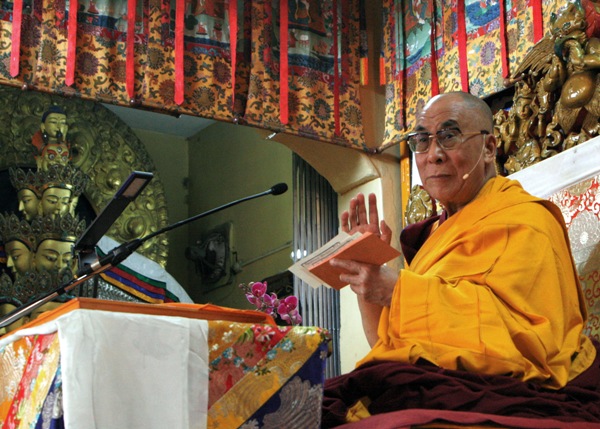
His Holiness the Dalai Lama giving teachings at Namgyal Monastery. Photo by Abhishek Madhukar

I loved that last week I happened to get back to Dharamsala just in time again for the Dalai Lama’s teachings. This one was on Nagarjuna and Tsongkhapa‘s writings, at the request of a Taiwanese group. Great bookend that I arrived Dharamsala first in August to attend a teaching before leaving for the High Himalayas, and then arrived again to attend a teaching after my journey! This one was four days long, and included an initiation for Vairocana tantra. The town swells with visitors and cars during these times, and then very quickly shrinks back when the teachings end.

I was so happy also to return to my little home-away-from-home here. Very grateful to a friend for helping me find this place, in prime location close to Namgyal Monastery, with wraparound terrace, mountain view, morning sun streaming in. It’s clean, no bad mildew or mold odors like many spaces here are stricken by because of monsoon.

Speaking of monsoon, it is still raining here! Locals said it not only began early this year and would normally be over by mid-September, but is still lingering. I have been caught in it again and totally drenched, thinking rueful thoughts to myself as my pants were soaked and my shoes like wet squishy sponges that would take days to dry. I had expected that by my return in October the rainy season would be over. But, well, who am I to complain? I haven’t even had to live through months of this!

And let me quickly add, it’s better. Did I mention the sun? Yes, many mornings it does come streaming into my room. Such a joy to wake up to! The weather pattern currently is, some sun in the morning, and then by afternoon or evening the mist and clouds roll in. The whiteout this creates make the visibility of the switchback roads about 12 feet ahead.

Sunny view, Dharamsala
Monsoon mist view, Dharamsala
Monsoon whiteout mist view, Dharamsala

Upon my return, I met with two geshes for further guidance on research resources and references. I’ve now got thousands of photos and image management to do, and will be spending time identifying what I’ve shot.

I think I will be frequenting the Tibetan Library & Archives a lot. Oh, and what a sight to see when I toured it! It has been, and is still, undergoing renovations since I was last here three years ago. The director is commendably bringing it into the 21st century! I’m thrilled to see that the old museum, previously saddled by poor lighting and exhibition conditions, is now newly expanded and nearing completion. There will be proper track lighting, display cases, and descriptive placards to do its fine collection of paintings and sculptures justice. The library stacks are newly organized in archival and accessible contemporary shelving. Their collection of sacred texts, which are tens of thousands of leaves of text traditionally bundled and kept tied together in fabric, is now being digitally scanned and stored.  What else…Oh, a New Media Department! A room with computer monitors dedicated to storing and presenting its new collection of videos and other digital media on Tibetan subjects. Lastly, soon to come will be a new floor of offices and administrative space.

Meanwhile, J organized a film night in which my work was featured along with an American documentary filmmaker, Ronny Novick. In attendance were two chodpas, lay tantric practitioners who do special meditation practices at cemetaries in order to cut through ego and realize emptiness, and who were interested in my latest animation Into the Midst because they said it’s just like what they visualize when they practice Chod. Wow. The conversation that ensued with these Kagyu yogis about some of their inner experiences was eye-opening.

Chodpas are also spiritual healers, and as traveling mendicants, may be invited by community members to conduct prayers for the deceased, the living, and those believed to be wandering spirits.  See them in a Chod prayer session here.

Tibetan Buddhist chodpas, Dharamsala, India
Two chodpas, Tibetan Buddhist mendicants who live by travelling and receiving alms for their prayer services, engaged in a Chod session. Tibetans have a strong tradition of welcoming chodpas to stay at their home for a day or two to say prayers for the deceased, the living, and wandering spirits.
Photo by Tenzin Tsundue.