Kalachakra

Thoughts on the Eve of Kalachakra in Ladakh 2014

July 2, 2014

Kalachakra will take place in Ladakh, India, near the city of Leh starting tomorrow July 3 – July 14. I wish I could be there this year, but alas, I will be here at home in the U.S. And on this, the eve of the event, I’m thinking about when I attended the Kalachakra Event for World Peace in Washington, D.C. held in July of 2011.

At that time, I had returned from my first trip to India where I happened to meet one of the organizers of this event. It was not long before he recruited me to help with video content for the large screens at Verizon Center, where the ritual was hosted.

Kalachakra in Washington DC

I helped design and produce material for projection onto the arena screens. Content included Kalachakra prayers, and video presentations of photographs which were shown in between ritual sessions during breaks. These were essentially images of Tibetan subjects by noted photographers such as Don Farber, Tenzin Choejor, Abhishek Madhukar, and many others.

In the process of creating the video material, I had the wonderful experience of working closely with an American Tibetan Buddhist nun named Ani Tenzin Lhamo-la. Her guidance was invaluable. I could not have made these videos for Kalachakra without her. What’s more, her friendship, moxie, and insight as a psychotherapist and monastic have been memorable and enduring.

dalai-lama-and-monks-at-kalachakra-2011-washington-d-c
The Dalai Lama with monastics on stage at Kalachakra Event for World Peace, Verizon Center, Washington, D.C., July, 2011. Photo: Tenzin Choejor/OHHDL

I felt most honored to have produced a video chronology of the Dalai Lama’s life in celebration of his 76th birthday, which occurred on the first day of Kalachakra, July 6, 2011.

While I am not at liberty to post the video because it was created exclusively for the birthday occasion, I am so pleased to have had the opportunity to work with archived images of His Holiness. Joining that day to help celebrate the Dalai Lama’s birthday were Mahatma Gandhi’s grandson, Arun, and Martin Luther King Jr.’s son, Martin. It was a historic appearance together.

kalachakra-2011-washington-d-c
Kalachakra Event for World Peace, Washington, D.C., July, 2011

I recently suddenly thought of the Dalai Lama sitting in the middle of the thekpu, the ritual platform on which the elaborate Kalachakra sand mandala is created. He does this on the first day of consecrating the ground where the sacred artform is performed, and again when the mandala is about to be dissolved.

I realized that for me, he is the real life version of the deity that resides in the middle of the mandala. Which is to say, I realized in my heart that he is a living example of compassion and wisdom united.

For all its elaborate ritual and complex symbolism, this is the basic goal of tantra—the union of compassion and wisdom. Wisdom of the ultimate nature of mind and reality. The mandala is the guide, the mnemonic image to aide a practitioner towards such enlightenment.

At the end of this ten-day-long event, the sand mandala was swept into a ritual vase to be taken to a nearby body of water and released after chanting and prayers were performed.

Pouring the sand mandala into the water is a way to release blessings out into the world. I was so happy to be part of the small group attending this final ritual act of Kalachakra.

Eva Lee and Andrew Lazarow, Kalachakra 2011, Washington DC
Backstage with Andrew Lazarow and his indispensable assistance, preparing a playlist.
Inside the Verizon Center media control room during Kalachakra Event for World Peace 2011, Washington, D.C.
Inside the media control room during Kalachakra Event for World Peace 2011
A cherished moment of receiving a blessing from the Dalai Lama. Photo: Tenzin Choejor

I send warm thoughts to all those who are now engaged in making Kalachakra happen in Ladakh, India! I hope it is blissful and awakening.

Lastly, I wish a hearty Happy Birthday to the Dalai Lama. Your Holiness, I will be thinking of you this weekend on the 6th!
Backwards in Time for the Sake of Mandalas

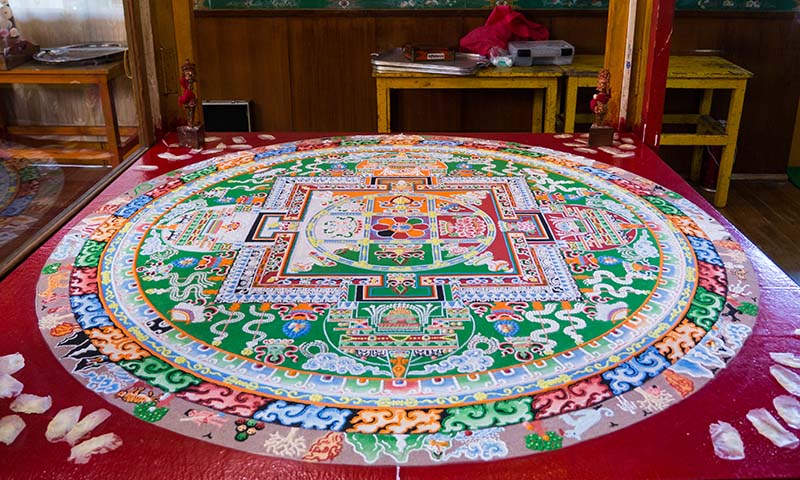
Yamantaka Sand Mandala
Yamantaka Sand Mandala, Namgyal Monastery, India. © 2010, Eva Lee.

I’ve gone about it all backwards. Backwards in time, in pursuit of mandalas. It all started when I heard that a sand mandala was going to be made at Namgyal Monastery in Dharamsala, India, in 2010. So I went there, and found out that it was a Yamantaka mandala, part of a ten-day-long highest yoga tantra ritual which occurs annually at the Dalai Lama‘s personal monastery. My previous post here describes what little I knew then as I observed and documented the creation and dissolution of it. The resultant film and photographs can be seen here.

When I came back to the U.S., it was as if a floodgate had opened. I needed to learn more. No, not just more, but all I could about Tibetan mandalas–about their variety, their purpose, their history, the meditation practices they engendered, and so forth. What did it all really mean? What modern significance did it have?

My bookshelves began to fill up with writings about tantra and Buddhist philosophy, written by the first Tibetan teachers to venture into the Western world, post-1959 exodus from Tibet. Titles by the Dalai Lama, Chogyam Trungpa Rinpoche, Lama Thubten Yeshe, Dilgo Khentse Rinpoche, as a few examples, abounded. I also read works by contemporary lamas like Dzogchen Ponlop Rinpoche, Pema Choedron, Tsoknyi Rinpoche, Tenzin Palmo. Tibetan scholars and historians David Snellgrove, Robert Thurman, Deborah Klimburg-Salter, Martin Brauen, and others figured in there, too.

All this, in addition to my previous discoveries of well-respected meditation teachers from other Buddhist traditions–Sharon Salzberg, Joseph Goldstein, Jack Kornfeld, B. Allan Wallace. I followed the writing of neuroscientists and clinicians, too, who studied or used meditation in their work. They were also involved with fascinating Mind & Life Institute research or conferences–Richard Davidson, Jon Kabat-Zinn, Paul Ekman, Daniel Goleman.

It was a mindfulness-neuro-tantric-philoso-fest that poured forth!

Meanwhile, in 2011, the ritual experiences continued. I attended the Dalai Lama’s Kalachakra event for World Peace in Washington D.C., and witnessed the Kalachakra Mandala.

Compassion Mandala created by Drepung Gomang Monks at Western Connecticut State University on the occasion of the Dalai Lama's talk on Creativity and Compassion, October, 2012.
Compassion Mandala created by Drepung Gomang Monks at Western Connecticut State University on the occasion of the Dalai Lama’s talk on Creativity and Compassion, October, 2012. © 2012, Eva Lee.

In 2012, I was at the Dalai Lama’s talk at Western Connecticut State University at which time I encountered a Compassion Mandala.

At both events, I had the wonderful opportunity of befriending and working with monks, nuns, plus other Buddhist practitioners and followers.

It was a steady flow. The waters at the floodgates just did not tire out. Answers came, and new questions arose.

Thus, on the heels of this, last year in 2013 I arrived back to India to experience and research rare Indo-Tibetan mandalas in Himalayan monasteries of Spiti, Lahaul, and Ladakh. How might they have evolved into Tibetan forms that we know today? What was this Indo-Tibetan 10th to 12th century period called the Second Great Transmission of Buddhism from India to Tibet? What did the sacred art look like? What did it mean?

View of mandala wall painting, Nangbarnangzad, Mangyu Monastery, Ladakh
View of mandala wall painting, Nangbarnangzad, Mangyu Monastery, Ladakh. © 2013, Eva Lee.


At the end of my travels through the Himalayan high altitudes, I then thought, let’s reel back in time some more. What came before the Indo-Tibetan era?

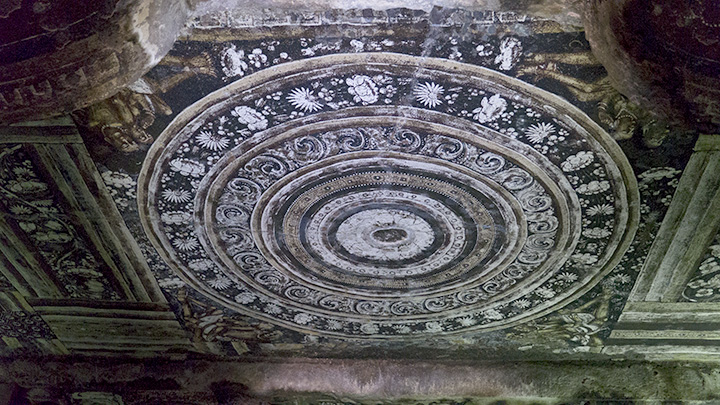
The answer was, Indian Buddhism, which could be seen at Ajanta and Ellora Caves where there are remains of elaborate 2nd to 8th century C.E. wall paintings, sculptures, and architecture. Such purely Indian Buddhist art is still preserved at these South Indian sites in the state of Maharashtra.

Ceiling painting, Ajanta Cave 2, near Aurangabad, India
Ceiling painting, Ajanta Cave 2, near Aurangabad, India. © 2013, Eva Lee.


Finally, what might have come even before this in India? I mean in B.C.E. times. When I searched further, it seems that the Buddhist art historical record stops here. According to historians, not much still exists before the 1st century C.E. Little is known in India archeologically prior to this time.

So what’s it all about? Why would an artist go for all this? New artwork from my Fulbright experience does beckon me in the studio.

I guess I’m just driven by the big questions about mind and reality, which Buddhist philosophy seems to address best. And moreover, that largely works within a Western scientific paradigm. It doesn’t hurt, either, that an affable spiritual leader like the Dalai Lama continues to inspire and exemplify how one can be intellectually sharp, existentially awake, and compassionately engaged in the world. Despite being a keeper of complex Tibetan rituals and esoteric tantric teachings, he can still keep it simple and distill wisdom down to these words: “There is no need for temples, no need for complicated philosophies. My brain and my heart are my temples. My philosophy is kindness.”