Key Monastery

Smacked Dumb with Awe and Miraculous Flying Hats

September 14th continued…Shashur Monastery…

By now, it should come as no surprise that the grandeur of the view at every monastery is a given, but I promise you, nature still just smacks you dumb with awe like the nicest bully you’ve ever had the fortune to meet!

View of Bhaga River Valley en route to Shashur Monastery, Lahaul

The magnificent scale of the Himalayan landscape, the distance as far as your eye can see but which your mind can’t fathom, the lighting! You can see the same view over and over, and yet at different times of day, it’s as if you’re facing a new expanse, a different space. And while you’re in a car traveling, the changing vantage points as you wend your way on hairpin turns and switchback roads just leaves you idiotic with glee as you inhale all the sights to full capacity.

Shashur Monastery, like Tayul, is just a few kilometers away from Keylong. That’s why it was doable to see both on the same day.

Shashur Monastery amidst its namesake of blue pines, Lahaul
Shashur Monastery amidst its namesake of junipers, the needles of which lamas burn for purification, Lahaul
Panoramic view of Shashur Monastery, Lahaul, India
Panoramic view of Shashur Monastery, Lahaul

Shashur and its contemporary flourishing Tayul and Gemur monasteries were part of a 17th to 18th century height of new Drukpa centers of Zanskar, Ladakh, and Druk Yul state of Southeastern Tibet (what is now Bhutan, the Buddhist country with a gross national happiness index.) This period was a spiritual revival of Drukpa masters coming to Lahaul on pilgrimage, such as Dewa Gyatso, Taktsang Repa, who founded the great Hemis Monastery (Ladakh), Rangrik Repa, and Serzang Rinchen who built Tayul.

The monastery has three floors and as you enter the ground level temple, you find a shrine with numerous spiritual personages. Front and center is the great Mahasiddha Drubchen Dewa Gyatso, revered founder of Shashur in early 17th century. He was from Zanskar.

Ground floor shrine, Shashur Monastery, Lahaul
Shashur Monastery’s ground floor shrine, Lahaul. Yes, that’s me in the reflection, the statue doesn’t have legs like that!

Now there is this little holy statue of him that has a miraculous hat. It is said that monks on occasion come into the temple in the morning to find the guru’s hat mysteriously lying on the floor many feet away.

Statue of the revered founder Dewa Gyatso, Shashur Monastery, Lahaul
Statue of the revered founder Dewa Gyatso and his miraculous hat, Shashur Monastery, Lahaul

This is understood as a warning sign of trouble to come, issued out of the master’s compassionate spirit. Images of master Taktsang Repa have also been separated from his hat by virtue of this same phenomena. Similar miracles reported in Tibet were also taken as alerts to disasters such as famine, war, or epidemic.

Dubchen Nawang Tsering, left rear in yellow, and Shabdrung Nawang Namgyal on right in pink, Shashur Monastery, Lahaul
Dubchen Nawang Tsering, disciple of Rangrik Repa (left rear in yellow), and Shabdrung Nawang Namgyal on right in pink. The contemporary framed photograph at right is the current Gyalwang Drukpa spiritual leader. Shashur Monastery, Lahaul

There is also Shabdrung Ngawang Namgyal (1594-1651), great lineage holder, 2nd incarnation of 4th Gyalwang Drukpa, and founder of Druk Yul state in the 1640s. In the 1670s lamas of Shashur and Gandhola built relationships with this new Drukpa state which had enduring effects on Lahaul. To this day, there are deep spiritual ties between Garsha and Bhutan. Gandhola is still administered through Bhutanese lineage. It is Khandro Thrinlay, whom I met in Manali (see earlier post) who is presently looking after the preservation of Guru Ghantal. She holds the dual distinction of hailing from the Shakya Shri lineage as well as being the widow of the royal Bhutanese Drukpa spiritual leader, His Holiness the 9th Shabdrung Ngawang Jigme.

Whew, so much discussion about lineage holders often leaves a Westerner cross-eyed with provenance, but one has to remember that in esoteric spiritual teachings, the guru-disciple relationship is key because it’s transmitted orally and personally. Genuine teachings must come from authentic masters who can trace their roots back to prior authentic masters. It’s the branches-stemming-from-the-trunk idea.

While the sculptures in the shrines are carefully tended to, the paintings on canvas in this temple are rather loosely tacked onto the walls. It appears that some have become sooty, probably from years of incense burning, and attempts to clean them have left a number of the paintings smudged.

Mural on canvas loosely tacked to wall, Shashur Monastery first floor temple, Lahaul
Detail of mural on canvas, Shashur Monastery first floor temple, Lahaul
Detail of above wall mural with evidence of soot and attempt to clean leaving facial details marred, Shashur Monastery first floor temple, Lahaul
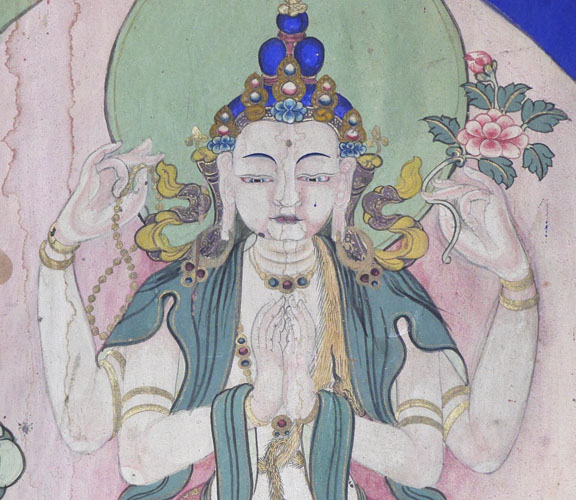
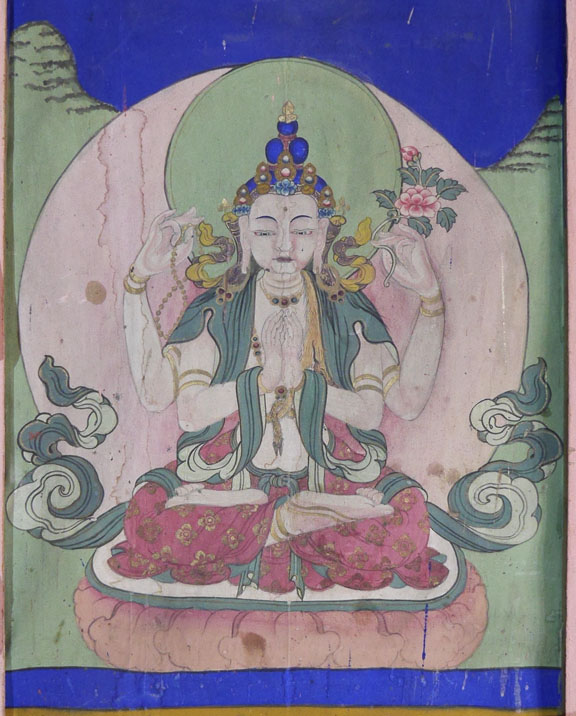
Avalokiteshvara, deity of compassion, from wall mural of Shashur Monastery, Lahaul
Detail of Avalokiteshvara, deity of compassion, from wall mural of Shashur Monastery, Lahaul. From stylistic similarities to an Avalokiteshvara painted at Guru Ghantal, this was possibly painted by Lama Tashi Temphel circa 1860, known to have painted at Shashur in addition to Gandhola.
Avalokiteshvara, deity of compassion, from wall mural of Shashur Monastery, Lahaul
Avalokiteshvara, deity of compassion, from wall mural of Shashur Monastery, Lahaul. Possibly painted by Lama Tashi Temphel circa 1860.

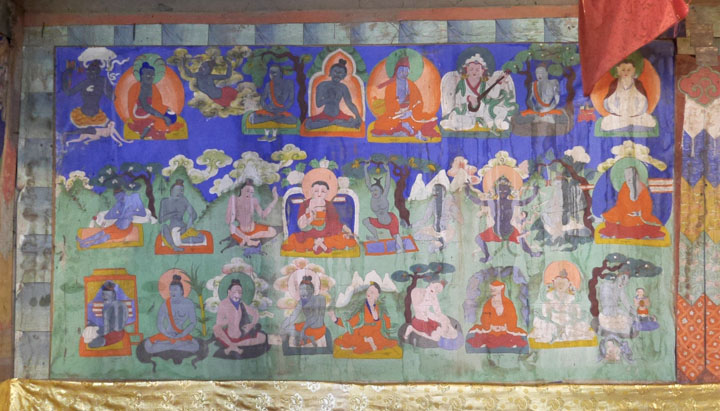
On the second floor of Shashur is a larger shrine room with statue of Vajradhara, the primordial Buddha, and paintings of the 84 Indian Mahasiddhas, main mahasiddhas of the Drukpa lineage, and great gurus and yidams.

11_1030619_yes_2nd Fl-Vajradhara_72
Center statue of Vajradhara, the Primordial Buddha, second floor temple of Shashur Monastery, Lahaul
Portion of 84 Mahasiddhas paintings, second floor temple of Shashur Monastery, Lahaul
Portion of 84 Mahasiddhas paintings,  second floor temple of Shashur Monastery, Lahaul
Detail of 84 Mahasiddhas paintings, second floor temple of Shashur Monastery, Lahaul
Portion of 84 Mahasiddhas paintings,  second floor temple of Shashur Monastery, Lahaul
Detail of 84 Mahasiddhas paintings, second floor temple of Shashur Monastery, Lahaul
This is likely Guru Rinpoche with consort in center surrounded by protector deities, wall painting on second floor temple of Shashur Monastery, Lahaul
This is likely Padmasambhava (Guru Rinpoche) with consort in center surrounded by protector deities, wall painting on second floor temple of Shashur Monastery, Lahaul

With full respect for the content, I’m sad to say that as a visual artist I find the wall paintings in Shashur (as well as Tayul) aesthetically unremarkable. Well, as I was forewarned by a local, Lahaul is not really a place for incredible paintings or visual depictions of mandalas as it is for visceral yogic experience in the land and spiritual centers.

Much more interesting than the painted mahasiddhas on the second floor walls were the statues flanking Vajradhara. One was Chakrasamvara and consort Vajrayogini or Vajavahari, and the other identified as Red Chakrasamvara. Both were most unusual in style and completely unconventional in terms of proportion. They do not look like Tibetan renditions of the deities and their consorts.

Possibly Mahadev and consort Uma, an unusual statue for its exceptionally different style from most Tibetan sculpture, notably its lack of conventional proportion, Shashur Monastery, Lahaul
Detail of Red Chakrasavara, an unusual statue for its exceptionally different style from most Tibetan sculpture, notably its lack of conventional proportion, Shashur Monastery, Lahaul
Possibly Mahadev and consort Uma, an unusual statue for its exceptionally different style from most Tibetan sculpture, notably its lack of conventional proportion, Shashur Monastery, Lahaul
Red Chakrasamvara, an unusual statue for its exceptionally different style from most Tibetan sculpture, notably its lack of conventional proportion, Shashur Monastery, Lahaul
Chakrasamvara and consort Vajravahari, an unusual statue for its exceptionally different style from most Tibetan sculpture, notably its lack of conventional proportion, Shashur Monastery, Lahaul
Detail of Chakrasamvara and consort Vajravahari, an unusual statue for its exceptionally different style from most Tibetan sculpture, notably its lack of conventional proportion, Shashur Monastery, Lahaul
Chakrasamvara and consort Vajravahari, an usual statue for its exceptionally different style from most Tibetan sculpture, Shashur Monastery, Lahaul
Chakrasamvara and consort Vajravahari, an unusual statue for its exceptionally different style from most Tibetan sculpture, notably its lack of conventional proportion, Shashur Monastery, Lahaul

Shashur’s third floor temple was built by Lama Sonam, a disciple of Shakya Shri, in the 20th century during a spiritual revival of the time. Its altar features a statue of Padmasambhava.

Central statue of Padmasambhava, third floor altar of Shashur Monastery, Lahaul

While it was not happening during my visit, it bears mentioning that Shashur is well-known for its annual sacred cham dance which occurs in June or July. Visitors come from all over to witness the three-day rituals that culminate in cham performance. As a ritual, it is not to be seen and received as entertainment but rather as spiritual elevations transmitted to the audience as movement and gesture. Here is one that was performed when I visited Key Monastery in Spiti.

Key Monastery monks demonstrate ritual dance, with abbott presiding over the ceremony, Spiti
Key Monastery monks demonstrate The Black Hat cham dance, with abbott presiding over the ceremony
View of Bhaga Valley, Lahaul, in the late afternoon sun
View of Bhaga Valley, Lahaul, in the late afternoon sun driving back to Keylong from Shashur Monastery

All photos © 2013, Eva Lee.

Key Monastery: Marauding Monastics and the Western Himalayas

September 8th     A Return to Key Monastery

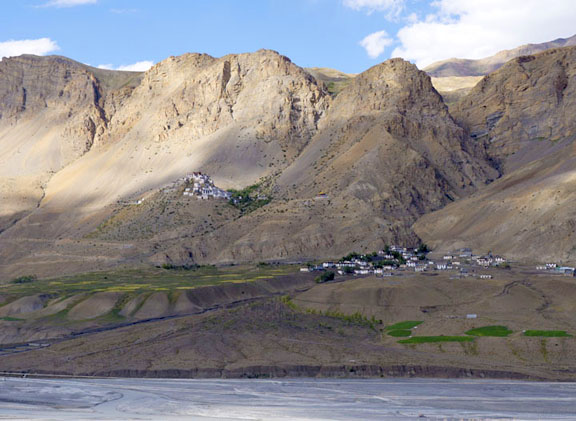
View of Key Monastery from across the Spiti River Valley

A second try today to document the ancient interiors of Key Monastery, whose abbot had in the 11th century been none other than The Great Translator Rinchen Zangpo himself, proved to be a challenge. However, in a nice turn of events, we discovered upon arrival that a special demonstration of sacred dances was in progress. The occasion was the visit of an important official from Shimla.

Entrance to Key Monastery, Spiti

The main interior courtyard was filled with visitors and administrators, with the monastery abbot presiding over the ceremony, as junior and senior monks looked on.

Key Monastery monks demonstrate ritual dance, with abbott presiding over the ceremony, Spiti
Key Monastery monks demonstrate the Black Hat cham dance, with abbott presiding over the ceremony as young ones watch

Key Monastery monks demonstrate ritual dance, with abbott presiding over the ceremony as young monks look on, Spiti

Young monks attending a ritual dance demonstration performed by more senior monks

A word about the architecture of Key…Built on a hilltop with a fortress appearance, this reflects typical Western Himalayan monastic architecture after circa 12th century, influenced by the development of invaders.

Key Monastery built atop a hill, characteristic of the later period of post-12th century Buddhist architectural development, Spiti
Key Monastery built atop a hill, characteristic of the later period of post-12th century Buddhist architectural development

Earlier period structures such as late 10th century nearby Tabo Monastery and Alchi Monastery (in Ladakh) are located in the valley on flat open land, integrated with their villages. Invaders were oftentimes rival Buddhist sects supported by the might of the Mongolian military, such as the Sakya sect who headed Key Monastery in the 14th century, and the Gelugpa sect who headed it in the 17th century. The latter came to dominate the majority of monasteries in Spiti.

In fact, most of us don’t associate monastics with marauding, but post-12th century onwards, the region saw inter-sectarian clashes, conquering by bloodshed, innumerable invasions by Chinese and Mongolian forces, shifting power structures, and political unrest throughout the Western Himalayas. Thus, that illustrious period of refined Indo-Tibetan art and architecture under the guidance of Lotsawa Rinchen Zangpo and the collaboration of Kashmiri artists eventually came to an end.

View of Spiti en route to Key Monastery, with a village nestled in its valley
_1010360_yes_72
Vast and dynamic view of Spiti River Valley

All photos © 2013, Eva Lee.

Key Kye Kee Ki Monastery and the Fine Art of Imprecision

September 5th – Spiti adventure continues…

Key, Kye, Kee, Ki Monastery, Spiti

Spelling is a flexible art in India. One often finds multiple spellings for names, places, and in signs. Take Key Monastery, for instance. It is also known as Kye, Kee, and Ki Monastery. It’s all good, take your pick! I’ve even had one monk spell his own name twice for me because sometimes he goes by Tanzin and sometimes Tenzin.

For a stickler about spelling like I am, this is an interesting lesson in imprecision. Especially if you’re asking for directions to a certain street or hotel, and you find that it’s spelled differently by different people, and you can’t help but wonder if you’re talking about the same place. Well, it’s okay, you’ll just do what you have to do, which is, you’ll find out!

It seems to me there’s a kind of accepted uncertainty principle here. It even extends to what people say. If, for example, you ask someone for directions, and he doesn’t know where the place is, he will not say he doesn’t know. He will give you information about where it is. Yes, that’s right, he will tell you something about what he does not know. My Western mind with its penchant for exactness doesn’t get it at all, but let me take a stab and guess:  This fellow might think to himself, it may not be right, but it may be approximately right, so it will help.

I have noticed that when my Indian friends need directions, they will ask numerous people the same thing. One time, I was driving with a friend and we were looking for a particular site. He stopped to ask probably half a dozen people within only a half mile’s distance, a kind of cross-reference overkill. A precision begotten by statistical probability. The wider you cast your bets, the better your chances are to get the (flexible and imprecise) jackpot. At least, I think it’s something like that…

It seems to me that here in India, it’s implicitly understood that circumstances, and the world, and the universe, are not exact. And more importantly, we are not masters of these spheres, we are just part of the process. Everything is relative, everything changes, everything has the potential for uncertainty at any time. It is readily, deeply accepted and tolerated that things might or might not work out.

One Indian friend quipped, “I.S.T.–Indian Stretchable Time,” (instead of Indian Standard Time) when he told me a story about his friend who was supposed to come pick him up in a remote area by car, but arrived three days later than expected! Okay, so maybe that example is an extreme one, but the moral of the story is not that the friend let him down, but that he came despite the fact that he had deterring factors that prevented him from coming on time!

Oh, the power has just come back here at the hotel, praise be! So I’m quickly plugging everything in to charge. Spiti has been largely without electricity for the past eight months! And it is being doled out to different areas at the moment, so no power here until about 8 or 8:30pm, supposedly anyway, because the past two nights here have been powerless. I can’t understand the reason why exactly. I mean eight months is a long time to have a vital civic repair apparently unattended to, or not tangibly improved.  Not sure if it’s because of devastating natural disaster or simply government mishandling and bad infrastructure. Maybe both. I do know that the next state, Utterakand, has suffered devastating floods and landslides recently, so it’s perhaps spillover?

Today was a bit hard to get kickstarted since I had another headache-filled sleep last night—altitude adjustments still. It’s Day 3 at about 12,000 feet high. Hope tonight will be better. I woke up disoriented, not knowing the time because my iPhone was out of power, head splitting. But we ended up going to Key Monastery after I spent the morning charging at a nearby café. The owner is getting power from the petrol station’s generator across the street. Thank goodness for their help! Otherwise, I literally would not be able to continue my work without charged batteries for my camera, or power to backup files onto laptop!

En route to Key Monastery, Spiti, India
View of Spiti Valley en route to Key Monastery, India

Key Monastery’s current spiritual leader is Lochen Tulku, the 19th reincarnation of Losatwa Rinchen Zangpo, the Great Translator wand former abbott who was so instrumental in this area for revitalizing Buddhism, translating all the original Sanskrit sutras, and building new monasteries in the 10th-11th centuries.

It turned out to be difficult to get permission to photograph the older murals here, despite my having a Spitian connection to a high level administrative monk. The concession is I can photograph the new assembly hall, which is nice but not so interesting for my Indo-Tibetan mural and mandala project. Nonetheless, the day spent at the monastery was pleasant. The monks were kind and invited us to tea, showed us the older temples, and merely asked that we not photograph. J’s local Spitian friend has offered to do some further investigation on my behalf, and we will see if possibly in a couple of days, there may be an opportunity to shoot the older murals.

View of Key Monastery's new main temple, Spiti
View of Key Monastery’s new main temple and assembly hall, Spiti

All photos © 2013, Eva Lee.

Out of Order in the Himalayas

It will be a bit out of order, but what the heck….Of course, I mean out of sequence, not broken!

I’m working on retroactive blog posts of basically all my experiences from last month’s travels through Spiti, Lahaul, and Ladakh to research and document Indo-Tibetan murals. Why didn’t I just post along the way? Because, internet stick and four SIM cards later, I was not able to access the internet while on the road. Especially in electricity-challenged Spiti, where kerosene for generators is even rationed, and Ladakh, border security area where cellular and other signals are highly controlled. I gave up trying and decided I would post when I got back to Dharamsala.

And here I am back in Dharamsala…but I did not think it would take long to back-post since I’ve already written a lot of material while still traveling. However, with image management and identification of thousands of photos shot in monasteries, it’s proving to be more time-consuming to present with accompanying photos. And who wants to read text here without the images? Not me!

So here’s what I’m going to do.  I’m going to toggle back and forth between posting about the present, and posting about last month, as I continue researching here in the lower Himalayas. In addition to Dhangkar and Lhalung Monasteries which are already here on this blog, stay tuned for accounts of what I saw and did at Key Monastery, Tabo Monastery, Kardang, Guru Ghantal, Shashur, Tayul, and Poekar Monasteries, including Phakpa in Triloknath and Markul Devi Temple in Udaipur sojourns. Then Alchi, Mangyu, Lamayuru, Likir, Shey, Thiksey, Hemis, and Mulbek Chamba Monasteries.  Yes, jam-packed with history, anecdotes, incredible landscapes, and ponderings!