Sept 9, 2013 Spiti adventure continues…on to Lahaul, India
After a jaunty jiggly jeep ride of over 10 hours from Kaza back through the magnificent giant boulder rubble of Spiti Valley, Kunzum-la Pass (this time populated by yaks grazing and loafing!) and getting stuck fording a glacial melt waterfall that flooded the rocky road, we arrived in Keylong, Lahaul.
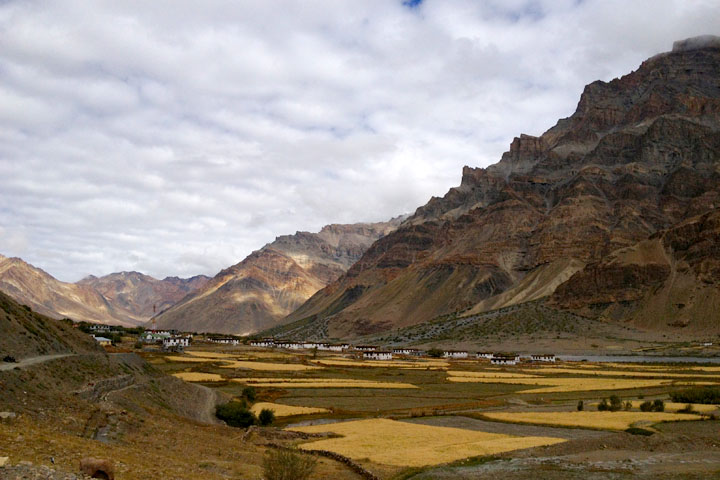
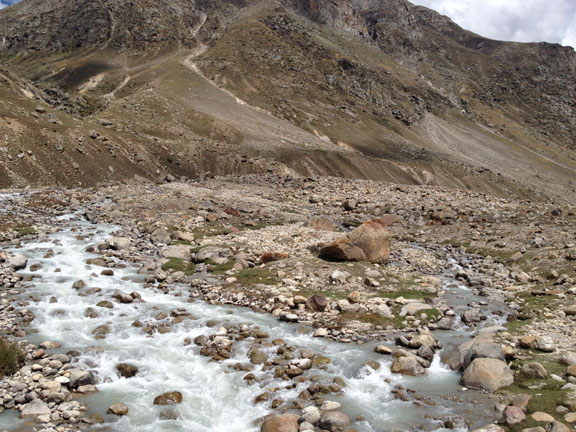
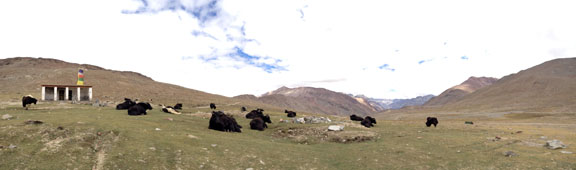
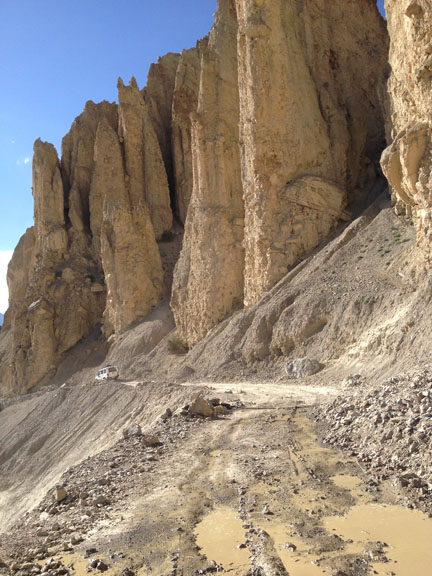
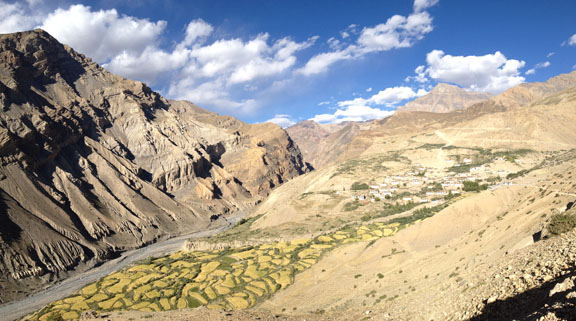
View of farmland in early morning Spiti Valley, en route to Keylong, LahaulSpiti Valley in the marbled early morning sun. As dry and desolate as Spiti may seem, there is always the play of light and colorful vistasApproaching the stupas of Kunzum la pass, the high point of the road at about 15000 ft altitude. This time there was a herd of yak grazing and resting. Glaciers can be seen within relatively close range.Kunzum la pass, where I circumambulated the stupas and got a close look at yaks gathered there. Glaciers can be seen at above left.Herd of yaks dotting Kunzum la pass, at about 15000 feet altitude, the highest point of the road through Spiti ValleyYak grazing, this one looks like he’s molting or has been shavedYaks grazing and resting at Kunzum la pass, seen en route from Spiti to LahaulTibetan Buddhist stupas at Kunzum la pass, monuments in honor of this high point of the road through Spiti ValleyAt this time of year in September, there are streams of glacial melt such as this one which frequently cross the road. They can be as small as trickles or as large as river flows, and it’s wise to travel as much as possible in the morning before the hot afternoon sun increases the flow of these waters that you have to cross with your vehicle.Huge boulder piles along the road from Kaza, Spiti, to Keylong, Lahaul. It’s difficult to judge the monumental scale from just a photo, but to give you an idea, this foreground rock is as tall as a person.Huge boulder piles along the road from Kaza, Spiti, to Keylong, Lahaul
Magnificent and desolate…
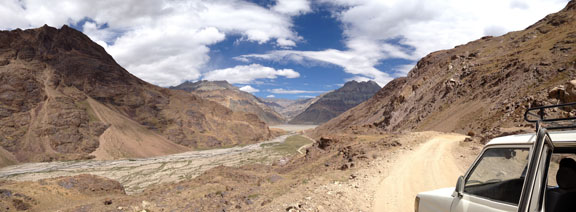
Our jeep on the road through the dry desert terrain of Spiti Valley, India
Once you experience the vast scale of the Himalayas, you can readily understand why the environment induces existential concerns and spiritual development. There’s nothing like realizing our small duration as human beings in the context of gigantic geological time and space, and beyond this, the grand cosmos to put human desires and expectations into a completely different focus.
A large Tibetan Buddhist stupa is dwarfed by the magnificent scale of the Himalayan mountains
Here is our jeep stuck on rocks while attempting to ford the rapidly flowing waterfall that flooded the road in the afternoon. We had patiently waited while the vehicle before us was stuck and finally managed to get out. In that 45 minutes or so, unfortunately, the water flow started increasing as the hot afternoon sun melted more glaciers! We got out eventually though with the help of others waiting to pass, including military men and a monk who moved earth and rubble, pushed and rocked the car, as our driver revved forward.
Our jeep stuck on rocks while attempting to ford the rapidly flowing waterfall that floods the road in the afternoon in Spiti Valley.The said rapidly flowing waterfall which created a river across the road, Spiti Valley, India
In contrast, as you approach and enter Lahaul Valley, high waterfalls are plenty but do not flood the roads. Lahaul is also a welcoming green landscape with grass, shrubbery, trees, and evergreens. The region is also well known for its delicious potatoes, as well as crops of barley, peas, cabbage, apple and other fruit orchards. Even here in high altitude, it is a heartland for growing food to be transported throughout India.
One sees many high waterfalls throughout the more verdant Lahaul Valley
With arrival in Keylong, Lahaul, in late afternoon we spent the rest of the day trying to get some logistics done. For my part, it was to get (yet another) SIM card that will get a cell signal here in the high Himalayas, and hopefully maintain a signal when I later travel to Ladakh further north. After the last week in Kaza, Spiti, without any cell phone coverage by my existing SIM card to communicate with family or arrange meetings or call for travel, etc., I decided to get another with a different carrier. Here in India, there is no single carrier that can provide national coverage, so one gets used to swapping out SIM cards and switching providers as the need arises when you travel from area to area. I have three SIMs now. The last one took so long to do—don’t ask the maddening details about how it took well over two hours to buy the SIM in one place and take it to another place to cut down. Around here you get used to relatively simple things taking an inordinate amount of time to accomplish, in this case, out of lack of coordination and know-how on merchants’ part. I’ve learned to smile a lot, shake my head, and say to myself, “It’s India…” Trust me, even Indians say this!
I never got to treat my very dry leather shoes as I had promised myself. They look like they’re going to crack from the dust-pounding they get in this high desert climate and unpaved roads. Nor did I get to download from the internet café the software plug-in I desperately need to manage my photographs. I couldn’t do it in Spiti because my download was too big for the internet café’s monthly ration of data permitted. Who knew an internet cafe would be rationed for data?! But, ok, lack of resources…I shook my head and smiled, it’s India.
But what India lacks, it definitely makes up for in its sublime experiences!
View of Keylong nestled in the Bhagha River Valley, Lahaul
Which brings me to Lahaul, also known by Buddhists as Garsha Khandroling, a region with a deep history of highly realized yogis. These are the practitioners who spend many years or decades in seclusion meditating in caves. You may have heard about adepts who can demonstrate astounding practices of mind over matter, such as levitate or dry wet sheets in the snow with heat generated from their bodies, confounding the scientists who studied this phenomena. Or you may have heard of Jetsunma Tenzin Palmo, the American Tibetan Buddhist nun and her Cave in the Snow. In any case, more on Garsha in the next post…
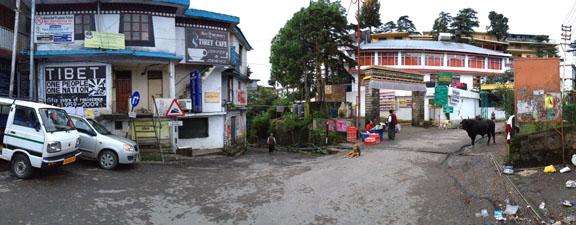
My home corner in Dharamsala, with Namgyal Monastery entrance at right.
September 1st
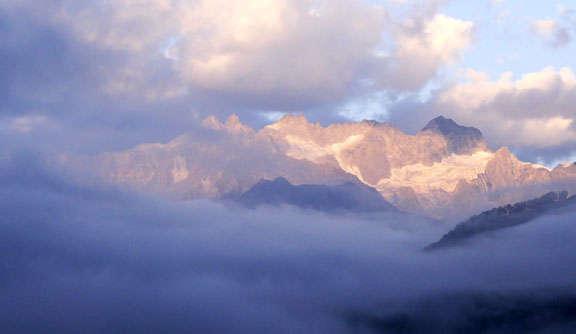
J and I started off for Manali 6am from Dharamsala, watching the sun rise along the way. At a certain altitude, the sun in full array, we saw a veritable Roerich painting before our eyes. It was snow-peaked mountains appearing to float above a thick, solid, fluffy white cloud bank. I always thought the man took artistic license with his imagery, but sure enough, the chiseled facets cast by morning light on the Himalayas were in orange and purple-gray displays, the base of the mountains nestled in airy clouds. The scene looked like a fairytale setting.
My first encounter with Nicholas Roerich-like scenery. I always thought the painter used artistic license to enhance colors and compositions of his Himalayan scenes, but they in fact look this dreamy and stunning
The main road where Rohtang pass is looks by our standards like a single lane dirt road. There is no railing at the irregular precipitous edge, and passing the slow trucks that ply the road means a lot of honking on the driver’s part and then a wing and a prayer to get back in lane without encountering oncoming traffic. Might makes right on Indian roads so trucks have the de facto right of way. Somehow it all works out, amazing.
I got a bit carsick from the descent, switchbacks all the way, the driver taking them maybe a bit faster, with blind passing, than my stomach could take. The diesel fumes and road dust was killing me. The smell of diesel alone is enough to nauseate me. Fortunately, there was AC which I asked for halfway through. We arrived around 1pm, with pitstop for breakfast at cheesy hotel bar/dining hall (J said she’d have to work on the driver to get him to choose better stops). Well, anyway, the aloo parathas (potato-filled flatbreads) were tasty and it was good to use the bathroom. Otherwise, it’s a roadside affair of finding a large rock or bush to go behind when nature calls!
We stayed at a place called Leela Huts after finding that J’s fave old Johnson’s Lodge, with English-styled cottage accommodations, was under renovation and closed. Leela Huts has a hilarious website: www.leelahuts.com. The sentence that had us in tears with laughter was, “Leela Huts swear sheer solitude to that tired man who has retired to the valley for a bracing vacation, away from the irksome crowd.” Now there’s some florid Indian English for you! But anyway, it was a well-kept, walled off little oasis with two and three-bedroom houses with full kitchen and baths. We opted for just the hut with single large room.
We hightailed it to Manali because Khandro Thrinlay-la was in town for the afternoon before needing to leave for her next teaching engagement, and she invited J and I to come for a visit. OK, so here is one bit of convoluted family history. Her older brother is Sey Rinpoche, their father a great Drukpa Kagyu practitioner named Apho Rinpoche, who descended from the great grandfather Shakya Shri, who began this special lineage of masters in the Six Yogas of Naropa, a Milarepa tradition. These are the accomplished meditators who retreat for three years, three months, and three days to practice the secret tummo and other methods which develop, I am told, levitation skills and various abilities that defy convention. You would never know who was a great practitioner usually because they can look like any humble villager, and they never reveal their abilities normally.
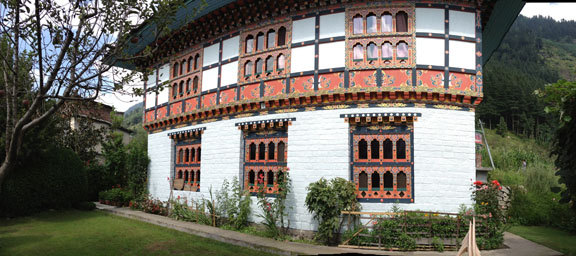
Khandro-la’s Bhutanese-style temple, Manali
Sey Rinpoche was supposed to be in Manali upon our arrival to meet with us, and make arrangements for access to monasteries in Lahoul where the family hails from, but we found he had left for Pangi where he is building a new retreat center. Instead, his sister Khandro-la (www.khachodling.org) was at home briefly, a lovely Bhutanese-styled house with colorful painted motifs on the crown and windows. She received us in her prayer room where she was doing prayers for safe travels, since it is the astrological snake year, and by Tibetan beliefs an obstacle year for those born in snake years. I thought snake year was auspicious for snakes, but this must be the Chinese thinking. We discovered we all three are snakes.
Khandro-la has an international following which includes a lot of Australians, and women. She has a feminist approach, and is educated in the U.S., with MA in psychology, completed by the advice of none other than His Holiness the Dalai Lama. I find her interesting and contemporary. After learning about my Fulbright project, she asked me to photograph the murals at Gandhola, which turns out to be Guru Ghantal where I had planned to visit and document. She said it’s the oldest temple in Lahaul and she is interested in preserving its heritage properly.
We went back late in the afternoon to see Khandro-la’s assistant, and her younger brother who runs Druk Expeditions. He gave suggestions on places to visit in Lahaul, and so did Khandro-la’s assistant. It turns out that there is not so much to see in the way of murals of mandalas in Lahaul, but rather, Lahauli temples and area are structured spatially like a mandala. The suggestion was to go for a kora (a clockwise circumambulation around a sacred location) of Drilbu Ri Mountain, a holy site of the tantric deity Chakrasambhava, near where Guru Ghantal is, and experience the mandala physically, but to hire a guide so as not to get lost, and also to help carry things. Sounds like a nice idea, but we’ll see how I adjust to high altitude by then! I have so far been suffering from night headaches (like having a vice grip around my head!) and shortness of breath, bit of loss of appetite.
Often the road in Spiti is nothing more than rocky terrain in which one must ford a glacial stream.
Next morning 5am we were off to Spiti. Aaah, at last the journey to high Himalayas truly begins! Our driver was a nice man, very good careful driver, and not as aggressive as some others. He drove a Toyota Qualis which J remarked didn’t look like the most comfortable car, but it was a tanker, and boy, I was happy about that. You wouldn’t believe how parts of the road were like fording small rivers and waterfalls, with large rocks and vertiginous drops! These are areas where glacial melts can wash out the road by afternoon. After a couple of particularly nerve-wracking spots, we cheered our driver for his skillful driving! J said many a car or truck has been caught stuck in these. One has to be on the road early enough to pass these before the water starts rushing down in the warmest part of day.
Kunzum la with herd of yaks, altitude of about 15,000 feet
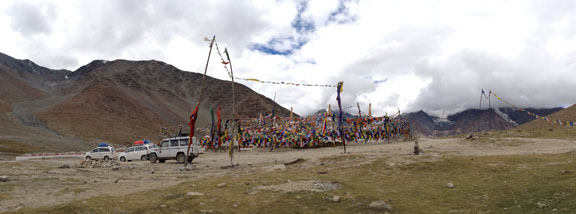
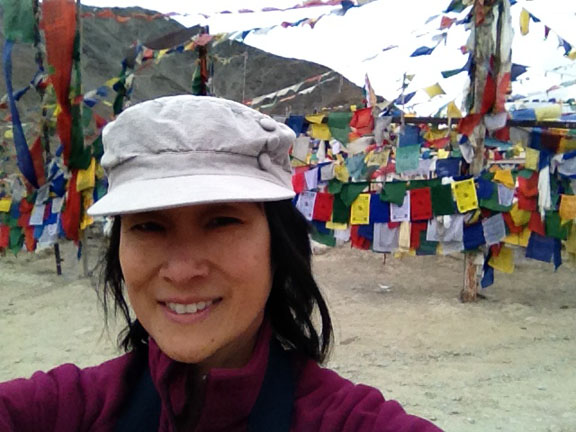
I took a lot of photos en route, what spectacular vistas! We had also many pit stops at big rocks where we could hide and relieve ourselves by the side of the road. Kunzum-la was quite windy. It’s a high point at about 15,000 ft altitude, and marked by three stupas and small shrines to the Dalai Lama and Karmapa and other lamas. J and I made incense offering here as a Geshe-la (title of a learned Tibetan Buddhist scholar akin to a PhD) suggested was an auspicious thing to do en route. I was feeling the shortness of breath by now, and when the wind blew the incense into my face, the odor caused me to feel nauseous. However, I totally loved seeing the wildly billowing and plentiful, layered, colored prayer flags blowing in the wind. We ended up not picnicking at the Nechung stupa as originally planned because J thought it was too windy and cold. She was mindful not to be exposed too much in case of causing illness. We instead ate in a large, flat valley, which was also windy, but at least less so.
Tibetan prayer flags and stupas mark Kunzum la passExhilarated and a bit short of breath at Kunzum la pass, altitude approximately 15,000 feet
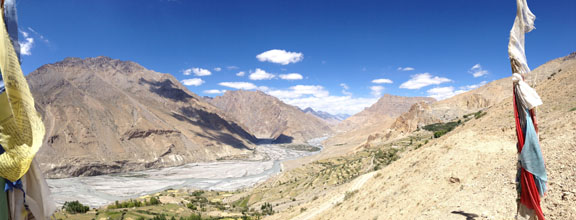
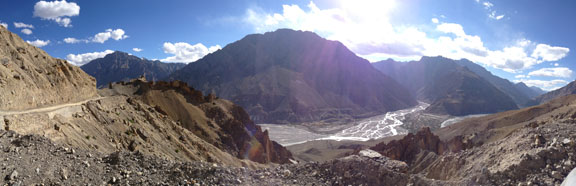
The Spiti Valley is grand beyond belief! While passing Kullu Valley earlier was stunning, too, for its lush steep landscape, cascading, tall waterfalls that put Yosemite National Park ones in the kids’ playground, grazing sheep and goats, impossibly tall and regal pine trees, Spiti land looks like gigantic rock and sand slides of barren beauty, with a wide river valley that equally shocks one with its scale. The river rushes in what looks like silver rivulets wending its way within the valley from the road high above, but any of its strands would dwarf a normal inland river. J said this is what is characteristic about Spiti, and at every switchback turn on the road, another great Roerich-like view is to be had. If I had stopped the car every time I wanted to take a photograph, we never would have arrived in time. Manali to Kaza was about a 10-12 hour jaunty, bumpy car ride.
En route to Kaza, Spiti, a high altitude desert landscapeMagnificent rock structures, nature’s sculptures, en route to Dhangkar Monastery, SpitiSpiti Valley heading towards Dhangkar Monastery. The grandeur of scale is stunning!Himalayan scale is overwhelming. What looks here like squiggly bits of green is actually massive farmland. En route to Dhangkar MonasteryEn route to Dhangkar Monastery. Spiti Valley in any lighting is stunning.
This is not an official U.S. Department of State website. The views and information presented here are solely those of the artist, and do not represent the Fulbright Program, the Department of State, or any other entity.