Fulbright Documentary Series at Columbia University and Library of Tibetan Works & Archives
Posted
Losar Tashi Delek! Happy Lunar New Year to all who celebrate!
I’m pleased to announce that five of my documentaries are now part of the Columbia University Tibetan Studies Library, one of the most extensive collections of Tibetan texts and archival material in the U.S.A. The documentaries are also in the Library of Tibetan Works & Archives, and may be viewed through their Multimedia Library.
The documentaries are:
Tabo Monastery Tsug Lhakhang (Main Assembly Hall) See the interior of this rare, Buddhist temple located in Spiti region of Western Himalayas, India. Famed Tabo Monastery is known as the oldest continually functioning Tibetan Buddhist monastery, the art of which the Dalai Lama said “delightfully expresses the vigor of the transmission of Buddhism from India to Tibet and the dynamic mingling of cultures.” Established in 996 C.E. by the Buddhist king of Guge in Western Tibet, Yeshe O’d, and the The Great Translator Rinchen Zangpo, it flourished in a golden epoch of Indo-Tibetan collaboration in spreading Buddhist culture.
Lamayuru Monastery Senge Lhakhang (Lion Temple) (00:03:24) Rare, medieval temple located in Ladakh region of Western Himalayas, India. Founded by The Great Translator Rinchen Zangpo and King Yeshe O’d of Guge, Western Tibet, circa late 11th century.
Mangyu Monastery Nangbarnangzad (0:03:03) Rare, medieval temple located in Ladakh region of Western Himalayas, India. Founded by The Great Translator Rinchen Zangpo and King Yeshe O’d of Guge, Western Tibet, circa late 11th century.
Lhalung Monastery Serkhang (Golden Hall)(00:01:45) Rare, medieval temple located in Spiti region of Western Himalayas, India. Founded by The Great Translator Rinchen Zangpo and King Yeshe O’d of Guge, Western Tibet, circa late 10th century.
Yamantaka (00:56:38) A candid view of an esoteric and complex Tibetan Buddhist highest yoga tantra held at Namgyal Monastery in Dharamsala, India. Monks create an elaborate sand mandala, ritual cakes and other sacred arts, offer prayers, chant, play ritual instruments, and meditate over the course of ten days. As one viewer said, “Beautiful, bizarre, and fascinating!”
Incidentally, many viewers have asked me about what is happening at around 42:14 in the Yamantaka video, where a young Caucasian man is in the Main Temple talking loudly and animatedly to a gathering of monks.This was a debate exam in session for students of the Institute of Buddhist Dialectics (which adjoins Namgyal Monastery), characterized by dramatic and distinctive hand clapping, body motions, and rhetoric. It was an event unrelated to Yamantaka, but which coincided with it. Tibetan Buddhists have a long and famed tradition of continuing the ancient Indian Buddhist practice of philosophical debate.
All documentaries filmed during Fulbright research on Indo-Tibetan mandalas of the 10th-12th century. With thanks and gratitude to Office of His Holiness the 14th Dalai Lama, Namgyal Monastery, and Nechung Monastery for their support in my quest to document these temples and Yamantaka ritual. Made possible in part by the support of Fulbright-Nehru Research Program, Council for the International Exchange of Scholars, and United States-India Education Foundation.
New Video Documentaries: Interior Views of Indo-Tibetan Temples at Tabo, Lamayuru, Lhalung and Mangyu Monasteries
Posted
Tabo Monastery Tsug Lhakhang, Spiti, India
At long last, I have completed four short video documentaries of the interiors of Indo-Tibetan monasteries that flourished during the 10th to 12th centuries. I feel so very honored to have had the opportunity to visit, research, and document these incredible temples.
The temples are:
Tabo Monastery’s Tsug Lhakhang, the Main Assembly Hall, renowned as the oldest continually functioning Tibetan Buddhist monastery, the art of which the Dalai Lama said “delightfully expresses the vigor of the transmission of Buddhism from India to Tibet and the dynamic mingling of cultures.” Established in 996 C.E. in ancient Western Tibet, now Spiti, India
Lamayuru Monastery’s Senge Lhakhang, or Lion Temple, established in the 11th century on a plateau in what is now Ladakh, India. Ca. 11th century, the oldest temple at Yamayuru Monastery. Contains well-preserved and rare Indo-Tibetan clay sculptures of Vairocana, Dhyani (Supreme) Buddhas, and Vajradhatu mandalas, including Gonkhang with protector deities, Ladakh, India
Lhalung Monastery’s Serkhang, the Golden Hall, founded in the early 11th century and located in present-day Spiti, India.
All four sites are among the rare Indo-Tibetan temples still found today with extant, fairly well-preserved, poly-chromed clay sculptures which depict the Five Supreme or Dhyani Buddhas, along with their associated 32 deities. These sculptures form a distinctive sacred art of this period.
After viewing these videos, which show the visual expression of Buddhism, I hope you will find inspiration to learn more about the philosophy and practice of Buddhism.
The wealth of empirical knowledge gathered through millenia by Buddhist meditation practitioners not only benefits those seeking spiritual development, but also those looking for less stress and more happiness. Who wouldn’t want that?
I believe this tradition offers a tremendously positive impact on contemporary society.
Look further, and see for yourself how psychology, health, and medical fields have made advances in treatments based on meditation. For example, neuroscientists in their research on the human brain have garnered great insights in studies on meditation and its effects on cognition and emotional regulation. A pioneer on this Dr. Richard Davidson of The Center for Healthy Minds. One result is the development of Mindfulness Based Stress Reduction (MBSR) pioneered by Dr. John Kabat-Zinn which has been applied with great success as a non-pharmaceutical approach to coping with pain and emotional challenges.
Less stress, more happiness. Again, who wouldn’t want that?
I wish you all the best in your curiosity, and your journey towards learning about mind and well-being, hallmarks of Buddhist practice.
A Look at the Art of Zigar Monastery, Chokyi Lodro, Deer Park Institute in Comparison to Their Indo-Tibetan Predecessors
Posted
October 21, 2013
At Rewalsar, visitors may circumambulate the famed Lotus Lake and see the many monasteries built around it today. It is a pilgrimage site for Tibetan Buddhists who revere Padmasambhava (Guru Rinpoche), the Indian tantric master who is said to have performed a miracle here which you can read about in my previous post, Miracle at Lotus Lake and the Secret Caves of Rewalsar.
View of Tso Pema (Lotus Lake) from Zigar Monastery, Rewalsar, India
The most noticeable monastery in Rewalsar these days is Zigar Orgyen Choekorling Monastery because of its 138 feet high golden statue of Guru Rinpoche.
Zigar Monastery features a monumental golden statue of Guru Rinpoche, Tso Pema/Rewalsar, India Photo: Frederic Martin DuchampZigar Monastery’s 138 feet high statue of Guru Rinpoche, Rewalsar (Tso Pema), IndiaDetail of Zigar Monastery’s 138 feet high statue of Guru Rinpoche, Rewalsar (Tso Pema), IndiaPanorama of Zigar Monastery’s courtyard, Rewalsar (Tso Pema), IndiaSide view of Zigar Monastery’s courtyard, Rewalsar (Tso Pema), IndiaInterior of main temple, Zigar Monastery, Rewalsar (Tso Pema)
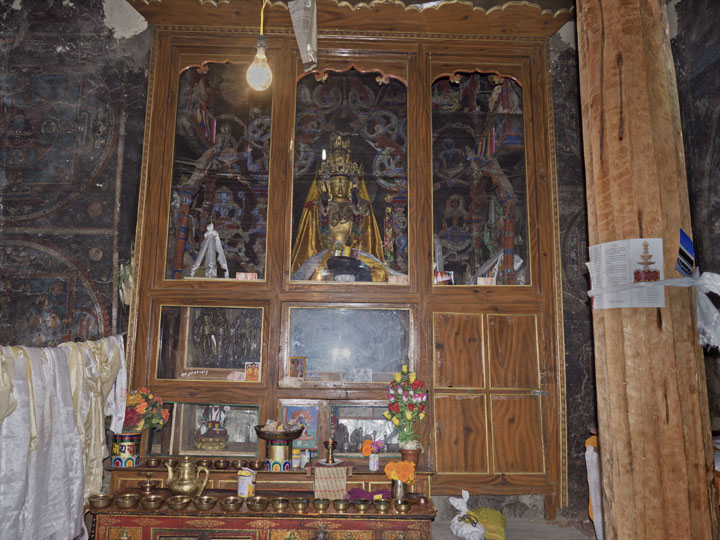
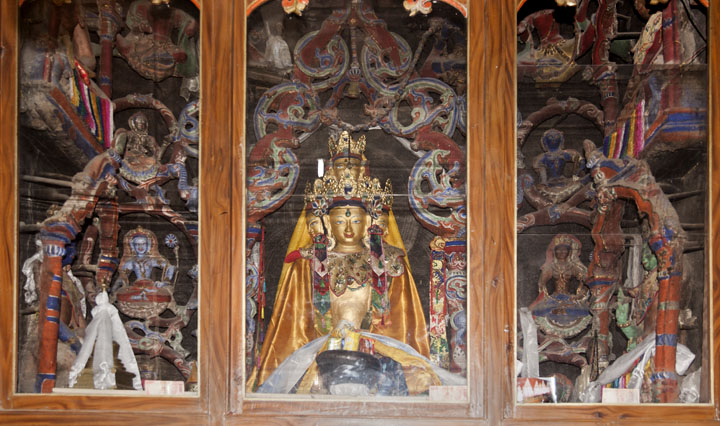
Quite unexpectedly, inside Zigar Monastery’s main temple this morning, I saw three large sculptures and was struck by how they had sculptural backgrounds attached to the wall highly reminiscent of Indo-Tibetan ones from the 11th century in ancient Western Tibet.
Detail of central altar with Shakyamuni Buddha, Zigar Monastery, Rewalsar (Tso Pema) Photo: Frederic Martin DuchampDetail of central altar with Shakyamuni Buddha, and background reminiscent of Indo-Tibetan sculpture, Zigar Monastery, Rewalsar (Tso Pema)
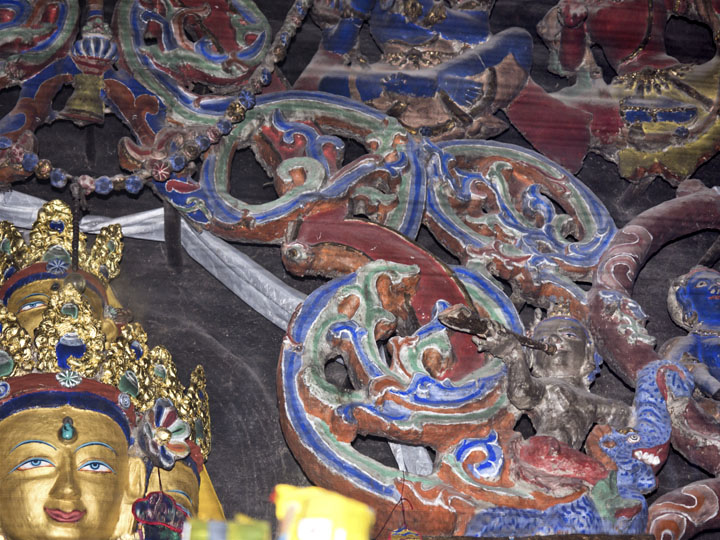
I immediately saw these background sculptural reliefs as contemporary versions of the below artforms. The following are central altars of circa 11th century Lamayuru Monastery’s Senge Lhakhang in Ladakh, and Lhalung Monastery’s Serkhang (Golden Hall) in Spiti.
Detail of altar, Lamayuru Monastery Senge Lhakang, Ladakh, India
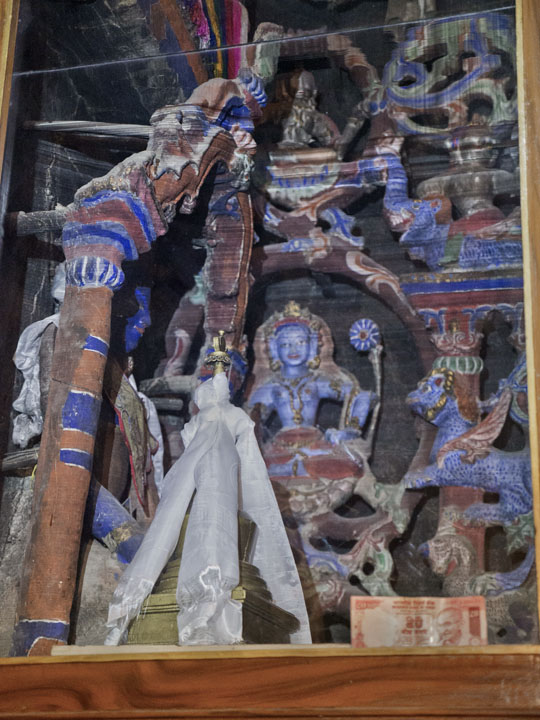
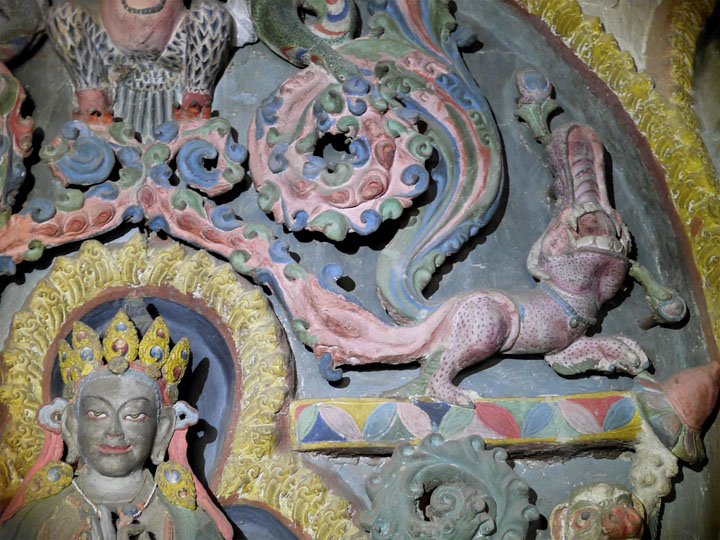
The first similarity was the use of relief sculptures attached to the wall. Other key similarities include central figures within a tri-lobed halo, surmounted by the Hindu mythical garuda, ornate scrollwork with figures and animals, in particular the Indian-derived makara, a crocodile-like sea creature. Both ancient and modern sculptures are all made of clay. The contemporary presentation as multi-colored wall reliefs is largely the same as the Indo-Tibetan, even while stylistic handling and some content are different.
Detail of central altar, Lhalung Monastery Serkhang, Spiti, India
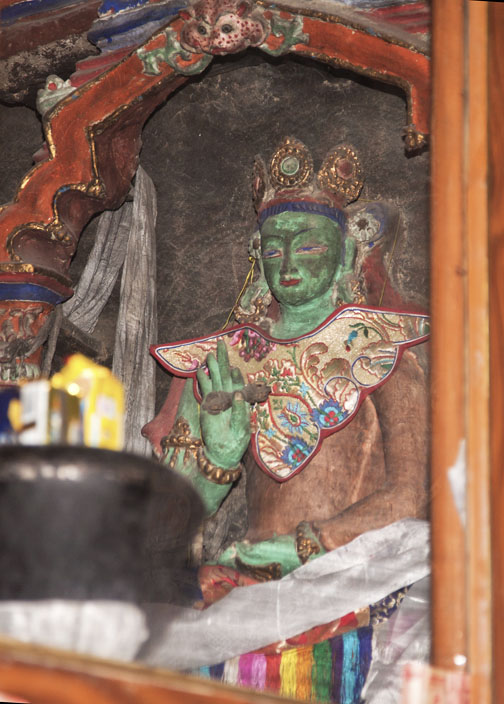
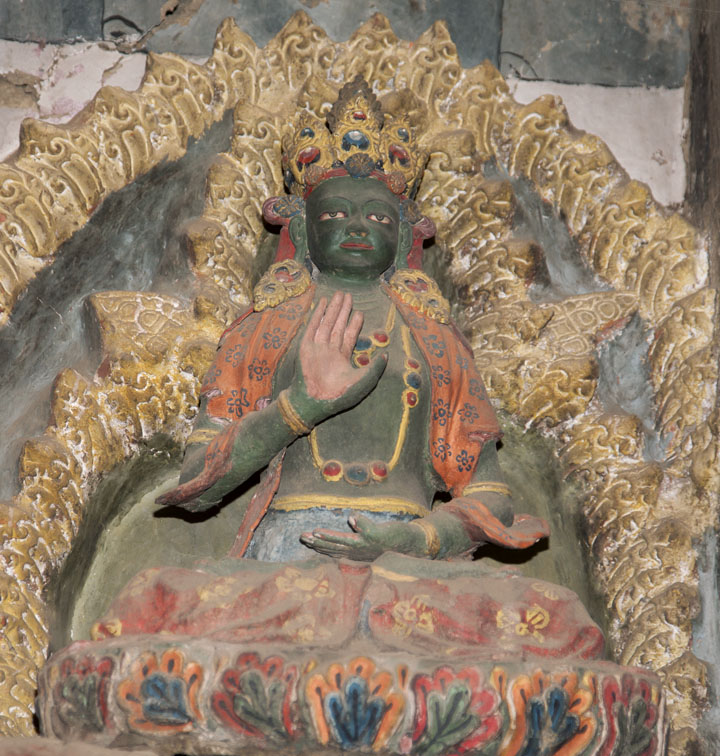
This is the second figure also in the main temple of Zigar Monastery, a Green Tara.
Green Tara, Zigar Monastery, Rewalsar (Tso pema)Detail of Green Tara, Zigar Monastery, Rewalsar (Tso pema)
This sculpture, as are the three in the main temple, is by the same artist, beautifully painted and detailed.
Detail of Chenrezig (Avalokiteshvara), Zigar Monastery, Rewalsar (Tso Pema)
I learned that the master sculptor was named Tashi Norbu. I was able to contact him and visit him later in the day. Wow, it was total chance that he was in India and happened to be nearby. He would have been out of the country were it not for an unfortunate recent event which prevented him from going. I was so excited to be able to ask the artist technical and aesthetic questions!
Master sculptor Tashi Norbu Photo: Frederic Martin Duchamp
Tashi Norbu is Bhutanese, as are many of the artists commissioned by monasteries today to create artwork. In Rinchen Zangpo’s time, 10th-11th centuries, it was Kashmiri artists who were considered the finest artists to give expression to Buddhist concepts, and they were largely the ones responsible for the art of 10th-12th century monasteries in the Himalayas during the Great Second Transmission of Buddhism from India to Tibet.
Main temple, Deer Park Institute, Bir, India
Tashi Norbu was invited to make numerous sculptures in the area. In addition to Zigar Monastery, he created works for Deer Park Institute in Bir, and Dzongsar Khyentse Chokyi Lodro Institute in Chaundra. We went together to visit these sites as I learned about his process.
His account about how Dzongsar Khyentse Rinpoche, who commissioned him for both Deer Park and Chokyi Lodro artwork, was so exacting about getting the face of the Deer Park Manjushri to look “right” (according to its original divined appearance) was so interesting. According to the artist, this required no less than eleven tries–that is, eleven fully sculpted, completed, then discarded heads–and many meditation retreats by the artist together with lamas in order to get it correct. Wow, this was the first time I’d ever heard of this working method. Be in meditation communally for aesthetic guidance, in order to “see” the work together for the artist to create it.
Manjushri statue by Tashi Norbu, Deer Park Institute, Bir, IndiaDetail of Manjushri statue by Tashi Norbu, Deer Park Institute, Bir, IndiaDetail of Manjushri statue by Tashi Norbu, Deer Park Institute, Bir, India
Another rinpoche, on a later separate unrelated occasion, told me this same thing. He said, rather than strategize conceptually to create a “successful” work of art, as he believes many contemporary artists do, instead, an artist should use mindfulness to connect with inner realities and then create from that vision.
Main altar at Chokyi Lodro Institute, Chaundra, India, sculpture by Tashi Norbu
It would be interesting to see Tashi Norbu’s sculptures in progress, from beginning to end. As a painter who has never sculpted, I can’t fathom how one constructs monumental Tibetan Buddhist statues.
He said the underlying forms are wood and iron with wire mesh, concrete, and then final layers are clay. The clay is made from Tibetan paper mixed with clay and water until the right consistency is achieved. Then the work is air-dried, carved, primed, painted and gilded. The faces and hands are usually painted in a special pure gold paint made in Nepal. You can burnish this to bring it up to a luster, but burnishing usually mars the clay surface a bit and affects the details, so this is not done on the faces and hands.
Monumental Buddha, main altar at Chokyi Lodro Institute, Chaundra, India
The finished statues have hollow interiors where prayers written on rolled paper and katas (ritual scarves) are placed.
Main temple at Dzongsar Khyentse Chokyi Lodro Institute, Chaundra, India. Standing with me are Tashi Norbu and Venerable TenzinPanorama of Dzongsar Khyentse Chokyi Lodro Institute, Chaundra, India
When I returned to Dharamsala, I told my photographer friend Frederic Martin Duchamp about my trip to Tso Pema, and learned that he happened to have also met Tashi Norbu a few years ago when the artist was sculpting the now completed statues for Zigar Monastery. AND he had photographs of some of them in-progress. What serendipity–or, as the Tibetans say, auspicious coincidence!
So the following are before and after photos of all the main Zigar Monastery statues, thanks to Frederic who has generously shared them with me. Click here to see a short video transition of the first example.
Before and after, Shakyamuni Buddha, Zigar Monastery, Rewalsar, India. Photo: Frederic Martin DuchampDetailed before and after, Shakyamuni Buddha, Zigar Monastery, Rewalsar, India. Photos: Frederic Martin DuchampBefore and after, Green Tara, Zigar Monastery, Rewalsar, India. Photos: Frederic Martin DuchampBefore and after, Shakyamuni Buddha, Zigar Monastery, Rewalsar, India. Photos: Frederic Martin DuchampBefore and after, Chenrezig, Zigar Monastery, Rewalsar, India. Photo: Frederic Martin Duchamp
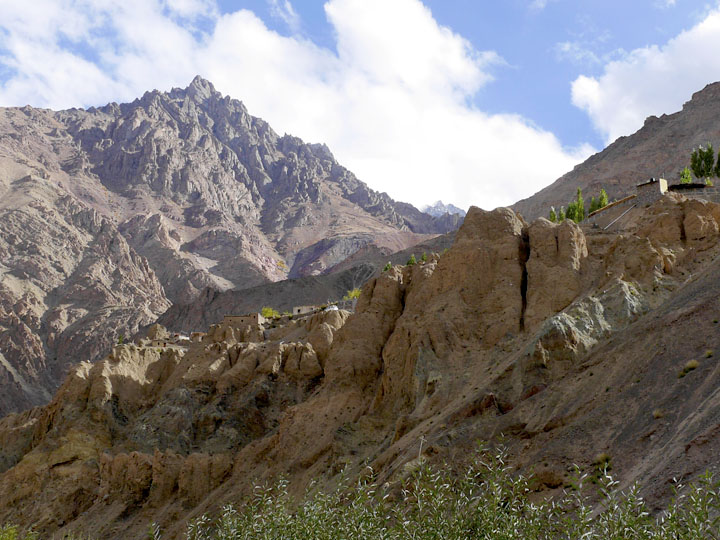
View of Mangyu Village, Ladakh, India. To get there, one drives through narrow valley gorges. The village remains hidden until you drive practically right up to it.
Like Lamayuru Monastery’s Indo-Tibetan Senge Lhakhang, Mangyu Monastery’s Vairocana temple is also a small intimate place. Classic, pre-13th century, early period architecture, the site is nestled in and integrated with a village as opposed to fortified and atop on a hill from the community.
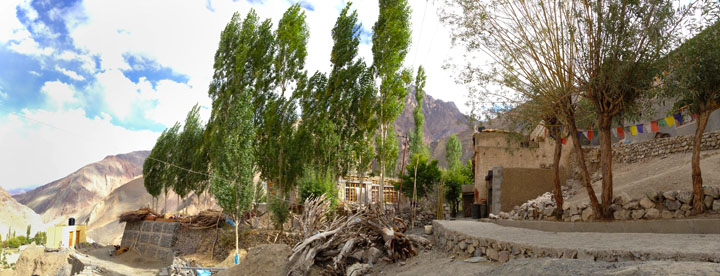
Beginning of Mangyu Village, Ladakh, India
I believe that up till fairly recently, let’s say last twenty years, there was no motorable road up to Mangyu Village, which means it was largely isolated and unknown by travelers. We parked a little below the village and walked up to the monastery, passing by small grocery stores that had countertop service for a simple meal of packaged and flavored maggi noodles (what we call ramen noodles in the U.S.) I was starving and grateful to be served one! When traveling around these more remote parts, one never knows where and what the next meal may be. This village had no restaurants or dhabas, nor did I see guesthouses. This is lovely because it indicates that tourism hasn’t bloomed here. Mangyu is pristine for this reason.
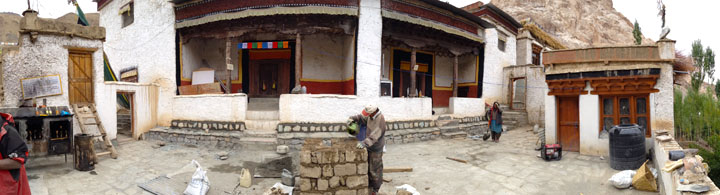
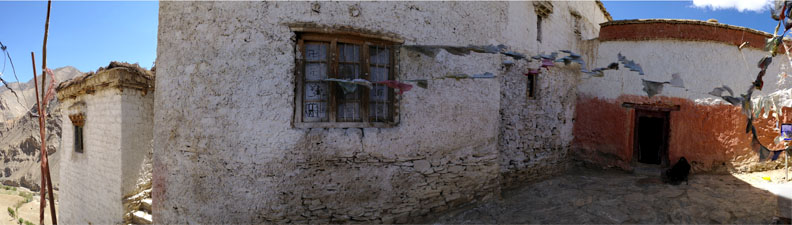
Panorama of Mangyu Monastery with Chenrezig Lhakhang on left, Nambarnangze (Vairocana temple) on right, together flanked by Chamba Lhakhangs of Maitreya and Jambeyang sculptures, Ladakh. Workers are making repairs under the auspices of INTACH, the Indian National Trust for Art and Cultural Heritage.
Tourism is a challenge to local and modest communities here in the Himalayas. While it brings income, it also brings ecological stress. And ecological stress is no small thing to cope with when the land is semi-arid and mountainous, the people mostly poor, the government ill-equipped to provide adequate infrastructure. The need for food and water sources, sewage, sanitation, and modern transportation to serve tourists often ravage the natural beauty here.
Especially if it brings non-biodegradable garbage like plastic. It’s very upsetting to see packaging or other plastic objects thrown over the side of a Himalayan mountain or floating through the streams, stuck in rocks. Indeed, the Himalayan areas I’ve traveled to have dumps located on the mountain side. You can often see them along the road while driving on the highways. It will be a sudden burst of packaging color en masse among the earthy rocks and otherwise scenic beauty. It’s either this or shopkeepers and townsfolk simply burn the garbage. Yes, they burn it, open-air, in front of their shops or homes, frequently plastic and all.
Plastic bottles and those plastic carton drink containers, potato chip and candy wrappers are the most noticeable litter in the streets. I sadly think, these things will never degrade into anything that can be absorbed properly here. Nor anywhere on Earth for that matter, but since we are here on the topic of the Himalayas, my point is that tourism causes environmental strain and damage. I always ask for boiled water at hotels to cut down on the plastic, and carry a thermos with me. Of course, on some occasions, I can’t avoid it and will guiltily buy water in a plastic bottle.
But my visit to Mangyu Monastery was not one of these occasions, I’m happy to report!
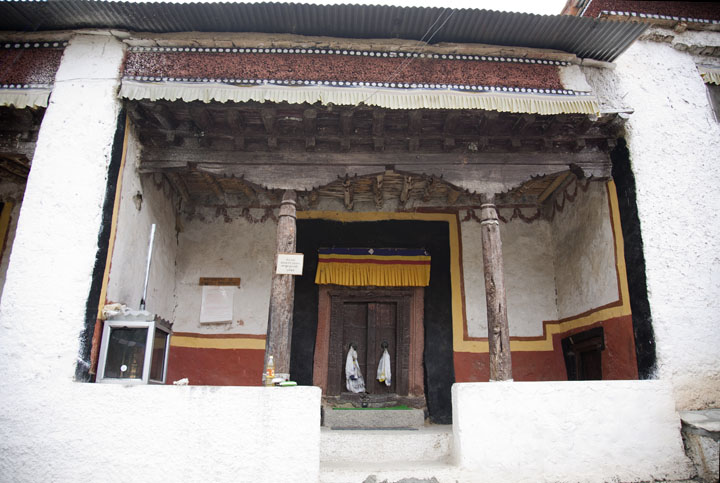
Entrance to Nambarnangze (Vairocana temple), ca. 11th century Indo-Tibetan early monastic architecture, Mangyu Monastery, Ladakh. Photo: Kishore Thukral
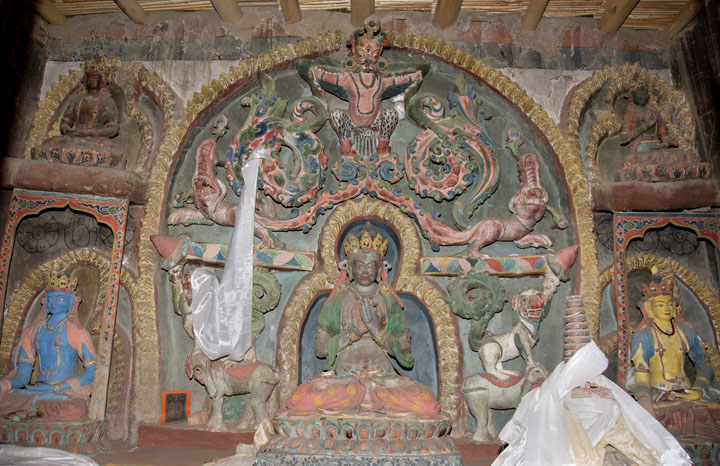
In the 11th century Indo-Tibetan tradition of The Great Translator Rinchen Zangpo, this altar in Nambarnangze once again features Vairocana in the center, surrounded by the Dhyani Buddhas, offering goddesses, animals, and ornate scrollwork, topped by a garuda. See floor plan here.
Experience the interior of this rare, medieval Vairocana temple by seeing a walk-through video here.
View of Nambarnangze interior, with Indo-Tibetan clay sculptures and wall paintings. The altar is now unfortunately encased by glass making it difficult to see the fine craftsmanship of Kashmiri artists, ca. early 11th century, LadakhIndo-Tibetan clay sculptures of Vairocana and Dhyani Buddhas of altar, Nambarnangze, Mangyu Monastery, Ladakh. Now unfortunately encased by glass, making it difficult to see the fine craftsmanship of Kashmiri artists, ca. early 11th century, Photo: Kishore Thukral
For further info on Vajradhatu Mandala structure upon which early monasteries of this period were based, see this post on Lamayuru Monastery’s Senge Lhakhang and this one on the celebrated Tabo Monastery’s Tsug Lhakhang.
Detail of Vairocana Buddha sculpture, ca. 11th century, altar of Nambarnangze, Mangyu Monastery, LadakhDetail of ornate scrollwork, animals and offering goddesses, rare 11th century Indo-Tibeta clay sculptures, altar of Nambarnangze, Mangyu Monastery, Ladakh, IndiaDetail of Vairocana Buddha, with ornate scrollwork, animals and offering goddesses, rare 11th century Indo-Tibetan clay sculptures, altar of Nambarnangze, Mangyu Monastery, LadakhDetail of Amoghasiddha, a Dhyani (Supreme) Buddha, rare 11th century Indo-Tibetan clay sculpture, altar of Nambarnangze, Mangyu Monastery, Ladakh. Photo: Kishore Thukral
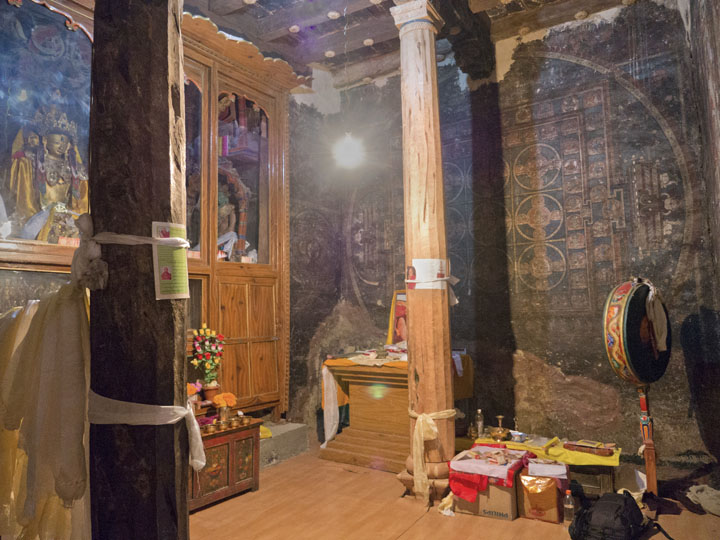
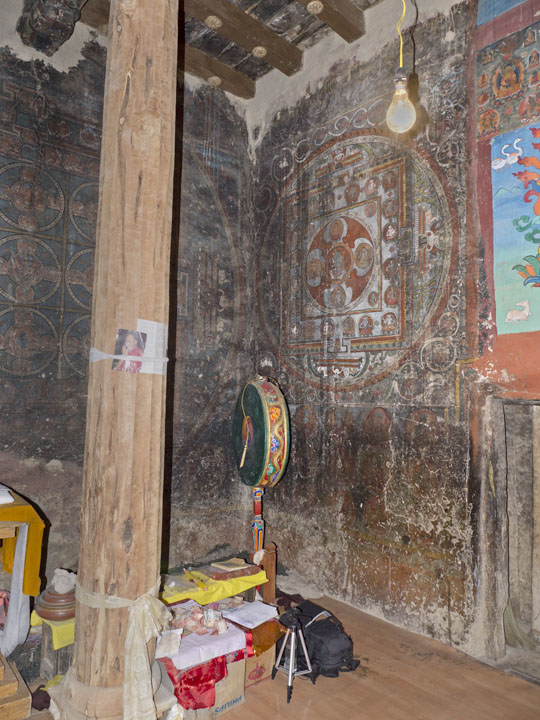
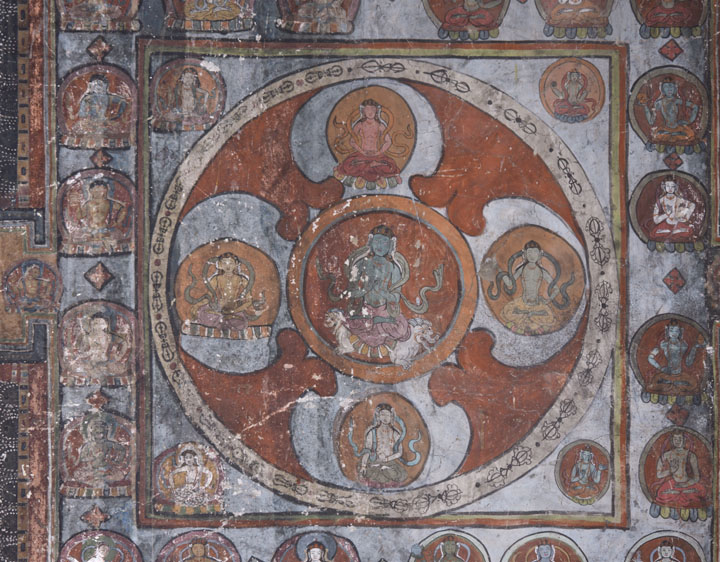
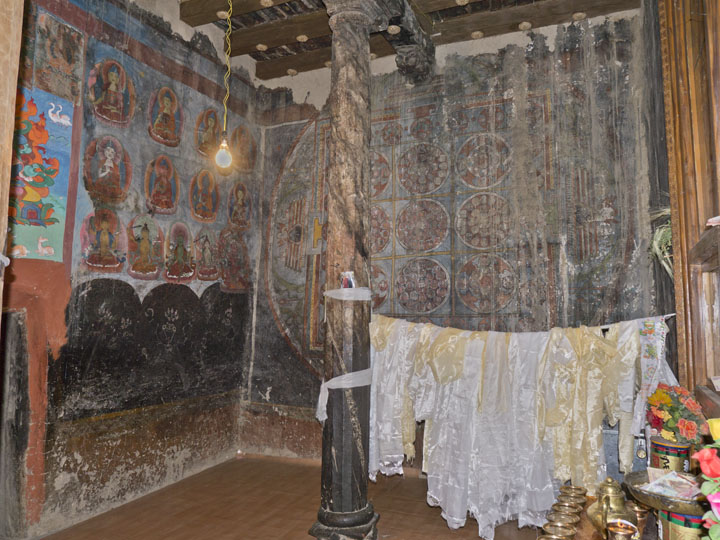
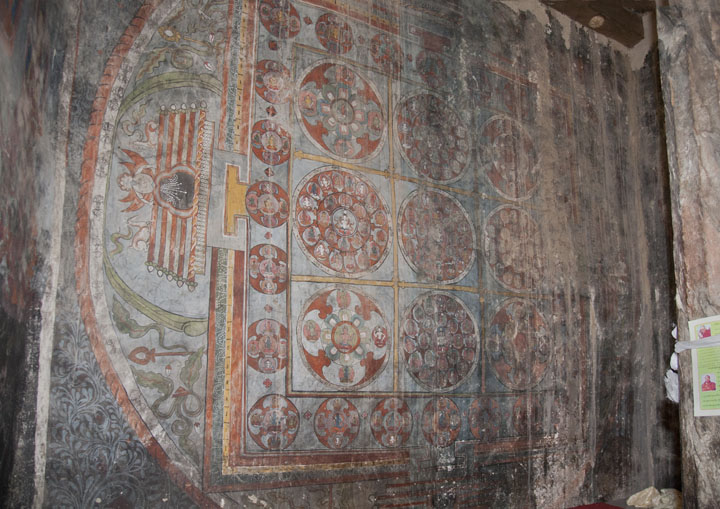
The small Vairocana temple is symmetrically painted on its left and right side walls with one large central Vajradhatu mandala each, flanked by smaller mandalas of related divinities or protectors. On the right side wall, the paintings look like well-conserved oe well-preserved original Indo-Tibetan.
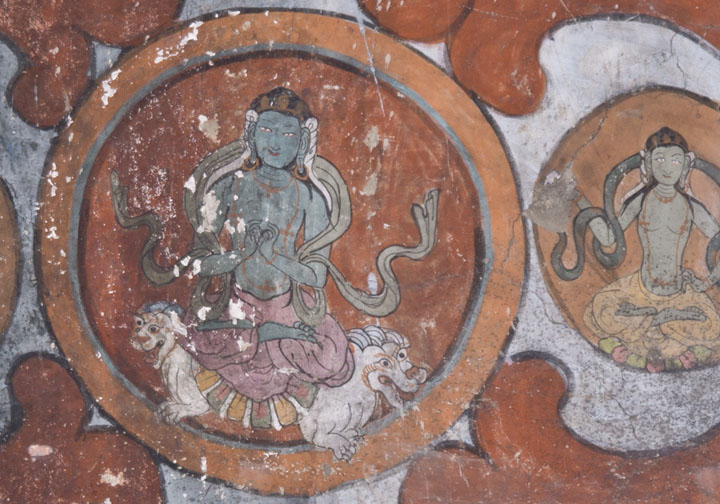
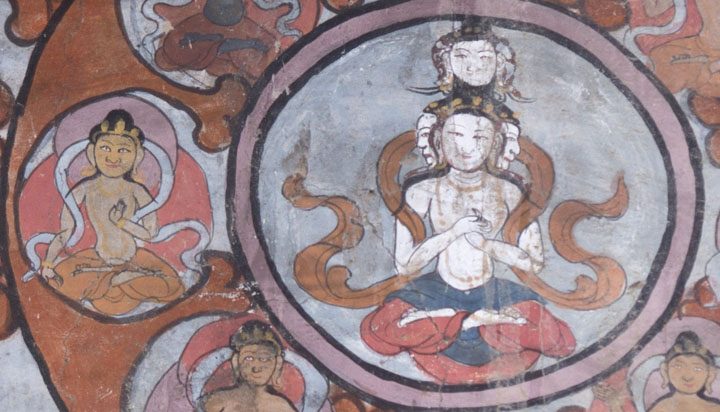
Interior of Nambarnangze, Mangyu Monastery, with ca. 11th century Indo-Tibetan sculptures and wall paintings, Ladakh. Visible on right is Vajradhatu Mandala.Detail from Vajradhatu mandala, Indo-Tibetan ca. 11th century right side wall painting, Nambarnangze (Vairocana temple) of Mangyu Monastery, Ladakh, IndiaDetail from Vajradhatu mandala, Indo-Tibetan ca. 11th century right side wall painting, Nambarnangze (Vairocana temple) of Mangyu Monastery, Ladakh, IndiaInterior view of Nambarnangze, right side wall adjoining entrance wall, Mangyu Monastery, with ca. 11th century Indo-Tibetan wall paintings, Ladakh
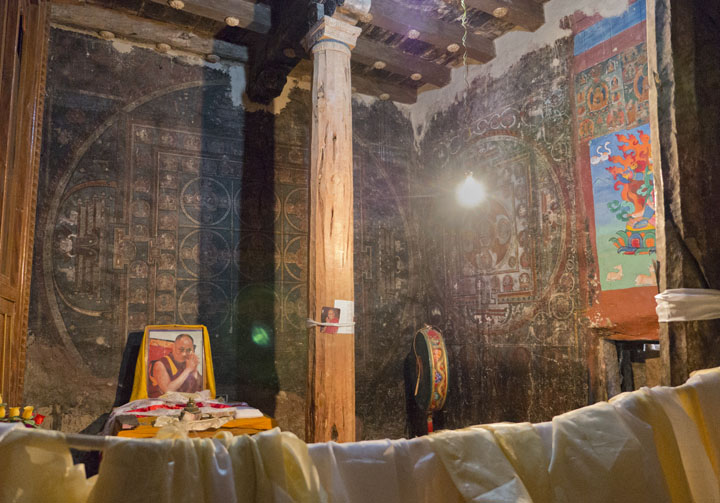
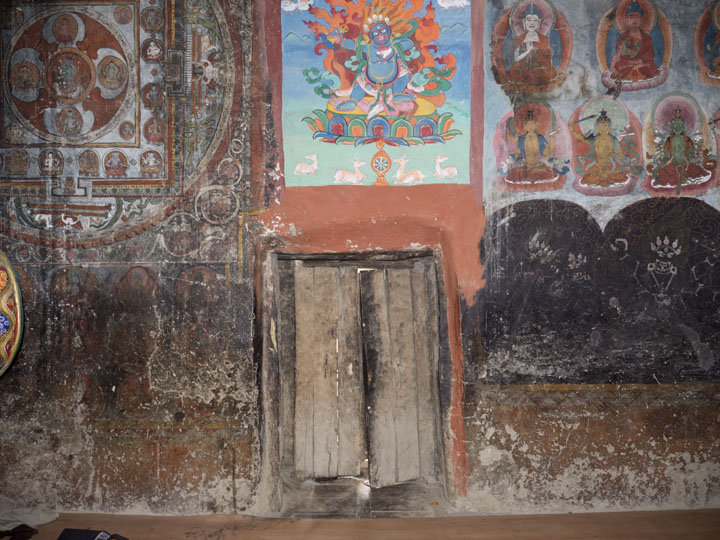
On this entrance wall, however, most everything has been repainted. Peter van Ham in his book Heavenly Himalayas: The Murals of Mangyu and other Discoveries in Ladakh, published recently in 2010, gives a very different description of the state of the protector deity painting above the door.
The entrance wall of Nambarnangze, Mangyu Monastery, Ladakh. Wall paintings here are mostly repainted over ca.11th century originals.
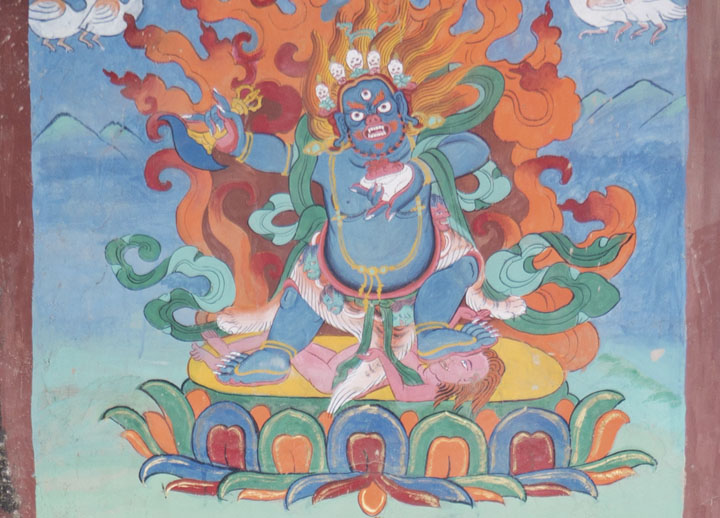
He writes, “The entrance…is protected by a wrathful blue deity, painted above the door. Only the right half of the painting has been preserved, the rest has been washed away by water leakage through the roof…As two peculiarities the protector is adorned with beautiful shawls displaying typical Ladakhi tie-dye patterns and in his right hand he holds a knife with an interesting blade of Indo-Iranian shape, the tip of which is equipped with a vajra-like structure.”
Repainted Mahakala above entrance door of Vairocana Temple, Mangyu Monastery, Ladakh.
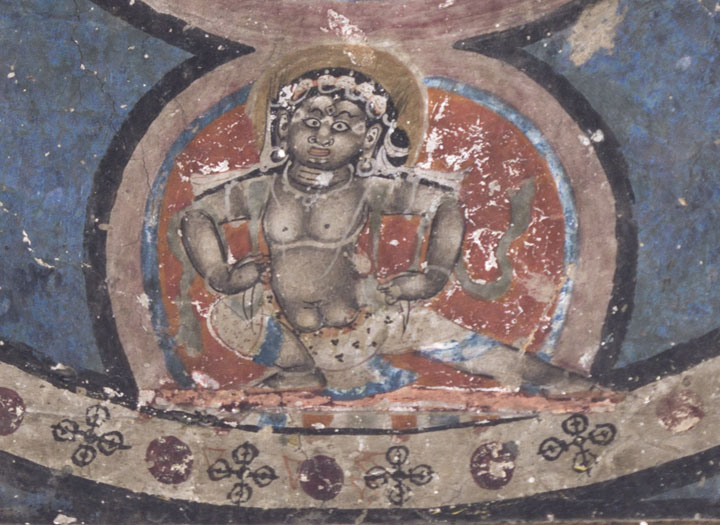
The discrepancy between van Ham’s description and the above photo shows that this Mahakala was certainly repainted in the last few years. As we can see, absent are the shawls with Ladakhi patterns. This evidence, along with mismatched colors and less refined execution, leaves me shocked and deeply saddened over the handling of Mangyu Monastery preservation.
While the colors in this repainted mandala on the left of this entrance wall are more in keeping with extant original murals, the execution looks nothing at all like the sophisticated, skillful, and expressive handling of Indo-Tibetan artists.
Interior view of Nambarnangze, Mangyu Monastery, with Indo-Tibetan wall paintings, LadakhDetail of repainted mandala on left side of entrance wall, Nambarnangze, Mangyu Monastery, LadakhDetail of repainted mandala on left side of entrance wall, Mangyu Monastery, Ladakh. Stylistically different, this was probably repainted in recent years.Detail of repainted mandala, Nambarnangze, Mangyu Monastery, Ladakh. Stylistically different and lacking in refinement, this is strong evidence of repainting over original Indo-Tibetan art.
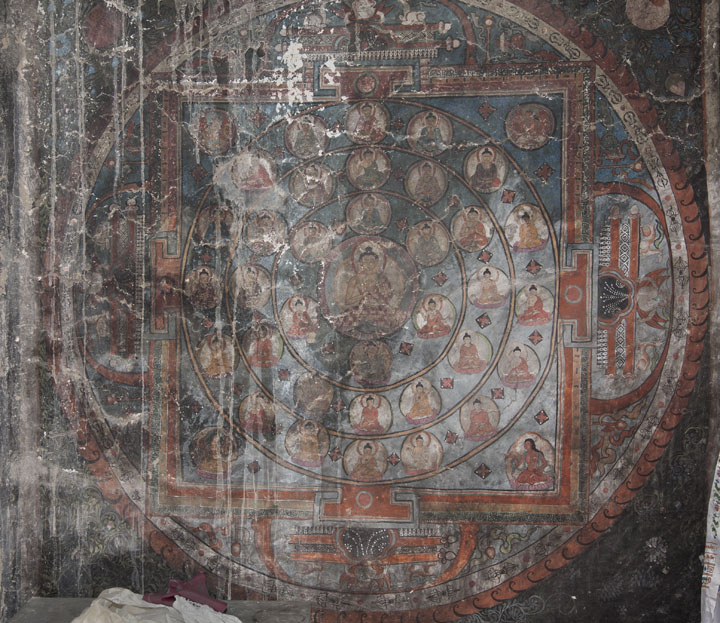
The same is true for the left side wall. What van Ham describes of the 11.5 foot diameter mandala that dominates this wall does not match what currently exists. This must also be a recently repainted mandala.
View of Vajradhatu mandala on left side wall, adjacent to a variety of wall paintings that post-date the Indo-Tibetan period, another example of repainting that threatens the survival and art-historical importance of the originalsView of Vajradhatu mandala, also repainted, Nambarnangze, Mangyu Monastery, Ladakh. Photo: Kishore Thukral
When this is what an example of original quality and style looks like (click on second image on the bottom) the quality and style of this repainted example pales in comparison.
Detail of repainted Vajradhatu mandala, Nambarnangze, Mangyu Monastery, Ladakh. Once again, stylistic and quality differences indicate repainting over Indo-Tibetan originals.
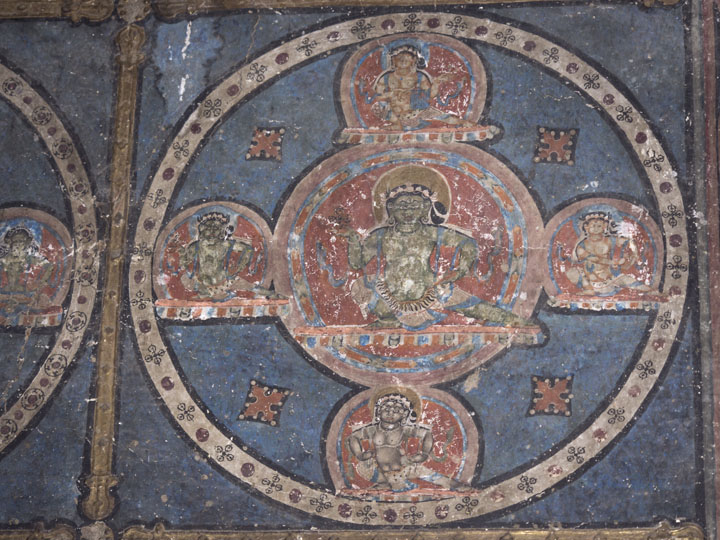
This small Buddha mandala is on the left of the altar wall. It contains some original and repainted areas.
Buddha mandala, Nambarnangze, Mangyu Monastery, Ladakh. Stylistic and quality differences indicate repainting over Indo-Tibetan originals. Photo: Kishore Thukral
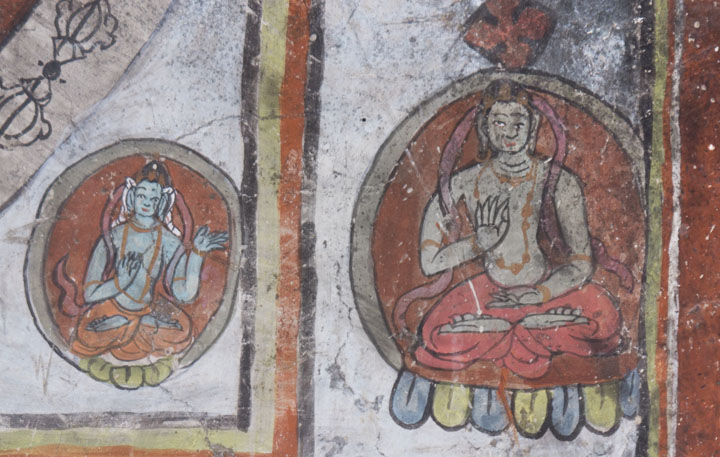
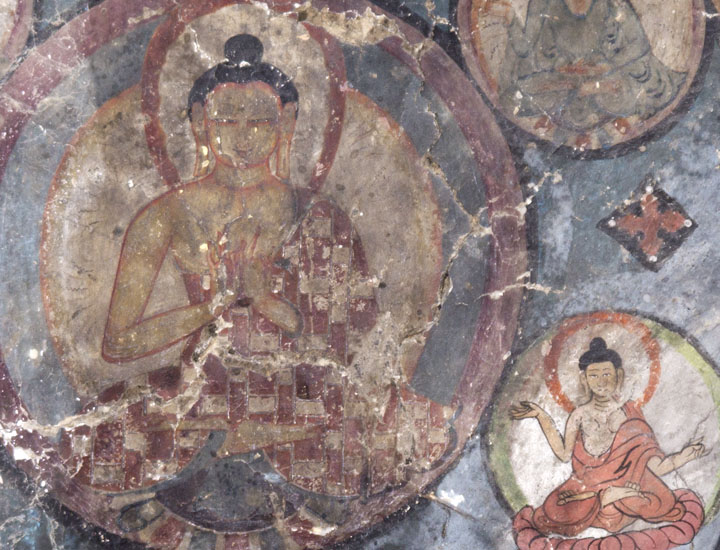
Here is a side-by-side view of what appears to be an original Indo-Tibetan Buddha in center next to a contemporary repainted one.
Detail of Buddha mandala, Nambarnangze, Mangyu Monastery, Ladakh. The central Buddha looks original, but at lower left, stylistic and quality differences indicate repainting over Indo-Tibetan originals.
The historian David Snellgrove wrote in Indo-Tibetan Buddhism: Indian Buddhists and their Tibetan Successors, “The absence of all Buddhist wall-painting in India apart from the Ajanta Caves represents an enormous loss for the history of Indian art. Some deductions can be made from fragmentary remains in Central Asia and especially from the earliest surviving Tibetan murals from about A.D. 1000 onward, and from miniature paintings on Pala manuscripts of about that date.”
While Mangyu may still be pristine from a tourist/environmental point of view, it is less so from an art-historical one. Like I fear for Tabo, Alchi, and other remaining monasteries that have Indo-Tibetan significance, these beautiful, rare wall paintings are disappearing not only through age and exposure to natural elements, but also through the unexpected hands of man. The resultant replacement paintings, lacking in comparable quality, style, etc., are functionally erasing historical records. The originals are thus disappearing over time due to lack of proper conservation and restoration.
View of Himalayan valley from stairs to main temple just before entering courtyard, Lamayuru Monastery, Ladakh
To continue where I left off in my last post, I found Lamayuru Monastery really charming. Not only did the architectural spaces seem personal and intimate, but the experience of them was diverse and unexpected. One temple to the next seemed different in character and time.
The Dukhang, or main temple, is hidden behind a stairway façade, the doors of which open to reveal a fully enclosed courtyard, open only to the sky above. From here there is access to temples located on higher levels.
Courtyard of Dukhang, main temple, Lamayuru Monastery, Ladakh. Intimacy within the grandeur of the Himalayas just right outside the entry doors.Entrance to Dukhang, main temple, Lamayuru Monasetery, Ladakh
The Dukhang’s interior has an enclosed two-story atrium surrounded by colonnade. It was dramatically lit from skylights above, the main source of lighting in this semi-dark hall.
Interior of Dukhang, main temple, Lamayuru Monastery, Ladakh
Lining the walls are a library of scriptures and a rich collection of statuary honoring the Kagyu lineage, including such luminaries as the masters Tilopa, Naropa, Marpa, and Milarepa.
Interior of Dukhang, main temple, Lamayuru Monastery, Ladakh
Along this same wall, K and I did a collective gasp when our monk guide opened a small door to reveal a cave where the amazing Naropa had meditated in the 11th century. Visiting caves that have been graced by enlightened masters is not merely a curiosity. It is considered a blessing. Lay persons and adepts alike seek these places to meditate in the presence of greatness achieved.
Now incorporated into the temple, Naropa’s cave must have been at one time a separate and secret retreat. He is the mahasiddha who developed the yogi practice known as the Six Yogas of Naropa, which has been in continual use by practitioners since he introduced it. This is predominantly the method yogis at Kardang Monastery, for example, utilize in attaining their feats of mind over matter. To learn more, see this earlier post.
Cave where Indian master Naropa meditated in 11th century, Lamayuru Monastery, LadakhStatues placed in small cave where Indian master Naropa (in back) meditated in 11th century, Lamayuru Monastery, Ladakh. In front on left is most likely Taktsang Repa and on right Milarepa
This next small temple off the same courtyard as the main temple is dedicated to reliquaries.
Temple with reliquaries, Lamayuru Monastery, LadakhDetail of reliquaries with colorful tormas, ritual offerings made out of butter and flour, Lamayuru Monastery, LadakhA collection of statues also in this temple, Lamayuru Monastery, LadakhThe mahasiddha Marpa, always depicted with wide staring eyes, Lamayuru Monastery, LadakhVajradhara, the Primordial Buddha, Lamayuru Monastery, Ladakh
Marpa was a famously tough master with his disciple Milarepa, whom he refused to teach when the latter came repeatedly to seek his guidance. Instead he asked Milarepa thrice to single-handedly construct him a building–then tear it down! That is to say, he made the hapless disciple build something, then destroy it, on three different occasions. In a sense, Milarepa needed such profound purification for his prior spiteful and mass-murderous deeds.
Milarepa, disciple of Marpa, usually depicted with hand to ear engaged in a special yogi practice. He is the famously angry and spiteful practitioner who was able to transcend his evil deeds through dedicated asceticism and meditation in cave retreat. He is said to have had calluses on his rear from his years of unrelenting practice!Mural in same temple depicting protector deities and royal warriors, Lamayuru Monastery, LadakhMural depicitng protector deities at center and lineage masters at right, Lamayuru Monastery, LadakhDetail of female protector Tsering-ma riding a snow lion. Wall painting, Lamayuru Monastery, Ladakh. I like the graceful movement of this figure, and judging from the more Chinese influence in style, the murals in this temple post-date Indo-Tibetan period.
Next up was seeing the Avalokiteshvara temple, where my breath was taken away again by the exquisite sculpture there.
Entrance to Avalokiteshvara temple, Lamayuru Monastery, LadakhInterior of Avalokiteshvara temple, Lamayuru Monastery, Ladakh
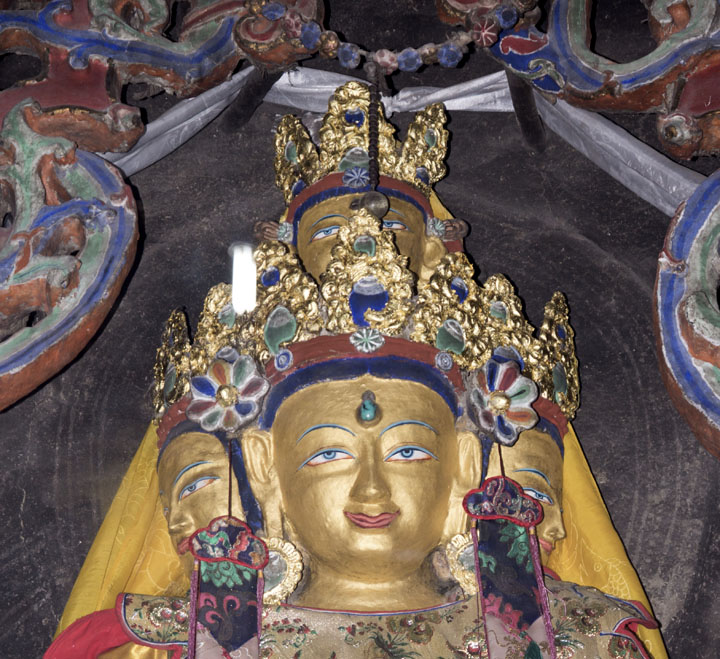
I really loved this temple for its beautiful Avalokiteshvara statue, bodhisattva of compassion, also known as Chenrezig–thousand-armed and eleven-headed, all the better to see, hear, and lend a helping hand to the suffering. It was located in an inner sanctum behind the altar.
While the wall paintings in the Avalokiteshvara temple probably date from a later period judging from stylistic differences, it is possible that this statue dates to the earlier Indo-Tibetan period. Purely conjecture, but I was comparing the similarities in the face of Avalokiteshvara with this Vairocana from Sumda Chun, a remote and largely untouched monastery from the 11th century. These statues have more formal affinity with each other than do the Avalokiteshvara with the painting of one from the same Lamayuru temple.
On left is Vairocana sculpture from 11th century Sumda Chun Monastery, on right is Avalokiteshvara. The facial features have strong similarities in style and execution, as compared to the below painting of Avalokiteshvara from the same Lamayuru templePainting of thousand-armed Avalokiteshvara in its dedicated temple, Lamayuru Monastery, Ladakh. Bearing more Chinese influence in style, the face is softer and rounder, less typical of Kashmiri-influenced art of Indo-Tibetan period
It looks to me that this painting shows more Chinese influence, which would indicate it was created later than Indo-Tibetan period, probably post-13th century.
I heard a story that the goddess Tara emanated from Avalokiteshvara when, upon realizing the magnitude of the samsaric condition for all sentient beings, he shed tears. One tear became White Tara, and the other Green Tara.
Green Tara, surrounded by her 21 emanations which are mostly peaceful versions but some are wrathful forms. Contemporary sculpture, Namgyal Monastery, Dharamsala
Today, Tara retreats are one of the more common kriya tantras taught. She has contemporary feminist appeal as a female buddha. She is also an empowering figure in being regarded as Mother of All Buddhas. Additionally, as a bodhisattva who, seeing the gender bias of the male-dominated precinct of enlightenment in Buddhist religious order, vows to be reborn life after life in order to attain enlightenment in female form. I am reminded of what I have read about Jetsunma Tenzin Palmo, the British-born Tibetan Buddhist nun who spent twelve years in solitary meditation in a cave in Lahaul above Tayul Monastery, and who experienced such gender-bias in monastic orders.
Offerings, Avalokiteshvara temple, Lamayuru Monastery, Ladakh. The large center chalice is a butter lamp.Interior of Avalokiteshvara temple with old woman who had just finished her full body prostrations here Lamayuru Monastery, LadakhInterior of Avalokiteshvara temple looking back towards entrance, Lamayuru Monastery, Ladakh
View of Dukhang courtyard from second level, Lamayuru Monastery, LadakhKagyu monk making tormas, ritual butter cake offerings, in the kitchen on second floor above Dukhang courtyard, Lamayuru Monastery, Ladakh
Lamayuru Monastery–what an experience, and it’s grown fonder in my memory…
View of Lamayuru Monastery on plateau at top, with Lamayuru Village below, Ladakh, India
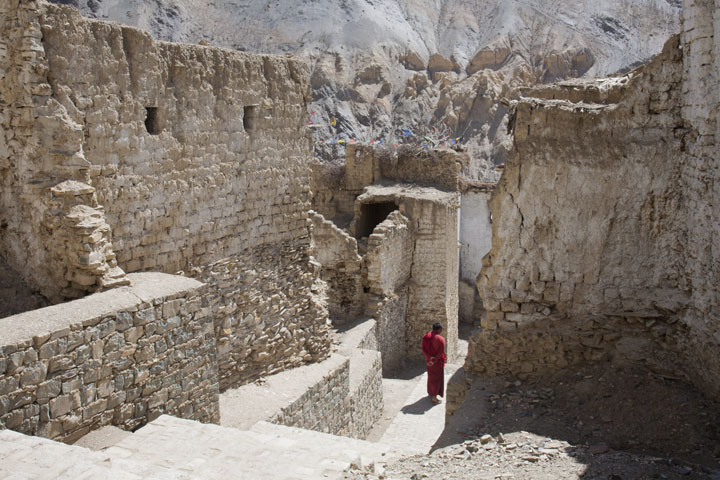
Seeing Lamayuru Monastery today was a rich experience. The hilltop monastery complex is a delightful warren of small passageways that give way to open views. It includes the functional old, the relatively new, and then the crumbling ruins. Walking through it really imparts the feeling of a medieval village in its different stages of development and abandon.
Senge Lhakhang, ca. 11th century, the oldest temple at Yamayuru Monastery. Contains well-preserved and rare Indo-Tibetan clay sculptures of Vairocana, Dhyani (Supreme) Buddhas, and Vajradhatu mandalas, including Gonkhang with protector deities, Ladakh, India
It’s an intimate temple. Upon entering, one faces the splendid and well-preserved altar which by now, dear reader following this blog, you will recognize as belonging to the rare Indo-Tibetan 11th century period of sacred art.
As at Lhalung and Tabo Monasteries, the temple features Vairocana and the Dhyani (Supreme) BuddhasAmitabha, Akshobhya, Amoghasiddha, and Ratnasambhava. These are polychromed clay sculptures seated on lotus thrones inside stylized alcoves. Here at Lamayuru, Vairocana is also seated atop lions which is how the temple derives its name. Senge means lion in Tibetan. He is surrounded by animals, scrollwork, and surmounted by a prominent protective Garuda, the powerful Hindu mythical bird.
Experience the interior of Lamayuru Monastery’s Senge Lhakhang by watching this exclusive video walk-through here.
[vimeo 137311083 w=600 h=337]
Main altar, Senge Lhakhang, Lamayuru Monastery, Ladakh. Central figure is Vairocana, flanked by Dhyani Buddhas (clockwise from left) Aksobya (blue), Amitabha (red), Amoghasiddhi (green), and Ratnasambhava (yellow), surmounted at top by Garuda. Photo: Kishore ThukralIndo-Tibetan clay sculpture of Vairocana, Buddha of Wisdom, one of the Five Dhyani Buddhas, main altar Senge Lhakhang, Lamayuru Monastery, LadakhDetail of main altar with central Vairocana surrounded by animals and surmounted by Garuda, main altar Senge Lhakhang, Lamayuru Monastery, LadakhRatnasambhava, one of the Dhyani (Supreme) Buddhas, rare 11th century Indo-Tibetan clay sculpture, main altar Senge Lhakhang, Lamayuru Monastery, LadakhDetail of Vairocana Buddha and animals, rare 11th century Indo-Tibetan clay sculptures, main altar Senge Lhakhang, Lamayuru Monastery, LadakhDetail of Akshobya, one of the Dhyani (Supreme) Buddhas, 11th century Indo-Tibetan clay sculpture, main altar Senge Lhakhang, Lamayuru Monastery, LadakhAkshobya, one of the Dhyani (Supreme) Buddhas, 11th century Indo-Tibetan clay sculpture, main altar Senge Lhakhang, Lamayuru Monastery, LadakhAmoghasiddha, one of the Dhyani (Supreme) Buddhas, rare Indo-Tibetan clay sculpture, main altar Senge Lhakhang, Lamayuru Monastery, Ladakh. Photo: Kishore ThukralAmitabha, one of the Dhyani (Supreme) Buddhas, rare Indo-Tibetan clay sculpture, main altar Senge Lhakhang, Lamayuru Monastery, Ladakh. Photo: Kishore ThukralGaruda, Hindu mythical bird, main altar Senge Lhakhang, Lamayuru Monastery, LadakhThe lions or Senge, main altar Senge Lhakhang, Lamayuru Monastery, Ladakh
In stark contrast to the fine state of the sculptures, the wall murals are in a very deteriorated condition, faded and water-damaged. In fact, facing the altar, the whole right side wall is altogether undecipherable, almost completely devoid of the original imagery. Looks blackened and/or delaminated down to the mud bricks. It’s incredible that after over one thousand years of time, anything can remain at all, really. Time has really ravaged this wall. I wish it were different!
The left hand wall can still be glimpsed. If only some effective and accurate conservation could be done to preserve these historically significant, rare examples of Indo-Tibetan Buddhism and the Second Transmission of Buddhism from India to Tibet!
Vajradhatu Mandala, Indo-Tibetan wall painting, Senge Lhakhang, Lamayuru Monastery, Ladakh
While it’s difficult to see details of the above wall painting, it is certainly a Vajradhatu Mandala and as such, its structure is usually this:
At center is Vairocana with the 4 Dhyani Buddhas (Amitabha, Akshobhya, Ratnasambhava, Amoghasiddha) positioned around him in the cardinal directions, each encircled by 4 bodhisattvas. There are an additional 12 deities–4 guardians, 4 outer offering goddesses, and 4 inner offering goddesses. In all, the basic set of Vajradhatu mandala deities is 33 or 37. Vajrayana mandalas and the deities that reside within them are essentially symbols of the qualities of consciousness to develop on one’s spiritual path. They are mnemonic devices to aid a practitioner towards enlightenment.
Variations in Vajradhatu mandalas are seen in different monasteries with the addition of up to 60 other divinities–such as the 16 arhats or 12 pratyekabuddhas, among others. These are often depicted on the outer sections as additional circles or squares in the same mandala composition, or in altogether separate small mandalas.
It is important to note that such symbolic plenitude expresses manifestations of the same fundamental principles. Buddhism did inherit the Hindu understanding of many-paths-to-the-same-truth. These additional divinities also have their basis in written scripture or canonical commentaries.
Avalokiteshvara (Chenrezig), bodhisattva of compassion, Indo-Tibetan wall painting, Senge Lhakhang, Lamayuru Monastery, Ladakh
Adjoining the main temple room is a gonkhang, chapel dedicated to protector deities.
Protector deities, including Mahakala and Lhamo Palmo, Gonkhang, Senge Lhakhang, Lamayuru Monastery, Ladakh. Photo: Kishore ThukralView of Senge Lhakhang, with Indo-Tibetan sculptures and wall paintings, Lamayuru Monastery, LadakhConversing with Kagyu monk at entrance of Senge Lhakhang, Lamayuru Monastery, Ladakh. Photo: Kishore Thukral
Lamayuru grounds in this older section near the Senge Lhakhang is characterized by these passageways that are alternately nestled and enclosed, then open and expansive.
Walking through older parts of Lamayuru Monastery, Ladakh. Photo: Kishore ThukralWalking through older parts of Lamayuru Monastery, Ladakh. Photo: Kishore ThukralWalking through older parts of Lamayuru Monastery, Ladakh. Photo: Kishore ThukralWalking through ruins of of Lamayuru Monastery, Ladakh. Photo: Kishore Thukral
Among the stone ruins, amidst the Himalayan landscape, I tried to imagine the charming bygone era of great vitality during the reign of Western Tibet’s Guge kings Yeshe O’d and Changjup O’d whose vision reformed and ignited the spread of Vajrayana Buddhism from India to Tibet in the 10th to 12th centuries. How it must have been in this remote Himalayan landscape a thousand years ago, when these walls and buildings were new, its monastic and lay inhabitants filled with rejuvenated fervor and scholarship!
Walking through older parts of Lamayuru Monastery, Ladakh. Photo: Kishore ThukralView of Himalayan Village and valley from Lamayuru Monastery, Ladakh
This is not an official U.S. Department of State website. The views and information presented here are solely those of the artist, and do not represent the Fulbright Program, the Department of State, or any other entity.