Fulbright Documentary Series at Columbia University and Library of Tibetan Works & Archives
Posted
Losar Tashi Delek! Happy Lunar New Year to all who celebrate!
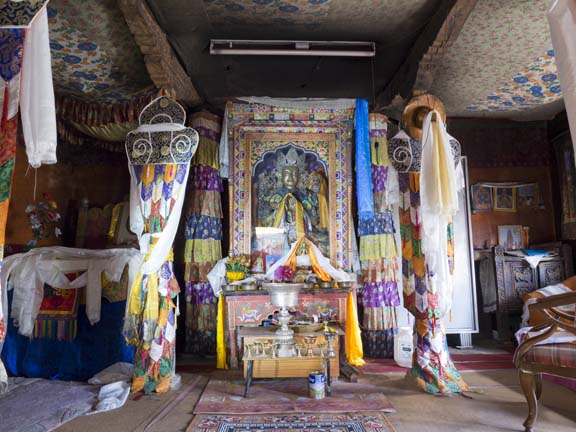
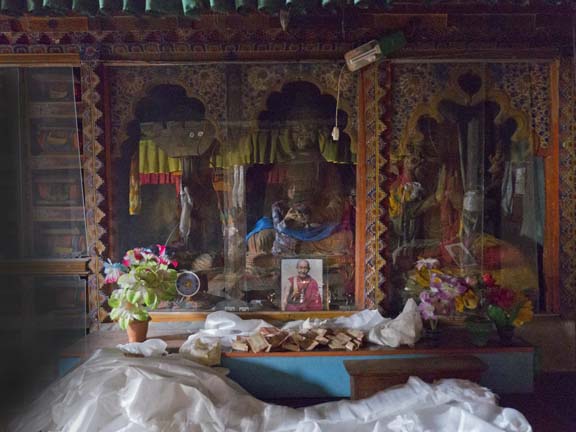
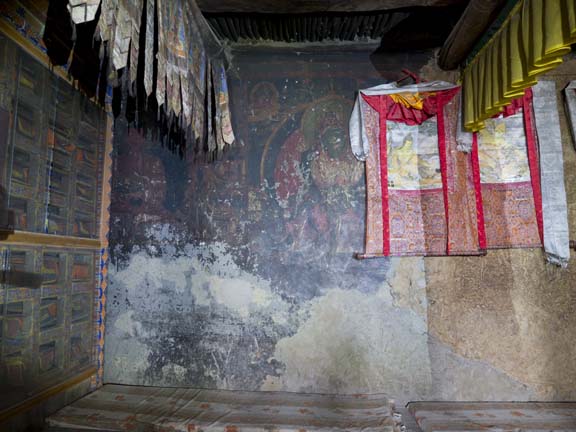
I’m pleased to announce that five of my documentaries are now part of the Columbia University Tibetan Studies Library, one of the most extensive collections of Tibetan texts and archival material in the U.S.A. The documentaries are also in the Library of Tibetan Works & Archives, and may be viewed through their Multimedia Library.
The documentaries are:
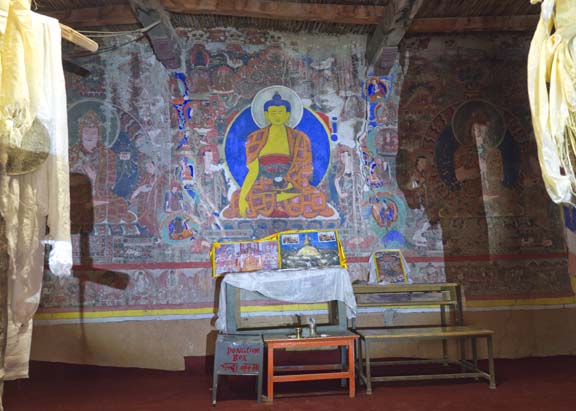
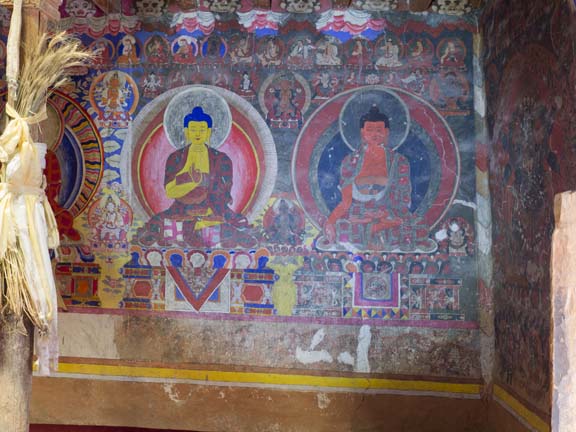
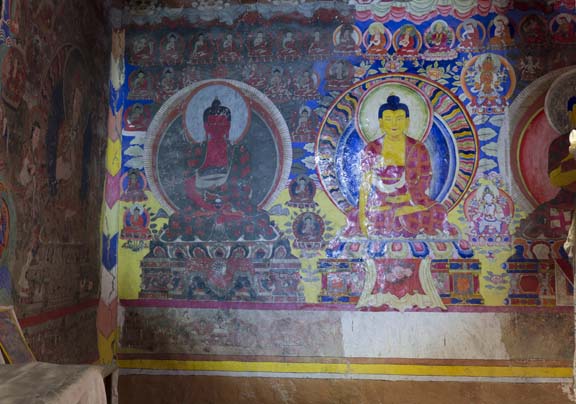
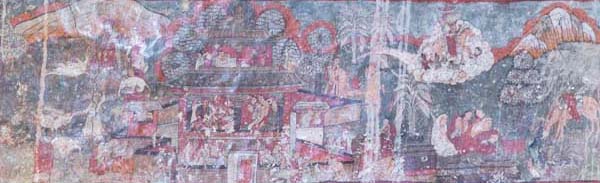
Tabo Monastery Tsug Lhakhang (Main Assembly Hall) See the interior of this rare, Buddhist temple located in Spiti region of Western Himalayas, India. Famed Tabo Monastery is known as the oldest continually functioning Tibetan Buddhist monastery, the art of which the Dalai Lama said “delightfully expresses the vigor of the transmission of Buddhism from India to Tibet and the dynamic mingling of cultures.” Established in 996 C.E. by the Buddhist king of Guge in Western Tibet, Yeshe O’d, and the The Great Translator Rinchen Zangpo, it flourished in a golden epoch of Indo-Tibetan collaboration in spreading Buddhist culture.
Lamayuru Monastery Senge Lhakhang (Lion Temple) (00:03:24) Rare, medieval temple located in Ladakh region of Western Himalayas, India. Founded by The Great Translator Rinchen Zangpo and King Yeshe O’d of Guge, Western Tibet, circa late 11th century.
Mangyu Monastery Nangbarnangzad (0:03:03) Rare, medieval temple located in Ladakh region of Western Himalayas, India. Founded by The Great Translator Rinchen Zangpo and King Yeshe O’d of Guge, Western Tibet, circa late 11th century.
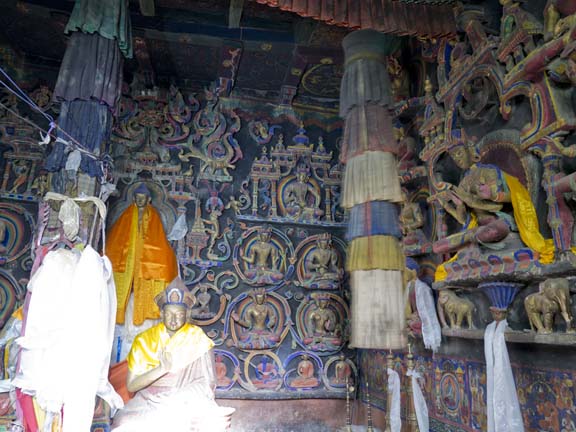
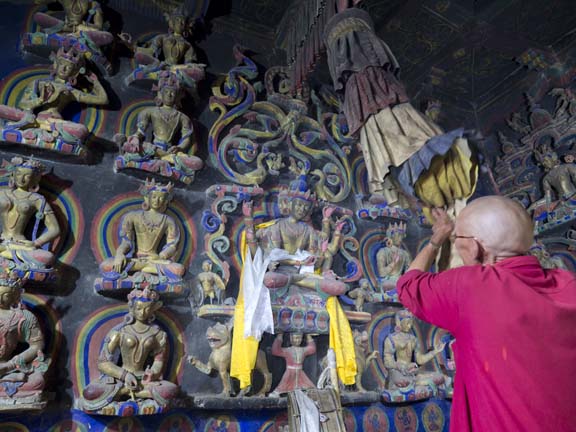
Lhalung Monastery Serkhang (Golden Hall)(00:01:45) Rare, medieval temple located in Spiti region of Western Himalayas, India. Founded by The Great Translator Rinchen Zangpo and King Yeshe O’d of Guge, Western Tibet, circa late 10th century.
Yamantaka (00:56:38) A candid view of an esoteric and complex Tibetan Buddhist highest yoga tantra held at Namgyal Monastery in Dharamsala, India. Monks create an elaborate sand mandala, ritual cakes and other sacred arts, offer prayers, chant, play ritual instruments, and meditate over the course of ten days. As one viewer said, “Beautiful, bizarre, and fascinating!”
Incidentally, many viewers have asked me about what is happening at around 42:14 in the Yamantaka video, where a young Caucasian man is in the Main Temple talking loudly and animatedly to a gathering of monks.This was a debate exam in session for students of the Institute of Buddhist Dialectics (which adjoins Namgyal Monastery), characterized by dramatic and distinctive hand clapping, body motions, and rhetoric. It was an event unrelated to Yamantaka, but which coincided with it. Tibetan Buddhists have a long and famed tradition of continuing the ancient Indian Buddhist practice of philosophical debate.
All documentaries filmed during Fulbright research on Indo-Tibetan mandalas of the 10th-12th century. With thanks and gratitude to Office of His Holiness the 14th Dalai Lama, Namgyal Monastery, and Nechung Monastery for their support in my quest to document these temples and Yamantaka ritual. Made possible in part by the support of Fulbright-Nehru Research Program, Council for the International Exchange of Scholars, and United States-India Education Foundation.
New Video Documentaries: Interior Views of Indo-Tibetan Temples at Tabo, Lamayuru, Lhalung and Mangyu Monasteries
Posted
Tabo Monastery Tsug Lhakhang, Spiti, India
At long last, I have completed four short video documentaries of the interiors of Indo-Tibetan monasteries that flourished during the 10th to 12th centuries. I feel so very honored to have had the opportunity to visit, research, and document these incredible temples.
The temples are:
Tabo Monastery’s Tsug Lhakhang, the Main Assembly Hall, renowned as the oldest continually functioning Tibetan Buddhist monastery, the art of which the Dalai Lama said “delightfully expresses the vigor of the transmission of Buddhism from India to Tibet and the dynamic mingling of cultures.” Established in 996 C.E. in ancient Western Tibet, now Spiti, India
Lamayuru Monastery’s Senge Lhakhang, or Lion Temple, established in the 11th century on a plateau in what is now Ladakh, India. Ca. 11th century, the oldest temple at Yamayuru Monastery. Contains well-preserved and rare Indo-Tibetan clay sculptures of Vairocana, Dhyani (Supreme) Buddhas, and Vajradhatu mandalas, including Gonkhang with protector deities, Ladakh, India
Lhalung Monastery’s Serkhang, the Golden Hall, founded in the early 11th century and located in present-day Spiti, India.
All four sites are among the rare Indo-Tibetan temples still found today with extant, fairly well-preserved, poly-chromed clay sculptures which depict the Five Supreme or Dhyani Buddhas, along with their associated 32 deities. These sculptures form a distinctive sacred art of this period.
After viewing these videos, which show the visual expression of Buddhism, I hope you will find inspiration to learn more about the philosophy and practice of Buddhism.
The wealth of empirical knowledge gathered through millenia by Buddhist meditation practitioners not only benefits those seeking spiritual development, but also those looking for less stress and more happiness. Who wouldn’t want that?
I believe this tradition offers a tremendously positive impact on contemporary society.
Look further, and see for yourself how psychology, health, and medical fields have made advances in treatments based on meditation. For example, neuroscientists in their research on the human brain have garnered great insights in studies on meditation and its effects on cognition and emotional regulation. A pioneer on this Dr. Richard Davidson of The Center for Healthy Minds. One result is the development of Mindfulness Based Stress Reduction (MBSR) pioneered by Dr. John Kabat-Zinn which has been applied with great success as a non-pharmaceutical approach to coping with pain and emotional challenges.
Less stress, more happiness. Again, who wouldn’t want that?
I wish you all the best in your curiosity, and your journey towards learning about mind and well-being, hallmarks of Buddhist practice.
A Look at the Art of Zigar Monastery, Chokyi Lodro, Deer Park Institute in Comparison to Their Indo-Tibetan Predecessors
Posted
October 21, 2013
At Rewalsar, visitors may circumambulate the famed Lotus Lake and see the many monasteries built around it today. It is a pilgrimage site for Tibetan Buddhists who revere Padmasambhava (Guru Rinpoche), the Indian tantric master who is said to have performed a miracle here which you can read about in my previous post, Miracle at Lotus Lake and the Secret Caves of Rewalsar.
View of Tso Pema (Lotus Lake) from Zigar Monastery, Rewalsar, India
The most noticeable monastery in Rewalsar these days is Zigar Orgyen Choekorling Monastery because of its 138 feet high golden statue of Guru Rinpoche.
Zigar Monastery features a monumental golden statue of Guru Rinpoche, Tso Pema/Rewalsar, India Photo: Frederic Martin DuchampZigar Monastery’s 138 feet high statue of Guru Rinpoche, Rewalsar (Tso Pema), IndiaDetail of Zigar Monastery’s 138 feet high statue of Guru Rinpoche, Rewalsar (Tso Pema), IndiaPanorama of Zigar Monastery’s courtyard, Rewalsar (Tso Pema), IndiaSide view of Zigar Monastery’s courtyard, Rewalsar (Tso Pema), IndiaInterior of main temple, Zigar Monastery, Rewalsar (Tso Pema)
Quite unexpectedly, inside Zigar Monastery’s main temple this morning, I saw three large sculptures and was struck by how they had sculptural backgrounds attached to the wall highly reminiscent of Indo-Tibetan ones from the 11th century in ancient Western Tibet.
Detail of central altar with Shakyamuni Buddha, Zigar Monastery, Rewalsar (Tso Pema) Photo: Frederic Martin DuchampDetail of central altar with Shakyamuni Buddha, and background reminiscent of Indo-Tibetan sculpture, Zigar Monastery, Rewalsar (Tso Pema)
I immediately saw these background sculptural reliefs as contemporary versions of the below artforms. The following are central altars of circa 11th century Lamayuru Monastery’s Senge Lhakhang in Ladakh, and Lhalung Monastery’s Serkhang (Golden Hall) in Spiti.
Detail of altar, Lamayuru Monastery Senge Lhakang, Ladakh, India
The first similarity was the use of relief sculptures attached to the wall. Other key similarities include central figures within a tri-lobed halo, surmounted by the Hindu mythical garuda, ornate scrollwork with figures and animals, in particular the Indian-derived makara, a crocodile-like sea creature. Both ancient and modern sculptures are all made of clay. The contemporary presentation as multi-colored wall reliefs is largely the same as the Indo-Tibetan, even while stylistic handling and some content are different.
Detail of central altar, Lhalung Monastery Serkhang, Spiti, India
This is the second figure also in the main temple of Zigar Monastery, a Green Tara.
Green Tara, Zigar Monastery, Rewalsar (Tso pema)Detail of Green Tara, Zigar Monastery, Rewalsar (Tso pema)
This sculpture, as are the three in the main temple, is by the same artist, beautifully painted and detailed.
Detail of Chenrezig (Avalokiteshvara), Zigar Monastery, Rewalsar (Tso Pema)
I learned that the master sculptor was named Tashi Norbu. I was able to contact him and visit him later in the day. Wow, it was total chance that he was in India and happened to be nearby. He would have been out of the country were it not for an unfortunate recent event which prevented him from going. I was so excited to be able to ask the artist technical and aesthetic questions!
Master sculptor Tashi Norbu Photo: Frederic Martin Duchamp
Tashi Norbu is Bhutanese, as are many of the artists commissioned by monasteries today to create artwork. In Rinchen Zangpo’s time, 10th-11th centuries, it was Kashmiri artists who were considered the finest artists to give expression to Buddhist concepts, and they were largely the ones responsible for the art of 10th-12th century monasteries in the Himalayas during the Great Second Transmission of Buddhism from India to Tibet.
Main temple, Deer Park Institute, Bir, India
Tashi Norbu was invited to make numerous sculptures in the area. In addition to Zigar Monastery, he created works for Deer Park Institute in Bir, and Dzongsar Khyentse Chokyi Lodro Institute in Chaundra. We went together to visit these sites as I learned about his process.
His account about how Dzongsar Khyentse Rinpoche, who commissioned him for both Deer Park and Chokyi Lodro artwork, was so exacting about getting the face of the Deer Park Manjushri to look “right” (according to its original divined appearance) was so interesting. According to the artist, this required no less than eleven tries–that is, eleven fully sculpted, completed, then discarded heads–and many meditation retreats by the artist together with lamas in order to get it correct. Wow, this was the first time I’d ever heard of this working method. Be in meditation communally for aesthetic guidance, in order to “see” the work together for the artist to create it.
Manjushri statue by Tashi Norbu, Deer Park Institute, Bir, IndiaDetail of Manjushri statue by Tashi Norbu, Deer Park Institute, Bir, IndiaDetail of Manjushri statue by Tashi Norbu, Deer Park Institute, Bir, India
Another rinpoche, on a later separate unrelated occasion, told me this same thing. He said, rather than strategize conceptually to create a “successful” work of art, as he believes many contemporary artists do, instead, an artist should use mindfulness to connect with inner realities and then create from that vision.
Main altar at Chokyi Lodro Institute, Chaundra, India, sculpture by Tashi Norbu
It would be interesting to see Tashi Norbu’s sculptures in progress, from beginning to end. As a painter who has never sculpted, I can’t fathom how one constructs monumental Tibetan Buddhist statues.
He said the underlying forms are wood and iron with wire mesh, concrete, and then final layers are clay. The clay is made from Tibetan paper mixed with clay and water until the right consistency is achieved. Then the work is air-dried, carved, primed, painted and gilded. The faces and hands are usually painted in a special pure gold paint made in Nepal. You can burnish this to bring it up to a luster, but burnishing usually mars the clay surface a bit and affects the details, so this is not done on the faces and hands.
Monumental Buddha, main altar at Chokyi Lodro Institute, Chaundra, India
The finished statues have hollow interiors where prayers written on rolled paper and katas (ritual scarves) are placed.
Main temple at Dzongsar Khyentse Chokyi Lodro Institute, Chaundra, India. Standing with me are Tashi Norbu and Venerable TenzinPanorama of Dzongsar Khyentse Chokyi Lodro Institute, Chaundra, India
When I returned to Dharamsala, I told my photographer friend Frederic Martin Duchamp about my trip to Tso Pema, and learned that he happened to have also met Tashi Norbu a few years ago when the artist was sculpting the now completed statues for Zigar Monastery. AND he had photographs of some of them in-progress. What serendipity–or, as the Tibetans say, auspicious coincidence!
So the following are before and after photos of all the main Zigar Monastery statues, thanks to Frederic who has generously shared them with me. Click here to see a short video transition of the first example.
Before and after, Shakyamuni Buddha, Zigar Monastery, Rewalsar, India. Photo: Frederic Martin DuchampDetailed before and after, Shakyamuni Buddha, Zigar Monastery, Rewalsar, India. Photos: Frederic Martin DuchampBefore and after, Green Tara, Zigar Monastery, Rewalsar, India. Photos: Frederic Martin DuchampBefore and after, Shakyamuni Buddha, Zigar Monastery, Rewalsar, India. Photos: Frederic Martin DuchampBefore and after, Chenrezig, Zigar Monastery, Rewalsar, India. Photo: Frederic Martin Duchamp
Tabo Monastery: Himalayan Setting and Meditation Caves
Posted
Sept 6th, Tabo Village, the Spiti adventure continues…
Tabo Village, where Tabo Monastery is nestled in Spiti Valley unlike other Buddhist monasteries that were built as fortress-like compounds on hilltops
Well, here we are in Tabo! The famed Tabo Monastery is known as the oldest continually functioning Tibetan Buddhist monastery, the art of which the Dalai Lama said “delightfully expresses the vigor of the transmission of Buddhism from India to Tibet and the dynamic mingling of cultures.” Established in 996 C.E. by the Buddhist king of Guge in Western Tibet, Yeshe O’d, and the The Great Translator Rinchen Zangpo, it flourished in a golden epoch of Indo-Tibetan collaboration in spreading Buddhist culture.
Tabo Monastery complex behind stone walls in Tabo Village, Spiti Valley, India
Tabo’s existing sacred artwork and architecture have unique historical significance, not only for the aesthetic evidence of such cultural exchange, but also for its rarity. Due to the enormous destruction during the Chinese Cultural Revolution, where over 6000 monasteries and their artworks were destroyed between 1959-61, practically none of the early examples of Buddhist culture have survived in Tibet. Consequently, the monasteries of the Western Himalayan border areas of Spiti, Lahaul, and Ladakh, once part of Tibet, is of great importance for its legacy of early Tibetan Buddhist culture, and in particular, its connection with India.
Street view of entrance to Tabo Choskhor,Spiti, with the museum and library in building on rightUpon entering Tabo Monastery complex, the first building one sees is Tsug Lhakhang, the grand main assembly hallThe Tsug Lhakhang, Tabo Monastery, Spiti
Of the monasteries I’ll visit, Tabo, Alchi, Mangyu, Lamayuru, and Lhalung strike me as being of special importance. These have exceptional murals, unusual in cross-cultural style and depiction, executed in astounding refinement, with ornate clay sculptures that are cantilevered off the walls in Vajradhatu mandala arrangement of sacred space (more on this in the next post!) This type of work is specific to the area and is not found in any other Buddhist temples in the world. These monasteries also date back to that fertile period of Buddhist philosophical exchange and revitalization from India to Tibet beginning in the 10th century during The Great Translator Rinchen Zangpo’s time.
Documenting the extant artwork and architecture of these sites is essential because they are remarkable, and extreme Himalayan winters and potential earthquakes, such as the one that occurred in 1975, continue to threaten their survival. Proper conservation and restoration is critical for art history and posterity. Of immediate concern is the effects of climate change and increased rainfall in the normally more arid Spiti that has damaged Tabo’s murals and architecture. This 2010 article entitled “A Monastery’s Fading Colours,” published in The Indian Express, is about the challenging circumstances facing the monastery’s care under the maintenance of the Archeological Survey of India (ASI). The Times of India recently questioned the national organization’s general efficacy in its article, “92 ASI-protected Monuments Missing.”
Rear view of Tsug Lhakhang with workers currently repairing the mud exterior. Its back walls are as thick as 2.5 meters!Workers currently repairing the mud exterior of Tabo Monastery, Spiti
I find myself wishing these monasteries were designated UNESCO World Heritage sites, such as the early Buddhist Ajanta Caves are in India, or considered World Monuments. Perhaps this would bring more international attention and expertise to help hasten the appropriate preservation and protection against man-made as well as environmental challenges.
Fortunately, I was able to arrive in Tabo with all my equipment fully charged because the electrical power was mostly on during my previous night in Kaza, Spiti. But unfortunately, I was unable to photograph due to administrative details still to iron out. Perhaps by tomorrow, after the special 6:00 a.m. morning prayers for the recently deceased and venerated abbot of Tabo which will be performed as part the traditional 49 days’ observance. Despite not being able to photograph, the monk in charge of the monastery kindly showed me most of the temples in the complex.
What is so immediately striking is the contrast between the simple exterior architecture of mud brick and the resplendent interiors. Wow, the ornate interiors leave you speechless, what treasures of Indo-Tibetan art, history, and philosophy! Especially the dramatic, dark, moody, pensive main assembly hall (Tsug Lha-khang); the older Dromton Temple (Brom-ston Lha-khang), founded by the main disciple of the great teacher and adept Atisha; Initiation Temple (dKyil-kHor-khang), where monks are initiated; BodhisattvaMaitreya Temple (Byams-Pa Chen-po Lha-khang), with a 20 foot high painted mural of the future Buddha Maitreya; and the Golden Temple (gSer-khang).
View of Tabo Monastery complex showing Dromton Temple on far right and Bodhisattva Maitreya Temple left of it, Spiti, India
Oh, news flash! For incredible floor plans of these temples, including elevations, sections, 3D models, photo montages, and more, see this excellent website of an Austrian research team at Graz University of Technology that has been studying the architectural heritage of the Western Himalayas.
And did I mention caves? Yes, caves on a steep cliff above Tabo Monastery and village where, according to archeological evidence, monks had lived and practiced meditation since the 11th century. Now it is an ASI protected site. Most caves are open spaces showing evidence of ancient occupation–sooty interior walls and carved out niches, etc., as well as perhaps picnic use by modern visitors. But while exploring with my flashlight, I peered into an opening of a small closed door of a dark cave only to find a blanched seated figure looking back at me! Startled and flustered, realizing this was a real person and not a phantom, I muttered a quick, deepest apology, and left in a hurry! Well, I guess today there are still some practitioners who retreat to these caves. Whether this was a tourist trying it out, or a yogi, I have no idea.
Path to numerous caves above Tabo Monastery and village, Spiti, IndiaOne of numerous caves carved into the cliffs above Tabo Monastery, used by monks from the 11th century on, SpitiView of Tabo Monastery from inside a cave, Spiti
Have a virtual walk-through here of the insides of some of these caves:
View of the inside of the above Tabo cave, SpitiView of Tabo caves located on a steep cliffside above Tabo Monastery, SpitiView of Tabo Village from cave sites, Spiti, India
Ok, I hope I have a headache-less night’s sleep tonight. Day four at high altitude and I’m still adjusting, but Tabo is at about 10,000 feet high, 2000 feet lower than Kaza, so it should be better. Need to get up early to make it to 6am puja!
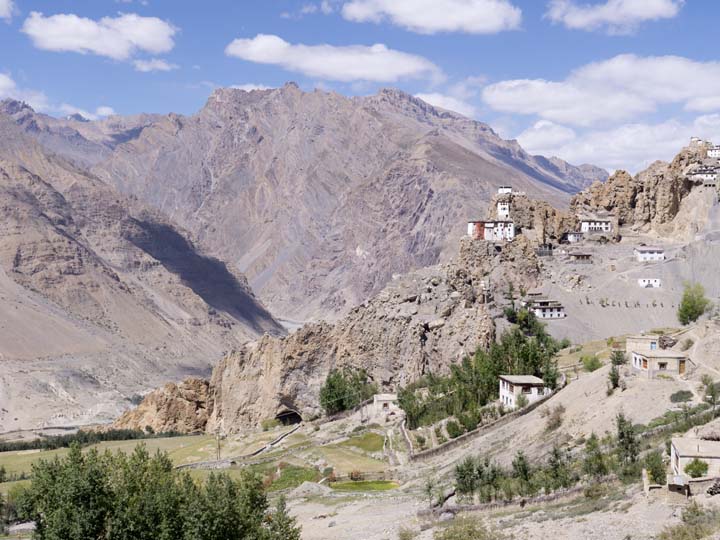
Dhangkar Monastery is seen on the ridge in the upper right. It consists of multi-storeyed buildings perched together, containing five different devotional halls.
September 4th
Our first day out to photograph was at Dhangkhar and Lhalung Monasteries. Both places granted permission because of local and monastic support. I was on my first documenting journey, and how positive an experience it was!
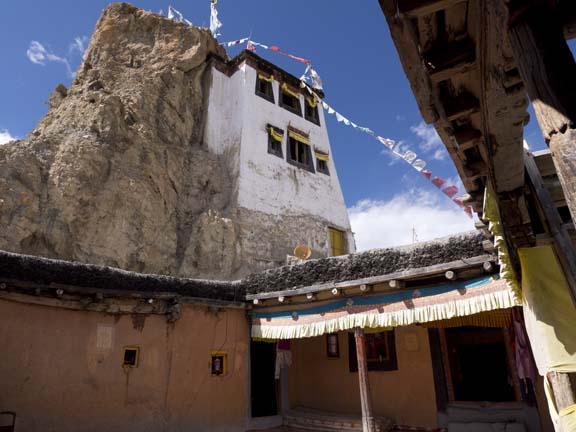
Entering Dhangkar Monastery’s Lha O-pa Gompa.Dhangkar Monastery clings to its rocky outcrops. Shown here is the level in which the Dukhang and Lhakang Gongma may be accessed.
I’ll let the images speak for themselves, but it bears saying that Dhangkar was an original home of the ruling Spitian kings over a thousand years ago, built on a ridge and rock outcrop as a fortress. It clings to the mountain with its whitewashed buildings and traditional thatched roofs. Some buildings seem to be built one on top of the other.
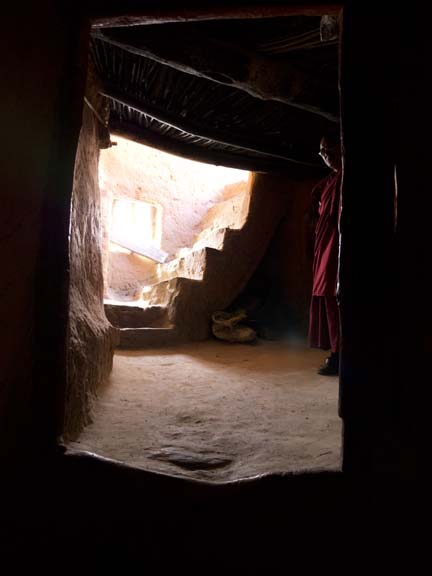
Dhangkar Monastery narrow passageways
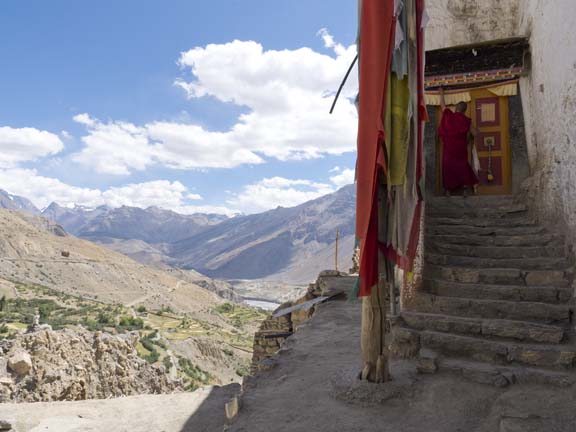
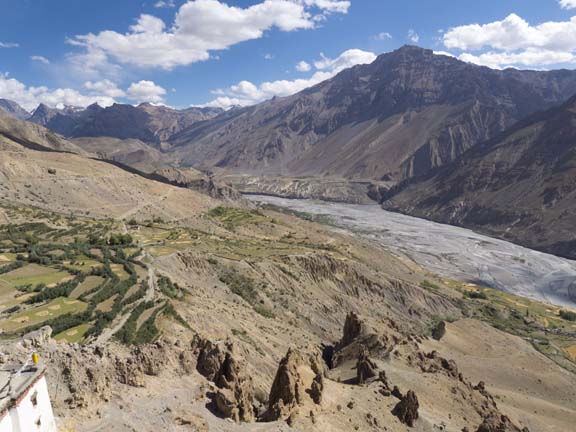
The interiors are navigated by narrow stairs (more like ladders, they’re so steep) and often low-ceilinged passageways. And when you scramble higher and higher, some stairs lead to the rooftops where you climb some more, on gravelly footpaths next to sheer cliff drops, in order to get into other adjacent buildings. Whenever you step outside, you are stunned by the incredible panorama of Spiti Valley in its splendor before you, dotted by the verdant, partitioned farmlands below, and the rigor of the sun casting impressive shadows across the mountain ridges.
View of Spiti Valley from rooftop of Lha O-pa Gompa, Dhangkar Monastery
Inside the Dukhang, which was the former assembly hall for monks before the new one was built a few years ago, sits a life-sized statue of Vajradhara, the “Diamond Being” who sees the ultimate nature of reality. One who does so is said to have wisdom, or right view.
In the lower level Kanjur Lhakang (library containing Buddhist scriptures) are three wooden figures: Lama Chodrag, Shakyamuni, the historical Buddha, and Maitreya, the future Buddha. On the walls are faded and sooty murals, which one can barely see. It’s easy to understand from these murals alone why in 2006 Dhangkar Monastery was named by World Monuments Fund as one of the 100 most endangered sites in the world.
Kanjur Lhakang library of Buddhist scriptures, Dhangkar Monastery, Spiti, India
In the uppermost building of Lha O-pa Gompa is Lhakang Gongma, which has the most to see in terms of murals. Its central back wall dominates with Shakyamuni, Je Tsongkhapa (the reformer and Gelugpa founder of the 14th century), and Lama Chodrag.
View of murals on the back central wall of Lhakang Gongma, Dhangkar Monastery, Spiti
The adjacent walls depict various manifestations of Buddha. I was struck in general by how varied the paintings are in terms of color, style, and deterioration. It’s clear evidence of selective repainting over the centuries. In the back central wall, for example, Shakyamuni is obviously brighter and more saturated in color than the other two figures. According to Peter van Ham’s book, The Forgotten Gods of Tibet: Early Buddhist Art of the Western Himalayas, only a few of the paintings have been left untouched. The rest stylistically suggest a date of around 17th century.
Buddha murals, Lhakang Gongma, Dhankar Monastery, SpitiBuddha murals showing evidence of repainting over the centuries, Lhakang Gongma, Dhangkar Monastery
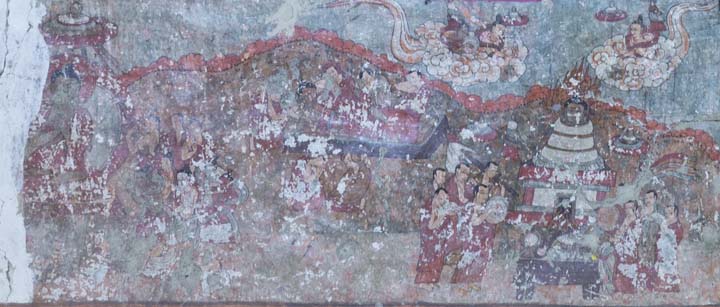
Of note in the murals is the frieze below the main figures, which largely depicts the life of Prince Siddartha, who became the historical Buddha, Shakyamuni. Tabo Monastery has a similar frieze in its Tsug Lhakang, the main assembly hall. Much of it is faded but the below two images are readily identifiable as the life of Siddartha at the palace of Kapilavastu, and the death of Buddha.
Life of Prince Siddartha at the palace of Kapilavastu, painted frieze at Lhakang Gongma, Dhangkar MonasteryDeath and cremation of Buddha, painted frieze at Lhakang Gongma, Dhangkar Monastery
We were told by locals that Dhangkar is older than the famous Tabo Monastery because, as the ancient home of indigenous kings, it contained a private temple from before the time of The Great Translator Rinchen Zangpo, pre-dating 10th century. Indeed, at the very top of the Dhangkar citadel are the remains of the palace, which you climb up to through a sleepy and steep quaint village that looks like it has maintained its same way of life for millenia.
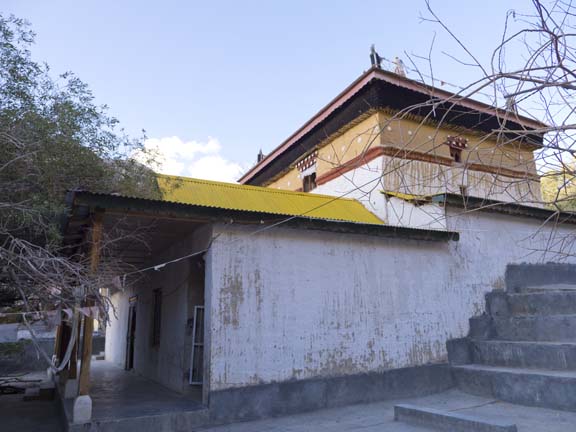
Later in the day, we went to Lhalung Monastery. I really loved this small temple pictured below.
Lhalung Monastery’s Serkhang or Golden Hall, Spiti
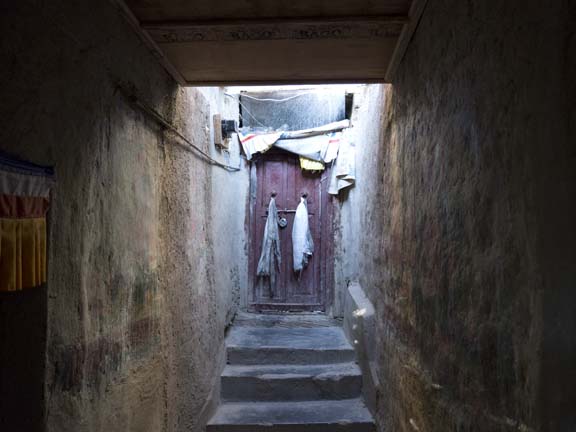
Lhalung Monastery, believed to be founded by The Great Translator Rinchen Zangpo, late 10th century C.E., was quite impressive. You enter through a narrow passageway to get to its Serkhang, which means literally House of Gold, but more often referred to as Golden Hall. Attached to its walls are sculptures of deities and other Buddhist personages. Three-dimensional figures in relief against the interior architecture of Buddhist temples are a distinctive feature of Indo-Tibetan artistry in Spiti and Ladakh areas. Similar ones are found at Tabo, Alchi, and Mangyu Monasteries.
Experience the rare and beautiful interior of Lhalung Monastery’s Serkhang by seeing a walk-through videohere.
Entrance to Lhalung Monastery’s Serkhang or Golden Hall
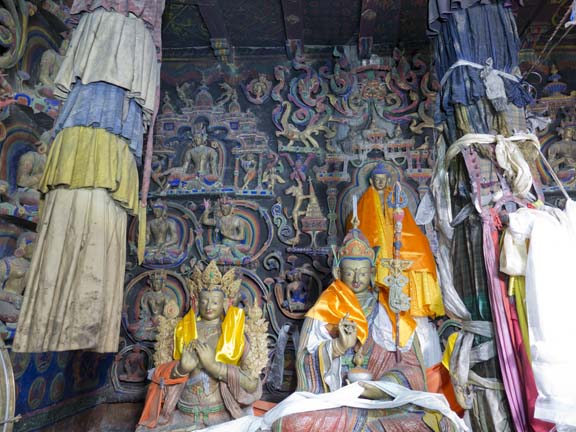
Once inside, the splendor of the ornately gilded and polychromed clay figures strikes you. The sculptures fill the temple practically from floor to ceiling. There are over 51 figures mounted on the walls or placed in the temple, arranged in mandala formations on each wall. Geshe-la said that these types of cantilevered relief sculptures are specific to the Trans-Himalayan region and are not found in Buddhist temples anywhere else.
On the central wall is Shakyamuni in the middle, flanked by two elaborate groups of five figures, each dominated by a deity–identified as Dharmadhatu Vagishvara, a complex form of Manjushri on the left, and Vajrasattva on the right. These figures are set in architectural alcoves, while the others are contained within lotus motif scrollwork, accented by decorative animals and dancers.
Maitreya, Guru Rinpoche, and Rinchen Zangpo (partly visible on right behind the column) form a trinity in the Serkhang altar of Lhalung Monastery, Spiti
Visible below is the right wall with sculptures arranged in a Prajnaparamita mandala, with Vairocana in the center surrounded by four Dyanibuddhas or Buddha-families: Ratnasambbhava, Akshobhya, Amoghasiddhi, and Amitabha, and their female attendants.
Rinchen Zangpo statue among a pantheon of sculpted deities, Serkhang (Golden Hall), Lhalung Monastery
On the left wall (photo below) is a Vajradhatu mandala arrangement around the three-faced and eight-armed Saravid Vairocana. Around him are the 16 deities in his cycle, including once again the Buddha families of Ratnasambhava, Akshobya, Amitabha, and Amoghasiddhi.
Left wall with Vajradhatu Mandala, Serkhang of Lhalung Monastery, Spiti
So now, that’s a lot of deities in one small temple! Their plethora really conveys not only aesthetic richness but also the complexity of Tibetan Buddhist tantric practice. What do all these deities represent in these mandala arrangements? Put simply, mandalas are visual guides for a practitioner in their meditation. They are aids in the realization of the true nature of mind and reality. As an oral and esoteric tradition, one needs a lineage teacher. Experiential understanding of this leads to liberation from conditioned existence–that is to say, leads to enlightenment or nirvana. Here is a succinct description of what the Five Buddha Families represent.
Geshe-la had said that the temples in these areas really demonstrate only the lower three tantras, not highest yoga tantra, which is mainly what Tibetan Buddhists practice today. The lower three are more concerned with purification, whereas the fourth level is actualizing self and deity, and therefore, enacting profound experience and understanding of emptiness. In The Great Translator Rinchen Zangpo’s time, late 10th century, focusing on the three lower tantras was a way to go back to roots and revitalize/reform tantric practice in Tibet which had grown distorted. This was partly the reason for the enormous interest in the original texts and their teachings, translating them from Sanskrit to Tibetan.
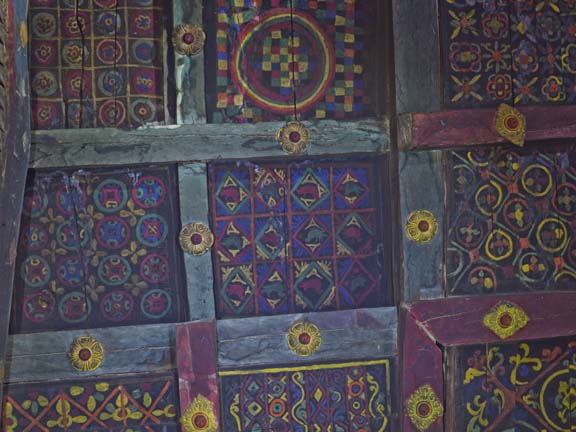
Lastly, the coffered ceilings were painted with delightful and folk-looking decorative motifs. Now I know what scholars mean when they speculate that these must reflect 10th century Kashmiri–influenced textiles.
Coffered ceiling of Serkhang, Lhalung Monastery, decorated with Kashmiri-influenced patterns that scholars believe reflect 10th century textile designs.
This is not an official U.S. Department of State website. The views and information presented here are solely those of the artist, and do not represent the Fulbright Program, the Department of State, or any other entity.