I loved seeing Tenzing Rigdol’s current art installation, Biography of a Thought, at the Metropolitan Museum of Art. Continue reading
mandala
Sherabling Monastery’s 3D Mandalas and Milarepa’s Redemption from Murder
October 23, 2013
Going to Palpung Sherabling Monastery in the foothills of the Indian Himalayas was a revelation. Three years ago, when I first visited I had happily stumbled upon resident monks rehearsing their famed Lama dances, held bi-annually in the courtyard. This time, however, I was riveted by another aspect of this Karma Kagyu lineage of Tibetan Buddhism which I had not seen before.
It was the treasure trove of 3D mandalas on its mezzanine level. Because they were not visible from the ground floor of the main temple, I missed them last time. This time, I traveled with a senior monk who asked for access to other areas of the temple with art interest, and was therefore taken up to the mezzanine. Wow, fourteen 3-dimensional mandalas of the tantras of Marpa! Usually, if one is lucky enough to come across any 3D wooden models, one sees only one or two of them at a time. Here were fourteen of them, of such variety and fine quality, too!
So allow me to walk you through how I saw these mandalas.
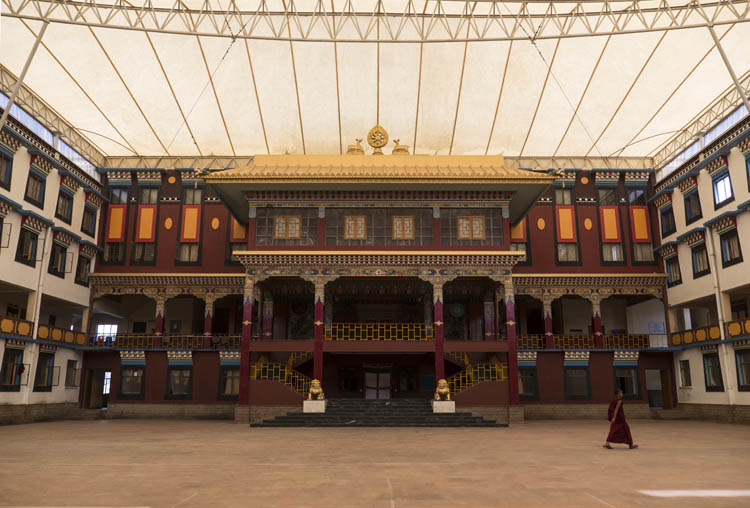
Here’s a view of Sherabling Main Temple and the inner courtyard. Very quiet that day, compared to the first time I saw it completely filled with monks dancing in organized circles.
Upon entering this well-appointed temple, you behold a 42-foot tall golden Maitreya, the future Buddha, seated on a throne beautifully gilded and elaborately decorated with filigree motifs.


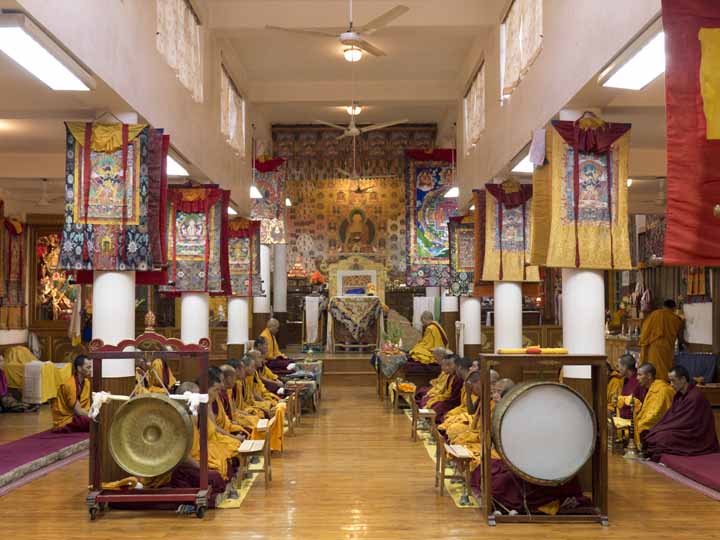
In fact, this whole main assembly hall is exceptionally ornate with its painted and gilded columns, cornices, thangkas and friezes.
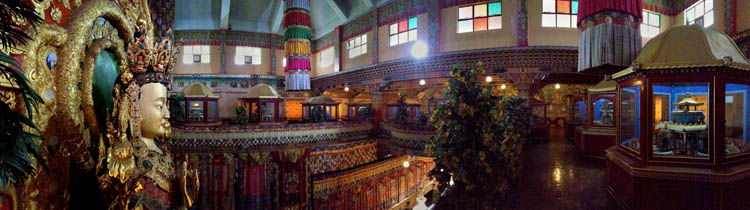
What is not visible when you stand on the ground floor is the spacious and tall mezzanine level above that houses the exquisite Mandala Shrine Hall. Here are some views of it.


And here’s a full view of this magnificent, monumental statue of Maitreya.

Himachal Pradesh, India
Notice that at the foot of the statue are photos of His Holiness the 14th Dalai Lama on the left, and His Holiness the 17th Gyalwang Karmapa on the right. The Dalai Lama is the spiritual leader of Tibetans and all Tibetan Buddhist schools, of which there are mainly four–Nyingma, Kagyu, Sakya, and Gelug. The Karmapa is the spiritual leader of the Kagyu school.
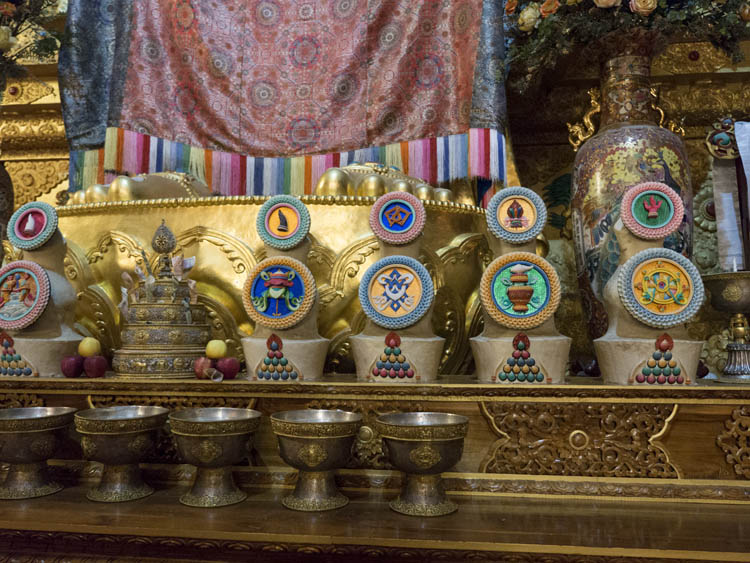
Now about the Mandala Shrine Hall, it displays wooden three-dimensional mandalas of the 14 tantras of Marpa. These are the main practices of the Palpung Sherabling (Kagyu) community.

Marpa (1012-1097 CE) was a great teacher and translator. In fact, one of his students became the first Karmapa. This is no small deal since the present Kagyu school’s Karmapa is the 17th incarnation, an older lineage than the Gelug school’s 14 Dalai Lamas. But perhaps, arguably, Marpa’s most famous student was Jetsun Milarepa (ca. 1052—ca. 1135 CE). How Milarepa became enlightened is an inspiring story of redemption.
As a layman, Milarepa had a dark personal history. He learned sorcery and exacted revenge upon an aunt and uncle who mistreated and took all of his family’s wealth upon the death of his father. As a result, Milarepa killed dozens of people through conjuring devastating hailstorms. Later, remorseful for his black deeds, he sought a teacher for help. That teacher turned out to be the fearsome Marpa, whose gaze was said to bely such inner power that people found it difficult to look at or be near him.

Marpa was apparently the right teacher for the destructive Milarepa to atone himself. He put him through arduous tasks, such as instructing him to build buildings, each time promising to teach him if he completed his request. However, Marpa repeatedly anguished and disappointed his hapless student by refusing to teach him sacred Buddhist practices. Despite building and tearing down three whole structures, and suffering much physical pain, Milarepa still did not received a single tantric oral transmission.

Milarepa was then asked to build a multi-story tower by Marpa at Lhodrag, where to this day the 11th century tower still stands. For a detailed telling of Milarepa’s trials and tribulations, see this Kagyu site.
When at last Marpa bestowed the spiritual teachings on Milarepa, his dedicated student then left to practice. After twelve years, he attained the state of Vajradhara (complete enlightenment).
Milarepa became a renowned ascetic and poet, a mahasiddha who lived in a cave in Namdaking, Tibet near the border of present day Nepal. He was said to have survived on nettles, an herb which caused his complexion to turn green. He is often portrayed in paintings with green skin tones for this reason. The other identifying aspect is his hand held to his ear. While it looks like a gesture of listening, I learned from a Tibetan nun that it is a yogic posture for affecting subtle energies of the body.

© 2007, Dru-gu Choegyal Rinpoche.

As for the Mandala Shrine Hall, it is an exceptional collection and display of the 14 tantras of Marpa. While most mandalas, such as the below Mahamaya mandala, follow the conventional form of a three-story palace with four gateways facing the cardinal directions, with the main deity residing at center, and associated deities in the surroundings, encompassed by ritual symbols and elements, only the initiated Kagyu practitioner would truly be familiar with the mandalas and their practices.

Even for practitioners from other Tibetan schools, the mandalas may seem unusual, such as this one. I believe the below mandala is that of a Dakini.

All photos © 2013, Eva Lee.
Except where otherwise credited
It’s Yamantaka Time
I’ve been furiously writing here to get up-to-date, and even though I’m still working on September things seen and heard, I must now share that it’s Yamantaka time! I am currently documenting this highest yoga tantra performed annually at Namgyal Monastery here in Dharamsala.

Yamantaka began four days ago before dawn’s light with earth ritual prayers to prepare the ground for this sacred art.

Then came three days of intensive work for the monks to rasp colored sand through metal funnels to create intricate designs symbolizing the main deity and his retinue of associated deities within the palace. For more info on mandalas and tantric, see this earlier post.


The sand mandala was just finished yesterday.

With the completion of the mandala, today was the generation stage of the ritual. The monks chanted while visualizing themselves arise as Yamantaka. Tomorrow begins three days of consecration, followed by fire puja, then dissolution of the mandala.
I love this bittersweet last part where the beautiful mandala is swept away. As George Harrison sang, all things must pass. It’s a lesson in the truth of impermanence and the wisdom of letting go. Some of the sand is given to visitors who come witness the event. Most of it is swept into a ritual vase that is then taken to a nearby body of water and poured into it. I think of it as sending good wishes and energy out into the world.
I look forward to seeing it again. It was a wonderful experience here three years ago. It will be a welcome deja vu.
All photos © 2013, Eva Lee.
Tabo Monastery and “The Forgotten Gods of Tibet”
In the book The Forgotten Gods of Tibet: Early Buddhist Art in the Western Himalayas, published in 1997, authors Peter van Ham and Aglaja Stirn wrote about Tabo Monastery‘s Tsug Lhakhang: “Unfortunately many of the paintings, especially in the lower register, are badly damaged. In fact the northern wall has a large area where nothing except for the grey wall can be made out. Some of these gaps were painted over in recent times–enhancing the impression of the high artistic merit of the old paintings since these newer additions only show a mediocre level of execution.”
Perhaps this may be an example (see image below). Notice how the figure to the left of the central Buddha is stylistically so different from the one on the right. As a trained fine arts painter as well as decorative painter, I must agree with authors van Ham and Stirn.

This below example of stylistic continuity is what the above example should look like.

Here is a view of a comparable original painting on the left and the one in question on the right. Stiff and simplistic in appearance, the repainted one bears little resemblance to the refined and delightfully detailed original.

Here, above the doorway, is another example of repainting in the chevron border and the two figures underneath.

Presented above are only a couple of examples. In person onsite at Tabo’s Tsug Lhakhang, one finds upon scrutiny numerous incidences of such inpainting and overpainting. I fear that if this kind of “restoration” continues, over time, the temple’s extraordinary original murals will be obliterated rather than preserved. That would be an immeasurable loss for India, art history, and world posterity.
Experience the interior of Tabo Monastery’s Tsug Lhakhang by watching this video walk-through here.
Tabo Monastery – Tsug Lhakhang (Main Assembly Hall) from Eva Lee on Vimeo.
Tabo Monastery is under the protection of the Archeological Survey of India, but it is unclear to me who is doing the painting.
The book Architectural Heritage: Ladakh by The Indian National Trust for Art and Cultural Heritage, published in 2003, says it is often the monastics who do not realize the need for proper conservation, being more concerned with the religious content of the murals and not the art historical significance.
“In the great temples, the execution of wall paintings is carried out by monks and scholars whose canonical knowledge is profound…Most wall paintings are done on perishable mud plaster, and as these begin to disintegrate, these are either removed to draw fresh paintings or retraced and retouched to maintain their vibrancy and freshness. This way it is sometimes painful to witness a ruthless operation in which centuries old paintings are lost along with the structure by eager lamas to construct new structure and, consequently, draw another set of wall paintings…As soon as the walls begin to crack, or paintings fade, they are at once repainted.”
While it appears that at times the goals of Tabo Monastery and Archeological Survey of India may be at cross-purposes with one another, there seems to be great effort for mutual respect. After all, Tabo is a functioning Tibetan Buddhist religious site. At the same time, it is a rare Indo-Tibetan historical site under ASI’s charge. The question is, how are these two establishments proceeding forward?
Repainting, however, is only one of the man-made challenges to the preservation of Indo-Tibetan murals. There are also issues involving structural changes to historical buildings (see this earlier post regarding repairs to the roof of Tabo’s Great Assembly Hall), vandalism, and the effects of tourism, to name some others. Then there are the natural challenges such as wet conditions caused by snow or rainfall, and movement caused by earthquakes.

Tabo Monastery Tsug Lhakhang inner sanctum, Spiti, India
I heard that it’s possible ASI may have applied for UNESCO World Heritage status for Tabo Monastery. In terms of conservation and preservation, this would be wonderful if it were to come about! I understand that the Ajanta Caves in Southern India, which contain stunning, well-preserved, ancient Buddhist paintings as old as 2nd century B.C.E., is a World Heritage site.
For further information about the Indo-Tibetan significance of this site, see Tabo Monastery: Vajradhatu Mandala Spendor.
All photos © 2013, Eva Lee.
Tabo Monastery: Vajradhatu Mandala Splendor
September 7th Tabo Monastery Part Two…here it is!

Six-o’clock morning puja for the recently deceased beloved abbot at Tabo Monastery was quite beautiful. I wasn’t fully awake for it, and drifted through listening to each monk use his voice artfully to express himself through prayer. Very nice. I found out later from a lama that while they all learn the basic rhythm, it is up to each individual monk to say the prayer as he wishes. In other words, they all chant the same prayer, but some go out and come in on certain parts, using their voices to inflect sound, create variety, meld, or syncopate, etc.
Afterwards I was able to do some documenting at Tabo today! Limited time, however, permitted only doing the interior of the Tsug Lhakhang, the Great Assembly Hall. I was thrilled because it was the most significant temple in terms of its Vajradhatu mandala arrangement and my research project.
Experience the interior of Tabo Monastery’s Tsug Lhakhang or Main Assembly Hall by watching this video walk-through.
Tabo Monastery – Tsug Lhakhang (Main Assembly Hall)

Wow, what a place! Dark and dramatic, with rays of light coming in through small ceiling windows, shining brilliantly on the main altar and then fading out towards the periphery of the assembly hall. I was stunned by the large number of statues and paintings to feast my eyes on! In a space that envelopes you in semi-darkness, it took some time to realize that just about every inch of wall and ceiling had been richly decorated.
With over a thousand years of continuous use as a meditation hall, I soaked in the sense of countless generations of monks who have spent their days here in peaceful meditation. I tried to fathom the devotion that Tabo’s Tsug Lhakhang has seen and sheltered. The overall impression is that of quiet yet teeming spiritual beauty.
Founded in 996 C.E. by the Guge (Western Tibet) king Yeshe O’d, the temple and statues are viewed clockwise in a Buddhist kora or circumambulation.
According to scholars, Kashmiri artists were responsible for the refined style of the statues and paintings. At the time, Buddhism had flourished in Kashmir and the region’s art was aesthetically sophisticated in expression and detail. Most of the art was executed circa 1042 C.E. during the renovation of the interior by Jangchub O’d, Yeshe O’d’s grand nephew.
The main altar features a gilded Vairocana. What a sight this tantric deity is with its larger-than-life four bodies, seated back to back, its serene faces looking out in the four cardinal directions. Distinctly Indian features include Indo-style trousers, painted red palms, procession carriage structure, and naga/garuda mount at top.
There are 32 multi-colored, graceful clay sculptures of Vairocana’s associated deities that line the assembly hall walls in Vajradhatu mandala order. Each is seated on a lotus pedestal, and cantilevers out of an attached sculpted halo background. Situated above eye-level, the figures look kindly and seem to lean towards you. Surrounding these deities on the wall are elaborate, colorful fresco paintings—scenes of Prince Sudhana’s pilgrimage and Buddha’s life on the lower frieze area; buddhas, bodhisattvas, other tantric deities and Bon goddesses in the upper area.


Distinctly Indian features include Indo-style trousers, painted red palms, procession carriage structure, and naga/garuda mount at top.


Tabo’s Main Assembly Hall, and in fact, the whole monastic complex was originally built according to a mandala concept as set forth by the Sarva-tathāgata-tattva-samgraha Tantra, practically a literal translation of it which distinguished this monastery. To the practitioner, therefore, Tabo’s interior and exterior order symbolized his sacred inner and outer realities. (More on this topic in previous post But Wait, A Bit About Mandalas.)
“The main temple, Tsug Lhakhang, was at the center of the whole complex. The center of the temple was also the center of the compound along the east-west axis, having its major statue, Saravid Vairocana, placed in the central spot [now moved to the altar] not only of its surrounding 32 statues but also of the whole complex….Later additions have diluted the concept, but temples from Tabo’s heyday, together with stupas or chorten, form a simple but clearly visible mandala in the architectural layout-plan.” (The Forgotten Gods of Tibet: Early Buddhist Art in the Western Himalayas by Peter van Ham and Aglaja Stirn. See also this book for excellent descriptions and further details on Tabo’s iconography)

Above is the floor plan of the Main Assembly Hall showing the Vajradhatu mandala arrangement of the Five Buddha Families: Vairocana, Amitabha, Amoghasiddhi, Akshobya, and Ratnasambhava, with their associated deities. These represent aspects of Buddha-nature that guide a practitioner to attain enlightenment according to the lower yoga tantras. Tibetan Buddhists today generally practice highest yoga tantra or Annutarayoga.
 Side view of Vairocana statue, main altar, Tabo Monastery, Spiti, India. The statue is built in the tradition of an Indian procession carriage, used for carrying the god around the temple or outside for blessing.
For photography and viewing, I came prepared with flashlights. Thank goodness they were fully charged, and that our current guesthouse has power! We would not have been able to see most of these dark interiors without them.

What a challenge it’s been to ensure my equipment is all charged and ready to go. Sadly, I am told by locals that Spiti in general lacks electricity because the Indian government is remiss in providing good infrastructure to all its citizens, and particularly to those communities that are remote, less populated, and lack political clout. As you can imagine this makes Spiti’s growing tourism especially difficult when hotel and restaurant owners, cyber cafes, etc., must routinely apologize to their clientele for not being able to meet their needs due to lack of power. I got creative with calculating how long my cell phone, laptop and camera equipment would last before finding the next feasible charging place.

Tabo Monastery Tsug Lhakhang

Tabo Monastery Tsug Lhakhang

Tabo Monastery Tsug Lhakhang
Behind the main altar is a small inner sanctum or cella that contains a 13th century statue of Amitabha in an elevated niche, flanked by two crowned statues of bodhisattvas, Padmapani on the left and Mahashtamaprapta on the right. Above him are figures identified as Apsaras or minor gods in the act of homage, and painted on his left and right are female attendants.

Stylistically different from the statues in the main hall, it looks like a later addition or replacement.


A narrow corridor for circumambulation surrounds Amitabha. Its inner walls are richly painted from floor to ceiling with Thousand Buddhas, manifestations of the enlightened one in splendid iteration of the five colors, different robes, lotus pedestals, and haloes.

On the outer walls are magnificent bodhisattvas and Supreme Buddhas (Tathagatas). These are my favorites! I really appreciate the mastery of these paintings in the inner sanctum. The below bodhisattva is an example of one of sixteen that symbolize aspects of Buddhahood stemming from Vairocana.

The bodhisattva figures literally took my breath away when I saw them revealed by my flashlight! Every brushstroke showed ease, delicacy and variety in execution. The highly inventive and detailed jewelry, as well as the fabric patterns, was a pleasure to discover. In addition, these paintings are well-preserved and dated 1042 C.E. when the temple was renovated. In other words, they appear as they were first created, untouched by other painters or conservators since then. What an incredible indication of the original quality of work that existed!
These inner sanctum figures look different from the ones on the upper register of the Tsug Lhakhang in that they are far more elaborate and refined. Additionally, Indo-Tibetan paintings show a freedom of composition not found in later Tibetan artworks where proportions and poses are more defined by convention.
The Supreme Buddhas were also delightfully painted, exhibiting a similar level of refinement and delicacy but painted at a much larger scale, about life-size.

Tabo Monastery Tsug Lhakhang inner sanctum
I particularly like the sense of ease yet energy that this below Buddha expresses. His face and gaze are sublime, his hands in graceful repose. But his unusual robe depicts rhythm and movement in the undulating sleeves and neckline detail. Coupled with the artist’s use of primary colors and radiating spirals in the halo, the overall effect of this painting is vibrant immediacy.


All photos © 2013, Eva Lee.
But Wait, a Bit about Mandalas
Okay, I know I promised to post Part Two of Tabo Monastery next, but as I’ve been writing, I’ve found it necessary to do a lot of explaining. In fact, so much explaining in between the photos of Tabo’s interior that it’s a bit interrupting. So I’ve decided to get the explaining done with first. All right with you? Great, read on!
When I first came to Namgyal Monastery in 2010 to observe and document a highest yoga tantra ritual Yamantaka, I knew precious little about the vast world of Tibetan Buddhist tantric deities. What I knew was that an elaborate sand mandala would be made by the Dalai Lama’s monks in their temple in McLeod Ganj, India. I did not know at that time, for example, that this intricate 2-dimensional Yamantaka design represented a 3-dimensional palace, in which the deity resides at the center.
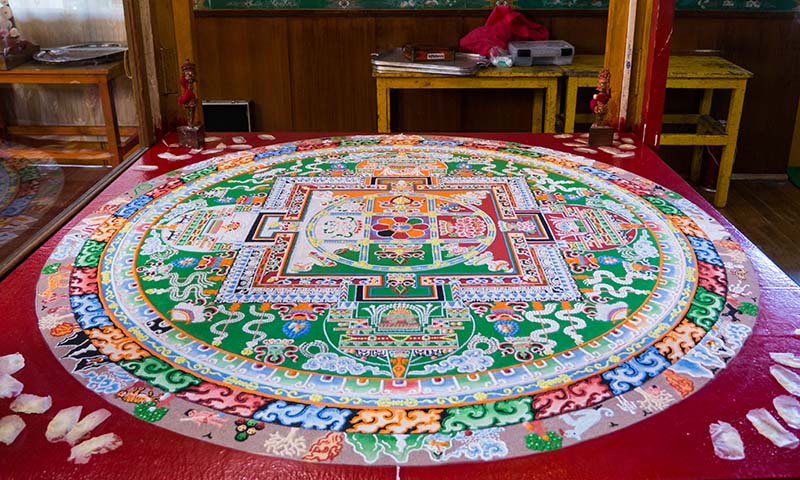
I learned that as a sacred art, whether made of sand, cloth, or metal, its purpose is to be a meditation aid to a tantric practitioner. A sort of blueprint, a sand mandala usually depicts a square multi-storied abode with four gates centered within a circle. Every element, from color, dots, vases, banners, letters, animals, etc., represents an essential part of the deity, his or her teachings, and Buddhist philosophy. Each deity in turn has a retinue of associated deities, which are also depicted. A person contemplating the mandala imagines entering into its palace and encountering all these elements, which is to say, meditates on the qualities and teachings they symbolize. To a devout practitioner, a mandala ultimately represents the mind of the Buddha.
An esoteric and advanced practice, Tibetan Buddhist tantra (also known as Vajrayana) is intended for the properly receptive initiate, with guidance from a qualified teacher or lama. It is an accelerated, experiential way to realize the Buddhist wisdom of the ultimate nature of mind and reality, and great compassion. First taught by the historical Shakyamuni Buddha over 2500 years ago, it has been passed through oral tradition by lineage teachers. Its goal is enlightenment of the practitioner for the benefit of all sentient beings. And, believe me, this means all. One of my favorite little prayers is one I learned on a meditation retreat, and it goes like this:
May all beings, large or small
or middling, near or far,
visible or invisible,
born or yet to be born,
May all beings be happy and content.
Let no one deceive another.
Let no one despise another,
whether out of greed, hatred, or ignorance.
And as a mother would risk her life
to save her only child,
let us cultivate this feeling
of loving friendliness towards one another.
Quite a vast scope! And speaking of scope, there are literally hundreds of tantric deities, each with unique mandalas representing different sets of details and qualities specific to his or her teachings and practice. All varieties transmit fundamentally the same Buddhist wisdom and compassion, but each deity provides a different identity with which practitioners, according to their particular personality, can relate to or find affinity with. It is important to note that it is understood in tantra that none of these deities are real in the conventional sense. They do not exist, but are symbols, visualized in their mandala in a specific and procedural meditation practice.
This multiplicity is something Buddhism shares with its Hindu beginnings. Prince Siddhartha, after all, was born and raised a Hindu before his ascetic wanderings led him to enlightenment as Shakyamuni Buddha. I really appreciate India’s cultural acceptance of many-paths-to-the-same-truth. I understand that Hindu deities are so vast they number in the millions. This acknowledgement of relativity, even acceptance of the co-existence of apparent contradiction, is truly an admirable hallmark of Hinduism, and in particular, Buddhist non-duality.
Although intricate, aesthetically compelling, and often mysterious to the non-practitioner, mandalas are meant for religious use and are not intended as works of art for museum or private collection. In fact, I had occasion recently to discuss this very topic with a Buddhist nun. Her position was that tantra is a secret and profound practice, the art of which should only be for the eyes of practitioners. What would it serve to reveal what is not meant for the uninitiated? While I can understand her viewpoint, I believe that since the Tibetan diaspora has led to the spread of Buddhist teachings, and the increasingly ubiquitous access to seeing tantric mandalas, it is better for the sake of education to reveal some things about them accurately rather than risk erroneous speculation and misunderstanding.
In 1988, the Dalai Lama permitted the first public construction of a mandala in the West as a means of teaching about and preserving Tibetan culture. This was the Kalachakra Mandala, an example of which can be seen here, constructed in sand at the Museum of Natural History in New York City by Namgyal monks from Dharamsala, India. He also felt that it would be a benefit because a mandala is thought to bring peace and harmony to the area where it is being created. Even viewing a mandala is believed by Buddhists to be enough to effect positive change for greater compassion, awareness, and a better sense of well-being.
Since the construction of this first mandala in the West, many have been created all over the world. Drepung Gomang Monastery in Southern India has a group of monks who come to the United States annually to demonstrate their arts through the Sacred Arts Tour. Last year, I had the privilege to witness and document a Compassion Sand Mandala which these monks made as an offering to the Dalai Lama on the occasion of his talks on Compassion and Creativity at Western Connecticut State University.
Beyond the artistic representation of a mandala, there is the mandala principle, which I believe was first clearly articulated and taught in the U.S. by Chogyam Trungpa Rinpoche. (See his book Orderly Chaos: The Mandala Principle) From a philosophical point of view, everything is dependently interrelated, the seeming order and chaos are one and the same, the joy and the suffering, and so forth. The apparent dualities abound, and yet they are all constituently the same.
In real life situations, I think of mandala principle as Buddhism-in-action in the sense that your immediate surroundings is your mandala, and all the people you encounter are part of it, too. You have Buddha-nature within you, and so do they. With awareness and practice that comes from meditation, you have at every moment the potential to actualize compassion and wisdom in what you think, what you say, and what you do.