Mangyu

Yamantaka, the Documentary is Here!


At long last, I’ve finished editing this documentary! You can see it above or go to this Vimeo link where Yamantaka is uploaded.

Yamantaka, what an esoteric and complex practice. This candid view of a Tibetan Buddhist  highest yoga tantra was filmed over the course of ten days at Namgyal Monastery in Dharamsala, India. You will see monks create an elaborate sand mandala, ritual cakes, and other sacred arts, offer prayers, chant, play ritual instruments, purify and meditate. On the last day, the sand mandala is swept into a vase and released into the world as a blessing for all. This is always the breathtaking but cringe-worthy part, for those of us who treasure and want to hold onto the beauty of a meticulously created mandala.

I would like to say I am grateful to the Office of His Holiness the Dalai Lama and Namgyal Monastery for the opportunity to document this event. This feature length video was also made possible in part by the support of Fulbright-Nehru Research Program, Council for the International Exchange of Scholars, and United States-India Education Foundation.

Ideally, I would have liked to complete and release this documentary last year, but I’ve learned that one simply cannot rush certain things. Especially when careful viewing and understanding of the footage is at stake. Add to this the required post-production magic of removing flickering segments, compensating for low lighting conditions, color adjustments, fixing sound challenges, and so forth, and you have an enduring, long workflow at hand.

But, hey, slack must be cut for the fact that the intervening mini-documentaries on Tabo, Lamayuru, Lhalung, and Mangyu Monasteries were also in simultaneous production. See the interiors of these rare, medieval Buddhist temples here, said to be founded by The Great Translator Rinchen Zangpo and King Yeshe O’d of Guge, Western Tibet, circa late 10th to 11th century, located in Spiti and Ladakh regions of the Western Himalayas, India. Read more about them here.

Incidentally, many viewers have asked me about what is happening at around 42:14 in the Yamantaka video, where a young Caucasian man is in the Main Temple talking loudly and animatedly to a gathering of monks. This was a debate exam in session for students of the Institute of Buddhist Dialectics (which adjoins Namgyal Monastery), characterized by dramatic and distinctive hand clapping, body motions, and rhetoric. It was an event unrelated to Yamantaka, but which coincided with it.Tibetan Buddhists have a long and famed tradition of continuing the ancient Indian Buddhist practice of philosophical debate.
Transitions Back to the U.S.

Gee, I’ve so far recounted only the September travels through Spiti, Lahaul, and Ladakh. There’s also October, November, and December to cover. Keeping this travelogue about my Fulbright experiences is taking longer than I anticipated!  Editing photos (lots) and video (much) take time. So does research and writing.

And guess what? Now I have completed my Fulbright in India! Yes, that’s right, I’m back in the U.S.! It’s unbelievable how time flew by. I arrived just before Christmas holidays to rejoin family and friends, and rang in 2014 at home.

But, dear reader, there is much more to come. This blog is not over yet. After I finished traveling through the Himalayan high altitudes, I went to the lower altitude areas of Dharamsala, Bir, and Rewalsar (Tso Pema) to see the artwork of contemporary monasteries.

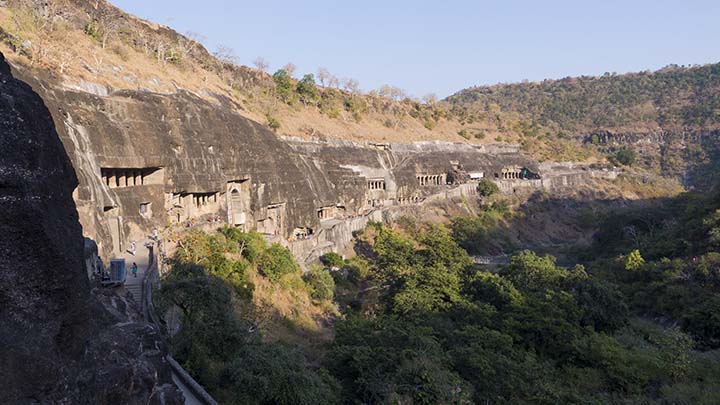
Plus, I also went to see the Buddhist carvings and frescoes of Ajanta, Ellora, and Aurangabad Caves in Southern India. These date from 2nd century B.C.E. to 8th century C.E., preceding the Indo-Tibetan period that I have been concentrating on in the Spiti, Lahaul, and Ladakh areas.  After researching the sacred artwork of 10th century monasteries such as Tabo, Lamayuru, Lhalung, Mangyu, and Alchi, I felt compelled to see what came before. 

Ajanta coming up next! Here is a sneak peak. I promise you’ll never think of the word “cave” the same way again! 

Ajanta Caves, a UNESCO World Heritage site, India
Ajanta Caves, a UNESCO World Heritage site located in a horse-shoe shaped river valley, approximately 30 elaborately carved and painted rock-cut caves dating circa 2nd century B.C.E to 480 or 650 C.E. Buddhist caves, near Aurangabad, India
Ajanta Cave 26, India
Ajanta Cave 26, a chaitya hall with stupa, colonnade walkway, and carved relief sculptures. Seen on left wall is Buddha in his parinirvana pose, India

All photos © 2013, Eva Lee.

Out of Order in the Himalayas

It will be a bit out of order, but what the heck….Of course, I mean out of sequence, not broken!

I’m working on retroactive blog posts of basically all my experiences from last month’s travels through Spiti, Lahaul, and Ladakh to research and document Indo-Tibetan murals. Why didn’t I just post along the way? Because, internet stick and four SIM cards later, I was not able to access the internet while on the road. Especially in electricity-challenged Spiti, where kerosene for generators is even rationed, and Ladakh, border security area where cellular and other signals are highly controlled. I gave up trying and decided I would post when I got back to Dharamsala.

And here I am back in Dharamsala…but I did not think it would take long to back-post since I’ve already written a lot of material while still traveling. However, with image management and identification of thousands of photos shot in monasteries, it’s proving to be more time-consuming to present with accompanying photos. And who wants to read text here without the images? Not me!

So here’s what I’m going to do.  I’m going to toggle back and forth between posting about the present, and posting about last month, as I continue researching here in the lower Himalayas. In addition to Dhangkar and Lhalung Monasteries which are already here on this blog, stay tuned for accounts of what I saw and did at Key Monastery, Tabo Monastery, Kardang, Guru Ghantal, Shashur, Tayul, and Poekar Monasteries, including Phakpa in Triloknath and Markul Devi Temple in Udaipur sojourns. Then Alchi, Mangyu, Lamayuru, Likir, Shey, Thiksey, Hemis, and Mulbek Chamba Monasteries.  Yes, jam-packed with history, anecdotes, incredible landscapes, and ponderings!