McLeod Ganj

Dharamsala Home Sweet Home

I find myself steeped in good memories of McLeod Ganj, Dharamsala, where I lived and continued research for over two months after I finished traveling through Spiti, Lahaul, and Ladakh.

Temple square, near Dalai Lama's Namgyal Monastery, McLeod Ganj, Dharamsala, India
Early morning at Temple Square, near Dalai Lama’s Namgyal Monastery, McLeod Ganj, Dharamsala, India
McLeod Ganj street in monsoon
Jogibara Road in monsoon season, McLeod Ganj, Dharamsala, India

Home of His Holiness the 14th Dalai Lama, Namgyal Monastery, the Tibetan government-in-exile, and a Tibetan and Indian community, this former British hill station in the foothills of the Himalayas attracts visitors from far and wide. They come to attend teachings, events, study, volunteer, get involved. There are a large number of Western expats living here, too.

I descended from the high altitudes and arrived in McLeod Ganj (approx. 6000 feet altitude) end of September. It was surprisingly still monsoon season, which is usually over by mid-month. But 2013 was a particularly long and relentless monsoon. Everyone agreed. It lasted well into October, and I was drenched many times mistakenly thinking I could quickly go from point A to point B and not get too wet.

The area is one of the wettest in the state of Himachal Pradesh, with up to 120 inches of rain from July to mid-September. 120 inches! In six weeks. That’s 20 inches a week, almost 3 inches a day! You gird yourself for constant moisture, fog, mold, and mildew. Hanging laundry takes close to two days to dry. Resident friends warned me to safeguard all my electronics by putting them in a closet with hot lamps shining on them. It’s practically a whiteout at times, dangerous for driving because you can’t see beyond 10 or 12 feet in front of you on mountainous hairpin turns.

Monsoon mist view, Dharamsala
Whiteout monsoon mist view, McLeod Ganj, Dharamsala

Downpours pelt you like sheets of water performing a sports arena wave (you know, where sports fans get up from their seats and raise their arms overhead in succession). No really, you can actually see this phenomena of denser sheets of rain cascading across less dense ones over the valleys and on the streets. An umbrella is futile. I used one anyway out of stubborn habit, and I was almost always ruefully muttering to myself when I arrived some place with clothing stuck to me like I had put them on straight out of a washing machine with a broken spin cycle. I finally learned that when a Dharamsala monsoon rain starts, you WILL be drenched unless you duck for cover. I started carrying a poncho. And there is a reason why locals wear flip flops and brave the wet streets open-toed. It’s because normal shoes become spongy, perpetually dank and musty.

And then, one day, it’s over! The clouds and mist clear up. The horizon expands and Dharamsala, or Dasa as it is fondly called for short, looks like this.

Post-monsoon season, sunshine galore in Dharamsala

Glorious and crisp, far as your eye can see. Warm and sunny.

View of McLeod Ganj, Dharamsala, India
View of McLeod Ganj near Namgyal Monastery, Dharamsala, India
View of McLeod Ganj, Dharamsala, India, from rooftop restaurant
View of McLeod Ganj from Ashoka Restaurant rooftop, Dharamsala, India
View of McLeod Ganj, near Namgyal Monastery

The street vendors no longer have to cover their wares from rain and mud with tarp.

Temple Road, McLeod Ganj, Dharamsala, India
Upper Temple Road, McLeod Ganj, Dharamsala, India

People enjoy outdoor dining and cafes again.
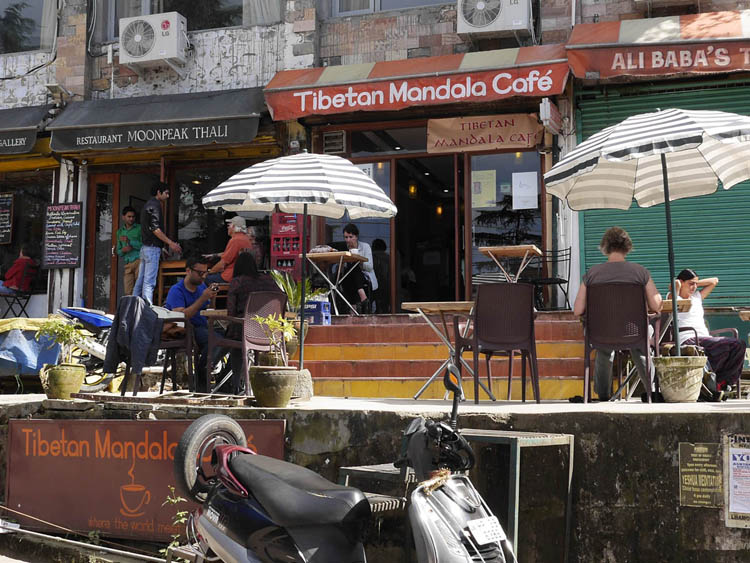
Cafes on Temple Road, McLeod Ganj, Dharamsala, India
Cafe row on Temple Road, McLeod Ganj, Dharamsala, India

This was my usual walk on Temple Road back to where I was staying, near Namgyal Monastery.
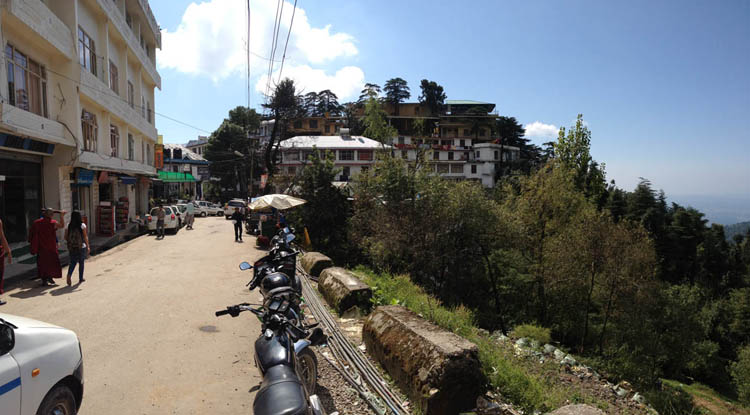
Temple Road, McLeod Ganj, Dharamsala, India
Lower Temple Road, heading towards Namgyal Monastery, McLeod Ganj, Dharamsala, India
Namgyal Monastery complex visible here through the trees
Namgyal Monastery visible here through the trees. The upper yellow buildings are open to the public where the main temples are located. Lower white buildings are monks quarters and other private areas.

Stores that I became acquainted with along the way.
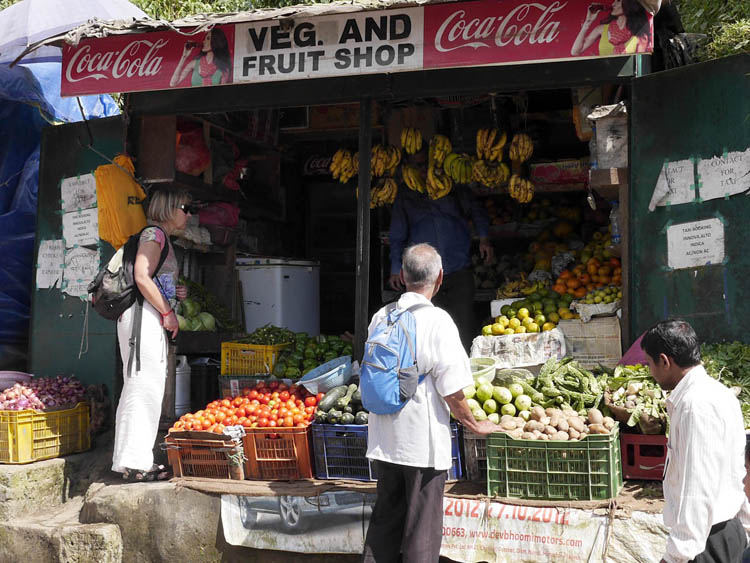
A typical fruit and vegetable stand, McLeod Ganj, Dharamsala, India

I was a regular at this stationary store. Go figure, I just never had enough pens or pads or envelopes, or superglue. I bought paper clasps here which served as clothespins or toothpaste tube holders, or food clips. Travel makes me look at objects more resourcefully.

My local stationary supply store on Temple Road, McLeod Ganj, Dharamsala, India
Local stationary supply store on Temple Road, McLeod Ganj, Dharamsala, India

This shop always caught my eye with its colorful display.

Clothing store with Western fashions and trekking gear, Temple Road, McLeod Ganj, Dharamsala

At left, the location of a trusty ATM machine! Very important. I was grateful that it always worked, which is not always the case elsewhere in India.

Jogibara Road, McLeod Ganj, Dharamsala, India
Continuation of Temple Road heading towards the main chowk or square, McLeod Ganj, Dharamsala, India

This is the raucous main square of McLeod Ganj, where several main roads converge. Where buses, taxis, and tourists depart and arrive. Where there is sure to be traffic jams throughout the day caused by congestion, narrow roads, crossing people animals.

The raucous main chowk or square, always a busy meeting place, McLeod Ganj

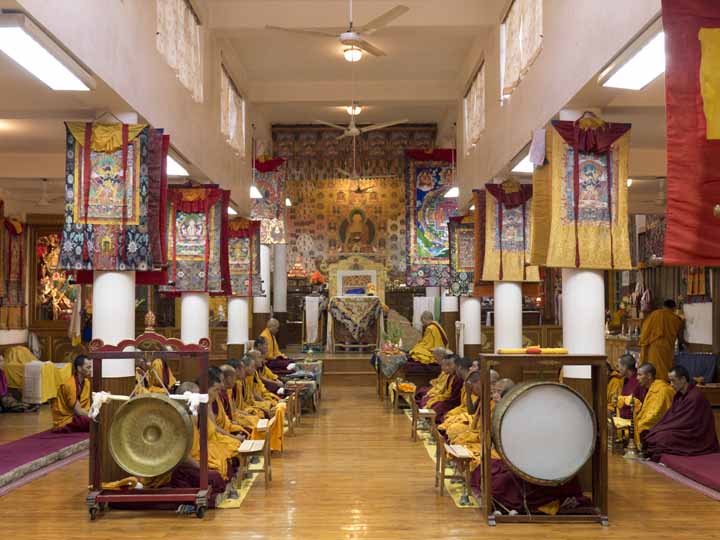
During my time in Dasa, I had the fortune of attending no less than three of the Dalai Lama’s teachings at Namgyal Monastery, including a Mind & Life conference, which I wrote about here. I also had the honor of audience with local rinpoches, geshes, monks and administrators, as well as observing and documenting the annual Yamantaka highest yoga tantra ritual.
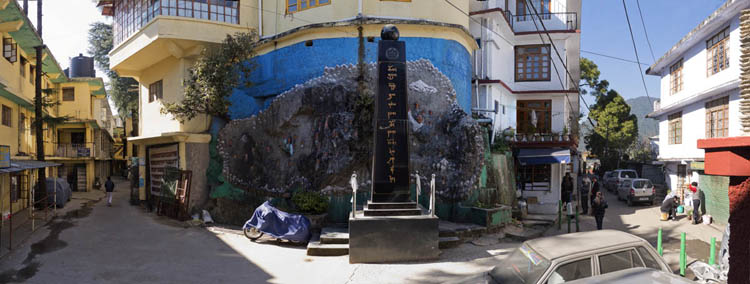
Panorama of entrance to Namgyal Monastery, McLeod Ganj
Yamantaka morning rituals, Namgyal Monastery, McLeod Ganj
Assembly for Yamantaka morning ritual, Namgyal Monastery, McLeod Ganj

In addition, I attended the Tibetan Film Festival, as well as the Dharamsala International Film Festival, both held at Tibetan Institute for Performing Arts (TIPA).

Tibetan Film Festival 2013 at Tibetan Institute of Performing Arts (TIPA), McLeod Ganj
Lunch hour outdoor performances during Tibetan Film Festival 2013,
held at Tibetan Institute of Performing Arts (TIPA), McLeod Ganj

Plus, a number of music-poetry-art fusion events staged by local artists. Poetry would be read during live musical performances, while a painter begins and completes a painting on canvas in one evening.
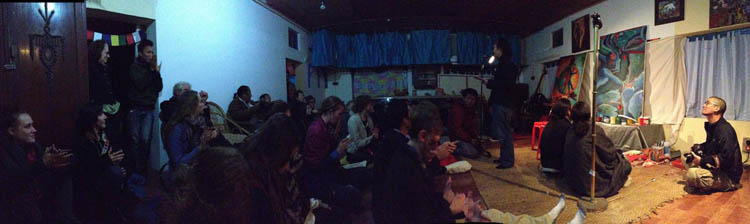
Music-poetry-art fusion event, Dharamsala, India

There was a revolving door of gatherings, which I’m grateful to Dasa friends for inviting me to. Diwali celebrations, dinners, movie nights, artist meetings, music jams, salons, fundraisers. Truly warm, good times.

1-Dasa (25)
A welcome daily visitor

When not out and about, I was in my apartment, which incidentally came with a kitty. She showed up on my terrace one day.

I must say she was a welcome visitor. Although she left a lot of nose smears looking in through my newly cleaned window, she did accompany me many days as I sat indoors editing footage, photo-correcting, researching, and writing.

Verma House, a lovely place to stay, McLeod Ganj
Evidence of looking in on me a few too many times

Which reminds me of a story I heard about the Dalai Lama, who once had two cats as pets. After they spent their last days with him in his palace, he decided he would not have pets anymore–too much attachment!

Yes, indeed, I was sad to leave this little one, but happy to learn that she actually belonged to my neighbor.

On my last day in Dharamsala, I left a bag of cat food at their doorstep, then went for a final kora around the monastery complex on this fine, scintillating morning.

Panorama of Namgyal Monastery circumambulatory, McLeod Ganj, Dharamsala
Panorama of Namgyal Monastery circumambulatory, McLeod Ganj

All photos © 2013, Eva Lee.

But Wait, a Bit about Mandalas

Okay, I know I promised to post Part Two of Tabo Monastery next, but as I’ve been writing, I’ve found it necessary to do a lot of explaining.  In fact, so much explaining in between the photos of Tabo’s interior that it’s a bit interrupting. So I’ve decided to get the explaining done with first. All right with you? Great, read on!

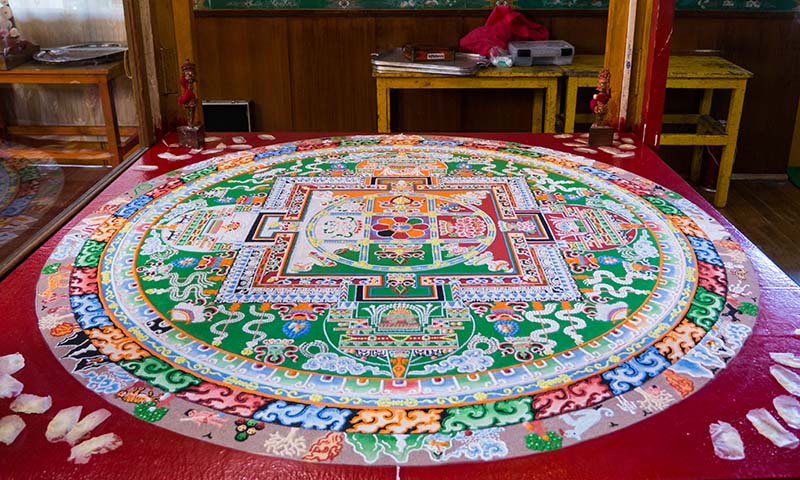
When I first came to Namgyal Monastery in 2010 to observe and document a highest yoga tantra ritual Yamantaka, I knew precious little about the vast world of Tibetan Buddhist tantric deities. What I knew was that an elaborate sand mandala would be made by the Dalai Lama’s monks in their temple in McLeod Ganj, India. I did not know at that time, for example, that this intricate 2-dimensional Yamantaka design represented a 3-dimensional palace, in which the deity resides at the center.

Yamantaka Sand Mandala
Yamantaka Sand Mandala, Namgyal Monastery, India

I learned that as a sacred art, whether made of sand, cloth, or metal, its purpose is to be a meditation aid to a tantric practitioner. A sort of blueprint, a sand mandala usually depicts a square multi-storied abode with four gates centered within a circle. Every element, from color, dots, vases, banners, letters, animals, etc., represents an essential part of the deity, his or her teachings, and Buddhist philosophy. Each deity in turn has a retinue of associated deities, which are also depicted. A person contemplating the mandala imagines entering into its palace and encountering all these elements, which is to say, meditates on the qualities and teachings they symbolize. To a devout practitioner, a mandala ultimately represents the mind of the Buddha.

An esoteric and advanced practice, Tibetan Buddhist tantra (also known as Vajrayana) is intended for the properly receptive initiate, with guidance from a qualified teacher or lama. It is an accelerated, experiential way to realize the Buddhist wisdom of the ultimate nature of mind and reality, and great compassion.  First taught by the historical Shakyamuni Buddha over 2500 years ago, it has been passed through oral tradition by lineage teachers. Its goal is enlightenment of the practitioner for the benefit of all sentient beings. And, believe me, this means all.  One of my favorite little prayers is one I learned on a meditation retreat, and it goes like this:

May all beings, large or small
or middling, near or far,
visible or invisible,
born or yet to be born,
May all beings be happy and content.
Let no one deceive another.
Let no one despise another,
whether out of greed, hatred, or ignorance.
And as a mother would risk her life
to save her only child,
let us cultivate this feeling
of loving friendliness towards one another.

Quite a vast scope!  And speaking of scope, there are literally hundreds of tantric deities, each with unique mandalas representing different sets of details and qualities specific to his or her teachings and practice. All varieties transmit fundamentally the same Buddhist wisdom and compassion, but each deity provides a different identity with which practitioners, according to their particular personality, can relate to or find affinity with. It is important to note that it is understood in tantra that none of these deities are real in the conventional sense. They do not exist, but are symbols, visualized in their mandala in a specific and procedural meditation practice.

This multiplicity is something Buddhism shares with its Hindu beginnings.  Prince Siddhartha, after all, was born and raised a Hindu before his ascetic wanderings led him to enlightenment as Shakyamuni Buddha.  I really appreciate India’s cultural acceptance of many-paths-to-the-same-truth.  I understand that Hindu deities are so vast they number in the millions.  This acknowledgement of relativity, even acceptance of the co-existence of apparent contradiction, is truly an admirable hallmark of Hinduism, and in particular, Buddhist non-duality.

Although intricate, aesthetically compelling, and often mysterious to the non-practitioner, mandalas are meant for religious use and are not intended as works of art for museum or private collection. In fact, I had occasion recently to discuss this very topic with a Buddhist nun.  Her position was that tantra is a secret and profound practice, the art of which should only be for the eyes of practitioners.  What would it serve to reveal what is not meant for the uninitiated? While I can understand her viewpoint, I believe that since the Tibetan diaspora has led to the spread of Buddhist teachings, and the increasingly ubiquitous access to seeing tantric mandalas, it is better for the sake of education to reveal some things about them accurately rather than risk erroneous speculation and misunderstanding.

In 1988, the Dalai Lama permitted the first public construction of a mandala in the West as a means of teaching about and preserving Tibetan culture. This was the Kalachakra Mandala, an example of which can be seen here, constructed in sand at the Museum of Natural History in New York City by Namgyal monks from Dharamsala, India. He also felt that it would be a benefit because a mandala is thought to bring peace and harmony to the area where it is being created. Even viewing a mandala is believed by Buddhists to be enough to effect positive change for greater compassion, awareness, and a better sense of well-being.

Since the construction of this first mandala in the West, many have been created all over the world. Drepung Gomang Monastery in Southern India has a group of monks who come to the United States annually to demonstrate their arts through the Sacred Arts Tour.  Last year, I had the privilege to witness and document a Compassion Sand Mandala which these monks made as an offering to the Dalai Lama on the occasion of his talks on Compassion and Creativity at Western Connecticut State University.

Beyond the artistic representation of a mandala, there is the mandala principle, which I believe was first clearly articulated and taught in the U.S. by Chogyam Trungpa Rinpoche.  (See his book Orderly Chaos: The Mandala Principle) From a philosophical point of view, everything is dependently interrelated, the seeming order and chaos are one and the same, the joy and the suffering, and so forth.  The apparent dualities abound, and yet they are all constituently the same.

In real life situations, I think of mandala principle as Buddhism-in-action in the sense that your immediate surroundings is your mandala, and all the people you encounter are part of it, too.  You have Buddha-nature within you, and so do they.  With awareness and practice that comes from meditation, you have at every moment the potential to actualize compassion and wisdom in what you think, what you say, and what you do.