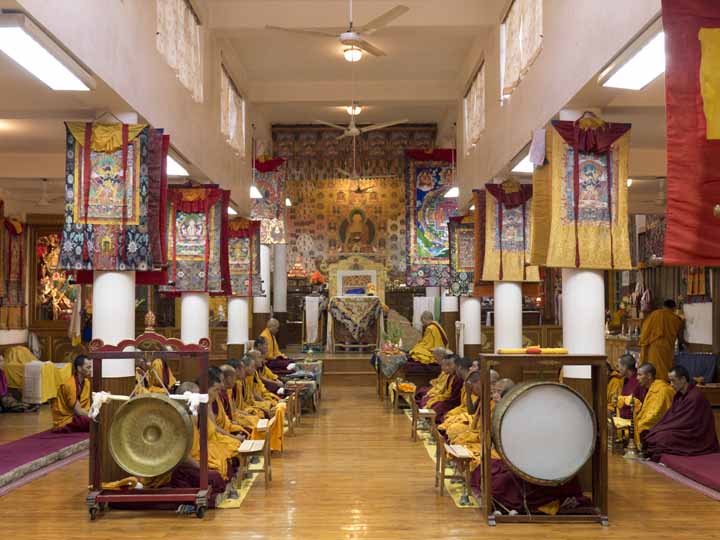
Mind & Life conference

Dharamsala Home Sweet Home

I find myself steeped in good memories of McLeod Ganj, Dharamsala, where I lived and continued research for over two months after I finished traveling through Spiti, Lahaul, and Ladakh.

Temple square, near Dalai Lama's Namgyal Monastery, McLeod Ganj, Dharamsala, India
Early morning at Temple Square, near Dalai Lama’s Namgyal Monastery, McLeod Ganj, Dharamsala, India
McLeod Ganj street in monsoon
Jogibara Road in monsoon season, McLeod Ganj, Dharamsala, India

Home of His Holiness the 14th Dalai Lama, Namgyal Monastery, the Tibetan government-in-exile, and a Tibetan and Indian community, this former British hill station in the foothills of the Himalayas attracts visitors from far and wide. They come to attend teachings, events, study, volunteer, get involved. There are a large number of Western expats living here, too.

I descended from the high altitudes and arrived in McLeod Ganj (approx. 6000 feet altitude) end of September. It was surprisingly still monsoon season, which is usually over by mid-month. But 2013 was a particularly long and relentless monsoon. Everyone agreed. It lasted well into October, and I was drenched many times mistakenly thinking I could quickly go from point A to point B and not get too wet.

The area is one of the wettest in the state of Himachal Pradesh, with up to 120 inches of rain from July to mid-September. 120 inches! In six weeks. That’s 20 inches a week, almost 3 inches a day! You gird yourself for constant moisture, fog, mold, and mildew. Hanging laundry takes close to two days to dry. Resident friends warned me to safeguard all my electronics by putting them in a closet with hot lamps shining on them. It’s practically a whiteout at times, dangerous for driving because you can’t see beyond 10 or 12 feet in front of you on mountainous hairpin turns.

Monsoon mist view, Dharamsala
Whiteout monsoon mist view, McLeod Ganj, Dharamsala

Downpours pelt you like sheets of water performing a sports arena wave (you know, where sports fans get up from their seats and raise their arms overhead in succession). No really, you can actually see this phenomena of denser sheets of rain cascading across less dense ones over the valleys and on the streets. An umbrella is futile. I used one anyway out of stubborn habit, and I was almost always ruefully muttering to myself when I arrived some place with clothing stuck to me like I had put them on straight out of a washing machine with a broken spin cycle. I finally learned that when a Dharamsala monsoon rain starts, you WILL be drenched unless you duck for cover. I started carrying a poncho. And there is a reason why locals wear flip flops and brave the wet streets open-toed. It’s because normal shoes become spongy, perpetually dank and musty.

And then, one day, it’s over! The clouds and mist clear up. The horizon expands and Dharamsala, or Dasa as it is fondly called for short, looks like this.

Post-monsoon season, sunshine galore in Dharamsala

Glorious and crisp, far as your eye can see. Warm and sunny.

View of McLeod Ganj, Dharamsala, India
View of McLeod Ganj near Namgyal Monastery, Dharamsala, India
View of McLeod Ganj, Dharamsala, India, from rooftop restaurant
View of McLeod Ganj from Ashoka Restaurant rooftop, Dharamsala, India
View of McLeod Ganj, near Namgyal Monastery

The street vendors no longer have to cover their wares from rain and mud with tarp.

Temple Road, McLeod Ganj, Dharamsala, India
Upper Temple Road, McLeod Ganj, Dharamsala, India

People enjoy outdoor dining and cafes again.
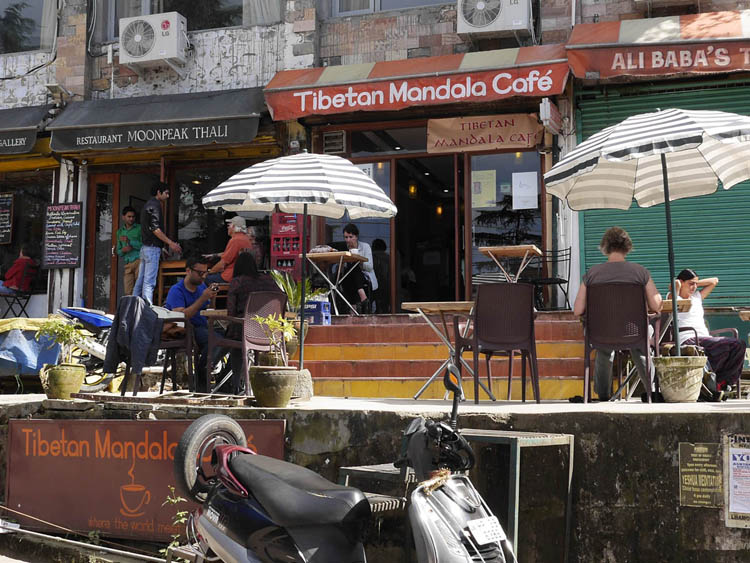
Cafes on Temple Road, McLeod Ganj, Dharamsala, India
Cafe row on Temple Road, McLeod Ganj, Dharamsala, India

This was my usual walk on Temple Road back to where I was staying, near Namgyal Monastery.
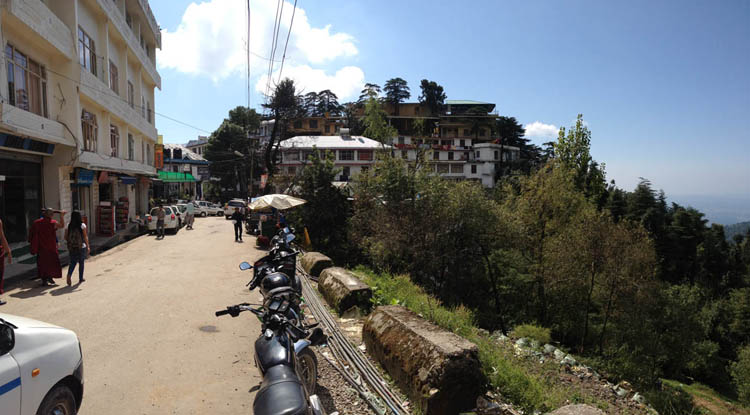
Temple Road, McLeod Ganj, Dharamsala, India
Lower Temple Road, heading towards Namgyal Monastery, McLeod Ganj, Dharamsala, India
Namgyal Monastery complex visible here through the trees
Namgyal Monastery visible here through the trees. The upper yellow buildings are open to the public where the main temples are located. Lower white buildings are monks quarters and other private areas.

Stores that I became acquainted with along the way.
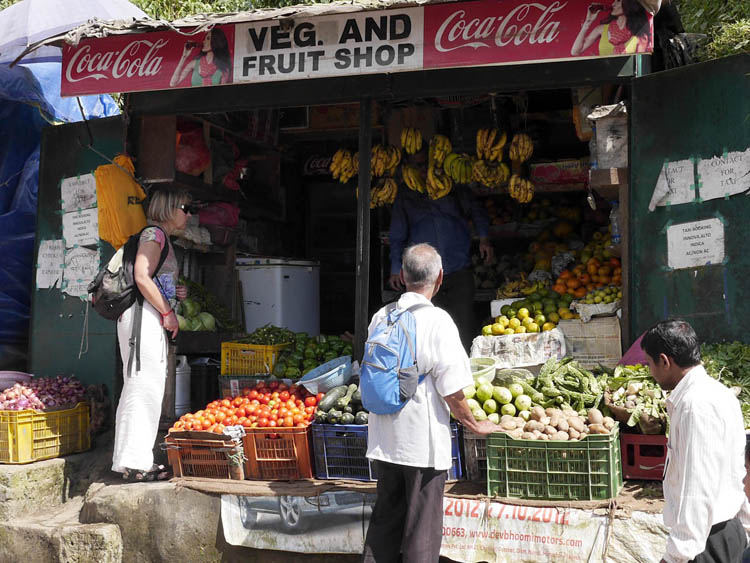
A typical fruit and vegetable stand, McLeod Ganj, Dharamsala, India

I was a regular at this stationary store. Go figure, I just never had enough pens or pads or envelopes, or superglue. I bought paper clasps here which served as clothespins or toothpaste tube holders, or food clips. Travel makes me look at objects more resourcefully.

My local stationary supply store on Temple Road, McLeod Ganj, Dharamsala, India
Local stationary supply store on Temple Road, McLeod Ganj, Dharamsala, India

This shop always caught my eye with its colorful display.

Clothing store with Western fashions and trekking gear, Temple Road, McLeod Ganj, Dharamsala

At left, the location of a trusty ATM machine! Very important. I was grateful that it always worked, which is not always the case elsewhere in India.

Jogibara Road, McLeod Ganj, Dharamsala, India
Continuation of Temple Road heading towards the main chowk or square, McLeod Ganj, Dharamsala, India

This is the raucous main square of McLeod Ganj, where several main roads converge. Where buses, taxis, and tourists depart and arrive. Where there is sure to be traffic jams throughout the day caused by congestion, narrow roads, crossing people animals.

The raucous main chowk or square, always a busy meeting place, McLeod Ganj

During my time in Dasa, I had the fortune of attending no less than three of the Dalai Lama’s teachings at Namgyal Monastery, including a Mind & Life conference, which I wrote about here. I also had the honor of audience with local rinpoches, geshes, monks and administrators, as well as observing and documenting the annual Yamantaka highest yoga tantra ritual.
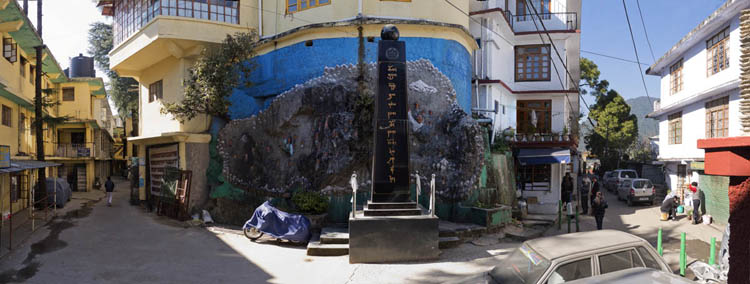
Panorama of entrance to Namgyal Monastery, McLeod Ganj
Yamantaka morning rituals, Namgyal Monastery, McLeod Ganj
Assembly for Yamantaka morning ritual, Namgyal Monastery, McLeod Ganj

In addition, I attended the Tibetan Film Festival, as well as the Dharamsala International Film Festival, both held at Tibetan Institute for Performing Arts (TIPA).

Tibetan Film Festival 2013 at Tibetan Institute of Performing Arts (TIPA), McLeod Ganj
Lunch hour outdoor performances during Tibetan Film Festival 2013,
held at Tibetan Institute of Performing Arts (TIPA), McLeod Ganj

Plus, a number of music-poetry-art fusion events staged by local artists. Poetry would be read during live musical performances, while a painter begins and completes a painting on canvas in one evening.
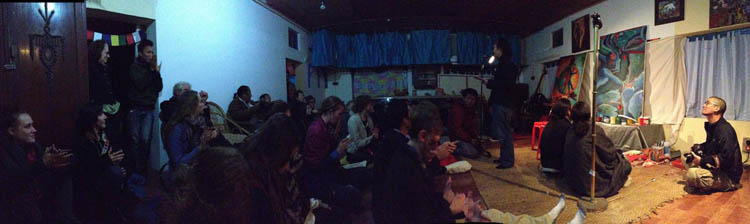
Music-poetry-art fusion event, Dharamsala, India

There was a revolving door of gatherings, which I’m grateful to Dasa friends for inviting me to. Diwali celebrations, dinners, movie nights, artist meetings, music jams, salons, fundraisers. Truly warm, good times.

1-Dasa (25)
A welcome daily visitor

When not out and about, I was in my apartment, which incidentally came with a kitty. She showed up on my terrace one day.

I must say she was a welcome visitor. Although she left a lot of nose smears looking in through my newly cleaned window, she did accompany me many days as I sat indoors editing footage, photo-correcting, researching, and writing.

Verma House, a lovely place to stay, McLeod Ganj
Evidence of looking in on me a few too many times

Which reminds me of a story I heard about the Dalai Lama, who once had two cats as pets. After they spent their last days with him in his palace, he decided he would not have pets anymore–too much attachment!

Yes, indeed, I was sad to leave this little one, but happy to learn that she actually belonged to my neighbor.

On my last day in Dharamsala, I left a bag of cat food at their doorstep, then went for a final kora around the monastery complex on this fine, scintillating morning.

Panorama of Namgyal Monastery circumambulatory, McLeod Ganj, Dharamsala
Panorama of Namgyal Monastery circumambulatory, McLeod Ganj

All photos © 2013, Eva Lee.

Thoughts on Craving, Desire, and Addiction in Dharamsala

I just spent the past week attending Mind & Life Conference which was held with the Dalai Lama at his residence here in Dharamsala, India. Well, that is, I attended the live broadcast of it at the adjacent Namgyal Monastery. I wish I had been able to be at the conference in person!

I’ve been to public ones in the U.S. and India in the past and they are always thought-provoking, authentically open dialogues between scientists, scholars, and contemplative practitioners. I absolutely love these conferences because exciting interdisciplinary ideas emerge and unexpected conversations evolve about, well, what mind is and how we can work with our minds to live skillfully and beneficially.

Organized around a chosen topic, invited presenters speak about their research or practice, then open it up to questions and discussions. In the process, paradigms, assumptions, and philosophical traditions are examined. Issues are raised for how we can improve or solve humanity’s contemporary problems.

The topic of this one was “Craving, Desire, and Addiction.” Check out the Program and Schedule of Events.  Mind & Life Institute assembled a remarkable group of participants–neuroscientists, clinicians, a sociologist, a Christian mystical scholar, monks, and others–who brought first-person perspectives to the table. One neuroscientist, Mark Lewis, had been an addict himself and talked about his subjective experience of the craving cycle, and his objective one as a researcher working on identifying the neurological structures of the brain involved in and affected by substance abuse.

Some eye-opening things I learned from research findings include the idea of the “erosion of free will” in addiction. Dopamine and serotonin structures in the brain involved in thinking, restraint, and projected rewards are actually altered and “hijacked” by addiction so that addicts are, in fact, biochemically disadvantaged in breaking the cycle of craving-imagining-planning-taking the substance, as opposed to non-addicts. Studies indicate that addiction recurs even though addicts no longer find pleasure in the substance and know that it will cause them and others harm.

One anthropologist presented some stunning statistics about the regulation of addictive substances as a program of prevention. In the U.S., criminalization of drugs has resulted in disproportionate incarceration. The American population is 5% of the world population, but is 25% of the world’s incarcerated! African-Americans form 13% of the U.S. population, but are 45% of those jailed for non-violent drug offense! There seems to be a serious bias in the implementation of drug laws. Another example, in New York City, more white people use marijuana, but more black people are arrested for it.

These facts, and many other compelling ones on prevention, intervention, and treatment were discussed. Incidentally, Mind & Life will be posting videos of the conference soon on its website. So if you missed the live webcasts, you can watch them archived online. I highly recommend it if you are or you know someone who is affected by substance abuse and addiction.

The conference was profound in scope. Key discussions centered on definitions and experiences of desire and craving, and how they can be met and transformed. It was insightful not only for illuminating root causes of suffering for addicts but for all of us living in contemporary materialistic culture where craving things becomes the norm for excessive consumption. I read recently that acquiring more than what you need was considered by many pre-industrialized indigenous cultures as pathological. What prescience!

It makes a lot of sense when you consider the suffering of anxiety, depression, neuroses, and suicides in the U.S. among young people who are desperately stressed, competing with each other towards educational goals aimed ultimately at attaining material wealth. The documentary Race to Nowhere is a disturbing and sad account of this phenomena. It illustrates a basis for the alarming disconnection between emotional health and well-being, and what is defined as “success” in American life. See the trailer here.

And while I’m on this topic, the book Teach Your Children Well: Parenting for Authentic Success also takes an insightful look at how we are raising and educating kids.  The New York Times writes, “It would be easy, on first glance, to dismiss [psychologist] Madeline Levine’s Teach Your Children Well as yet another new arrival in a long line of books that have urged us…to push back and just say no to the pressures of perfectionistic, high-performance parenting. But to give in to first impressions would be a mistake. Levine works with teenagers who are depleted, angry and sad…so lost are they in the pursuit of goals that have drained their lives of pleasure, contentment and connection. ‘Our current version of success is a failure,’ she writes. It’s a damning, and altogether accurate, clinical diagnosis.”

And how much of this cultural milieu might drive people to substance use and abuse in an unfortunate attempt to alleviate suffering? It is known that the harmful patterns of addiction take a profound toll on both the individual and society. According to Mind & Life, addiction to alcohol, tobacco, and illicit drugs, for example, is estimated to cost the United States $600 billion per year. Did you just read that correctly? Yes, you did, $600 BILLION. On the emotional level, it’s immeasurable how deeply it traumatizes families and friends, sometimes for generations.

At this Mind & Life conference, as part of the discussion on effective treatment for addiction, the Dalai Lama advocated prevention through new initiatives in education that increases self-awareness and connection to others through the practice of kindness. Because many social ills come from the hyper-individualism championed by the contemporary industrialized world, such excessive self-focus, he said, ultimately produces separation and unhappiness. It gives rise to an “us and them” mentality which makes aggression, greed, and war possible. Instead, we need to develop not only our thinking skills but our emotional ones as well.

If you’re an educator, counselor, or parent, take a look at this nascent movement and see what you can do to make a difference.

See an example of how incorporating kindness in children’s education works in this PBS video. Groundbreaking studies of children learning through mindfulness and kindness curricula currently under way and developed by University of Wisconsin Center for Investigating Healthy Minds are yielding increases in positive social behavior. See here for further information on this and similar programs.