Padmasambhava

A Look at the Art of Zigar Monastery, Chokyi Lodro, Deer Park Institute in Comparison to Their Indo-Tibetan Predecessors

October 21, 2013

At Rewalsar, visitors may circumambulate the famed Lotus Lake and see the many monasteries built around it today. It is a pilgrimage site for Tibetan Buddhists who revere Padmasambhava (Guru Rinpoche), the Indian tantric master who is said to have performed a miracle here which you can read about in my previous post, Miracle at Lotus Lake and the Secret Caves of Rewalsar.

View of Tso Pema (Lotus Lake) from Zigar Monastery, Rewalsar, India

The most noticeable monastery in Rewalsar these days is Zigar Orgyen Choekorling Monastery because of its 138 feet high golden statue of Guru Rinpoche.

Zigar Monastery features a monumental golden statue of Guru Rinpoche, Tso Pema/Rewalsar, India
Photo: Frederic Martin Duchamp
Zigar Monastery's 138 feet high statue of Guru Rinpoche, Rewalsar (Tso Pema), India
Zigar Monastery’s 138 feet high statue of Guru Rinpoche, Rewalsar (Tso Pema), India
Zigar Monastery's 138 feet high statue of Guru Rinpoche, Rewalsar (Tso Pema), India
Detail of Zigar Monastery’s 138 feet high statue of Guru Rinpoche, Rewalsar (Tso Pema), India
Panorama of Zigar Monastery's courtyard, Rewalsar (Tso Pema), India
Panorama of Zigar Monastery’s courtyard, Rewalsar (Tso Pema), India
Side view of Zigar Monastery's courtyard, Rewalsar (Tso Pema), India
Side view of Zigar Monastery’s courtyard, Rewalsar (Tso Pema), India
Interior of main temple, Zigar Monastery, Rewalsar (Tso Pema)

Quite unexpectedly, inside Zigar Monastery’s main temple this morning, I saw three large sculptures and was struck by how they had sculptural backgrounds attached to the wall highly reminiscent of Indo-Tibetan ones from the 11th century in ancient Western Tibet.

Detail of central altar with Shakyamuni Buddha, Zigar Monastery, Rewalsar (Tso Pema)
Photo: Frederic Martin Duchamp
Detail of central altar with Shakyamuni Buddha, Zigar Monastery, Rewalsar (Tso Pema)
Detail of central altar with Shakyamuni Buddha, and background reminiscent of Indo-Tibetan sculpture, Zigar Monastery, Rewalsar (Tso Pema)

I immediately saw these background sculptural reliefs as contemporary versions of the below artforms. The following are central altars of circa 11th century Lamayuru Monastery’s Senge Lhakhang in Ladakh, and Lhalung Monastery’s Serkhang (Golden Hall) in Spiti.

Detail of altar, Lamayuru Monastery Senge Lhakang, Ladakh, India

The first similarity was the use of relief sculptures attached to the wall. Other key similarities include central figures within a tri-lobed halo, surmounted by the Hindu mythical garuda, ornate scrollwork with figures and animals, in particular the Indian-derived makara, a crocodile-like sea creature. Both ancient and modern sculptures are all made of clay. The contemporary presentation as multi-colored wall reliefs is largely the same as the Indo-Tibetan, even while stylistic handling and some content are different.

Detail of central altar, Lhalung Monastery, Spiti, India
Detail of central altar, Lhalung Monastery Serkhang, Spiti, India

This is the second figure also in the main temple of Zigar Monastery, a Green Tara.

Green Tara, Zigar Monastery, Rewalsar (Tso pema)
Detail of Green Tara, Zigar Monastery, Rewalsar (Tso pema)

And lastly, the third figure, Shakyamuni Buddha in his earth-witness mudra.

Shakyamuni Buddha, Zigar Monastery, Rewalsar (Tso pema)
Detail of Shakyamuni Buddha, Zigar Monastery, Rewalsar (Tso pema)

Above the Zigar Monastery main temple is a smaller temple dedicated to Chenrezig, also known as Avalokiteshvara, deity of compassion.

Chenrezig (Avalokiteshvara), Zigar Monastery, Rewalsar (Tso Pema)

This sculpture, as are the three in the main temple, is by the same artist, beautifully painted and detailed.

Detail of Chenrezig (Avalokiteshvara), Zigar Monastery, Rewalsar (Tso Pema)

I learned that the master sculptor was named Tashi Norbu. I was able to contact him and visit him later in the day. Wow, it was total chance that he was in India and happened to be nearby. He would have been out of the country were it not for an unfortunate recent event which prevented him from going. I was so excited to be able to ask the artist technical and aesthetic questions!

Master sculptor Tashi Norbu
Photo: Frederic Martin Duchamp

Tashi Norbu is Bhutanese, as are many of the artists commissioned by monasteries today to create artwork. In Rinchen Zangpo’s time, 10th-11th centuries, it was Kashmiri artists who were considered the finest artists to give expression to Buddhist concepts, and they were largely the ones responsible for the art of 10th-12th century monasteries in the Himalayas during the Great Second Transmission of Buddhism from India to Tibet.

Main temple, Deer Park Institute, Bir, India

Tashi Norbu was invited to make numerous sculptures in the area. In addition to Zigar Monastery, he created works for Deer Park Institute in Bir, and Dzongsar Khyentse Chokyi Lodro Institute in Chaundra. We went together to visit these sites as I learned about his process.

His account about how Dzongsar Khyentse Rinpoche, who commissioned him for both Deer Park and Chokyi Lodro artwork, was so exacting about getting the face of the Deer Park Manjushri to look “right” (according to its original divined appearance) was so interesting. According to the artist, this required no less than eleven tries–that is, eleven fully sculpted, completed, then discarded heads–and many meditation retreats by the artist together with lamas in order to get it correct. Wow, this was the first time I’d ever heard of this working method.  Be in meditation communally for aesthetic guidance, in order to “see” the work together for the artist to create it.

Manjushri statue by Tashi Norbu, Deer Park Institute, Bir, India
Detail of Manjushri statue by Tashi Norbu, Deer Park Institute, Bir, India

Another rinpoche, on a later separate unrelated occasion, told me this same thing. He said, rather than strategize conceptually to create a “successful” work of art, as he believes many contemporary artists do, instead, an artist should use mindfulness to connect with inner realities and then create from that vision.

Main altar at Chokyi Lodro Institute, Bir, India
Main altar at Chokyi Lodro Institute, Chaundra, India, sculpture by Tashi Norbu

It would be interesting to see Tashi Norbu’s sculptures in progress, from beginning to end. As a painter who has never sculpted, I can’t fathom how one constructs monumental Tibetan Buddhist statues.

He said the underlying forms are wood and iron with wire mesh, concrete, and then final layers are clay.  The clay is made from Tibetan paper mixed with clay and water until the right consistency is achieved.  Then the work is air-dried, carved, primed, painted and gilded. The faces and hands are usually painted in a special pure gold paint made in Nepal.  You can burnish this to bring it up to a luster, but burnishing usually mars the clay surface a bit and affects the details, so this is not done on the faces and hands.

Monumental Buddha, main altar at Chokyi Lodro Institute, Bir, India
Monumental Buddha, main altar at Chokyi Lodro Institute, Chaundra, India

The finished statues have hollow interiors where prayers written on rolled paper and katas (ritual scarves) are placed.

Main temple at Chokyi Lodro Institute, Bir, India
Main temple at Dzongsar Khyentse Chokyi Lodro Institute, Chaundra, India.
Standing with me are Tashi Norbu and Venerable Tenzin
Panorama of Dzongsar Khyentse Chokyi Lodro Institute, Chaundra, India

When I returned to Dharamsala, I told my photographer friend Frederic Martin Duchamp about my trip to Tso Pema, and learned that he happened to have also met Tashi Norbu a few years ago when the artist was sculpting the now completed statues for Zigar Monastery. AND he had photographs of some of them in-progress. What serendipity–or, as the Tibetans say, auspicious coincidence!

So the following are before and after photos of all the main Zigar Monastery statues, thanks to Frederic who has generously shared them with me. Click here to see a short video transition of the first example.

Before and after, Shakyamuni Buddha, Zigar Monastery, Rewalsar, India
Before and after, Shakyamuni Buddha, Zigar Monastery, Rewalsar, India. Photo: Frederic Martin Duchamp
Before and after, Shakyamuni Buddha, Zigar Monastery, Rewalsar, India
Detailed before and after, Shakyamuni Buddha, Zigar Monastery, Rewalsar, India. Photos: Frederic Martin Duchamp
Before and after, Shakyamuni Buddha, Zigar Monastery, Rewalsar, India
Before and after, Green Tara, Zigar Monastery, Rewalsar, India. Photos: Frederic Martin Duchamp
Before and after, Shakyamuni Buddha, Zigar Monastery, Rewalsar, India
Before and after, Shakyamuni Buddha, Zigar Monastery, Rewalsar, India. Photos: Frederic Martin Duchamp
Before and after, Chenrezig, Zigar Monastery, Rewalsar, India
Before and after, Chenrezig, Zigar Monastery, Rewalsar, India. Photo: Frederic Martin Duchamp

All photos © 2013, Eva Lee.
Except where otherwise credited


Miracle at Lotus Lake and the Secret Caves of Rewalsar

October 21, 2013

Now that I’m back in Dharamsala, with eyes fresh from seeing 10th-12th century Indo-Tibetan mandalas in monasteries of Spiti, Lahaul, and Ladakh, I made local trips through these lower Himalayas to see contemporary Tibetan monasteries.

Rewalsar, also known as Tso Pema to Tibetans, Himachal Pradesh, India
Rewalsar, also known as Tso Pema (Lotus Lake) to Tibetans, Himachal Pradesh, India. The monumental golden statue of Padmasambhava (Guru Rinpoche) atop Zigar Orgyen Choekorling Monastery can be seen upper right on the hillside
Photo: bharatdiscovery.org

First stop was Rewalsar, or Tso Pema (Lotus Lake) as Tibetans call it. It is the site of a legendary miracle by Padmasambhava. Also known as Guru Rinpoche, this Indian sage brought Buddhism to Tibet in the 8th century, and is said to have subdued the people and the local blood-thirsty spirits through demonstrations of his magical powers as an adept practitioner.  Padmasambhava is especially revered by the Tibetan Buddhist Nyingma school who regard him as the Second Buddha, the First Buddha being Shakyamuni.

The legend of the lake is that Guru Rinpoche was teaching Princess Mandarava tantra in local secret caves, and she became his consort.  Her father the King of Zahor was greatly displeased and attempted to burn them both in the valley below.  But Guru Rinpoche turned the pyre into water, and the fire became a lake.  Thus, Lotus Lake miraculously came into being and is revered by Tibetan Buddhists.

View of Tso Pema/Lotus Lake near the famed Guru Rinpoche secret caves, Rewalsar
View of Tso Pema/Lotus Lake near the famed Guru Rinpoche secret caves up the hills, Rewalsar

Incidentally, it is also revered by Hindus, who regard the area as Hanuman’s land. Punjabis, as well, because Padmasambhava is one of their ten holy teachers.

After driving up to the hills above Tso Pema, one must go on foot up to the caves. Most of the way is fairly well paved and with stairs.

Pathway up to secret caves of Guru Rinpoche, Rewalsar, India
Pathway up to secret caves of Guru Rinpoche, Rewalsar

It is a pleasant scramble through some rocky but grassy areas, hung with plenty of Tibetan prayer flags.

Tibetan prayer flags on the hillside of Rewalsar caves
Tibetan prayer flags on the continued pathway up to Rewalsar caves

At the top, there is a nunnery with small temples, a cafe for visitors, and dotting the hillside are numerous modest stone huts and cave entrances currently in use by nuns and other retreatants.

Retreat huts and caves used today by nuns and retreatants, Rewalsar, India
Entrances to meditation caves currently in use, Rewalsar
Entrances to meditation caves currently in use, Rewalsar. I like how this is one is called “Cave No. 4,” very practical.
Retreat hut, Rewalsar, India

The landscape is punctuated by crags and boulders.

More abundant Tibetan prayer flags on the hillside of Rewalsar caves, India
More abundant Tibetan prayer flags on the hillside of Rewalsar caves

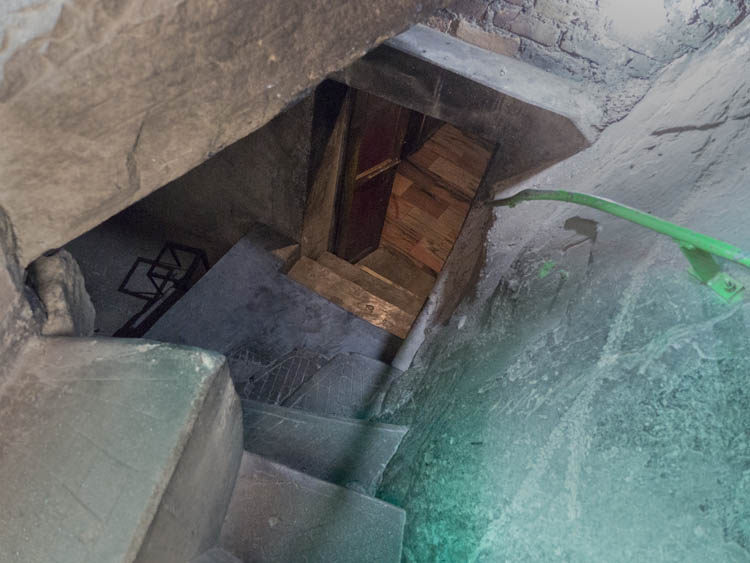
When we finally came upon the secret cave of Guru Rinpoche, the entrance was this steep decline down, which today has cement steps, a doorway, and lighting. I tried to imagine it as the dark natural crack it must have been originally, getting darker as you descended into the cave.

Entrance to Guru Rinpoche's meditation caves, Rewalsar, India
Entrance to Guru Rinpoche’s meditation caves, Rewalsar, India

The stairway leads to a small antechamber which then leads to this section of the cave underground.

Guru Rinpoche meditation cave, Rewalsar, India
Guru Rinpoche meditation cave, Rewalsar

I tried to imagine this cave in Guru Rinpoche’s day, without the flooring, ritual objects and electricity. It must have been a mysterious womb-like place to practice meditation, to contemplate existence in pitch blackness, to truly face nothingness in the subterranean absence of stimuli.

Panorama of Guru Rinpoche meditation cave, Rewalsar, India
Panorama of Guru Rinpoche meditation cave, Rewalsar
Altar inside Guru Rinpoche meditation cave, Rewalsar, India
Altar inside Guru Rinpoche meditation cave, Rewalsar

In another cave is this large statue of Guru Rinpoche, built into a nook where above his head is a natural opening revealing daylight.

Statue of Guru Rinpoche (Padmasambhava), Rewalsar caves, India
Statue of Guru Rinpoche (Padmasambhava), Rewalsar caves
Statue of Guru Rinpoche (Padmasambhava), Rewalsar caves, India
A monk says prayers before a statue of Guru Rinpoche (Padmasambhava), Rewalsar caves

Just beyond this section is a smaller connected cave dedicated to his consort, Princess Mandarava.

Statue of Princess Mandarava, Rewalsar cave
Statue of Princess Mandarava in cave dedicated to Guru Rinpoche’s consort, Rewalsar cave
Cave of Princess Mandarava, looking back out towards larger section containing statue of Guru Rinpoche, Rewalsar cave

It is said that pilgrimage to sacred sites where realized masters practiced meditation, such as these caves, imparts blessings to its visitors.

Rewalsar is also considered an auspicious place to be on retreat. The two Chod practitioners (chodpas) I met in Dharmasala (whom I wrote a bit about here) are currently on a few months’ retreat here.

They invited me to visit with them in their cabin near the caves. So I had planned to be in town when they were on a brief break from their hermitage. I learned that there are two short times of the month, according to the Tibetan lunar calendar, that retreatants may come out of isolation to tend to things outside.

These chodpas are lay tantric practitioners not only working towards enlightenment through Chod rituals (serious esoteric stuff, as one Zen practitioner friend of mine commented, “These guys are hardcore!”) but they are also shamanic healers. As traveling mendicants, they may be invited by community members to conduct prayers for the deceased, the living, and those believed to be wandering spirits.

Panorama of Rewalsar area from chodpa retreat cabin
Panorama of Rewalsar area from chodpa retreat cabin, with Tso Pema (Lotus Lake) visible in distance
Interior of chodpa's retreat hut, Rewalsar
Interior of chodpa’s retreat hut, Rewalsar
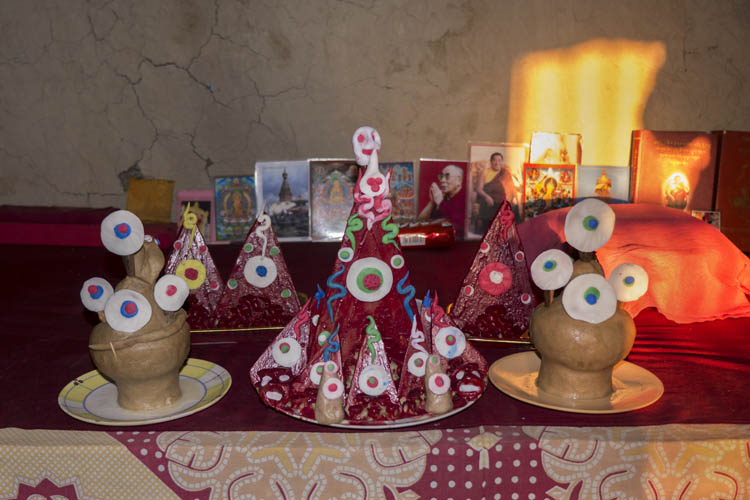
Chod ritual objects made out of flour and water

Pictured above is the one-room cabin of a chodpa. On the long table against the back wall are ritual offerings made from colored flour and water.

During my visit, it so happened that the chodpas recently conducted healing prayers for a child I was acquainted with who suffered from a neurological brain disorder. They showed me some of the ritual objects created and used for this purpose.

I heard separately later that this child, who was located hours away from Rewalsar, demonstrated some unusual and extended calm behavior the day after the Chod treatment. Coincidence? Maybe. Go figure. Nothing in modern science can currently explain such phenomena as Chod healing.

Chod ritual objects made out of flour and water

Over a thousand years later, with the thriving nunnery, occupied caves, retreat huts and monasteries of Rewalsar, it certainly seems to me that Guru Rinpoche’s legacy is alive and well here.

My next post is about Rewalsar’s Zigar Monastery in which I first encounter contemporary sacred arts a lot like their Indo-Tibetan predecessors of 11th century Spiti and Ladakh. What’s more, I then met the master artist responsible and learned some insightful things about his art process! Stay tuned…

All photos © 2013, Eva Lee.

A Chosen Place: Tayul Monastery

September 14th     Lahaul adventure continues…

Tayul Monastery, Lahaul, India

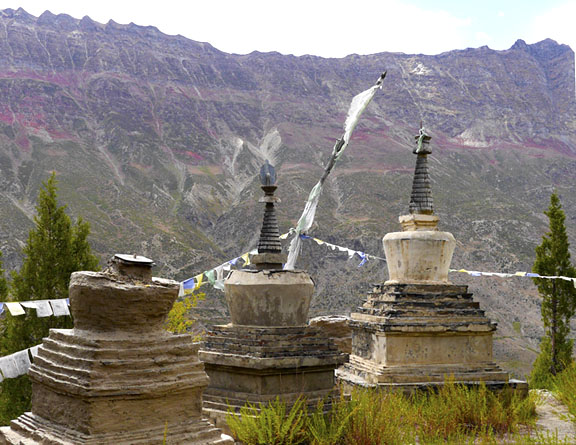
Today was Shashur and Tayul Monasteries. Both are not far from Keylong, just several kilometers away. Tayul Monastery was founded in the 17th century, but like Kardang Monastery, little appears to remain from its original period. The current main temple was renovated in the 19th century. Probably the oldest objects to be seen are the ancient stupas one encounters en route, on the hike up to the site.

Ancient stupas on walking trail en route to Tayul Monastery, opposite Drilbu Ri Mountain, Lahaul, India
Ancient stupas on walking trail en route to Tayul Monastery, opposite Drilbu Ri Mountain, Lahaul

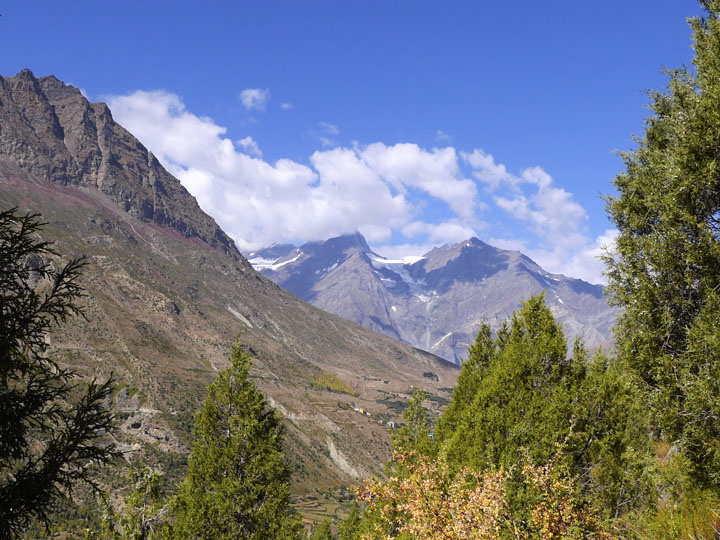
It must be reached on foot because there is no motorable road off the main road. The hike up is beautiful, of course, for its vistas. I was glad driver D accompanied me up because the trail is not so clear in some places. Locals do always advise having a guide. I still get winded doing the slightest incline up but hopefully each day will get better as I continue to acclimate to high altitude.

View across Bhaga Valley amid pine trees on trail to Tayul Monastery, Lahaul, India
View across Bhaga Valley amid pine trees on trail to Tayul Monastery, Lahaul

Directly opposite is sacred Drilbu Ri mountain. You can always spot it by looking for those seven little peaks in a row that lead to a notched area where one treks up and over to reach the summit.

Drilbu Ri Mountain seen from across Bhaga Valley, easily identifiable by its seven peaks and the notch just to the right, where trail to its summit proceeds
Statue possibly of founder and yogi Serzang Rinchen. Tayul Monastery,Lahaul

In fact, the story goes that Tayul, which means “chosen place,” was a location noticed by founder and Drukpa yogi Serzang Rinchen when he made his pilgrimage up Drilbu Ri. From across the Bhaga Valley, after a meritorious kora around the mountain, he saw the site and decided to build a hermitage there which became Tayul Monastery. Upon entering the main temple, one sees the 12 foot statue of Padmasambhava (Guru Rinpoche), revered as a great sage and living Buddha by Tibetans for introducing Buddhism to Tibet in the 8th century, displaying miraculous feats in taming local spirits in the process. Flanking him at the altar are statues of Dakini Singha Mukha, and the wrathful emanation of the guru.

Altar with Padmasambhava (Guru Rinpoche) in center, flanked by Dakini Singha Mukha and wrathful emanation of guru, Lahaul, India
Altar with Padmasambhava (Guru Rinpoche) in center, flanked by Dakini Singha Mukha and wrathful emanation of guru
Statue of Singha Mukha, Tayul Monastery, Lahaul
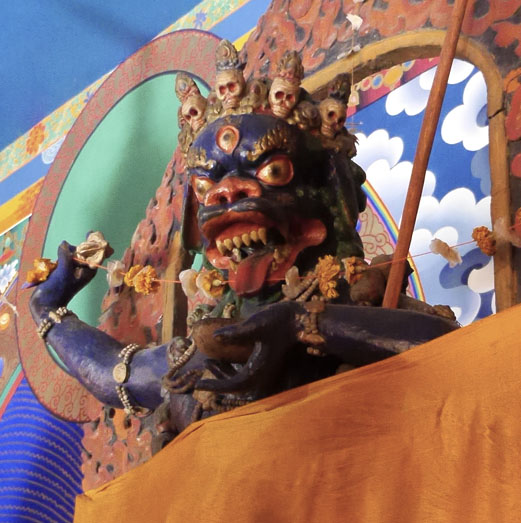
Wrathful emanation of Guru Rinpoche, Tayul Monastery, Lahaul

The original wall paintings from the 19th century by Lama Tashi Temphel, who stayed there and helped expand the monastery, are no longer extant. In its place are new paintings. Unfortunately, I found these contemporary-styled depictions rather stiff in execution, and less refined than older wall paintings I have seen to date in previous monasteries. Lama Temphel also made sacred images at Guru Ghantal Monastery, which happily can still be seen there. It had been suggested to me that Lahaul is not so much a place to find ancient Indo-Tibetan artwork, nor exquisite old wall paintings or mandalas even, as it is a place to be experienced physically as a land of yogi training, legend, and pilgrimage. So far, so true. 

View of new wall paintings, Tayul Monastery, Lahaul
Detail of new wall paintings, Chakrasamvara in center with Guru Rinpoche above and surrounded by dakinis, Tayul Monastery, Lahaul
Detail of new wall paintings, featuring Drukpa lineage masters, Tayul Monastery, Lahaul

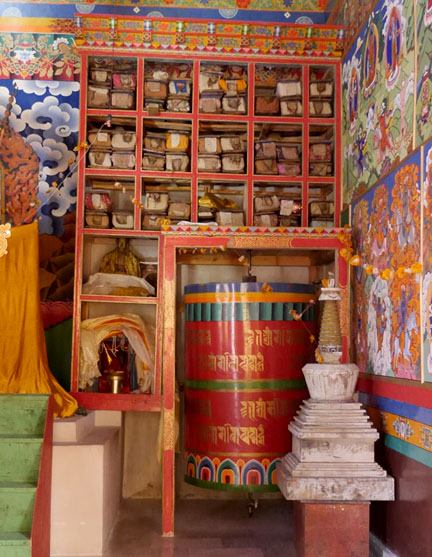
Tayul Monastery contains a complete Kangyur library and a large mani wheel that contains thousands of prayers. When spun, its blessings are activated and multiplies. According to its lamas, this wheel has been known to spin by itself on certain special occasions.

Kangyur library, and mani wheel known to rotate on its own on auspicious Buddhist days, Tayul Monastery, Lahaul

The British-born Tibetan Buddhist nun Tenzin Palmo was one of the first Westerners to encounter high Tibetan lamas in the early 1960s when she first arrived in India. She lived at Tayul for six years before retreating to a cave above it for twelve years. I read her biography Cave in the Snow like it was a suspense-thriller. I found her story and existential experiences riveting. It was a page-turner. Her retreat was abruptly interrupted by immigration authorities. Thus began her exit from solitary yogic practice to being a teacher in the world, a living example of Western and female accomplishment on the dharma path.

I always think that one beneficial outcome of the Tibet situation post-1959 is the creation of a diaspora which has lead to the spread of Buddhism in the Western world.

I saw Shashur Monastery the same day as Tayul. More to come!

All photos © 2013, Eva Lee.

Poekar Monastery Surprises

Sept. 13, 2013     Lahaul adventure continues…

Today was spent going to Poekar Monastery, known partly for where Apho Rinpoche had commissioned Bhutanese artists to create a giant Guru Rinpoche statue. One can say that the Bhutanese are present-day masters of sublime Buddhist art. Their style and techniques are favored by Tibetans. I have seen their work grace many contemporary monasteries.

Poekar Monastery, Lahaul, India
Poeker Monastery on upper right (yes, that little cluster of white above the other little cluster of white which is the village below), Lahaul Valley

While Poekar was not originally on my radar for visiting, J had learned yesterday at a meeting in Manali with one of Apho Rinpoche’s sons, Jampal-la, that he was heading to Keylong for Tara puja (prayer), to be followed by Guru Rinpoche puja the day after. She immediately called to inform me that I should join them. That is to say, in her irrepressible and talented role of what Malcolm Gladwell calls a “connector,” she invited me to join them at her behest and on their behalf! Right, then, another unforeseen opportunity to observe and experience. So, I said OK, thank you!

Statue of Guru Rinpoche, Poekar Monastery, Lahaul
Statue of Guru Rinpoche, Poekar Monastery, Lahaul. It doesn’t look that big at this angle but this is one-and-a-half stories high. Also known as Padmasambhava, he was the sage who introduced Tibet to Buddhism in the 8th century.

I planned to stay overnight (because J said it was fine to) and brought all my camera equipment and some clothing, all jammed in my wheeling suitcase.  But when I got there with the driver, I couldn’t reach Jampal-la on his phone for details, and found while searching for the monastery that it was a good steep half hour hike up!  So much for wheeling in my suitcase.  It became clear that unless I hoisted my rather heavy suitcase up, the only other option was to go back to my Keylong hotel. Driver D, who had climbed up to the monastery with me to ensure that I was safely escorted, was kind enough to offer to go back down to the car to fetch it, but I didn’t feel good about him doing that!

Anyway, perhaps one day was enough. Maybe better to get to Shashur and Tayul, or Guru Ghantal the next day. These were planned destinations and I wanted to make sure I had enough time to document them. Jampal-la suggested also Phakpa Monastery in Triloknath, a sacred site of Avalokiteshvara, and Markula Devi Temple in Udaipur, sacred site of Vajrvahari.

The Tara puja was an annual event that Poekar Monastery’s American sponsor requests.  The resident monks and nuns are yogi retreatants, as most are in Lahaul. Together, they conducted the prayers, chanting in refreshing cross-gender unison, something one doesn’t experience very much since monks and nuns are usually living separate monastic lives.

In fact, Tara as a tantric deity has contemporary feminist appeal. She is referred to in the Perfection of Wisdom (Prajnaparamita) sutra, a very key Mahayana text, and is considered the female form of Avalokiteshvara, the deity of infinite compassion. With these two strong combinations of wisdom and compassion, she embodies powerful aspects of the practitioner’s own Buddha-nature. She has 21 forms or emanations in all, each associated with certain colors and psycho-physical energies.

Green Tara
Green Tara surrounded by her other enamations

During Tara puja, we all sat cross-legged on the floor as is customary. I was flanked by two nuns who would hand me grains of rice to toss in the air at intervals during prayer. Jampal and his wife were guests of honor.

It was nice talking to them both in between prayer sessions.  We talked about how the West seems to the East and vice versa.  I shared my observations of what I thought was positive and negative about each social order, their apparent outlooks on life, and expectations of how things should be. Jampal-la and his wife shared theirs. I learned from him that, even though he comes from a line of great traditional solitary practitioners, his view is unexpectedly open to contemporary and Western exposure, and it is this:

Begin on the secular level with teachings about how to simply be a good, moral person before getting to the more esoteric and higher teachings. Let individuals develop and choose whether they want to be Buddhist or not. Then if they do, higher teachings can always come later. He has helped to sponsor a group of young girls by sending them to school and working on exactly this approach. In this way, he is aligned with the Dalai Lama’s initiative on secular ethics.

What’s more, their teen is in the U.S. now attending university through the generosity of a sponsor. They feel strongly that young Tibetans should experience what the West has to offer, and then decide for themselves whether to follow that life or come back to the East.  Otherwise, they will always feel doubt or curiosity that the (democratic/ materialist/capitalist/etc.) grass is greener on the other side. Eye-opening to chance the risks of the world, coming from a family and lineage legacy of hermitic existence.

The day passed so seamlessly from breakfast to morning prayers, to lunch and afternoon conversation, with such friendliness exuding from everyone at Poekar.

Poekar Monastery nuns, Lahaul, India
Poekar Monastery nuns, Lahaul

Sadly, when I learned that the next prayer session would continue in a different temple an hour’s ascent further up the mountain (surprise once again) I decided it was too late in the day, and time for me to travel back. Upon hearing this, the nuns and monks, who by now were spread willy-nilly on the hillside climbing up, began to wave and smile and utter lovely goodbyes. They repeatedly implored me to stay over. Truly, their sincerity warmed me so much, I found myself walking away hand clasped to heart.

Poekar Monastery monks, Lahaul, India
Poekar Monastery monks, Lahaul
View of Lahaul Valley from Poekar Monastery village, India
View of Lahaul Valley from Poekar Monastery village

All photos © 2013, Eva Lee.