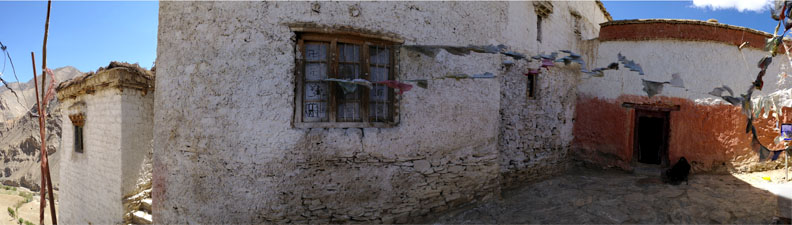
View of Lamayuru Monastery on plateau at top, with Lamayuru Village below, Ladakh, India
Seeing Lamayuru Monastery today was a rich experience. The hilltop monastery complex is a delightful warren of small passageways that give way to open views. It includes the functional old, the relatively new, and then the crumbling ruins. Walking through it really imparts the feeling of a medieval village in its different stages of development and abandon.
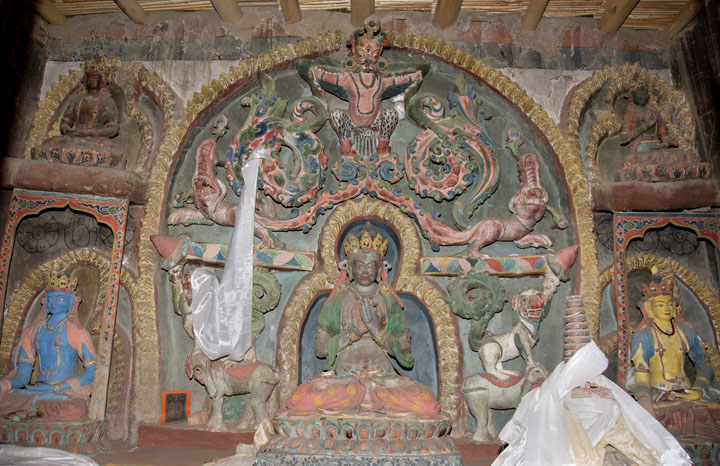
Senge Lhakhang, ca. 11th century, the oldest temple at Yamayuru Monastery. Contains well-preserved and rare Indo-Tibetan clay sculptures of Vairocana, Dhyani (Supreme) Buddhas, and Vajradhatu mandalas, including Gonkhang with protector deities, Ladakh, India
It’s an intimate temple. Upon entering, one faces the splendid and well-preserved altar which by now, dear reader following this blog, you will recognize as belonging to the rare Indo-Tibetan 11th century period of sacred art.
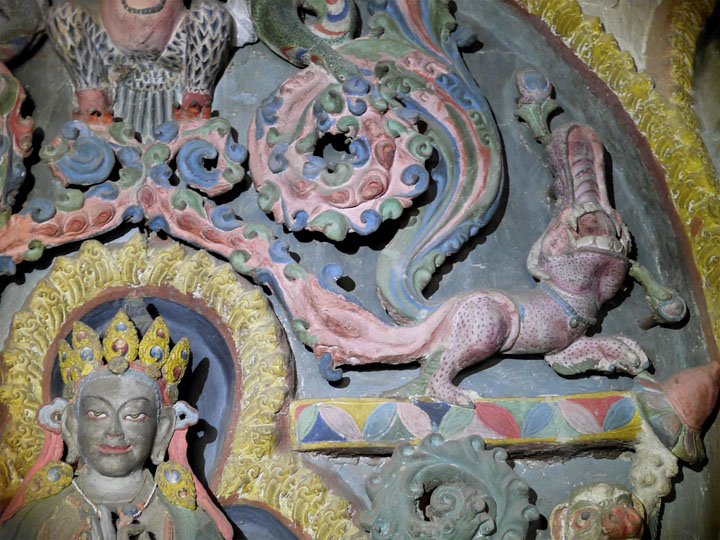
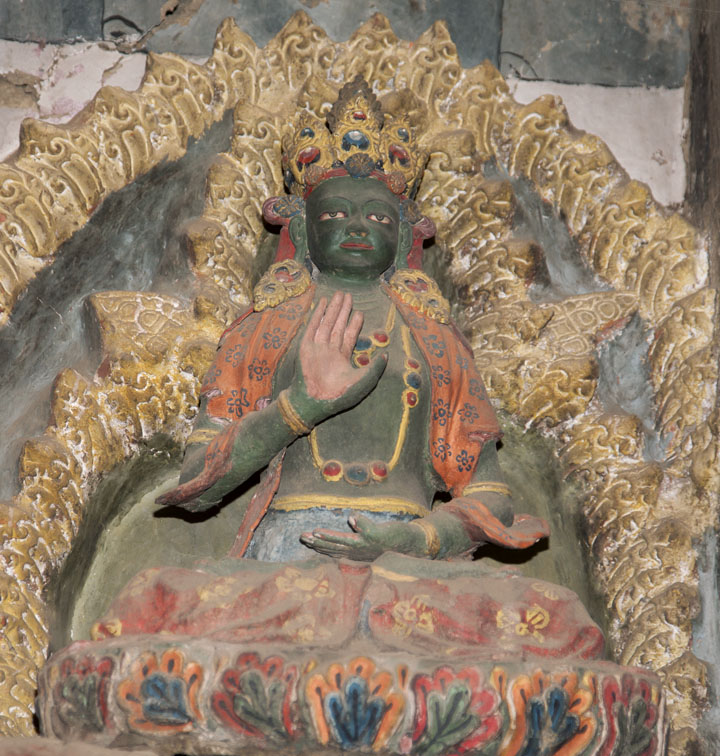
As at Lhalung and Tabo Monasteries, the temple features Vairocana and the Dhyani (Supreme) BuddhasAmitabha, Akshobhya, Amoghasiddha, and Ratnasambhava. These are polychromed clay sculptures seated on lotus thrones inside stylized alcoves. Here at Lamayuru, Vairocana is also seated atop lions which is how the temple derives its name. Senge means lion in Tibetan. He is surrounded by animals, scrollwork, and surmounted by a prominent protective Garuda, the powerful Hindu mythical bird.
Experience the interior of Lamayuru Monastery’s Senge Lhakhang by watching this exclusive video walk-through here.
[vimeo 137311083 w=600 h=337]
Main altar, Senge Lhakhang, Lamayuru Monastery, Ladakh. Central figure is Vairocana, flanked by Dhyani Buddhas (clockwise from left) Aksobya (blue), Amitabha (red), Amoghasiddhi (green), and Ratnasambhava (yellow), surmounted at top by Garuda. Photo: Kishore ThukralIndo-Tibetan clay sculpture of Vairocana, Buddha of Wisdom, one of the Five Dhyani Buddhas, main altar Senge Lhakhang, Lamayuru Monastery, LadakhDetail of main altar with central Vairocana surrounded by animals and surmounted by Garuda, main altar Senge Lhakhang, Lamayuru Monastery, LadakhRatnasambhava, one of the Dhyani (Supreme) Buddhas, rare 11th century Indo-Tibetan clay sculpture, main altar Senge Lhakhang, Lamayuru Monastery, LadakhDetail of Vairocana Buddha and animals, rare 11th century Indo-Tibetan clay sculptures, main altar Senge Lhakhang, Lamayuru Monastery, LadakhDetail of Akshobya, one of the Dhyani (Supreme) Buddhas, 11th century Indo-Tibetan clay sculpture, main altar Senge Lhakhang, Lamayuru Monastery, LadakhAkshobya, one of the Dhyani (Supreme) Buddhas, 11th century Indo-Tibetan clay sculpture, main altar Senge Lhakhang, Lamayuru Monastery, LadakhAmoghasiddha, one of the Dhyani (Supreme) Buddhas, rare Indo-Tibetan clay sculpture, main altar Senge Lhakhang, Lamayuru Monastery, Ladakh. Photo: Kishore ThukralAmitabha, one of the Dhyani (Supreme) Buddhas, rare Indo-Tibetan clay sculpture, main altar Senge Lhakhang, Lamayuru Monastery, Ladakh. Photo: Kishore ThukralGaruda, Hindu mythical bird, main altar Senge Lhakhang, Lamayuru Monastery, LadakhThe lions or Senge, main altar Senge Lhakhang, Lamayuru Monastery, Ladakh
In stark contrast to the fine state of the sculptures, the wall murals are in a very deteriorated condition, faded and water-damaged. In fact, facing the altar, the whole right side wall is altogether undecipherable, almost completely devoid of the original imagery. Looks blackened and/or delaminated down to the mud bricks. It’s incredible that after over one thousand years of time, anything can remain at all, really. Time has really ravaged this wall. I wish it were different!
The left hand wall can still be glimpsed. If only some effective and accurate conservation could be done to preserve these historically significant, rare examples of Indo-Tibetan Buddhism and the Second Transmission of Buddhism from India to Tibet!
Vajradhatu Mandala, Indo-Tibetan wall painting, Senge Lhakhang, Lamayuru Monastery, Ladakh
While it’s difficult to see details of the above wall painting, it is certainly a Vajradhatu Mandala and as such, its structure is usually this:
At center is Vairocana with the 4 Dhyani Buddhas (Amitabha, Akshobhya, Ratnasambhava, Amoghasiddha) positioned around him in the cardinal directions, each encircled by 4 bodhisattvas. There are an additional 12 deities–4 guardians, 4 outer offering goddesses, and 4 inner offering goddesses. In all, the basic set of Vajradhatu mandala deities is 33 or 37. Vajrayana mandalas and the deities that reside within them are essentially symbols of the qualities of consciousness to develop on one’s spiritual path. They are mnemonic devices to aid a practitioner towards enlightenment.
Variations in Vajradhatu mandalas are seen in different monasteries with the addition of up to 60 other divinities–such as the 16 arhats or 12 pratyekabuddhas, among others. These are often depicted on the outer sections as additional circles or squares in the same mandala composition, or in altogether separate small mandalas.
It is important to note that such symbolic plenitude expresses manifestations of the same fundamental principles. Buddhism did inherit the Hindu understanding of many-paths-to-the-same-truth. These additional divinities also have their basis in written scripture or canonical commentaries.
Avalokiteshvara (Chenrezig), bodhisattva of compassion, Indo-Tibetan wall painting, Senge Lhakhang, Lamayuru Monastery, Ladakh
Adjoining the main temple room is a gonkhang, chapel dedicated to protector deities.
Protector deities, including Mahakala and Lhamo Palmo, Gonkhang, Senge Lhakhang, Lamayuru Monastery, Ladakh. Photo: Kishore ThukralView of Senge Lhakhang, with Indo-Tibetan sculptures and wall paintings, Lamayuru Monastery, LadakhConversing with Kagyu monk at entrance of Senge Lhakhang, Lamayuru Monastery, Ladakh. Photo: Kishore Thukral
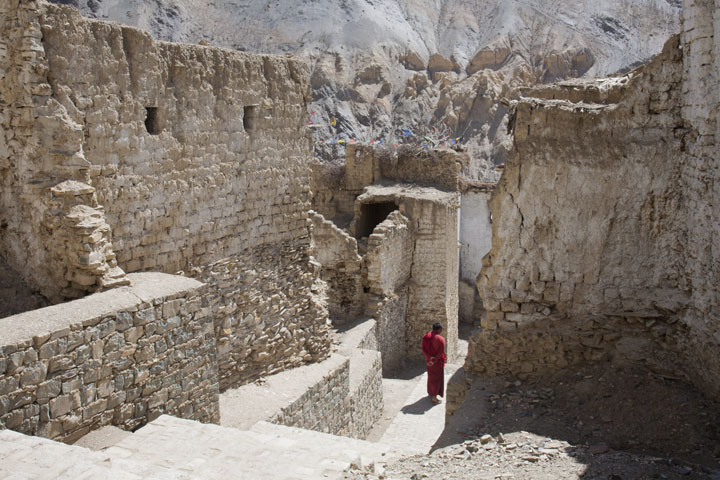
Lamayuru grounds in this older section near the Senge Lhakhang is characterized by these passageways that are alternately nestled and enclosed, then open and expansive.
Walking through older parts of Lamayuru Monastery, Ladakh. Photo: Kishore ThukralWalking through older parts of Lamayuru Monastery, Ladakh. Photo: Kishore ThukralWalking through older parts of Lamayuru Monastery, Ladakh. Photo: Kishore ThukralWalking through ruins of of Lamayuru Monastery, Ladakh. Photo: Kishore Thukral
Among the stone ruins, amidst the Himalayan landscape, I tried to imagine the charming bygone era of great vitality during the reign of Western Tibet’s Guge kings Yeshe O’d and Changjup O’d whose vision reformed and ignited the spread of Vajrayana Buddhism from India to Tibet in the 10th to 12th centuries. How it must have been in this remote Himalayan landscape a thousand years ago, when these walls and buildings were new, its monastic and lay inhabitants filled with rejuvenated fervor and scholarship!
Walking through older parts of Lamayuru Monastery, Ladakh. Photo: Kishore ThukralView of Himalayan Village and valley from Lamayuru Monastery, Ladakh
Tabo Monastery Tsug Lhakhang, with meditation caves in the cliffs beyond, Spiti, India
Six-o’clock morning puja for the recently deceased beloved abbot at Tabo Monastery was quite beautiful. I wasn’t fully awake for it, and drifted through listening to each monk use his voice artfully to express himself through prayer. Very nice. I found out later from a lama that while they all learn the basic rhythm, it is up to each individual monk to say the prayer as he wishes. In other words, they all chant the same prayer, but some go out and come in on certain parts, using their voices to inflect sound, create variety, meld, or syncopate, etc.
Afterwards I was able to do some documenting at Tabo today! Limited time, however, permitted only doing the interior of the Tsug Lhakhang, the Great Assembly Hall. I was thrilled because it was the most significant temple in terms of its Vajradhatu mandala arrangement and my research project.
Experience the interior of Tabo Monastery’s Tsug Lhakhang or Main Assembly Hall by watching this video walk-through.
Entering the Great Assembly Hall from its antechamber, Tabo Monastery
Wow, what a place! Dark and dramatic, with rays of light coming in through small ceiling windows, shining brilliantly on the main altar and then fading out towards the periphery of the assembly hall. I was stunned by the large number of statues and paintings to feast my eyes on! In a space that envelopes you in semi-darkness, it took some time to realize that just about every inch of wall and ceiling had been richly decorated.
With over a thousand years of continuous use as a meditation hall, I soaked in the sense of countless generations of monks who have spent their days here in peaceful meditation. I tried to fathom the devotion that Tabo’s Tsug Lhakhang has seen and sheltered. The overall impression is that of quiet yet teeming spiritual beauty.
Founded in 996 C.E. by the Guge (Western Tibet) king Yeshe O’d, the temple and statues are viewed clockwise in a Buddhist kora or circumambulation.
According to scholars, Kashmiri artists were responsible for the refined style of the statues and paintings. At the time, Buddhism had flourished in Kashmir and the region’s art was aesthetically sophisticated in expression and detail. Most of the art was executed circa 1042 C.E. during the renovation of the interior by Jangchub O’d, Yeshe O’d’s grand nephew.
The main altar features a gilded Vairocana. What a sight this tantric deity is with its larger-than-life four bodies, seated back to back, its serene faces looking out in the four cardinal directions. Distinctly Indian features include Indo-style trousers, painted red palms, procession carriage structure, and naga/garuda mount at top.
There are 32 multi-colored, graceful clay sculptures of Vairocana’s associated deities that line the assembly hall walls in Vajradhatu mandala order. Each is seated on a lotus pedestal, and cantilevers out of an attached sculpted halo background. Situated above eye-level, the figures look kindly and seem to lean towards you. Surrounding these deities on the wall are elaborate, colorful fresco paintings—scenes of Prince Sudhana’s pilgrimage and Buddha’s life on the lower frieze area; buddhas, bodhisattvas, other tantric deities and Bon goddesses in the upper area.
Clay statues of tantric deities in Vajradhatu mandala arrangement, Tabo MonasterySudhana’s pilgrimage on lower frieze, Tabo Monastery Tsug Lhakhang. Much of it is too deteriorated to see clearly.Guardian deity at far left, painted buddhas and bodhisattvas on upper areas of Tabo Monastery Tsug LhakhangVairocana statue, main altar, Tabo Monastery Tsug Lhakhang, Spiti, India Distinctly Indian features include Indo-style trousers, painted red palms, procession carriage structure, and naga/garuda mount at top.View of gilded Vairocana statue from inner sanctum, Tabo Monastery Tsug Lhakhang, Spiti, IndiaDetail of gold Vairocana, Tabo Monastery Great Assembly Hall altar, Spiti, India
Tabo’s Main Assembly Hall, and in fact, the whole monastic complex was originally built according to a mandala concept as set forth by the Sarva-tathāgata-tattva-samgraha Tantra, practically a literal translation of it which distinguished this monastery. To the practitioner, therefore, Tabo’s interior and exterior order symbolized his sacred inner and outer realities. (More on this topic in previous post But Wait, A Bit About Mandalas.)
“The main temple, Tsug Lhakhang, was at the center of the whole complex. The center of the temple was also the center of the compound along the east-west axis, having its major statue, Saravid Vairocana, placed in the central spot [now moved to the altar] not only of its surrounding 32 statues but also of the whole complex….Later additions have diluted the concept, but temples from Tabo’s heyday, together with stupas or chorten, form a simple but clearly visible mandala in the architectural layout-plan.” (The Forgotten Gods of Tibet: Early Buddhist Art in the Western Himalayas by Peter van Ham and Aglaja Stirn. See also this book for excellent descriptions and further details on Tabo’s iconography)
Vajradhatu mandala arrangement of Vairocana and 32 associated deities, Tabo Monastery, Spiti, India.
Above is the floor plan of the Main Assembly Hall showing the Vajradhatu mandala arrangement of the Five Buddha Families: Vairocana, Amitabha, Amoghasiddhi, Akshobya, and Ratnasambhava, with their associated deities. These represent aspects of Buddha-nature that guide a practitioner to attain enlightenment according to the lower yoga tantras. Tibetan Buddhists today generally practice highest yoga tantra or Annutarayoga.
Side view of Vairocana statue, main altar, Tabo Monastery, Spiti, India. The statue is built in the tradition of an Indian procession carriage, used for carrying the god around the temple or outside for blessing.
For photography and viewing, I came prepared with flashlights. Thank goodness they were fully charged, and that our current guesthouse has power! We would not have been able to see most of these dark interiors without them.
Vajrahasa statue, part of the Gem family of Ratnasambhava, Tabo Monastery
What a challenge it’s been to ensure my equipment is all charged and ready to go. Sadly, I am told by locals that Spiti in general lacks electricity because the Indian government is remiss in providing good infrastructure to all its citizens, and particularly to those communities that are remote, less populated, and lack political clout. As you can imagine this makes Spiti’s growing tourism especially difficult when hotel and restaurant owners, cyber cafes, etc., must routinely apologize to their clientele for not being able to meet their needs due to lack of power. I got creative with calculating how long my cell phone, laptop and camera equipment would last before finding the next feasible charging place.
Vajrakarma statue, part of the Action family of Amoghasiddhi Tabo Monastery Tsug LhakhangVajrayaksa statue, part of the Action family of Amogasiddhi Tabo Monastery Tsug LhakhangAkshobya statue, Vajra family Tabo Monastery Tsug Lhakhang
Behind the main altar is a small inner sanctum or cella that contains a 13th century statue of Amitabha in an elevated niche, flanked by two crowned statues of bodhisattvas, Padmapani on the left and Mahashtamaprapta on the right. Above him are figures identified as Apsaras or minor gods in the act of homage, and painted on his left and right are female attendants.
Amitabha statue, inner sanctum, Tabo Monastery Tsug Lhakhang Stylistically different from the statues in the main hall, it looks like a later addition or replacement.Padmapani statue, inner sanctum, Tabo Monastery Tsug Lhakhang. Visible on the left are some of the Thousand Buddhas that are painted on the circumambulatory inner walls.Vajrapasa statue guarding entrance to inner sanctum, Tabo Monastery Tsug Lhakhang
A narrow corridor for circumambulation surrounds Amitabha. Its inner walls are richly painted from floor to ceiling with Thousand Buddhas, manifestations of the enlightened one in splendid iteration of the five colors, different robes, lotus pedestals, and haloes.
Buddhas in a Thousand Buddha depiction on inner sanctum circumambulatory walls, Tabo Monastery
On the outer walls are magnificent bodhisattvas and Supreme Buddhas (Tathagatas). These are my favorites! I really appreciate the mastery of these paintings in the inner sanctum. The below bodhisattva is an example of one of sixteen that symbolize aspects of Buddhahood stemming from Vairocana.
Bodhisattva, from outer circumambulatory wall of Tabo Monastery Tsug Lhakhang
The bodhisattva figures literally took my breath away when I saw them revealed by my flashlight! Every brushstroke showed ease, delicacy and variety in execution. The highly inventive and detailed jewelry, as well as the fabric patterns, was a pleasure to discover. In addition, these paintings are well-preserved and dated 1042 C.E. when the temple was renovated. In other words, they appear as they were first created, untouched by other painters or conservators since then. What an incredible indication of the original quality of work that existed!
These inner sanctum figures look different from the ones on the upper register of the Tsug Lhakhang in that they are far more elaborate and refined. Additionally, Indo-Tibetan paintings show a freedom of composition not found in later Tibetan artworks where proportions and poses are more defined by convention.
The Supreme Buddhas were also delightfully painted, exhibiting a similar level of refinement and delicacy but painted at a much larger scale, about life-size.
Supreme Buddha dressed in unusual pleated robe, painted on outer wall of circumambulatory, Tabo Monastery Tsug Lhakhang inner sanctum
I particularly like the sense of ease yet energy that this below Buddha expresses. His face and gaze are sublime, his hands in graceful repose. But his unusual robe depicts rhythm and movement in the undulating sleeves and neckline detail. Coupled with the artist’s use of primary colors and radiating spirals in the halo, the overall effect of this painting is vibrant immediacy.
Supreme Buddha on outer wall, inner sanctum of Tabo Monastery Tsug LhakhangDetail of Supreme Buddha on outer wall, inner sanctum of Tabo Monastery Tsug Lhakhang
This is not an official U.S. Department of State website. The views and information presented here are solely those of the artist, and do not represent the Fulbright Program, the Department of State, or any other entity.