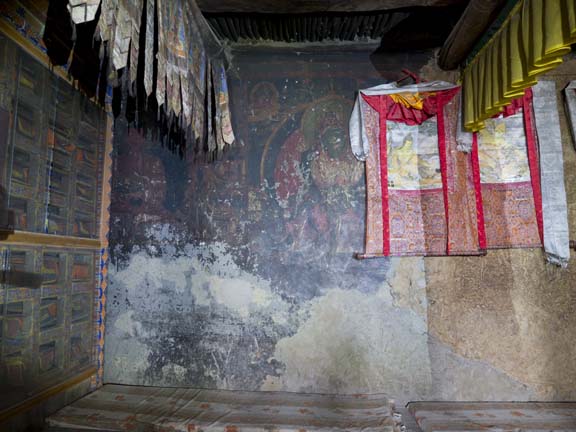
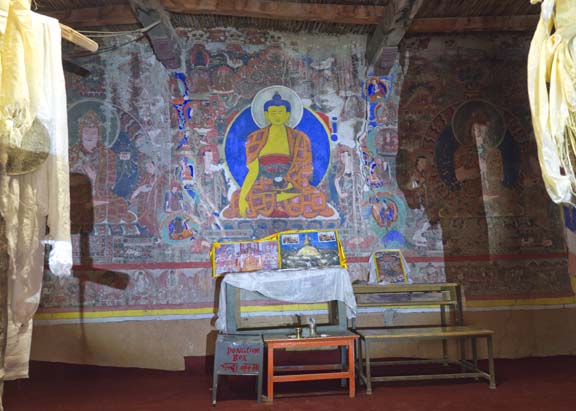
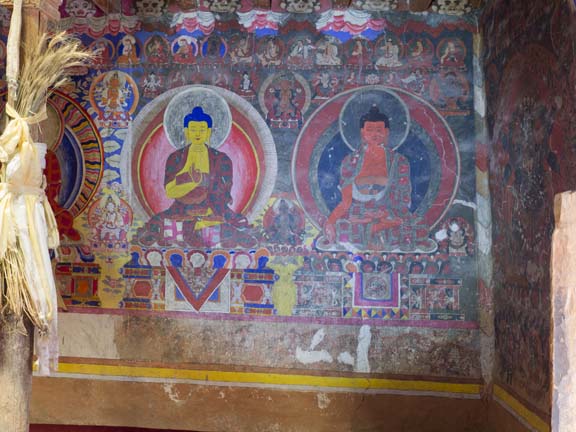
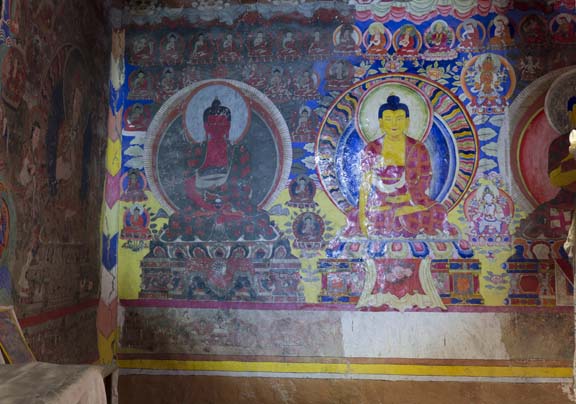
Fulbright Documentary Series at Columbia University and Library of Tibetan Works & Archives
Posted
Losar Tashi Delek! Happy Lunar New Year to all who celebrate!
I’m pleased to announce that five of my documentaries are now part of the Columbia University Tibetan Studies Library, one of the most extensive collections of Tibetan texts and archival material in the U.S.A. The documentaries are also in the Library of Tibetan Works & Archives, and may be viewed through their Multimedia Library.
The documentaries are:
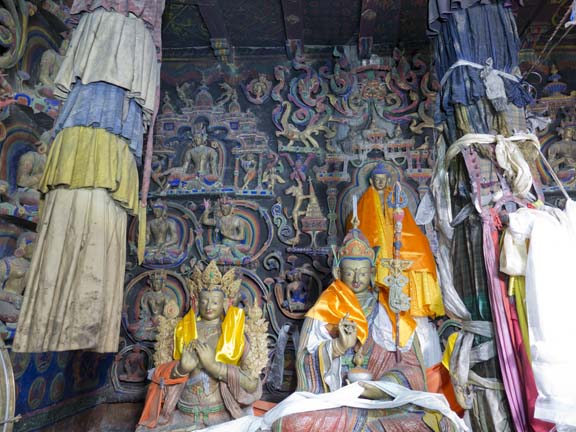
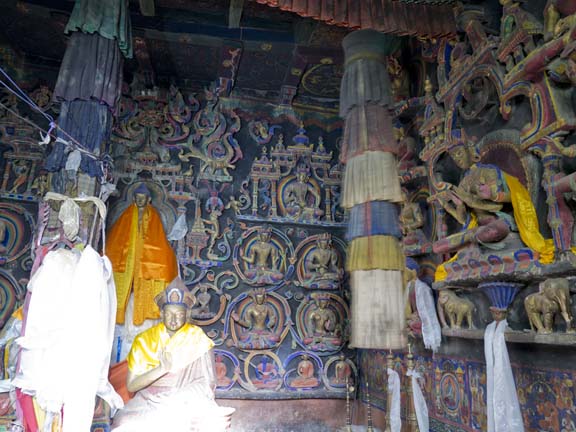
Tabo Monastery Tsug Lhakhang (Main Assembly Hall) See the interior of this rare, Buddhist temple located in Spiti region of Western Himalayas, India. Famed Tabo Monastery is known as the oldest continually functioning Tibetan Buddhist monastery, the art of which the Dalai Lama said “delightfully expresses the vigor of the transmission of Buddhism from India to Tibet and the dynamic mingling of cultures.” Established in 996 C.E. by the Buddhist king of Guge in Western Tibet, Yeshe O’d, and the The Great Translator Rinchen Zangpo, it flourished in a golden epoch of Indo-Tibetan collaboration in spreading Buddhist culture.
Lamayuru Monastery Senge Lhakhang (Lion Temple) (00:03:24) Rare, medieval temple located in Ladakh region of Western Himalayas, India. Founded by The Great Translator Rinchen Zangpo and King Yeshe O’d of Guge, Western Tibet, circa late 11th century.
Mangyu Monastery Nangbarnangzad (0:03:03) Rare, medieval temple located in Ladakh region of Western Himalayas, India. Founded by The Great Translator Rinchen Zangpo and King Yeshe O’d of Guge, Western Tibet, circa late 11th century.
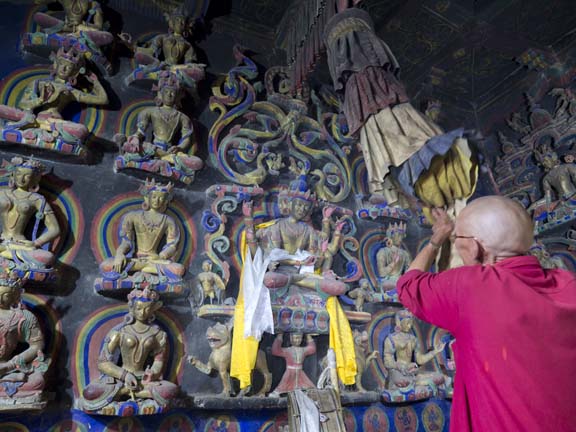
Lhalung Monastery Serkhang (Golden Hall)(00:01:45) Rare, medieval temple located in Spiti region of Western Himalayas, India. Founded by The Great Translator Rinchen Zangpo and King Yeshe O’d of Guge, Western Tibet, circa late 10th century.
Yamantaka (00:56:38) A candid view of an esoteric and complex Tibetan Buddhist highest yoga tantra held at Namgyal Monastery in Dharamsala, India. Monks create an elaborate sand mandala, ritual cakes and other sacred arts, offer prayers, chant, play ritual instruments, and meditate over the course of ten days. As one viewer said, “Beautiful, bizarre, and fascinating!”
Incidentally, many viewers have asked me about what is happening at around 42:14 in the Yamantaka video, where a young Caucasian man is in the Main Temple talking loudly and animatedly to a gathering of monks.This was a debate exam in session for students of the Institute of Buddhist Dialectics (which adjoins Namgyal Monastery), characterized by dramatic and distinctive hand clapping, body motions, and rhetoric. It was an event unrelated to Yamantaka, but which coincided with it. Tibetan Buddhists have a long and famed tradition of continuing the ancient Indian Buddhist practice of philosophical debate.
All documentaries filmed during Fulbright research on Indo-Tibetan mandalas of the 10th-12th century. With thanks and gratitude to Office of His Holiness the 14th Dalai Lama, Namgyal Monastery, and Nechung Monastery for their support in my quest to document these temples and Yamantaka ritual. Made possible in part by the support of Fulbright-Nehru Research Program, Council for the International Exchange of Scholars, and United States-India Education Foundation.
Breathtaking Alchi Monastery
Posted
September 24, 2013
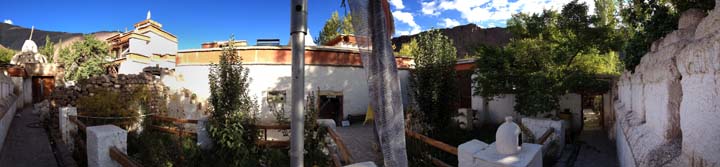
Panorama of Alchi Monastery, Ladakh, India
And what about Alchi? Famous Alchi Monastery, which contains some of the most beautiful and beguiling Buddhist art and iconography from the Indo-Tibetan world.
Indeed, I did visit Alchi, said to be founded by the legendary Great Translator Rinchen Zangpo (958-1055 C.E.) However, I was unable to get permission to study its interiors more closely and document. Despite having some strong letters of support, time and other circumstances conspired against the process when I arrived with only a small window of opportunity to work. After all, it takes time to sort these things out. One Indian friend of mine quipped, “I.S.T.,” which he said stands for Indian Stretchable Time as opposed to Indian Standard Time.
So, I will here share what I have–mostly vignettes of Alchi, some exterior photographs, along with interior images from others who have studied and accessed Alchi.
Like Tabo Monastery, Alchi Monastery’s complex is located in a river valley, integrated with its village. This is typical of earlier phase Himalayan monastic architecture, versus the later phase post 12th century, in which monasteries were fortified and built up on a hill.
Located about 67 kilometers west of Leh in Ladakh region, at 10,500 feet altitude, Alchi contains six temples as well as three painted gateway stupas.
Gateway stupa, an unusual feature of Alchi Monastery, Ladakh, India
The three oldest temples are the Assembly Hall or Dukhang, also known as the Vairocana Temple; the Sumtsek, named for its recognizable three-storied building; and the Manjushri Temple. These buildings are dated from approximately mid-12th to early 13th century. In addition, there are other chörtenand temples built during the 13th and 14th century. Many of these are visible along the circumambulatory surrounding the complex.
Site map of Alchi Monastery complex, Ladakh, India
As you can see from the above site map and aerial photos, the temples are built close together, basically along a single axis, with other structures surrounding them in proximity. Narrow views are generally all one can photograph because it is difficult to get enough distance onsite.
More gateway stupas with a view of Sumtsek Temple in rear, Alchi Monastery, Ladakh, India
As it turns out, I was only able to visit the Sumtsek and the Vairocana Temple. The other temples and spaces were closed to the general public that morning.
Facade of Sumtsek Temple, Alchi Monastery, Ladakh, India
The Sumtsek facade is distinguished by its carved wooden porch.
Another view of Sumtsek Temple, named for its three stories, Alchi Monastery, Ladakh, IndiaDetail of Sumtsek carved wood facade, Alchi Monastery, Ladakh, India. Photo: Kishore ThukralDetail of Sumtsek facade with view of second story terrace roof, Alchi Monastery, Ladakh, IndiaDetail of Sumtsek carved wooden facade, Alchi Monastery, Ladakh, India
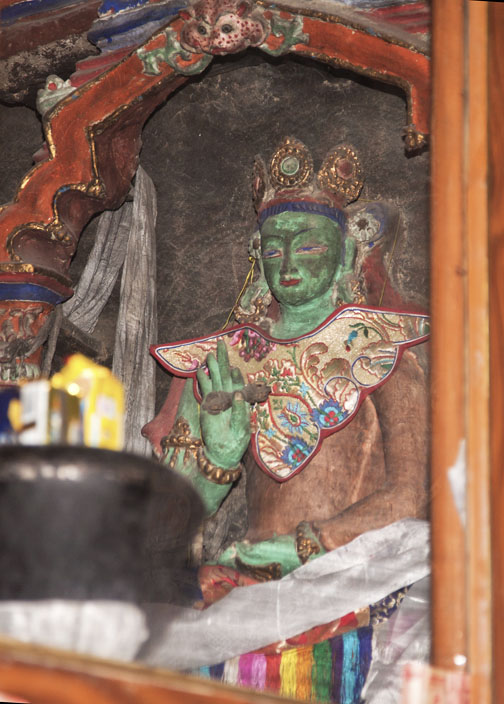
As with most other temples of this time period, one must bend down in order to enter through the small, short doorway. When you are inside the ground floor of the Sumtsek, you see three monumental sculptures in niches. They are Maitreya, Avalokiteshvara and Manjushri. See images here created by the team of researchers at Graz University.
They stand so tall at about 14 1/2 feet high in the interior architecture that their heads, in fact, reach the second floor and seem to look out at the viewer from their niches. Shown in the above link is the head of Manjushri on the second floor of the Sumtsek. A beautifully painted and richly adorned Tara stands above him, flanked by two mandalas.
I wish that I had been able to access the second floor to see this in person! Only the ground floor was open to the general public.
Judging from these photos, the upper levels had numerous mandalas, the subject of my research. One cannot see these well from the ground level given the limited sight lines .
What a pity! I was there, but could not quite get there! So close and yet so far…
This third level cupola with its mandalas would have been so golden to see.
I had to settle instead for seeing most of Alchi’s Sumtsek paintings in reproduction two months later in photographer Aditya Arya’s studios. I had the occasion to meet with him in New Delhi to discuss his project photographing “every inch” of Alchi’s interiors.
Alchi’s iconography is truly delightful to scrutinize, with its delicate drawings and imaginative compositions. I recommend you visit Arya’s website here to see some images.
I also recommend the book “Alchi: The Living Heritage of Ladakh,” a catalogue published on the occasion of The National Museum’s exhibition of Arya’s Alchi photographs in New Delhi. In it are extensive photographs and details of Alchi paintings.
I must say, however, that what I saw in his documentation of the first floor of the Sumtsek, which he photographed about five years ago, did not match a lot of what I saw onsite. As a trained painter in fine arts as well as decorative arts, I can say without doubt that alot of the apparently recent restoration work at Alchi does not do the original artwork justice. These areas are painted in a different hand and style. There is cause for concern about such results. Like I discussed in this post on Mangyu Monastery and this one on Tabo Monastery, similarly, I fear that Alchi paintings will slowly disappear by virtue of ill-conceived “restoration.”
According to the Smithsonian Magazine article Glimpses of the Lost World of Alchi,written in 2010, the concern about conserving Alchi’s murals and buildings is not new. In 1990, German art historian Roger Goepper, photographer Jaroslav Poncar and art conservators from Cologne, Germany, launched the Save Alchi Project. Some work was done, but it ended two years later due to what Goepper referred to as “growing confusion over administrative responsibility.” Or, some say, between religious and national interests.
According to the article, although “tourists now far outnumber worshipers, Alchi is still a living temple under religious control of the nearby Likir Monastery…Monks from Likir serve as Alchi’s caretakers, collecting entrance fees and enforcing a prohibition on photography inside the temples…At the same time, responsibility for preserving Alchi as a historic site rests with the [Indian] government’s Archaeological Survey of India (ASI). Relations between the ASI and the Likir monks have long been fraught. The monks are wary of government intrusion into religious matters; the ASI worries the monks will undertake restorations that damage the Alchi murals. The result is a stalemate that has thwarted conservation efforts.” Since the publication of this article, I hope the stalemate is in the process of being sorted out.
I can happily report that the wall paintings of the Vairocana Temple, which included massive mandalas, were breathtaking and well-preserved. They appeared untouched by questionable conservation efforts. OR, better yet, they are a testimony to conservation well done! I hope so.
Panorama of Vairocana Temple and its courtyard. At far right is the doorway to the courtyard of Manjushri and Lotsava temples, Alchi Monastery, Ladakh, India
Unfortunately, I do not have images to share here of the exquisite interior of the Vairocana Temple.
Side view of Vairocana Temple with its mountainous surroundings, Alchi Monastery, Ladakh, India
But I have a better idea. Consider getting an airline ticket to fly here and see Alchi for yourself. It’s best to experience the Himalayas in person anyway!
Truly, it’s ineffable. There are no words or images that can convey the exhilaration and revelation of being in the grandeur of the Himalayas.
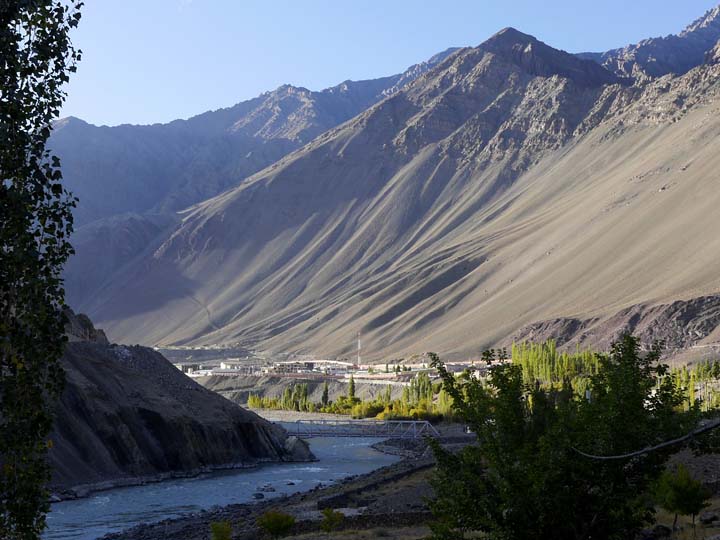
View of Alchi Monastery circumambulatory with prayer flags by the Indus River in early morning light, Ladakh.Himalayan mountains and the Indus River Valley as seen from Alchi Monastery circumambulatory. A border area, Ladakh has high military presence, such as this military compound in the distance.
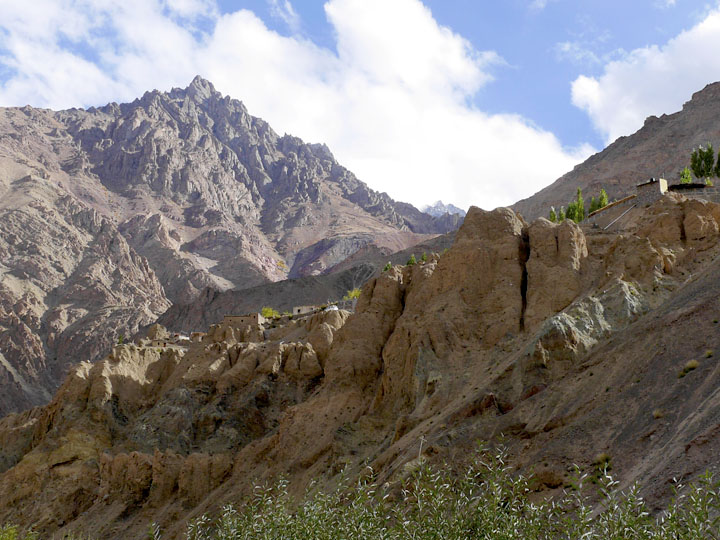
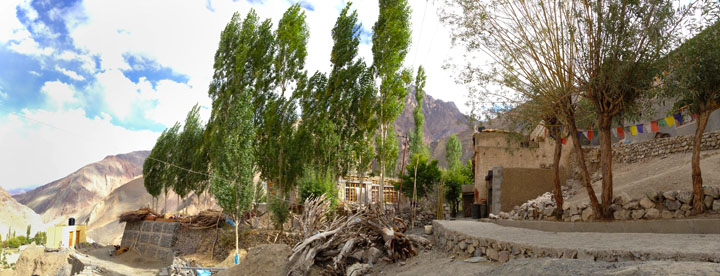
View of Mangyu Village, Ladakh, India. To get there, one drives through narrow valley gorges. The village remains hidden until you drive practically right up to it.
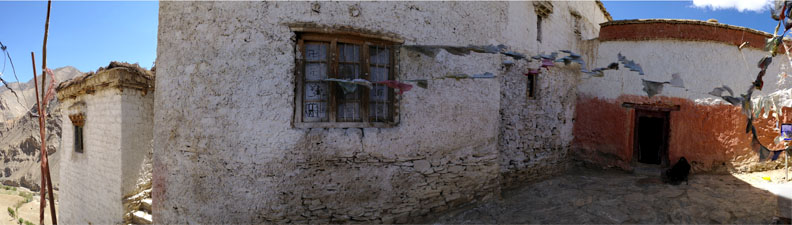
Like Lamayuru Monastery’s Indo-Tibetan Senge Lhakhang, Mangyu Monastery’s Vairocana temple is also a small intimate place. Classic, pre-13th century, early period architecture, the site is nestled in and integrated with a village as opposed to fortified and atop on a hill from the community.
Beginning of Mangyu Village, Ladakh, India
I believe that up till fairly recently, let’s say last twenty years, there was no motorable road up to Mangyu Village, which means it was largely isolated and unknown by travelers. We parked a little below the village and walked up to the monastery, passing by small grocery stores that had countertop service for a simple meal of packaged and flavored maggi noodles (what we call ramen noodles in the U.S.) I was starving and grateful to be served one! When traveling around these more remote parts, one never knows where and what the next meal may be. This village had no restaurants or dhabas, nor did I see guesthouses. This is lovely because it indicates that tourism hasn’t bloomed here. Mangyu is pristine for this reason.
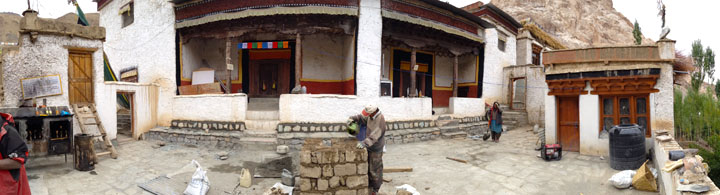
Panorama of Mangyu Monastery with Chenrezig Lhakhang on left, Nambarnangze (Vairocana temple) on right, together flanked by Chamba Lhakhangs of Maitreya and Jambeyang sculptures, Ladakh. Workers are making repairs under the auspices of INTACH, the Indian National Trust for Art and Cultural Heritage.
Tourism is a challenge to local and modest communities here in the Himalayas. While it brings income, it also brings ecological stress. And ecological stress is no small thing to cope with when the land is semi-arid and mountainous, the people mostly poor, the government ill-equipped to provide adequate infrastructure. The need for food and water sources, sewage, sanitation, and modern transportation to serve tourists often ravage the natural beauty here.
Especially if it brings non-biodegradable garbage like plastic. It’s very upsetting to see packaging or other plastic objects thrown over the side of a Himalayan mountain or floating through the streams, stuck in rocks. Indeed, the Himalayan areas I’ve traveled to have dumps located on the mountain side. You can often see them along the road while driving on the highways. It will be a sudden burst of packaging color en masse among the earthy rocks and otherwise scenic beauty. It’s either this or shopkeepers and townsfolk simply burn the garbage. Yes, they burn it, open-air, in front of their shops or homes, frequently plastic and all.
Plastic bottles and those plastic carton drink containers, potato chip and candy wrappers are the most noticeable litter in the streets. I sadly think, these things will never degrade into anything that can be absorbed properly here. Nor anywhere on Earth for that matter, but since we are here on the topic of the Himalayas, my point is that tourism causes environmental strain and damage. I always ask for boiled water at hotels to cut down on the plastic, and carry a thermos with me. Of course, on some occasions, I can’t avoid it and will guiltily buy water in a plastic bottle.
But my visit to Mangyu Monastery was not one of these occasions, I’m happy to report!
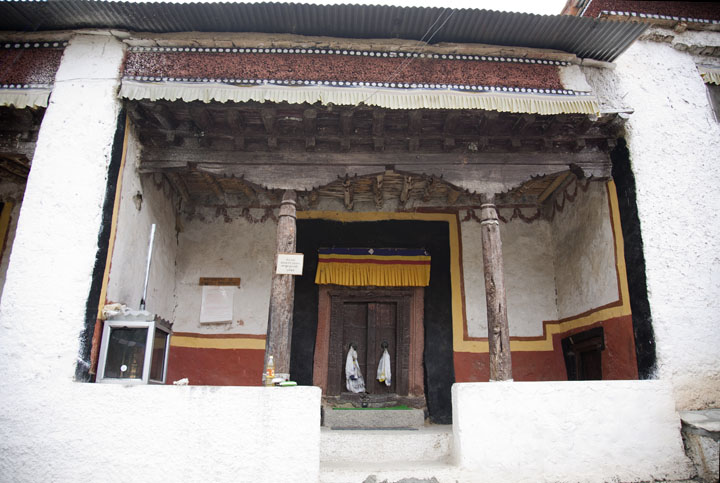
Entrance to Nambarnangze (Vairocana temple), ca. 11th century Indo-Tibetan early monastic architecture, Mangyu Monastery, Ladakh. Photo: Kishore Thukral
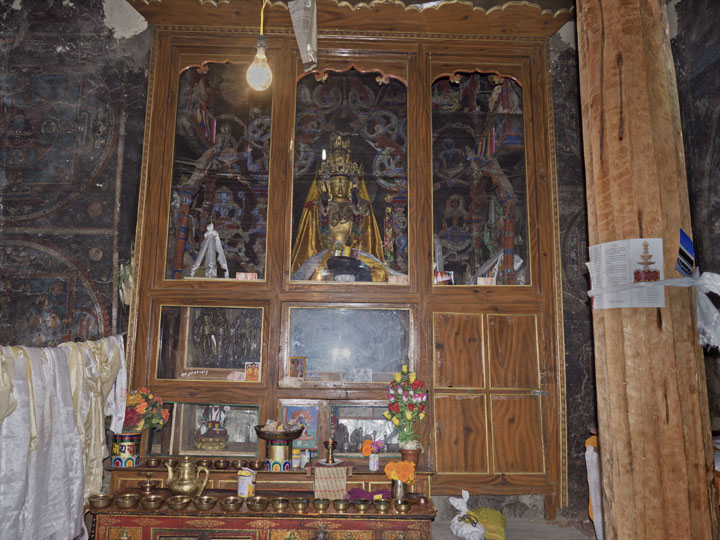
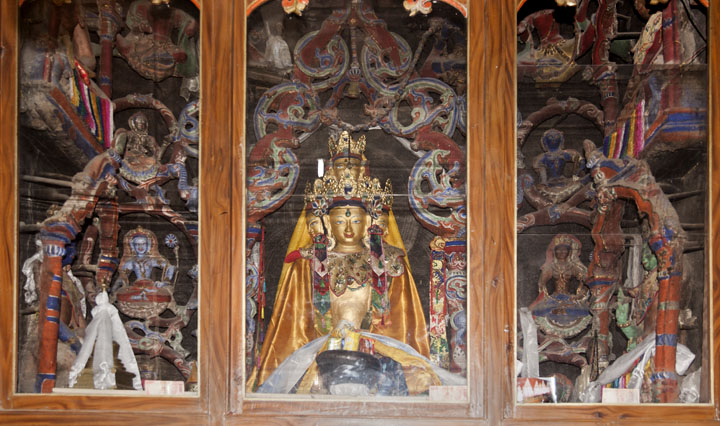
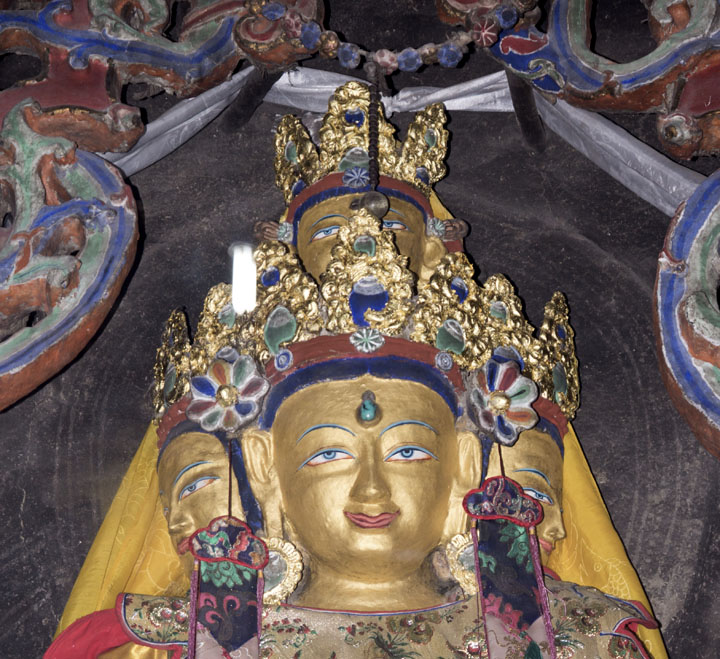
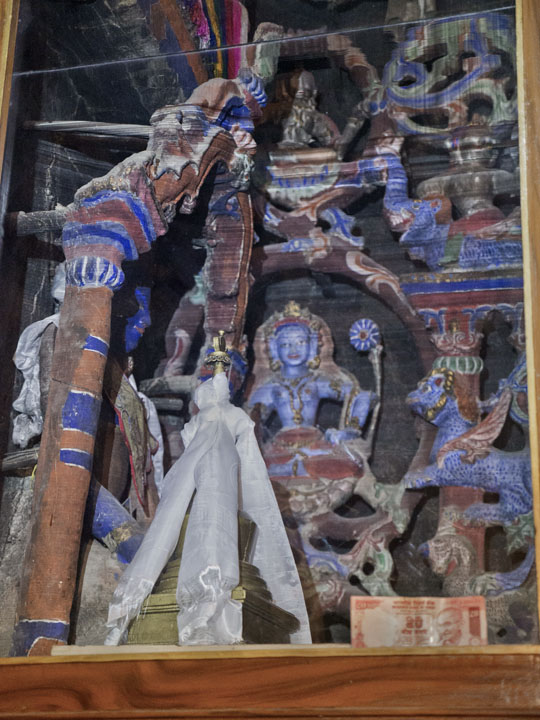
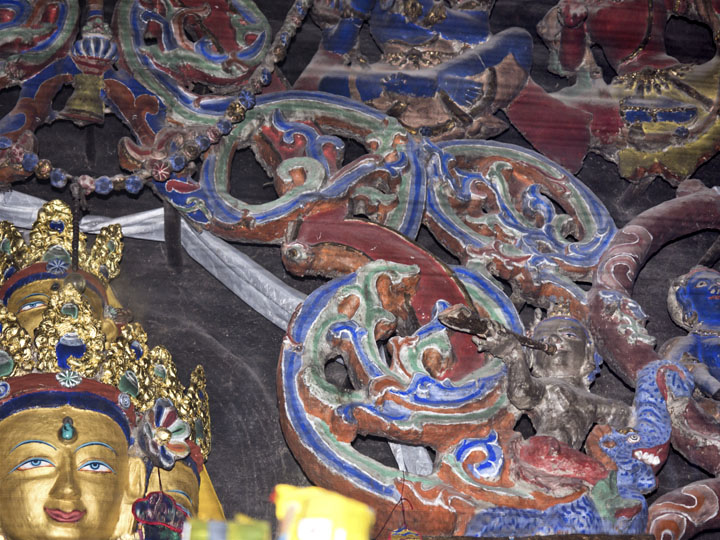
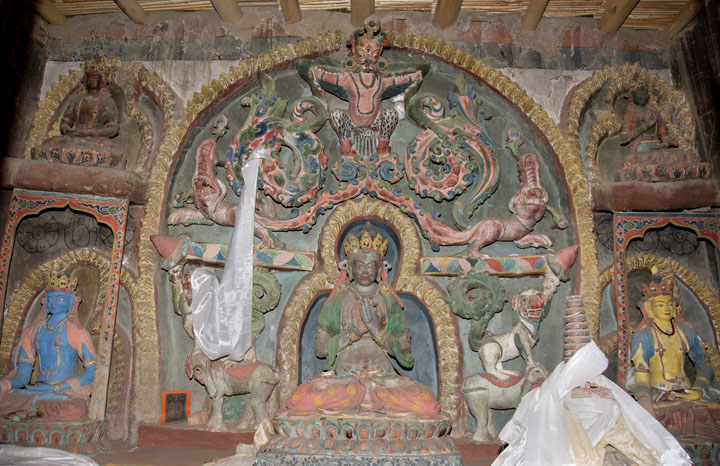
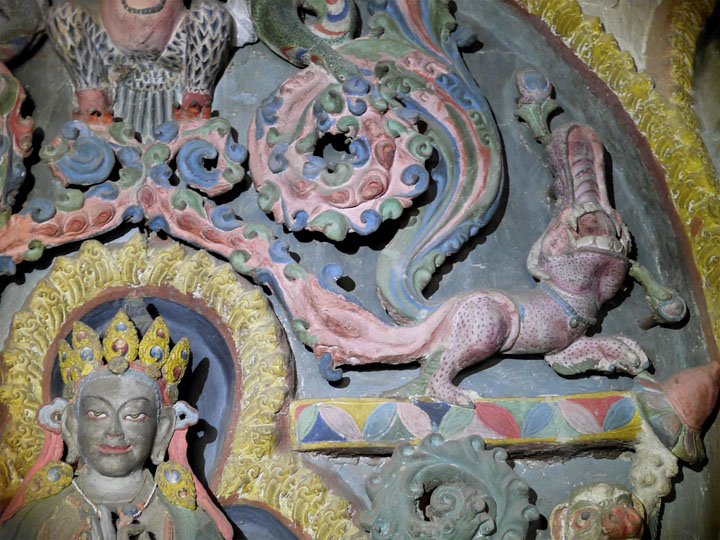
In the 11th century Indo-Tibetan tradition of The Great Translator Rinchen Zangpo, this altar in Nambarnangze once again features Vairocana in the center, surrounded by the Dhyani Buddhas, offering goddesses, animals, and ornate scrollwork, topped by a garuda. See floor plan here.
Experience the interior of this rare, medieval Vairocana temple by seeing a walk-through video here.
View of Nambarnangze interior, with Indo-Tibetan clay sculptures and wall paintings. The altar is now unfortunately encased by glass making it difficult to see the fine craftsmanship of Kashmiri artists, ca. early 11th century, LadakhIndo-Tibetan clay sculptures of Vairocana and Dhyani Buddhas of altar, Nambarnangze, Mangyu Monastery, Ladakh. Now unfortunately encased by glass, making it difficult to see the fine craftsmanship of Kashmiri artists, ca. early 11th century, Photo: Kishore Thukral
For further info on Vajradhatu Mandala structure upon which early monasteries of this period were based, see this post on Lamayuru Monastery’s Senge Lhakhang and this one on the celebrated Tabo Monastery’s Tsug Lhakhang.
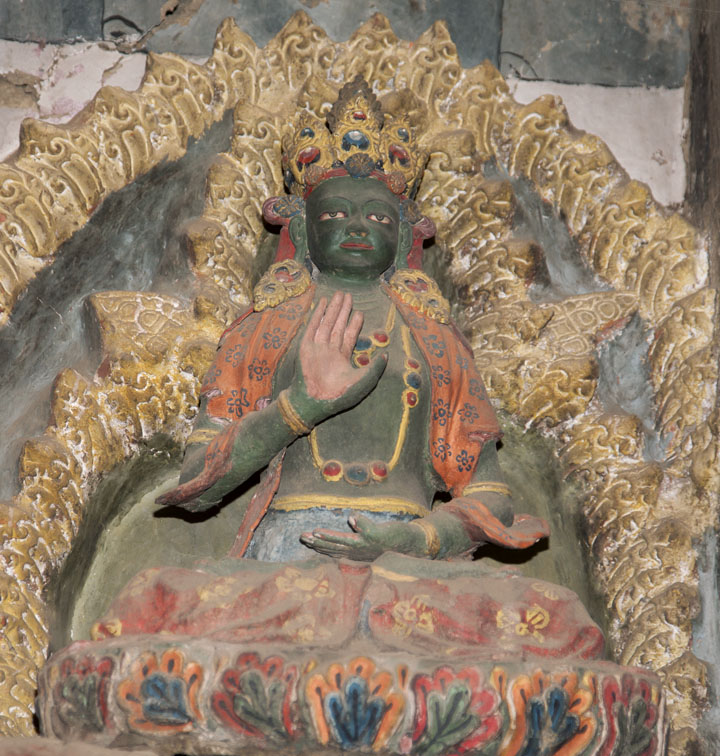
Detail of Vairocana Buddha sculpture, ca. 11th century, altar of Nambarnangze, Mangyu Monastery, LadakhDetail of ornate scrollwork, animals and offering goddesses, rare 11th century Indo-Tibeta clay sculptures, altar of Nambarnangze, Mangyu Monastery, Ladakh, IndiaDetail of Vairocana Buddha, with ornate scrollwork, animals and offering goddesses, rare 11th century Indo-Tibetan clay sculptures, altar of Nambarnangze, Mangyu Monastery, LadakhDetail of Amoghasiddha, a Dhyani (Supreme) Buddha, rare 11th century Indo-Tibetan clay sculpture, altar of Nambarnangze, Mangyu Monastery, Ladakh. Photo: Kishore Thukral
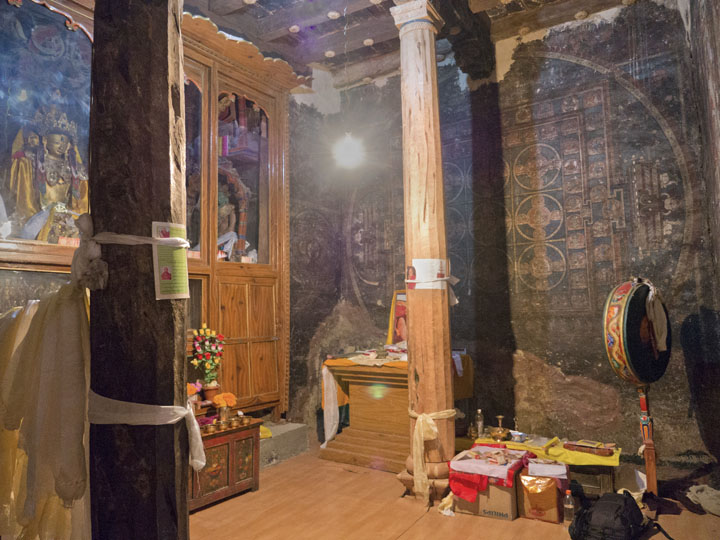
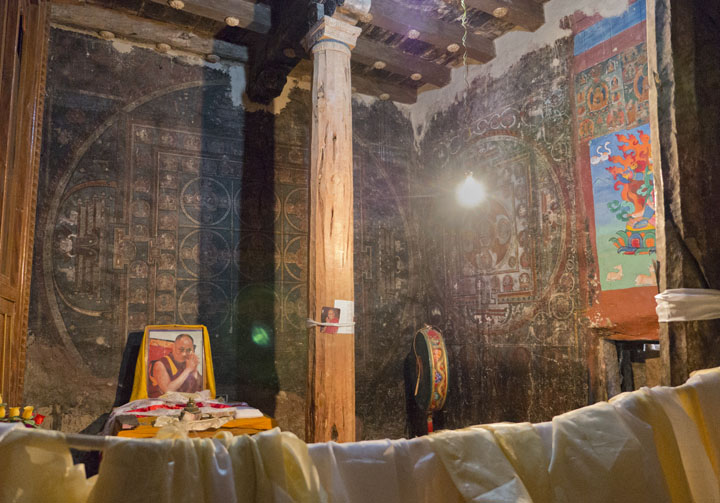
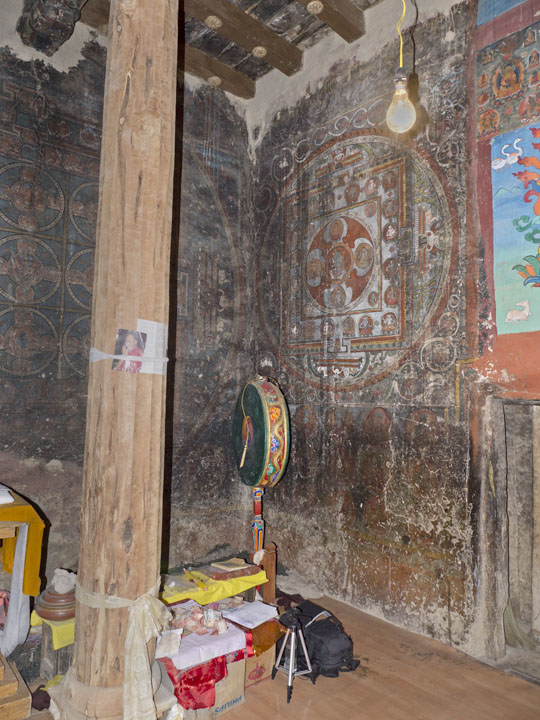
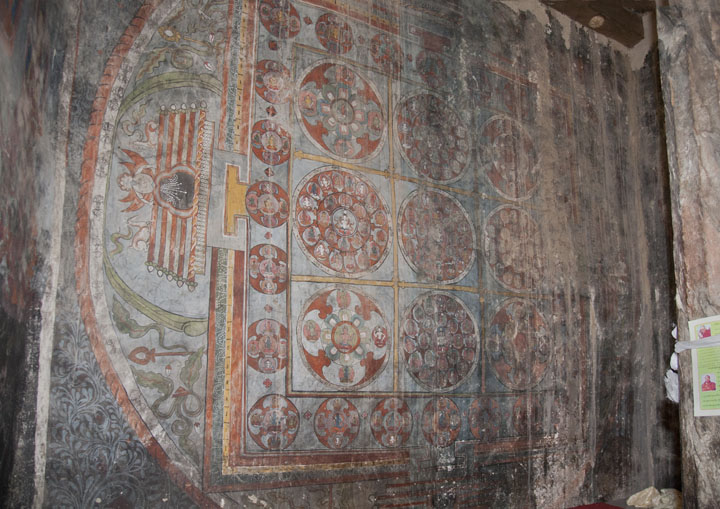
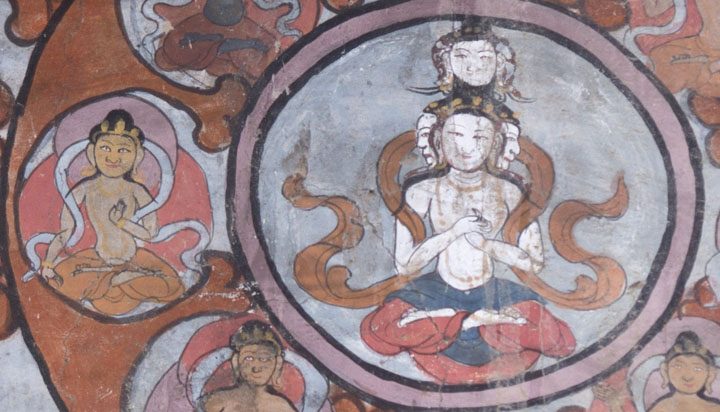
The small Vairocana temple is symmetrically painted on its left and right side walls with one large central Vajradhatu mandala each, flanked by smaller mandalas of related divinities or protectors. On the right side wall, the paintings look like well-conserved oe well-preserved original Indo-Tibetan.
Interior of Nambarnangze, Mangyu Monastery, with ca. 11th century Indo-Tibetan sculptures and wall paintings, Ladakh. Visible on right is Vajradhatu Mandala.Detail from Vajradhatu mandala, Indo-Tibetan ca. 11th century right side wall painting, Nambarnangze (Vairocana temple) of Mangyu Monastery, Ladakh, IndiaDetail from Vajradhatu mandala, Indo-Tibetan ca. 11th century right side wall painting, Nambarnangze (Vairocana temple) of Mangyu Monastery, Ladakh, IndiaInterior view of Nambarnangze, right side wall adjoining entrance wall, Mangyu Monastery, with ca. 11th century Indo-Tibetan wall paintings, Ladakh
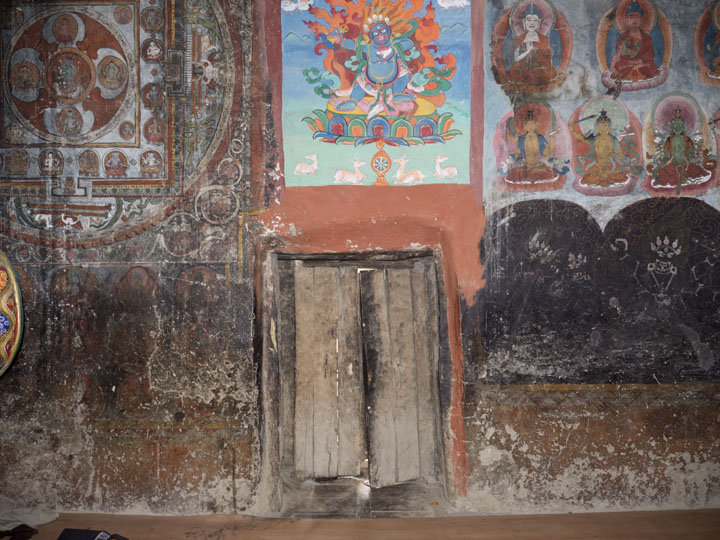
On this entrance wall, however, most everything has been repainted. Peter van Ham in his book Heavenly Himalayas: The Murals of Mangyu and other Discoveries in Ladakh, published recently in 2010, gives a very different description of the state of the protector deity painting above the door.
The entrance wall of Nambarnangze, Mangyu Monastery, Ladakh. Wall paintings here are mostly repainted over ca.11th century originals.
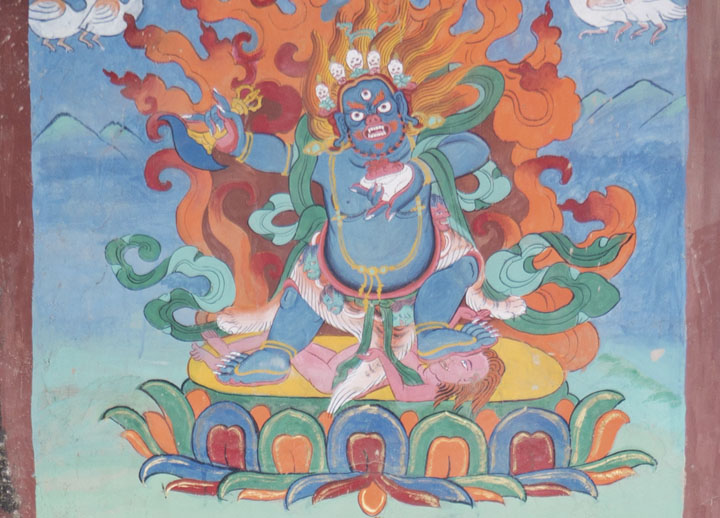
He writes, “The entrance…is protected by a wrathful blue deity, painted above the door. Only the right half of the painting has been preserved, the rest has been washed away by water leakage through the roof…As two peculiarities the protector is adorned with beautiful shawls displaying typical Ladakhi tie-dye patterns and in his right hand he holds a knife with an interesting blade of Indo-Iranian shape, the tip of which is equipped with a vajra-like structure.”
Repainted Mahakala above entrance door of Vairocana Temple, Mangyu Monastery, Ladakh.
The discrepancy between van Ham’s description and the above photo shows that this Mahakala was certainly repainted in the last few years. As we can see, absent are the shawls with Ladakhi patterns. This evidence, along with mismatched colors and less refined execution, leaves me shocked and deeply saddened over the handling of Mangyu Monastery preservation.
While the colors in this repainted mandala on the left of this entrance wall are more in keeping with extant original murals, the execution looks nothing at all like the sophisticated, skillful, and expressive handling of Indo-Tibetan artists.
Interior view of Nambarnangze, Mangyu Monastery, with Indo-Tibetan wall paintings, LadakhDetail of repainted mandala on left side of entrance wall, Nambarnangze, Mangyu Monastery, LadakhDetail of repainted mandala on left side of entrance wall, Mangyu Monastery, Ladakh. Stylistically different, this was probably repainted in recent years.Detail of repainted mandala, Nambarnangze, Mangyu Monastery, Ladakh. Stylistically different and lacking in refinement, this is strong evidence of repainting over original Indo-Tibetan art.
The same is true for the left side wall. What van Ham describes of the 11.5 foot diameter mandala that dominates this wall does not match what currently exists. This must also be a recently repainted mandala.
View of Vajradhatu mandala on left side wall, adjacent to a variety of wall paintings that post-date the Indo-Tibetan period, another example of repainting that threatens the survival and art-historical importance of the originalsView of Vajradhatu mandala, also repainted, Nambarnangze, Mangyu Monastery, Ladakh. Photo: Kishore Thukral
When this is what an example of original quality and style looks like (click on second image on the bottom) the quality and style of this repainted example pales in comparison.
Detail of repainted Vajradhatu mandala, Nambarnangze, Mangyu Monastery, Ladakh. Once again, stylistic and quality differences indicate repainting over Indo-Tibetan originals.
This small Buddha mandala is on the left of the altar wall. It contains some original and repainted areas.
Buddha mandala, Nambarnangze, Mangyu Monastery, Ladakh. Stylistic and quality differences indicate repainting over Indo-Tibetan originals. Photo: Kishore Thukral
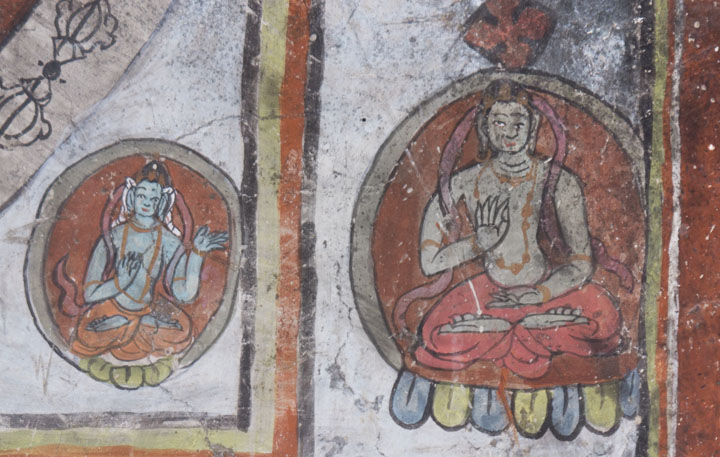
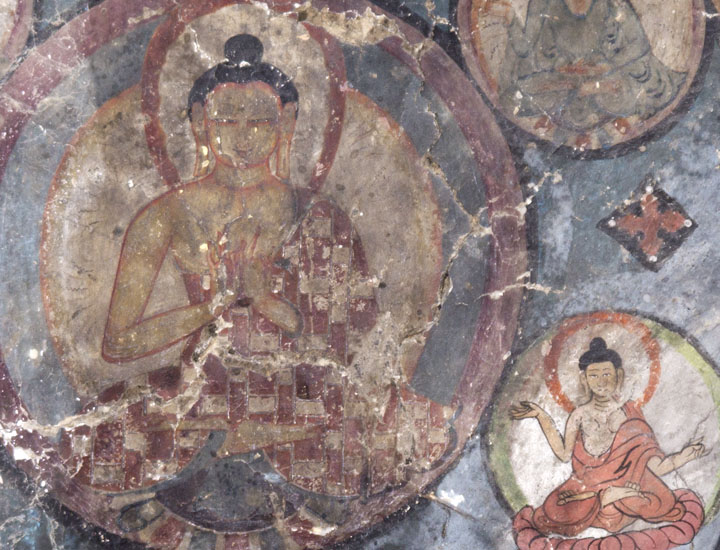
Here is a side-by-side view of what appears to be an original Indo-Tibetan Buddha in center next to a contemporary repainted one.
Detail of Buddha mandala, Nambarnangze, Mangyu Monastery, Ladakh. The central Buddha looks original, but at lower left, stylistic and quality differences indicate repainting over Indo-Tibetan originals.
The historian David Snellgrove wrote in Indo-Tibetan Buddhism: Indian Buddhists and their Tibetan Successors, “The absence of all Buddhist wall-painting in India apart from the Ajanta Caves represents an enormous loss for the history of Indian art. Some deductions can be made from fragmentary remains in Central Asia and especially from the earliest surviving Tibetan murals from about A.D. 1000 onward, and from miniature paintings on Pala manuscripts of about that date.”
While Mangyu may still be pristine from a tourist/environmental point of view, it is less so from an art-historical one. Like I fear for Tabo, Alchi, and other remaining monasteries that have Indo-Tibetan significance, these beautiful, rare wall paintings are disappearing not only through age and exposure to natural elements, but also through the unexpected hands of man. The resultant replacement paintings, lacking in comparable quality, style, etc., are functionally erasing historical records. The originals are thus disappearing over time due to lack of proper conservation and restoration.
View of Lamayuru Monastery on plateau at top, with Lamayuru Village below, Ladakh, India
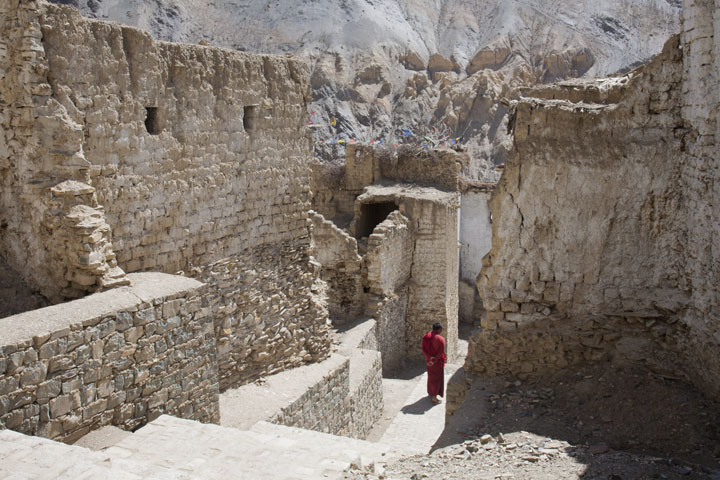
Seeing Lamayuru Monastery today was a rich experience. The hilltop monastery complex is a delightful warren of small passageways that give way to open views. It includes the functional old, the relatively new, and then the crumbling ruins. Walking through it really imparts the feeling of a medieval village in its different stages of development and abandon.
Senge Lhakhang, ca. 11th century, the oldest temple at Yamayuru Monastery. Contains well-preserved and rare Indo-Tibetan clay sculptures of Vairocana, Dhyani (Supreme) Buddhas, and Vajradhatu mandalas, including Gonkhang with protector deities, Ladakh, India
It’s an intimate temple. Upon entering, one faces the splendid and well-preserved altar which by now, dear reader following this blog, you will recognize as belonging to the rare Indo-Tibetan 11th century period of sacred art.
As at Lhalung and Tabo Monasteries, the temple features Vairocana and the Dhyani (Supreme) BuddhasAmitabha, Akshobhya, Amoghasiddha, and Ratnasambhava. These are polychromed clay sculptures seated on lotus thrones inside stylized alcoves. Here at Lamayuru, Vairocana is also seated atop lions which is how the temple derives its name. Senge means lion in Tibetan. He is surrounded by animals, scrollwork, and surmounted by a prominent protective Garuda, the powerful Hindu mythical bird.
Experience the interior of Lamayuru Monastery’s Senge Lhakhang by watching this exclusive video walk-through here.
[vimeo 137311083 w=600 h=337]
Main altar, Senge Lhakhang, Lamayuru Monastery, Ladakh. Central figure is Vairocana, flanked by Dhyani Buddhas (clockwise from left) Aksobya (blue), Amitabha (red), Amoghasiddhi (green), and Ratnasambhava (yellow), surmounted at top by Garuda. Photo: Kishore ThukralIndo-Tibetan clay sculpture of Vairocana, Buddha of Wisdom, one of the Five Dhyani Buddhas, main altar Senge Lhakhang, Lamayuru Monastery, LadakhDetail of main altar with central Vairocana surrounded by animals and surmounted by Garuda, main altar Senge Lhakhang, Lamayuru Monastery, LadakhRatnasambhava, one of the Dhyani (Supreme) Buddhas, rare 11th century Indo-Tibetan clay sculpture, main altar Senge Lhakhang, Lamayuru Monastery, LadakhDetail of Vairocana Buddha and animals, rare 11th century Indo-Tibetan clay sculptures, main altar Senge Lhakhang, Lamayuru Monastery, LadakhDetail of Akshobya, one of the Dhyani (Supreme) Buddhas, 11th century Indo-Tibetan clay sculpture, main altar Senge Lhakhang, Lamayuru Monastery, LadakhAkshobya, one of the Dhyani (Supreme) Buddhas, 11th century Indo-Tibetan clay sculpture, main altar Senge Lhakhang, Lamayuru Monastery, LadakhAmoghasiddha, one of the Dhyani (Supreme) Buddhas, rare Indo-Tibetan clay sculpture, main altar Senge Lhakhang, Lamayuru Monastery, Ladakh. Photo: Kishore ThukralAmitabha, one of the Dhyani (Supreme) Buddhas, rare Indo-Tibetan clay sculpture, main altar Senge Lhakhang, Lamayuru Monastery, Ladakh. Photo: Kishore ThukralGaruda, Hindu mythical bird, main altar Senge Lhakhang, Lamayuru Monastery, LadakhThe lions or Senge, main altar Senge Lhakhang, Lamayuru Monastery, Ladakh
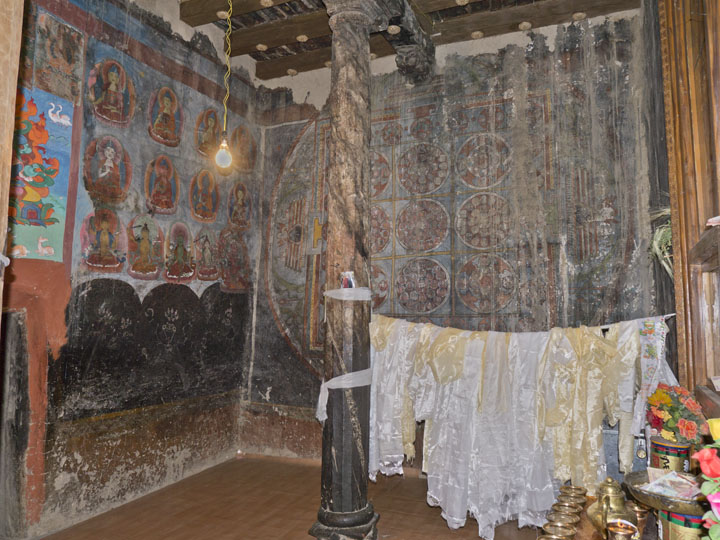
In stark contrast to the fine state of the sculptures, the wall murals are in a very deteriorated condition, faded and water-damaged. In fact, facing the altar, the whole right side wall is altogether undecipherable, almost completely devoid of the original imagery. Looks blackened and/or delaminated down to the mud bricks. It’s incredible that after over one thousand years of time, anything can remain at all, really. Time has really ravaged this wall. I wish it were different!
The left hand wall can still be glimpsed. If only some effective and accurate conservation could be done to preserve these historically significant, rare examples of Indo-Tibetan Buddhism and the Second Transmission of Buddhism from India to Tibet!
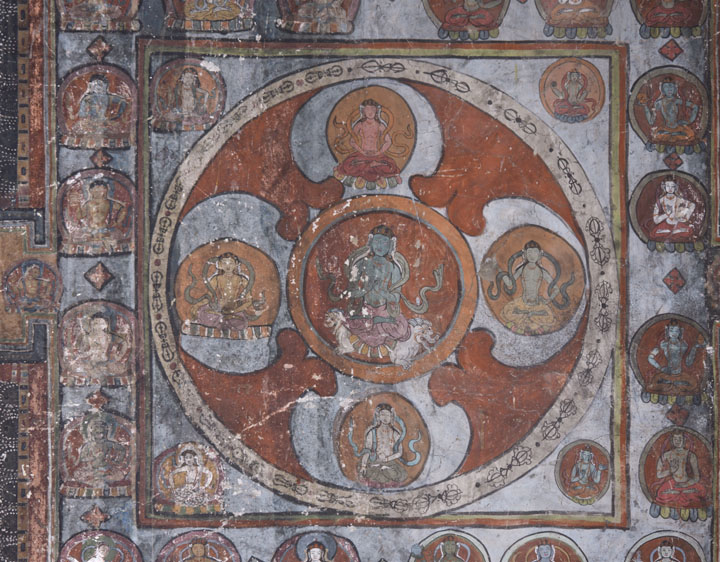
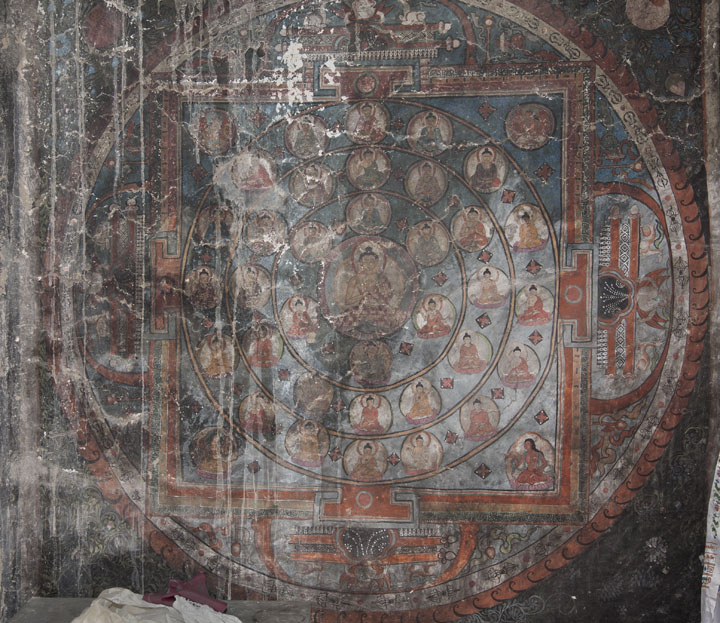
Vajradhatu Mandala, Indo-Tibetan wall painting, Senge Lhakhang, Lamayuru Monastery, Ladakh
While it’s difficult to see details of the above wall painting, it is certainly a Vajradhatu Mandala and as such, its structure is usually this:
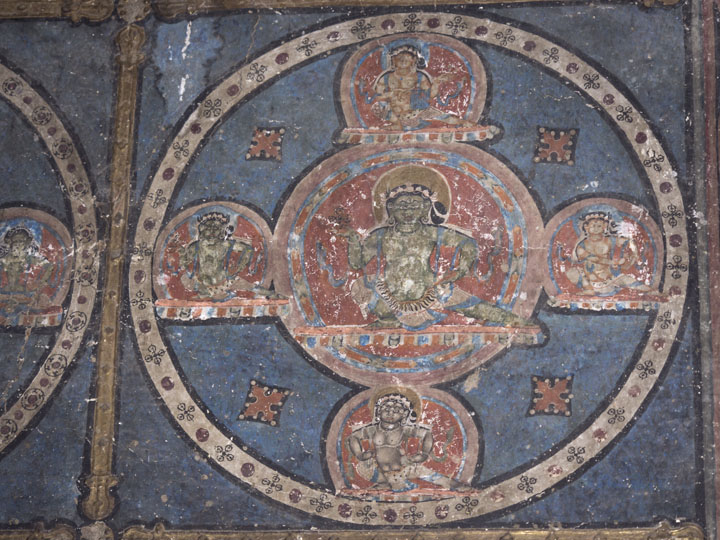
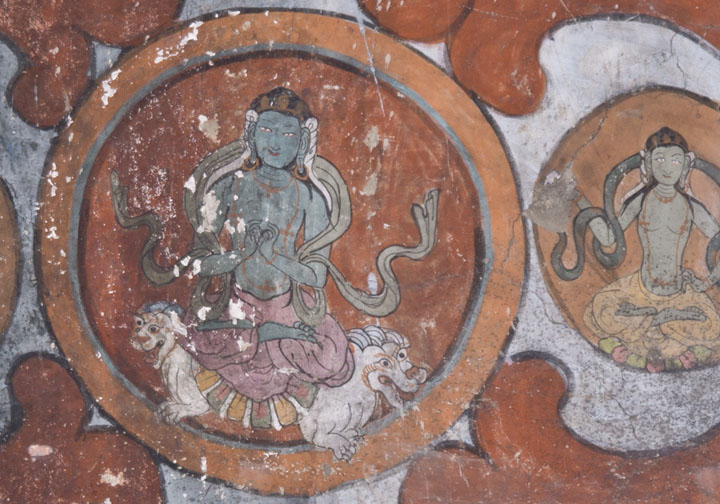
At center is Vairocana with the 4 Dhyani Buddhas (Amitabha, Akshobhya, Ratnasambhava, Amoghasiddha) positioned around him in the cardinal directions, each encircled by 4 bodhisattvas. There are an additional 12 deities–4 guardians, 4 outer offering goddesses, and 4 inner offering goddesses. In all, the basic set of Vajradhatu mandala deities is 33 or 37. Vajrayana mandalas and the deities that reside within them are essentially symbols of the qualities of consciousness to develop on one’s spiritual path. They are mnemonic devices to aid a practitioner towards enlightenment.
Variations in Vajradhatu mandalas are seen in different monasteries with the addition of up to 60 other divinities–such as the 16 arhats or 12 pratyekabuddhas, among others. These are often depicted on the outer sections as additional circles or squares in the same mandala composition, or in altogether separate small mandalas.
It is important to note that such symbolic plenitude expresses manifestations of the same fundamental principles. Buddhism did inherit the Hindu understanding of many-paths-to-the-same-truth. These additional divinities also have their basis in written scripture or canonical commentaries.
Avalokiteshvara (Chenrezig), bodhisattva of compassion, Indo-Tibetan wall painting, Senge Lhakhang, Lamayuru Monastery, Ladakh
Adjoining the main temple room is a gonkhang, chapel dedicated to protector deities.
Protector deities, including Mahakala and Lhamo Palmo, Gonkhang, Senge Lhakhang, Lamayuru Monastery, Ladakh. Photo: Kishore ThukralView of Senge Lhakhang, with Indo-Tibetan sculptures and wall paintings, Lamayuru Monastery, LadakhConversing with Kagyu monk at entrance of Senge Lhakhang, Lamayuru Monastery, Ladakh. Photo: Kishore Thukral
Lamayuru grounds in this older section near the Senge Lhakhang is characterized by these passageways that are alternately nestled and enclosed, then open and expansive.
Walking through older parts of Lamayuru Monastery, Ladakh. Photo: Kishore ThukralWalking through older parts of Lamayuru Monastery, Ladakh. Photo: Kishore ThukralWalking through older parts of Lamayuru Monastery, Ladakh. Photo: Kishore ThukralWalking through ruins of of Lamayuru Monastery, Ladakh. Photo: Kishore Thukral
Among the stone ruins, amidst the Himalayan landscape, I tried to imagine the charming bygone era of great vitality during the reign of Western Tibet’s Guge kings Yeshe O’d and Changjup O’d whose vision reformed and ignited the spread of Vajrayana Buddhism from India to Tibet in the 10th to 12th centuries. How it must have been in this remote Himalayan landscape a thousand years ago, when these walls and buildings were new, its monastic and lay inhabitants filled with rejuvenated fervor and scholarship!
Walking through older parts of Lamayuru Monastery, Ladakh. Photo: Kishore ThukralView of Himalayan Village and valley from Lamayuru Monastery, Ladakh
My travel companion K and I left Keylong at 5:00 a.m. to head to Leh. The wonderful and inspired Lahauli adventure had come to an end, and it was now time for Ladakh!
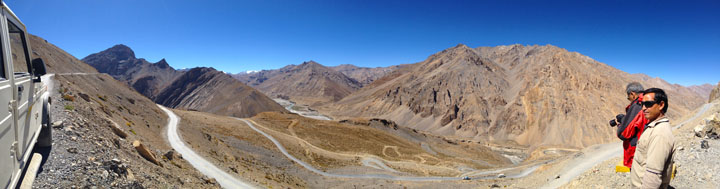
It was a long drive of about 11-12 hours on the Manali-Leh Highway, with stops for photos, breakfast and lunch. Unbelievable rugged terrain that seems to endlessly unfurl its textural vistas as you drive along hour after hour. Empty, cold, semi-arid desert across vast mountain ranges.
Rugged terrain of Manali-Leh Highway, en route to Ladakh
Like the road trip from Spiti to Lahaul, the land is at once austere and captivating. Fortunately, unlike the jagged, unpaved highway from Spiti to Lahaul, this one was rather well-paved and maintained. Besides tourists, it’s well-used by the military guarding the Sino-Indian border, and there are checkpoints along the way where all vehicles must stop and register passing through.
En route, one passes places with quaint names like Zingzingbar and Lachulung-la, ascending ever higher. From our starting point at Keylong, it’s 3349 meters altitude going up to the high point of Tanglang-la of 5328 meters. I felt short of breath at times, but thank goodness I’m long over altitude adjustments (the first week in Spiti was vice-grip-like, headache-filled nights in addition to shortness of breath), though it is no joke to continue to take precautions and be aware of the dangers of high altitude sickness. People can die from it, and pretty quickly, too.
Roadside tent dhabas (eateries) and basic dormitory accommodations are set up for the summer season from about June to September, Manali-Leh Highway
There are no villages or towns the whole stretch of road from Keylong to Leh, only roadside stops for food or overnight stays. These are makeshift temporary seasonal tents that offer cots for travelers to sleep in and a basic menu of dishes such as paranthas, rice and dahl, chow mein. Breakfast was at one of these places.
Interior of a roadside dhaba (eatery) with cots for overnight stays, Manali-Leh Highway, Ladakh
Shortly after taking off on the road again after breakfast, we saw this. Can you spot the little guy in the below photo?
Manali-Leh Highway
Didn’t see him? Okay, then look here…
Marmot out in morning sun, Manali-Leh Highway, en route to Ladakh
Marmots were poking their heads out of rock crevices, or walking out in the open like this one, presumably searching for breakfast. Cute pudgy little things, they reminded me of our local American groundhogs.
Driver G was really nice, good conversationalist, great driver. He is a trekking guide and luxury tent campsite owner in Manali who conducts Himalayan adventure trips. He is also an old friend of K’s. K said G saved his life once on a mountaineering trip.
With his four wheel drive flatbed truck, he would deftly take uphill shortcuts connecting switchback roads, such as here at the Gata Loops, the part of the highway famed for its 21 hairpin turns.
The part of Manali-Leh Highway famed for its 21 hairpin turns on the road, en route to LadakhGate Loops on Manali-Leh Highway, en route to LadakhTurquoise water offset against the pinks of the mountain range and red-siena ground cover. Yes, it really looks like this on parts of the Manali-Leh Highway heading to Ladakh!
Kangla Jal trekking pass point and India Gate reminds me of out West in Zion or Bryce Canyons in the U.S.
Near Kangla Jal trekking pass, Manali-Leh Highway, en route to LadakhIndia Gate, near Kangla Jal trekking pass, Manali-Leh Highway, en route to Ladakh
Lunch was at another tent site, where people really make do with little water and toilets are open air. One gets good at finding large rocks to befriend!
Lunch en route to Ladakh on Manali-Leh Highway
Not long after leaving the lunch site, we came upon the plateau portion of the trip called Morey Plains. Instead of traveling through passageways and valleys, this section was a wide open flat expanse of land.
Morey Plains, Manali-Leh Highway, en route to LadakhBeginning of Morey Plains, Manali-Leh Highway, en route to LadakhJust straight road! Morey Plains, Manali-Leh Highway, en route to Ladakh
The Himalayan mountains along the way are diverse in colors and shapes. Some are more black like these below, and others more pink and warm flesh tones gradating into earth reds as you see more of as you get closer to Leh.
Natures sculpts some stunning shapes and presents here nuanced gray and black tones along the Manali-Leh HighwayThe Himalayas, as far as your eye can see…Large cars are just specks on the thready-looking roads
When we reached Tangla-la, the high point with an altitude of over 17,500 feet, it was marked by a large shrine and elaborate prayer flags. Other travelers stopped for a gander and to marvel that they, too, had made it to this point on the road to Leh. Inside the shrine there were Hindu and Buddhist deities.
Tanglang-la Pass with shrine and prayer flags, the highest point on the Manali-Leh Highway at 5328 meters (over 17500 feet), en route to Ladakh, IndiaShrine at Tanglang-la Pass, the highest point on the Manali-Leh Highway at 5328 meters (over 17500 feet)Hindu and Buddhist deities, inside shrine at Tanglang-la Pass, the highest point on the Manali-Leh Highway en route to Ladakh, India
How did people in ancient times manage traveling through this rough barren terrain? Actually many of them didn’t and perished along the way. I’m thinking of Rinchen Zangpo’s party of 21, whom King Yeshe O’d sent from Guge, Western Tibet, to India in the late 10th century, only 2 of whom made it back alive.
IS IT NOT? Khardung-la is the first highest pass in India.
As you get closer to the city of Leh on the highway, you begin to see stupas and chortens in the landscape. This little monastery is among the first signs of permanent dwellings as you come out of the hinterlands and approach civilization, still about two hours’ drive before reaching the outer monasteries of Leh, such as Stakna.
The scenic view of Stagna Monastery as you come out of the remoteness of the Manali-Leh Highway and reach outskirts of Leh, Ladakh, IndiaMuch of Leh looks like this combination of vast dry flatlands adjacent to mountains with villages nestled in the valleys.
This story has proven staying power on my mind. I was going to write about Kardang Monastery, the first site I visited in Lahaul, but I have been thinking about this other content, so must share it here, now.
What if you were in a situation where you had to choose between your freedom from prison, or bringing a great spiritual teacher to your country to enlighten its citizens? Yeshe O’d, the 11th century Buddhist King of Guge in Western Tibet was faced with this choice.
During his lifetime (967-1040 C.E.), he had inherited a kingdom in a confused and degenerate era of Buddhism, a condition that followed its religious repression by previous King Langdarma (863-906 C.E.) To counter dissolute Buddhist practices and ideas, Yeshe O’d aimed to restore pure teachings in a variety of educational and development initiatives.
He sent young scholars to India to study Sanskrit, the original language of Buddhist scriptures. He imported and had faithfully translated Sanskrit sutras, tantras, and commentaries into Tibetan. He built monasteries all over his vast kingdom, and brought a team of inspired artists from Kashmir, where Buddhism had long flourished, to help illustrate the fundamentals of tantric practice. If you have been following this blog, you know then that this involved depictions of the deity Vairocana, the Dhyanibuddhas (Five Buddha families) and their associated cycle of deities in a Vajradhatu mandala order of art and architecture. It resulted in a distinctive period of Indo-Tibetan sacred art which can still be seen today in late 10th and 11th century sites such as Tabo and Lhalung monasteries in Spiti; Alchi, Lamayuru, Mangyu, and Sumda Chun monasteries in Ladakh. Finally, Yeshe O’d also searched for and invited a great Indian master to teach in Tibet.
Of the twenty-one individuals he sent to India to study Sanskrit, only two survived to return from the arduous journey to inform him of the great master Atisha.
One of these students later became The Great Translator Rinchen Zangpo who, through his scholarly excellence and dharma dedication together with the king’s support, helped effect what is known as the Second Great Transmission of Buddhism from India to Tibet. It spanned the late 10th to 12th centuries C.E.
Upon learning of Atisha, Yeshe O’d proceeded to commission a second party armed with gold offerings to request the master to come to Tibet. Of the nine people sent, only one survived, but he was unable to persuade the scholar to leave the learned monastic university center of Vikramashila where he was teaching Indian disciples.
Undeterred, and collecting more gold to offer, the king decided to go personally in a third expedition to meet Atisha. However, along the way he was captured by a rival King of Garlog near Nepal who imprisoned him for ransom. With the intention of deterring the spread of Buddhism, this king demanded Yeshe O’d’s weight in gold for his release, or that he give up his mission to go to India.
By now, many years had passed since the first initiative of sending students to India to study Sanskrit, and Yeshe O’d was an older man. When his nephew Changchub O’d arrived with a large sum of gold collected from throughout Western Tibet, it was not the full Guge king’s body weight. It is said that the gold remaining still required was equal to his head. So the Garlog ruler refused to release his hostage.
Changchub O’d then met with his uncle, who was chained in his dark prison cell, vowing to redouble his efforts to get more gold for his release. Yeshe O’d, however, then instructed him to offer the gold thus far collected instead to Atisha. He said, “I have died countless times in previous lives, but I am sure I have never before sacrificed myself for the Buddha’s Dharma. Now I am very happy to do so. Whomever you send to India, please have him tell Atisha that I have given my life for the welfare of my subjects and the Dharma so that he could be brought to Tibet. Although I have not had the fortune to meet him this lifetime, I have fervent hopes that I can in the future.” In great grief, Changjub O’d agreed to follow his wishes.
And so, Yeshe O’d died in prison for the sake of benefiting others. This story sticks with me for its selflessness and model example of bodhicitta, great generosity. Buddhist history has proven its profundity.
Atisha, upon hearing the circumstances, felt moved by enormous compassion, and he then finally did come to Tibet at the age of 53, sometime in the first half of the 11th century C.E. Along the way, he wrote his masterpiece Lamp for the Path to Enlightenment, a short text in 67 verses which lays out the entire Buddhist path in terms of the three vehicles: Hinayana, Mahayana, and Vajrayana, and became the model for later texts in Stages of the Path.
He remained in Tibet for the rest of his life where he successfully taught and propagated pure teachings that amounted to an illustrious reform within the Second Great Transmission of Buddhism to Tibet. And much to his gratitude, Atisha even showed the very learned Lotsawa Rinchen Zangpo, who was by now aged in his 80s, how to properly practice tantra. Atisha is further credited for laying the groundwork for Je Tsongkhapa’s 14th century seminal teachings.
Lahaul: Garsha Khandroling, Land of the Dakinis
Posted
Dancing Dakini, Tibet, ca.18th century
Lahaul is known by Tibetan meditation practitioners and adepts as Garsha Khandroling, Land of the Dakinis. Dakinis are energetic female spiritual guides often depicted as blissful and fierce dancers.
Lahaul has an illustrious Drukpa Kagyu lineage of highly realized yogis and yoginis who do the Six Yogas of Naropa, esoteric methods bestowed by master to disciple in direct teachings. These are the meditators who go into seclusion in caves or simple dwellings for years or decades in order to realize spiritual liberation–that is to say, Buddha-nature through tantric wisdom and compassion practices.
As I mentioned in my last post, I have heard about some of the mind-over-matter feats that yogis demonstrate which confound conventional explanations, such as levitation, miraculous healing of the sick, making snow fall, taking bad karma upon oneself for the benefit of another. Another perplexing thing, upon death, the bodies of many advanced practitioners do not decay according to the normal time frame of most people. They are believed to be fully aware in the bardo state, the intermediate stage between death and rebirth.
Well, I’ve learned that while it’s difficult to wrap one’s rational mind around such reported phenomena, sitting on the I-don’t-know fence is a flexible and open-minded place to be. After all, outside of spiritual matters we can’t explain, for example, quantum entanglement or what Albert Einstein called “spooky action at a distance,” but it appears to happen!
The great yogi Shakya Shri
Garsha has attracted and hosted countless masters and disciples in pursuit of enlightenment for over 2000 years in unbroken continuity. Inspirations for pilgrims include the sacred abodes of Chakrasamvara at Drilbu Ri Mountain opposite Keylong; Avalokiteshvara at Phakba Temple in Triloknath; and Varjavahari at Markula Devi Temple in Udaipur.
Keylong, Lahaul’s largest village, has several important monasteries only a few kilometers away. These were flourishing Buddhist centers centuries ago, such as Kardang, Shashur and Tayul Monasteries. The oldest one, Gandhola (Guru Ghantal) dates to 1st century C.E. according to archeological evidence. I visited each of these places and to come will be posts featuring them.
View of Gandhola (Guru Ghantal) Monastery, way upper left, with Thupcholing Monastery below on the plateau. Those green-roofed structures are meditation huts for retreatants. Both sites overlook Tandi bridge where the mighty Chandra and Bagha Rivers join in what is considered by Buddhists and Hindus alike as a sacred union.
The delight to be found in Lahaul is that over time, masters have left legends, relics, shrines, stupas, sacred paintings, sculptures, and other spiritual encounters that dot the landscape awaiting discovery by travelers and seekers. The more you look, the more you will see, but it takes some uncovering. For example, what looks unimpressive on the outside may contain a treasure on the inside, such as Jabjes Monastery in Kardang Village. Or one has to do a bit of breathless hiking up a mountain to see some of these old monasteries, hidden meditation caves, and charnel grounds.
Jabjes Monastery located in Kardang Village was built around a legendary rock with the miraculous imprints of yogi Gyalwa Gotsangpa’s knees and genitalia, which formed in the stone as he passionately chased and tried to embrace a dakini who disappeared into it. The rock may be seen today inside the temple, Lahaul, India.
However, I’m told by locals that most visitors just pass through Lahaul, heading to the more tourist traveled and trekked sites in Ladakh or Spiti. What a pity!
More readily noticeable and understood by travelers is that Keylong stretches along the main trade route between the Rohtang and Baralacha passes above the Bhaga River. Besides being a thoroughfare between Ladakh, Kullu and Spiti regions, it is also the district headquarters of Lahaul and Spiti, with strategic military presence. In addition, above and below the village one sees lush farmlands growing barley, peas, potatoes, corn, cabbage, mustard greens, squash, and much more. Apples and other fruit orchards are plentiful. My local driver D told me that agriculture is the economic mainstay of Lahaul, and judging from some of the mansions built by some farming families, the wealth of this abundant agrarian heartland is evident. The food harvested is transported all over India. I would not have guessed that at an altitude of over 10,000 feet there would be such a cornucopia!
View of Keylong on hiking trail from Kardang Monastery to Keylong
D’s ancestral farmland is in the Manali area of Kullu Valley, but he lives and works in Keylong to service the tourist industry as an extension of the family business. Indeed, it’s all in the family. I’ve learned from Lahaulis and Spitians I met that relatives live and work together. This was always the tradition, and it largely continues today.
Another thing I learned was that unlike Tibetans, Lahaulis, Spitians and Ladakhis, while culturally and historically part of Tibet, are indigenous to their regions, and as such are not refugees in India but full citizens. In addition, they have their own language and customs. In fact, the Indian government recognizes them as ethnic “tribals,” who may therefore qualify for certain affirmative action positions or opportunities.
It isn’t only just the passerby tourist who may miss the treasure to be found in Lahaul. I realized that my driver, while he probably identifies himself as a Buddhist, is fairly uninformed about the great legacy of his roots. At one point in our travels, he asked me how much I knew about the Dalai Lama and Buddhism. I thought it was a prompt for me to in turn ask him what he knew and be enlightened by his local knowledge, but it was not a segue way to that at all! He told me he tried to find books on Buddhism in Hindi, but could not. It pained me to hear this–that someone looking for knowledge could not access it.
D said that Lahaulis are educated in Indian schools, are fluent in Hindi but not Tibetan, and frequently not English, either. I noticed this is especially true of the women, who largely live domestic lives caring for family and have little contact with others. English is spoken mainly to communicate with foreigners. Feeling affinity for Indian culture and language, many Lahaulis have assimilated to a large extent in recent generations. Most cannot read the readily available contemporary books in Tibetan on Tibetan Buddhism to fill in on the lack of local education on this topic. Books in English are plenty, but nor can they read these since the written language is “too deep” to understand. It was an exquisite and sad irony that I, a foreigner from the other side of the world, knew more about his spiritual roots than he did. That he, a resident in the incredible Garsha, a descendent of the local culture, could not find one book he could read to study Buddhism deeper!
Farm land and orchards above and below Keylong Village in the fertile valley of Bagha River, Lahaul
It’s a double whammy of cultural distance and spiritual loss. Without being able to study Buddhist philosophy and learn about its unique teachings on dependent origination, one runs the risk of meaningless ritual practice with no or limited realization of freedom from life’s delusions and sufferings.
What’s more, Tibetan Buddhists have a marvelous literary and scholarly tradition, founded on the translation and study of original source materials. Lotsawa Rinchen Zangpo’s translations of Buddhist scriptures from Sanskrit to Tibetan has not only preserved a written heritage now lost in India but produced a renaissance of tantric study and practice. This was during the late 10th to 11th centuries, a flourishing period referred to as the second great propagation of Buddhism. It is the Indo-Tibetan history I’ve been trailing through the sacred art of mandalas, monastery murals, and sculptures.
Garsha: Heartland of the Dakinis
In fact, a (French) Tibetan Buddhist nun, while living in Keylong, discovered the very same thing–that Lahaulis did not know much about the dharma history of their own land. Furthermore, part of why Lahaul’s Buddhist legacy is little known is due to a dearth of literature on it. So she wrote the book Garsha: Heartland of the Dakinis in 2011, published by the Garsha Young Drukpa Association. I have a copy in English, the language it was originally written in. Currently, it needs to be translated into Hindi for local readers.
It is a remarkable small book, jam-packed with a wealth of information about Garsha’s ancient history, the Drukpa lineage masters, dakinis, the founding of monasteries, anecdotes, local legends, descriptions of sacred sites, miracles, reliquaries, carved stones, and much more. It is probably the most, and perhaps only, comprehensive account of Lahaul’s history from the Buddhist perspective. Because it is written by a monastic with open access to living lineage teachers, and unpublished historic materials in Bhoti/Tibetan, the book is a treasure trove of knowledge.
I learned about the book and purchased it from Khandro Thrinlay la when I met her in Manali en route to Spiti (see earlier post here). She is a lama and direct descendent of the Drukpa Kagyu Shakya Shri lineage, with very close spiritual ties to Lahaul. My travel companion J was happy to find it available for sale later in Keylong because she wanted to buy it and donate copies to Tabo Monastery Library in Spiti and The Library of Tibetan Works and Archives in Dharamsala. Funny thing, though, she did not find it in a book store but at a small travel agency/internet cafe establishment run by a lovely Lahauli man keen on the book. You see what I mean? The more you look, the more you will find around here!
Tabo Monastery: Himalayan Setting and Meditation Caves
Posted
Sept 6th, Tabo Village, the Spiti adventure continues…
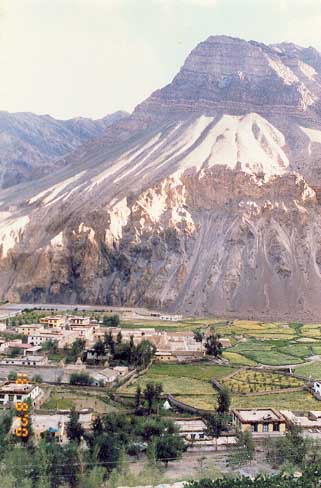
Tabo Village, where Tabo Monastery is nestled in Spiti Valley unlike other Buddhist monasteries that were built as fortress-like compounds on hilltops
Well, here we are in Tabo! The famed Tabo Monastery is known as the oldest continually functioning Tibetan Buddhist monastery, the art of which the Dalai Lama said “delightfully expresses the vigor of the transmission of Buddhism from India to Tibet and the dynamic mingling of cultures.” Established in 996 C.E. by the Buddhist king of Guge in Western Tibet, Yeshe O’d, and the The Great Translator Rinchen Zangpo, it flourished in a golden epoch of Indo-Tibetan collaboration in spreading Buddhist culture.
Tabo Monastery complex behind stone walls in Tabo Village, Spiti Valley, India
Tabo’s existing sacred artwork and architecture have unique historical significance, not only for the aesthetic evidence of such cultural exchange, but also for its rarity. Due to the enormous destruction during the Chinese Cultural Revolution, where over 6000 monasteries and their artworks were destroyed between 1959-61, practically none of the early examples of Buddhist culture have survived in Tibet. Consequently, the monasteries of the Western Himalayan border areas of Spiti, Lahaul, and Ladakh, once part of Tibet, is of great importance for its legacy of early Tibetan Buddhist culture, and in particular, its connection with India.
Street view of entrance to Tabo Choskhor,Spiti, with the museum and library in building on rightUpon entering Tabo Monastery complex, the first building one sees is Tsug Lhakhang, the grand main assembly hallThe Tsug Lhakhang, Tabo Monastery, Spiti
Of the monasteries I’ll visit, Tabo, Alchi, Mangyu, Lamayuru, and Lhalung strike me as being of special importance. These have exceptional murals, unusual in cross-cultural style and depiction, executed in astounding refinement, with ornate clay sculptures that are cantilevered off the walls in Vajradhatu mandala arrangement of sacred space (more on this in the next post!) This type of work is specific to the area and is not found in any other Buddhist temples in the world. These monasteries also date back to that fertile period of Buddhist philosophical exchange and revitalization from India to Tibet beginning in the 10th century during The Great Translator Rinchen Zangpo’s time.
Documenting the extant artwork and architecture of these sites is essential because they are remarkable, and extreme Himalayan winters and potential earthquakes, such as the one that occurred in 1975, continue to threaten their survival. Proper conservation and restoration is critical for art history and posterity. Of immediate concern is the effects of climate change and increased rainfall in the normally more arid Spiti that has damaged Tabo’s murals and architecture. This 2010 article entitled “A Monastery’s Fading Colours,” published in The Indian Express, is about the challenging circumstances facing the monastery’s care under the maintenance of the Archeological Survey of India (ASI). The Times of India recently questioned the national organization’s general efficacy in its article, “92 ASI-protected Monuments Missing.”
Rear view of Tsug Lhakhang with workers currently repairing the mud exterior. Its back walls are as thick as 2.5 meters!Workers currently repairing the mud exterior of Tabo Monastery, Spiti
I find myself wishing these monasteries were designated UNESCO World Heritage sites, such as the early Buddhist Ajanta Caves are in India, or considered World Monuments. Perhaps this would bring more international attention and expertise to help hasten the appropriate preservation and protection against man-made as well as environmental challenges.
Fortunately, I was able to arrive in Tabo with all my equipment fully charged because the electrical power was mostly on during my previous night in Kaza, Spiti. But unfortunately, I was unable to photograph due to administrative details still to iron out. Perhaps by tomorrow, after the special 6:00 a.m. morning prayers for the recently deceased and venerated abbot of Tabo which will be performed as part the traditional 49 days’ observance. Despite not being able to photograph, the monk in charge of the monastery kindly showed me most of the temples in the complex.
What is so immediately striking is the contrast between the simple exterior architecture of mud brick and the resplendent interiors. Wow, the ornate interiors leave you speechless, what treasures of Indo-Tibetan art, history, and philosophy! Especially the dramatic, dark, moody, pensive main assembly hall (Tsug Lha-khang); the older Dromton Temple (Brom-ston Lha-khang), founded by the main disciple of the great teacher and adept Atisha; Initiation Temple (dKyil-kHor-khang), where monks are initiated; BodhisattvaMaitreya Temple (Byams-Pa Chen-po Lha-khang), with a 20 foot high painted mural of the future Buddha Maitreya; and the Golden Temple (gSer-khang).
View of Tabo Monastery complex showing Dromton Temple on far right and Bodhisattva Maitreya Temple left of it, Spiti, India
Oh, news flash! For incredible floor plans of these temples, including elevations, sections, 3D models, photo montages, and more, see this excellent website of an Austrian research team at Graz University of Technology that has been studying the architectural heritage of the Western Himalayas.
And did I mention caves? Yes, caves on a steep cliff above Tabo Monastery and village where, according to archeological evidence, monks had lived and practiced meditation since the 11th century. Now it is an ASI protected site. Most caves are open spaces showing evidence of ancient occupation–sooty interior walls and carved out niches, etc., as well as perhaps picnic use by modern visitors. But while exploring with my flashlight, I peered into an opening of a small closed door of a dark cave only to find a blanched seated figure looking back at me! Startled and flustered, realizing this was a real person and not a phantom, I muttered a quick, deepest apology, and left in a hurry! Well, I guess today there are still some practitioners who retreat to these caves. Whether this was a tourist trying it out, or a yogi, I have no idea.
Path to numerous caves above Tabo Monastery and village, Spiti, IndiaOne of numerous caves carved into the cliffs above Tabo Monastery, used by monks from the 11th century on, SpitiView of Tabo Monastery from inside a cave, Spiti
Have a virtual walk-through here of the insides of some of these caves:
View of the inside of the above Tabo cave, SpitiView of Tabo caves located on a steep cliffside above Tabo Monastery, SpitiView of Tabo Village from cave sites, Spiti, India
Ok, I hope I have a headache-less night’s sleep tonight. Day four at high altitude and I’m still adjusting, but Tabo is at about 10,000 feet high, 2000 feet lower than Kaza, so it should be better. Need to get up early to make it to 6am puja!
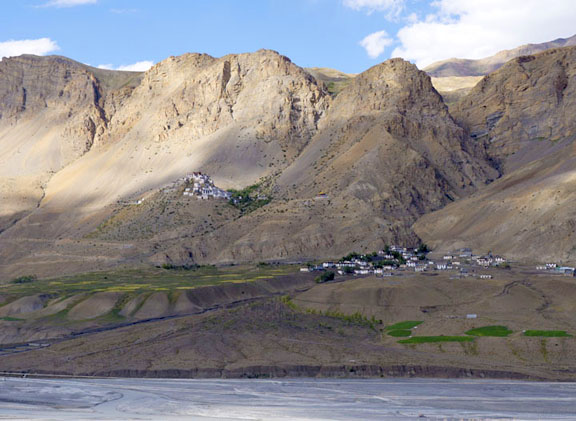
View of Key Monastery from across the Spiti River Valley
A second try today to document the ancient interiors of Key Monastery, whose abbot had in the 11th century been none other than The Great Translator Rinchen Zangpo himself, proved to be a challenge. However, in a nice turn of events, we discovered upon arrival that a special demonstration of sacred dances was in progress. The occasion was the visit of an important official from Shimla.
Entrance to Key Monastery, Spiti
The main interior courtyard was filled with visitors and administrators, with the monastery abbot presiding over the ceremony, as junior and senior monks looked on.
Key Monastery monks demonstrate the Black Hat chamdance, with abbott presiding over the ceremony as young ones watch
Young monks attending a ritual dance demonstration performed by more senior monks
A word about the architecture of Key…Built on a hilltop with a fortress appearance, this reflects typical Western Himalayan monastic architecture after circa 12th century, influenced by the development of invaders.
Key Monastery built atop a hill, characteristic of the later period of post-12th century Buddhist architectural development
Earlier period structures such as late 10th century nearby Tabo Monastery and Alchi Monastery (in Ladakh) are located in the valley on flat open land, integrated with their villages. Invaders were oftentimes rival Buddhist sects supported by the might of the Mongolian military, such as the Sakya sect who headed Key Monastery in the 14th century, and the Gelugpa sect who headed it in the 17th century. The latter came to dominate the majority of monasteries in Spiti.
In fact, most of us don’t associate monastics with marauding, but post-12th century onwards, the region saw inter-sectarian clashes, conquering by bloodshed, innumerable invasions by Chinese and Mongolian forces, shifting power structures, and political unrest throughout the Western Himalayas. Thus, that illustrious period of refined Indo-Tibetan art and architecture under the guidance of Lotsawa Rinchen Zangpo and the collaboration of Kashmiri artists eventually came to an end.
View of Spiti en route to Key Monastery, with a village nestled in its valleyVast and dynamic view of Spiti River Valley
Spelling is a flexible art in India. One often finds multiple spellings for names, places, and in signs. Take Key Monastery, for instance. It is also known as Kye, Kee, and Ki Monastery. It’s all good, take your pick! I’ve even had one monk spell his own name twice for me because sometimes he goes by Tanzin and sometimes Tenzin.
For a stickler about spelling like I am, this is an interesting lesson in imprecision. Especially if you’re asking for directions to a certain street or hotel, and you find that it’s spelled differently by different people, and you can’t help but wonder if you’re talking about the same place. Well, it’s okay, you’ll just do what you have to do, which is, you’ll find out!
It seems to me there’s a kind of accepted uncertainty principle here. It even extends to what people say. If, for example, you ask someone for directions, and he doesn’t know where the place is, he will not say he doesn’t know. He will give you information about where it is. Yes, that’s right, he will tell you something about what he does not know. My Western mind with its penchant for exactness doesn’t get it at all, but let me take a stab and guess: This fellow might think to himself, it may not be right, but it may be approximately right, so it will help.
I have noticed that when my Indian friends need directions, they will ask numerous people the same thing. One time, I was driving with a friend and we were looking for a particular site. He stopped to ask probably half a dozen people within only a half mile’s distance, a kind of cross-reference overkill. A precision begotten by statistical probability. The wider you cast your bets, the better your chances are to get the (flexible and imprecise) jackpot. At least, I think it’s something like that…
It seems to me that here in India, it’s implicitly understood that circumstances, and the world, and the universe, are not exact. And more importantly, we are not masters of these spheres, we are just part of the process. Everything is relative, everything changes, everything has the potential for uncertainty at any time. It is readily, deeply accepted and tolerated that things might or might not work out.
One Indian friend quipped, “I.S.T.–Indian Stretchable Time,” (instead of Indian Standard Time) when he told me a story about his friend who was supposed to come pick him up in a remote area by car, but arrived three days later than expected! Okay, so maybe that example is an extreme one, but the moral of the story is not that the friend let him down, but that he came despite the fact that he had deterring factors that prevented him from coming on time!
Oh, the power has just come back here at the hotel, praise be! So I’m quickly plugging everything in to charge. Spiti has been largely without electricity for the past eight months! And it is being doled out to different areas at the moment, so no power here until about 8 or 8:30pm, supposedly anyway, because the past two nights here have been powerless. I can’t understand the reason why exactly. I mean eight months is a long time to have a vital civic repair apparently unattended to, or not tangibly improved. Not sure if it’s because of devastating natural disaster or simply government mishandling and bad infrastructure. Maybe both. I do know that the next state, Utterakand, has suffered devastating floods and landslides recently, so it’s perhaps spillover?
Today was a bit hard to get kickstarted since I had another headache-filled sleep last night—altitude adjustments still. It’s Day 3 at about 12,000 feet high. Hope tonight will be better. I woke up disoriented, not knowing the time because my iPhone was out of power, head splitting. But we ended up going to Key Monastery after I spent the morning charging at a nearby café. The owner is getting power from the petrol station’s generator across the street. Thank goodness for their help! Otherwise, I literally would not be able to continue my work without charged batteries for my camera, or power to backup files onto laptop!
View of Spiti Valley en route to Key Monastery, India
Key Monastery’s current spiritual leader is Lochen Tulku, the 19th reincarnation of Losatwa Rinchen Zangpo, the Great Translator wand former abbott who was so instrumental in this area for revitalizing Buddhism, translating all the original Sanskrit sutras, and building new monasteries in the 10th-11th centuries.
It turned out to be difficult to get permission to photograph the older murals here, despite my having a Spitian connection to a high level administrative monk. The concession is I can photograph the new assembly hall, which is nice but not so interesting for my Indo-Tibetan mural and mandala project. Nonetheless, the day spent at the monastery was pleasant. The monks were kind and invited us to tea, showed us the older temples, and merely asked that we not photograph. J’s local Spitian friend has offered to do some further investigation on my behalf, and we will see if possibly in a couple of days, there may be an opportunity to shoot the older murals.
View of Key Monastery’s new main temple and assembly hall, Spiti
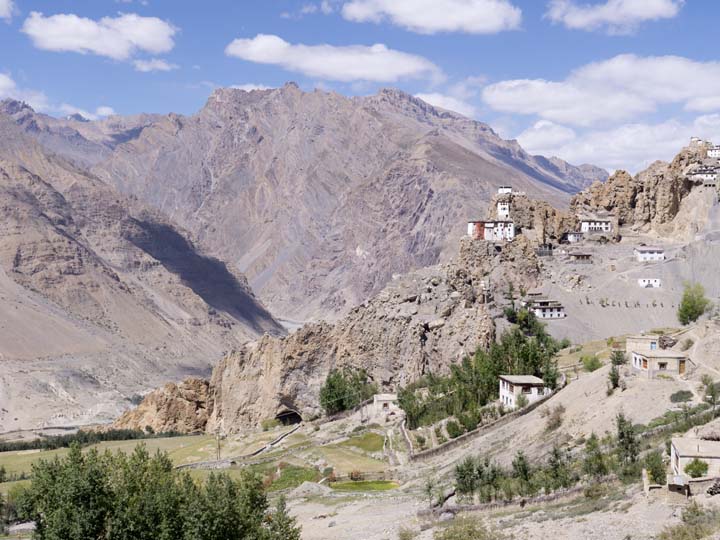
Dhangkar Monastery is seen on the ridge in the upper right. It consists of multi-storeyed buildings perched together, containing five different devotional halls.
September 4th
Our first day out to photograph was at Dhangkhar and Lhalung Monasteries. Both places granted permission because of local and monastic support. I was on my first documenting journey, and how positive an experience it was!
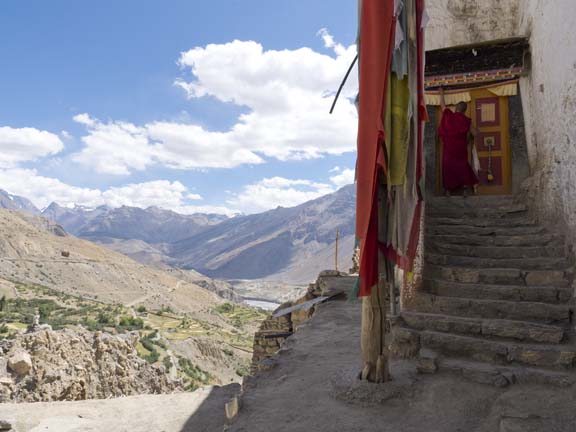
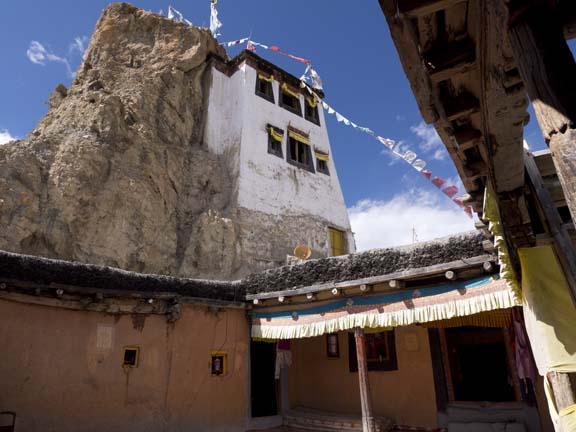
Entering Dhangkar Monastery’s Lha O-pa Gompa.Dhangkar Monastery clings to its rocky outcrops. Shown here is the level in which the Dukhang and Lhakang Gongma may be accessed.
I’ll let the images speak for themselves, but it bears saying that Dhangkar was an original home of the ruling Spitian kings over a thousand years ago, built on a ridge and rock outcrop as a fortress. It clings to the mountain with its whitewashed buildings and traditional thatched roofs. Some buildings seem to be built one on top of the other.
Dhangkar Monastery narrow passageways
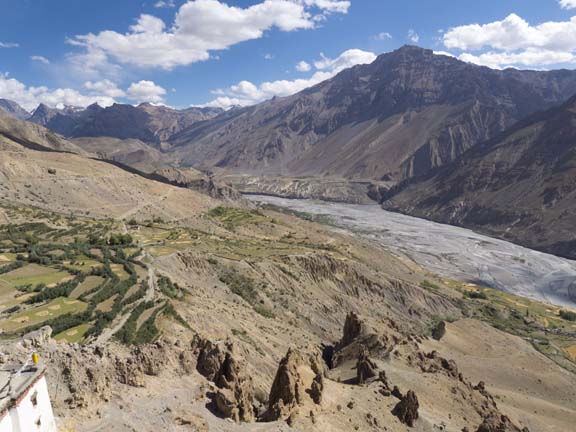
The interiors are navigated by narrow stairs (more like ladders, they’re so steep) and often low-ceilinged passageways. And when you scramble higher and higher, some stairs lead to the rooftops where you climb some more, on gravelly footpaths next to sheer cliff drops, in order to get into other adjacent buildings. Whenever you step outside, you are stunned by the incredible panorama of Spiti Valley in its splendor before you, dotted by the verdant, partitioned farmlands below, and the rigor of the sun casting impressive shadows across the mountain ridges.
View of Spiti Valley from rooftop of Lha O-pa Gompa, Dhangkar Monastery
Inside the Dukhang, which was the former assembly hall for monks before the new one was built a few years ago, sits a life-sized statue of Vajradhara, the “Diamond Being” who sees the ultimate nature of reality. One who does so is said to have wisdom, or right view.
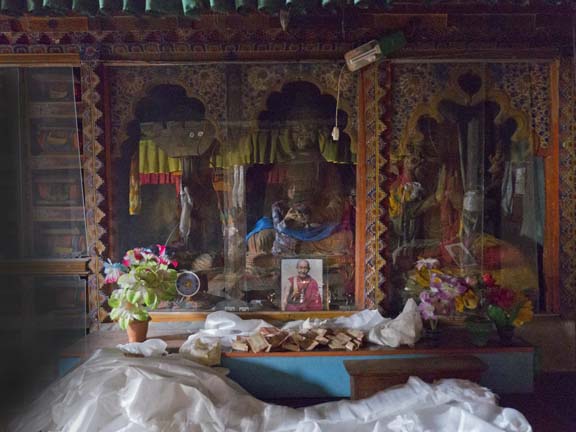
In the lower level Kanjur Lhakang (library containing Buddhist scriptures) are three wooden figures: Lama Chodrag, Shakyamuni, the historical Buddha, and Maitreya, the future Buddha. On the walls are faded and sooty murals, which one can barely see. It’s easy to understand from these murals alone why in 2006 Dhangkar Monastery was named by World Monuments Fund as one of the 100 most endangered sites in the world.
Kanjur Lhakang library of Buddhist scriptures, Dhangkar Monastery, Spiti, India
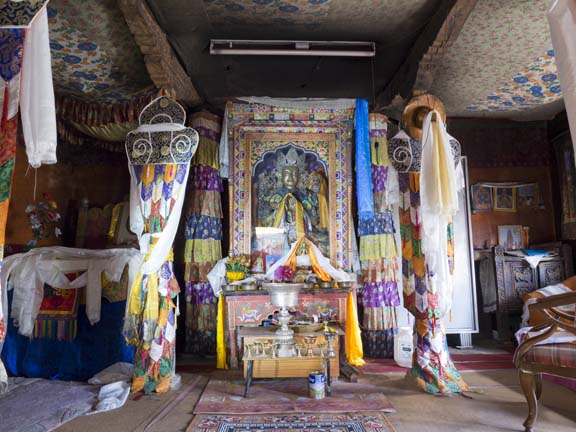
In the uppermost building of Lha O-pa Gompa is Lhakang Gongma, which has the most to see in terms of murals. Its central back wall dominates with Shakyamuni, Je Tsongkhapa (the reformer and Gelugpa founder of the 14th century), and Lama Chodrag.
View of murals on the back central wall of Lhakang Gongma, Dhangkar Monastery, Spiti
The adjacent walls depict various manifestations of Buddha. I was struck in general by how varied the paintings are in terms of color, style, and deterioration. It’s clear evidence of selective repainting over the centuries. In the back central wall, for example, Shakyamuni is obviously brighter and more saturated in color than the other two figures. According to Peter van Ham’s book, The Forgotten Gods of Tibet: Early Buddhist Art of the Western Himalayas, only a few of the paintings have been left untouched. The rest stylistically suggest a date of around 17th century.
Buddha murals, Lhakang Gongma, Dhankar Monastery, SpitiBuddha murals showing evidence of repainting over the centuries, Lhakang Gongma, Dhangkar Monastery
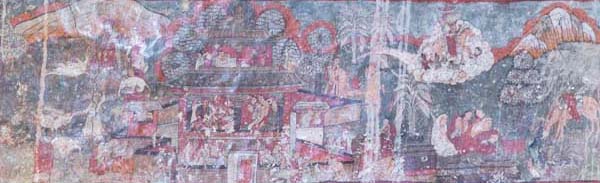
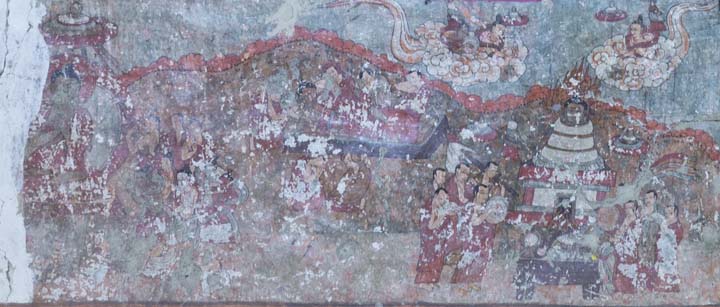
Of note in the murals is the frieze below the main figures, which largely depicts the life of Prince Siddartha, who became the historical Buddha, Shakyamuni. Tabo Monastery has a similar frieze in its Tsug Lhakang, the main assembly hall. Much of it is faded but the below two images are readily identifiable as the life of Siddartha at the palace of Kapilavastu, and the death of Buddha.
Life of Prince Siddartha at the palace of Kapilavastu, painted frieze at Lhakang Gongma, Dhangkar MonasteryDeath and cremation of Buddha, painted frieze at Lhakang Gongma, Dhangkar Monastery
We were told by locals that Dhangkar is older than the famous Tabo Monastery because, as the ancient home of indigenous kings, it contained a private temple from before the time of The Great Translator Rinchen Zangpo, pre-dating 10th century. Indeed, at the very top of the Dhangkar citadel are the remains of the palace, which you climb up to through a sleepy and steep quaint village that looks like it has maintained its same way of life for millenia.
Later in the day, we went to Lhalung Monastery. I really loved this small temple pictured below.
Lhalung Monastery’s Serkhang or Golden Hall, Spiti
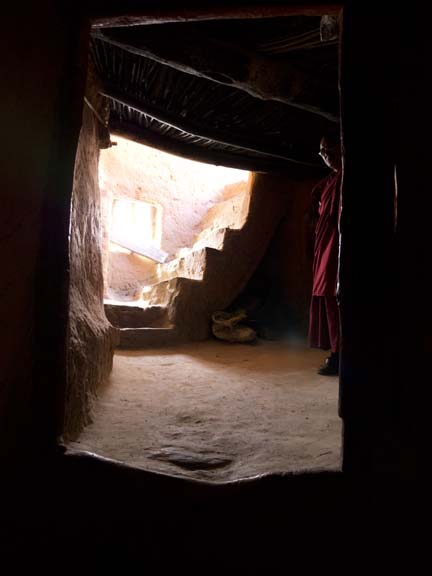
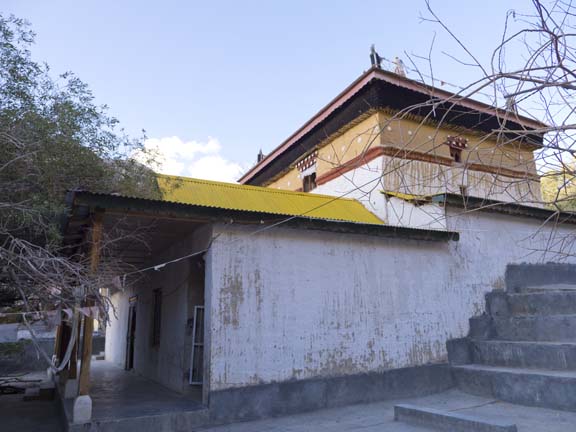
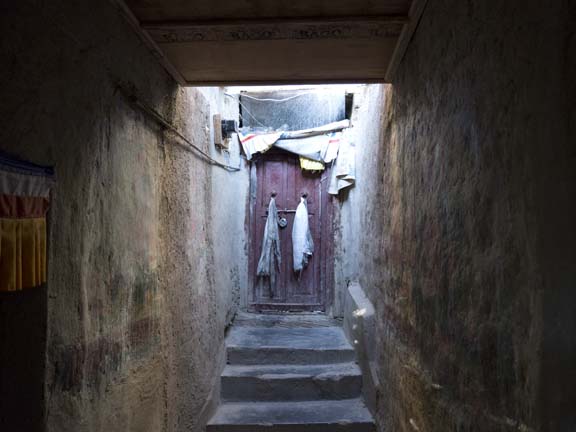
Lhalung Monastery, believed to be founded by The Great Translator Rinchen Zangpo, late 10th century C.E., was quite impressive. You enter through a narrow passageway to get to its Serkhang, which means literally House of Gold, but more often referred to as Golden Hall. Attached to its walls are sculptures of deities and other Buddhist personages. Three-dimensional figures in relief against the interior architecture of Buddhist temples are a distinctive feature of Indo-Tibetan artistry in Spiti and Ladakh areas. Similar ones are found at Tabo, Alchi, and Mangyu Monasteries.
Experience the rare and beautiful interior of Lhalung Monastery’s Serkhang by seeing a walk-through videohere.
Entrance to Lhalung Monastery’s Serkhang or Golden Hall
Once inside, the splendor of the ornately gilded and polychromed clay figures strikes you. The sculptures fill the temple practically from floor to ceiling. There are over 51 figures mounted on the walls or placed in the temple, arranged in mandala formations on each wall. Geshe-la said that these types of cantilevered relief sculptures are specific to the Trans-Himalayan region and are not found in Buddhist temples anywhere else.
On the central wall is Shakyamuni in the middle, flanked by two elaborate groups of five figures, each dominated by a deity–identified as Dharmadhatu Vagishvara, a complex form of Manjushri on the left, and Vajrasattva on the right. These figures are set in architectural alcoves, while the others are contained within lotus motif scrollwork, accented by decorative animals and dancers.
Maitreya, Guru Rinpoche, and Rinchen Zangpo (partly visible on right behind the column) form a trinity in the Serkhang altar of Lhalung Monastery, Spiti
Visible below is the right wall with sculptures arranged in a Prajnaparamita mandala, with Vairocana in the center surrounded by four Dyanibuddhas or Buddha-families: Ratnasambbhava, Akshobhya, Amoghasiddhi, and Amitabha, and their female attendants.
Rinchen Zangpo statue among a pantheon of sculpted deities, Serkhang (Golden Hall), Lhalung Monastery
On the left wall (photo below) is a Vajradhatu mandala arrangement around the three-faced and eight-armed Saravid Vairocana. Around him are the 16 deities in his cycle, including once again the Buddha families of Ratnasambhava, Akshobya, Amitabha, and Amoghasiddhi.
Left wall with Vajradhatu Mandala, Serkhang of Lhalung Monastery, Spiti
So now, that’s a lot of deities in one small temple! Their plethora really conveys not only aesthetic richness but also the complexity of Tibetan Buddhist tantric practice. What do all these deities represent in these mandala arrangements? Put simply, mandalas are visual guides for a practitioner in their meditation. They are aids in the realization of the true nature of mind and reality. As an oral and esoteric tradition, one needs a lineage teacher. Experiential understanding of this leads to liberation from conditioned existence–that is to say, leads to enlightenment or nirvana. Here is a succinct description of what the Five Buddha Families represent.
Geshe-la had said that the temples in these areas really demonstrate only the lower three tantras, not highest yoga tantra, which is mainly what Tibetan Buddhists practice today. The lower three are more concerned with purification, whereas the fourth level is actualizing self and deity, and therefore, enacting profound experience and understanding of emptiness. In The Great Translator Rinchen Zangpo’s time, late 10th century, focusing on the three lower tantras was a way to go back to roots and revitalize/reform tantric practice in Tibet which had grown distorted. This was partly the reason for the enormous interest in the original texts and their teachings, translating them from Sanskrit to Tibetan.
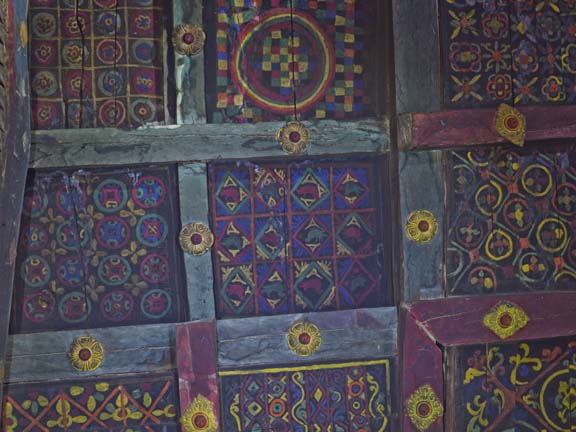
Lastly, the coffered ceilings were painted with delightful and folk-looking decorative motifs. Now I know what scholars mean when they speculate that these must reflect 10th century Kashmiri–influenced textiles.
Coffered ceiling of Serkhang, Lhalung Monastery, decorated with Kashmiri-influenced patterns that scholars believe reflect 10th century textile designs.
I’m currently reading David Snellgrove’s “Indo-Tibetan Buddhism: Indian Buddhists & Their Tibetan Successors.” It concentrates on the tantric period of Buddhist theory and practice, from the 8th to the 13th centuries. This was a fertile time of the transmission of Buddhism from India to Tibet. I’m particularly interested in the prodigious legacy of The Great Translator Rinchen Zangpo (958–1055 C.E.) who translated voluminous original Sanskrit sutras into Tibetan, and therefore helped preserve the doctrines and teachings. These original Sanskrit sources are now largely lost in India.
Photo: Tabo Monastery
Rinchen Zangpo is also credited with building over one hundred monasteries in Western Tibet, many still existing now in modern day Indian Himalayas, including the famous Tabo Monastery in Spiti, Himachal Pradesh.
I really look forward to seeing Tabo’s murals. They are extensive and among the best preserved from Rinchen Zangpo’s time. In addition to the art, its architecture is an excellent example of mandala layout and structure, built in direct relationship to sutra descriptions. Founded in 996 C.E., Tabo is considered to be the oldest continuously functioning Buddhist monastery in India and the Himalayas.
This is not an official U.S. Department of State website. The views and information presented here are solely those of the artist, and do not represent the Fulbright Program, the Department of State, or any other entity.













 Marmots were poking their heads out of rock crevices, or walking out in the open like this one, presumably searching for breakfast. Cute pudgy little things, they reminded me of our local American groundhogs.