sand mandala

The Sand in Sand Mandalas

Yamantaka Mandala_Eva Lee
Yamantaka Mandala

Many readers have asked me about the sand used in creating sand mandalas. What is it? Where does it come from? Is it store-bought? If not, how is it made? How is it colored? Is it colored with natural dyes?

So I asked a monk friend of mine, who resides at Namgyal Monastery in Dharamsala, India, and here’s what he told me.

There in India, the colored sand is handmade. Special white stones are picked from the banks of rivers located in the nearby larger towns of Manali or Rewalsar. After transporting these stones back to the monastery,  junior monks crush the stones manually in a “thick iron pot.” Gee, are you thinking what I’m thinking? A gigantic mortar and pestle? Wow, can you imagine the labor?!

When the stone is finally crushed into a sandy powder, they then wash it over and over again, adding natural fabric dyes purchased from local markets. Finally, the sand is put in the sun to dry.

The monks make a variety of sand, from courser to more refined. The quality used depends on the design element of the mandalas. For example, fine quality sand must be used for details, such as the faces of deities and animal figures, or the delicate ornamentation of architecture.

When monks travel, such as for example those in Sacred Arts Tour who create mandalas in America, they may buy pre-made colored sand in the U.S. However, they often still have to custom-make certain colors because not all store-bought ones are suitable for the specific symbolic colors of mandalas.
 

It’s Yamantaka Time

I’ve been furiously writing here to get up-to-date, and even though I’m still working on September things seen and heard, I must now share that it’s Yamantaka time! I am currently documenting this highest yoga tantra performed annually at Namgyal Monastery here in Dharamsala.

2_1080803_72
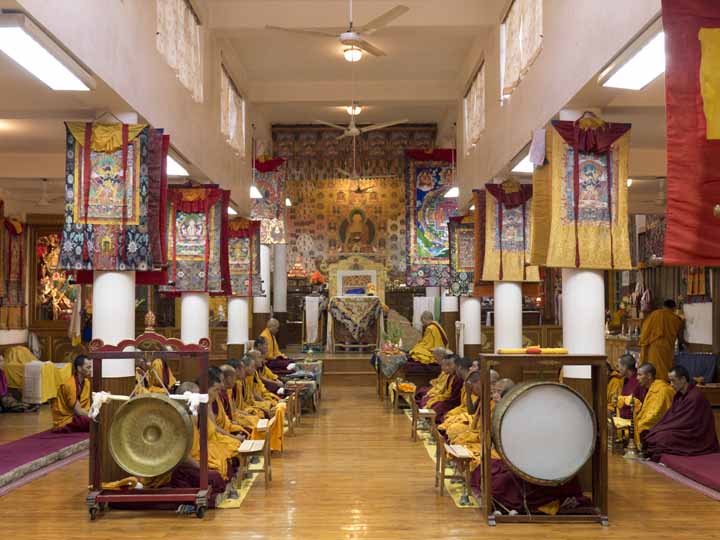
Highest yoga tantra ritual, Yamantaka, begins pre-dawn at Namgyal Monastery, Dharamsala
1_1070590_yes_72
The moon shines over Dharamsala Valley as Namgyal monks begin pre-dawn prayers for Yamantaka ritual. This highest yoga tantra occurs annually over the course of about ten days at Namgyal Monastery.

Yamantaka began four days ago before dawn’s light with earth ritual prayers to prepare the ground for this sacred art.

3_1070714_yes_72
Offerings are made in the thekpu during earth ritual prayers to prepare the ground for the creating a sand mandala

Then came three days of intensive work for the monks to rasp colored sand through metal funnels to create intricate designs symbolizing the main deity and his retinue of associated deities within the palace. For more info on mandalas and tantric, see this earlier post.

4_1070825_1
Day one involves marking out the eight directions in white, and then monks draw the basic structure of the mandala in black ink before beginning with colored sand.
5_1070914_yes_1
The sand mandala begins with symbolic depiction of Yamantaka deity who resides in the center. A mandala is a two-dimensional representation of a thee-dimensional palace, used as an aide in tantric meditation practice.
6_1080037_yes_1
Day one of creating Yamantaka sand mandala continues, Namgyal Monastery, Dharamsala
7_1080107_yes_1
The mandala after the first day’s completion
8_1080149_yes
Day two of creating sand mandala. This monk is scribing a floral design with a pencil into the background sand, after which he will create it on top in other different gradated colors.
Day two of making Yamantaka sand mandala, Namgyal Monastery, Dharamsala
Day two of making Yamantaka sand mandala, Namgyal Monastery, Dharamsala. The four gateways to the palace can now clearly be seen outlined in black, flanked by black-and-white cornice design.
Day two of making Yamantaka sand mandala, Namgyal Monastery, Dharamsala
Day two of making Yamantaka sand mandala. The gateways are further elaborated as the green background color is begun for the next section. The monks began early morning and will work well into the night to ensure progress and completion of the mandala within three days.
Day two of making Yamantaka sand mandala, Namgyal Monastery, Dharamsala
Day three of making Yamantaka sand mandala, with completed gateways, banner designs, vases, and other symbols that are mnemonic devices for tantric meditation, Namgyal Monastery, Dharamsala
Day two of making Yamantaka sand mandala, Namgyal Monastery, Dharamsala
Working on the outer borders, day three of making Yamantaka sand mandala, Namgyal Monastery, Dharamsala
Day three of making Yamantaka sand mandala, Namgyal Monastery, Dharamsala
The sand is gradated on this outer border, day three of making Yamantaka sand mandala, Namgyal Monastery, Dharamsala
Day three of making Yamantaka sand mandala, Namgyal Monastery, Dharamsala
Working on the final outer border which represents the charnel grounds, day three of making Yamantaka sand mandala, Namgyal Monastery, Dharamsala

The sand mandala was just finished yesterday.

The completed Yamantaka sand mandala, Namgyal Monastery, Dharamsala

With the completion of the mandala, today was the generation stage of the ritual. The monks chanted while visualizing themselves arise as Yamantaka. Tomorrow begins three days of consecration, followed by fire puja, then dissolution of the mandala.

I love this bittersweet last part where the beautiful mandala is swept away. As George Harrison sang, all things must pass. It’s a lesson in the truth of impermanence and the wisdom of letting go. Some of the sand is given to visitors who come witness the event. Most of it is swept into a ritual vase that is then taken to a nearby body of water and poured into it. I think of it as sending good wishes and energy out into the world.

I look forward to seeing it again. It was a wonderful experience here three years ago. It will be a welcome deja vu

All photos © 2013, Eva Lee.