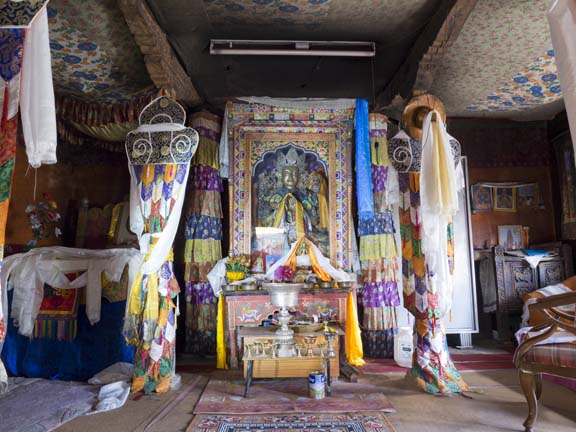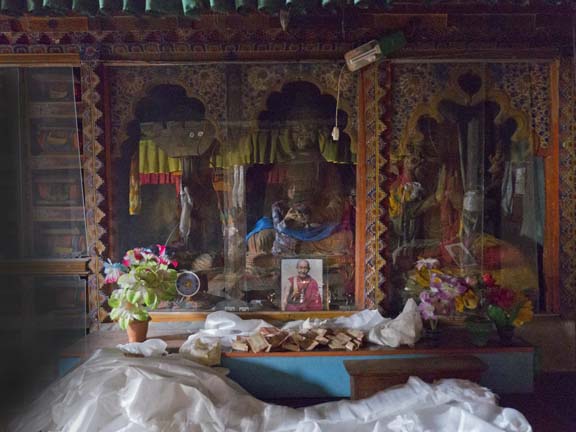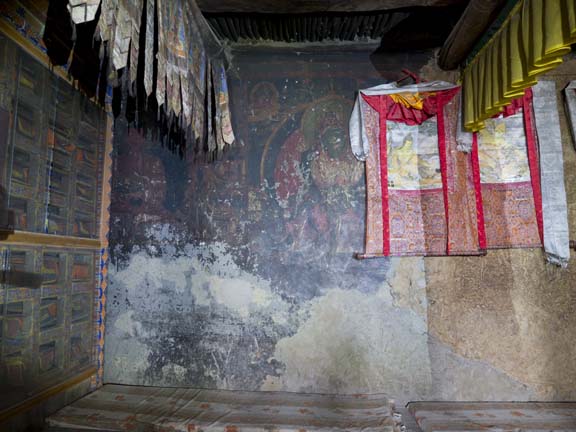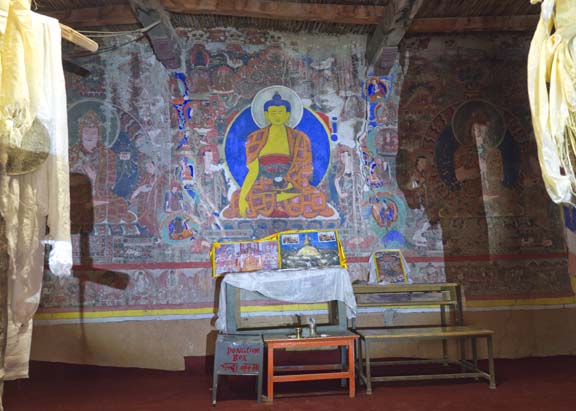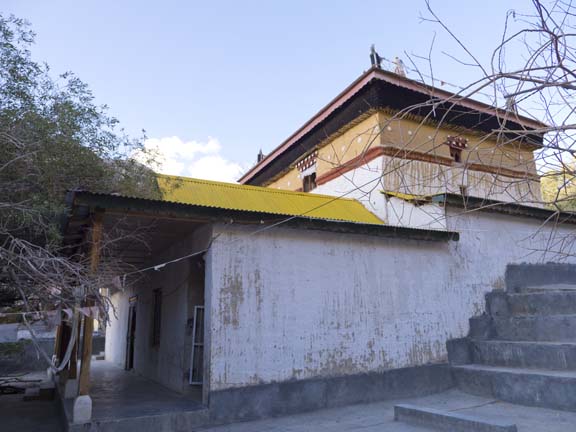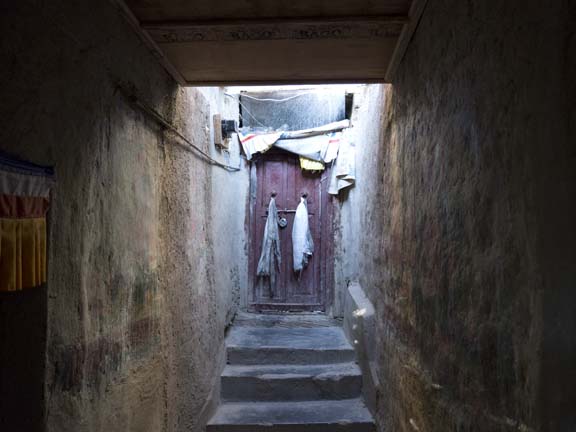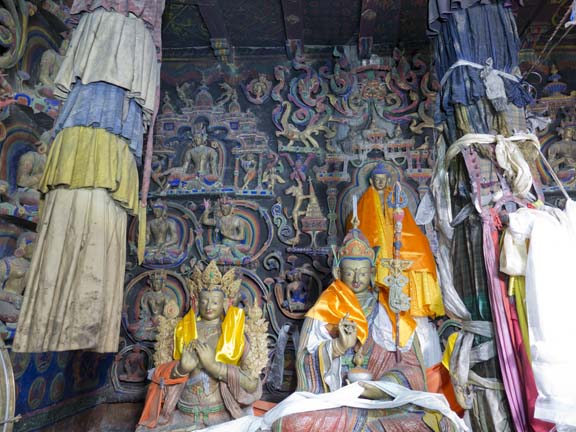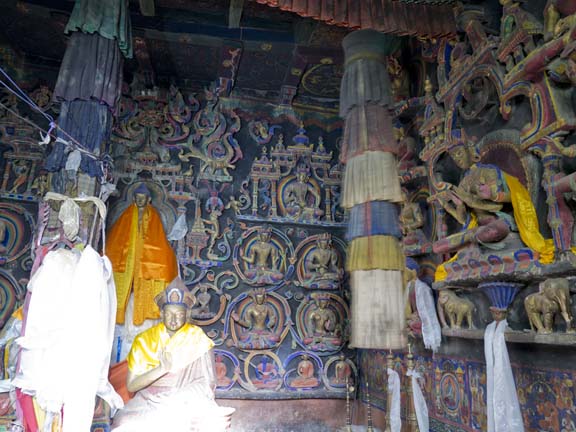
Spiti

Backwards in Time for the Sake of Mandalas

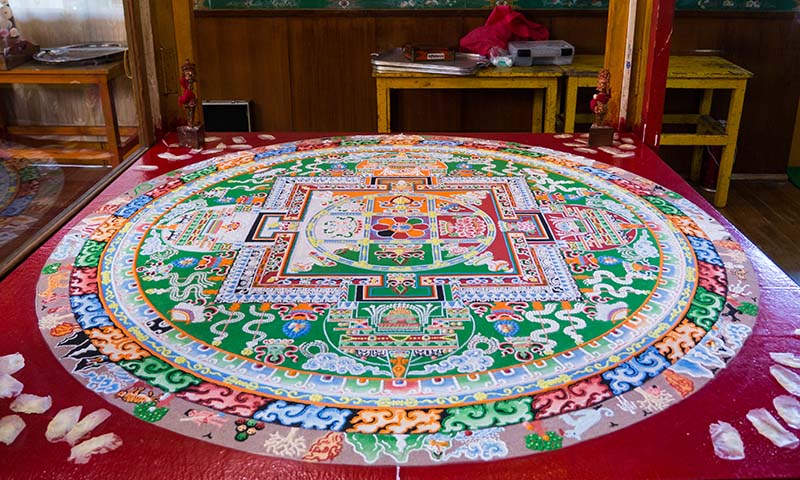
Yamantaka Sand Mandala
Yamantaka Sand Mandala, Namgyal Monastery, India. © 2010, Eva Lee.

I’ve gone about it all backwards. Backwards in time, in pursuit of mandalas. It all started when I heard that a sand mandala was going to be made at Namgyal Monastery in Dharamsala, India, in 2010. So I went there, and found out that it was a Yamantaka mandala, part of a ten-day-long highest yoga tantra ritual which occurs annually at the Dalai Lama‘s personal monastery. My previous post here describes what little I knew then as I observed and documented the creation and dissolution of it. The resultant film and photographs can be seen here.

When I came back to the U.S., it was as if a floodgate had opened. I needed to learn more. No, not just more, but all I could about Tibetan mandalas–about their variety, their purpose, their history, the meditation practices they engendered, and so forth. What did it all really mean? What modern significance did it have?

My bookshelves began to fill up with writings about tantra and Buddhist philosophy, written by the first Tibetan teachers to venture into the Western world, post-1959 exodus from Tibet. Titles by the Dalai Lama, Chogyam Trungpa Rinpoche, Lama Thubten Yeshe, Dilgo Khentse Rinpoche, as a few examples, abounded. I also read works by contemporary lamas like Dzogchen Ponlop Rinpoche, Pema Choedron, Tsoknyi Rinpoche, Tenzin Palmo. Tibetan scholars and historians David Snellgrove, Robert Thurman, Deborah Klimburg-Salter, Martin Brauen, and others figured in there, too.

All this, in addition to my previous discoveries of well-respected meditation teachers from other Buddhist traditions–Sharon Salzberg, Joseph Goldstein, Jack Kornfeld, B. Allan Wallace. I followed the writing of neuroscientists and clinicians, too, who studied or used meditation in their work. They were also involved with fascinating Mind & Life Institute research or conferences–Richard Davidson, Jon Kabat-Zinn, Paul Ekman, Daniel Goleman.

It was a mindfulness-neuro-tantric-philoso-fest that poured forth!

Meanwhile, in 2011, the ritual experiences continued. I attended the Dalai Lama’s Kalachakra event for World Peace in Washington D.C., and witnessed the Kalachakra Mandala.

Compassion Mandala created by Drepung Gomang Monks at Western Connecticut State University on the occasion of the Dalai Lama's talk on Creativity and Compassion, October, 2012.
Compassion Mandala created by Drepung Gomang Monks at Western Connecticut State University on the occasion of the Dalai Lama’s talk on Creativity and Compassion, October, 2012. © 2012, Eva Lee.

In 2012, I was at the Dalai Lama’s talk at Western Connecticut State University at which time I encountered a Compassion Mandala.

At both events, I had the wonderful opportunity of befriending and working with monks, nuns, plus other Buddhist practitioners and followers.

It was a steady flow. The waters at the floodgates just did not tire out. Answers came, and new questions arose.

Thus, on the heels of this, last year in 2013 I arrived back to India to experience and research rare Indo-Tibetan mandalas in Himalayan monasteries of Spiti, Lahaul, and Ladakh. How might they have evolved into Tibetan forms that we know today? What was this Indo-Tibetan 10th to 12th century period called the Second Great Transmission of Buddhism from India to Tibet? What did the sacred art look like? What did it mean?

View of mandala wall painting, Nangbarnangzad, Mangyu Monastery, Ladakh
View of mandala wall painting, Nangbarnangzad, Mangyu Monastery, Ladakh. © 2013, Eva Lee.


At the end of my travels through the Himalayan high altitudes, I then thought, let’s reel back in time some more. What came before the Indo-Tibetan era?

The answer was, Indian Buddhism, which could be seen at Ajanta and Ellora Caves where there are remains of elaborate 2nd to 8th century C.E. wall paintings, sculptures, and architecture. Such purely Indian Buddhist art is still preserved at these South Indian sites in the state of Maharashtra.
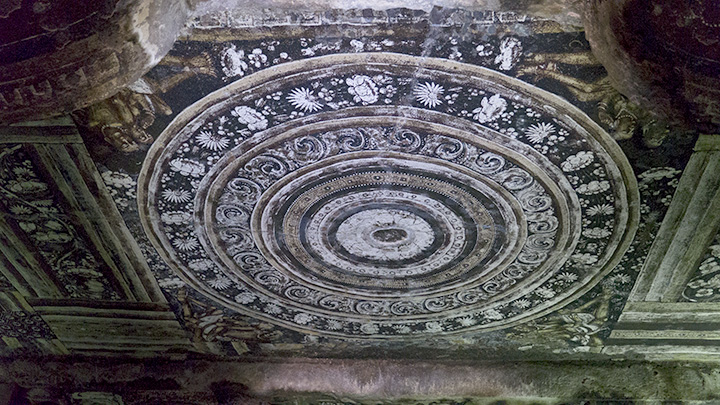
Ceiling painting, Ajanta Cave 2, near Aurangabad, India
Ceiling painting, Ajanta Cave 2, near Aurangabad, India. © 2013, Eva Lee.


Finally, what might have come even before this in India? I mean in B.C.E. times. When I searched further, it seems that the Buddhist art historical record stops here. According to historians, not much still exists before the 1st century C.E. Little is known in India archeologically prior to this time.

So what’s it all about? Why would an artist go for all this? New artwork from my Fulbright experience does beckon me in the studio.

I guess I’m just driven by the big questions about mind and reality, which Buddhist philosophy seems to address best. And moreover, that largely works within a Western scientific paradigm. It doesn’t hurt, either, that an affable spiritual leader like the Dalai Lama continues to inspire and exemplify how one can be intellectually sharp, existentially awake, and compassionately engaged in the world. Despite being a keeper of complex Tibetan rituals and esoteric tantric teachings, he can still keep it simple and distill wisdom down to these words: “There is no need for temples, no need for complicated philosophies. My brain and my heart are my temples. My philosophy is kindness.”
Transitions Back to the U.S.

Gee, I’ve so far recounted only the September travels through Spiti, Lahaul, and Ladakh. There’s also October, November, and December to cover. Keeping this travelogue about my Fulbright experiences is taking longer than I anticipated!  Editing photos (lots) and video (much) take time. So does research and writing.

And guess what? Now I have completed my Fulbright in India! Yes, that’s right, I’m back in the U.S.! It’s unbelievable how time flew by. I arrived just before Christmas holidays to rejoin family and friends, and rang in 2014 at home.

But, dear reader, there is much more to come. This blog is not over yet. After I finished traveling through the Himalayan high altitudes, I went to the lower altitude areas of Dharamsala, Bir, and Rewalsar (Tso Pema) to see the artwork of contemporary monasteries.

Plus, I also went to see the Buddhist carvings and frescoes of Ajanta, Ellora, and Aurangabad Caves in Southern India. These date from 2nd century B.C.E. to 8th century C.E., preceding the Indo-Tibetan period that I have been concentrating on in the Spiti, Lahaul, and Ladakh areas.  After researching the sacred artwork of 10th century monasteries such as Tabo, Lamayuru, LhalungMangyu, and Alchi, I felt compelled to see what came before. 

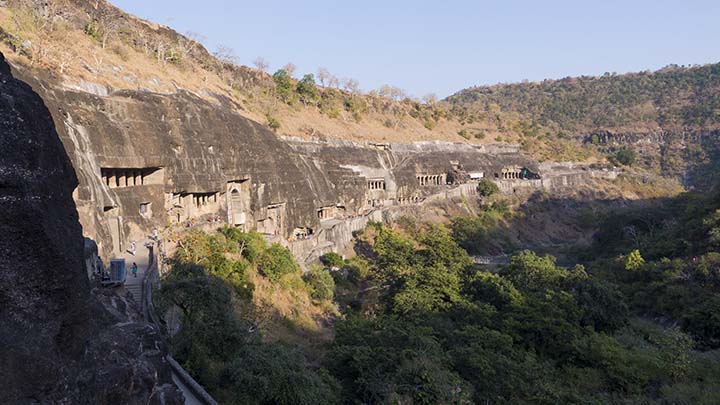
Ajanta coming up next! Here is a sneak peak. I promise you’ll never think of the word “cave” the same way again! 

Ajanta Caves, a UNESCO World Heritage site, India
Ajanta Caves, a UNESCO World Heritage site located in a horse-shoe shaped river valley, approximately 30 elaborately carved and painted rock-cut caves dating circa 2nd century B.C.E to 480 or 650 C.E. Buddhist caves, near Aurangabad, India
Ajanta Cave 26, India
Ajanta Cave 26, a chaitya hall with stupa, colonnade walkway, and carved relief sculptures. Seen on left wall is Buddha in his parinirvana pose, India

All photos © 2013, Eva Lee.

It’s India!

Sept 9, 2013        Spiti adventure continues…on to Lahaul, India

After a jaunty jiggly jeep ride of over 10 hours from Kaza back through the magnificent giant boulder rubble of Spiti Valley, Kunzum-la Pass (this time populated by yaks grazing and loafing!) and getting stuck fording a glacial melt waterfall that flooded the rocky road, we arrived in Keylong, Lahaul.

Keylong will be home base as I travel to visit Kardang, Guru Ghantal, Shashur, and Tayul Monasteries, as well as Phakba/Triloknath and Markula Devi temples.

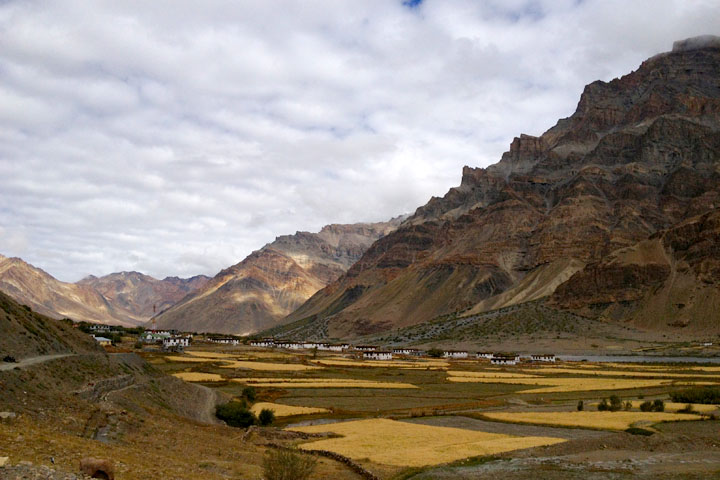
View of farms in early morning Spiti Valley, en route to Keylong, Lahaul
View of farmland in early morning Spiti Valley, en route to Keylong, Lahaul
Spiti Valley in the marbleized lighting of morning sun, India
Spiti Valley in the marbled early morning sun. As dry and desolate as Spiti may seem, there is always the play of light and colorful vistas
Approaching the stupas of Kunzum la pass, where this time there was a herd of yak grazing and resting. Glaciers can be seen at above left.
Approaching the stupas of Kunzum la pass, the high point of the road at about 15000 ft altitude. This time there was a herd of yak grazing and resting. Glaciers can be seen within relatively close range.
Approaching the stupas of Kunzum la pass, where this time there was a herd of yak grazing and resting. Glaciers can be seen at above left.
Kunzum la pass, where I circumambulated the stupas and got a close look at yaks gathered there. Glaciers can be seen at above left.
Herd of yaks at Kunzum la pass, at about 15000 feet altitude, Spiti Valley
Herd of yaks dotting Kunzum la pass, at about 15000 feet altitude, the highest point of the road through Spiti Valley
Yak grazing at Kunzum la pass, Spiti Valley
Yak grazing, this one looks like he’s molting or has been shaved
Yaks grazing and resting at Kunzum la pass, Spiti, India
Yaks grazing and resting at Kunzum la pass, seen en route from Spiti to Lahaul
Stupas at Kunzum la pass, at about 15000 feet altitude, Spiti Valley, India
Tibetan Buddhist stupas at Kunzum la pass, monuments in honor of this high point of the road through Spiti Valley
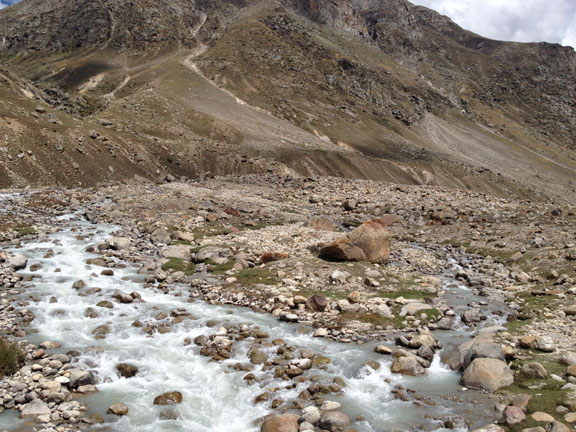
Glacial melt streams on the roadside, Spiti, India
At this time of year in September, there are streams of glacial melt such as this one which frequently cross the road. They can be as small as trickles or as large as river flows, and it’s wise to travel as much as possible in the morning before the hot afternoon sun increases the flow of these waters that you have to cross with your vehicle.
Huge boulder piles along the road from Kaza, Spiti, to Keylong, Lahaul
Huge boulder piles along the road from Kaza, Spiti, to Keylong, Lahaul. It’s difficult to judge the monumental scale from just a photo, but to give you an idea, this foreground rock is as tall as a person.
Huge boulder piles along the road from Kaza, Spiti, to Keylong, Lahaul

Magnificent and desolate…

Our jeep on the road through the dry desert terrain of Spiti Valley, India

Once you experience the vast scale of the Himalayas, you can readily understand why the environment induces existential concerns and spiritual development. There’s nothing like realizing our small duration as human beings in the context of gigantic geological time and space, and beyond this, the grand cosmos to put human desires and expectations into a completely different focus.

16-IMG_2575_yes_72

A large Tibetan Buddhist stupa is dwarfed by the magnificent scale of the Himalayan mountains

Here is our jeep stuck on rocks while attempting to ford the rapidly flowing waterfall that flooded the road in the afternoon. We had patiently waited while the vehicle before us was stuck and finally managed to get out. In that 45 minutes or so, unfortunately, the water flow started increasing as the hot afternoon sun melted more glaciers! We got out eventually though with the help of others waiting to pass, including military men and a monk who moved earth and rubble, pushed and rocked the car, as our driver revved forward.

Jeep stuck on rocks while attempting to ford rapidly flowing waterfall, Spiti Valley, India
Our jeep stuck on rocks while attempting to ford the rapidly flowing waterfall that floods the road in the afternoon in Spiti Valley.
Rapidly flowing waterfall in the afternoon glacial melt, which creates a river across the road, Spiti Valley, India
The said rapidly flowing waterfall which created a river across the road, Spiti Valley, India

In contrast, as you approach and enter Lahaul Valley, high waterfalls are plenty but do not flood the roads. Lahaul is also a welcoming green landscape with grass, shrubbery, trees, and evergreens. The region is also well known for its delicious potatoes, as well as crops of barley, peas, cabbage, apple and other fruit orchards. Even here in high altitude, it is a heartland for growing food to be transported throughout India.

High waterfall, Lahaul Valley
One sees many high waterfalls throughout the more verdant Lahaul Valley

With arrival in Keylong, Lahaul, in late afternoon we spent the rest of the day trying to get some logistics done.  For my part, it was to get (yet another) SIM card that will get a cell signal here in the high Himalayas, and hopefully maintain a signal when I later travel to Ladakh further north.  After the last week in Kaza, Spiti, without any cell phone coverage by my existing SIM card to communicate with family or arrange meetings or call for travel, etc., I decided to get another with a different carrier. Here in India, there is no single carrier that can provide national coverage, so one gets used to swapping out SIM cards and switching providers as the need arises when you travel from area to area. I have three SIMs now. The last one took so long to do—don’t ask the maddening details about how it took well over two hours to buy the SIM in one place and take it to another place to cut down. Around here you get used to relatively simple things taking an inordinate amount of time to accomplish, in this case, out of lack of coordination and know-how on merchants’ part. I’ve learned to smile a lot, shake my head, and say to myself, “It’s India…” Trust me, even Indians say this!

I never got to treat my very dry leather shoes as I had promised myself. They look like they’re going to crack from the dust-pounding they get in this high desert climate and unpaved roads.  Nor did I get to download from the internet café the software plug-in I desperately need to manage my photographs. I couldn’t do it in Spiti because my download was too big for the internet café’s monthly ration of data permitted. Who knew an internet cafe would be rationed for data?! But, ok, lack of resources…I shook my head and smiled, it’s India.

But what India lacks, it definitely makes up for in its sublime experiences!

View of Keylong nestled in the Bhagha River Valley, Lahaul

Which brings me to Lahaul, also known by Buddhists as Garsha Khandroling, a region with a deep history of highly realized yogis.  These are the practitioners who spend many years or decades in seclusion meditating in caves.  You may have heard about adepts who can demonstrate astounding practices of mind over matter, such as levitate or dry wet sheets in the snow with heat generated from their bodies, confounding the scientists who studied this phenomena.  Or you may have heard of Jetsunma Tenzin Palmo, the American Tibetan Buddhist nun and her Cave in the Snow. In any case, more on Garsha in the next post…

All photos © 2013, Eva Lee.

Tabo Monastery: Himalayan Setting and Meditation Caves

Sept 6th, Tabo Village, the Spiti adventure continues…

Tabo Monastery within Tabo Village
Tabo Village, where Tabo Monastery is nestled in Spiti Valley unlike other Buddhist monasteries that were built as fortress-like compounds on hilltops

Well, here we are in Tabo! The famed Tabo Monastery is known as the oldest continually functioning Tibetan Buddhist monastery, the art of which the Dalai Lama said “delightfully expresses the vigor of the transmission of Buddhism from India to Tibet and the dynamic mingling of cultures.” Established in 996 C.E. by the Buddhist king of Guge in Western Tibet, Yeshe O’d, and the The Great Translator Rinchen Zangpo, it flourished in a golden epoch of Indo-Tibetan collaboration in spreading Buddhist culture.

Tabo Monastery complex behind stone walls in Tabo Village
Tabo Monastery complex behind stone walls in Tabo Village, Spiti Valley, India

Tabo’s existing sacred artwork and architecture have unique historical significance, not only for the aesthetic evidence of such cultural exchange, but also for its rarityDue to the enormous destruction during the Chinese Cultural Revolution, where over 6000 monasteries and their artworks were destroyed between 1959-61, practically none of the early examples of Buddhist culture have survived in Tibet. Consequently, the monasteries of the Western Himalayan border areas of Spiti, Lahaul, and Ladakh, once part of Tibet, is of great importance for its legacy of early Tibetan Buddhist culture, and in particular, its connection with India.

Street view of Tabo Chokhor
Street view of entrance to Tabo Choskhor,Spiti, with the museum and library in building on right
Upon entering Tabo Monastery complex, the first building one sees is Tsug Lhakhang, the grand main assembly hall
The Tsug Lhakhang, TAbo Monastery, Spiti
The Tsug Lhakhang, Tabo Monastery, Spiti

Of the monasteries I’ll visit, Tabo, Alchi, Mangyu, Lamayuru, and Lhalung strike me as being of special importance. These have exceptional murals, unusual in cross-cultural style and depiction, executed in astounding refinement, with ornate clay sculptures that are cantilevered off the walls in Vajradhatu mandala arrangement of sacred space (more on this in the next post!) This type of work is specific to the area and is not found in any other Buddhist temples in the world. These monasteries also date back to that fertile period of Buddhist philosophical exchange and revitalization from India to Tibet beginning in the 10th century during The Great Translator Rinchen Zangpo’s time.

Documenting the extant artwork and architecture of these sites is essential because they are remarkable, and extreme Himalayan winters and potential earthquakes, such as the one that occurred in 1975, continue to threaten their survival. Proper conservation and restoration is critical for art history and posterity. Of immediate concern is the effects of climate change and increased rainfall in the normally more arid Spiti that has damaged Tabo’s murals and architecture. This 2010 article entitled “A Monastery’s Fading Colours,” published in The Indian Express, is about the challenging circumstances facing the monastery’s care under the maintenance of the Archeological Survey of India (ASI).  The Times of India recently questioned the national organization’s general efficacy in its article, “92 ASI-protected Monuments Missing.”

Rear view of Tsug Lhakhang, Tabo Monastery, Spiti
Rear view of Tsug Lhakhang with workers currently repairing the mud exterior. Its back walls are as thick as 2.5 meters!
Workers repairing the mud exterior of Tabo Monastery
Workers currently repairing the mud exterior of Tabo Monastery, Spiti

I find myself wishing these monasteries were designated UNESCO World Heritage sites, such as the early Buddhist Ajanta Caves are in India, or considered World Monuments. Perhaps this would bring more international attention and expertise to help hasten the appropriate preservation and protection against man-made as well as environmental challenges.

Fortunately, I was able to arrive in Tabo with all my equipment fully charged because the electrical power was mostly on during my previous night in Kaza, Spiti. But unfortunately, I was unable to photograph due to administrative details still to iron out. Perhaps by tomorrow, after the special 6:00 a.m. morning prayers for the recently deceased and venerated abbot of Tabo which will be performed as part the traditional 49 days’ observance. Despite not being able to photograph, the monk in charge of the monastery kindly showed me most of the temples in the complex.

What is so immediately striking is the contrast between the simple exterior architecture of mud brick and the resplendent interiors. Wow, the ornate interiors leave you speechless, what treasures of Indo-Tibetan art, history, and philosophy! Especially the dramatic, dark, moody, pensive main assembly hall (Tsug Lha-khang); the older Dromton Temple (Brom-ston Lha-khang), founded by the main disciple of the great teacher and adept Atisha; Initiation Temple (dKyil-kHor-khang), where monks are initiated; Bodhisattva Maitreya Temple (Byams-Pa Chen-po Lha-khang), with a 20 foot high painted mural of the future Buddha Maitreya; and the Golden Temple (gSer-khang).

3_OtherVws (10)
View of Tabo Monastery complex showing Dromton Temple on far right and Bodhisattva Maitreya Temple left of it, Spiti, India

Oh, news flash! For incredible floor plans of these temples, including elevations, sections, 3D models, photo montages, and more, see this excellent website of an Austrian research team at Graz University of Technology that has been studying the architectural heritage of the Western Himalayas.

And did I mention caves? Yes, caves on a steep cliff above Tabo Monastery and village where, according to archeological evidence, monks had lived and practiced meditation since the 11th century. Now it is an ASI protected site. Most caves are open spaces showing evidence of ancient occupation–sooty interior walls and carved out niches, etc., as well as perhaps picnic use by modern visitors. But while exploring with my flashlight, I peered into an opening of a small closed door of a dark cave only to find a blanched seated figure looking back at me! Startled and flustered, realizing this was a real person and not a phantom, I muttered a quick, deepest apology, and left in a hurry! Well, I guess today there are still some practitioners who retreat to these caves. Whether this was a tourist trying it out, or a yogi, I have no idea.

Path to Tabo caves
Path to numerous caves above Tabo Monastery and village, Spiti, India
Tabo caves
One of numerous caves carved into the cliffs above Tabo Monastery, used by monks from the 11th century on, Spiti
View of Tabo Monastery from inside cave
View of Tabo Monastery from inside a cave, Spiti

Have a virtual walk-through here of the insides of some of these caves:

View inside a Tabo cave
View of the inside of the above Tabo cave, Spiti
View of Tabo caves
View of Tabo caves located on a steep cliffside above Tabo Monastery, Spiti
View of Tabo Village from cave sites, Spiti, India

Ok, I hope I have a headache-less night’s sleep tonight.  Day four at high altitude and I’m still adjusting, but Tabo is at about 10,000 feet high, 2000 feet lower than Kaza, so it should be better.  Need to get up early to make it to 6am puja!

All photos © 2013, Eva Lee.

Key Monastery: Marauding Monastics and the Western Himalayas

September 8th     A Return to Key Monastery

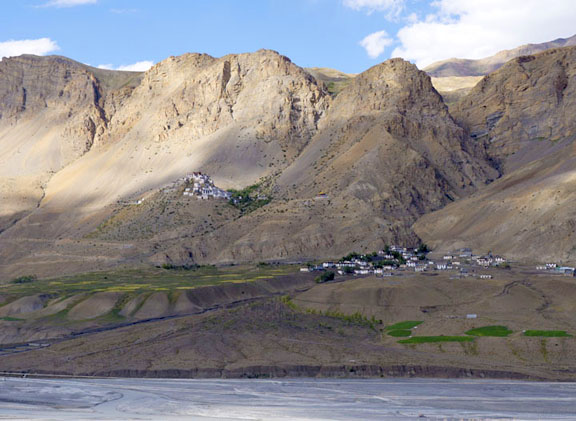
View of Key Monastery from across the Spiti River Valley

A second try today to document the ancient interiors of Key Monastery, whose abbot had in the 11th century been none other than The Great Translator Rinchen Zangpo himself, proved to be a challenge. However, in a nice turn of events, we discovered upon arrival that a special demonstration of sacred dances was in progress. The occasion was the visit of an important official from Shimla.

Entrance to Key Monastery, Spiti

The main interior courtyard was filled with visitors and administrators, with the monastery abbot presiding over the ceremony, as junior and senior monks looked on.

Key Monastery monks demonstrate ritual dance, with abbott presiding over the ceremony, Spiti
Key Monastery monks demonstrate the Black Hat cham dance, with abbott presiding over the ceremony as young ones watch

Key Monastery monks demonstrate ritual dance, with abbott presiding over the ceremony as young monks look on, Spiti

Young monks attending a ritual dance demonstration performed by more senior monks

A word about the architecture of Key…Built on a hilltop with a fortress appearance, this reflects typical Western Himalayan monastic architecture after circa 12th century, influenced by the development of invaders.

Key Monastery built atop a hill, characteristic of the later period of post-12th century Buddhist architectural development, Spiti
Key Monastery built atop a hill, characteristic of the later period of post-12th century Buddhist architectural development

Earlier period structures such as late 10th century nearby Tabo Monastery and Alchi Monastery (in Ladakh) are located in the valley on flat open land, integrated with their villages. Invaders were oftentimes rival Buddhist sects supported by the might of the Mongolian military, such as the Sakya sect who headed Key Monastery in the 14th century, and the Gelugpa sect who headed it in the 17th century. The latter came to dominate the majority of monasteries in Spiti.

In fact, most of us don’t associate monastics with marauding, but post-12th century onwards, the region saw inter-sectarian clashes, conquering by bloodshed, innumerable invasions by Chinese and Mongolian forces, shifting power structures, and political unrest throughout the Western Himalayas. Thus, that illustrious period of refined Indo-Tibetan art and architecture under the guidance of Lotsawa Rinchen Zangpo and the collaboration of Kashmiri artists eventually came to an end.

View of Spiti en route to Key Monastery, with a village nestled in its valley
_1010360_yes_72
Vast and dynamic view of Spiti River Valley

All photos © 2013, Eva Lee.

Key Kye Kee Ki Monastery and the Fine Art of Imprecision

September 5th – Spiti adventure continues…

Key, Kye, Kee, Ki Monastery, Spiti

Spelling is a flexible art in India. One often finds multiple spellings for names, places, and in signs. Take Key Monastery, for instance. It is also known as Kye, Kee, and Ki Monastery. It’s all good, take your pick! I’ve even had one monk spell his own name twice for me because sometimes he goes by Tanzin and sometimes Tenzin.

For a stickler about spelling like I am, this is an interesting lesson in imprecision. Especially if you’re asking for directions to a certain street or hotel, and you find that it’s spelled differently by different people, and you can’t help but wonder if you’re talking about the same place. Well, it’s okay, you’ll just do what you have to do, which is, you’ll find out!

It seems to me there’s a kind of accepted uncertainty principle here. It even extends to what people say. If, for example, you ask someone for directions, and he doesn’t know where the place is, he will not say he doesn’t know. He will give you information about where it is. Yes, that’s right, he will tell you something about what he does not know. My Western mind with its penchant for exactness doesn’t get it at all, but let me take a stab and guess:  This fellow might think to himself, it may not be right, but it may be approximately right, so it will help.

I have noticed that when my Indian friends need directions, they will ask numerous people the same thing. One time, I was driving with a friend and we were looking for a particular site. He stopped to ask probably half a dozen people within only a half mile’s distance, a kind of cross-reference overkill. A precision begotten by statistical probability. The wider you cast your bets, the better your chances are to get the (flexible and imprecise) jackpot. At least, I think it’s something like that…

It seems to me that here in India, it’s implicitly understood that circumstances, and the world, and the universe, are not exact. And more importantly, we are not masters of these spheres, we are just part of the process. Everything is relative, everything changes, everything has the potential for uncertainty at any time. It is readily, deeply accepted and tolerated that things might or might not work out.

One Indian friend quipped, “I.S.T.–Indian Stretchable Time,” (instead of Indian Standard Time) when he told me a story about his friend who was supposed to come pick him up in a remote area by car, but arrived three days later than expected! Okay, so maybe that example is an extreme one, but the moral of the story is not that the friend let him down, but that he came despite the fact that he had deterring factors that prevented him from coming on time!

Oh, the power has just come back here at the hotel, praise be! So I’m quickly plugging everything in to charge. Spiti has been largely without electricity for the past eight months! And it is being doled out to different areas at the moment, so no power here until about 8 or 8:30pm, supposedly anyway, because the past two nights here have been powerless. I can’t understand the reason why exactly. I mean eight months is a long time to have a vital civic repair apparently unattended to, or not tangibly improved.  Not sure if it’s because of devastating natural disaster or simply government mishandling and bad infrastructure. Maybe both. I do know that the next state, Utterakand, has suffered devastating floods and landslides recently, so it’s perhaps spillover?

Today was a bit hard to get kickstarted since I had another headache-filled sleep last night—altitude adjustments still. It’s Day 3 at about 12,000 feet high. Hope tonight will be better. I woke up disoriented, not knowing the time because my iPhone was out of power, head splitting. But we ended up going to Key Monastery after I spent the morning charging at a nearby café. The owner is getting power from the petrol station’s generator across the street. Thank goodness for their help! Otherwise, I literally would not be able to continue my work without charged batteries for my camera, or power to backup files onto laptop!

En route to Key Monastery, Spiti, India
View of Spiti Valley en route to Key Monastery, India

Key Monastery’s current spiritual leader is Lochen Tulku, the 19th reincarnation of Losatwa Rinchen Zangpo, the Great Translator wand former abbott who was so instrumental in this area for revitalizing Buddhism, translating all the original Sanskrit sutras, and building new monasteries in the 10th-11th centuries.

It turned out to be difficult to get permission to photograph the older murals here, despite my having a Spitian connection to a high level administrative monk. The concession is I can photograph the new assembly hall, which is nice but not so interesting for my Indo-Tibetan mural and mandala project. Nonetheless, the day spent at the monastery was pleasant. The monks were kind and invited us to tea, showed us the older temples, and merely asked that we not photograph. J’s local Spitian friend has offered to do some further investigation on my behalf, and we will see if possibly in a couple of days, there may be an opportunity to shoot the older murals.

View of Key Monastery's new main temple, Spiti
View of Key Monastery’s new main temple and assembly hall, Spiti

All photos © 2013, Eva Lee.

Out of Order in the Himalayas

It will be a bit out of order, but what the heck….Of course, I mean out of sequence, not broken!

I’m working on retroactive blog posts of basically all my experiences from last month’s travels through Spiti, Lahaul, and Ladakh to research and document Indo-Tibetan murals. Why didn’t I just post along the way? Because, internet stick and four SIM cards later, I was not able to access the internet while on the road. Especially in electricity-challenged Spiti, where kerosene for generators is even rationed, and Ladakh, border security area where cellular and other signals are highly controlled. I gave up trying and decided I would post when I got back to Dharamsala.

And here I am back in Dharamsala…but I did not think it would take long to back-post since I’ve already written a lot of material while still traveling. However, with image management and identification of thousands of photos shot in monasteries, it’s proving to be more time-consuming to present with accompanying photos. And who wants to read text here without the images? Not me!

So here’s what I’m going to do.  I’m going to toggle back and forth between posting about the present, and posting about last month, as I continue researching here in the lower Himalayas. In addition to Dhangkar and Lhalung Monasteries which are already here on this blog, stay tuned for accounts of what I saw and did at Key Monastery, Tabo Monastery, Kardang, Guru Ghantal, Shashur, Tayul, and Poekar Monasteries, including Phakpa in Triloknath and Markul Devi Temple in Udaipur sojourns. Then Alchi, Mangyu, Lamayuru, Likir, Shey, Thiksey, Hemis, and Mulbek Chamba Monasteries.  Yes, jam-packed with history, anecdotes, incredible landscapes, and ponderings!

Dhangkar and Lhalung Monasteries in Spiti

Image
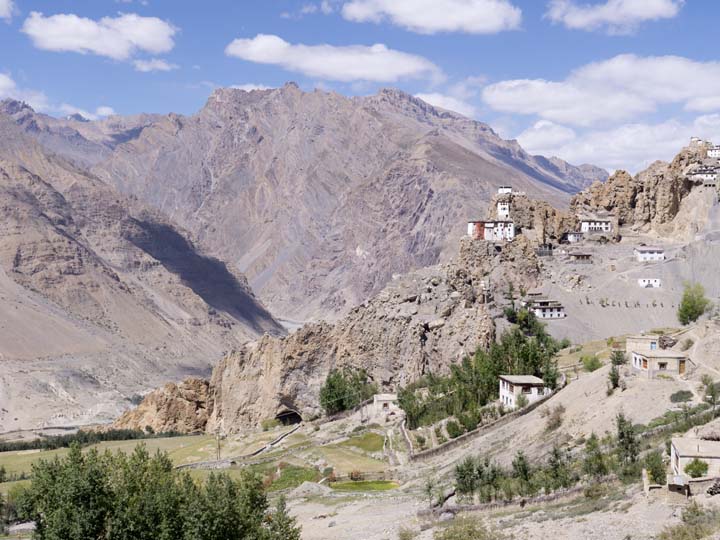
Dhangkar Monastery is seen on the ridge in the upper right. It consists of multi-storeyed buildings perched together, containing five different devotional halls.

September 4th

Our first day out to photograph was at Dhangkhar and Lhalung Monasteries. Both places granted permission because of local and monastic support. I was on my first documenting journey, and how positive an experience it was!

Dhangkar Monastery's Lha O-pa Gompa
Entering Dhangkar Monastery’s Lha O-pa Gompa.

Dhangkar Monastery
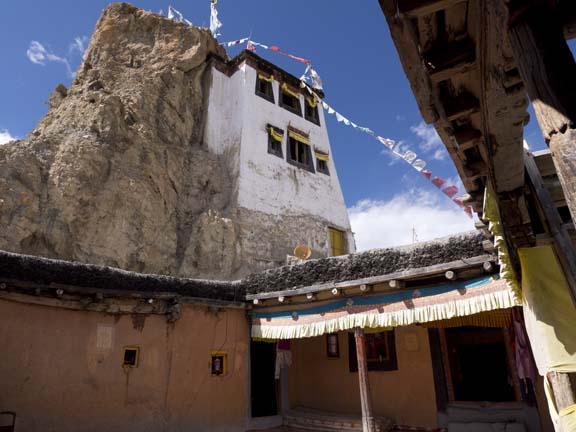
Dhangkar Monastery clings to its rocky outcrops. Shown here is the level in which the Dukhang and Lhakang Gongma may be accessed.

I’ll let the images speak for themselves, but it bears saying that Dhangkar was an original home of the ruling Spitian kings over a thousand years ago, built on a ridge and rock outcrop as a fortress. It clings to the mountain with its whitewashed buildings and traditional thatched roofs. Some buildings seem to be built one on top of the other.

Dhangkar Monastery narrow passageways

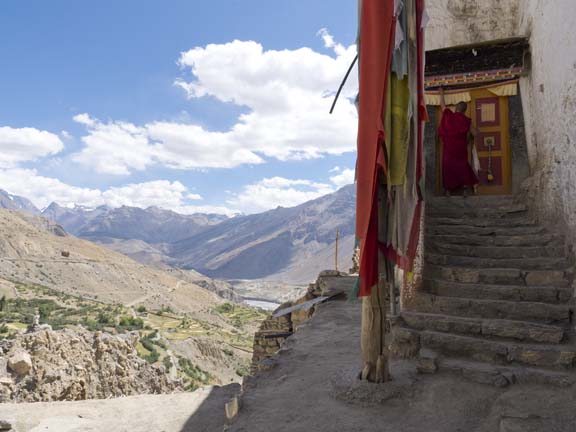
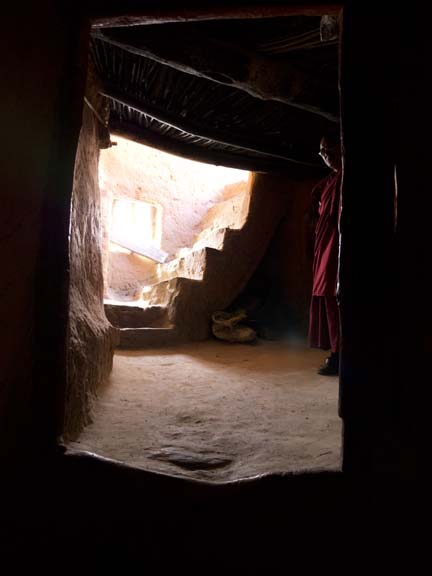
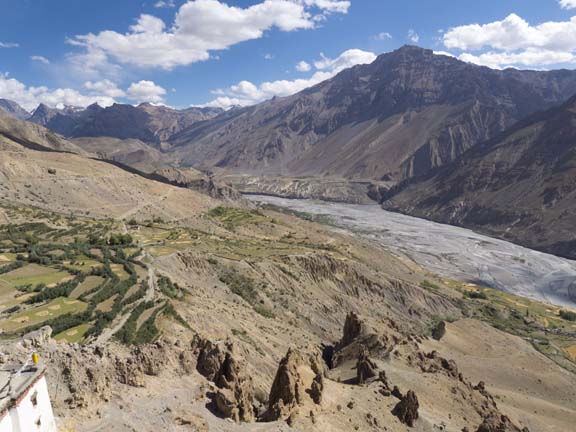
The interiors are navigated by narrow stairs (more like ladders, they’re so steep) and often low-ceilinged passageways. And when you scramble higher and higher, some stairs lead to the rooftops where you climb some more, on gravelly footpaths next to sheer cliff drops, in order to get into other adjacent buildings. Whenever you step outside, you are stunned by the incredible panorama of Spiti Valley in its splendor before you, dotted by the verdant, partitioned farmlands below, and the rigor of the sun casting impressive shadows across the mountain ridges.

View of Spiti Valley from rooftop of Lha O-pa Gompa, Dhangkar Monastery

Inside the Dukhang, which was the former assembly hall for monks before the new one was built a few years ago, sits a life-sized statue of Vajradhara, the “Diamond Being” who sees the ultimate nature of reality. One who does so is said to have wisdom, or right view.

Vajradhara statue, Dhangkar Monastery, Spiti

Kanjur Lhakang, library, Dhangkar Monastery

In the lower level Kanjur Lhakang (library containing Buddhist scriptures) are three wooden figures: Lama Chodrag, Shakyamuni, the historical Buddha, and Maitreya, the future Buddha. On the walls are faded and sooty murals, which one can barely see. It’s easy to understand from these murals alone why in 2006 Dhangkar Monastery was named by World Monuments Fund as one of the 100 most endangered sites in the world.

Kanjur Lhakang, library, Dhangkar Monastery
Kanjur Lhakang library of Buddhist scriptures, Dhangkar Monastery, Spiti, India

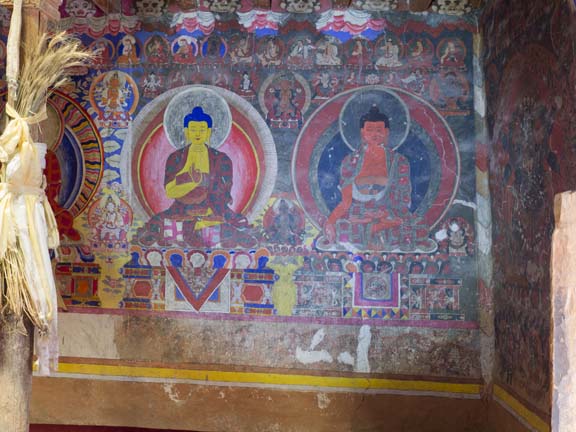
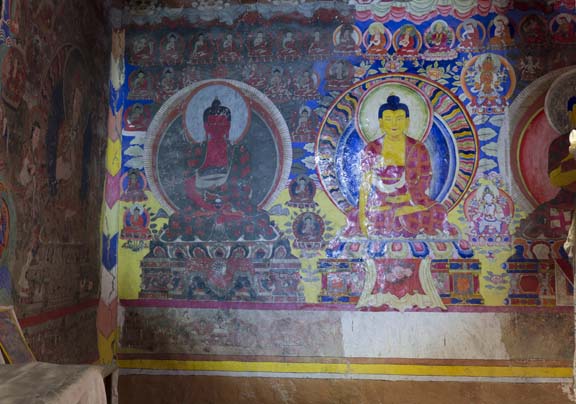
In the uppermost building of Lha O-pa Gompa is Lhakang Gongma, which has the most to see in terms of murals. Its central back wall dominates with Shakyamuni, Je Tsongkhapa (the reformer and Gelugpa founder of the 14th century), and Lama Chodrag.

Lhakang Gongma murals, Dhangkar Monastery
View of murals on the back central wall of Lhakang Gongma, Dhangkar Monastery, Spiti

The adjacent walls depict various manifestations of Buddha. I was struck in general by how varied the paintings are in terms of color, style, and deterioration. It’s clear evidence of selective repainting over the centuries. In the back central wall, for example, Shakyamuni is obviously brighter and more saturated in color than the other two figures. According to Peter van Ham’s book, The Forgotten Gods of Tibet: Early Buddhist Art of the Western Himalayas, only a few of the paintings have been left untouched. The rest stylistically suggest a date of around 17th century.

Buddha murals, Lhakang Gongma, Dhankar Monastery
Buddha murals, Lhakang Gongma, Dhankar Monastery, Spiti

Buddha murals showing evidence of repainting over the centuries, Lhakang Gongma, Dharkar Monastery
Buddha murals showing evidence of repainting over the centuries, Lhakang Gongma, Dhangkar Monastery

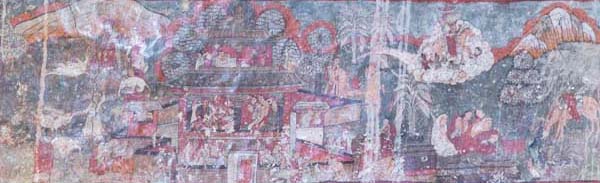
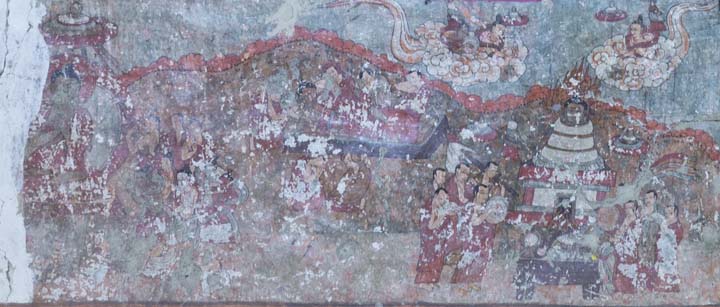
Of note in the murals is the frieze below the main figures, which largely depicts the life of Prince Siddartha, who became the historical Buddha, Shakyamuni. Tabo Monastery has a similar frieze in its Tsug Lhakang, the main assembly hall. Much of it is faded but the below two images are readily identifiable as the life of Siddartha at the palace of Kapilavastu, and the death of Buddha.

Dhangkar_Lhakang Gongma frieze
Life of Prince Siddartha at the palace of Kapilavastu, painted frieze at Lhakang Gongma, Dhangkar Monastery

Life of Prince Siddartha at the palace of Kapilavastu, painted frieze at Lhakang Gongma, Dhangkar Monastery
Death and cremation of Buddha, painted frieze at Lhakang Gongma, Dhangkar Monastery

We were told by locals that Dhangkar is older than the famous Tabo Monastery because, as the ancient home of indigenous kings, it contained a private temple from before the time of The Great Translator Rinchen Zangpo, pre-dating 10th century. Indeed, at the very top of the Dhangkar citadel are the remains of the palace, which you climb up to through a sleepy and steep quaint village that looks like it has maintained its same way of life for millenia.

Later in the day, we went to Lhalung Monastery. I really loved this small temple pictured below.

Lhalung Monastery, Spiti
Lhalung Monastery’s Serkhang or Golden Hall, Spiti

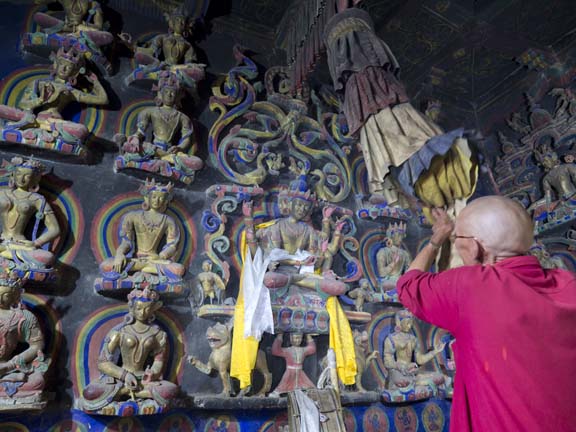
Lhalung Monastery, believed to be founded by The Great Translator Rinchen Zangpo, late 10th century C.E., was quite impressive. You enter through a narrow passageway to get to its Serkhang, which means literally House of Gold, but more often referred to as Golden Hall. Attached to its walls are sculptures of deities and other Buddhist personages. Three-dimensional figures in relief against the interior architecture of Buddhist temples are a distinctive feature of Indo-Tibetan artistry in Spiti and Ladakh areas. Similar ones are found at Tabo, Alchi, and Mangyu Monasteries.

Experience the rare and beautiful interior of Lhalung Monastery’s Serkhang by seeing a walk-through video here.

Entrance to Lhalung Monastery's Serkhang or Golden Hall
Entrance to Lhalung Monastery’s Serkhang or Golden Hall

Once inside, the splendor of the ornately gilded and polychromed clay figures strikes you. The sculptures fill the temple practically from floor to ceiling. There are over 51 figures mounted on the walls or placed in the temple, arranged in mandala formations on each wall. Geshe-la said that these types of cantilevered relief sculptures are specific to the Trans-Himalayan region and are not found in Buddhist temples anywhere else.

On the central wall is Shakyamuni in the middle, flanked by two elaborate groups of five figures, each dominated by a deity–identified as Dharmadhatu Vagishvara, a complex form of Manjushri on the left, and Vajrasattva on the right. These figures are set in architectural alcoves, while the others are contained within lotus motif scrollwork, accented by decorative animals and dancers.

Serkhang, Golden Hall, Lhalung Monastery
Maitreya, Guru Rinpoche, and Rinchen Zangpo (partly visible on right behind the column) form a trinity in the Serkhang altar of Lhalung Monastery, Spiti

Visible below is the right wall with sculptures arranged in a Prajnaparamita mandala, with Vairocana in the center surrounded by four Dyanibuddhas or Buddha-families: Ratnasambbhava, Akshobhya, Amoghasiddhi, and Amitabha, and their female attendants.

Serkhang, Lhalung Monastery, Spiti
Rinchen Zangpo statue among a pantheon of sculpted deities, Serkhang (Golden Hall), Lhalung Monastery

On the left wall (photo below) is a Vajradhatu mandala arrangement around the three-faced and eight-armed Saravid Vairocana. Around him are the 16 deities in his cycle, including once again the Buddha families of Ratnasambhava, Akshobya, Amitabha, and Amoghasiddhi.

Vajradhatu Mandala, Serkhang of Lhalung Monastery, Spiti
Left wall with Vajradhatu Mandala, Serkhang of Lhalung Monastery, Spiti

So now, that’s a lot of deities in one small temple! Their plethora really conveys not only aesthetic richness but also the complexity of Tibetan Buddhist tantric practice. What do all these deities represent in these mandala arrangements? Put simply, mandalas are visual guides for a practitioner in their meditation. They are aids in the realization of the true nature of mind and reality. As an oral and esoteric tradition, one needs a lineage teacher. Experiential understanding of this leads to liberation from conditioned existence–that is to say, leads to enlightenment or nirvana. Here is a succinct description of what the Five Buddha Families represent.

Geshe-la had said that the temples in these areas really demonstrate only the lower three tantras, not highest yoga tantra, which is mainly what Tibetan Buddhists practice today. The lower three are more concerned with purification, whereas the fourth level is actualizing self and deity, and therefore, enacting profound experience and understanding of emptiness. In The Great Translator Rinchen Zangpo’s time, late 10th century, focusing on the three lower tantras was a way to go back to roots and revitalize/reform tantric practice in Tibet which had grown distorted. This was partly the reason for the enormous interest in the original texts and their teachings, translating them from Sanskrit to Tibetan.

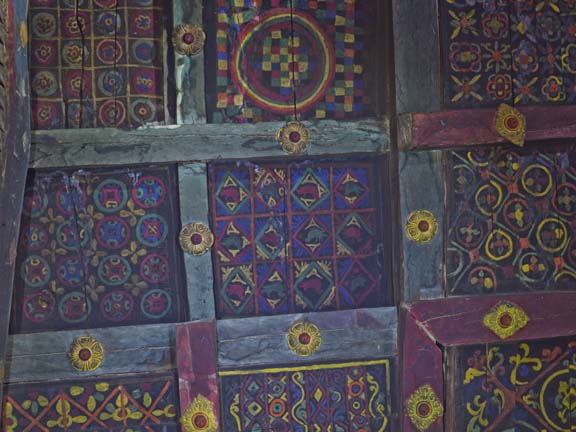
Lastly, the coffered ceilings were painted with delightful and folk-looking decorative motifs. Now I know what scholars mean when they speculate that these must reflect 10th century Kashmiri–influenced textiles.

Coffered ceiling of Serkhang, Lhalung Monastery, Spiti
Coffered ceiling of Serkhang, Lhalung Monastery, decorated with Kashmiri-influenced patterns that scholars believe reflect 10th century textile designs.

All photos © 2013, Eva Lee.


When it Rains in Dharamsala

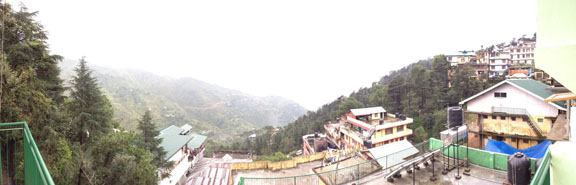
View of Dharamsala from my balcony near Namgyal Monastery

I’ve arrived in Dharamsala! “Land of the Mahayana,” as one monk fondly referred to it. It is the home of the Dalai Lama and the Tibetan government in exile. It’s as I remember it from three years ago.  With some new construction, new businesses, but largely as before, though I had not seen it in monsoon season. It’s warm but wet everywhere. Sheets of rain whip through during different times of the day. Honking cars with foggy windows (how can drivers possibly see?) ford overflowing water which rushes down the narrow hilly roads like a bowling ball follows a gutter. Shopkeepers and street vendors shuffle their wares in and out of shelter.  Pedestrians dodge canyon-sized potholes and sludgy puddles. I’ve been drenched twice while foolishly attempting to get to my next destination with a measly umbrella that may as well be one of those toothpick paper ones you get as a decoration on a cocktail. The rain just soaks everything, and wet clothes take days to dry.  Now I know what Tibetan poet Tenzin Tsundue means when he writes, “When it rains in Dharamsala/raindrops wear boxing gloves/thousands of them/come crashing down and beat my room.”

In fact, I read that Dharamsala area is one of the wettest monsoon places in India. Residents here tell me stories about how this season defies your attempts at staying mold-free. Electronic equipment, beware of condensation. A photographer friend told me he has to store his cameras in a small closet where he keeps a light shining for warmth and dryness.

I’m also told that monsoon will end in about two weeks. How do we know? The sun is beginning to shine more in between the rain bouts, and the fog lifts for some sneak previews of the beautiful vistas here in the foothills of the Himalayas.

No rest for the weary here, as I prepare for my trip to the higher altitudes. And I am weary, believe me, still getting over jetlag, and overjoyed when I can sleep for more than four hours and wake up when it’s dawn instead of the dark of night!

I arrived just in time for the second day of the Dalai Lama’s three-day teachings at Namgyal Monastery—nice way to begin! His Holiness looks as warm and jolly as ever. The temples and mezzanine areas have been outfitted with large flat screen TVs and speakers for translations.  For security reasons, all electronic equipment is banned and one must check in these items at a designated counter. This includes even small items like USB sticks and earphones. It used to be that you could bring in transistor radios and headphones to tune into the channel that translated in your language. After being issued my ID pass to attend the teachings, I passed security and found my way to the Kalachakra temple where English-speakers are directed.

The Dalai Lama was seated in the adjacent main temple, and from my spot in the rear kitty-corner, I could see him faintly through a glass window, albeit distorted from the reflection of ambient light. I marveled that I was once again in this temple where I had previously filmed Yamantaka ritual three years ago, as monks generously served butter tea with the morning breakfast of Tibetan bread (like a large English muffin). Yes, they actually cook and serve this to all the masses of people who come for the teachings, picking their way through everyone seated knee-to-knee on the floor, pouring tea from large steaming metal kettles and handing out bread from buckets.

Aside from attending the teachings, I have also been delivering letters of introduction, and meeting with Tibetan administrators, advisor, and a Geshe. This is a Buddhist scholarly title roughly the equivalent of the PhD title of Doctor, although it takes many more years of study to earn. Geshe-la shared with me some of his critical and historical knowledge of the areas I’ll be visiting as well as the images I’ll see.  I’ve now acquired my letters of support from various Tibetan offices for my research.  I will bring these with me to monasteries of the Himalayas seeking permission to photograph. These last few days have also been filled with meeting old friends and new ones over meals, tea, and even movie screening of Escape from Tibet one night, followed by discussion.

Tomorrow I leave bright and early for Manali, en route to Spiti. Today’s agenda is to pack, buy katas which are offering scarves, food for the road, pick up my internet stick and hope that it might work in the high altitudes. I am told, good luck! Spiti may sometimes lack electricity even for charging your electronic devices. Fingers crossed that I can keep my camera charged to be able to document monasteries and murals! J, my travel companion and longtime resident of India, has arranged for a meeting with Khandro-la, an exceptional female Buddhist practitioner, so we must hightail it to Manali and arrive before she leaves for her next teaching engagement.