Kalachakra will take place in Ladakh, India, near the city of Leh starting tomorrow July 3 – July 14. I wish I could be there this year, but alas, I will be here at home in the U.S. And on this, the eve of the event, I’m thinking about when I attended the Kalachakra Event for World Peace in Washington, D.C. held in July of 2011.
At that time, I had returned from my first trip to India where I happened to meet one of the organizers of this event. It was not long before he recruited me to help with video content for the large screens at Verizon Center, where the ritual was hosted.
I helped design and produce material for projection onto the arena screens. Content included Kalachakra prayers, and video presentations of photographs which were shown in between ritual sessions during breaks. These were essentially images of Tibetan subjects by noted photographers such as Don Farber, Tenzin Choejor, Abhishek Madhukar, and many others.
In the process of creating the video material, I had the wonderful experience of working closely with an American Tibetan Buddhist nun named Ani Tenzin Lhamo-la. Her guidance was invaluable. I could not have made these videos for Kalachakra without her. What’s more, her friendship, moxie, and insight as a psychotherapist and monastic have been memorable and enduring.
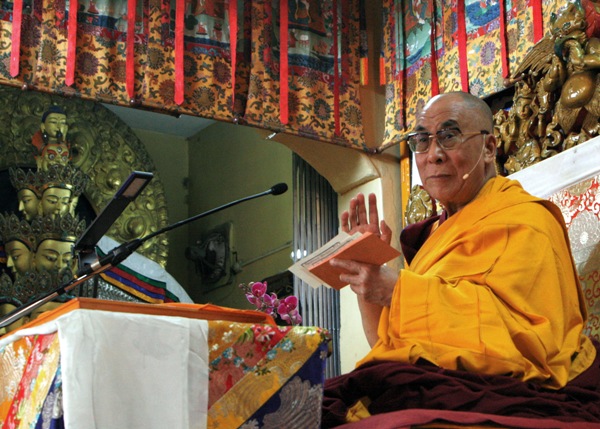
The Dalai Lama with monastics on stage at Kalachakra Event for World Peace, Verizon Center, Washington, D.C., July, 2011. Photo: Tenzin Choejor/OHHDL
I felt most honored to have produced a video chronology of the Dalai Lama’s life in celebration of his 76th birthday, which occurred on the first day of Kalachakra, July 6, 2011.
While I am not at liberty to post the video because it was created exclusively for the birthday occasion, I am so pleased to have had the opportunity to work with archived images of His Holiness. Joining that day to help celebrate the Dalai Lama’s birthday were Mahatma Gandhi’s grandson, Arun, and Martin Luther King Jr.’s son, Martin. It was a historic appearance together.
Kalachakra Event for World Peace, Washington, D.C., July, 2011
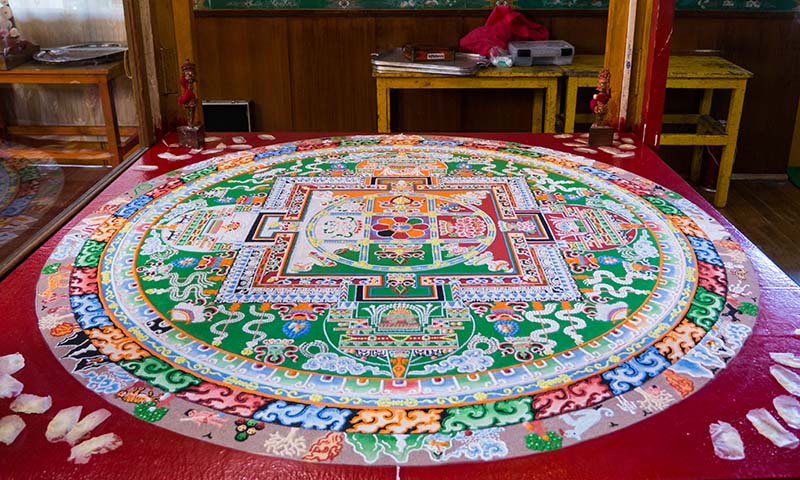
I recently suddenly thought of the Dalai Lama sitting in the middle of the thekpu, the ritual platform on which the elaborate Kalachakra sand mandala is created. He does this on the first day of consecrating the ground where the sacred artform is performed, and again when the mandala is about to be dissolved.
I realized that for me, he is the real life version of the deity that resides in the middle of the mandala. Which is to say, I realized in my heart that he is a living example of compassion and wisdom united.
For all its elaborate ritual and complex symbolism, this is the basic goal of tantra—the union of compassion and wisdom. Wisdom of the ultimate nature of mind and reality. The mandala is the guide, the mnemonic image to aide a practitioner towards such enlightenment.
At the end of this ten-day-long event, the sand mandala was swept into a ritual vase to be taken to a nearby body of water and released after chanting and prayers were performed.
Pouring the sand mandala into the water is a way to release blessings out into the world. I was so happy to be part of the small group attending this final ritual act of Kalachakra.
Backstage with Andrew Lazarow and his indispensable assistance, preparing a playlist.Inside the media control room during Kalachakra Event for World Peace 2011A cherished moment of receiving a blessing from the Dalai Lama. Photo: Tenzin Choejor
I send warm thoughts to all those who are now engaged in making Kalachakra happen in Ladakh, India! I hope it is blissful and awakening.
Lastly, I wish a hearty Happy Birthday to the Dalai Lama. Your Holiness, I will be thinking of you this weekend on the 6th!
But Wait, a Bit about Mandalas
Posted
Okay, I know I promised to post Part Two of Tabo Monastery next, but as I’ve been writing, I’ve found it necessary to do a lot of explaining. In fact, so much explaining in between the photos of Tabo’s interior that it’s a bit interrupting. So I’ve decided to get the explaining done with first. All right with you? Great, read on!
When I first came to Namgyal Monastery in 2010 to observe and document a highest yoga tantra ritual Yamantaka, I knew precious little about the vast world of Tibetan Buddhist tantric deities. What I knew was that an elaborate sand mandala would be made by the Dalai Lama’s monks in their temple in McLeod Ganj, India. I did not know at that time, for example, that this intricate 2-dimensional Yamantaka design represented a 3-dimensional palace, in which the deity resides at the center.
Yamantaka Sand Mandala, Namgyal Monastery, India
I learned that as a sacred art, whether made of sand, cloth, or metal, its purpose is to be a meditation aid to a tantric practitioner. A sort of blueprint, a sand mandala usually depicts a square multi-storied abode with four gates centered within a circle. Every element, from color, dots, vases, banners, letters, animals, etc., represents an essential part of the deity, his or her teachings, and Buddhist philosophy. Each deity in turn has a retinue of associated deities, which are also depicted. A person contemplating the mandala imagines entering into its palace and encountering all these elements, which is to say, meditates on the qualities and teachings they symbolize. To a devout practitioner, a mandala ultimately represents the mind of the Buddha.
An esoteric and advanced practice, Tibetan Buddhist tantra (also known as Vajrayana) is intended for the properly receptive initiate, with guidance from a qualified teacher or lama. It is an accelerated, experiential way to realize the Buddhist wisdom of the ultimate nature of mind and reality, and great compassion. First taught by the historical Shakyamuni Buddha over 2500 years ago, it has been passed through oral tradition by lineage teachers. Its goal is enlightenment of the practitioner for the benefit of all sentient beings. And, believe me, this means all. One of my favorite little prayers is one I learned on a meditation retreat, and it goes like this:
May all beings, large or small
or middling, near or far,
visible or invisible,
born or yet to be born,
May all beings be happy and content.
Let no one deceive another.
Let no one despise another,
whether out of greed, hatred, or ignorance.
And as a mother would risk her life
to save her only child,
let us cultivate this feeling
of loving friendliness towards one another.
Quite a vast scope! And speaking of scope, there are literally hundreds of tantric deities, each with unique mandalas representing different sets of details and qualities specific to his or her teachings and practice. All varieties transmit fundamentally the same Buddhist wisdom and compassion, but each deity provides a different identity with which practitioners, according to their particular personality, can relate to or find affinity with. It is important to note that it is understood in tantra that none of these deities are real in the conventional sense. They do not exist, but are symbols, visualized in their mandala in a specific and procedural meditation practice.
This multiplicity is something Buddhism shares with its Hindu beginnings. Prince Siddhartha, after all, was born and raised a Hindu before his ascetic wanderings led him to enlightenment as Shakyamuni Buddha. I really appreciate India’s cultural acceptance of many-paths-to-the-same-truth. I understand that Hindu deities are so vast they number in the millions. This acknowledgement of relativity, even acceptance of the co-existence of apparent contradiction, is truly an admirable hallmark of Hinduism, and in particular, Buddhist non-duality.
Although intricate, aesthetically compelling, and often mysterious to the non-practitioner, mandalas are meant for religious use and are not intended as works of art for museum or private collection. In fact, I had occasion recently to discuss this very topic with a Buddhist nun. Her position was that tantra is a secret and profound practice, the art of which should only be for the eyes of practitioners. What would it serve to reveal what is not meant for the uninitiated? While I can understand her viewpoint, I believe that since the Tibetan diaspora has led to the spread of Buddhist teachings, and the increasingly ubiquitous access to seeing tantric mandalas, it is better for the sake of education to reveal some things about them accurately rather than risk erroneous speculation and misunderstanding.
In 1988, the Dalai Lama permitted the first public construction of a mandala in the West as a means of teaching about and preserving Tibetan culture. This was the Kalachakra Mandala, an example of which can be seen here, constructed in sand at the Museum of Natural History in New York City by Namgyal monks from Dharamsala, India. He also felt that it would be a benefit because a mandala is thought to bring peace and harmony to the area where it is being created. Even viewing a mandala is believed by Buddhists to be enough to effect positive change for greater compassion, awareness, and a better sense of well-being.
Since the construction of this first mandala in the West, many have been created all over the world. Drepung Gomang Monastery in Southern India has a group of monks who come to the United States annually to demonstrate their arts through the Sacred Arts Tour. Last year, I had the privilege to witness and document a Compassion Sand Mandala which these monks made as an offering to the Dalai Lama on the occasion of his talks on Compassion and Creativity at Western Connecticut State University.
Beyond the artistic representation of a mandala, there is the mandala principle, which I believe was first clearly articulated and taught in the U.S. by Chogyam Trungpa Rinpoche. (See his book Orderly Chaos: The Mandala Principle) From a philosophical point of view, everything is dependently interrelated, the seeming order and chaos are one and the same, the joy and the suffering, and so forth. The apparent dualities abound, and yet they are all constituently the same.
In real life situations, I think of mandala principle as Buddhism-in-action in the sense that your immediate surroundings is your mandala, and all the people you encounter are part of it, too. You have Buddha-nature within you, and so do they. With awareness and practice that comes from meditation, you have at every moment the potential to actualize compassion and wisdom in what you think, what you say, and what you do.
Dharamsala Return, Monsoon Mist, and Midst
Posted
His Holiness the Dalai Lama giving teachings at Namgyal Monastery. Photo by Abhishek Madhukar
I loved that last week I happened to get back to Dharamsala just in time again for the Dalai Lama’s teachings. This one was on Nagarjuna and Tsongkhapa‘s writings, at the request of a Taiwanese group. Great bookend that I arrived Dharamsala first in August to attend a teaching before leaving for the High Himalayas, and then arrived again to attend a teaching after my journey! This one was four days long, and included an initiation for Vairocana tantra. The town swells with visitors and cars during these times, and then very quickly shrinks back when the teachings end.
I was so happy also to return to my little home-away-from-home here. Very grateful to a friend for helping me find this place, in prime location close to Namgyal Monastery, with wraparound terrace, mountain view, morning sun streaming in. It’s clean, no bad mildew or mold odors like many spaces here are stricken by because of monsoon.
Speaking of monsoon, it is still raining here! Locals said it not only began early this year and would normally be over by mid-September, but is still lingering. I have been caught in it again and totally drenched, thinking rueful thoughts to myself as my pants were soaked and my shoes like wet squishy sponges that would take days to dry. I had expected that by my return in October the rainy season would be over. But, well, who am I to complain? I haven’t even had to live through months of this!
And let me quickly add, it’s better. Did I mention the sun? Yes, many mornings it does come streaming into my room. Such a joy to wake up to! The weather pattern currently is, some sun in the morning, and then by afternoon or evening the mist and clouds roll in. The whiteout this creates make the visibility of the switchback roads about 12 feet ahead.
Upon my return, I met with two geshes for further guidance on research resources and references. I’ve now got thousands of photos and image management to do, and will be spending time identifying what I’ve shot.
I think I will be frequenting the Tibetan Library & Archives a lot. Oh, and what a sight to see when I toured it! It has been, and is still, undergoing renovations since I was last here three years ago. The director is commendably bringing it into the 21st century! I’m thrilled to see that the old museum, previously saddled by poor lighting and exhibition conditions, is now newly expanded and nearing completion. There will be proper track lighting, display cases, and descriptive placards to do its fine collection of paintings and sculptures justice. The library stacks are newly organized in archival and accessible contemporary shelving. Their collection of sacred texts, which are tens of thousands of leaves of text traditionally bundled and kept tied together in fabric, is now being digitally scanned and stored. What else…Oh, a New Media Department! A room with computer monitors dedicated to storing and presenting its new collection of videos and other digital media on Tibetan subjects. Lastly, soon to come will be a new floor of offices and administrative space.
Meanwhile, J organized a film night in which my work was featured along with an American documentary filmmaker, Ronny Novick. In attendance were two chodpas, lay tantric practitioners who do special meditation practices at cemetaries in order to cut through ego and realize emptiness, and who were interested in my latest animation Into the Midst because they said it’s just like what they visualize when they practice Chod. Wow. The conversation that ensued with these Kagyu yogis about some of their inner experiences was eye-opening.
Chodpas are also spiritual healers, and as traveling mendicants, may be invited by community members to conduct prayers for the deceased, the living, and those believed to be wandering spirits. See them in a Chod prayer session here.
Two chodpas, Tibetan Buddhist mendicants who live by travelling and receiving alms for their prayer services, engaged in a Chod session. Tibetans have a strong tradition of welcoming chodpas to stay at their home for a day or two to say prayers for the deceased, the living, and wandering spirits. Photo by Tenzin Tsundue.
This is not an official U.S. Department of State website. The views and information presented here are solely those of the artist, and do not represent the Fulbright Program, the Department of State, or any other entity.