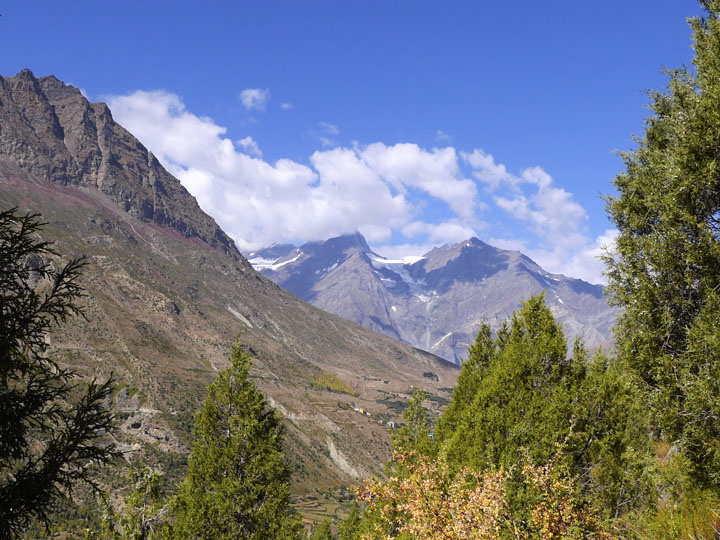
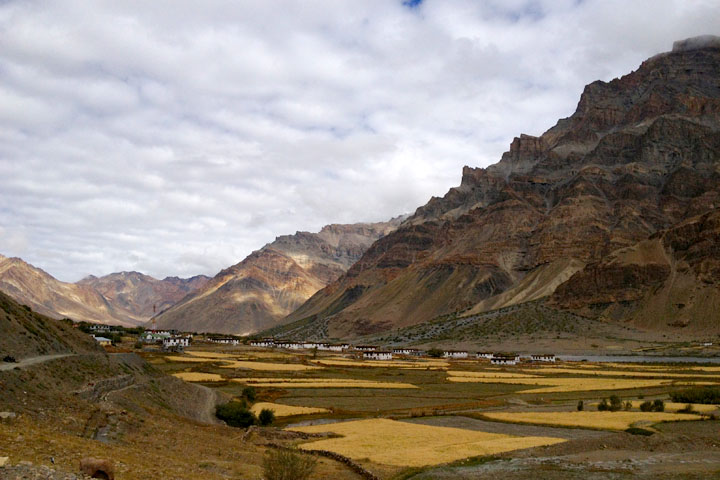
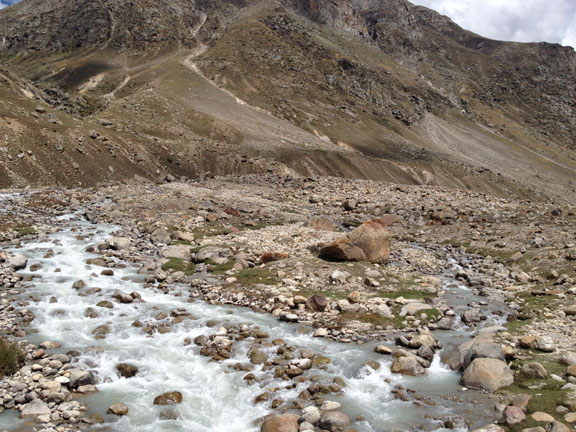
View of Himalayan valley from stairs to main temple just before entering courtyard, Lamayuru Monastery, Ladakh
To continue where I left off in my last post, I found Lamayuru Monastery really charming. Not only did the architectural spaces seem personal and intimate, but the experience of them was diverse and unexpected. One temple to the next seemed different in character and time.
The Dukhang, or main temple, is hidden behind a stairway façade, the doors of which open to reveal a fully enclosed courtyard, open only to the sky above. From here there is access to temples located on higher levels.
Courtyard of Dukhang, main temple, Lamayuru Monastery, Ladakh. Intimacy within the grandeur of the Himalayas just right outside the entry doors.Entrance to Dukhang, main temple, Lamayuru Monasetery, Ladakh
The Dukhang’s interior has an enclosed two-story atrium surrounded by colonnade. It was dramatically lit from skylights above, the main source of lighting in this semi-dark hall.
Interior of Dukhang, main temple, Lamayuru Monastery, Ladakh
Lining the walls are a library of scriptures and a rich collection of statuary honoring the Kagyu lineage, including such luminaries as the masters Tilopa, Naropa, Marpa, and Milarepa.
Interior of Dukhang, main temple, Lamayuru Monastery, Ladakh
Along this same wall, K and I did a collective gasp when our monk guide opened a small door to reveal a cave where the amazing Naropa had meditated in the 11th century. Visiting caves that have been graced by enlightened masters is not merely a curiosity. It is considered a blessing. Lay persons and adepts alike seek these places to meditate in the presence of greatness achieved.
Now incorporated into the temple, Naropa’s cave must have been at one time a separate and secret retreat. He is the mahasiddha who developed the yogi practice known as the Six Yogas of Naropa, which has been in continual use by practitioners since he introduced it. This is predominantly the method yogis at Kardang Monastery, for example, utilize in attaining their feats of mind over matter. To learn more, see this earlier post.
Cave where Indian master Naropa meditated in 11th century, Lamayuru Monastery, LadakhStatues placed in small cave where Indian master Naropa (in back) meditated in 11th century, Lamayuru Monastery, Ladakh. In front on left is most likely Taktsang Repa and on right Milarepa
This next small temple off the same courtyard as the main temple is dedicated to reliquaries.
Temple with reliquaries, Lamayuru Monastery, LadakhDetail of reliquaries with colorful tormas, ritual offerings made out of butter and flour, Lamayuru Monastery, LadakhA collection of statues also in this temple, Lamayuru Monastery, LadakhThe mahasiddha Marpa, always depicted with wide staring eyes, Lamayuru Monastery, LadakhVajradhara, the Primordial Buddha, Lamayuru Monastery, Ladakh
Marpa was a famously tough master with his disciple Milarepa, whom he refused to teach when the latter came repeatedly to seek his guidance. Instead he asked Milarepa thrice to single-handedly construct him a building–then tear it down! That is to say, he made the hapless disciple build something, then destroy it, on three different occasions. In a sense, Milarepa needed such profound purification for his prior spiteful and mass-murderous deeds.
Milarepa, disciple of Marpa, usually depicted with hand to ear engaged in a special yogi practice. He is the famously angry and spiteful practitioner who was able to transcend his evil deeds through dedicated asceticism and meditation in cave retreat. He is said to have had calluses on his rear from his years of unrelenting practice!Mural in same temple depicting protector deities and royal warriors, Lamayuru Monastery, LadakhMural depicitng protector deities at center and lineage masters at right, Lamayuru Monastery, LadakhDetail of female protector Tsering-ma riding a snow lion. Wall painting, Lamayuru Monastery, Ladakh. I like the graceful movement of this figure, and judging from the more Chinese influence in style, the murals in this temple post-date Indo-Tibetan period.
Next up was seeing the Avalokiteshvara temple, where my breath was taken away again by the exquisite sculpture there.
Entrance to Avalokiteshvara temple, Lamayuru Monastery, LadakhInterior of Avalokiteshvara temple, Lamayuru Monastery, Ladakh
I really loved this temple for its beautiful Avalokiteshvara statue, bodhisattva of compassion, also known as Chenrezig–thousand-armed and eleven-headed, all the better to see, hear, and lend a helping hand to the suffering. It was located in an inner sanctum behind the altar.
While the wall paintings in the Avalokiteshvara temple probably date from a later period judging from stylistic differences, it is possible that this statue dates to the earlier Indo-Tibetan period. Purely conjecture, but I was comparing the similarities in the face of Avalokiteshvara with this Vairocana from Sumda Chun, a remote and largely untouched monastery from the 11th century. These statues have more formal affinity with each other than do the Avalokiteshvara with the painting of one from the same Lamayuru temple.
On left is Vairocana sculpture from 11th century Sumda Chun Monastery, on right is Avalokiteshvara. The facial features have strong similarities in style and execution, as compared to the below painting of Avalokiteshvara from the same Lamayuru templePainting of thousand-armed Avalokiteshvara in its dedicated temple, Lamayuru Monastery, Ladakh. Bearing more Chinese influence in style, the face is softer and rounder, less typical of Kashmiri-influenced art of Indo-Tibetan period
It looks to me that this painting shows more Chinese influence, which would indicate it was created later than Indo-Tibetan period, probably post-13th century.
I heard a story that the goddess Tara emanated from Avalokiteshvara when, upon realizing the magnitude of the samsaric condition for all sentient beings, he shed tears. One tear became White Tara, and the other Green Tara.
Green Tara, surrounded by her 21 emanations which are mostly peaceful versions but some are wrathful forms. Contemporary sculpture, Namgyal Monastery, Dharamsala
Today, Tara retreats are one of the more common kriya tantras taught. She has contemporary feminist appeal as a female buddha. She is also an empowering figure in being regarded as Mother of All Buddhas. Additionally, as a bodhisattva who, seeing the gender bias of the male-dominated precinct of enlightenment in Buddhist religious order, vows to be reborn life after life in order to attain enlightenment in female form. I am reminded of what I have read about Jetsunma Tenzin Palmo, the British-born Tibetan Buddhist nun who spent twelve years in solitary meditation in a cave in Lahaul above Tayul Monastery, and who experienced such gender-bias in monastic orders.
Offerings, Avalokiteshvara temple, Lamayuru Monastery, Ladakh. The large center chalice is a butter lamp.Interior of Avalokiteshvara temple with old woman who had just finished her full body prostrations here Lamayuru Monastery, LadakhInterior of Avalokiteshvara temple looking back towards entrance, Lamayuru Monastery, Ladakh
View of Dukhang courtyard from second level, Lamayuru Monastery, LadakhKagyu monk making tormas, ritual butter cake offerings, in the kitchen on second floor above Dukhang courtyard, Lamayuru Monastery, Ladakh
Lamayuru Monastery–what an experience, and it’s grown fonder in my memory…
Today was Shashur and Tayul Monasteries. Both are not far from Keylong, just several kilometers away. Tayul Monastery was founded in the 17th century, but like Kardang Monastery, little appears to remain from its original period. The current main temple was renovated in the 19th century. Probably the oldest objects to be seen are the ancient stupas one encounters en route, on the hike up to the site.
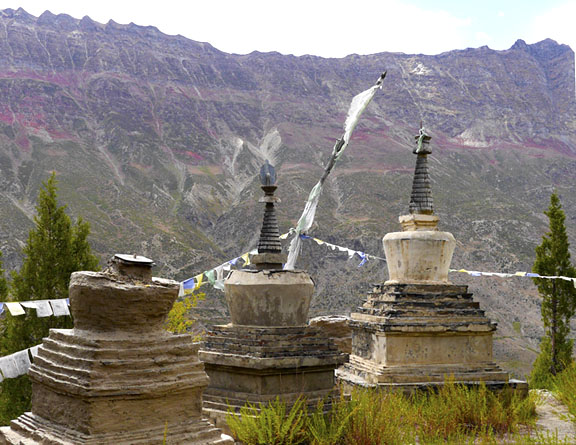
Ancient stupas on walking trail en route to Tayul Monastery, opposite Drilbu Ri Mountain, Lahaul
It must be reached on foot because there is no motorable road off the main road. The hike up is beautiful, of course, for its vistas. I was glad driver D accompanied me up because the trail is not so clear in some places. Locals do always advise having a guide. I still get winded doing the slightest incline up but hopefully each day will get better as I continue to acclimate to high altitude.
View across Bhaga Valley amid pine trees on trail to Tayul Monastery, Lahaul
Directly opposite is sacred Drilbu Ri mountain. You can always spot it by looking for those seven little peaks in a row that lead to a notched area where one treks up and over to reach the summit.
Drilbu Ri Mountain seen from across Bhaga Valley, easily identifiable by its seven peaks and the notch just to the right, where trail to its summit proceedsStatue possibly of founder and yogi Serzang Rinchen. Tayul Monastery,Lahaul
In fact, the story goes that Tayul, which means “chosen place,” was a location noticed by founder and Drukpa yogi Serzang Rinchen when he made his pilgrimage up Drilbu Ri. From across the Bhaga Valley, after a meritorious kora around the mountain, he saw the site and decided to build a hermitage there which became Tayul Monastery. Upon entering the main temple, one sees the 12 foot statue of Padmasambhava (Guru Rinpoche), revered as a great sage and living Buddha by Tibetans for introducing Buddhism to Tibet in the 8th century, displaying miraculous feats in taming local spirits in the process. Flanking him at the altar are statues of Dakini Singha Mukha, and the wrathful emanation of the guru.
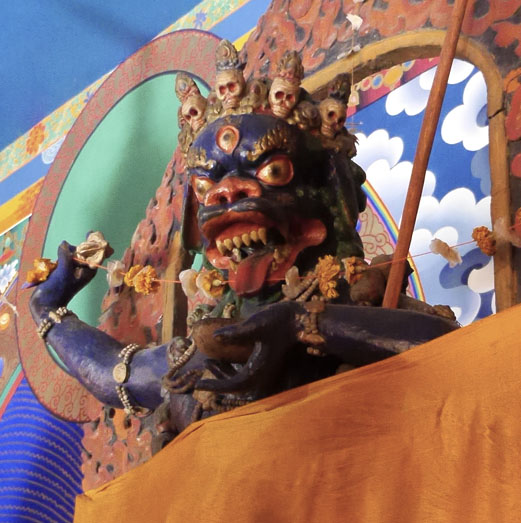
Altar with Padmasambhava (Guru Rinpoche) in center, flanked by Dakini Singha Mukha and wrathful emanation of guruStatue of Singha Mukha, Tayul Monastery, LahaulWrathful emanation of Guru Rinpoche, Tayul Monastery, Lahaul
The original wall paintings from the 19th century by Lama Tashi Temphel, who stayed there and helped expand the monastery, are no longer extant. In its place are new paintings. Unfortunately, I found these contemporary-styled depictions rather stiff in execution, and less refined than older wall paintings I have seen to date in previous monasteries. Lama Temphel also made sacred images at Guru Ghantal Monastery, which happily can still be seen there. It had been suggested to me that Lahaul is not so much a place to find ancient Indo-Tibetan artwork, nor exquisite old wall paintings or mandalas even, as it is a place to be experienced physically as a land of yogi training, legend, and pilgrimage. So far, so true.
View of new wall paintings, Tayul Monastery, LahaulDetail of new wall paintings, Chakrasamvara in center with Guru Rinpoche above and surrounded by dakinis, Tayul Monastery, LahaulDetail of new wall paintings, featuring Drukpa lineage masters, Tayul Monastery, Lahaul
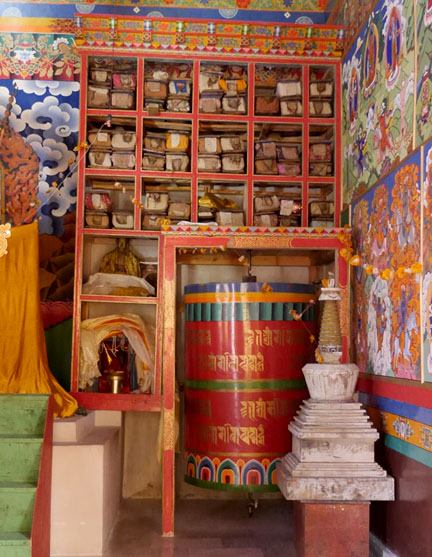
Tayul Monastery contains a complete Kangyur library and a large mani wheel that contains thousands of prayers. When spun, its blessings are activated and multiplies. According to its lamas, this wheel has been known to spin by itself on certain special occasions.
Kangyur library, and mani wheel known to rotate on its own on auspicious Buddhist days, Tayul Monastery, Lahaul
The British-born Tibetan Buddhist nun Tenzin Palmo was one of the first Westerners to encounter high Tibetan lamas in the early 1960s when she first arrived in India. She lived at Tayul for six years before retreating to a cave above it for twelve years. I read her biography Cave in the Snow like it was a suspense-thriller. I found her story and existential experiences riveting. It was a page-turner. Her retreat was abruptly interrupted by immigration authorities. Thus began her exit from solitary yogic practice to being a teacher in the world, a living example of Western and female accomplishment on the dharma path.
I always think that one beneficial outcome of the Tibet situation post-1959 is the creation of a diaspora which has lead to the spread of Buddhism in the Western world.
I saw Shashur Monastery the same day as Tayul. More to come!
Lahaul is known by Tibetan meditation practitioners and adepts as Garsha Khandroling, Land of the Dakinis. Dakinis are energetic female spiritual guides often depicted as blissful and fierce dancers.
Lahaul has an illustrious Drukpa Kagyu lineage of highly realized yogis and yoginis who do the Six Yogas of Naropa, esoteric methods bestowed by master to disciple in direct teachings. These are the meditators who go into seclusion in caves or simple dwellings for years or decades in order to realize spiritual liberation–that is to say, Buddha-nature through tantric wisdom and compassion practices.
As I mentioned in my last post, I have heard about some of the mind-over-matter feats that yogis demonstrate which confound conventional explanations, such as levitation, miraculous healing of the sick, making snow fall, taking bad karma upon oneself for the benefit of another. Another perplexing thing, upon death, the bodies of many advanced practitioners do not decay according to the normal time frame of most people. They are believed to be fully aware in the bardo state, the intermediate stage between death and rebirth.
Well, I’ve learned that while it’s difficult to wrap one’s rational mind around such reported phenomena, sitting on the I-don’t-know fence is a flexible and open-minded place to be. After all, outside of spiritual matters we can’t explain, for example, quantum entanglement or what Albert Einstein called “spooky action at a distance,” but it appears to happen!
The great yogi Shakya Shri
Garsha has attracted and hosted countless masters and disciples in pursuit of enlightenment for over 2000 years in unbroken continuity. Inspirations for pilgrims include the sacred abodes of Chakrasamvara at Drilbu Ri Mountain opposite Keylong; Avalokiteshvara at Phakba Temple in Triloknath; and Varjavahari at Markula Devi Temple in Udaipur.
Keylong, Lahaul’s largest village, has several important monasteries only a few kilometers away. These were flourishing Buddhist centers centuries ago, such as Kardang, Shashur and Tayul Monasteries. The oldest one, Gandhola (Guru Ghantal) dates to 1st century C.E. according to archeological evidence. I visited each of these places and to come will be posts featuring them.
View of Gandhola (Guru Ghantal) Monastery, way upper left, with Thupcholing Monastery below on the plateau. Those green-roofed structures are meditation huts for retreatants. Both sites overlook Tandi bridge where the mighty Chandra and Bagha Rivers join in what is considered by Buddhists and Hindus alike as a sacred union.
The delight to be found in Lahaul is that over time, masters have left legends, relics, shrines, stupas, sacred paintings, sculptures, and other spiritual encounters that dot the landscape awaiting discovery by travelers and seekers. The more you look, the more you will see, but it takes some uncovering. For example, what looks unimpressive on the outside may contain a treasure on the inside, such as Jabjes Monastery in Kardang Village. Or one has to do a bit of breathless hiking up a mountain to see some of these old monasteries, hidden meditation caves, and charnel grounds.
Jabjes Monastery located in Kardang Village was built around a legendary rock with the miraculous imprints of yogi Gyalwa Gotsangpa’s knees and genitalia, which formed in the stone as he passionately chased and tried to embrace a dakini who disappeared into it. The rock may be seen today inside the temple, Lahaul, India.
However, I’m told by locals that most visitors just pass through Lahaul, heading to the more tourist traveled and trekked sites in Ladakh or Spiti. What a pity!
More readily noticeable and understood by travelers is that Keylong stretches along the main trade route between the Rohtang and Baralacha passes above the Bhaga River. Besides being a thoroughfare between Ladakh, Kullu and Spiti regions, it is also the district headquarters of Lahaul and Spiti, with strategic military presence. In addition, above and below the village one sees lush farmlands growing barley, peas, potatoes, corn, cabbage, mustard greens, squash, and much more. Apples and other fruit orchards are plentiful. My local driver D told me that agriculture is the economic mainstay of Lahaul, and judging from some of the mansions built by some farming families, the wealth of this abundant agrarian heartland is evident. The food harvested is transported all over India. I would not have guessed that at an altitude of over 10,000 feet there would be such a cornucopia!
View of Keylong on hiking trail from Kardang Monastery to Keylong
D’s ancestral farmland is in the Manali area of Kullu Valley, but he lives and works in Keylong to service the tourist industry as an extension of the family business. Indeed, it’s all in the family. I’ve learned from Lahaulis and Spitians I met that relatives live and work together. This was always the tradition, and it largely continues today.
Another thing I learned was that unlike Tibetans, Lahaulis, Spitians and Ladakhis, while culturally and historically part of Tibet, are indigenous to their regions, and as such are not refugees in India but full citizens. In addition, they have their own language and customs. In fact, the Indian government recognizes them as ethnic “tribals,” who may therefore qualify for certain affirmative action positions or opportunities.
It isn’t only just the passerby tourist who may miss the treasure to be found in Lahaul. I realized that my driver, while he probably identifies himself as a Buddhist, is fairly uninformed about the great legacy of his roots. At one point in our travels, he asked me how much I knew about the Dalai Lama and Buddhism. I thought it was a prompt for me to in turn ask him what he knew and be enlightened by his local knowledge, but it was not a segue way to that at all! He told me he tried to find books on Buddhism in Hindi, but could not. It pained me to hear this–that someone looking for knowledge could not access it.
D said that Lahaulis are educated in Indian schools, are fluent in Hindi but not Tibetan, and frequently not English, either. I noticed this is especially true of the women, who largely live domestic lives caring for family and have little contact with others. English is spoken mainly to communicate with foreigners. Feeling affinity for Indian culture and language, many Lahaulis have assimilated to a large extent in recent generations. Most cannot read the readily available contemporary books in Tibetan on Tibetan Buddhism to fill in on the lack of local education on this topic. Books in English are plenty, but nor can they read these since the written language is “too deep” to understand. It was an exquisite and sad irony that I, a foreigner from the other side of the world, knew more about his spiritual roots than he did. That he, a resident in the incredible Garsha, a descendent of the local culture, could not find one book he could read to study Buddhism deeper!
Farm land and orchards above and below Keylong Village in the fertile valley of Bagha River, Lahaul
It’s a double whammy of cultural distance and spiritual loss. Without being able to study Buddhist philosophy and learn about its unique teachings on dependent origination, one runs the risk of meaningless ritual practice with no or limited realization of freedom from life’s delusions and sufferings.
What’s more, Tibetan Buddhists have a marvelous literary and scholarly tradition, founded on the translation and study of original source materials. Lotsawa Rinchen Zangpo’s translations of Buddhist scriptures from Sanskrit to Tibetan has not only preserved a written heritage now lost in India but produced a renaissance of tantric study and practice. This was during the late 10th to 11th centuries, a flourishing period referred to as the second great propagation of Buddhism. It is the Indo-Tibetan history I’ve been trailing through the sacred art of mandalas, monastery murals, and sculptures.
Garsha: Heartland of the Dakinis
In fact, a (French) Tibetan Buddhist nun, while living in Keylong, discovered the very same thing–that Lahaulis did not know much about the dharma history of their own land. Furthermore, part of why Lahaul’s Buddhist legacy is little known is due to a dearth of literature on it. So she wrote the book Garsha: Heartland of the Dakinis in 2011, published by the Garsha Young Drukpa Association. I have a copy in English, the language it was originally written in. Currently, it needs to be translated into Hindi for local readers.
It is a remarkable small book, jam-packed with a wealth of information about Garsha’s ancient history, the Drukpa lineage masters, dakinis, the founding of monasteries, anecdotes, local legends, descriptions of sacred sites, miracles, reliquaries, carved stones, and much more. It is probably the most, and perhaps only, comprehensive account of Lahaul’s history from the Buddhist perspective. Because it is written by a monastic with open access to living lineage teachers, and unpublished historic materials in Bhoti/Tibetan, the book is a treasure trove of knowledge.
I learned about the book and purchased it from Khandro Thrinlay la when I met her in Manali en route to Spiti (see earlier post here). She is a lama and direct descendent of the Drukpa Kagyu Shakya Shri lineage, with very close spiritual ties to Lahaul. My travel companion J was happy to find it available for sale later in Keylong because she wanted to buy it and donate copies to Tabo Monastery Library in Spiti and The Library of Tibetan Works and Archives in Dharamsala. Funny thing, though, she did not find it in a book store but at a small travel agency/internet cafe establishment run by a lovely Lahauli man keen on the book. You see what I mean? The more you look, the more you will find around here!
Sept 9, 2013 Spiti adventure continues…on to Lahaul, India
After a jaunty jiggly jeep ride of over 10 hours from Kaza back through the magnificent giant boulder rubble of Spiti Valley, Kunzum-la Pass (this time populated by yaks grazing and loafing!) and getting stuck fording a glacial melt waterfall that flooded the rocky road, we arrived in Keylong, Lahaul.
View of farmland in early morning Spiti Valley, en route to Keylong, LahaulSpiti Valley in the marbled early morning sun. As dry and desolate as Spiti may seem, there is always the play of light and colorful vistasApproaching the stupas of Kunzum la pass, the high point of the road at about 15000 ft altitude. This time there was a herd of yak grazing and resting. Glaciers can be seen within relatively close range.Kunzum la pass, where I circumambulated the stupas and got a close look at yaks gathered there. Glaciers can be seen at above left.Herd of yaks dotting Kunzum la pass, at about 15000 feet altitude, the highest point of the road through Spiti ValleyYak grazing, this one looks like he’s molting or has been shavedYaks grazing and resting at Kunzum la pass, seen en route from Spiti to LahaulTibetan Buddhist stupas at Kunzum la pass, monuments in honor of this high point of the road through Spiti ValleyAt this time of year in September, there are streams of glacial melt such as this one which frequently cross the road. They can be as small as trickles or as large as river flows, and it’s wise to travel as much as possible in the morning before the hot afternoon sun increases the flow of these waters that you have to cross with your vehicle.Huge boulder piles along the road from Kaza, Spiti, to Keylong, Lahaul. It’s difficult to judge the monumental scale from just a photo, but to give you an idea, this foreground rock is as tall as a person.Huge boulder piles along the road from Kaza, Spiti, to Keylong, Lahaul
Magnificent and desolate…
Our jeep on the road through the dry desert terrain of Spiti Valley, India
Once you experience the vast scale of the Himalayas, you can readily understand why the environment induces existential concerns and spiritual development. There’s nothing like realizing our small duration as human beings in the context of gigantic geological time and space, and beyond this, the grand cosmos to put human desires and expectations into a completely different focus.
A large Tibetan Buddhist stupa is dwarfed by the magnificent scale of the Himalayan mountains
Here is our jeep stuck on rocks while attempting to ford the rapidly flowing waterfall that flooded the road in the afternoon. We had patiently waited while the vehicle before us was stuck and finally managed to get out. In that 45 minutes or so, unfortunately, the water flow started increasing as the hot afternoon sun melted more glaciers! We got out eventually though with the help of others waiting to pass, including military men and a monk who moved earth and rubble, pushed and rocked the car, as our driver revved forward.
Our jeep stuck on rocks while attempting to ford the rapidly flowing waterfall that floods the road in the afternoon in Spiti Valley.The said rapidly flowing waterfall which created a river across the road, Spiti Valley, India
In contrast, as you approach and enter Lahaul Valley, high waterfalls are plenty but do not flood the roads. Lahaul is also a welcoming green landscape with grass, shrubbery, trees, and evergreens. The region is also well known for its delicious potatoes, as well as crops of barley, peas, cabbage, apple and other fruit orchards. Even here in high altitude, it is a heartland for growing food to be transported throughout India.
One sees many high waterfalls throughout the more verdant Lahaul Valley
With arrival in Keylong, Lahaul, in late afternoon we spent the rest of the day trying to get some logistics done. For my part, it was to get (yet another) SIM card that will get a cell signal here in the high Himalayas, and hopefully maintain a signal when I later travel to Ladakh further north. After the last week in Kaza, Spiti, without any cell phone coverage by my existing SIM card to communicate with family or arrange meetings or call for travel, etc., I decided to get another with a different carrier. Here in India, there is no single carrier that can provide national coverage, so one gets used to swapping out SIM cards and switching providers as the need arises when you travel from area to area. I have three SIMs now. The last one took so long to do—don’t ask the maddening details about how it took well over two hours to buy the SIM in one place and take it to another place to cut down. Around here you get used to relatively simple things taking an inordinate amount of time to accomplish, in this case, out of lack of coordination and know-how on merchants’ part. I’ve learned to smile a lot, shake my head, and say to myself, “It’s India…” Trust me, even Indians say this!
I never got to treat my very dry leather shoes as I had promised myself. They look like they’re going to crack from the dust-pounding they get in this high desert climate and unpaved roads. Nor did I get to download from the internet café the software plug-in I desperately need to manage my photographs. I couldn’t do it in Spiti because my download was too big for the internet café’s monthly ration of data permitted. Who knew an internet cafe would be rationed for data?! But, ok, lack of resources…I shook my head and smiled, it’s India.
But what India lacks, it definitely makes up for in its sublime experiences!
View of Keylong nestled in the Bhagha River Valley, Lahaul
Which brings me to Lahaul, also known by Buddhists as Garsha Khandroling, a region with a deep history of highly realized yogis. These are the practitioners who spend many years or decades in seclusion meditating in caves. You may have heard about adepts who can demonstrate astounding practices of mind over matter, such as levitate or dry wet sheets in the snow with heat generated from their bodies, confounding the scientists who studied this phenomena. Or you may have heard of Jetsunma Tenzin Palmo, the American Tibetan Buddhist nun and her Cave in the Snow. In any case, more on Garsha in the next post…
This is not an official U.S. Department of State website. The views and information presented here are solely those of the artist, and do not represent the Fulbright Program, the Department of State, or any other entity.