Tenzin Palmo

Backwards in Time for the Sake of Mandalas

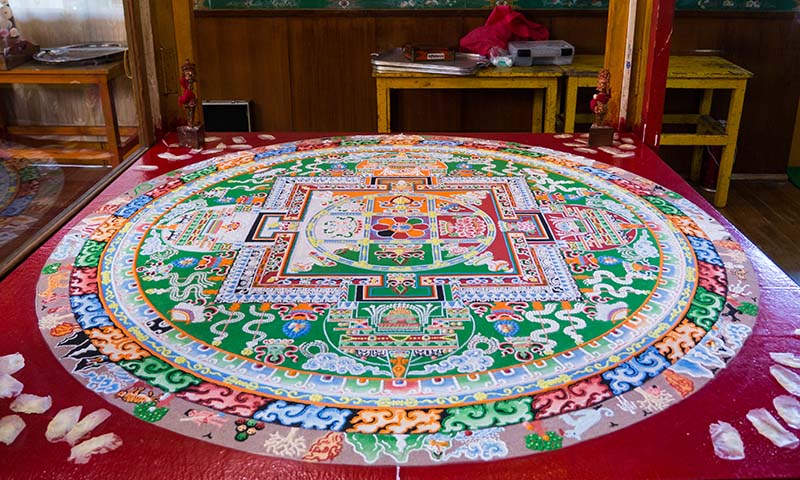
Yamantaka Sand Mandala
Yamantaka Sand Mandala, Namgyal Monastery, India. © 2010, Eva Lee.

I’ve gone about it all backwards. Backwards in time, in pursuit of mandalas. It all started when I heard that a sand mandala was going to be made at Namgyal Monastery in Dharamsala, India, in 2010. So I went there, and found out that it was a Yamantaka mandala, part of a ten-day-long highest yoga tantra ritual which occurs annually at the Dalai Lama‘s personal monastery. My previous post here describes what little I knew then as I observed and documented the creation and dissolution of it. The resultant film and photographs can be seen here.

When I came back to the U.S., it was as if a floodgate had opened. I needed to learn more. No, not just more, but all I could about Tibetan mandalas–about their variety, their purpose, their history, the meditation practices they engendered, and so forth. What did it all really mean? What modern significance did it have?

My bookshelves began to fill up with writings about tantra and Buddhist philosophy, written by the first Tibetan teachers to venture into the Western world, post-1959 exodus from Tibet. Titles by the Dalai Lama, Chogyam Trungpa Rinpoche, Lama Thubten Yeshe, Dilgo Khentse Rinpoche, as a few examples, abounded. I also read works by contemporary lamas like Dzogchen Ponlop Rinpoche, Pema Choedron, Tsoknyi Rinpoche, Tenzin Palmo. Tibetan scholars and historians David Snellgrove, Robert Thurman, Deborah Klimburg-Salter, Martin Brauen, and others figured in there, too.

All this, in addition to my previous discoveries of well-respected meditation teachers from other Buddhist traditions–Sharon Salzberg, Joseph Goldstein, Jack Kornfeld, B. Allan Wallace. I followed the writing of neuroscientists and clinicians, too, who studied or used meditation in their work. They were also involved with fascinating Mind & Life Institute research or conferences–Richard Davidson, Jon Kabat-Zinn, Paul Ekman, Daniel Goleman.

It was a mindfulness-neuro-tantric-philoso-fest that poured forth!

Meanwhile, in 2011, the ritual experiences continued. I attended the Dalai Lama’s Kalachakra event for World Peace in Washington D.C., and witnessed the Kalachakra Mandala.

Compassion Mandala created by Drepung Gomang Monks at Western Connecticut State University on the occasion of the Dalai Lama's talk on Creativity and Compassion, October, 2012.
Compassion Mandala created by Drepung Gomang Monks at Western Connecticut State University on the occasion of the Dalai Lama’s talk on Creativity and Compassion, October, 2012. © 2012, Eva Lee.

In 2012, I was at the Dalai Lama’s talk at Western Connecticut State University at which time I encountered a Compassion Mandala.

At both events, I had the wonderful opportunity of befriending and working with monks, nuns, plus other Buddhist practitioners and followers.

It was a steady flow. The waters at the floodgates just did not tire out. Answers came, and new questions arose.

Thus, on the heels of this, last year in 2013 I arrived back to India to experience and research rare Indo-Tibetan mandalas in Himalayan monasteries of Spiti, Lahaul, and Ladakh. How might they have evolved into Tibetan forms that we know today? What was this Indo-Tibetan 10th to 12th century period called the Second Great Transmission of Buddhism from India to Tibet? What did the sacred art look like? What did it mean?

View of mandala wall painting, Nangbarnangzad, Mangyu Monastery, Ladakh
View of mandala wall painting, Nangbarnangzad, Mangyu Monastery, Ladakh. © 2013, Eva Lee.


At the end of my travels through the Himalayan high altitudes, I then thought, let’s reel back in time some more. What came before the Indo-Tibetan era?

The answer was, Indian Buddhism, which could be seen at Ajanta and Ellora Caves where there are remains of elaborate 2nd to 8th century C.E. wall paintings, sculptures, and architecture. Such purely Indian Buddhist art is still preserved at these South Indian sites in the state of Maharashtra.
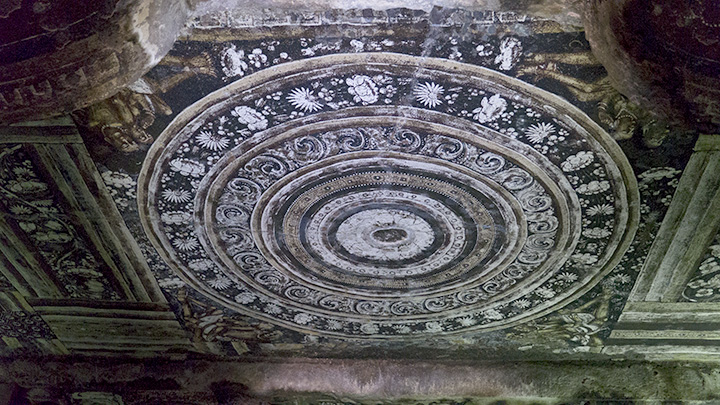
Ceiling painting, Ajanta Cave 2, near Aurangabad, India
Ceiling painting, Ajanta Cave 2, near Aurangabad, India. © 2013, Eva Lee.


Finally, what might have come even before this in India? I mean in B.C.E. times. When I searched further, it seems that the Buddhist art historical record stops here. According to historians, not much still exists before the 1st century C.E. Little is known in India archeologically prior to this time.

So what’s it all about? Why would an artist go for all this? New artwork from my Fulbright experience does beckon me in the studio.

I guess I’m just driven by the big questions about mind and reality, which Buddhist philosophy seems to address best. And moreover, that largely works within a Western scientific paradigm. It doesn’t hurt, either, that an affable spiritual leader like the Dalai Lama continues to inspire and exemplify how one can be intellectually sharp, existentially awake, and compassionately engaged in the world. Despite being a keeper of complex Tibetan rituals and esoteric tantric teachings, he can still keep it simple and distill wisdom down to these words: “There is no need for temples, no need for complicated philosophies. My brain and my heart are my temples. My philosophy is kindness.”

Collective Gasps at Lamayuru’s Temples

September 22nd     Lamayuru Monastery – Part Two

Lamayuru Monastery, Ladakh
View of Himalayan valley from stairs to main temple just before entering courtyard, Lamayuru Monastery, Ladakh

To continue where I left off in my last post, I found Lamayuru Monastery really charming. Not only did the architectural spaces seem personal and intimate, but the experience of them was diverse and unexpected. One temple to the next seemed different in character and time.

The Dukhang, or main temple, is hidden behind a stairway façade, the doors of which open to reveal a fully enclosed courtyard, open only to the sky above. From here there is access to temples located on higher levels.

Courtyard of Dukhang, main temple, Lamayuru Monastery, Ladakh
Courtyard of Dukhang, main temple, Lamayuru Monastery, Ladakh. Intimacy within the grandeur of the Himalayas just right outside the entry doors.
Entrance to Dukhang, main temple, Lamayuru Monasetery, Ladakh

The Dukhang’s interior has an enclosed two-story atrium surrounded by colonnade. It was dramatically lit from skylights above, the main source of lighting in this semi-dark hall.

Interior of Dukhang, Lamayuru Monastery, Ladakh
Interior of Dukhang, main temple, Lamayuru Monastery, Ladakh

Lining the walls are a library of scriptures and a rich collection of statuary honoring the Kagyu lineage, including such luminaries as the masters Tilopa, Naropa, Marpa, and Milarepa.

Interior of Dukhang, Lamayuru Monastery, Ladakh
Interior of Dukhang, main temple, Lamayuru Monastery, Ladakh

Along this same wall, K and I did a collective gasp when our monk guide opened a small door to reveal a cave where the amazing Naropa had meditated in the 11th century. Visiting caves that have been graced by enlightened masters is not merely a curiosity. It is considered a blessing. Lay persons and adepts alike seek these places to meditate in the presence of greatness achieved.

Now incorporated into the temple, Naropa’s cave must have been at one time a separate and secret retreat. He is the mahasiddha who developed the yogi practice known as the Six Yogas of Naropa, which has been in continual use by practitioners since he introduced it. This is predominantly the method yogis at Kardang Monastery, for example, utilize in attaining their feats of mind over matter. To learn more, see this earlier post.

Cave where Indian master Naropa meditated in 11th century, Lamayuru Monastery, Ladakh
Statues placed in small cave where Indian master Naropa (in back) meditated in 11th century, Lamayuru Monastery, Ladakh. In front on left is most likely Taktsang Repa and on right Milarepa

This next small temple off the same courtyard as the main temple is dedicated to reliquaries.

9_1050046_yes_72
Temple with reliquaries, Lamayuru Monastery, Ladakh
10_1050040_yes_72
Detail of reliquaries with colorful tormas, ritual offerings made out of butter and flour, Lamayuru Monastery, Ladakh
11_1050058_yes_72
A collection of statues also in this temple, Lamayuru Monastery, Ladakh
13_1050066_yes_Marpa_72
The mahasiddha Marpa, always depicted with wide staring eyes, Lamayuru Monastery, Ladakh
14_1050067_yes_72
Vajradhara, the Primordial Buddha, Lamayuru Monastery, Ladakh

Marpa was a famously tough master with his disciple Milarepa, whom he refused to teach when the latter came repeatedly to seek his guidance. Instead he asked Milarepa thrice to single-handedly construct him a building–then tear it down! That is to say, he made the hapless disciple build something, then destroy it, on three different occasions. In a sense, Milarepa needed such profound purification for his prior spiteful and mass-murderous deeds.

15_1050068_yes_72
Milarepa, disciple of Marpa, usually depicted with hand to ear engaged in a special yogi practice. He is the famously angry and spiteful practitioner who was able to transcend his evil deeds through dedicated asceticism and meditation in cave retreat. He is said to have had calluses on his rear from his years of unrelenting practice!
16_1050050_yes_72
Mural in same temple depicting protector deities and royal warriors, Lamayuru Monastery, Ladakh
17_1050051_yes_72
Mural depicitng protector deities at center and lineage masters at right, Lamayuru Monastery, Ladakh
17_MG_8626_yes_72
Detail of  female protector Tsering-ma riding a snow lion. Wall painting, Lamayuru Monastery, Ladakh. I like the graceful movement of this figure, and judging from the more Chinese influence in style, the murals in this temple post-date Indo-Tibetan period.

Next up was seeing the Avalokiteshvara temple, where my breath was taken away again by the exquisite sculpture there.

Enrance to Avalokiteshvara temple, Lamayuru Monastery, Ladakh
Entrance to Avalokiteshvara temple, Lamayuru Monastery, Ladakh
Avalokiteshvara temple, Lamayuru Monastery, Ladakh
Interior of Avalokiteshvara temple, Lamayuru Monastery, Ladakh

I really loved this temple for its beautiful Avalokiteshvara statue, bodhisattva of compassion, also known as Chenrezig–thousand-armed and eleven-headed, all the better to see, hear, and lend a helping hand to the suffering. It was located in an inner sanctum behind the altar.

Inner sanctum, Avalokiteshvara temple, Lamayuru Monastery, Ladakh
Avalokiteshvara statue, Lamayuru Monastery, Ladakh
Avalokiteshvara statue, really beautiful! Lamayuru Monastery, Ladakh
Detail of Avalokiteshvara statue, Lamayuru Monastery, Ladakh

While the wall paintings in the Avalokiteshvara temple probably date from a later period judging from stylistic differences, it is possible that this statue dates to the earlier Indo-Tibetan period. Purely conjecture, but I was comparing the similarities in the face of Avalokiteshvara with this Vairocana from Sumda Chun, a remote and largely untouched monastery from the 11th century. These statues have more formal affinity with each other than do the Avalokiteshvara with the painting of one from the same Lamayuru temple.

Comparison of Sumda Chun Vairocana with Lamayuru Avalokiteshvara
On left is Vairocana sculpture from 11th century Sumda Chun Monastery, on right is Avalokiteshvara. The facial features have strong similarities in style and execution, as compared to the below painting of Avalokiteshvara from the same Lamayuru temple
Painting of Avalokiteshvara, Lamayuru Monastery, Ladakh, India
Painting of thousand-armed Avalokiteshvara in its dedicated temple, Lamayuru Monastery, Ladakh. Bearing more Chinese influence in style, the face is softer and rounder, less typical of Kashmiri-influenced art of Indo-Tibetan period

It looks to me that this painting shows more Chinese influence, which would indicate it was created later than Indo-Tibetan period, probably post-13th century.

I heard a story that the goddess Tara emanated from Avalokiteshvara when, upon realizing the magnitude of the samsaric condition for all sentient beings, he shed tears. One tear became White Tara, and the other Green Tara.

Green Tara
Green Tara, surrounded by her 21 emanations which are mostly peaceful versions but some are wrathful forms. Contemporary sculpture, Namgyal Monastery, Dharamsala

Today, Tara retreats are one of the more common kriya tantras taught. She has contemporary feminist appeal as a female buddha. She is also an empowering figure in being regarded as Mother of All Buddhas. Additionally, as a bodhisattva who, seeing the gender bias of the male-dominated precinct of enlightenment in Buddhist religious order, vows to be reborn life after life in order to attain enlightenment in female form. I am reminded of what I have read about Jetsunma Tenzin Palmo, the British-born Tibetan Buddhist nun who spent twelve years in solitary meditation in a cave in Lahaul above Tayul Monastery, and who experienced such gender-bias in monastic orders.

Offerings, Avalokiteshvara temple, Lamayuru Monastery, Ladakh
Offerings, Avalokiteshvara temple, Lamayuru Monastery, Ladakh. The large center chalice is a butter lamp.
Interior of Avalokiteshvara temple, Lamayuru Monastery, Ladakh
Interior of Avalokiteshvara temple with old woman who had just finished her full body prostrations here
Lamayuru Monastery, Ladakh
Interior of Avalokiteshvara temple, Lamayuru Monastery, Ladakh
Interior of Avalokiteshvara temple looking back towards entrance, Lamayuru Monastery, Ladakh
Interior of Avalokiteshvara temple, Lamayuru Monastery, Ladakh
View of Dukhang courtyard from second level, Lamayuru Monastery, Ladakh
Lamayuru monk making tormas, ritual butter cake offerings, in the kitchen
Kagyu monk making tormas, ritual butter cake offerings, in the kitchen on second floor above Dukhang courtyard, Lamayuru Monastery, Ladakh

Lamayuru Monastery–what an experience, and it’s grown fonder in my memory…

All photos © 2013, Eva Lee.

A Chosen Place: Tayul Monastery

September 14th     Lahaul adventure continues…

Tayul Monastery, Lahaul, India

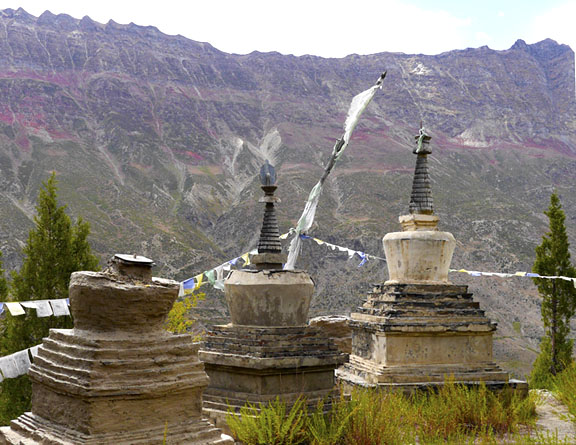
Today was Shashur and Tayul Monasteries. Both are not far from Keylong, just several kilometers away. Tayul Monastery was founded in the 17th century, but like Kardang Monastery, little appears to remain from its original period. The current main temple was renovated in the 19th century. Probably the oldest objects to be seen are the ancient stupas one encounters en route, on the hike up to the site.

Ancient stupas on walking trail en route to Tayul Monastery, opposite Drilbu Ri Mountain, Lahaul, India
Ancient stupas on walking trail en route to Tayul Monastery, opposite Drilbu Ri Mountain, Lahaul

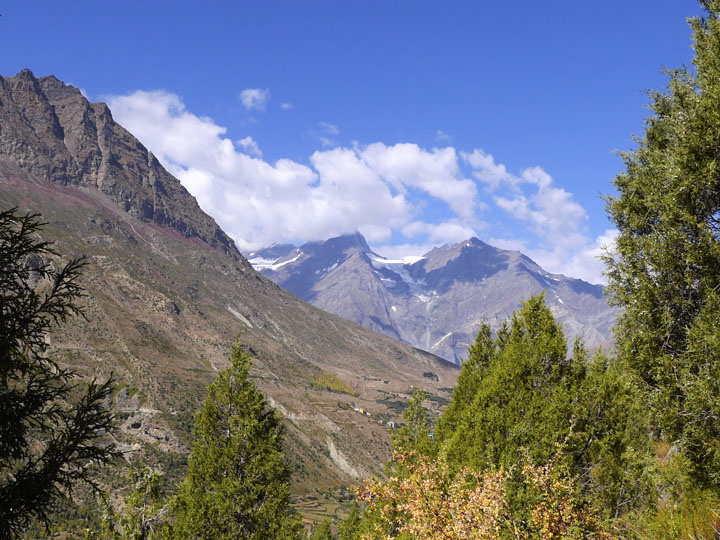
It must be reached on foot because there is no motorable road off the main road. The hike up is beautiful, of course, for its vistas. I was glad driver D accompanied me up because the trail is not so clear in some places. Locals do always advise having a guide. I still get winded doing the slightest incline up but hopefully each day will get better as I continue to acclimate to high altitude.

View across Bhaga Valley amid pine trees on trail to Tayul Monastery, Lahaul, India
View across Bhaga Valley amid pine trees on trail to Tayul Monastery, Lahaul

Directly opposite is sacred Drilbu Ri mountain. You can always spot it by looking for those seven little peaks in a row that lead to a notched area where one treks up and over to reach the summit.

Drilbu Ri Mountain seen from across Bhaga Valley, easily identifiable by its seven peaks and the notch just to the right, where trail to its summit proceeds
Statue possibly of founder and yogi Serzang Rinchen. Tayul Monastery,Lahaul

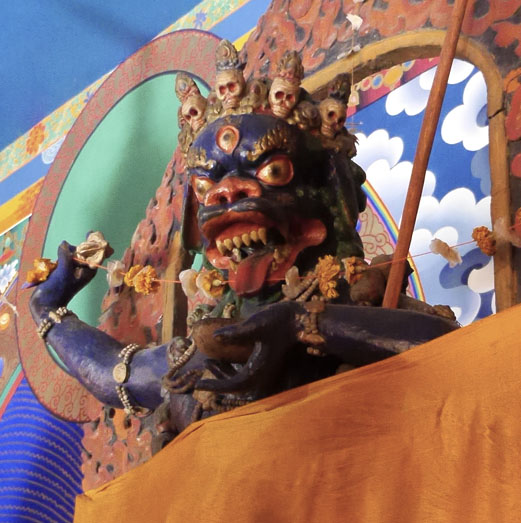
In fact, the story goes that Tayul, which means “chosen place,” was a location noticed by founder and Drukpa yogi Serzang Rinchen when he made his pilgrimage up Drilbu Ri. From across the Bhaga Valley, after a meritorious kora around the mountain, he saw the site and decided to build a hermitage there which became Tayul Monastery. Upon entering the main temple, one sees the 12 foot statue of Padmasambhava (Guru Rinpoche), revered as a great sage and living Buddha by Tibetans for introducing Buddhism to Tibet in the 8th century, displaying miraculous feats in taming local spirits in the process. Flanking him at the altar are statues of Dakini Singha Mukha, and the wrathful emanation of the guru.

Altar with Padmasambhava (Guru Rinpoche) in center, flanked by Dakini Singha Mukha and wrathful emanation of guru, Lahaul, India
Altar with Padmasambhava (Guru Rinpoche) in center, flanked by Dakini Singha Mukha and wrathful emanation of guru
Statue of Singha Mukha, Tayul Monastery, Lahaul
Wrathful emanation of Guru Rinpoche, Tayul Monastery, Lahaul

The original wall paintings from the 19th century by Lama Tashi Temphel, who stayed there and helped expand the monastery, are no longer extant. In its place are new paintings. Unfortunately, I found these contemporary-styled depictions rather stiff in execution, and less refined than older wall paintings I have seen to date in previous monasteries. Lama Temphel also made sacred images at Guru Ghantal Monastery, which happily can still be seen there. It had been suggested to me that Lahaul is not so much a place to find ancient Indo-Tibetan artwork, nor exquisite old wall paintings or mandalas even, as it is a place to be experienced physically as a land of yogi training, legend, and pilgrimage. So far, so true. 

View of new wall paintings, Tayul Monastery, Lahaul
Detail of new wall paintings, Chakrasamvara in center with Guru Rinpoche above and surrounded by dakinis, Tayul Monastery, Lahaul
Detail of new wall paintings, featuring Drukpa lineage masters, Tayul Monastery, Lahaul

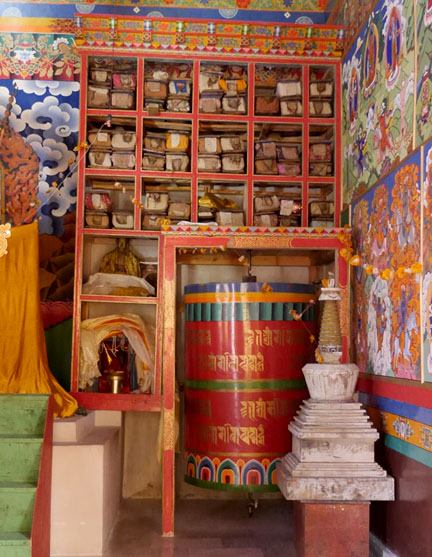
Tayul Monastery contains a complete Kangyur library and a large mani wheel that contains thousands of prayers. When spun, its blessings are activated and multiplies. According to its lamas, this wheel has been known to spin by itself on certain special occasions.

Kangyur library, and mani wheel known to rotate on its own on auspicious Buddhist days, Tayul Monastery, Lahaul

The British-born Tibetan Buddhist nun Tenzin Palmo was one of the first Westerners to encounter high Tibetan lamas in the early 1960s when she first arrived in India. She lived at Tayul for six years before retreating to a cave above it for twelve years. I read her biography Cave in the Snow like it was a suspense-thriller. I found her story and existential experiences riveting. It was a page-turner. Her retreat was abruptly interrupted by immigration authorities. Thus began her exit from solitary yogic practice to being a teacher in the world, a living example of Western and female accomplishment on the dharma path.

I always think that one beneficial outcome of the Tibet situation post-1959 is the creation of a diaspora which has lead to the spread of Buddhism in the Western world.

I saw Shashur Monastery the same day as Tayul. More to come!

All photos © 2013, Eva Lee.