Fulbright Documentary Series at Columbia University and Library of Tibetan Works & Archives
Posted
Losar Tashi Delek! Happy Lunar New Year to all who celebrate!
I’m pleased to announce that five of my documentaries are now part of the Columbia University Tibetan Studies Library, one of the most extensive collections of Tibetan texts and archival material in the U.S.A. The documentaries are also in the Library of Tibetan Works & Archives, and may be viewed through their Multimedia Library.
The documentaries are:
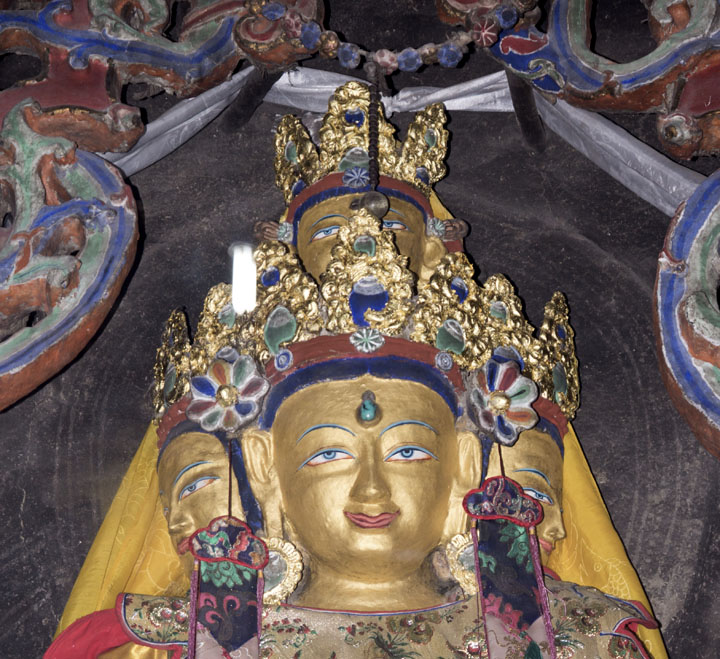
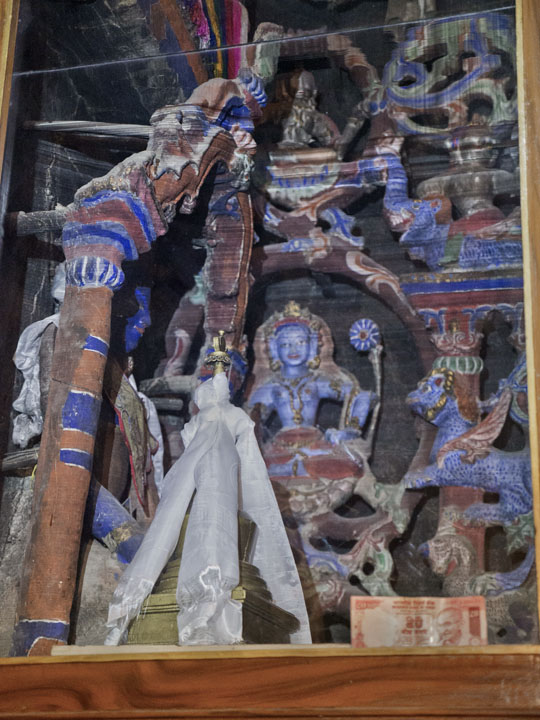
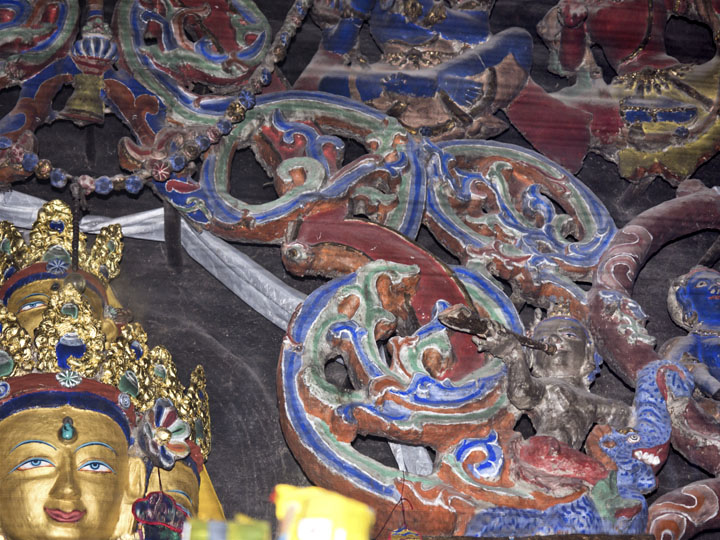
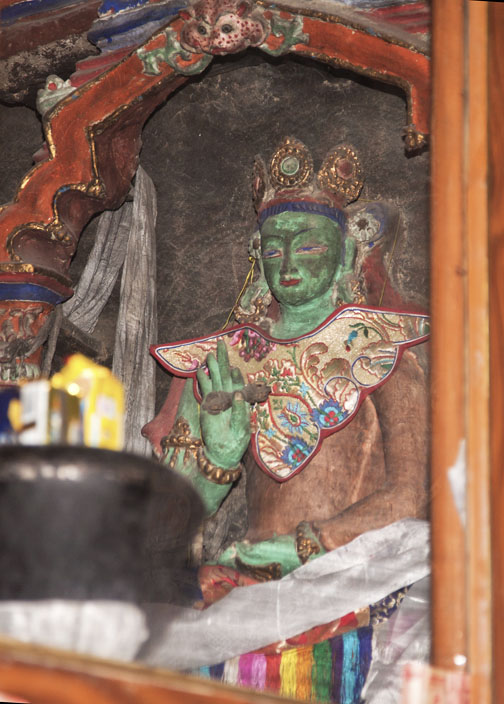
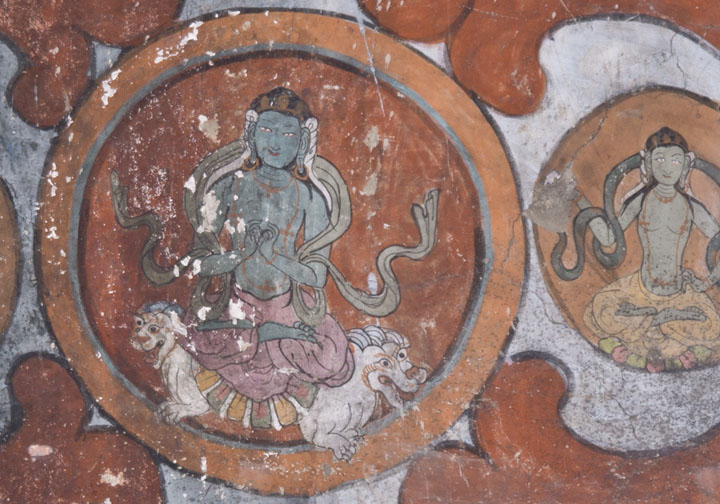
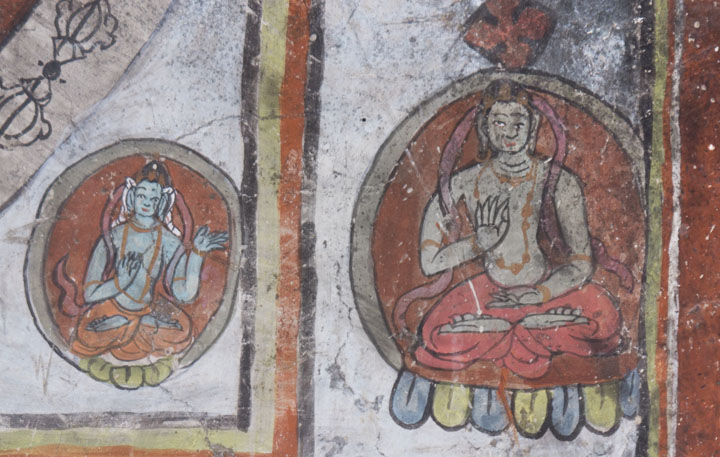
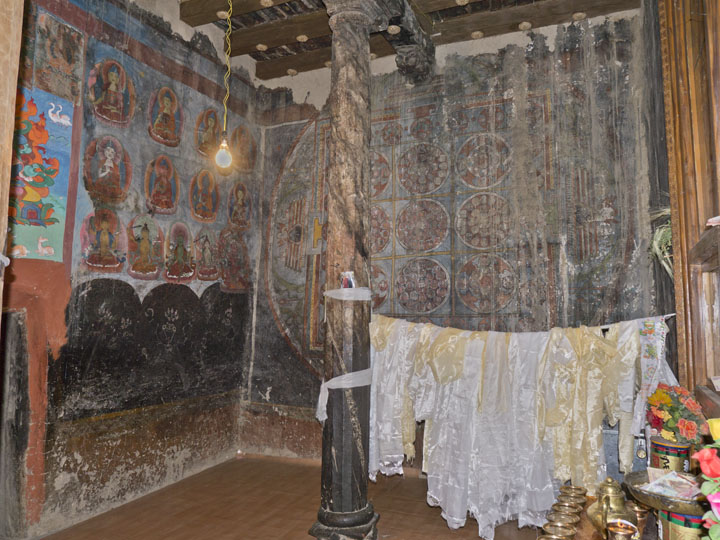
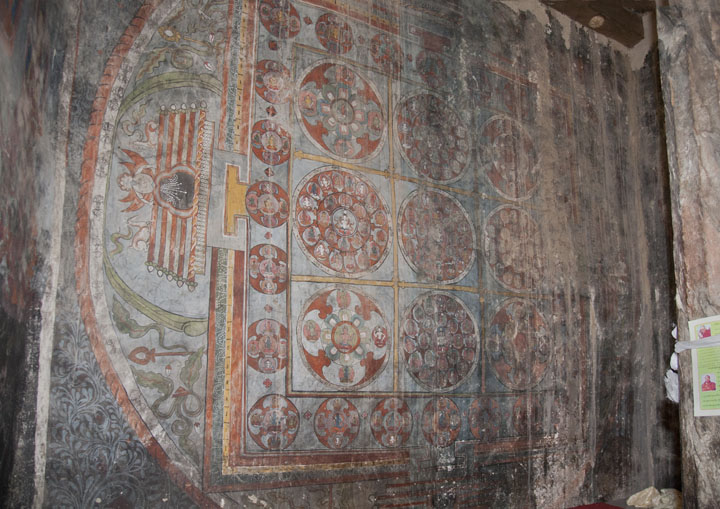
Tabo Monastery Tsug Lhakhang (Main Assembly Hall) See the interior of this rare, Buddhist temple located in Spiti region of Western Himalayas, India. Famed Tabo Monastery is known as the oldest continually functioning Tibetan Buddhist monastery, the art of which the Dalai Lama said “delightfully expresses the vigor of the transmission of Buddhism from India to Tibet and the dynamic mingling of cultures.” Established in 996 C.E. by the Buddhist king of Guge in Western Tibet, Yeshe O’d, and the The Great Translator Rinchen Zangpo, it flourished in a golden epoch of Indo-Tibetan collaboration in spreading Buddhist culture.
Lamayuru Monastery Senge Lhakhang (Lion Temple) (00:03:24) Rare, medieval temple located in Ladakh region of Western Himalayas, India. Founded by The Great Translator Rinchen Zangpo and King Yeshe O’d of Guge, Western Tibet, circa late 11th century.
Mangyu Monastery Nangbarnangzad (0:03:03) Rare, medieval temple located in Ladakh region of Western Himalayas, India. Founded by The Great Translator Rinchen Zangpo and King Yeshe O’d of Guge, Western Tibet, circa late 11th century.
Lhalung Monastery Serkhang (Golden Hall)(00:01:45) Rare, medieval temple located in Spiti region of Western Himalayas, India. Founded by The Great Translator Rinchen Zangpo and King Yeshe O’d of Guge, Western Tibet, circa late 10th century.
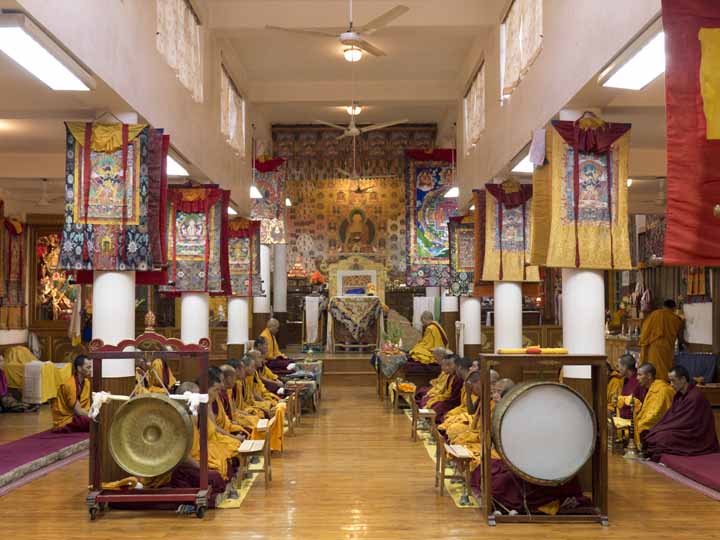
Yamantaka (00:56:38) A candid view of an esoteric and complex Tibetan Buddhist highest yoga tantra held at Namgyal Monastery in Dharamsala, India. Monks create an elaborate sand mandala, ritual cakes and other sacred arts, offer prayers, chant, play ritual instruments, and meditate over the course of ten days. As one viewer said, “Beautiful, bizarre, and fascinating!”
Incidentally, many viewers have asked me about what is happening at around 42:14 in the Yamantaka video, where a young Caucasian man is in the Main Temple talking loudly and animatedly to a gathering of monks.This was a debate exam in session for students of the Institute of Buddhist Dialectics (which adjoins Namgyal Monastery), characterized by dramatic and distinctive hand clapping, body motions, and rhetoric. It was an event unrelated to Yamantaka, but which coincided with it. Tibetan Buddhists have a long and famed tradition of continuing the ancient Indian Buddhist practice of philosophical debate.
All documentaries filmed during Fulbright research on Indo-Tibetan mandalas of the 10th-12th century. With thanks and gratitude to Office of His Holiness the 14th Dalai Lama, Namgyal Monastery, and Nechung Monastery for their support in my quest to document these temples and Yamantaka ritual. Made possible in part by the support of Fulbright-Nehru Research Program, Council for the International Exchange of Scholars, and United States-India Education Foundation.
The Sand in Sand Mandalas
Posted
Yamantaka Mandala
Many readers have asked me about the sand used in creating sand mandalas. What is it? Where does it come from? Is it store-bought? If not, how is it made? How is it colored? Is it colored with natural dyes?
So I asked a monk friend of mine, who resides at Namgyal Monastery in Dharamsala, India, and here’s what he told me.
There in India, the colored sand is handmade. Special white stones are picked from the banks of rivers located in the nearby larger towns of Manali or Rewalsar. After transporting these stones back to the monastery, junior monks crush the stones manually in a “thick iron pot.” Gee, are you thinking what I’m thinking? A gigantic mortar and pestle? Wow, can you imagine the labor?!
When the stone is finally crushed into a sandy powder, they then wash it over and over again, adding natural fabric dyes purchased from local markets. Finally, the sand is put in the sun to dry.
The monks make a variety of sand, from courser to more refined. The quality used depends on the design element of the mandalas. For example, fine quality sand must be used for details, such as the faces of deities and animal figures, or the delicate ornamentation of architecture.
When monks travel, such as for example those in Sacred Arts Tour who create mandalas in America, they may buy pre-made colored sand in the U.S. However, they often still have to custom-make certain colors because not all store-bought ones are suitable for the specific symbolic colors of mandalas.
New Video Documentaries: Interior Views of Indo-Tibetan Temples at Tabo, Lamayuru, Lhalung and Mangyu Monasteries
Posted
Tabo Monastery Tsug Lhakhang, Spiti, India
At long last, I have completed four short video documentaries of the interiors of Indo-Tibetan monasteries that flourished during the 10th to 12th centuries. I feel so very honored to have had the opportunity to visit, research, and document these incredible temples.
The temples are:
Tabo Monastery’s Tsug Lhakhang, the Main Assembly Hall, renowned as the oldest continually functioning Tibetan Buddhist monastery, the art of which the Dalai Lama said “delightfully expresses the vigor of the transmission of Buddhism from India to Tibet and the dynamic mingling of cultures.” Established in 996 C.E. in ancient Western Tibet, now Spiti, India
Lamayuru Monastery’s Senge Lhakhang, or Lion Temple, established in the 11th century on a plateau in what is now Ladakh, India. Ca. 11th century, the oldest temple at Yamayuru Monastery. Contains well-preserved and rare Indo-Tibetan clay sculptures of Vairocana, Dhyani (Supreme) Buddhas, and Vajradhatu mandalas, including Gonkhang with protector deities, Ladakh, India
Lhalung Monastery’s Serkhang, the Golden Hall, founded in the early 11th century and located in present-day Spiti, India.
All four sites are among the rare Indo-Tibetan temples still found today with extant, fairly well-preserved, poly-chromed clay sculptures which depict the Five Supreme or Dhyani Buddhas, along with their associated 32 deities. These sculptures form a distinctive sacred art of this period.
After viewing these videos, which show the visual expression of Buddhism, I hope you will find inspiration to learn more about the philosophy and practice of Buddhism.
The wealth of empirical knowledge gathered through millenia by Buddhist meditation practitioners not only benefits those seeking spiritual development, but also those looking for less stress and more happiness. Who wouldn’t want that?
I believe this tradition offers a tremendously positive impact on contemporary society.
Look further, and see for yourself how psychology, health, and medical fields have made advances in treatments based on meditation. For example, neuroscientists in their research on the human brain have garnered great insights in studies on meditation and its effects on cognition and emotional regulation. A pioneer on this Dr. Richard Davidson of The Center for Healthy Minds. One result is the development of Mindfulness Based Stress Reduction (MBSR) pioneered by Dr. John Kabat-Zinn which has been applied with great success as a non-pharmaceutical approach to coping with pain and emotional challenges.
Less stress, more happiness. Again, who wouldn’t want that?
I wish you all the best in your curiosity, and your journey towards learning about mind and well-being, hallmarks of Buddhist practice.
Betwixt: New Animation and Experimental Film by Eva Lee
Posted
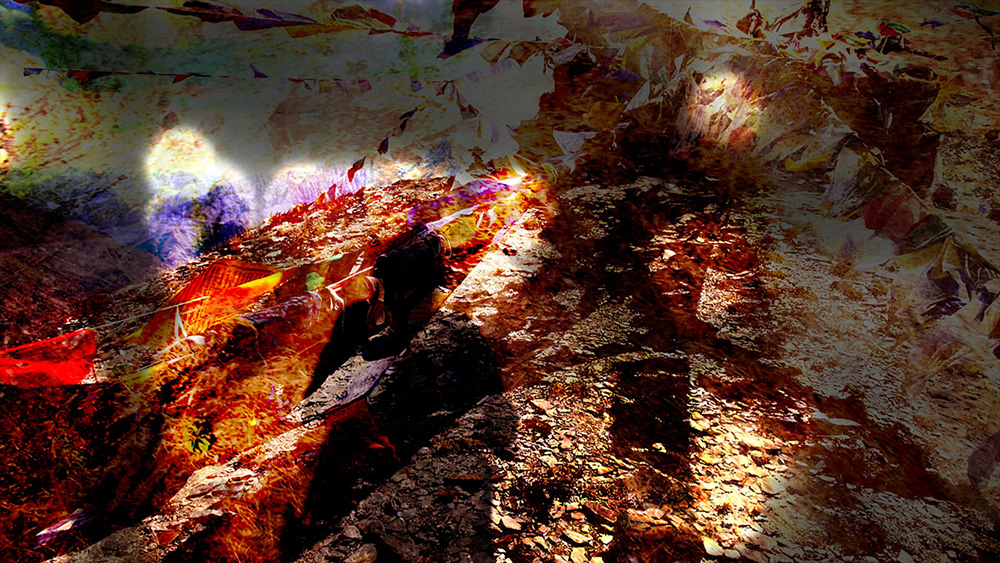
Found adventures and forgotten homes, dreams of departures and arrivals. Yes, that is the description for “Betwixt,” my latest new animation and experimental film.
You want to see a sneak peek, you say? Why not! Click on the image below.
Still from “Betwixt,” new animation and experimental film by Fulbright artist Eva Lee
Inspired by research on Tibetan Buddhist mandalas in Indian Himalayas. Made possible in part by support from Fulbright Scholar Program.
Thoughts on the Eve of Kalachakra in Ladakh 2014
Posted
July 2, 2014
Kalachakra will take place in Ladakh, India, near the city of Leh starting tomorrow July 3 – July 14. I wish I could be there this year, but alas, I will be here at home in the U.S. And on this, the eve of the event, I’m thinking about when I attended the Kalachakra Event for World Peace in Washington, D.C. held in July of 2011.
At that time, I had returned from my first trip to India where I happened to meet one of the organizers of this event. It was not long before he recruited me to help with video content for the large screens at Verizon Center, where the ritual was hosted.
I helped design and produce material for projection onto the arena screens. Content included Kalachakra prayers, and video presentations of photographs which were shown in between ritual sessions during breaks. These were essentially images of Tibetan subjects by noted photographers such as Don Farber, Tenzin Choejor, Abhishek Madhukar, and many others.
In the process of creating the video material, I had the wonderful experience of working closely with an American Tibetan Buddhist nun named Ani Tenzin Lhamo-la. Her guidance was invaluable. I could not have made these videos for Kalachakra without her. What’s more, her friendship, moxie, and insight as a psychotherapist and monastic have been memorable and enduring.
The Dalai Lama with monastics on stage at Kalachakra Event for World Peace, Verizon Center, Washington, D.C., July, 2011. Photo: Tenzin Choejor/OHHDL
I felt most honored to have produced a video chronology of the Dalai Lama’s life in celebration of his 76th birthday, which occurred on the first day of Kalachakra, July 6, 2011.
While I am not at liberty to post the video because it was created exclusively for the birthday occasion, I am so pleased to have had the opportunity to work with archived images of His Holiness. Joining that day to help celebrate the Dalai Lama’s birthday were Mahatma Gandhi’s grandson, Arun, and Martin Luther King Jr.’s son, Martin. It was a historic appearance together.
Kalachakra Event for World Peace, Washington, D.C., July, 2011
I recently suddenly thought of the Dalai Lama sitting in the middle of the thekpu, the ritual platform on which the elaborate Kalachakra sand mandala is created. He does this on the first day of consecrating the ground where the sacred artform is performed, and again when the mandala is about to be dissolved.
I realized that for me, he is the real life version of the deity that resides in the middle of the mandala. Which is to say, I realized in my heart that he is a living example of compassion and wisdom united.
For all its elaborate ritual and complex symbolism, this is the basic goal of tantra—the union of compassion and wisdom. Wisdom of the ultimate nature of mind and reality. The mandala is the guide, the mnemonic image to aide a practitioner towards such enlightenment.
At the end of this ten-day-long event, the sand mandala was swept into a ritual vase to be taken to a nearby body of water and released after chanting and prayers were performed.
Pouring the sand mandala into the water is a way to release blessings out into the world. I was so happy to be part of the small group attending this final ritual act of Kalachakra.
Backstage with Andrew Lazarow and his indispensable assistance, preparing a playlist.Inside the media control room during Kalachakra Event for World Peace 2011A cherished moment of receiving a blessing from the Dalai Lama. Photo: Tenzin Choejor
I send warm thoughts to all those who are now engaged in making Kalachakra happen in Ladakh, India! I hope it is blissful and awakening.
Lastly, I wish a hearty Happy Birthday to the Dalai Lama. Your Holiness, I will be thinking of you this weekend on the 6th!
Sherabling Monastery’s 3D Mandalas and Milarepa’s Redemption from Murder
Posted
October 23, 2013
Going to Palpung Sherabling Monastery in the foothills of the Indian Himalayas was a revelation. Three years ago, when I first visited I had happily stumbled upon resident monks rehearsing their famed Lama dances, held bi-annually in the courtyard. This time, however, I was riveted by another aspect of this Karma Kagyu lineage of Tibetan Buddhism which I had not seen before.
It was the treasure trove of 3D mandalas on its mezzanine level. Because they were not visible from the ground floor of the main temple, I missed them last time. This time, I traveled with a senior monk who asked for access to other areas of the temple with art interest, and was therefore taken up to the mezzanine. Wow, fourteen 3-dimensional mandalas of the tantras of Marpa! Usually, if one is lucky enough to come across any 3D wooden models, one sees only one or two of them at a time. Here were fourteen of them, of such variety and fine quality, too!
So allow me to walk you through how I saw these mandalas.
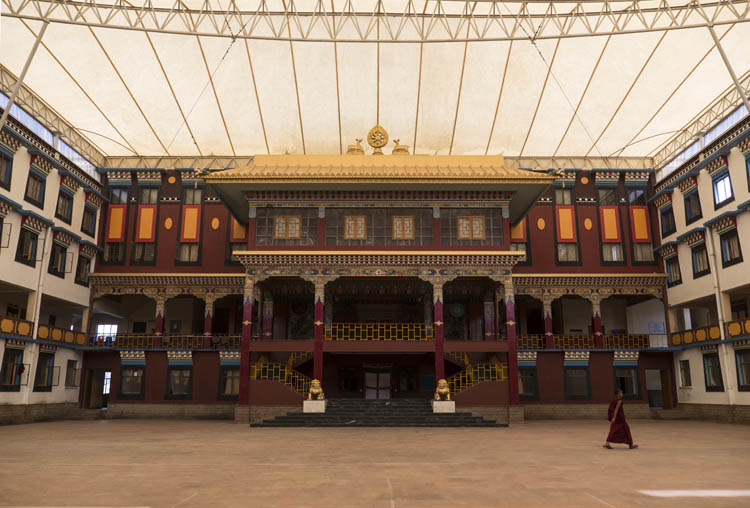
Here’s a view of Sherabling Main Temple and the inner courtyard. Very quiet that day, compared to the first time I saw it completely filled with monks dancing in organized circles.
Sherabling Main Temple complex, with inner courtyard, Himachal Pradesh, India.
Upon entering this well-appointed temple, you behold a 42-foot tall golden Maitreya, the future Buddha, seated on a throne beautifully gilded and elaborately decorated with filigree motifs.
Maitreya, the future Buddha, Sherabling Monastery main altar, Himachal Pradesh, IndiaSherabling Main Temple, looking back towards front entrance and inner courtyard beyond, Himachal Pradesh, India
In fact, this whole main assembly hall is exceptionally ornate with its painted and gilded columns, cornices, thangkas and friezes.
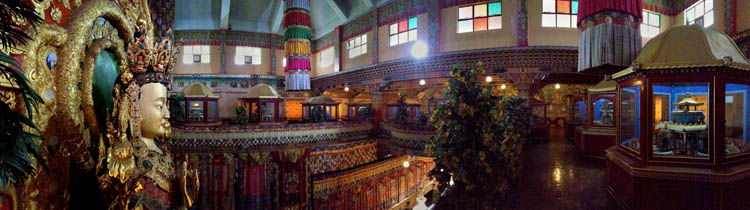
What is not visible when you stand on the ground floor is the spacious and tall mezzanine level above that houses the exquisite Mandala Shrine Hall. Here are some views of it.
View of Maitreya statue from mezzanine level of Sherabling Monastery Main Temple, Himachal Pradesh, IndiaPanoramic view of Maitreya statue from mezzanine level of Sherabling Monastery Main Temple. Visible on either side are 3-dimensional mandalas, part of the 14 tantras of Marpa, Himachal Pradesh, India
And here’s a full view of this magnificent, monumental statue of Maitreya.
Maitreya, the future Buddha, a 42-foot statue in Sherabling Monastery Main Temple Himachal Pradesh, India
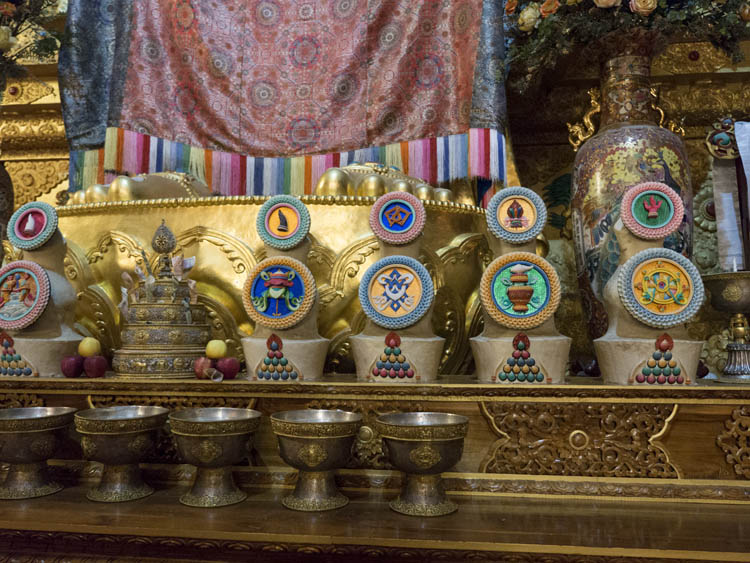
Detail of some of the Eight Auspicious Symbols of Buddhism, and other ritual objects, at the foot of the monumental Maitreya statue. Sherabling Monastery Main Temple
Now about the Mandala Shrine Hall, it displays wooden three-dimensional mandalas of the 14 tantras of Marpa. These are the main practices of the Palpung Sherabling (Kagyu) community.
Profile view of Maitreya statue from mezzanine level of Sherabling Monastery Main Temple
Marpa (1012-1097 CE) was a great teacher and translator. In fact, one of his students became the first Karmapa. This is no small deal since the present Kagyu school’s Karmapa is the 17th incarnation, an older lineage than the Gelug school’s 14 Dalai Lamas. But perhaps, arguably, Marpa’s most famous student was Jetsun Milarepa (ca. 1052—ca. 1135 CE). How Milarepa became enlightened is an inspiring story of redemption.
As a layman, Milarepa had a dark personal history. He learned sorcery and exacted revenge upon an aunt and uncle who mistreated and took all of his family’s wealth upon the death of his father. As a result, Milarepa killed dozens of people through conjuring devastating hailstorms. Later, remorseful for his black deeds, he sought a teacher for help. That teacher turned out to be the fearsome Marpa, whose gaze was said to bely such inner power that people found it difficult to look at or be near him.
The mahasiddha Marpa, always depicted with wide staring eyes, Lamayuru Monastery, Ladakh
Marpa was apparently the right teacher for the destructive Milarepa to atone himself. He put him through arduous tasks, such as instructing him to build buildings, each time promising to teach him if he completed his request. However, Marpa repeatedly anguished and disappointed his hapless student by refusing to teach him sacred Buddhist practices. Despite building and tearing down three whole structures, and suffering much physical pain, Milarepa still did not received a single tantric oral transmission.
The nine story tower that Milarepa single-handedly built, Sekhar Gutok, Lhodrag, Tibet.
Milarepa was then asked to build a multi-story tower by Marpa at Lhodrag, where to this day the 11th century tower still stands. For a detailed telling of Milarepa’s trials and tribulations, see this Kagyu site.
When at last Marpa bestowed the spiritual teachings on Milarepa, his dedicated student then left to practice. After twelve years, he attained the state of Vajradhara (complete enlightenment).
Milarepa became a renowned ascetic and poet, a mahasiddha who lived in a cave in Namdaking, Tibet near the border of present day Nepal. He was said to have survived on nettles, an herb which caused his complexion to turn green. He is often portrayed in paintings with green skin tones for this reason. The other identifying aspect is his hand held to his ear. While it looks like a gesture of listening, I learned from a Tibetan nun that it is a yogic posture for affecting subtle energies of the body.
As for the Mandala Shrine Hall, it is an exceptional collection and display of the 14 tantras of Marpa. While most mandalas, such as the below Mahamaya mandala, follow the conventional form of a three-story palace with four gateways facing the cardinal directions, with the main deity residing at center, and associated deities in the surroundings, encompassed by ritual symbols and elements, only the initiated Kagyu practitioner would truly be familiar with the mandalas and their practices.
Mahamaya mandala, Sherabling Monastery Main Temple, Himachal Pradesh, India
Even for practitioners from other Tibetan schools, the mandalas may seem unusual, such as this one. I believe the below mandala is that of a Dakini.
Detail of one of the fourteen 3-dimensional mandalas of the tantras of Marpa, Karma Kagyu lineage of Tibetan BuddhismPanoramic view of Mandala Shrine Hall, Sherabling Monastery, Himachal Pradesh, India
Miracle at Lotus Lake and the Secret Caves of Rewalsar
Posted
October 21, 2013
Now that I’m back in Dharamsala, with eyes fresh from seeing 10th-12th century Indo-Tibetan mandalas in monasteries of Spiti, Lahaul, and Ladakh, I made local trips through these lower Himalayas to see contemporary Tibetan monasteries.
Rewalsar, also known as Tso Pema (Lotus Lake) to Tibetans, Himachal Pradesh, India. The monumental golden statue of Padmasambhava (Guru Rinpoche) atop Zigar Orgyen Choekorling Monastery can be seen upper right on the hillside Photo: bharatdiscovery.org
First stop was Rewalsar, or Tso Pema (Lotus Lake) as Tibetans call it. It is the site of a legendary miracle by Padmasambhava. Also known as Guru Rinpoche, this Indian sage brought Buddhism to Tibet in the 8th century, and is said to have subdued the people and the local blood-thirsty spirits through demonstrations of his magical powers as an adept practitioner. Padmasambhava is especially revered by the Tibetan Buddhist Nyingma school who regard him as the Second Buddha, the First Buddha being Shakyamuni.
The legend of the lake is that Guru Rinpoche was teaching Princess Mandarava tantra in local secret caves, and she became his consort. Her father the King of Zahor was greatly displeased and attempted to burn them both in the valley below. But Guru Rinpoche turned the pyre into water, and the fire became a lake. Thus, Lotus Lake miraculously came into being and is revered by Tibetan Buddhists.
View of Tso Pema/Lotus Lake near the famed Guru Rinpoche secret caves up the hills, Rewalsar
Incidentally, it is also revered by Hindus, who regard the area as Hanuman’s land. Punjabis, as well, because Padmasambhava is one of their ten holy teachers.
After driving up to the hills above Tso Pema, one must go on foot up to the caves. Most of the way is fairly well paved and with stairs.
Pathway up to secret caves of Guru Rinpoche, Rewalsar
It is a pleasant scramble through some rocky but grassy areas, hung with plenty of Tibetan prayer flags.
Tibetan prayer flags on the continued pathway up to Rewalsar caves
At the top, there is a nunnery with small temples, a cafe for visitors, and dotting the hillside are numerous modest stone huts and cave entrances currently in use by nuns and other retreatants.
Retreat huts and caves used today by nuns and retreatants, Rewalsar, IndiaEntrances to meditation caves currently in use, Rewalsar. I like how this is one is called “Cave No. 4,” very practical.Retreat hut, Rewalsar, India
The landscape is punctuated by crags and boulders.
More abundant Tibetan prayer flags on the hillside of Rewalsar caves
When we finally came upon the secret cave of Guru Rinpoche, the entrance was this steep decline down, which today has cement steps, a doorway, and lighting. I tried to imagine it as the dark natural crack it must have been originally, getting darker as you descended into the cave.
Entrance to Guru Rinpoche’s meditation caves, Rewalsar, India
The stairway leads to a small antechamber which then leads to this section of the cave underground.
Guru Rinpoche meditation cave, Rewalsar
I tried to imagine this cave in Guru Rinpoche’s day, without the flooring, ritual objects and electricity. It must have been a mysterious womb-like place to practice meditation, to contemplate existence in pitch blackness, to truly face nothingness in the subterranean absence of stimuli.
Panorama of Guru Rinpoche meditation cave, RewalsarAltar inside Guru Rinpoche meditation cave, Rewalsar
In another cave is this large statue of Guru Rinpoche, built into a nook where above his head is a natural opening revealing daylight.
Statue of Guru Rinpoche (Padmasambhava), Rewalsar cavesA monk says prayers before a statue of Guru Rinpoche (Padmasambhava), Rewalsar caves
Just beyond this section is a smaller connected cave dedicated to his consort, Princess Mandarava.
Statue of Princess Mandarava in cave dedicated to Guru Rinpoche’s consort, Rewalsar caveCave of Princess Mandarava, looking back out towards larger section containing statue of Guru Rinpoche, Rewalsar cave
It is said that pilgrimage to sacred sites where realized masters practiced meditation, such as these caves, imparts blessings to its visitors.
Rewalsar is also considered an auspicious place to be on retreat. The two Chodpractitioners (chodpas) I met in Dharmasala (whom I wrote a bit about here) are currently on a few months’ retreat here.
They invited me to visit with them in their cabin near the caves. So I had planned to be in town when they were on a brief break from their hermitage. I learned that there are two short times of the month, according to the Tibetan lunar calendar, that retreatants may come out of isolation to tend to things outside.
These chodpas are lay tantric practitioners not only working towards enlightenment through Chod rituals (serious esoteric stuff, as one Zen practitioner friend of mine commented, “These guys are hardcore!”) but they are also shamanic healers. As traveling mendicants, they may be invited by community members to conduct prayers for the deceased, the living, and those believed to be wandering spirits.
Panorama of Rewalsar area from chodpa retreat cabin, with Tso Pema (Lotus Lake) visible in distanceInterior of chodpa’s retreat hut, RewalsarChod ritual objects made out of flour and water
Pictured above is the one-room cabin of a chodpa. On the long table against the back wall are ritual offerings made from colored flour and water.
During my visit, it so happened that the chodpas recently conducted healing prayers for a child I was acquainted with who suffered from a neurological brain disorder. They showed me some of the ritual objects created and used for this purpose.
I heard separately later that this child, who was located hours away from Rewalsar, demonstrated some unusual and extended calm behavior the day after the Chod treatment. Coincidence? Maybe. Go figure. Nothing in modern science can currently explain such phenomena as Chod healing.
Chod ritual objects made out of flour and water
Over a thousand years later, with the thriving nunnery, occupied caves, retreat huts and monasteries of Rewalsar, it certainly seems to me that Guru Rinpoche’s legacy is alive and well here.
My next post is about Rewalsar’s Zigar Monastery in which I first encounter contemporary sacred arts a lot like their Indo-Tibetan predecessors of 11th century Spiti and Ladakh. What’s more, I then met the master artist responsible and learned some insightful things about his art process! Stay tuned…
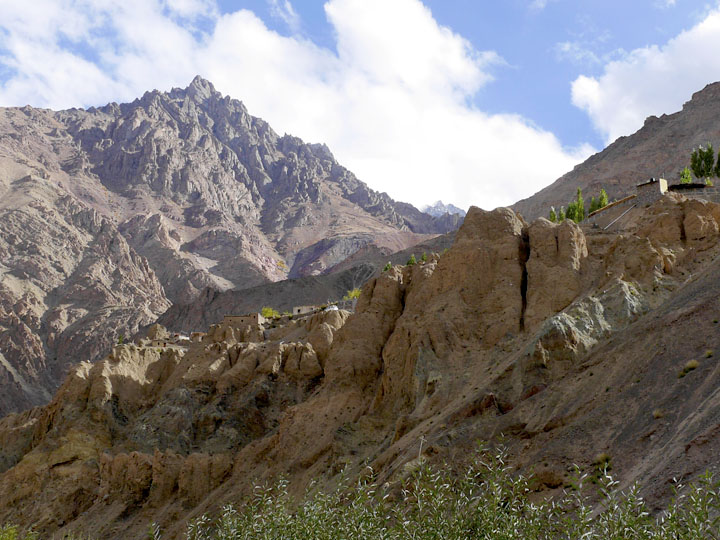
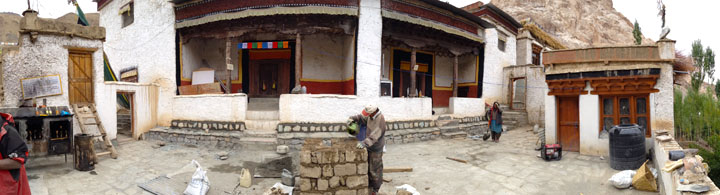
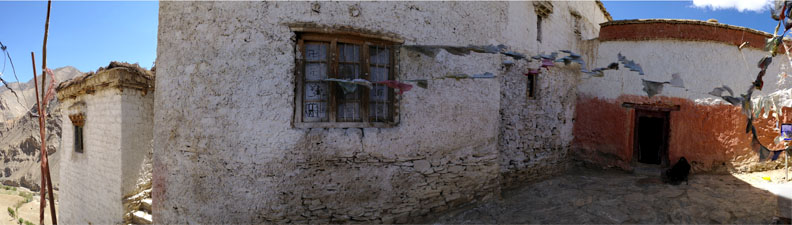
View of Mangyu Village, Ladakh, India. To get there, one drives through narrow valley gorges. The village remains hidden until you drive practically right up to it.
Like Lamayuru Monastery’s Indo-Tibetan Senge Lhakhang, Mangyu Monastery’s Vairocana temple is also a small intimate place. Classic, pre-13th century, early period architecture, the site is nestled in and integrated with a village as opposed to fortified and atop on a hill from the community.
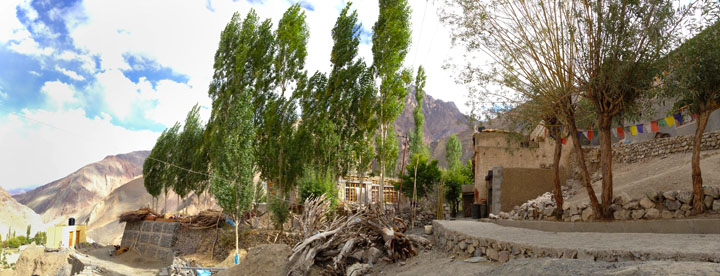
Beginning of Mangyu Village, Ladakh, India
I believe that up till fairly recently, let’s say last twenty years, there was no motorable road up to Mangyu Village, which means it was largely isolated and unknown by travelers. We parked a little below the village and walked up to the monastery, passing by small grocery stores that had countertop service for a simple meal of packaged and flavored maggi noodles (what we call ramen noodles in the U.S.) I was starving and grateful to be served one! When traveling around these more remote parts, one never knows where and what the next meal may be. This village had no restaurants or dhabas, nor did I see guesthouses. This is lovely because it indicates that tourism hasn’t bloomed here. Mangyu is pristine for this reason.
Panorama of Mangyu Monastery with Chenrezig Lhakhang on left, Nambarnangze (Vairocana temple) on right, together flanked by Chamba Lhakhangs of Maitreya and Jambeyang sculptures, Ladakh. Workers are making repairs under the auspices of INTACH, the Indian National Trust for Art and Cultural Heritage.
Tourism is a challenge to local and modest communities here in the Himalayas. While it brings income, it also brings ecological stress. And ecological stress is no small thing to cope with when the land is semi-arid and mountainous, the people mostly poor, the government ill-equipped to provide adequate infrastructure. The need for food and water sources, sewage, sanitation, and modern transportation to serve tourists often ravage the natural beauty here.
Especially if it brings non-biodegradable garbage like plastic. It’s very upsetting to see packaging or other plastic objects thrown over the side of a Himalayan mountain or floating through the streams, stuck in rocks. Indeed, the Himalayan areas I’ve traveled to have dumps located on the mountain side. You can often see them along the road while driving on the highways. It will be a sudden burst of packaging color en masse among the earthy rocks and otherwise scenic beauty. It’s either this or shopkeepers and townsfolk simply burn the garbage. Yes, they burn it, open-air, in front of their shops or homes, frequently plastic and all.
Plastic bottles and those plastic carton drink containers, potato chip and candy wrappers are the most noticeable litter in the streets. I sadly think, these things will never degrade into anything that can be absorbed properly here. Nor anywhere on Earth for that matter, but since we are here on the topic of the Himalayas, my point is that tourism causes environmental strain and damage. I always ask for boiled water at hotels to cut down on the plastic, and carry a thermos with me. Of course, on some occasions, I can’t avoid it and will guiltily buy water in a plastic bottle.
But my visit to Mangyu Monastery was not one of these occasions, I’m happy to report!
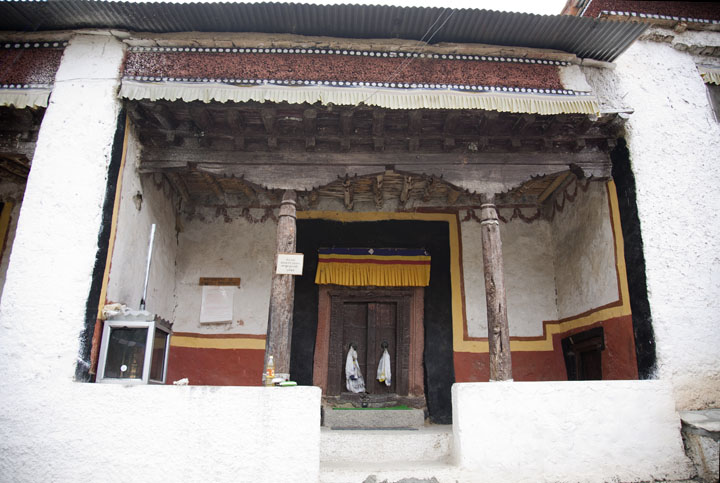
Entrance to Nambarnangze (Vairocana temple), ca. 11th century Indo-Tibetan early monastic architecture, Mangyu Monastery, Ladakh. Photo: Kishore Thukral
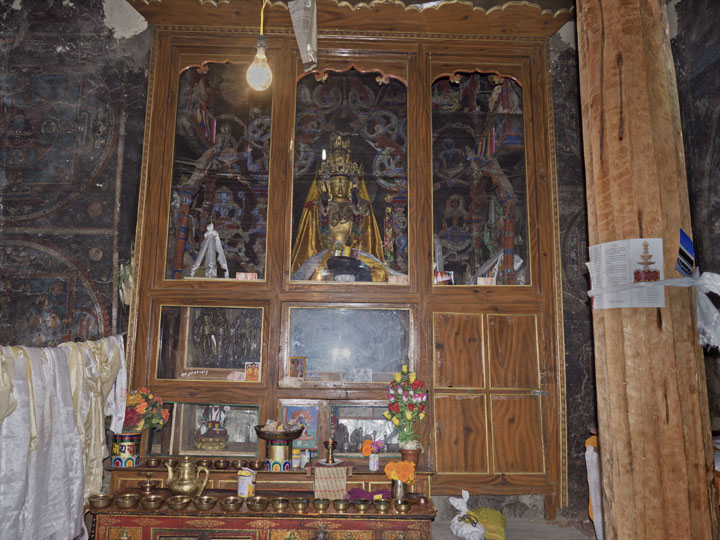
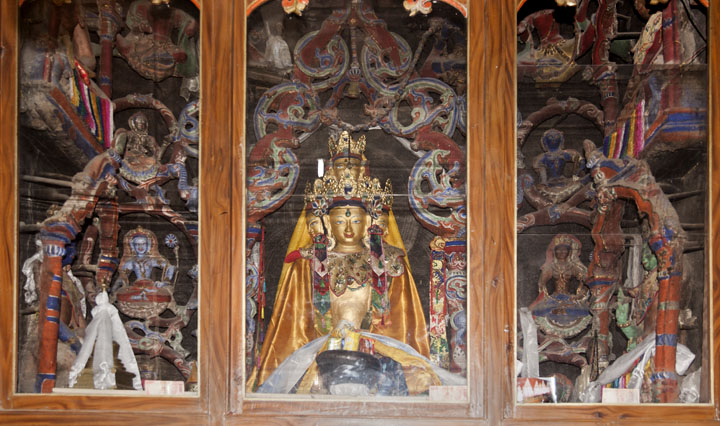
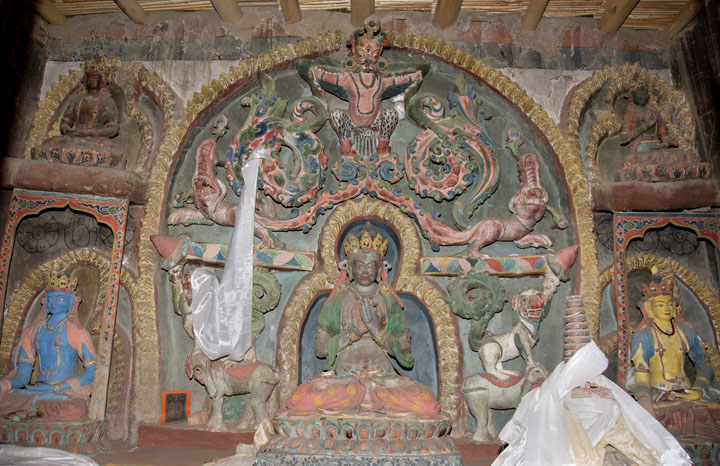
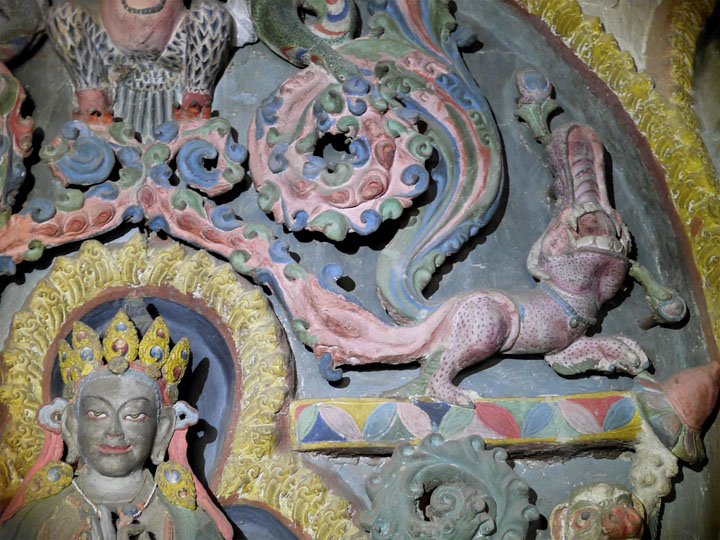
In the 11th century Indo-Tibetan tradition of The Great Translator Rinchen Zangpo, this altar in Nambarnangze once again features Vairocana in the center, surrounded by the Dhyani Buddhas, offering goddesses, animals, and ornate scrollwork, topped by a garuda. See floor plan here.
Experience the interior of this rare, medieval Vairocana temple by seeing a walk-through video here.
View of Nambarnangze interior, with Indo-Tibetan clay sculptures and wall paintings. The altar is now unfortunately encased by glass making it difficult to see the fine craftsmanship of Kashmiri artists, ca. early 11th century, LadakhIndo-Tibetan clay sculptures of Vairocana and Dhyani Buddhas of altar, Nambarnangze, Mangyu Monastery, Ladakh. Now unfortunately encased by glass, making it difficult to see the fine craftsmanship of Kashmiri artists, ca. early 11th century, Photo: Kishore Thukral
For further info on Vajradhatu Mandala structure upon which early monasteries of this period were based, see this post on Lamayuru Monastery’s Senge Lhakhang and this one on the celebrated Tabo Monastery’s Tsug Lhakhang.
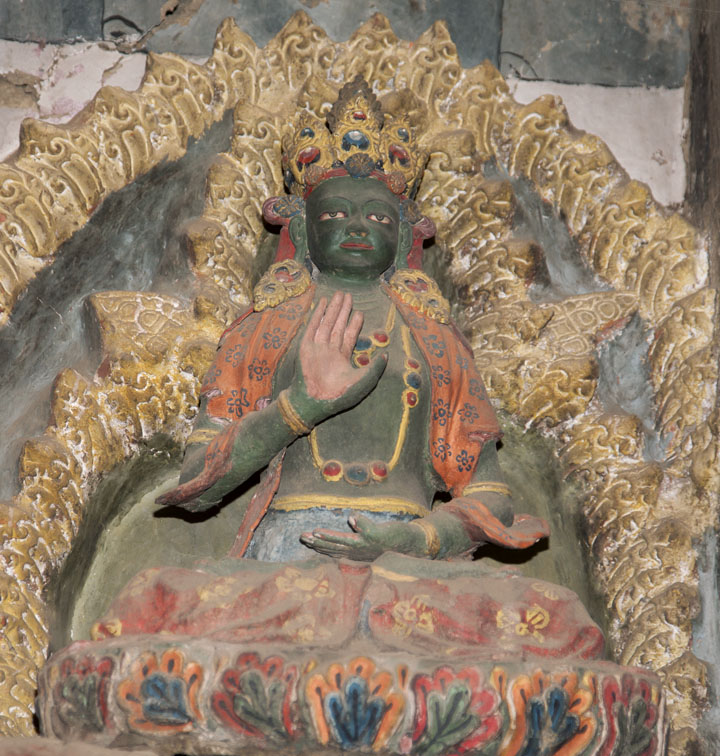
Detail of Vairocana Buddha sculpture, ca. 11th century, altar of Nambarnangze, Mangyu Monastery, LadakhDetail of ornate scrollwork, animals and offering goddesses, rare 11th century Indo-Tibeta clay sculptures, altar of Nambarnangze, Mangyu Monastery, Ladakh, IndiaDetail of Vairocana Buddha, with ornate scrollwork, animals and offering goddesses, rare 11th century Indo-Tibetan clay sculptures, altar of Nambarnangze, Mangyu Monastery, LadakhDetail of Amoghasiddha, a Dhyani (Supreme) Buddha, rare 11th century Indo-Tibetan clay sculpture, altar of Nambarnangze, Mangyu Monastery, Ladakh. Photo: Kishore Thukral
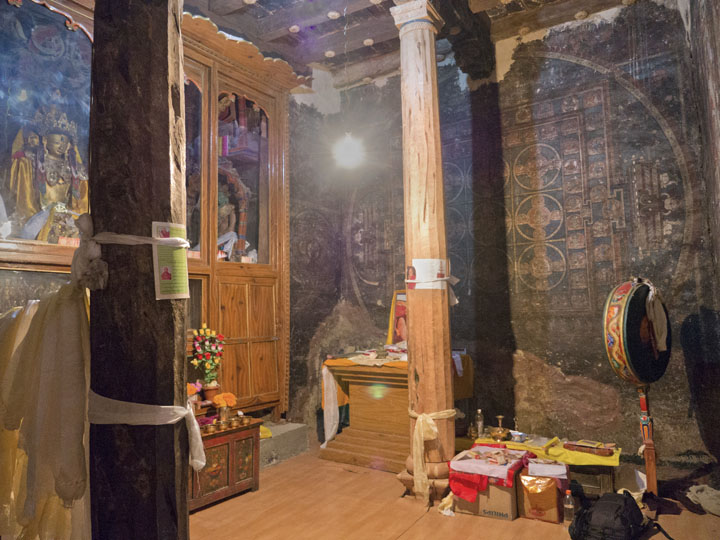
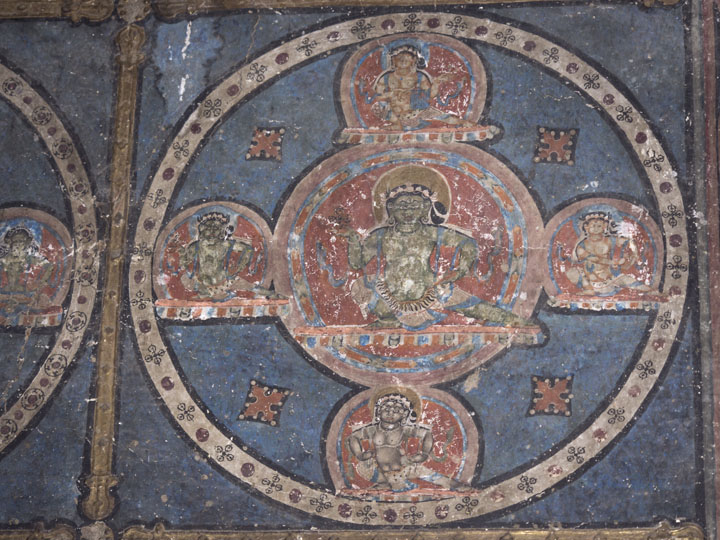
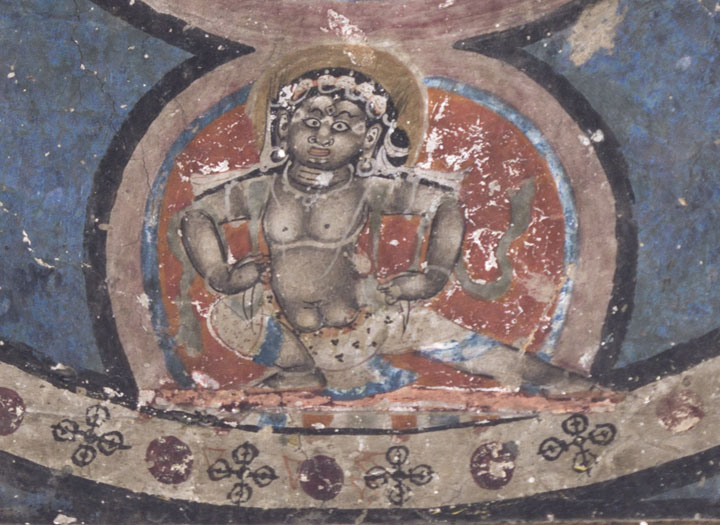
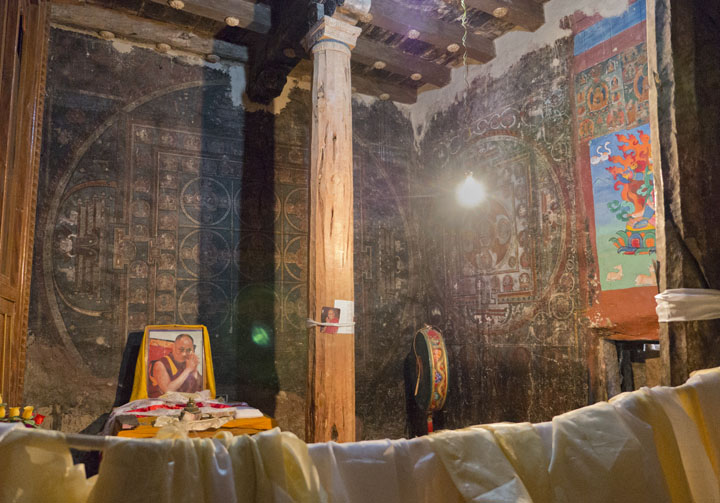
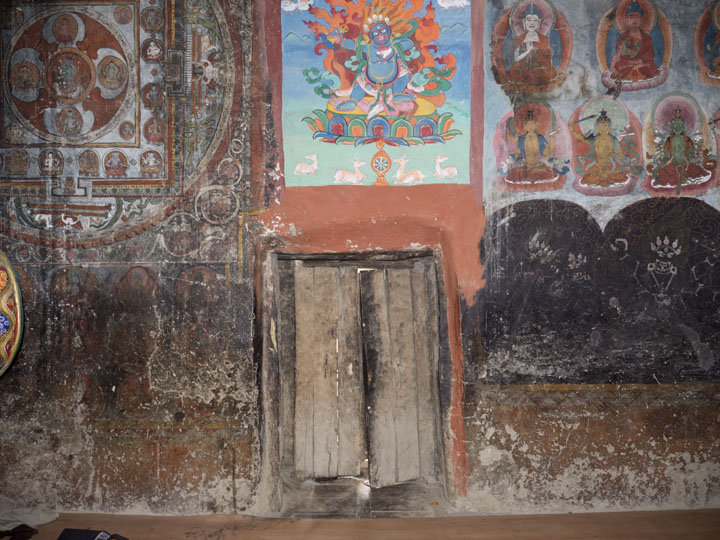
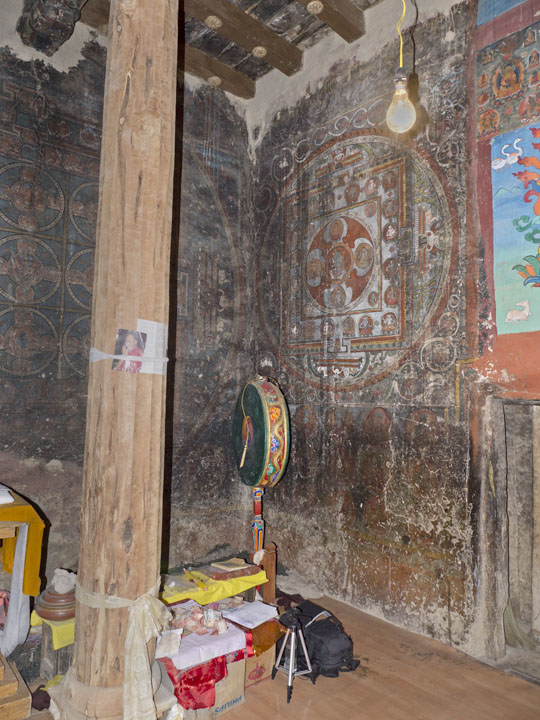
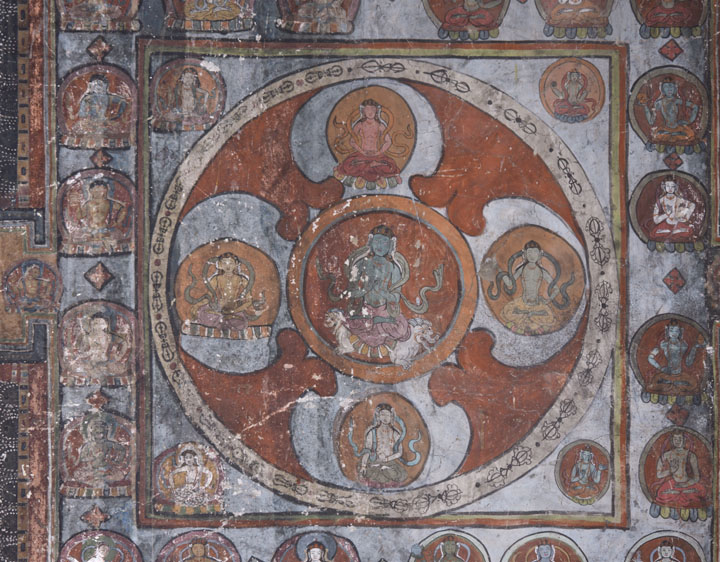
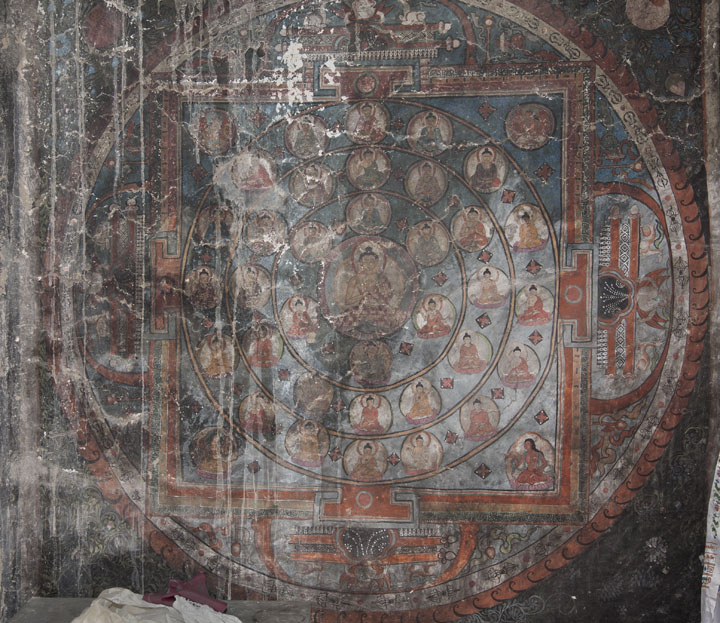
The small Vairocana temple is symmetrically painted on its left and right side walls with one large central Vajradhatu mandala each, flanked by smaller mandalas of related divinities or protectors. On the right side wall, the paintings look like well-conserved oe well-preserved original Indo-Tibetan.
Interior of Nambarnangze, Mangyu Monastery, with ca. 11th century Indo-Tibetan sculptures and wall paintings, Ladakh. Visible on right is Vajradhatu Mandala.Detail from Vajradhatu mandala, Indo-Tibetan ca. 11th century right side wall painting, Nambarnangze (Vairocana temple) of Mangyu Monastery, Ladakh, IndiaDetail from Vajradhatu mandala, Indo-Tibetan ca. 11th century right side wall painting, Nambarnangze (Vairocana temple) of Mangyu Monastery, Ladakh, IndiaInterior view of Nambarnangze, right side wall adjoining entrance wall, Mangyu Monastery, with ca. 11th century Indo-Tibetan wall paintings, Ladakh
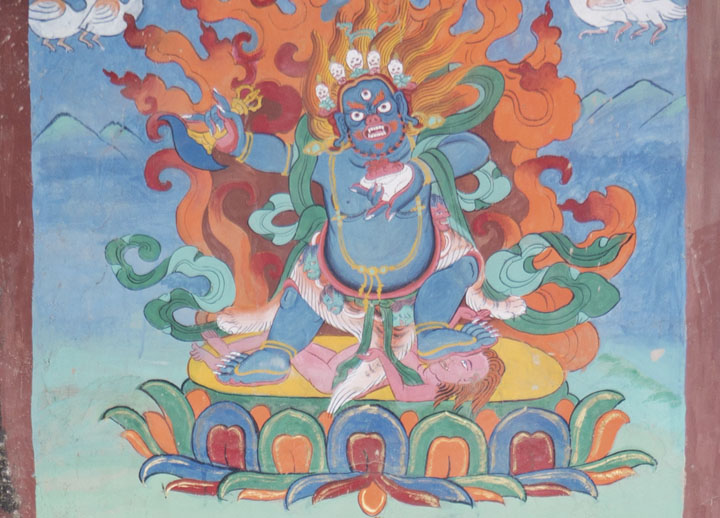
On this entrance wall, however, most everything has been repainted. Peter van Ham in his book Heavenly Himalayas: The Murals of Mangyu and other Discoveries in Ladakh, published recently in 2010, gives a very different description of the state of the protector deity painting above the door.
The entrance wall of Nambarnangze, Mangyu Monastery, Ladakh. Wall paintings here are mostly repainted over ca.11th century originals.
He writes, “The entrance…is protected by a wrathful blue deity, painted above the door. Only the right half of the painting has been preserved, the rest has been washed away by water leakage through the roof…As two peculiarities the protector is adorned with beautiful shawls displaying typical Ladakhi tie-dye patterns and in his right hand he holds a knife with an interesting blade of Indo-Iranian shape, the tip of which is equipped with a vajra-like structure.”
Repainted Mahakala above entrance door of Vairocana Temple, Mangyu Monastery, Ladakh.
The discrepancy between van Ham’s description and the above photo shows that this Mahakala was certainly repainted in the last few years. As we can see, absent are the shawls with Ladakhi patterns. This evidence, along with mismatched colors and less refined execution, leaves me shocked and deeply saddened over the handling of Mangyu Monastery preservation.
While the colors in this repainted mandala on the left of this entrance wall are more in keeping with extant original murals, the execution looks nothing at all like the sophisticated, skillful, and expressive handling of Indo-Tibetan artists.
Interior view of Nambarnangze, Mangyu Monastery, with Indo-Tibetan wall paintings, LadakhDetail of repainted mandala on left side of entrance wall, Nambarnangze, Mangyu Monastery, LadakhDetail of repainted mandala on left side of entrance wall, Mangyu Monastery, Ladakh. Stylistically different, this was probably repainted in recent years.Detail of repainted mandala, Nambarnangze, Mangyu Monastery, Ladakh. Stylistically different and lacking in refinement, this is strong evidence of repainting over original Indo-Tibetan art.
The same is true for the left side wall. What van Ham describes of the 11.5 foot diameter mandala that dominates this wall does not match what currently exists. This must also be a recently repainted mandala.
View of Vajradhatu mandala on left side wall, adjacent to a variety of wall paintings that post-date the Indo-Tibetan period, another example of repainting that threatens the survival and art-historical importance of the originalsView of Vajradhatu mandala, also repainted, Nambarnangze, Mangyu Monastery, Ladakh. Photo: Kishore Thukral
When this is what an example of original quality and style looks like (click on second image on the bottom) the quality and style of this repainted example pales in comparison.
Detail of repainted Vajradhatu mandala, Nambarnangze, Mangyu Monastery, Ladakh. Once again, stylistic and quality differences indicate repainting over Indo-Tibetan originals.
This small Buddha mandala is on the left of the altar wall. It contains some original and repainted areas.
Buddha mandala, Nambarnangze, Mangyu Monastery, Ladakh. Stylistic and quality differences indicate repainting over Indo-Tibetan originals. Photo: Kishore Thukral
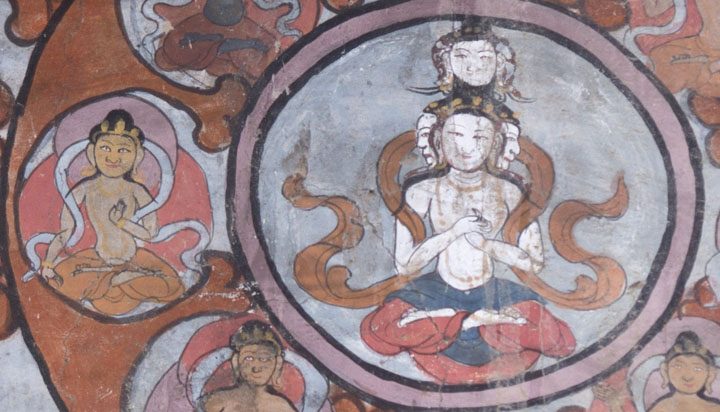
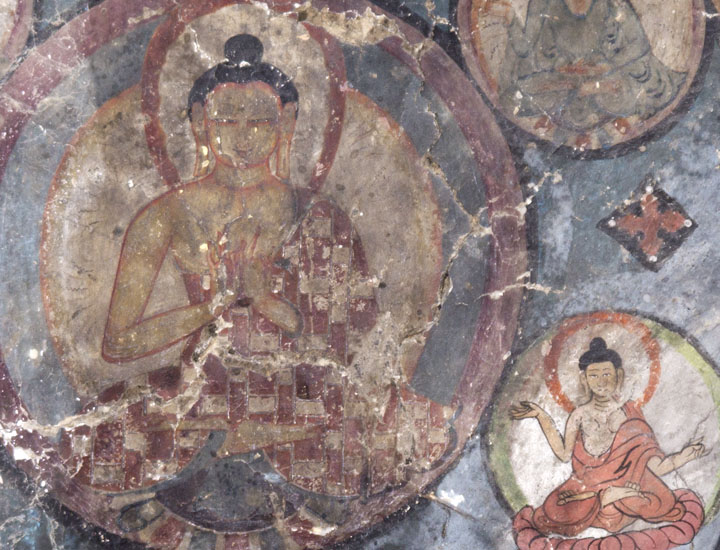
Here is a side-by-side view of what appears to be an original Indo-Tibetan Buddha in center next to a contemporary repainted one.
Detail of Buddha mandala, Nambarnangze, Mangyu Monastery, Ladakh. The central Buddha looks original, but at lower left, stylistic and quality differences indicate repainting over Indo-Tibetan originals.
The historian David Snellgrove wrote in Indo-Tibetan Buddhism: Indian Buddhists and their Tibetan Successors, “The absence of all Buddhist wall-painting in India apart from the Ajanta Caves represents an enormous loss for the history of Indian art. Some deductions can be made from fragmentary remains in Central Asia and especially from the earliest surviving Tibetan murals from about A.D. 1000 onward, and from miniature paintings on Pala manuscripts of about that date.”
While Mangyu may still be pristine from a tourist/environmental point of view, it is less so from an art-historical one. Like I fear for Tabo, Alchi, and other remaining monasteries that have Indo-Tibetan significance, these beautiful, rare wall paintings are disappearing not only through age and exposure to natural elements, but also through the unexpected hands of man. The resultant replacement paintings, lacking in comparable quality, style, etc., are functionally erasing historical records. The originals are thus disappearing over time due to lack of proper conservation and restoration.
View of Lamayuru Monastery on plateau at top, with Lamayuru Village below, Ladakh, India
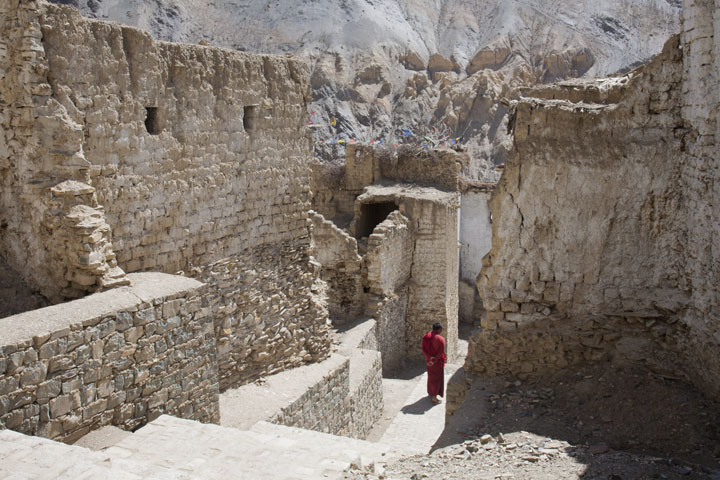
Seeing Lamayuru Monastery today was a rich experience. The hilltop monastery complex is a delightful warren of small passageways that give way to open views. It includes the functional old, the relatively new, and then the crumbling ruins. Walking through it really imparts the feeling of a medieval village in its different stages of development and abandon.
Senge Lhakhang, ca. 11th century, the oldest temple at Yamayuru Monastery. Contains well-preserved and rare Indo-Tibetan clay sculptures of Vairocana, Dhyani (Supreme) Buddhas, and Vajradhatu mandalas, including Gonkhang with protector deities, Ladakh, India
It’s an intimate temple. Upon entering, one faces the splendid and well-preserved altar which by now, dear reader following this blog, you will recognize as belonging to the rare Indo-Tibetan 11th century period of sacred art.
As at Lhalung and Tabo Monasteries, the temple features Vairocana and the Dhyani (Supreme) BuddhasAmitabha, Akshobhya, Amoghasiddha, and Ratnasambhava. These are polychromed clay sculptures seated on lotus thrones inside stylized alcoves. Here at Lamayuru, Vairocana is also seated atop lions which is how the temple derives its name. Senge means lion in Tibetan. He is surrounded by animals, scrollwork, and surmounted by a prominent protective Garuda, the powerful Hindu mythical bird.
Experience the interior of Lamayuru Monastery’s Senge Lhakhang by watching this exclusive video walk-through here.
[vimeo 137311083 w=600 h=337]
Main altar, Senge Lhakhang, Lamayuru Monastery, Ladakh. Central figure is Vairocana, flanked by Dhyani Buddhas (clockwise from left) Aksobya (blue), Amitabha (red), Amoghasiddhi (green), and Ratnasambhava (yellow), surmounted at top by Garuda. Photo: Kishore ThukralIndo-Tibetan clay sculpture of Vairocana, Buddha of Wisdom, one of the Five Dhyani Buddhas, main altar Senge Lhakhang, Lamayuru Monastery, LadakhDetail of main altar with central Vairocana surrounded by animals and surmounted by Garuda, main altar Senge Lhakhang, Lamayuru Monastery, LadakhRatnasambhava, one of the Dhyani (Supreme) Buddhas, rare 11th century Indo-Tibetan clay sculpture, main altar Senge Lhakhang, Lamayuru Monastery, LadakhDetail of Vairocana Buddha and animals, rare 11th century Indo-Tibetan clay sculptures, main altar Senge Lhakhang, Lamayuru Monastery, LadakhDetail of Akshobya, one of the Dhyani (Supreme) Buddhas, 11th century Indo-Tibetan clay sculpture, main altar Senge Lhakhang, Lamayuru Monastery, LadakhAkshobya, one of the Dhyani (Supreme) Buddhas, 11th century Indo-Tibetan clay sculpture, main altar Senge Lhakhang, Lamayuru Monastery, LadakhAmoghasiddha, one of the Dhyani (Supreme) Buddhas, rare Indo-Tibetan clay sculpture, main altar Senge Lhakhang, Lamayuru Monastery, Ladakh. Photo: Kishore ThukralAmitabha, one of the Dhyani (Supreme) Buddhas, rare Indo-Tibetan clay sculpture, main altar Senge Lhakhang, Lamayuru Monastery, Ladakh. Photo: Kishore ThukralGaruda, Hindu mythical bird, main altar Senge Lhakhang, Lamayuru Monastery, LadakhThe lions or Senge, main altar Senge Lhakhang, Lamayuru Monastery, Ladakh
In stark contrast to the fine state of the sculptures, the wall murals are in a very deteriorated condition, faded and water-damaged. In fact, facing the altar, the whole right side wall is altogether undecipherable, almost completely devoid of the original imagery. Looks blackened and/or delaminated down to the mud bricks. It’s incredible that after over one thousand years of time, anything can remain at all, really. Time has really ravaged this wall. I wish it were different!
The left hand wall can still be glimpsed. If only some effective and accurate conservation could be done to preserve these historically significant, rare examples of Indo-Tibetan Buddhism and the Second Transmission of Buddhism from India to Tibet!
Vajradhatu Mandala, Indo-Tibetan wall painting, Senge Lhakhang, Lamayuru Monastery, Ladakh
While it’s difficult to see details of the above wall painting, it is certainly a Vajradhatu Mandala and as such, its structure is usually this:
At center is Vairocana with the 4 Dhyani Buddhas (Amitabha, Akshobhya, Ratnasambhava, Amoghasiddha) positioned around him in the cardinal directions, each encircled by 4 bodhisattvas. There are an additional 12 deities–4 guardians, 4 outer offering goddesses, and 4 inner offering goddesses. In all, the basic set of Vajradhatu mandala deities is 33 or 37. Vajrayana mandalas and the deities that reside within them are essentially symbols of the qualities of consciousness to develop on one’s spiritual path. They are mnemonic devices to aid a practitioner towards enlightenment.
Variations in Vajradhatu mandalas are seen in different monasteries with the addition of up to 60 other divinities–such as the 16 arhats or 12 pratyekabuddhas, among others. These are often depicted on the outer sections as additional circles or squares in the same mandala composition, or in altogether separate small mandalas.
It is important to note that such symbolic plenitude expresses manifestations of the same fundamental principles. Buddhism did inherit the Hindu understanding of many-paths-to-the-same-truth. These additional divinities also have their basis in written scripture or canonical commentaries.
Avalokiteshvara (Chenrezig), bodhisattva of compassion, Indo-Tibetan wall painting, Senge Lhakhang, Lamayuru Monastery, Ladakh
Adjoining the main temple room is a gonkhang, chapel dedicated to protector deities.
Protector deities, including Mahakala and Lhamo Palmo, Gonkhang, Senge Lhakhang, Lamayuru Monastery, Ladakh. Photo: Kishore ThukralView of Senge Lhakhang, with Indo-Tibetan sculptures and wall paintings, Lamayuru Monastery, LadakhConversing with Kagyu monk at entrance of Senge Lhakhang, Lamayuru Monastery, Ladakh. Photo: Kishore Thukral
Lamayuru grounds in this older section near the Senge Lhakhang is characterized by these passageways that are alternately nestled and enclosed, then open and expansive.
Walking through older parts of Lamayuru Monastery, Ladakh. Photo: Kishore ThukralWalking through older parts of Lamayuru Monastery, Ladakh. Photo: Kishore ThukralWalking through older parts of Lamayuru Monastery, Ladakh. Photo: Kishore ThukralWalking through ruins of of Lamayuru Monastery, Ladakh. Photo: Kishore Thukral
Among the stone ruins, amidst the Himalayan landscape, I tried to imagine the charming bygone era of great vitality during the reign of Western Tibet’s Guge kings Yeshe O’d and Changjup O’d whose vision reformed and ignited the spread of Vajrayana Buddhism from India to Tibet in the 10th to 12th centuries. How it must have been in this remote Himalayan landscape a thousand years ago, when these walls and buildings were new, its monastic and lay inhabitants filled with rejuvenated fervor and scholarship!
Walking through older parts of Lamayuru Monastery, Ladakh. Photo: Kishore ThukralView of Himalayan Village and valley from Lamayuru Monastery, Ladakh
I’ve been furiously writing here to get up-to-date, and even though I’m still working on September things seen and heard, I must now share that it’s Yamantaka time! I am currently documenting this highest yoga tantra performed annually at Namgyal Monastery here in Dharamsala.
Highest yoga tantra ritual, Yamantaka, begins pre-dawn at Namgyal Monastery, DharamsalaThe moon shines over Dharamsala Valley as Namgyal monks begin pre-dawn prayers for Yamantaka ritual. This highest yoga tantra occurs annually over the course of about ten days at Namgyal Monastery.
Yamantaka began four days ago before dawn’s light with earth ritual prayers to prepare the ground for this sacred art.
Offerings are made in the thekpu during earth ritual prayers to prepare the ground for the creating a sand mandala
Then came three days of intensive work for the monks to rasp colored sand through metal funnels to create intricate designs symbolizing the main deity and his retinue of associated deities within the palace. For more info on mandalas and tantric, see this earlier post.
Day one involves marking out the eight directions in white, and then monks draw the basic structure of the mandala in black ink before beginning with colored sand.The sand mandala begins with symbolic depiction of Yamantaka deity who resides in the center. A mandala is a two-dimensional representation of a thee-dimensional palace, used as an aide in tantric meditation practice.Day one of creating Yamantaka sand mandala continues, Namgyal Monastery, DharamsalaThe mandala after the first day’s completionDay two of creating sand mandala. This monk is scribing a floral design with a pencil into the background sand, after which he will create it on top in other different gradated colors.Day two of making Yamantaka sand mandala, Namgyal Monastery, Dharamsala. The four gateways to the palace can now clearly be seen outlined in black, flanked by black-and-white cornice design.Day two of making Yamantaka sand mandala. The gateways are further elaborated as the green background color is begun for the next section. The monks began early morning and will work well into the night to ensure progress and completion of the mandala within three days.Day three of making Yamantaka sand mandala, with completed gateways, banner designs, vases, and other symbols that are mnemonic devices for tantric meditation, Namgyal Monastery, DharamsalaWorking on the outer borders, day three of making Yamantaka sand mandala, Namgyal Monastery, DharamsalaThe sand is gradated on this outer border, day three of making Yamantaka sand mandala, Namgyal Monastery, DharamsalaWorking on the final outer border which represents the charnel grounds, day three of making Yamantaka sand mandala, Namgyal Monastery, Dharamsala
The sand mandala was just finished yesterday.
The completed Yamantaka sand mandala, Namgyal Monastery, Dharamsala
With the completion of the mandala, today was the generation stage of the ritual. The monks chanted while visualizing themselves arise as Yamantaka. Tomorrow begins three days of consecration, followed by fire puja, then dissolution of the mandala.
I love this bittersweet last part where the beautiful mandala is swept away. As George Harrison sang, all things must pass. It’s a lesson in the truth of impermanence and the wisdom of letting go. Some of the sand is given to visitors who come witness the event. Most of it is swept into a ritual vase that is then taken to a nearby body of water and poured into it. I think of it as sending good wishes and energy out into the world.
I look forward to seeing it again. It was a wonderful experience here three years ago. It will be a welcome deja vu.
Yesterday, J and I came to Kardang Monastery to meet resident yogi and monastery head Lama Paljor-la. After learning about my project, he generously shared stories with us about the murals, objects, and photos in the main temple. J knows quite a lot about the Drukpa Lineage so they both had much to discuss.
Kardang Monastery as seen from across the Bhaga River, Lahaul
Kardang today is perhaps the best known monastery in Keylong owing to its association with the Shakya Shri Drukpa Lineage. Lineage is of terrific importance in Tibetan Buddhism because tantra is a living spiritual tradition transmitted orally in teachings from master to disciple. In this way, there is a connection from generation to generation which can be traced back to the Buddha himself.
Drubwang Shakya Shri (1983-1919) was an exceptional yogi who started out as a cook in a Drukpa monastery in Tibet. His lineage is unique because, through deep, whole-hearted practice, it is said he received his enlightenment directly from Vajradhara, the primordial Buddha. He was widely recognized as an incredible adept by other masters, including His Holiness the 14thDalai Lama. With pure connections going back only a few generations, Shakya Shri lineage is known for its effective master-to-disciple teachings which guide practitioners swiftly along the Buddhist spiritual path. Shakya Shri mastered Mahamudra in the Drukpa Kagyu tradition, and also Dzogchen through the Nyingma lineage. He was later known for being involved with the Ri-me (non-sectarian) movement.
It was Shakya Shri’s disciple Jetsun Norbu Rinpoche, who returned to Lahaul from Tibet after his master had passed away. As holder of his teachings, and in particular of the Six Yogas of Naropa and Mahamudra, he soon attracted 2000 followers from all over the Western Himalayas. Though his hermitage was thriving, he preferred to live in a cave above Kardang Monastery. In time, Kardang became known as a yogic training center.
Cave dwelling above Kardang Monastery, possibly like one that Norbu Rinpoche lived in
As I mentioned in an earlier post, you may have heard of Tibetan Buddhist practitioners who can do unusual physical things. It was some of Shakya Shri’s lineage yogis whom Harvard scientists studied in the 1980s doing tummo practice, in which they can raise the temperature of parts of their body by as much as 17 degrees! One study involved the yogis scantily clothed spending a Himalayan winter’s night outdoors on a rocky ledge at 15000 feet altitude where temperatures reached freezing. The yogis demonstrated they could remain warm and slept through the night without incident. I think most of us would have suffered hypothermia! It occurs to me that Lama Paljor-la could have been one of these yogis.
Kardang Monastery is believed to have been founded about 800 years ago, but nothing seems to remain of its original temple. The current main temple was first built by Norbu Rinpoche in the 1930s, but was rebuilt several years ago by Lama Paljor-la, a disciple of lineage holder and former monastery head Apho Rinpoche. I have had the pleasure of meeting three of Apho Rinpoche’s children in Manali en route to Spiti and coming back from Lahaul: lineage holder Sey Rinpoche, his brother Jampal who is also a recognized reincarnate but prefers to live a quiet life with his family, and Khandro Thrinlay whom I wrote about previously here.
Kardong Monastery, Lahaul
Kardang Monastery is situated directly opposite Keylong on the other side of Bhaga River. See this 360 degree video view below.
[vimeo 145002351 w=600 h=331]
When one enters the main temple, one sees a mixture of old and new murals on the walls. The older ones, possibly no older than the 1930s, were painted originally on canvas so they were removed and reinstalled. They collage the walls alongside newly painted scenes.
Interior of main temple at Kardang Monastery, Lahaul, with lama performing Mahakala prayers
At the altar are Buddha Shakyamuni statue on the middle, Vajradhara on the left and Padmasambhava on the right (also known as Guru Rinpoche, who introduced Buddhism to Tibet in the 8th century).
Vajrdhara on left, Buddha Shakyamuni in center, Padmasambhava on right, altar at Kardang Monastery, LahaulInterior view of Kardang Monastery where older and newer paintings collage the walls, LahaulOlder and newer paintings collage the walls of Kardang Monastery, LahaulInterior view of main temple, Kardang Monastery, LahaulDetail of an older painting depicting a scene from the Life of Buddha, Kardang Monastery, LahaulDetail of an older painting depicting Chenrezig, Kardang Monastery, LahaulDetail of an older painting depicting Padmasambhava with consort, surrounded by protector deities Kardang Monastery, Lahaul
The monastery has a large library which includes the complete Kangyur, given to Norbu Rinpoche by the king of Bhutan, and the complete collection of the Wisdom Words of His Holiness the 4th Gyalwang Drukpa, the spiritual leader of the Drukpa Lineage.
Kardang Monastery has an extensive library of Kangyur scripture and other complete texts. Also seen here are sculptures and relics of lineage mastersGegen Rinpoche on left, His Holiness the 12th (current) Gyalwang Drukpa on right, on altar of Kardang Monastery, LahaulA newly painted guru-yoga mandala on the ceiling, Kardang Monastery, Lahaul
Above the main temple is a room that had belonged to Apho Rinpoche. On the walls are paintings depicting Milarepa’s story that were originally painted on canvas and reinstalled in this new temple.
Apho Rinpoche’s former room above main temple, Kardang MonasteryScenes from Life of Milarepa, older wall paintings from Apho Rinpoche’s former room above main temple Kardang Monastery. Above right are newer paintings.Detail from Life of Milarepa, wall paintings, Kardang Monastery
I’m spending the night here tonight in one of the monastery guest rooms. There’s an Ani-la (nun) who has kindly cooked for me, but mostly Kandang’s community of eight monks and seven nuns are lone retreatants living in simple huts and cooking for themselves.
Detail from Life of Milarepa wall paintings, Kardang Monastery, Lahaul
J left this morning, and took the bus back to Manali. It was wonderful traveling with her, and I’ll miss her company to share travel discoveries with. Yes, so I’ll be here for several days on my own devices, until my next travel companion K arrives and we drive together to Ladakh. On my list of things to do here are to see Shashur and Tayul Monasteries.
View of Keylong from the courtyard of Kardang Monastery on the other side of the Bhaga River, Lahaul
Tomorrow I plan to walk back to Keylong via trail and footbridge across Bhaga River. I hope the paths are clearly visible and I don’t get lost! There’s no taxi to be had here unless I call for one from Keylong. And as Khandro-la’s assistant had told me, Lahaul does not have so much in the way of Indo-Tibetan mandalas, but is rather itself considered a Chakrasamvara mandala manifest, one should experience it on foot. Even though we are at over 11,000 feet altitude, it seems not too hard to go downhill and not terribly far to walk perhaps 5-8 kilometers, so I think I should follow this advice and experience Garsha. After all, I am over the worst of altitude adjustments. I had vice-grip headaches at night which made it hard to sleep, but the head pain progressively improved, and by the end of the first week, went away. So while I’m a bit short of breath sometimes exerting uphill, it’s not a hardship.
This story has proven staying power on my mind. I was going to write about Kardang Monastery, the first site I visited in Lahaul, but I have been thinking about this other content, so must share it here, now.
What if you were in a situation where you had to choose between your freedom from prison, or bringing a great spiritual teacher to your country to enlighten its citizens? Yeshe O’d, the 11th century Buddhist King of Guge in Western Tibet was faced with this choice.
During his lifetime (967-1040 C.E.), he had inherited a kingdom in a confused and degenerate era of Buddhism, a condition that followed its religious repression by previous King Langdarma (863-906 C.E.) To counter dissolute Buddhist practices and ideas, Yeshe O’d aimed to restore pure teachings in a variety of educational and development initiatives.
He sent young scholars to India to study Sanskrit, the original language of Buddhist scriptures. He imported and had faithfully translated Sanskrit sutras, tantras, and commentaries into Tibetan. He built monasteries all over his vast kingdom, and brought a team of inspired artists from Kashmir, where Buddhism had long flourished, to help illustrate the fundamentals of tantric practice. If you have been following this blog, you know then that this involved depictions of the deity Vairocana, the Dhyanibuddhas (Five Buddha families) and their associated cycle of deities in a Vajradhatu mandala order of art and architecture. It resulted in a distinctive period of Indo-Tibetan sacred art which can still be seen today in late 10th and 11th century sites such as Tabo and Lhalung monasteries in Spiti; Alchi, Lamayuru, Mangyu, and Sumda Chun monasteries in Ladakh. Finally, Yeshe O’d also searched for and invited a great Indian master to teach in Tibet.
Of the twenty-one individuals he sent to India to study Sanskrit, only two survived to return from the arduous journey to inform him of the great master Atisha.
One of these students later became The Great Translator Rinchen Zangpo who, through his scholarly excellence and dharma dedication together with the king’s support, helped effect what is known as the Second Great Transmission of Buddhism from India to Tibet. It spanned the late 10th to 12th centuries C.E.
Upon learning of Atisha, Yeshe O’d proceeded to commission a second party armed with gold offerings to request the master to come to Tibet. Of the nine people sent, only one survived, but he was unable to persuade the scholar to leave the learned monastic university center of Vikramashila where he was teaching Indian disciples.
Undeterred, and collecting more gold to offer, the king decided to go personally in a third expedition to meet Atisha. However, along the way he was captured by a rival King of Garlog near Nepal who imprisoned him for ransom. With the intention of deterring the spread of Buddhism, this king demanded Yeshe O’d’s weight in gold for his release, or that he give up his mission to go to India.
By now, many years had passed since the first initiative of sending students to India to study Sanskrit, and Yeshe O’d was an older man. When his nephew Changchub O’d arrived with a large sum of gold collected from throughout Western Tibet, it was not the full Guge king’s body weight. It is said that the gold remaining still required was equal to his head. So the Garlog ruler refused to release his hostage.
Changchub O’d then met with his uncle, who was chained in his dark prison cell, vowing to redouble his efforts to get more gold for his release. Yeshe O’d, however, then instructed him to offer the gold thus far collected instead to Atisha. He said, “I have died countless times in previous lives, but I am sure I have never before sacrificed myself for the Buddha’s Dharma. Now I am very happy to do so. Whomever you send to India, please have him tell Atisha that I have given my life for the welfare of my subjects and the Dharma so that he could be brought to Tibet. Although I have not had the fortune to meet him this lifetime, I have fervent hopes that I can in the future.” In great grief, Changjub O’d agreed to follow his wishes.
And so, Yeshe O’d died in prison for the sake of benefiting others. This story sticks with me for its selflessness and model example of bodhicitta, great generosity. Buddhist history has proven its profundity.
Atisha, upon hearing the circumstances, felt moved by enormous compassion, and he then finally did come to Tibet at the age of 53, sometime in the first half of the 11th century C.E. Along the way, he wrote his masterpiece Lamp for the Path to Enlightenment, a short text in 67 verses which lays out the entire Buddhist path in terms of the three vehicles: Hinayana, Mahayana, and Vajrayana, and became the model for later texts in Stages of the Path.
He remained in Tibet for the rest of his life where he successfully taught and propagated pure teachings that amounted to an illustrious reform within the Second Great Transmission of Buddhism to Tibet. And much to his gratitude, Atisha even showed the very learned Lotsawa Rinchen Zangpo, who was by now aged in his 80s, how to properly practice tantra. Atisha is further credited for laying the groundwork for Je Tsongkhapa’s 14th century seminal teachings.
This is not an official U.S. Department of State website. The views and information presented here are solely those of the artist, and do not represent the Fulbright Program, the Department of State, or any other entity.