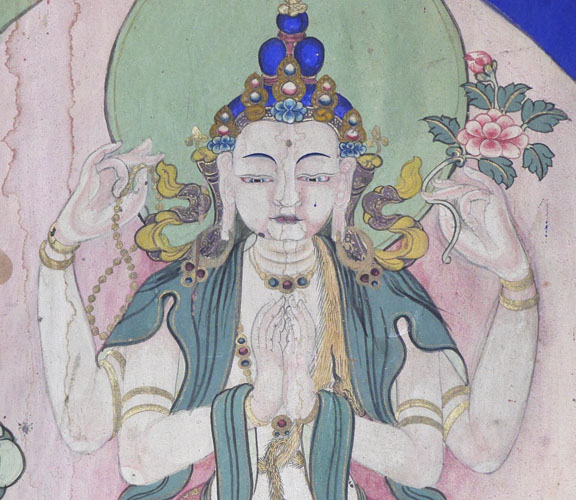
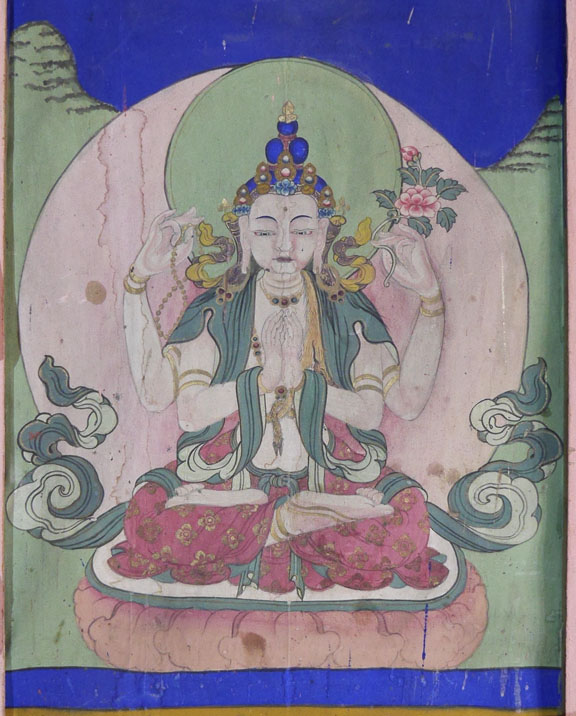
Vajradhara

Collective Gasps at Lamayuru’s Temples

September 22nd     Lamayuru Monastery – Part Two

Lamayuru Monastery, Ladakh
View of Himalayan valley from stairs to main temple just before entering courtyard, Lamayuru Monastery, Ladakh

To continue where I left off in my last post, I found Lamayuru Monastery really charming. Not only did the architectural spaces seem personal and intimate, but the experience of them was diverse and unexpected. One temple to the next seemed different in character and time.

The Dukhang, or main temple, is hidden behind a stairway façade, the doors of which open to reveal a fully enclosed courtyard, open only to the sky above. From here there is access to temples located on higher levels.

Courtyard of Dukhang, main temple, Lamayuru Monastery, Ladakh
Courtyard of Dukhang, main temple, Lamayuru Monastery, Ladakh. Intimacy within the grandeur of the Himalayas just right outside the entry doors.
Entrance to Dukhang, main temple, Lamayuru Monasetery, Ladakh

The Dukhang’s interior has an enclosed two-story atrium surrounded by colonnade. It was dramatically lit from skylights above, the main source of lighting in this semi-dark hall.

Interior of Dukhang, Lamayuru Monastery, Ladakh
Interior of Dukhang, main temple, Lamayuru Monastery, Ladakh

Lining the walls are a library of scriptures and a rich collection of statuary honoring the Kagyu lineage, including such luminaries as the masters Tilopa, Naropa, Marpa, and Milarepa.

Interior of Dukhang, Lamayuru Monastery, Ladakh
Interior of Dukhang, main temple, Lamayuru Monastery, Ladakh

Along this same wall, K and I did a collective gasp when our monk guide opened a small door to reveal a cave where the amazing Naropa had meditated in the 11th century. Visiting caves that have been graced by enlightened masters is not merely a curiosity. It is considered a blessing. Lay persons and adepts alike seek these places to meditate in the presence of greatness achieved.

Now incorporated into the temple, Naropa’s cave must have been at one time a separate and secret retreat. He is the mahasiddha who developed the yogi practice known as the Six Yogas of Naropa, which has been in continual use by practitioners since he introduced it. This is predominantly the method yogis at Kardang Monastery, for example, utilize in attaining their feats of mind over matter. To learn more, see this earlier post.

Cave where Indian master Naropa meditated in 11th century, Lamayuru Monastery, Ladakh
Statues placed in small cave where Indian master Naropa (in back) meditated in 11th century, Lamayuru Monastery, Ladakh. In front on left is most likely Taktsang Repa and on right Milarepa

This next small temple off the same courtyard as the main temple is dedicated to reliquaries.

9_1050046_yes_72
Temple with reliquaries, Lamayuru Monastery, Ladakh
10_1050040_yes_72
Detail of reliquaries with colorful tormas, ritual offerings made out of butter and flour, Lamayuru Monastery, Ladakh
11_1050058_yes_72
A collection of statues also in this temple, Lamayuru Monastery, Ladakh
13_1050066_yes_Marpa_72
The mahasiddha Marpa, always depicted with wide staring eyes, Lamayuru Monastery, Ladakh
14_1050067_yes_72
Vajradhara, the Primordial Buddha, Lamayuru Monastery, Ladakh

Marpa was a famously tough master with his disciple Milarepa, whom he refused to teach when the latter came repeatedly to seek his guidance. Instead he asked Milarepa thrice to single-handedly construct him a building–then tear it down! That is to say, he made the hapless disciple build something, then destroy it, on three different occasions. In a sense, Milarepa needed such profound purification for his prior spiteful and mass-murderous deeds.

15_1050068_yes_72
Milarepa, disciple of Marpa, usually depicted with hand to ear engaged in a special yogi practice. He is the famously angry and spiteful practitioner who was able to transcend his evil deeds through dedicated asceticism and meditation in cave retreat. He is said to have had calluses on his rear from his years of unrelenting practice!
16_1050050_yes_72
Mural in same temple depicting protector deities and royal warriors, Lamayuru Monastery, Ladakh
17_1050051_yes_72
Mural depicitng protector deities at center and lineage masters at right, Lamayuru Monastery, Ladakh
17_MG_8626_yes_72
Detail of  female protector Tsering-ma riding a snow lion. Wall painting, Lamayuru Monastery, Ladakh. I like the graceful movement of this figure, and judging from the more Chinese influence in style, the murals in this temple post-date Indo-Tibetan period.

Next up was seeing the Avalokiteshvara temple, where my breath was taken away again by the exquisite sculpture there.

Enrance to Avalokiteshvara temple, Lamayuru Monastery, Ladakh
Entrance to Avalokiteshvara temple, Lamayuru Monastery, Ladakh
Avalokiteshvara temple, Lamayuru Monastery, Ladakh
Interior of Avalokiteshvara temple, Lamayuru Monastery, Ladakh

I really loved this temple for its beautiful Avalokiteshvara statue, bodhisattva of compassion, also known as Chenrezig–thousand-armed and eleven-headed, all the better to see, hear, and lend a helping hand to the suffering. It was located in an inner sanctum behind the altar.

Inner sanctum, Avalokiteshvara temple, Lamayuru Monastery, Ladakh
Avalokiteshvara statue, Lamayuru Monastery, Ladakh
Avalokiteshvara statue, really beautiful! Lamayuru Monastery, Ladakh
Detail of Avalokiteshvara statue, Lamayuru Monastery, Ladakh

While the wall paintings in the Avalokiteshvara temple probably date from a later period judging from stylistic differences, it is possible that this statue dates to the earlier Indo-Tibetan period. Purely conjecture, but I was comparing the similarities in the face of Avalokiteshvara with this Vairocana from Sumda Chun, a remote and largely untouched monastery from the 11th century. These statues have more formal affinity with each other than do the Avalokiteshvara with the painting of one from the same Lamayuru temple.

Comparison of Sumda Chun Vairocana with Lamayuru Avalokiteshvara
On left is Vairocana sculpture from 11th century Sumda Chun Monastery, on right is Avalokiteshvara. The facial features have strong similarities in style and execution, as compared to the below painting of Avalokiteshvara from the same Lamayuru temple
Painting of Avalokiteshvara, Lamayuru Monastery, Ladakh, India
Painting of thousand-armed Avalokiteshvara in its dedicated temple, Lamayuru Monastery, Ladakh. Bearing more Chinese influence in style, the face is softer and rounder, less typical of Kashmiri-influenced art of Indo-Tibetan period

It looks to me that this painting shows more Chinese influence, which would indicate it was created later than Indo-Tibetan period, probably post-13th century.

I heard a story that the goddess Tara emanated from Avalokiteshvara when, upon realizing the magnitude of the samsaric condition for all sentient beings, he shed tears. One tear became White Tara, and the other Green Tara.

Green Tara
Green Tara, surrounded by her 21 emanations which are mostly peaceful versions but some are wrathful forms. Contemporary sculpture, Namgyal Monastery, Dharamsala

Today, Tara retreats are one of the more common kriya tantras taught. She has contemporary feminist appeal as a female buddha. She is also an empowering figure in being regarded as Mother of All Buddhas. Additionally, as a bodhisattva who, seeing the gender bias of the male-dominated precinct of enlightenment in Buddhist religious order, vows to be reborn life after life in order to attain enlightenment in female form. I am reminded of what I have read about Jetsunma Tenzin Palmo, the British-born Tibetan Buddhist nun who spent twelve years in solitary meditation in a cave in Lahaul above Tayul Monastery, and who experienced such gender-bias in monastic orders.

Offerings, Avalokiteshvara temple, Lamayuru Monastery, Ladakh
Offerings, Avalokiteshvara temple, Lamayuru Monastery, Ladakh. The large center chalice is a butter lamp.
Interior of Avalokiteshvara temple, Lamayuru Monastery, Ladakh
Interior of Avalokiteshvara temple with old woman who had just finished her full body prostrations here
Lamayuru Monastery, Ladakh
Interior of Avalokiteshvara temple, Lamayuru Monastery, Ladakh
Interior of Avalokiteshvara temple looking back towards entrance, Lamayuru Monastery, Ladakh
Interior of Avalokiteshvara temple, Lamayuru Monastery, Ladakh
View of Dukhang courtyard from second level, Lamayuru Monastery, Ladakh
Lamayuru monk making tormas, ritual butter cake offerings, in the kitchen
Kagyu monk making tormas, ritual butter cake offerings, in the kitchen on second floor above Dukhang courtyard, Lamayuru Monastery, Ladakh

Lamayuru Monastery–what an experience, and it’s grown fonder in my memory…

All photos © 2013, Eva Lee.

Smacked Dumb with Awe and Miraculous Flying Hats

September 14th continued…Shashur Monastery…

By now, it should come as no surprise that the grandeur of the view at every monastery is a given, but I promise you, nature still just smacks you dumb with awe like the nicest bully you’ve ever had the fortune to meet!

View of Bhaga River Valley en route to Shashur Monastery, Lahaul

The magnificent scale of the Himalayan landscape, the distance as far as your eye can see but which your mind can’t fathom, the lighting! You can see the same view over and over, and yet at different times of day, it’s as if you’re facing a new expanse, a different space. And while you’re in a car traveling, the changing vantage points as you wend your way on hairpin turns and switchback roads just leaves you idiotic with glee as you inhale all the sights to full capacity.

Shashur Monastery, like Tayul, is just a few kilometers away from Keylong. That’s why it was doable to see both on the same day.

Shashur Monastery amidst its namesake of blue pines, Lahaul
Shashur Monastery amidst its namesake of junipers, the needles of which lamas burn for purification, Lahaul
Panoramic view of Shashur Monastery, Lahaul, India
Panoramic view of Shashur Monastery, Lahaul

Shashur and its contemporary flourishing Tayul and Gemur monasteries were part of a 17th to 18th century height of new Drukpa centers of Zanskar, Ladakh, and Druk Yul state of Southeastern Tibet (what is now Bhutan, the Buddhist country with a gross national happiness index.) This period was a spiritual revival of Drukpa masters coming to Lahaul on pilgrimage, such as Dewa Gyatso, Taktsang Repa, who founded the great Hemis Monastery (Ladakh), Rangrik Repa, and Serzang Rinchen who built Tayul.

The monastery has three floors and as you enter the ground level temple, you find a shrine with numerous spiritual personages. Front and center is the great Mahasiddha Drubchen Dewa Gyatso, revered founder of Shashur in early 17th century. He was from Zanskar.

Ground floor shrine, Shashur Monastery, Lahaul
Shashur Monastery’s ground floor shrine, Lahaul. Yes, that’s me in the reflection, the statue doesn’t have legs like that!

Now there is this little holy statue of him that has a miraculous hat. It is said that monks on occasion come into the temple in the morning to find the guru’s hat mysteriously lying on the floor many feet away.

Statue of the revered founder Dewa Gyatso, Shashur Monastery, Lahaul
Statue of the revered founder Dewa Gyatso and his miraculous hat, Shashur Monastery, Lahaul

This is understood as a warning sign of trouble to come, issued out of the master’s compassionate spirit. Images of master Taktsang Repa have also been separated from his hat by virtue of this same phenomena. Similar miracles reported in Tibet were also taken as alerts to disasters such as famine, war, or epidemic.

Dubchen Nawang Tsering, left rear in yellow, and Shabdrung Nawang Namgyal on right in pink, Shashur Monastery, Lahaul
Dubchen Nawang Tsering, disciple of Rangrik Repa (left rear in yellow), and Shabdrung Nawang Namgyal on right in pink. The contemporary framed photograph at right is the current Gyalwang Drukpa spiritual leader. Shashur Monastery, Lahaul

There is also Shabdrung Ngawang Namgyal (1594-1651), great lineage holder, 2nd incarnation of 4th Gyalwang Drukpa, and founder of Druk Yul state in the 1640s. In the 1670s lamas of Shashur and Gandhola built relationships with this new Drukpa state which had enduring effects on Lahaul. To this day, there are deep spiritual ties between Garsha and Bhutan. Gandhola is still administered through Bhutanese lineage. It is Khandro Thrinlay, whom I met in Manali (see earlier post) who is presently looking after the preservation of Guru Ghantal. She holds the dual distinction of hailing from the Shakya Shri lineage as well as being the widow of the royal Bhutanese Drukpa spiritual leader, His Holiness the 9th Shabdrung Ngawang Jigme.

Whew, so much discussion about lineage holders often leaves a Westerner cross-eyed with provenance, but one has to remember that in esoteric spiritual teachings, the guru-disciple relationship is key because it’s transmitted orally and personally. Genuine teachings must come from authentic masters who can trace their roots back to prior authentic masters. It’s the branches-stemming-from-the-trunk idea.

While the sculptures in the shrines are carefully tended to, the paintings on canvas in this temple are rather loosely tacked onto the walls. It appears that some have become sooty, probably from years of incense burning, and attempts to clean them have left a number of the paintings smudged.

Mural on canvas loosely tacked to wall, Shashur Monastery first floor temple, Lahaul
Detail of mural on canvas, Shashur Monastery first floor temple, Lahaul
Detail of above wall mural with evidence of soot and attempt to clean leaving facial details marred, Shashur Monastery first floor temple, Lahaul
Avalokiteshvara, deity of compassion, from wall mural of Shashur Monastery, Lahaul
Detail of Avalokiteshvara, deity of compassion, from wall mural of Shashur Monastery, Lahaul. From stylistic similarities to an Avalokiteshvara painted at Guru Ghantal, this was possibly painted by Lama Tashi Temphel circa 1860, known to have painted at Shashur in addition to Gandhola.
Avalokiteshvara, deity of compassion, from wall mural of Shashur Monastery, Lahaul
Avalokiteshvara, deity of compassion, from wall mural of Shashur Monastery, Lahaul. Possibly painted by Lama Tashi Temphel circa 1860.

On the second floor of Shashur is a larger shrine room with statue of Vajradhara, the primordial Buddha, and paintings of the 84 Indian Mahasiddhas, main mahasiddhas of the Drukpa lineage, and great gurus and yidams.

11_1030619_yes_2nd Fl-Vajradhara_72
Center statue of Vajradhara, the Primordial Buddha, second floor temple of Shashur Monastery, Lahaul
Portion of 84 Mahasiddhas paintings, second floor temple of Shashur Monastery, Lahaul
Portion of 84 Mahasiddhas paintings,  second floor temple of Shashur Monastery, Lahaul
Detail of 84 Mahasiddhas paintings, second floor temple of Shashur Monastery, Lahaul
Portion of 84 Mahasiddhas paintings,  second floor temple of Shashur Monastery, Lahaul
Detail of 84 Mahasiddhas paintings, second floor temple of Shashur Monastery, Lahaul
This is likely Guru Rinpoche with consort in center surrounded by protector deities, wall painting on second floor temple of Shashur Monastery, Lahaul
This is likely Padmasambhava (Guru Rinpoche) with consort in center surrounded by protector deities, wall painting on second floor temple of Shashur Monastery, Lahaul

With full respect for the content, I’m sad to say that as a visual artist I find the wall paintings in Shashur (as well as Tayul) aesthetically unremarkable. Well, as I was forewarned by a local, Lahaul is not really a place for incredible paintings or visual depictions of mandalas as it is for visceral yogic experience in the land and spiritual centers.

Much more interesting than the painted mahasiddhas on the second floor walls were the statues flanking Vajradhara. One was Chakrasamvara and consort Vajrayogini or Vajavahari, and the other identified as Red Chakrasamvara. Both were most unusual in style and completely unconventional in terms of proportion. They do not look like Tibetan renditions of the deities and their consorts.

Possibly Mahadev and consort Uma, an unusual statue for its exceptionally different style from most Tibetan sculpture, notably its lack of conventional proportion, Shashur Monastery, Lahaul
Detail of Red Chakrasavara, an unusual statue for its exceptionally different style from most Tibetan sculpture, notably its lack of conventional proportion, Shashur Monastery, Lahaul
Possibly Mahadev and consort Uma, an unusual statue for its exceptionally different style from most Tibetan sculpture, notably its lack of conventional proportion, Shashur Monastery, Lahaul
Red Chakrasamvara, an unusual statue for its exceptionally different style from most Tibetan sculpture, notably its lack of conventional proportion, Shashur Monastery, Lahaul
Chakrasamvara and consort Vajravahari, an unusual statue for its exceptionally different style from most Tibetan sculpture, notably its lack of conventional proportion, Shashur Monastery, Lahaul
Detail of Chakrasamvara and consort Vajravahari, an unusual statue for its exceptionally different style from most Tibetan sculpture, notably its lack of conventional proportion, Shashur Monastery, Lahaul
Chakrasamvara and consort Vajravahari, an usual statue for its exceptionally different style from most Tibetan sculpture, Shashur Monastery, Lahaul
Chakrasamvara and consort Vajravahari, an unusual statue for its exceptionally different style from most Tibetan sculpture, notably its lack of conventional proportion, Shashur Monastery, Lahaul

Shashur’s third floor temple was built by Lama Sonam, a disciple of Shakya Shri, in the 20th century during a spiritual revival of the time. Its altar features a statue of Padmasambhava.

Central statue of Padmasambhava, third floor altar of Shashur Monastery, Lahaul

While it was not happening during my visit, it bears mentioning that Shashur is well-known for its annual sacred cham dance which occurs in June or July. Visitors come from all over to witness the three-day rituals that culminate in cham performance. As a ritual, it is not to be seen and received as entertainment but rather as spiritual elevations transmitted to the audience as movement and gesture. Here is one that was performed when I visited Key Monastery in Spiti.

Key Monastery monks demonstrate ritual dance, with abbott presiding over the ceremony, Spiti
Key Monastery monks demonstrate The Black Hat cham dance, with abbott presiding over the ceremony
View of Bhaga Valley, Lahaul, in the late afternoon sun
View of Bhaga Valley, Lahaul, in the late afternoon sun driving back to Keylong from Shashur Monastery

All photos © 2013, Eva Lee.
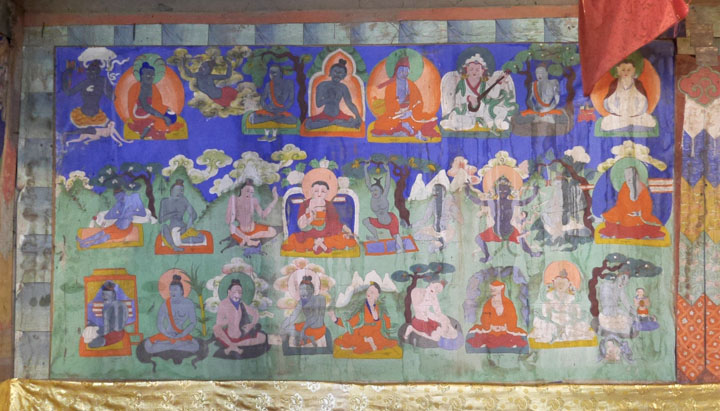
Hot Yogis of Kardang Monastery

Sept. 11, 2013     Lahaul visit begins…

Yesterday, J and I came to Kardang Monastery to meet resident yogi and monastery head Lama Paljor-la. After learning about my project, he generously shared stories with us about the murals, objects, and photos in the main temple. J knows quite a lot about the Drukpa Lineage so they both had much to discuss.
Kardang Monastery as seen from across the Bhaga River, Lahaul, India
Kardang Monastery as seen from across the Bhaga River, Lahaul

Kardang today is perhaps the best known monastery in Keylong owing to its association with the Shakya Shri Drukpa Lineage. Lineage is of terrific importance in Tibetan Buddhism because tantra is a living spiritual tradition transmitted orally in teachings from master to disciple. In this way, there is a connection from generation to generation which can be traced back to the Buddha himself.

Drubwang Shakya Shri (1983-1919) was an exceptional yogi who started out as a cook in a Drukpa monastery in Tibet. His lineage is unique because, through deep, whole-hearted practice, it is said he received his enlightenment directly from Vajradhara, the primordial Buddha. He was widely recognized as an incredible adept by other masters, including His Holiness the 14th Dalai Lama. With pure connections going back only a few generations, Shakya Shri lineage is known for its effective master-to-disciple teachings which guide practitioners swiftly along the Buddhist spiritual path. Shakya Shri mastered Mahamudra in the Drukpa Kagyu tradition, and also Dzogchen through the Nyingma lineage. He was later known for being involved with the Ri-me (non-sectarian) movement.

It was Shakya Shri’s disciple Jetsun Norbu Rinpoche, who returned to Lahaul from Tibet after his master had passed away. As holder of his teachings, and in particular of the Six Yogas of Naropa and Mahamudra, he soon attracted 2000 followers from all over the Western Himalayas. Though his hermitage was thriving, he preferred to live in a cave above Kardang Monastery.  In time, Kardang became known as a yogic training center.

Cave above Kardang Monastery, possibly like one that Norbu Rinpoche lived in
Cave dwelling above Kardang Monastery, possibly like one that Norbu Rinpoche lived in

As I mentioned in an earlier post, you may have heard of Tibetan Buddhist practitioners who can do unusual physical things. It was some of Shakya Shri’s lineage yogis whom Harvard scientists studied in the 1980s doing tummo practice, in which they can raise the temperature of parts of their body by as much as 17 degrees! One study involved the yogis scantily clothed spending a Himalayan winter’s night outdoors on a rocky ledge at 15000 feet altitude where temperatures reached freezing. The yogis demonstrated they could remain warm and slept through the night without incident. I think most of us would have suffered hypothermia! It occurs to me that Lama Paljor-la could have been one of these yogis.

Kardang Monastery is believed to have been founded about 800 years ago, but nothing seems to remain of its original temple. The current main temple was first built by Norbu Rinpoche in the 1930s, but was rebuilt several years ago by Lama Paljor-la, a disciple of lineage holder and former monastery head Apho Rinpoche. I have had the pleasure of meeting three of Apho Rinpoche’s children in Manali en route to Spiti and coming back from Lahaul: lineage holder Sey Rinpoche, his brother Jampal who is also a recognized reincarnate but prefers to live a quiet life with his family, and Khandro Thrinlay whom I wrote about previously here.

Kardong Monastery, Lahaul

Kardang Monastery is situated directly opposite Keylong on the other side of Bhaga River. See this 360 degree video view below.

[vimeo 145002351 w=600 h=331]


When one enters the main temple, one sees a mixture of old and new murals on the walls. The older ones, possibly no older than the 1930s, were painted originally on canvas so they were removed and reinstalled. They collage the walls alongside newly painted scenes.

The altar at Kardang Monastery, Lahaul
Interior of main temple at Kardang Monastery, Lahaul, with lama performing Mahakala prayers

At the altar are Buddha Shakyamuni statue on the middle, Vajradhara on the left and Padmasambhava on the right (also known as Guru Rinpoche, who introduced Buddhism to Tibet in the 8th century).

Buddha Shakyamuni in center, altar at Kardang Monastery, Lahaul
Vajrdhara on left, Buddha Shakyamuni in center, Padmasambhava on right, altar at Kardang Monastery, Lahaul
Interior view of Kardang Monastery, Lahaul
Interior view of Kardang Monastery where older and newer paintings collage the walls, Lahaul
Old and new paintings collage the walls of Kardang Monastery, Lahaul
Older and newer paintings collage the walls of Kardang Monastery, Lahaul
Interior view of main temple, Kardang Monastery, Lahaul
Detail of an older painting depicting a scene from the Life of Buddha, Kardang Monastery, Lahaul
Detail of an older painting depicting Chenrezig, Kardang Monastery, Lahaul
Detail of an older painting depicting Padmasambhava with consort, Kardang Monastery, Lahaul
Detail of an older painting depicting Padmasambhava with consort, surrounded by protector deities
Kardang Monastery, Lahaul

The monastery has a large library which includes the complete Kangyur, given to Norbu Rinpoche by the king of Bhutan, and the complete collection of the Wisdom Words of His Holiness the 4th Gyalwang Drukpa, the spiritual leader of the Drukpa Lineage.

Kardang Monastery has an extensive library of Kangyur scripture and other complete texts. Also seen here are sculptures of lineage masters, Lahaul, India
Kardang Monastery has an extensive library of Kangyur scripture and other complete texts. Also seen here are sculptures and relics of lineage masters
Gegen Rinpoche on left, His Holiness the 12th Gyalwang Drukpa on righton altar of Kardang Monastery, Lahaul
Gegen Rinpoche on left, His Holiness the 12th (current) Gyalwang Drukpa on right, on altar of Kardang Monastery, Lahaul
A newly painted mandala on the ceiling, Kardang Monastery, Lahaul
A newly painted guru-yoga mandala on the ceiling, Kardang Monastery, Lahaul

Above the main temple is a room that had belonged to Apho Rinpoche.  On the walls are paintings depicting Milarepa’s story that were originally painted on canvas and reinstalled in this new temple.

Apho Rinpoche's former room above main temple, Kardang Monastery
Apho Rinpoche’s former room above main temple, Kardang Monastery
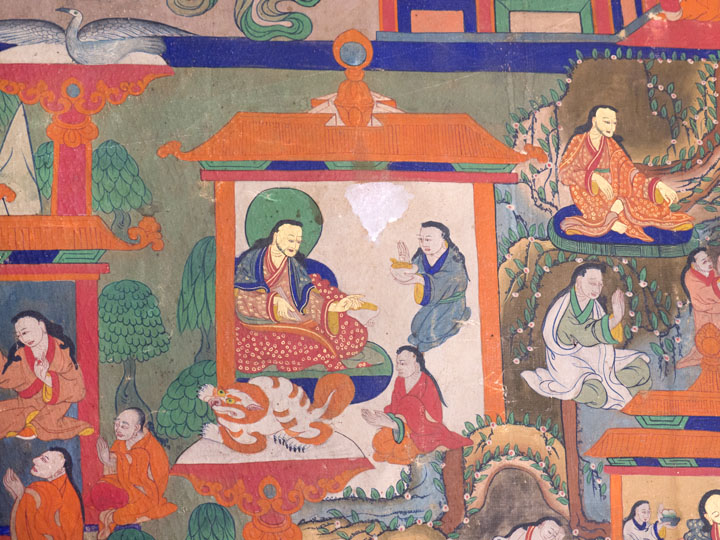
Scenes from Life of Milarepa, older wall paintings from Apho Rinpoche's former room above main temple Kardang Monastery, Lahaul
Scenes from Life of Milarepa, older wall paintings from Apho Rinpoche’s former room above main temple Kardang Monastery. Above right are newer paintings.
Detail from Life of Milarepa, wall paintings, Kardang Monastery

I’m spending the night here tonight in one of the monastery guest rooms. There’s an Ani-la (nun) who has kindly cooked for me, but mostly Kandang’s community of eight monks and seven nuns are lone retreatants living in simple huts and cooking for themselves.

Detail from Life of Milarepa wall paintings, Kardang Monastery, Lahaul

J left this morning, and took the bus back to Manali. It was wonderful traveling with her, and I’ll miss her company to share travel discoveries with. Yes, so I’ll be here for several days on my own devices, until my next travel companion K arrives and we drive together to Ladakh. On my list of things to do here are to see Shashur and Tayul Monasteries.

View of Keylong from the courtyard of Kardang Monastery on the other side of the Bhaga River, Lahaul

Tomorrow I plan to walk back to Keylong via trail and footbridge across Bhaga River.  I hope the paths are clearly visible and I don’t get lost! There’s no taxi to be had here unless I call for one from Keylong.  And as Khandro-la’s assistant had told me, Lahaul does not have so much in the way of Indo-Tibetan mandalas, but is rather itself considered a Chakrasamvara mandala manifest, one should experience it on foot.  Even though we are at over 11,000 feet altitude, it seems not too hard to go downhill and not terribly far to walk perhaps 5-8 kilometers, so I think I should follow this advice and experience Garsha. After all, I am over the worst of altitude adjustments. I had vice-grip headaches at night which made it hard to sleep, but the head pain progressively improved, and by the end of the first week, went away. So while I’m a bit short of breath sometimes exerting uphill, it’s not a hardship.

All photos © 2013, Eva Lee.