Fulbright Documentary Series at Columbia University and Library of Tibetan Works & Archives
Posted
Losar Tashi Delek! Happy Lunar New Year to all who celebrate!
I’m pleased to announce that five of my documentaries are now part of the Columbia University Tibetan Studies Library, one of the most extensive collections of Tibetan texts and archival material in the U.S.A. The documentaries are also in the Library of Tibetan Works & Archives, and may be viewed through their Multimedia Library.
The documentaries are:
Tabo Monastery Tsug Lhakhang (Main Assembly Hall) See the interior of this rare, Buddhist temple located in Spiti region of Western Himalayas, India. Famed Tabo Monastery is known as the oldest continually functioning Tibetan Buddhist monastery, the art of which the Dalai Lama said “delightfully expresses the vigor of the transmission of Buddhism from India to Tibet and the dynamic mingling of cultures.” Established in 996 C.E. by the Buddhist king of Guge in Western Tibet, Yeshe O’d, and the The Great Translator Rinchen Zangpo, it flourished in a golden epoch of Indo-Tibetan collaboration in spreading Buddhist culture.
Lamayuru Monastery Senge Lhakhang (Lion Temple) (00:03:24) Rare, medieval temple located in Ladakh region of Western Himalayas, India. Founded by The Great Translator Rinchen Zangpo and King Yeshe O’d of Guge, Western Tibet, circa late 11th century.
Mangyu Monastery Nangbarnangzad (0:03:03) Rare, medieval temple located in Ladakh region of Western Himalayas, India. Founded by The Great Translator Rinchen Zangpo and King Yeshe O’d of Guge, Western Tibet, circa late 11th century.
Lhalung Monastery Serkhang (Golden Hall)(00:01:45) Rare, medieval temple located in Spiti region of Western Himalayas, India. Founded by The Great Translator Rinchen Zangpo and King Yeshe O’d of Guge, Western Tibet, circa late 10th century.
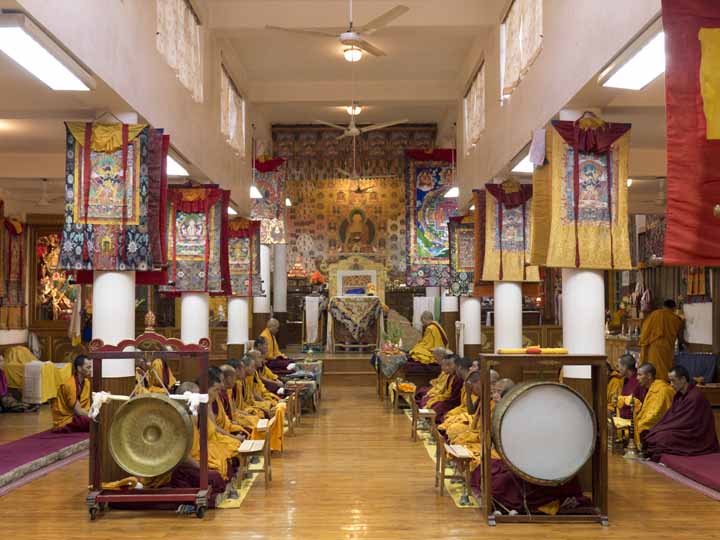
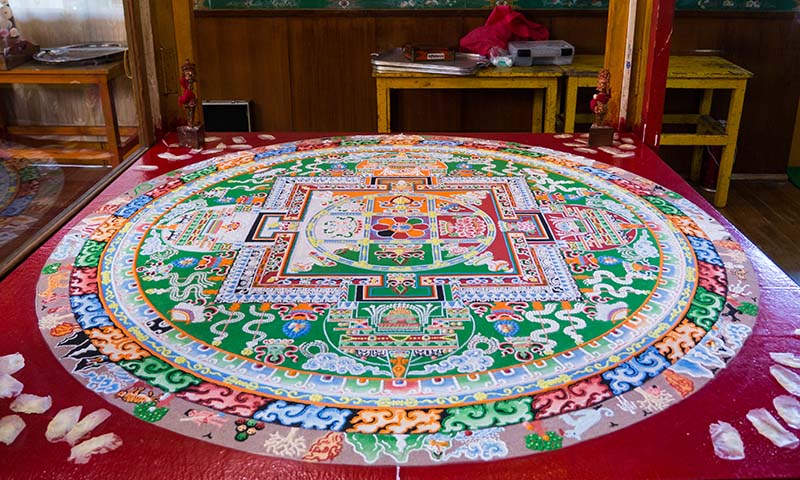
Yamantaka (00:56:38) A candid view of an esoteric and complex Tibetan Buddhist highest yoga tantra held at Namgyal Monastery in Dharamsala, India. Monks create an elaborate sand mandala, ritual cakes and other sacred arts, offer prayers, chant, play ritual instruments, and meditate over the course of ten days. As one viewer said, “Beautiful, bizarre, and fascinating!”
Incidentally, many viewers have asked me about what is happening at around 42:14 in the Yamantaka video, where a young Caucasian man is in the Main Temple talking loudly and animatedly to a gathering of monks.This was a debate exam in session for students of the Institute of Buddhist Dialectics (which adjoins Namgyal Monastery), characterized by dramatic and distinctive hand clapping, body motions, and rhetoric. It was an event unrelated to Yamantaka, but which coincided with it. Tibetan Buddhists have a long and famed tradition of continuing the ancient Indian Buddhist practice of philosophical debate.
All documentaries filmed during Fulbright research on Indo-Tibetan mandalas of the 10th-12th century. With thanks and gratitude to Office of His Holiness the 14th Dalai Lama, Namgyal Monastery, and Nechung Monastery for their support in my quest to document these temples and Yamantaka ritual. Made possible in part by the support of Fulbright-Nehru Research Program, Council for the International Exchange of Scholars, and United States-India Education Foundation.
Yamantaka, the Documentary is Here!
Posted
At long last, I’ve finished editing this documentary! You can see it above or go to this Vimeo link where Yamantaka is uploaded.
Yamantaka, what an esoteric and complex practice. This candid view of a Tibetan Buddhist highest yoga tantra was filmed over the course of ten days at Namgyal Monastery in Dharamsala, India. You will see monks create an elaborate sand mandala, ritual cakes, and other sacred arts, offer prayers, chant, play ritual instruments, purify and meditate. On the last day, the sand mandala is swept into a vase and released into the world as a blessing for all. This is always the breathtaking but cringe-worthy part, for those of us who treasure and want to hold onto the beauty of a meticulously created mandala.
Ideally, I would have liked to complete and release this documentary last year, but I’ve learned that one simply cannot rush certain things. Especially when careful viewing and understanding of the footage is at stake. Add to this the required post-production magic of removing flickering segments, compensating for low lighting conditions, color adjustments, fixing sound challenges, and so forth, and you have an enduring, long workflow at hand.
Incidentally, many viewers have asked me about what is happening at around 42:14 in the Yamantaka video, where a young Caucasian man is in the Main Temple talking loudly and animatedly to a gathering of monks. This was a debate exam in session for students of the Institute of Buddhist Dialectics (which adjoins Namgyal Monastery), characterized by dramatic and distinctive hand clapping, body motions, and rhetoric. It was an event unrelated to Yamantaka, but which coincided with it.Tibetan Buddhists have a long and famed tradition of continuing the ancient Indian Buddhist practice of philosophical debate.
Dharamsala Home Sweet Home
Posted
I find myself steeped in good memories of McLeod Ganj, Dharamsala, where I lived and continued research for over two months after I finished traveling through Spiti, Lahaul, and Ladakh.
Early morning at Temple Square, near Dalai Lama’s Namgyal Monastery, McLeod Ganj, Dharamsala, IndiaJogibara Road in monsoon season, McLeod Ganj, Dharamsala, India
Home of His Holiness the 14th Dalai Lama, Namgyal Monastery, the Tibetan government-in-exile, and a Tibetan and Indian community, this former British hill station in the foothills of the Himalayas attracts visitors from far and wide. They come to attend teachings, events, study, volunteer, get involved. There are a large number of Western expats living here, too.
I descended from the high altitudes and arrived in McLeod Ganj (approx. 6000 feet altitude) end of September. It was surprisingly still monsoon season, which is usually over by mid-month. But 2013 was a particularly long and relentless monsoon. Everyone agreed. It lasted well into October, and I was drenched many times mistakenly thinking I could quickly go from point A to point B and not get too wet.
The area is one of the wettest in the state of Himachal Pradesh, with up to 120 inches of rain from July to mid-September. 120 inches! In six weeks. That’s 20 inches a week, almost 3 inches a day! You gird yourself for constant moisture, fog, mold, and mildew. Hanging laundry takes close to two days to dry. Resident friends warned me to safeguard all my electronics by putting them in a closet with hot lamps shining on them. It’s practically a whiteout at times, dangerous for driving because you can’t see beyond 10 or 12 feet in front of you on mountainous hairpin turns.
Downpours pelt you like sheets of water performing a sports arena wave (you know, where sports fans get up from their seats and raise their arms overhead in succession). No really, you can actually see this phenomena of denser sheets of rain cascading across less dense ones over the valleys and on the streets. An umbrella is futile. I used one anyway out of stubborn habit, and I was almost always ruefully muttering to myself when I arrived some place with clothing stuck to me like I had put them on straight out of a washing machine with a broken spin cycle. I finally learned that when a Dharamsala monsoon rain starts, you WILL be drenched unless you duck for cover. I started carrying a poncho. And there is a reason why locals wear flip flops and brave the wet streets open-toed. It’s because normal shoes become spongy, perpetually dank and musty.
And then, one day, it’s over! The clouds and mist clear up. The horizon expands and Dharamsala, or Dasa as it is fondly called for short, looks like this.
Post-monsoon season, sunshine galore in Dharamsala
Glorious and crisp, far as your eye can see. Warm and sunny.
View of McLeod Ganj near Namgyal Monastery, Dharamsala, IndiaView of McLeod Ganj from Ashoka Restaurant rooftop, Dharamsala, IndiaView of McLeod Ganj, near Namgyal Monastery
The street vendors no longer have to cover their wares from rain and mud with tarp.
Upper Temple Road, McLeod Ganj, Dharamsala, India
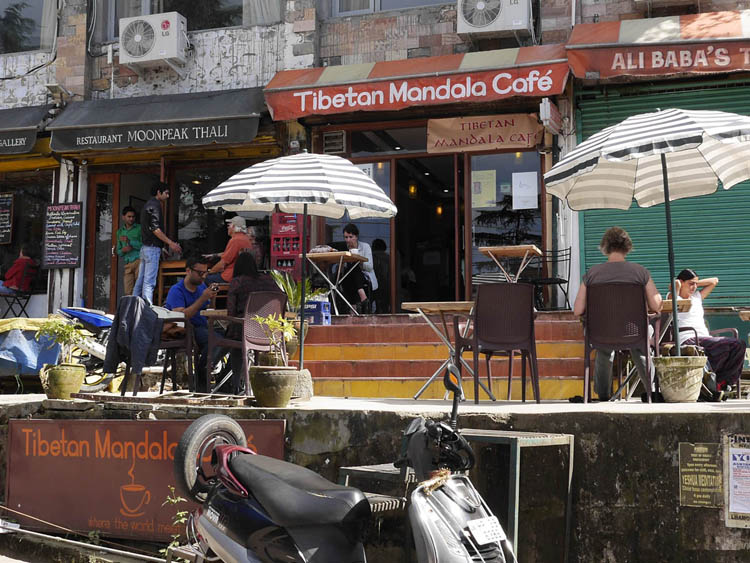
People enjoy outdoor dining and cafes again.
Cafe row on Temple Road, McLeod Ganj, Dharamsala, India
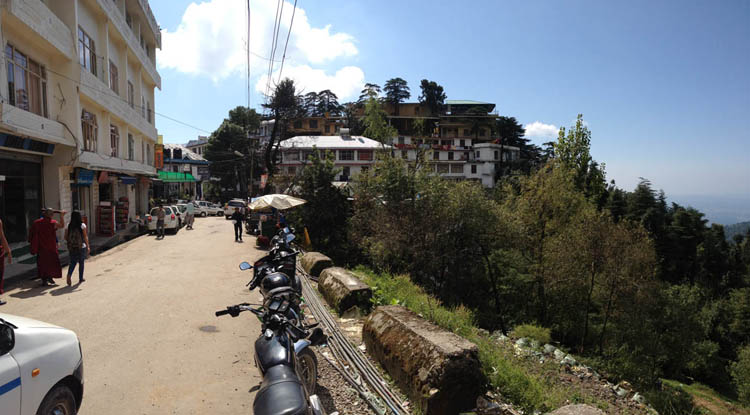
This was my usual walk on Temple Road back to where I was staying, near Namgyal Monastery.
Lower Temple Road, heading towards Namgyal Monastery, McLeod Ganj, Dharamsala, IndiaNamgyal Monastery visible here through the trees. The upper yellow buildings are open to the public where the main temples are located. Lower white buildings are monks quarters and other private areas.
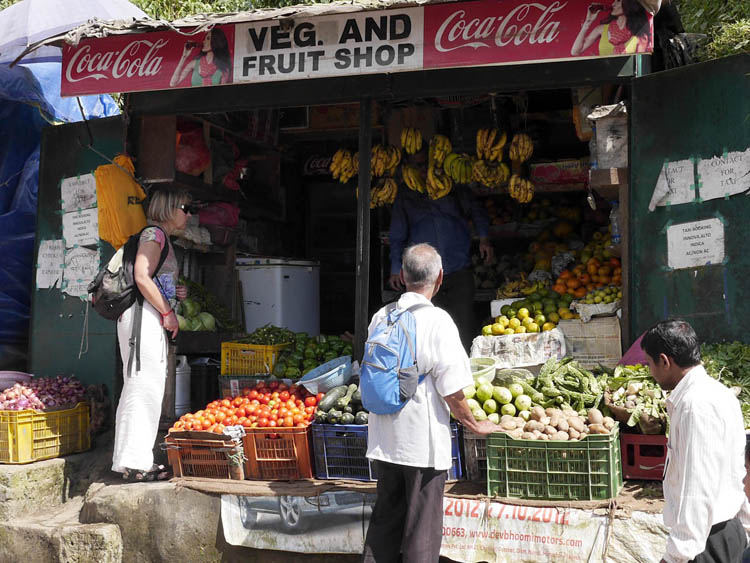
Stores that I became acquainted with along the way.
A typical fruit and vegetable stand, McLeod Ganj, Dharamsala, India
I was a regular at this stationary store. Go figure, I just never had enough pens or pads or envelopes, or superglue. I bought paper clasps here which served as clothespins or toothpaste tube holders, or food clips. Travel makes me look at objects more resourcefully.
Local stationary supply store on Temple Road, McLeod Ganj, Dharamsala, India
This shop always caught my eye with its colorful display.
Clothing store with Western fashions and trekking gear, Temple Road, McLeod Ganj, Dharamsala
At left, the location of a trusty ATM machine! Very important. I was grateful that it always worked, which is not always the case elsewhere in India.
Continuation of Temple Road heading towards the main chowk or square, McLeod Ganj, Dharamsala, India
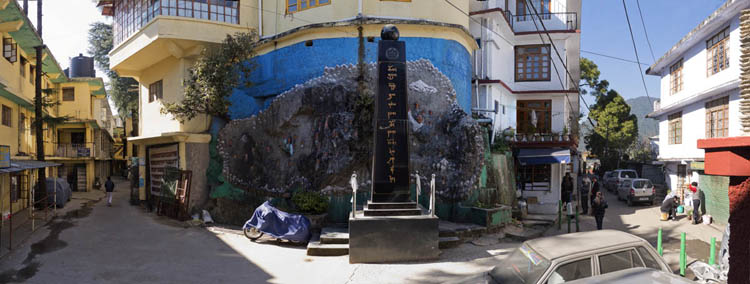
This is the raucous main square of McLeod Ganj, where several main roads converge. Where buses, taxis, and tourists depart and arrive. Where there is sure to be traffic jams throughout the day caused by congestion, narrow roads, crossing people animals.
The raucous main chowk or square, always a busy meeting place, McLeod Ganj
During my time in Dasa, I had the fortune of attending no less than three of the Dalai Lama’s teachings at Namgyal Monastery, including a Mind & Life conference, which I wrote about here. I also had the honor of audience with local rinpoches, geshes, monks and administrators, as well as observing and documenting the annual Yamantaka highest yoga tantra ritual.
Panorama of entrance to Namgyal Monastery, McLeod GanjAssembly for Yamantaka morning ritual, Namgyal Monastery, McLeod Ganj
Lunch hour outdoor performances during Tibetan Film Festival 2013, held at Tibetan Institute of Performing Arts (TIPA), McLeod Ganj
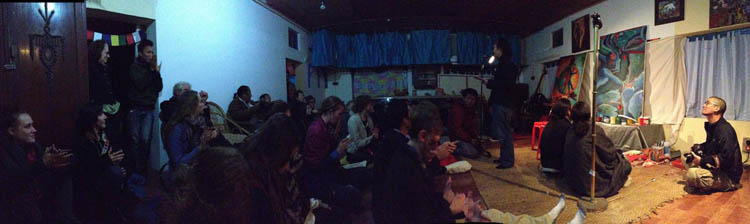
Plus, a number of music-poetry-art fusion events staged by local artists. Poetry would be read during live musical performances, while a painter begins and completes a painting on canvas in one evening.
Music-poetry-art fusion event, Dharamsala, India
There was a revolving door of gatherings, which I’m grateful to Dasa friends for inviting me to. Diwali celebrations, dinners, movie nights, artist meetings, music jams, salons, fundraisers. Truly warm, good times.
A welcome daily visitor
When not out and about, I was in my apartment, which incidentally came with a kitty. She showed up on my terrace one day.
I must say she was a welcome visitor. Although she left a lot of nose smears looking in through my newly cleaned window, she did accompany me many days as I sat indoors editing footage, photo-correcting, researching, and writing.
Evidence of looking in on me a few too many times
Which reminds me of a story I heard about the Dalai Lama, who once had two cats as pets. After they spent their last days with him in his palace, he decided he would not have pets anymore–too much attachment!
Yes, indeed, I was sad to leave this little one, but happy to learn that she actually belonged to my neighbor.
On my last day in Dharamsala, I left a bag of cat food at their doorstep, then went for a final koraaround the monastery complex on this fine, scintillating morning.
Panorama of Namgyal Monastery circumambulatory, McLeod Ganj, DharamsalaPanorama of Namgyal Monastery circumambulatory, McLeod Ganj
I’ve gone about it all backwards. Backwards in time, in pursuit of mandalas. It all started when I heard that a sand mandala was going to be made at Namgyal Monastery in Dharamsala, India, in 2010. So I went there, and found out that it was a Yamantaka mandala, part of a ten-day-long highest yoga tantra ritual which occurs annually at the Dalai Lama‘s personal monastery. My previous post here describes what little I knew then as I observed and documented the creation and dissolution of it. The resultant film and photographs can be seen here.
When I came back to the U.S., it was as if a floodgate had opened. I needed to learn more. No, not just more, but all I could about Tibetan mandalas–about their variety, their purpose, their history, the meditation practices they engendered, and so forth. What did it all really mean? What modern significance did it have?
My bookshelves began to fill up with writings about tantra and Buddhist philosophy, written by the first Tibetan teachers to venture into the Western world, post-1959 exodus from Tibet. Titles by the Dalai Lama, Chogyam Trungpa Rinpoche, Lama Thubten Yeshe, Dilgo Khentse Rinpoche, as a few examples, abounded. I also read works by contemporary lamas like Dzogchen Ponlop Rinpoche, Pema Choedron, Tsoknyi Rinpoche, Tenzin Palmo. Tibetan scholars and historians David Snellgrove, Robert Thurman, Deborah Klimburg-Salter, Martin Brauen, and others figured in there, too.
All this, in addition to my previous discoveries of well-respected meditation teachers from other Buddhist traditions–Sharon Salzberg, Joseph Goldstein, Jack Kornfeld, B. Allan Wallace. I followed the writing of neuroscientists and clinicians, too, who studied or used meditation in their work. They were also involved with fascinating Mind & Life Institute research or conferences–Richard Davidson, Jon Kabat-Zinn, Paul Ekman, Daniel Goleman.
It was a mindfulness-neuro-tantric-philoso-fest that poured forth!
Meanwhile, in 2011, the ritual experiences continued. I attended the Dalai Lama’s Kalachakra event for World Peace in Washington D.C., and witnessed the Kalachakra Mandala.
In 2012, I was at the Dalai Lama’s talk at Western Connecticut State University at which time I encountered a Compassion Mandala.
At both events, I had the wonderful opportunity of befriending and working with monks, nuns, plus other Buddhist practitioners and followers.
It was a steady flow. The waters at the floodgates just did not tire out. Answers came, and new questions arose.
Thus, on the heels of this, last year in 2013 I arrived back to India to experience and research rare Indo-Tibetan mandalas in Himalayan monasteries of Spiti, Lahaul, and Ladakh. How might they have evolved into Tibetan forms that we know today? What was this Indo-Tibetan 10th to 12th century period called the Second Great Transmission of Buddhism from India to Tibet? What did the sacred art look like? What did it mean?
At the end of my travels through the Himalayan high altitudes, I then thought, let’s reel back in time some more. What came before the Indo-Tibetan era?
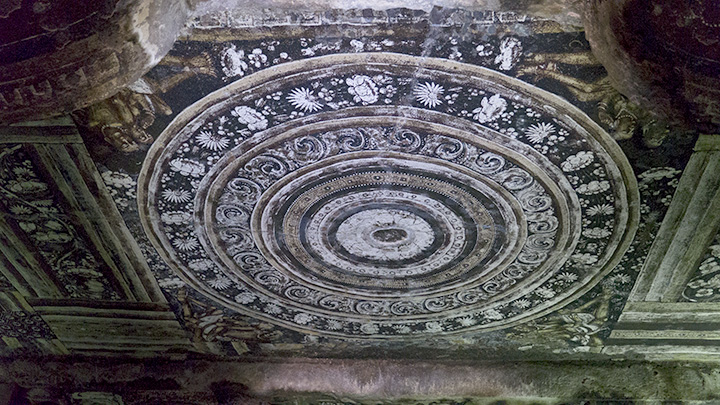
The answer was, Indian Buddhism, which could be seen at Ajanta and Ellora Caves where there are remains of elaborate 2nd to 8th century C.E. wall paintings, sculptures, and architecture. Such purely Indian Buddhist art is still preserved at these South Indian sites in the state of Maharashtra.
Finally, what might have come even before this in India? I mean in B.C.E. times. When I searched further, it seems that the Buddhist art historical record stops here. According to historians, not much still exists before the 1st century C.E. Little is known in India archeologically prior to this time.
So what’s it all about? Why would an artist go for all this? New artwork from my Fulbright experience does beckon me in the studio.
I guess I’m just driven by the big questions about mind and reality, which Buddhist philosophy seems to address best. And moreover, that largely works within a Western scientific paradigm. It doesn’t hurt, either, that an affable spiritual leader like the Dalai Lama continues to inspire and exemplify how one can be intellectually sharp, existentially awake, and compassionately engaged in the world. Despite being a keeper of complex Tibetan rituals and esoteric tantric teachings, he can still keep it simple and distill wisdom down to these words: “There is no need for temples, no need for complicated philosophies. My brain and my heart are my temples. My philosophy is kindness.”
It’s Yamantaka Time
Posted
I’ve been furiously writing here to get up-to-date, and even though I’m still working on September things seen and heard, I must now share that it’s Yamantaka time! I am currently documenting this highest yoga tantra performed annually at Namgyal Monastery here in Dharamsala.
Highest yoga tantra ritual, Yamantaka, begins pre-dawn at Namgyal Monastery, DharamsalaThe moon shines over Dharamsala Valley as Namgyal monks begin pre-dawn prayers for Yamantaka ritual. This highest yoga tantra occurs annually over the course of about ten days at Namgyal Monastery.
Yamantaka began four days ago before dawn’s light with earth ritual prayers to prepare the ground for this sacred art.
Offerings are made in the thekpu during earth ritual prayers to prepare the ground for the creating a sand mandala
Then came three days of intensive work for the monks to rasp colored sand through metal funnels to create intricate designs symbolizing the main deity and his retinue of associated deities within the palace. For more info on mandalas and tantric, see this earlier post.
Day one involves marking out the eight directions in white, and then monks draw the basic structure of the mandala in black ink before beginning with colored sand.The sand mandala begins with symbolic depiction of Yamantaka deity who resides in the center. A mandala is a two-dimensional representation of a thee-dimensional palace, used as an aide in tantric meditation practice.Day one of creating Yamantaka sand mandala continues, Namgyal Monastery, DharamsalaThe mandala after the first day’s completionDay two of creating sand mandala. This monk is scribing a floral design with a pencil into the background sand, after which he will create it on top in other different gradated colors.Day two of making Yamantaka sand mandala, Namgyal Monastery, Dharamsala. The four gateways to the palace can now clearly be seen outlined in black, flanked by black-and-white cornice design.Day two of making Yamantaka sand mandala. The gateways are further elaborated as the green background color is begun for the next section. The monks began early morning and will work well into the night to ensure progress and completion of the mandala within three days.Day three of making Yamantaka sand mandala, with completed gateways, banner designs, vases, and other symbols that are mnemonic devices for tantric meditation, Namgyal Monastery, DharamsalaWorking on the outer borders, day three of making Yamantaka sand mandala, Namgyal Monastery, DharamsalaThe sand is gradated on this outer border, day three of making Yamantaka sand mandala, Namgyal Monastery, DharamsalaWorking on the final outer border which represents the charnel grounds, day three of making Yamantaka sand mandala, Namgyal Monastery, Dharamsala
The sand mandala was just finished yesterday.
The completed Yamantaka sand mandala, Namgyal Monastery, Dharamsala
With the completion of the mandala, today was the generation stage of the ritual. The monks chanted while visualizing themselves arise as Yamantaka. Tomorrow begins three days of consecration, followed by fire puja, then dissolution of the mandala.
I love this bittersweet last part where the beautiful mandala is swept away. As George Harrison sang, all things must pass. It’s a lesson in the truth of impermanence and the wisdom of letting go. Some of the sand is given to visitors who come witness the event. Most of it is swept into a ritual vase that is then taken to a nearby body of water and poured into it. I think of it as sending good wishes and energy out into the world.
I look forward to seeing it again. It was a wonderful experience here three years ago. It will be a welcome deja vu.
Okay, I know I promised to post Part Two of Tabo Monastery next, but as I’ve been writing, I’ve found it necessary to do a lot of explaining. In fact, so much explaining in between the photos of Tabo’s interior that it’s a bit interrupting. So I’ve decided to get the explaining done with first. All right with you? Great, read on!
When I first came to Namgyal Monastery in 2010 to observe and document a highest yoga tantra ritual Yamantaka, I knew precious little about the vast world of Tibetan Buddhist tantric deities. What I knew was that an elaborate sand mandala would be made by the Dalai Lama’s monks in their temple in McLeod Ganj, India. I did not know at that time, for example, that this intricate 2-dimensional Yamantaka design represented a 3-dimensional palace, in which the deity resides at the center.
Yamantaka Sand Mandala, Namgyal Monastery, India
I learned that as a sacred art, whether made of sand, cloth, or metal, its purpose is to be a meditation aid to a tantric practitioner. A sort of blueprint, a sand mandala usually depicts a square multi-storied abode with four gates centered within a circle. Every element, from color, dots, vases, banners, letters, animals, etc., represents an essential part of the deity, his or her teachings, and Buddhist philosophy. Each deity in turn has a retinue of associated deities, which are also depicted. A person contemplating the mandala imagines entering into its palace and encountering all these elements, which is to say, meditates on the qualities and teachings they symbolize. To a devout practitioner, a mandala ultimately represents the mind of the Buddha.
An esoteric and advanced practice, Tibetan Buddhist tantra (also known as Vajrayana) is intended for the properly receptive initiate, with guidance from a qualified teacher or lama. It is an accelerated, experiential way to realize the Buddhist wisdom of the ultimate nature of mind and reality, and great compassion. First taught by the historical Shakyamuni Buddha over 2500 years ago, it has been passed through oral tradition by lineage teachers. Its goal is enlightenment of the practitioner for the benefit of all sentient beings. And, believe me, this means all. One of my favorite little prayers is one I learned on a meditation retreat, and it goes like this:
May all beings, large or small
or middling, near or far,
visible or invisible,
born or yet to be born,
May all beings be happy and content.
Let no one deceive another.
Let no one despise another,
whether out of greed, hatred, or ignorance.
And as a mother would risk her life
to save her only child,
let us cultivate this feeling
of loving friendliness towards one another.
Quite a vast scope! And speaking of scope, there are literally hundreds of tantric deities, each with unique mandalas representing different sets of details and qualities specific to his or her teachings and practice. All varieties transmit fundamentally the same Buddhist wisdom and compassion, but each deity provides a different identity with which practitioners, according to their particular personality, can relate to or find affinity with. It is important to note that it is understood in tantra that none of these deities are real in the conventional sense. They do not exist, but are symbols, visualized in their mandala in a specific and procedural meditation practice.
This multiplicity is something Buddhism shares with its Hindu beginnings. Prince Siddhartha, after all, was born and raised a Hindu before his ascetic wanderings led him to enlightenment as Shakyamuni Buddha. I really appreciate India’s cultural acceptance of many-paths-to-the-same-truth. I understand that Hindu deities are so vast they number in the millions. This acknowledgement of relativity, even acceptance of the co-existence of apparent contradiction, is truly an admirable hallmark of Hinduism, and in particular, Buddhist non-duality.
Although intricate, aesthetically compelling, and often mysterious to the non-practitioner, mandalas are meant for religious use and are not intended as works of art for museum or private collection. In fact, I had occasion recently to discuss this very topic with a Buddhist nun. Her position was that tantra is a secret and profound practice, the art of which should only be for the eyes of practitioners. What would it serve to reveal what is not meant for the uninitiated? While I can understand her viewpoint, I believe that since the Tibetan diaspora has led to the spread of Buddhist teachings, and the increasingly ubiquitous access to seeing tantric mandalas, it is better for the sake of education to reveal some things about them accurately rather than risk erroneous speculation and misunderstanding.
In 1988, the Dalai Lama permitted the first public construction of a mandala in the West as a means of teaching about and preserving Tibetan culture. This was the Kalachakra Mandala, an example of which can be seen here, constructed in sand at the Museum of Natural History in New York City by Namgyal monks from Dharamsala, India. He also felt that it would be a benefit because a mandala is thought to bring peace and harmony to the area where it is being created. Even viewing a mandala is believed by Buddhists to be enough to effect positive change for greater compassion, awareness, and a better sense of well-being.
Since the construction of this first mandala in the West, many have been created all over the world. Drepung Gomang Monastery in Southern India has a group of monks who come to the United States annually to demonstrate their arts through the Sacred Arts Tour. Last year, I had the privilege to witness and document a Compassion Sand Mandala which these monks made as an offering to the Dalai Lama on the occasion of his talks on Compassion and Creativity at Western Connecticut State University.
Beyond the artistic representation of a mandala, there is the mandala principle, which I believe was first clearly articulated and taught in the U.S. by Chogyam Trungpa Rinpoche. (See his book Orderly Chaos: The Mandala Principle) From a philosophical point of view, everything is dependently interrelated, the seeming order and chaos are one and the same, the joy and the suffering, and so forth. The apparent dualities abound, and yet they are all constituently the same.
In real life situations, I think of mandala principle as Buddhism-in-action in the sense that your immediate surroundings is your mandala, and all the people you encounter are part of it, too. You have Buddha-nature within you, and so do they. With awareness and practice that comes from meditation, you have at every moment the potential to actualize compassion and wisdom in what you think, what you say, and what you do.
This is not an official U.S. Department of State website. The views and information presented here are solely those of the artist, and do not represent the Fulbright Program, the Department of State, or any other entity.