Aside

Pristine Mangyu

Sept. 23, 2013

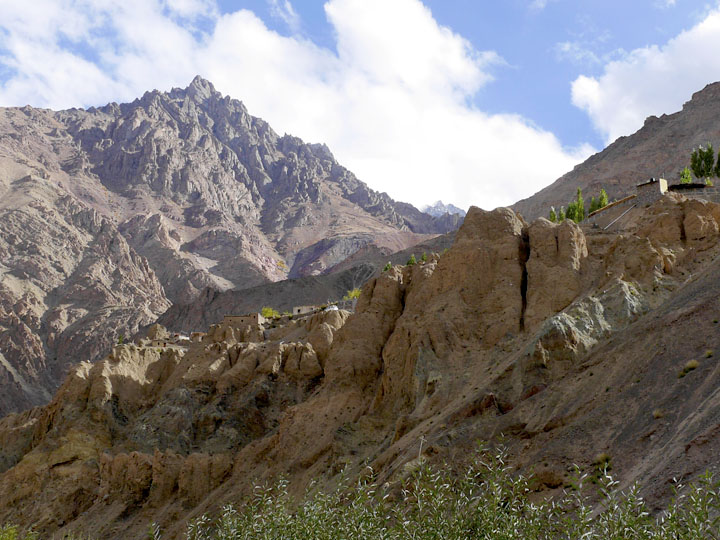
View of Mangyu Monastery village, Ladakh, India
View of Mangyu Village, Ladakh, India. To get there, one drives through narrow valley gorges. The village remains hidden until you drive practically right up to it.

Like Lamayuru Monastery’s Indo-Tibetan Senge Lhakhang, Mangyu Monastery’s Vairocana temple is also a small intimate place. Classic, pre-13th century, early period architecture, the site is nestled in and integrated with a village as opposed to fortified and atop on a hill from the community.
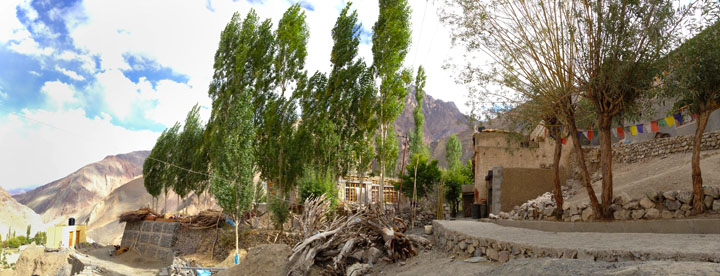
Beginning of Mangyu Monastery village, Ladakh, India
Beginning of Mangyu Village, Ladakh, India

I believe that up till fairly recently, let’s say last twenty years, there was no motorable road up to Mangyu Village, which means it was largely isolated and unknown by travelers. We parked a little below the village and walked up to the monastery, passing by small grocery stores that had countertop service for a simple meal of packaged and flavored maggi noodles (what we call ramen noodles in the U.S.) I was starving and grateful to be served one! When traveling around these more remote parts, one never knows where and what the next meal may be. This village had no restaurants or dhabas, nor did I see guesthouses. This is lovely because it indicates that tourism hasn’t bloomed here. Mangyu is pristine for this reason.
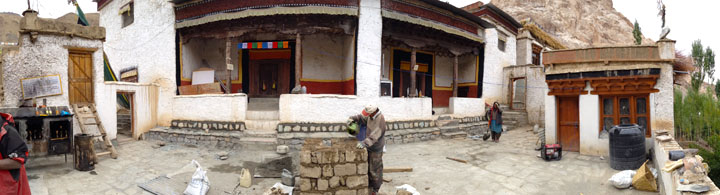
Panorama of Mangyu Monastery with Chenrezig Lhakhang on left, Nangbarnangzad (Vairocana temple) on right, together flanked by Chamba Lhakhangs of Maitreya and Jambeyang sculptures, Ladakh
Panorama of Mangyu Monastery with Chenrezig Lhakhang on left, Nambarnangze (Vairocana temple) on right, together flanked by Chamba Lhakhangs of Maitreya and Jambeyang sculptures, Ladakh. Workers are making repairs under the auspices of INTACH, the Indian National Trust for Art and Cultural Heritage.

Tourism is a challenge to local and modest communities here in the Himalayas. While it brings income, it also brings ecological stress. And ecological stress is no small thing to cope with when the land is semi-arid and mountainous, the people mostly poor, the government ill-equipped to provide adequate infrastructure. The need for food and water sources, sewage, sanitation, and modern transportation to serve tourists often ravage the natural beauty here.

Especially if it brings non-biodegradable garbage like plastic. It’s very upsetting to see packaging or other plastic objects thrown over the side of a Himalayan mountain or floating through the streams, stuck in rocks. Indeed, the Himalayan areas I’ve traveled to have dumps located on the mountain side. You can often see them along the road while driving on the highways. It will be a sudden burst of packaging color en masse among the earthy rocks and otherwise scenic beauty. It’s either this or shopkeepers and townsfolk simply burn the garbage. Yes, they burn it, open-air, in front of their shops or homes, frequently plastic and all.

Plastic bottles and those plastic carton drink containers, potato chip and candy wrappers are the most noticeable litter in the streets. I sadly think, these things will never degrade into anything that can be absorbed properly here. Nor anywhere on Earth for that matter, but since we are here on the topic of the Himalayas, my point is that tourism causes environmental strain and damage. I always ask for boiled water at hotels to cut down on the plastic, and carry a thermos with me. Of course, on some occasions, I can’t avoid it and will guiltily buy water in a plastic bottle.

But my visit to Mangyu Monastery was not one of these occasions, I’m happy to report!
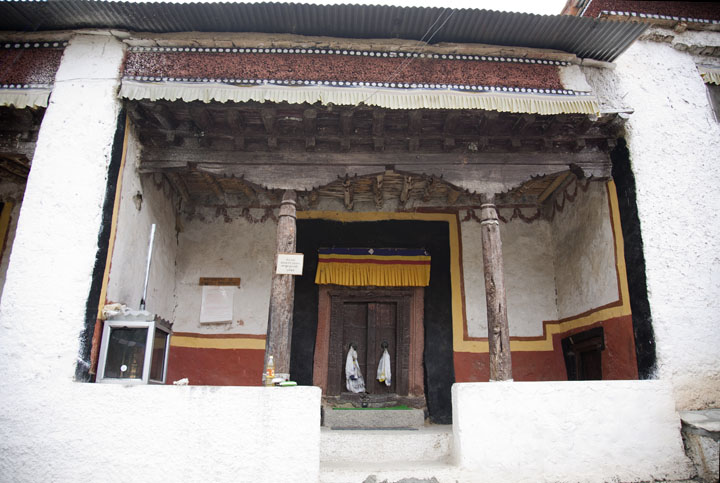
Entrance to Nangbarnangzad (Vairocana temple), ca. 11th century Indo-Tibetan early monastic architecture, Mangyu Monastery, Ladakh
Entrance to Nambarnangze (Vairocana temple), ca. 11th century Indo-Tibetan early monastic architecture, Mangyu Monastery, Ladakh. Photo: Kishore Thukral

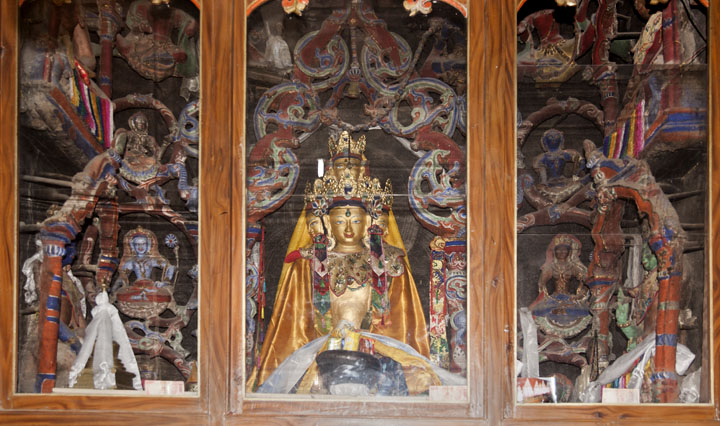
In the 11th century Indo-Tibetan tradition of The Great Translator Rinchen Zangpo, this altar in Nambarnangze once again features Vairocana in the center, surrounded by the Dhyani Buddhas, offering goddesses, animals, and ornate scrollwork, topped by a garuda. See floor plan here.

Experience the interior of this rare, medieval Vairocana temple by seeing a walk-through video here.

Mangyu Monastery Nangbarnangzad
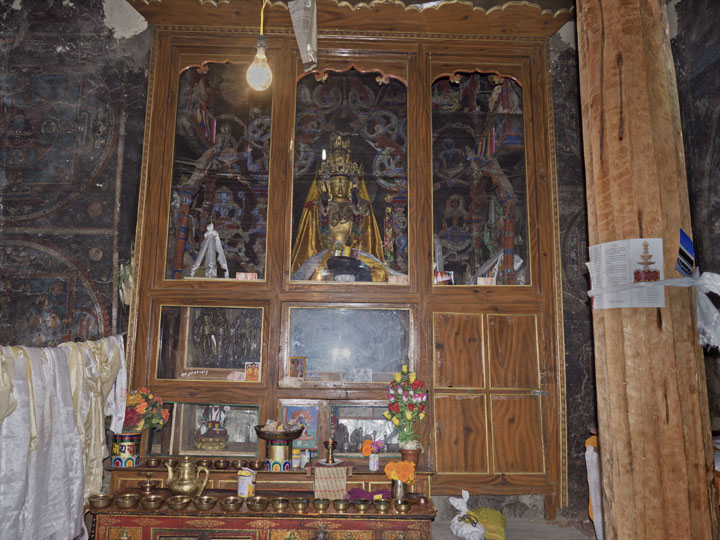
View of Nangbarnangzad interior, with Indo-Tibetan clay sculptures and wall paintings. The altar is now unfortunately encased by glass making it difficult to see the fine craftsmanship of Kashmiri artists, ca. early 11th century, Ladakh
View of Nambarnangze interior, with Indo-Tibetan clay sculptures and wall paintings. The altar is now unfortunately encased by glass making it difficult to see the fine craftsmanship of Kashmiri artists, ca. early 11th century, Ladakh
View of Indo-Tibetan clay sculptures of altar, now unfortunately encased by glass making it difficult to see the fine craftsmanship of Kashmiri artists, ca. early 11th century, Mangyu Monastery, Ladakh
Indo-Tibetan clay sculptures of Vairocana and Dhyani Buddhas of altar, Nambarnangze, Mangyu Monastery, Ladakh. Now unfortunately encased by glass, making it difficult to see the fine craftsmanship of Kashmiri artists, ca. early 11th century, Photo: Kishore Thukral

For further info on Vajradhatu Mandala structure upon which early monasteries of this period were based, see this post on Lamayuru Monastery’s Senge Lhakhang and this one on the celebrated Tabo Monastery’s Tsug Lhakhang.
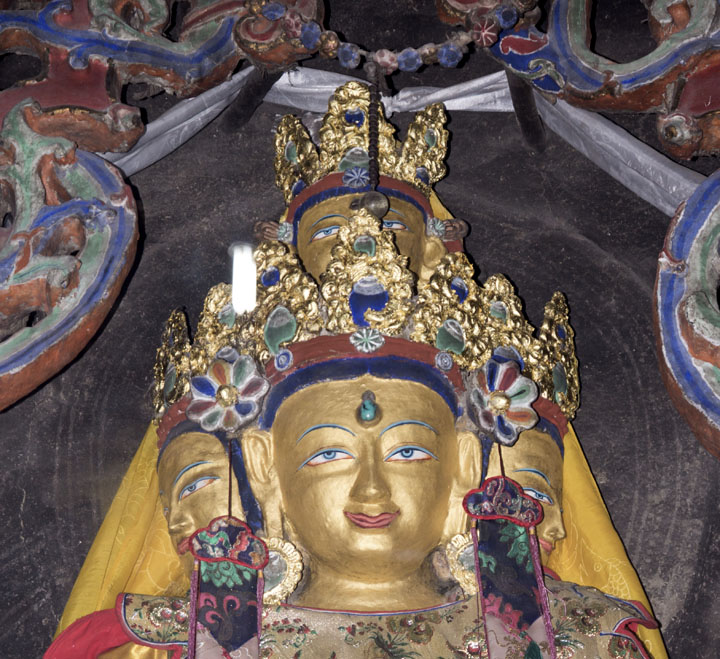
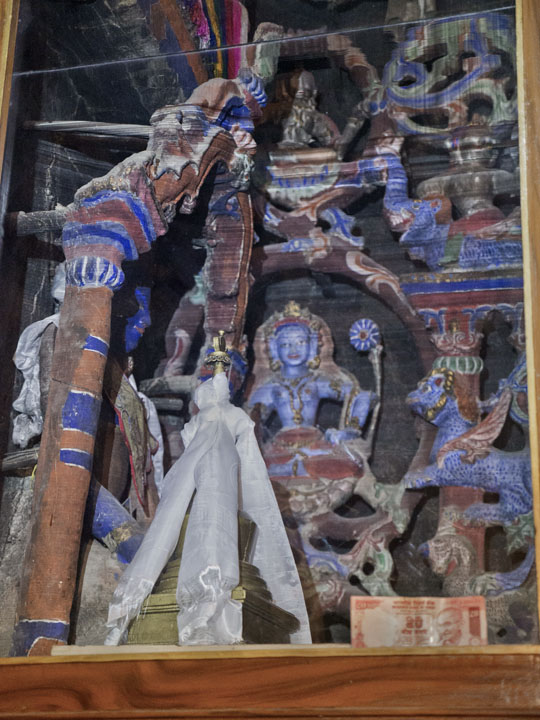
Detail of Vairocana Buddha, altar of Nangbarnangzad, Mangyu Monastery, Ladakh
Detail of Vairocana Buddha sculpture, ca. 11th century, altar of Nambarnangze, Mangyu Monastery, Ladakh
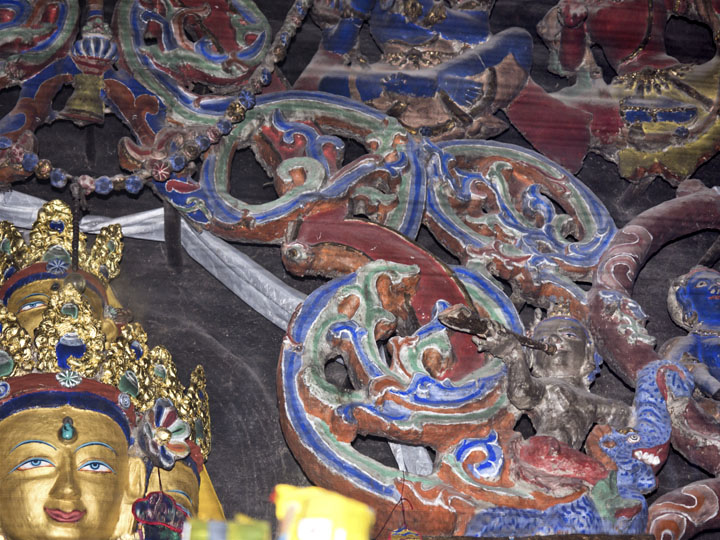
Detail of ornate scrollwork, animals and figurines, rare 11th century Indo-Tibeta clay sculptures, altar of Nangbarnangzad, Mangyu Monastery, Ladakh
Detail of ornate scrollwork, animals and offering goddesses, rare 11th century Indo-Tibeta clay sculptures, altar of Nambarnangze, Mangyu Monastery, Ladakh, India
Detail of Vairocana Buddha, with ornate scrollwork, animals and figurines, rare 11th century Indo-Tibeta clay sculptures, altar of Nangbarnangzad, Mangyu Monastery, Ladakh
Detail of Vairocana Buddha, with ornate scrollwork, animals and offering goddesses, rare 11th century Indo-Tibetan clay sculptures, altar of Nambarnangze, Mangyu Monastery, Ladakh
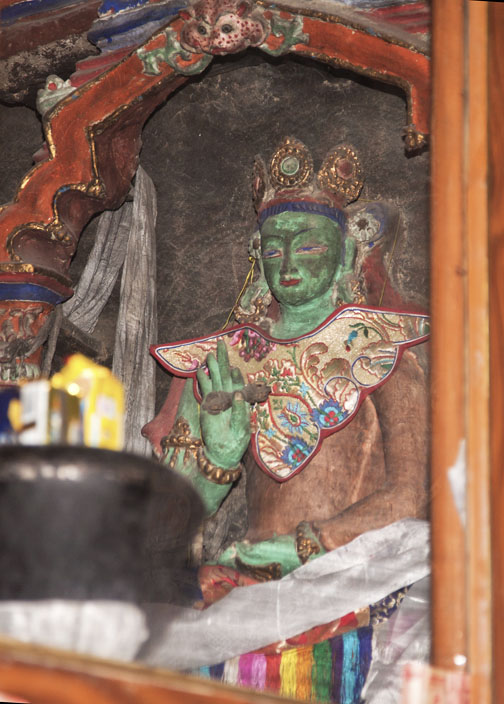
Detail of Amoghasiddha, a Dhyani (Supreme) Buddha, rare 11th century Indo-Tibetan clay sculpture, altar of Nangbarnangzad, Mangyu Monastery, Ladakh
Detail of Amoghasiddha, a Dhyani (Supreme) Buddha, rare 11th century Indo-Tibetan clay sculpture, altar of Nambarnangze, Mangyu Monastery, Ladakh. Photo: Kishore Thukral

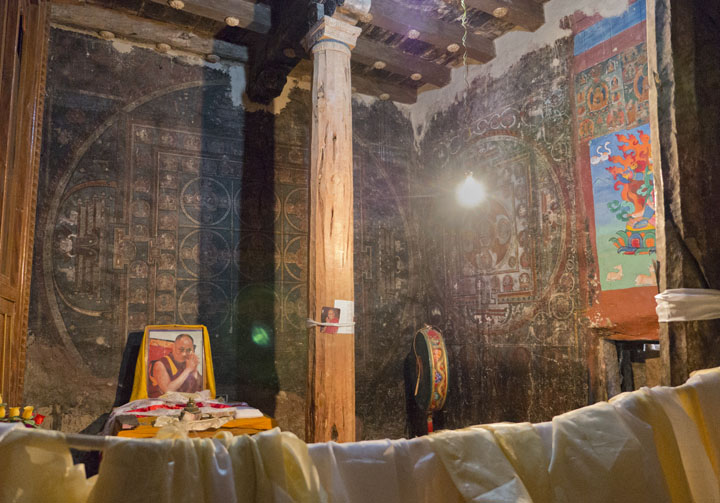
The small Vairocana temple is symmetrically painted on its left and right side walls with one large central Vajradhatu mandala each, flanked by smaller mandalas of related divinities or protectors. On the right side wall, the paintings look like well-conserved oe well-preserved original Indo-Tibetan.
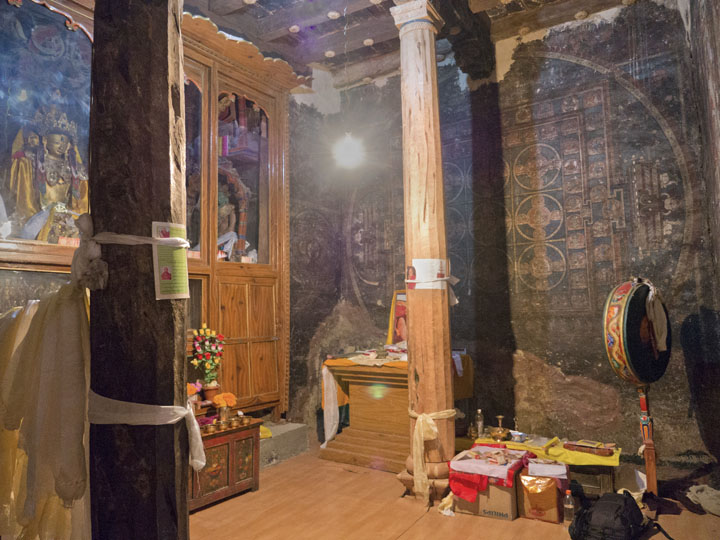
Interior of Nangbarnangzad, Mangyu Monastery, with Indo-Tibetan sculptures and wall paintings, Ladakh. Visible on right is Vajradhatu Mandala.
Interior of Nambarnangze, Mangyu Monastery, with ca. 11th century Indo-Tibetan sculptures and wall paintings, Ladakh. Visible on right is Vajradhatu Mandala.
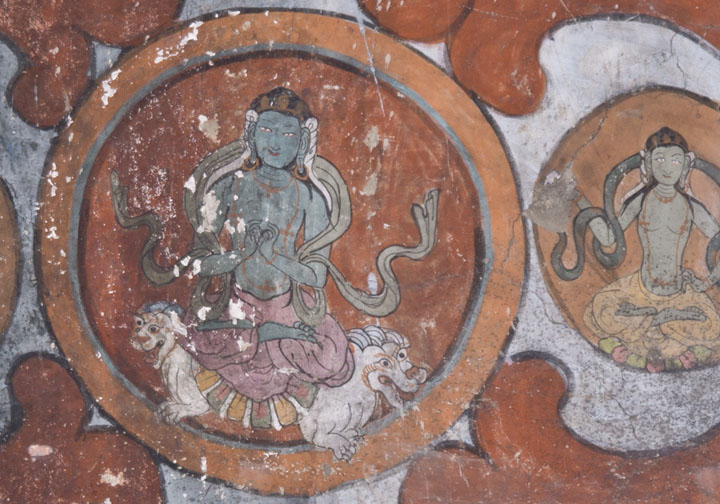
Detail from Vajradhatu mandala, Indo-Tibetan ca. 11th century wall painting, Nanbarnangad (Vairocana temple) of Mangyu Monastery, Ladakh, India
Detail from Vajradhatu mandala, Indo-Tibetan ca. 11th century right side wall painting, Nambarnangze (Vairocana temple) of Mangyu Monastery, Ladakh, India
Detail from Vajradhatu mandala, Indo-Tibetan ca. 11th century wall painting, Nanbarnangad (Vairocana temple) of Mangyu Monastery, Ladakh, India
Detail from Vajradhatu mandala, Indo-Tibetan ca. 11th century right side wall painting, Nambarnangze (Vairocana temple) of Mangyu Monastery, Ladakh, India
Interior view of Nanbarnangzad, Mangyu Monastery, with Indo-Tibetan wall paintings, Ladakh
Interior view of Nambarnangze, right side wall adjoining entrance wall, Mangyu Monastery, with ca. 11th century Indo-Tibetan wall paintings, Ladakh

On this entrance wall, however, most everything has been repainted. Peter van Ham in his book Heavenly Himalayas: The Murals of Mangyu and other Discoveries in Ladakh, published recently in 2010, gives a very different description of the state of the protector deity painting above the door.
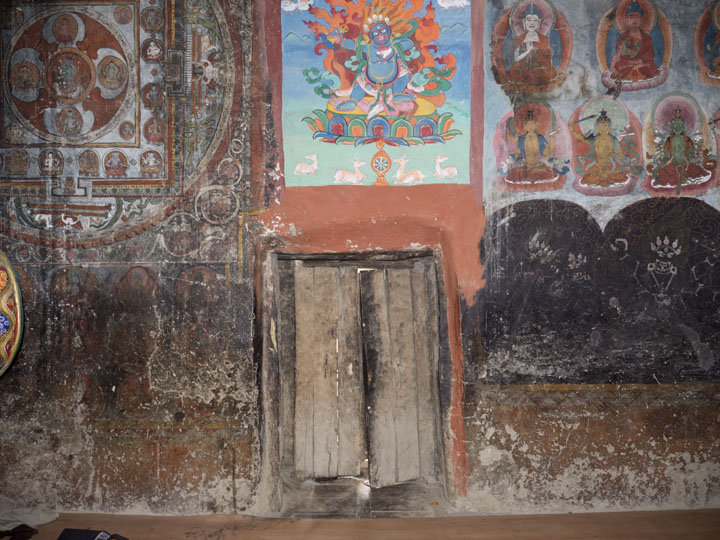
The entrance wall of Nangbarnangzad, Mangyu Monastery, Ladakh. Wall paintings here are mostly repainted over ca.11th century originals.
The entrance wall of Nambarnangze, Mangyu Monastery, Ladakh. Wall paintings here are mostly repainted over ca.11th century originals.

He writes, “The entrance…is protected by a wrathful blue deity, painted above the door. Only the right half of the painting has been preserved, the rest has been washed away by water leakage through the roof…As two peculiarities the protector is adorned with beautiful shawls displaying typical Ladakhi tie-dye patterns and in his right hand he holds a knife with an interesting blade of Indo-Iranian shape, the tip of which is equipped with a vajra-like structure.”
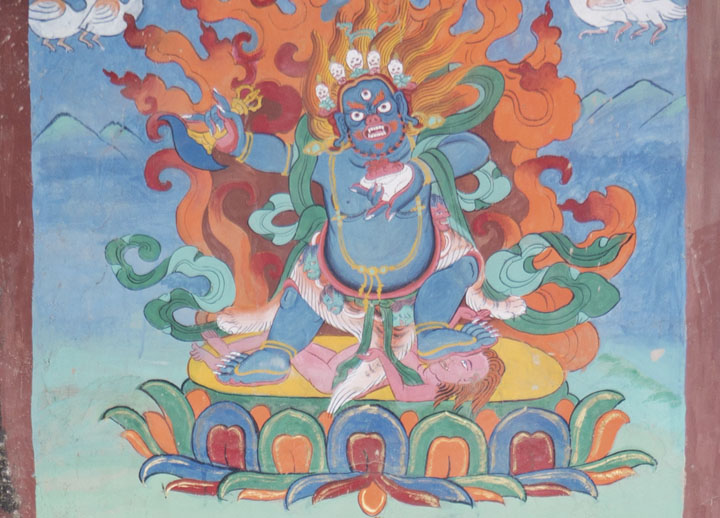
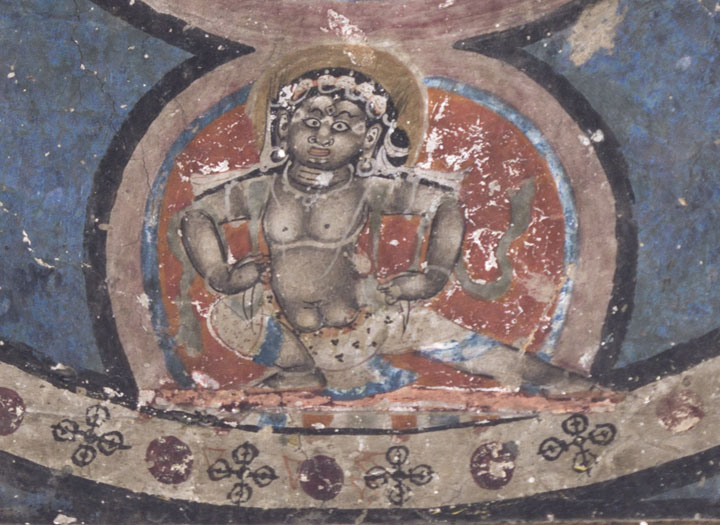
Repainted Mahakala above entrance door of Vairocana Temple, Mangyu Monastery, Ladakh.

The discrepancy between van Ham’s description and the above photo shows that this Mahakala was certainly repainted in the last few years. As we can see, absent are the shawls with Ladakhi patterns. This evidence, along with mismatched colors and less refined execution, leaves me shocked and deeply saddened over the handling of Mangyu Monastery preservation.

While the colors in this repainted mandala on the left of this entrance wall are more in keeping with extant original murals, the execution looks nothing at all like the sophisticated, skillful, and expressive handling of Indo-Tibetan artists.
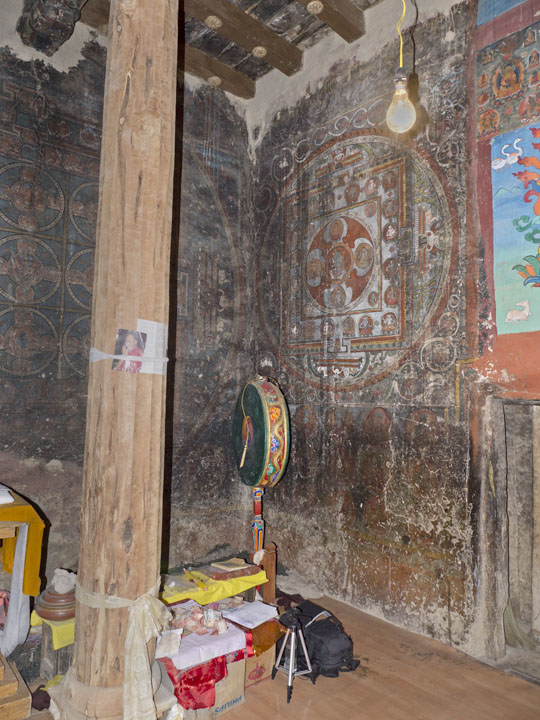
Interior view of Nanbarnangzad, Mangyu Monastery, with Indo-Tibetan wall paintings, Ladakh
Interior view of Nambarnangze, Mangyu Monastery, with Indo-Tibetan wall paintings, Ladakh
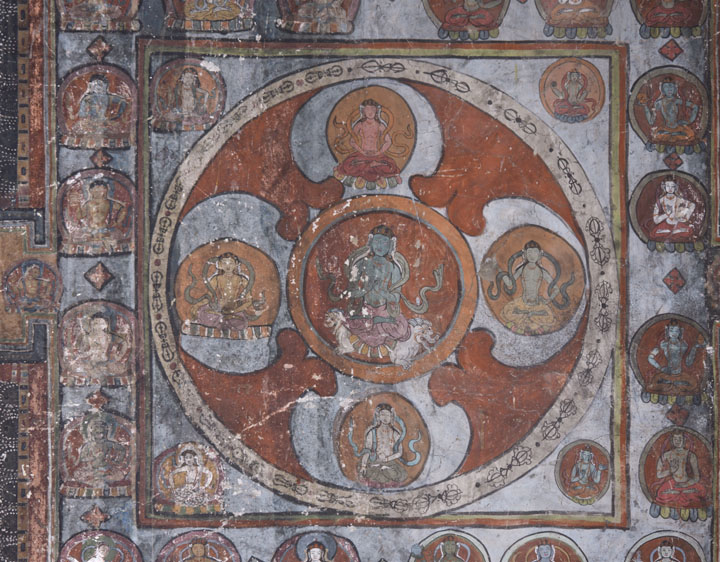
Detail of Vajradhatu mandala, Mangyu Monastery, Ladakh, India
Detail of  repainted mandala on left side of entrance wall, Nambarnangze, Mangyu Monastery, Ladakh
Detail of Vajradhatu mandala, Mangyu Monastery, Ladakh. Stylistically different, this was probably repainted over the ca. 11th century original Indo-Tibetan work by Kashmiri artists.
Detail of repainted mandala on left side of entrance wall, Mangyu Monastery, Ladakh. Stylistically different, this was probably repainted in recent years.
Detail of Vajradhatu mandala, Mangyu Monastery, Ladakh. Stylistically different and lacking in refinement, this is strong evidence of repainting over original Indo-Tibetan art.
Detail of repainted mandala, Nambarnangze, Mangyu Monastery, Ladakh. Stylistically different and lacking in refinement, this is strong evidence of repainting over original Indo-Tibetan art.

The same is true for the left side wall. What van Ham describes of the 11.5 foot diameter mandala that dominates this wall does not match what currently exists. This must also be a recently repainted mandala.
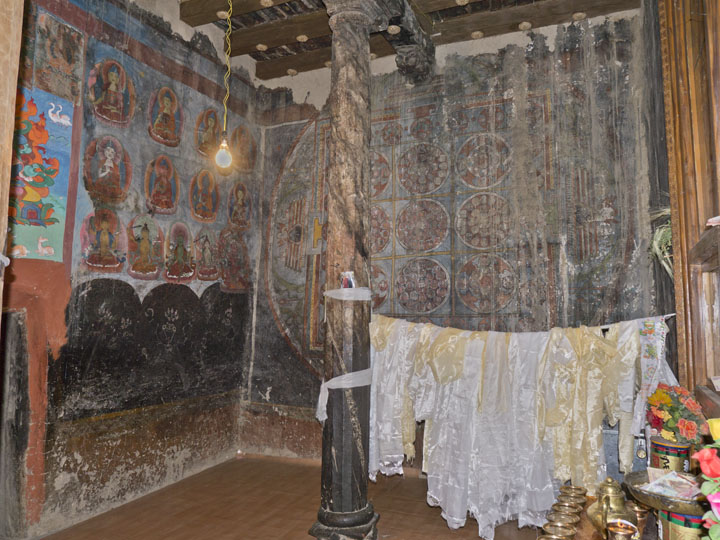
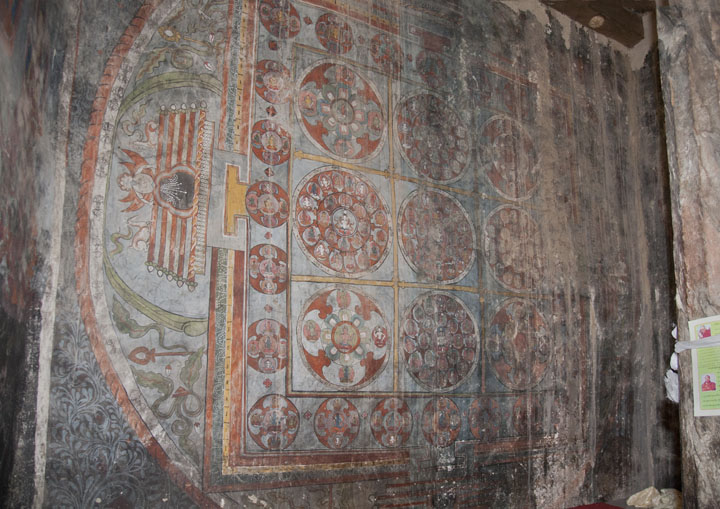
View of Vajradhatu mandala on back wall, adjacent to a variety of wall paintings that post-date the Indo-Tibetan period, another example of repainting that threatens the survival of the originals
View of Vajradhatu mandala on left side wall, adjacent to a variety of wall paintings that post-date the Indo-Tibetan period, another example of repainting that threatens the survival and art-historical importance of the originals
View of Vajradhatu mandala, Nangbarnangzad, Mangyu Monastery, Ladakh
View of Vajradhatu mandala, also repainted, Nambarnangze, Mangyu Monastery, Ladakh. Photo: Kishore Thukral

When this is what an example of original quality and style looks like (click on second image on the bottom) the quality and style of this repainted example pales in comparison.
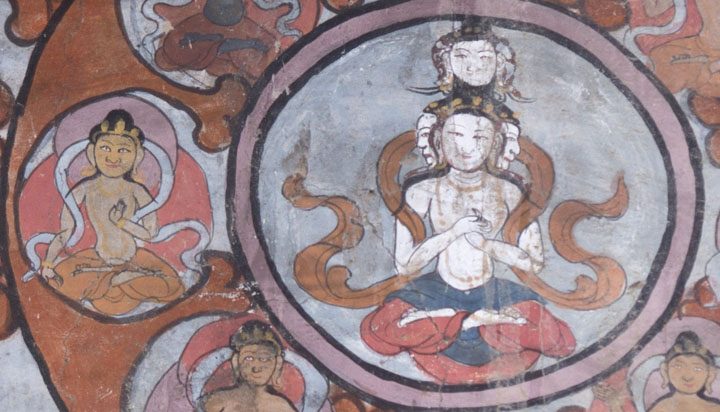
Detail of Vajradhatu mandala, Nangbarnangzad, Mangyu Monastery, Ladakh. Once again, stylistic and quality differences indicate repainting over Indo-Tibetan originals.
Detail of repainted Vajradhatu mandala, Nambarnangze, Mangyu Monastery, Ladakh. Once again, stylistic and quality differences indicate repainting over Indo-Tibetan originals.

This small Buddha mandala is on the left of the altar wall. It contains some original and repainted areas.
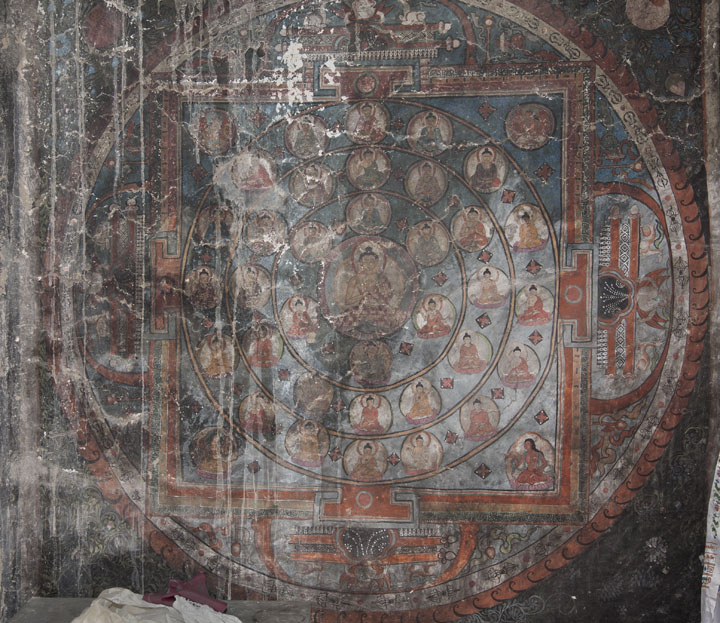
Buddha mandala, Nangbarnangzad, Mangyu Monastery, Ladakh. Stylistic and quality differences indicate repainting over Indo-Tibetan originals.
Buddha mandala, Nambarnangze, Mangyu Monastery, Ladakh. Stylistic and quality differences indicate repainting over Indo-Tibetan originals. Photo: Kishore Thukral

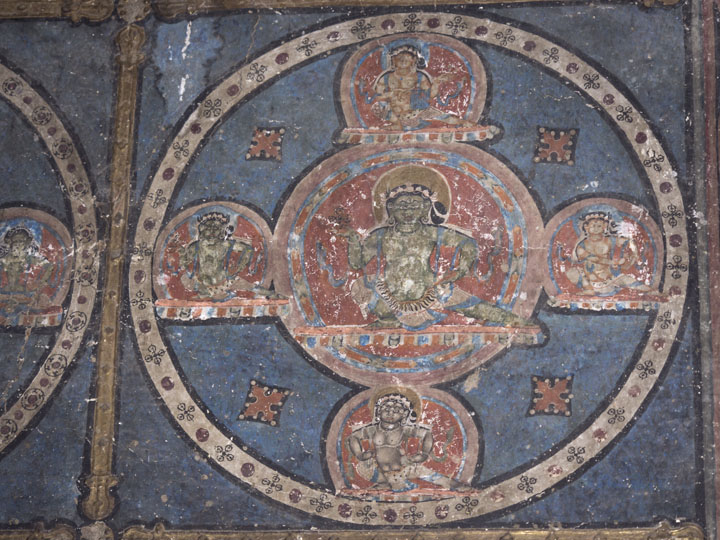
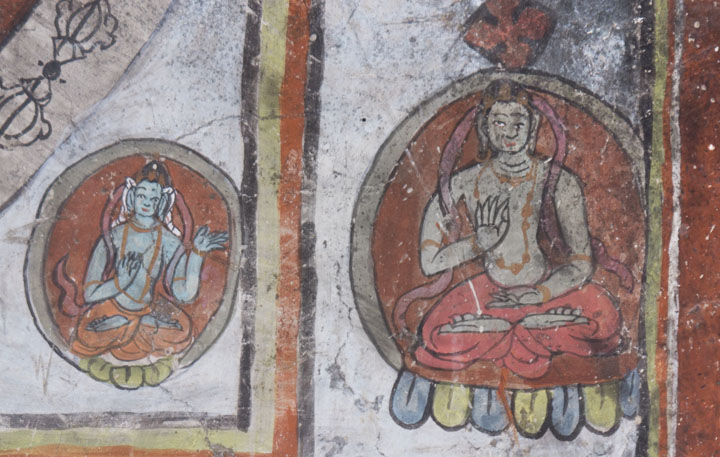
Here is a side-by-side view of what appears to be an original Indo-Tibetan Buddha in center next to a contemporary repainted one.
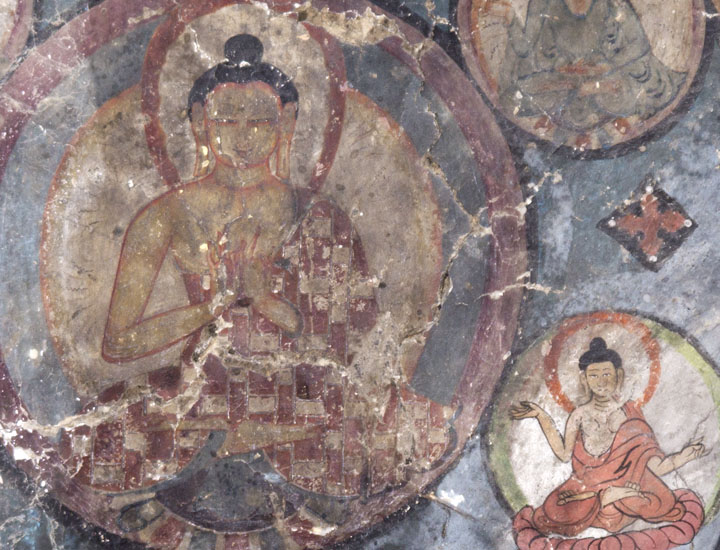
Detail of Buddha mandala, Nangbarnangzad, Mangyu Monastery, Ladakh. The central Buddha looks original, but at lower left, stylistic and quality differences indicate repainting over Indo-Tibetan originals.
Detail of Buddha mandala, Nambarnangze, Mangyu Monastery, Ladakh. The central Buddha looks original, but at lower left, stylistic and quality differences indicate repainting over Indo-Tibetan originals.

The historian David Snellgrove wrote in Indo-Tibetan Buddhism: Indian Buddhists and their Tibetan Successors, “The absence of all Buddhist wall-painting in India apart from the Ajanta Caves represents an enormous loss for the history of Indian art. Some deductions can be made from fragmentary remains in Central Asia and especially from the earliest surviving Tibetan murals from about A.D. 1000 onward, and from miniature paintings on Pala manuscripts of about that date.”

While Mangyu may still be pristine from a tourist/environmental point of view, it is less so from an art-historical one. Like I fear for Tabo, Alchi, and other remaining monasteries that have Indo-Tibetan significance, these beautiful, rare wall paintings are disappearing not only through age and exposure to natural elements, but also through the unexpected hands of man. The resultant replacement paintings, lacking in comparable quality, style, etc., are functionally erasing historical records. The originals are thus disappearing over time due to lack of proper conservation and restoration.

All photos © 2013, Eva Lee.

It Was My Day

Sept. 12, 2013     Lahaul adventure continues…

Ah, a great night’s sleep at Kardang Monastery, dreaming of sweet friendships.  Then a rainbow appeared during morning sunshowers and breakfast with Ani-la! I mean, gee, how much more welcomed can one feel?

Rainbow over Lahaul Valley during morning sunshowers, Kardang Monastery

Later I went to talk with Lama Paljor-la, and found him in his house with his two Russian disciples. They politely excused themselves so I could speak with him. We shared a truly warm conversation about spiritual outlook and concerns.

It turns out that one of his disciples was in great pain from kidney stones, so Lama Paljor-la rushed out to drive him to Keylong. I was supposed to ride in with them (having had second thoughts about walking back by myself) but due to the emergency, I reverted to my original plan of returning on foot.

Looking towards Keylong from Kardang Monastery courtyard, Lahaul

This poor fellow’s unfortunate circumstance became my fortunate one.

View up the Bhaga River Valley from Kardang Monastery, Lahaul
View up the Bhaga River Valley from on trail from Kardang Monastery to Keylong, Lahaul

It was lovely. I only saw one person on the long trail back. I had a most wonderful time alone.

View of Lahaul Valley on trail from Kardang Monastery to Keylong, Lahaul

At one point, I filmed the rushing waters of the Bhaga River, sat on a big rock catching my breath (gasping was more like it!) and suddenly felt…um, absolutely content.

Crossing the footbridge over the Bhaga River on the trail from Kardang Monastery to Keylong, Lahaul

Looking around me at the grand nature, feeling physically and mentally comfortable, at that moment, everything was so fine.

Contentment on the trail to Keylong from Kardang Monastery, Lahaul

It is said that Garsha can have that effect. I guess it was my day to experience it.

Taking a break
Along the trail to Keylong from Kardang Monastery, Lahaul Valley
Emerging into lower Keylong village from the cliffside trail back from Kardang Monastery, Lahaul

Funny to think, I almost missed it…

All photos © 2013, Eva Lee.

Hot Yogis of Kardang Monastery

Sept. 11, 2013     Lahaul visit begins…

Yesterday, J and I came to Kardang Monastery to meet resident yogi and monastery head Lama Paljor-la. After learning about my project, he generously shared stories with us about the murals, objects, and photos in the main temple. J knows quite a lot about the Drukpa Lineage so they both had much to discuss.

Kardang Monastery as seen from across the Bhaga River, Lahaul, India
Kardang Monastery as seen from across the Bhaga River, Lahaul

Kardang today is perhaps the best known monastery in Keylong owing to its association with the Shakya Shri Drukpa Lineage. Lineage is of terrific importance in Tibetan Buddhism because tantra is a living spiritual tradition transmitted orally in teachings from master to disciple. In this way, there is a connection from generation to generation which can be traced back to the Buddha himself.

Drubwang Shakya Shri (1983-1919) was an exceptional yogi who started out as a cook in a Drukpa monastery in Tibet. His lineage is unique because, through deep, whole-hearted practice, it is said he received his enlightenment directly from Vajradhara, the primordial Buddha. He was widely recognized as an incredible adept by other masters, including His Holiness the 14th Dalai Lama. With pure connections going back only a few generations, Shakya Shri lineage is known for its effective master-to-disciple teachings which guide practitioners swiftly along the Buddhist spiritual path. Shakya Shri mastered Mahamudra in the Drukpa Kagyu tradition, and also Dzogchen through the Nyingma lineage. He was later known for being involved with the Ri-me (non-sectarian) movement.

It was Shakya Shri’s disciple Jetsun Norbu Rinpoche, who returned to Lahaul from Tibet after his master had passed away. As holder of his teachings, and in particular of the Six Yogas of Naropa and Mahamudra, he soon attracted 2000 followers from all over the Western Himalayas. Though his hermitage was thriving, he preferred to live in a cave above Kardang Monastery.  In time, Kardang became known as a yogic training center.

Cave above Kardang Monastery, possibly like one that Norbu Rinpoche lived in
Cave dwelling above Kardang Monastery, possibly like one that Norbu Rinpoche lived in

As I mentioned in an earlier post, you may have heard of Tibetan Buddhist practitioners who can do unusual physical things. It was some of Shakya Shri’s lineage yogis whom Harvard scientists studied in the 1980s doing tummo practice, in which they can raise the temperature of parts of their body by as much as 17 degrees! One study involved the yogis scantily clothed spending a Himalayan winter’s night outdoors on a rocky ledge at 15000 feet altitude where temperatures reached freezing. The yogis demonstrated they could remain warm and slept through the night without incident. I think most of us would have suffered hypothermia! It occurs to me that Lama Paljor-la could have been one of these yogis.

Kardang Monastery is believed to have been founded about 800 years ago, but nothing seems to remain of its original temple. The current main temple was first built by Norbu Rinpoche in the 1930s, but was rebuilt several years ago by Lama Paljor-la, a disciple of lineage holder and former monastery head Apho Rinpoche. I have had the pleasure of meeting three of Apho Rinpoche’s children in Manali en route to Spiti and coming back from Lahaul: lineage holder Sey Rinpoche, his brother Jampal who is also a recognized reincarnate but prefers to live a quiet life with his family, and Khandro Thrinlay whom I wrote about previously here.

Kardong Monastery, Lahaul

Kardang Monastery is situated directly opposite Keylong on the other side of Bhaga River. See this 360 degree video view below.

[vimeo 145002351 w=600 h=331]


When one enters the main temple, one sees a mixture of old and new murals on the walls. The older ones, possibly no older than the 1930s, were painted originally on canvas so they were removed and reinstalled. They collage the walls alongside newly painted scenes.

The altar at Kardang Monastery, Lahaul
Interior of main temple at Kardang Monastery, Lahaul, with lama performing Mahakala prayers

At the altar are Buddha Shakyamuni statue on the middle, Vajradhara on the left and Padmasambhava on the right (also known as Guru Rinpoche, who introduced Buddhism to Tibet in the 8th century).

Buddha Shakyamuni in center, altar at Kardang Monastery, Lahaul
Vajrdhara on left, Buddha Shakyamuni in center, Padmasambhava on right, altar at Kardang Monastery, Lahaul
Interior view of Kardang Monastery, Lahaul
Interior view of Kardang Monastery where older and newer paintings collage the walls, Lahaul
Old and new paintings collage the walls of Kardang Monastery, Lahaul
Older and newer paintings collage the walls of Kardang Monastery, Lahaul
Interior view of main temple, Kardang Monastery, Lahaul
Detail of an older painting depicting a scene from the Life of Buddha, Kardang Monastery, Lahaul
Detail of an older painting depicting Chenrezig, Kardang Monastery, Lahaul
Detail of an older painting depicting Padmasambhava with consort, Kardang Monastery, Lahaul
Detail of an older painting depicting Padmasambhava with consort, surrounded by protector deities
Kardang Monastery, Lahaul

The monastery has a large library which includes the complete Kangyur, given to Norbu Rinpoche by the king of Bhutan, and the complete collection of the Wisdom Words of His Holiness the 4th Gyalwang Drukpa, the spiritual leader of the Drukpa Lineage.

Kardang Monastery has an extensive library of Kangyur scripture and other complete texts. Also seen here are sculptures of lineage masters, Lahaul, India
Kardang Monastery has an extensive library of Kangyur scripture and other complete texts. Also seen here are sculptures and relics of lineage masters
Gegen Rinpoche on left, His Holiness the 12th Gyalwang Drukpa on righton altar of Kardang Monastery, Lahaul
Gegen Rinpoche on left, His Holiness the 12th (current) Gyalwang Drukpa on right, on altar of Kardang Monastery, Lahaul
A newly painted mandala on the ceiling, Kardang Monastery, Lahaul
A newly painted guru-yoga mandala on the ceiling, Kardang Monastery, Lahaul

Above the main temple is a room that had belonged to Apho Rinpoche.  On the walls are paintings depicting Milarepa’s story that were originally painted on canvas and reinstalled in this new temple.

Apho Rinpoche's former room above main temple, Kardang Monastery
Apho Rinpoche’s former room above main temple, Kardang Monastery
Scenes from Life of Milarepa, older wall paintings from Apho Rinpoche's former room above main temple Kardang Monastery, Lahaul
Scenes from Life of Milarepa, older wall paintings from Apho Rinpoche’s former room above main temple Kardang Monastery. Above right are newer paintings.
Detail from Life of Milarepa, wall paintings, Kardang Monastery

I’m spending the night here tonight in one of the monastery guest rooms. There’s an Ani-la (nun) who has kindly cooked for me, but mostly Kandang’s community of eight monks and seven nuns are lone retreatants living in simple huts and cooking for themselves.

Detail from Life of Milarepa wall paintings, Kardang Monastery, Lahaul

J left this morning, and took the bus back to Manali. It was wonderful traveling with her, and I’ll miss her company to share travel discoveries with. Yes, so I’ll be here for several days on my own devices, until my next travel companion K arrives and we drive together to Ladakh. On my list of things to do here are to see Shashur and Tayul Monasteries.

View of Keylong from the courtyard of Kardang Monastery on the other side of the Bhaga River, Lahaul

Tomorrow I plan to walk back to Keylong via trail and footbridge across Bhaga River.  I hope the paths are clearly visible and I don’t get lost! There’s no taxi to be had here unless I call for one from Keylong.  And as Khandro-la’s assistant had told me, Lahaul does not have so much in the way of Indo-Tibetan mandalas, but is rather itself considered a Chakrasamvara mandala manifest, one should experience it on foot.  Even though we are at over 11,000 feet altitude, it seems not too hard to go downhill and not terribly far to walk perhaps 5-8 kilometers, so I think I should follow this advice and experience Garsha. After all, I am over the worst of altitude adjustments. I had vice-grip headaches at night which made it hard to sleep, but the head pain progressively improved, and by the end of the first week, went away. So while I’m a bit short of breath sometimes exerting uphill, it’s not a hardship.

All photos © 2013, Eva Lee.

Tabo Monastery: Himalayan Setting and Meditation Caves

Sept 6th, Tabo Village, the Spiti adventure continues…

Tabo Monastery within Tabo Village
Tabo Village, where Tabo Monastery is nestled in Spiti Valley unlike other Buddhist monasteries that were built as fortress-like compounds on hilltops

Well, here we are in Tabo! The famed Tabo Monastery is known as the oldest continually functioning Tibetan Buddhist monastery, the art of which the Dalai Lama said “delightfully expresses the vigor of the transmission of Buddhism from India to Tibet and the dynamic mingling of cultures.” Established in 996 C.E. by the Buddhist king of Guge in Western Tibet, Yeshe O’d, and the The Great Translator Rinchen Zangpo, it flourished in a golden epoch of Indo-Tibetan collaboration in spreading Buddhist culture.

Tabo Monastery complex behind stone walls in Tabo Village
Tabo Monastery complex behind stone walls in Tabo Village, Spiti Valley, India

Tabo’s existing sacred artwork and architecture have unique historical significance, not only for the aesthetic evidence of such cultural exchange, but also for its rarityDue to the enormous destruction during the Chinese Cultural Revolution, where over 6000 monasteries and their artworks were destroyed between 1959-61, practically none of the early examples of Buddhist culture have survived in Tibet. Consequently, the monasteries of the Western Himalayan border areas of Spiti, Lahaul, and Ladakh, once part of Tibet, is of great importance for its legacy of early Tibetan Buddhist culture, and in particular, its connection with India.

Street view of Tabo Chokhor
Street view of entrance to Tabo Choskhor,Spiti, with the museum and library in building on right
Upon entering Tabo Monastery complex, the first building one sees is Tsug Lhakhang, the grand main assembly hall
The Tsug Lhakhang, TAbo Monastery, Spiti
The Tsug Lhakhang, Tabo Monastery, Spiti

Of the monasteries I’ll visit, Tabo, Alchi, Mangyu, Lamayuru, and Lhalung strike me as being of special importance. These have exceptional murals, unusual in cross-cultural style and depiction, executed in astounding refinement, with ornate clay sculptures that are cantilevered off the walls in Vajradhatu mandala arrangement of sacred space (more on this in the next post!) This type of work is specific to the area and is not found in any other Buddhist temples in the world. These monasteries also date back to that fertile period of Buddhist philosophical exchange and revitalization from India to Tibet beginning in the 10th century during The Great Translator Rinchen Zangpo’s time.

Documenting the extant artwork and architecture of these sites is essential because they are remarkable, and extreme Himalayan winters and potential earthquakes, such as the one that occurred in 1975, continue to threaten their survival. Proper conservation and restoration is critical for art history and posterity. Of immediate concern is the effects of climate change and increased rainfall in the normally more arid Spiti that has damaged Tabo’s murals and architecture. This 2010 article entitled “A Monastery’s Fading Colours,” published in The Indian Express, is about the challenging circumstances facing the monastery’s care under the maintenance of the Archeological Survey of India (ASI).  The Times of India recently questioned the national organization’s general efficacy in its article, “92 ASI-protected Monuments Missing.”

Rear view of Tsug Lhakhang, Tabo Monastery, Spiti
Rear view of Tsug Lhakhang with workers currently repairing the mud exterior. Its back walls are as thick as 2.5 meters!
Workers repairing the mud exterior of Tabo Monastery
Workers currently repairing the mud exterior of Tabo Monastery, Spiti

I find myself wishing these monasteries were designated UNESCO World Heritage sites, such as the early Buddhist Ajanta Caves are in India, or considered World Monuments. Perhaps this would bring more international attention and expertise to help hasten the appropriate preservation and protection against man-made as well as environmental challenges.

Fortunately, I was able to arrive in Tabo with all my equipment fully charged because the electrical power was mostly on during my previous night in Kaza, Spiti. But unfortunately, I was unable to photograph due to administrative details still to iron out. Perhaps by tomorrow, after the special 6:00 a.m. morning prayers for the recently deceased and venerated abbot of Tabo which will be performed as part the traditional 49 days’ observance. Despite not being able to photograph, the monk in charge of the monastery kindly showed me most of the temples in the complex.

What is so immediately striking is the contrast between the simple exterior architecture of mud brick and the resplendent interiors. Wow, the ornate interiors leave you speechless, what treasures of Indo-Tibetan art, history, and philosophy! Especially the dramatic, dark, moody, pensive main assembly hall (Tsug Lha-khang); the older Dromton Temple (Brom-ston Lha-khang), founded by the main disciple of the great teacher and adept Atisha; Initiation Temple (dKyil-kHor-khang), where monks are initiated; Bodhisattva Maitreya Temple (Byams-Pa Chen-po Lha-khang), with a 20 foot high painted mural of the future Buddha Maitreya; and the Golden Temple (gSer-khang).

3_OtherVws (10)
View of Tabo Monastery complex showing Dromton Temple on far right and Bodhisattva Maitreya Temple left of it, Spiti, India

Oh, news flash! For incredible floor plans of these temples, including elevations, sections, 3D models, photo montages, and more, see this excellent website of an Austrian research team at Graz University of Technology that has been studying the architectural heritage of the Western Himalayas.

And did I mention caves? Yes, caves on a steep cliff above Tabo Monastery and village where, according to archeological evidence, monks had lived and practiced meditation since the 11th century. Now it is an ASI protected site. Most caves are open spaces showing evidence of ancient occupation–sooty interior walls and carved out niches, etc., as well as perhaps picnic use by modern visitors. But while exploring with my flashlight, I peered into an opening of a small closed door of a dark cave only to find a blanched seated figure looking back at me! Startled and flustered, realizing this was a real person and not a phantom, I muttered a quick, deepest apology, and left in a hurry! Well, I guess today there are still some practitioners who retreat to these caves. Whether this was a tourist trying it out, or a yogi, I have no idea.

Path to Tabo caves
Path to numerous caves above Tabo Monastery and village, Spiti, India
Tabo caves
One of numerous caves carved into the cliffs above Tabo Monastery, used by monks from the 11th century on, Spiti
View of Tabo Monastery from inside cave
View of Tabo Monastery from inside a cave, Spiti

Have a virtual walk-through here of the insides of some of these caves:

View inside a Tabo cave
View of the inside of the above Tabo cave, Spiti
View of Tabo caves
View of Tabo caves located on a steep cliffside above Tabo Monastery, Spiti
View of Tabo Village from cave sites, Spiti, India

Ok, I hope I have a headache-less night’s sleep tonight.  Day four at high altitude and I’m still adjusting, but Tabo is at about 10,000 feet high, 2000 feet lower than Kaza, so it should be better.  Need to get up early to make it to 6am puja!

All photos © 2013, Eva Lee.

Out of Order in the Himalayas

It will be a bit out of order, but what the heck….Of course, I mean out of sequence, not broken!

I’m working on retroactive blog posts of basically all my experiences from last month’s travels through Spiti, Lahaul, and Ladakh to research and document Indo-Tibetan murals. Why didn’t I just post along the way? Because, internet stick and four SIM cards later, I was not able to access the internet while on the road. Especially in electricity-challenged Spiti, where kerosene for generators is even rationed, and Ladakh, border security area where cellular and other signals are highly controlled. I gave up trying and decided I would post when I got back to Dharamsala.

And here I am back in Dharamsala…but I did not think it would take long to back-post since I’ve already written a lot of material while still traveling. However, with image management and identification of thousands of photos shot in monasteries, it’s proving to be more time-consuming to present with accompanying photos. And who wants to read text here without the images? Not me!

So here’s what I’m going to do.  I’m going to toggle back and forth between posting about the present, and posting about last month, as I continue researching here in the lower Himalayas. In addition to Dhangkar and Lhalung Monasteries which are already here on this blog, stay tuned for accounts of what I saw and did at Key Monastery, Tabo Monastery, Kardang, Guru Ghantal, Shashur, Tayul, and Poekar Monasteries, including Phakpa in Triloknath and Markul Devi Temple in Udaipur sojourns. Then Alchi, Mangyu, Lamayuru, Likir, Shey, Thiksey, Hemis, and Mulbek Chamba Monasteries.  Yes, jam-packed with history, anecdotes, incredible landscapes, and ponderings!