Ajanta Caves called “The Greatest Ancient Picture Gallery” by William Dalrymple
Posted
A statue of the Buddha in one of the Ajanta Caves, India
Excerpt from “The Greatest Picture Gallery” Read this captivating article by the excellent writer and historian William Dalrymple here at The New York Review of Books.
“[I]n 1819, a British hunting party in the jungles of the Western Ghats had followed a tiger into a remote river valley and stumbled onto what was soon recognized as one of the great wonders of India: the painted caves of Ajanta. On the walls of a line of thirty-one caves dug into an amphitheater of solid rock lay the most beautiful and ancient paintings in Buddhist art, the oldest of which dated from the second century BC—an otherwise lost golden age of Indian painting. In time it became clear that Ajanta contained probably the greatest picture gallery to survive from the ancient world, and along with the frescoes of Pompeii, the fabulous murals of Livia’s Garden House outside Rome, and the encaustic wax portraits of the Egyptian Fayyum, Ajanta’s walls represented perhaps the most comprehensive depiction of civilized life to survive from antiquity.”
This article brought back wonderful memories of visiting Ajanta Caves during my 2013-2014 Fulbright research and travels!
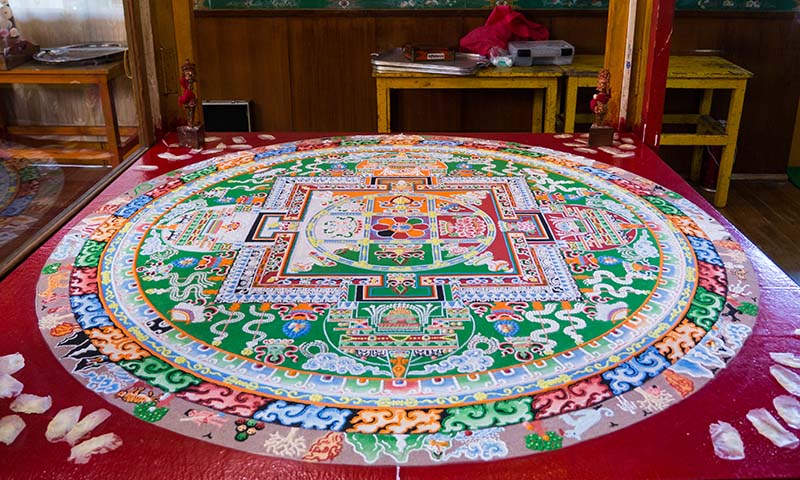
I’ve gone about it all backwards. Backwards in time, in pursuit of mandalas. It all started when I heard that a sand mandala was going to be made at Namgyal Monastery in Dharamsala, India, in 2010. So I went there, and found out that it was a Yamantaka mandala, part of a ten-day-long highest yoga tantra ritual which occurs annually at the Dalai Lama‘s personal monastery. My previous post here describes what little I knew then as I observed and documented the creation and dissolution of it. The resultant film and photographs can be seen here.
When I came back to the U.S., it was as if a floodgate had opened. I needed to learn more. No, not just more, but all I could about Tibetan mandalas–about their variety, their purpose, their history, the meditation practices they engendered, and so forth. What did it all really mean? What modern significance did it have?
My bookshelves began to fill up with writings about tantra and Buddhist philosophy, written by the first Tibetan teachers to venture into the Western world, post-1959 exodus from Tibet. Titles by the Dalai Lama, Chogyam Trungpa Rinpoche, Lama Thubten Yeshe, Dilgo Khentse Rinpoche, as a few examples, abounded. I also read works by contemporary lamas like Dzogchen Ponlop Rinpoche, Pema Choedron, Tsoknyi Rinpoche, Tenzin Palmo. Tibetan scholars and historians David Snellgrove, Robert Thurman, Deborah Klimburg-Salter, Martin Brauen, and others figured in there, too.
All this, in addition to my previous discoveries of well-respected meditation teachers from other Buddhist traditions–Sharon Salzberg, Joseph Goldstein, Jack Kornfeld, B. Allan Wallace. I followed the writing of neuroscientists and clinicians, too, who studied or used meditation in their work. They were also involved with fascinating Mind & Life Institute research or conferences–Richard Davidson, Jon Kabat-Zinn, Paul Ekman, Daniel Goleman.
It was a mindfulness-neuro-tantric-philoso-fest that poured forth!
Meanwhile, in 2011, the ritual experiences continued. I attended the Dalai Lama’s Kalachakra event for World Peace in Washington D.C., and witnessed the Kalachakra Mandala.
In 2012, I was at the Dalai Lama’s talk at Western Connecticut State University at which time I encountered a Compassion Mandala.
At both events, I had the wonderful opportunity of befriending and working with monks, nuns, plus other Buddhist practitioners and followers.
It was a steady flow. The waters at the floodgates just did not tire out. Answers came, and new questions arose.
Thus, on the heels of this, last year in 2013 I arrived back to India to experience and research rare Indo-Tibetan mandalas in Himalayan monasteries of Spiti, Lahaul, and Ladakh. How might they have evolved into Tibetan forms that we know today? What was this Indo-Tibetan 10th to 12th century period called the Second Great Transmission of Buddhism from India to Tibet? What did the sacred art look like? What did it mean?
At the end of my travels through the Himalayan high altitudes, I then thought, let’s reel back in time some more. What came before the Indo-Tibetan era?
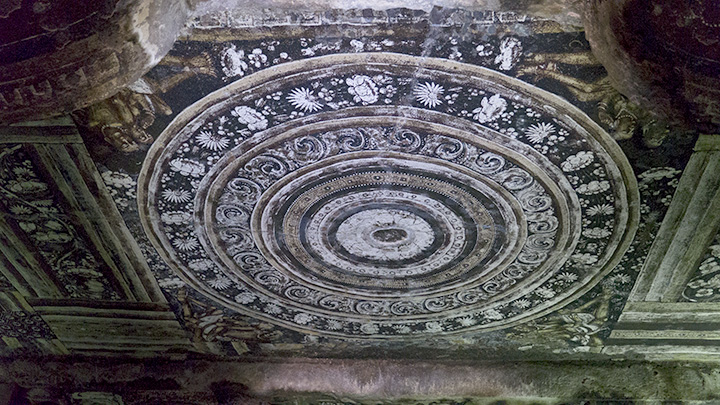
The answer was, Indian Buddhism, which could be seen at Ajanta and Ellora Caves where there are remains of elaborate 2nd to 8th century C.E. wall paintings, sculptures, and architecture. Such purely Indian Buddhist art is still preserved at these South Indian sites in the state of Maharashtra.
Finally, what might have come even before this in India? I mean in B.C.E. times. When I searched further, it seems that the Buddhist art historical record stops here. According to historians, not much still exists before the 1st century C.E. Little is known in India archeologically prior to this time.
So what’s it all about? Why would an artist go for all this? New artwork from my Fulbright experience does beckon me in the studio.
I guess I’m just driven by the big questions about mind and reality, which Buddhist philosophy seems to address best. And moreover, that largely works within a Western scientific paradigm. It doesn’t hurt, either, that an affable spiritual leader like the Dalai Lama continues to inspire and exemplify how one can be intellectually sharp, existentially awake, and compassionately engaged in the world. Despite being a keeper of complex Tibetan rituals and esoteric tantric teachings, he can still keep it simple and distill wisdom down to these words: “There is no need for temples, no need for complicated philosophies. My brain and my heart are my temples. My philosophy is kindness.”
Wow! The Kailash Temple of Ellora Caves, Plus Indra Sabha, Nudity, and the Dalai Lama
Posted
December 12-13, 2013
The Kailash Temple (Cave 16) is arguably the most famous one of all 34 caves at Ellora Caves. My previous post was about the marvelous Buddhist ones, but wow, this Hindu site is remarkable!
Base of the main temple, Ellora Cave 16
Built in the 8th century by the Rashtrakuta king Krishna I, 756-783 C.E., it is the most advanced excavation. An enormous Brahmanical complex, its most unrivaled feature is the free standing main temple in the center.
Did you read that right? Yes, you did! This “cave” has an open courtyard with a free-standing centerpiece, which entailed an ambitious, massive vertical excavation of incalculable tons of rock by approximately, I read, 17,000 laborers over the course of about 100 years. Vertical means that the structure was created by carving from top to bottom to realize this multi-level Dravidian-styled temple. What a feat! This magnificent cave is probably the largest excavation in the world measuring 276 feet long x 154 feet wide x 107 feet high.
What’s more, the complex is surrounded on three sides by colonnaded walkways three stories high with extensive overhang. There are huge carved panels there and alcoves with enormous sculptures of Brahman deities.
Panoramic view of Kailash Temple from the colonnaded walkway, Ellora Cave 16, HinduView of colonnade walkway near back of Kailash Temple. Visible at right is the extended overhang.View down the length of colonnaded walkway, Ellora Cave 16, Hindu
Kailash Temple, as its name suggests, is intended to recall the sacred Mount Kailash. This Himalayan mountain is an abode of Lord Shiva, and Ellora Cave 16 is dedicated to him.
Kailash is incidentally located in Tibet, and is one of holiest of the holy mountains for both Hindus and Buddhists alike. A pilgrimage there and circumambulating its base earns one great spiritual merit.
Left: Mount Kailash north face. Right: Mount Kailash south face, Tibet. Kailash Temple, as its name suggests, is intended to recall the sacred Mount Kailash. This Himalayan mountain is an abode of Lord Shiva, and Ellora Cave 16 is dedicated to him.
In my earlier Fulbright travels, I went to three other places in the Lahaul region of the Indian Himalayas that were also revered by both Hindus and Buddhists–Drilbu Ri Mountain, which I climbed to reach its 15,000 foot summit, Phakba, and Markul Devi Temple. I really admire that there has been a long history of mutual respect and shared reverence between these two indigenous major religions in India.
In addition to the expansive colonnaded walkways, within the courtyard of Ellora Cave 16 there are two other main structures. As is traditional in Shiva temples, the first is the Nandi Temple at the entrance. I actually missed seeing the sacred bull within in because I was mesmerized by the rest of the “cave” and just kept walking on!
The entrance and two-storied Nandi Mantapa or pavilion, Ellora Cave 16, HinduSide santuary within the courtyard near entrance of Ellora Cave 16. To its right is the beginning of the arcade that surrounds three sides of the complexUpon entering through the Nandi paviion, you are greeted by Gajalakshmi, the goddess Lakshmi surrounded by elephants on a lotus pond, Ellora Cave 16
The second structure is the main Kailash temple. Its base is carved with graceful life-sized elephants, lions, and mythological figures.
Graceful elephants standing at attention appear to uphold the base of Kailash Temple, Ellora Cave 16, HinduVisitors circumambulate the main temple, Ellora Cave 16, HinduWalking up to main temple, Ellora Cave 16. Traces of a formerly painted ceiling are visible.Entrance to main temple, Ellora Cave 16. Traces of painted facade can be seen on pilaster and elsewhere.
Upon entering, I feasted my eyes on the impressive intricacy of its interior. The central hall was richly carved. Everything, from its niches, pilasters, deities, figures, columns, etc., are ornamented. Most of the deities at the left of the entrance are Shaivaite (followers of Shiva) while on the right hand side the deities are Vaishnavaites (followers of Vishnu).
Interior of main temple looking towards the inner sanctum, Ellora Cave 16, HinduDetail of carved column, main temple, Ellora Cave 16, Hindu
The inner sanctum contains a large lingam, representative of Lord Shiva. Devotees leave offerings of flowers, money, candles and other objects.
Lastly, there is a significant sculpture at Ellora Cave 16 of Ravana, principle antagonist in the Hindu epic Ramayana, attempting to lift the abode of Lord Shiva, Mount Kailash, with all his might. It’s an unusual and expressive composition.
The Jain group of caves number 30-34, and they were the last to be excavated, circa 800-100 C.E. I was struck by Cave 32, also known as Indra Sabha, because it’s similar to Cave 16. It also features a central free-standing temple inside a courtyard, as well as Dravidian gate, and monolithic elephant sculpture by the entrance . Though smaller in scale, there are details of this cave that surpass its predecessor.
Ellora Cave 32, Jain temple, India
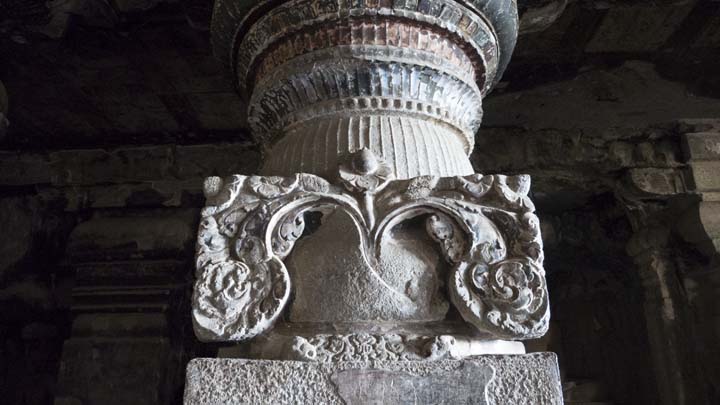
For example, the carved details and the unique designs of the columns on the second floor of the main temple truly outdo even the ornately decorated columns of Kailash Temple. They are massive in size and are carved in high relief. Some look like urns with draped garlands.
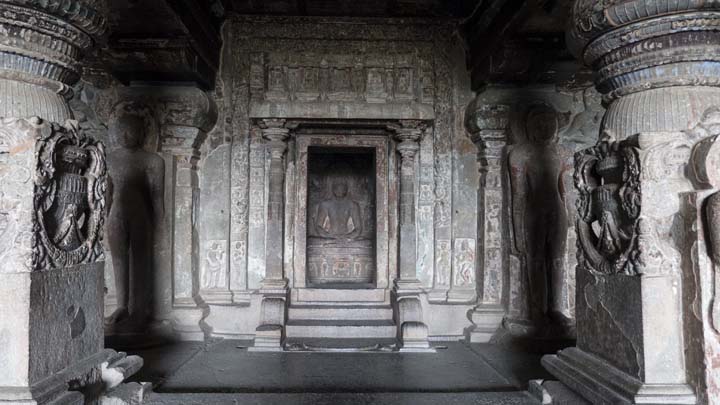
Ellora Cave 32, Jain temple, second floor, looking towards inner sanctumDetail of column, Ellora Cave 32, Jain temple, second floorDetail of column, Ellora Cave 32, Jain temple, second floor, India
Indra Sabha is actually a collection of shrines dedicated to the revered Mahavira, the 23rd tirthankara.
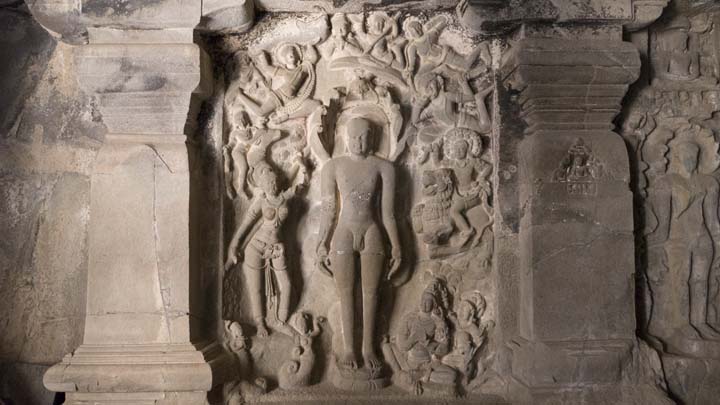
Inner sanctum with Mahavira statue, Ellora Cave 32, second floor, India
Mahavira (ca. 540-468 B.C.E.) was a contemporary of Buddha. The two had remarkably similar experiences and teachings. Like Buddha, Mahavira was born into a royal family. At the age of 30, he left his home in pursuit of spiritual awakening. Through ascetic practices for over twelve years, he achieved enlightenment. He traveled all over India for another 30 years to teach his philosophy, based on ahimsa (causing no injury through one’s deeds, words, or thoughts–which corresponds to Buddhist notions of body, speech, and mind); satya (absolute truth, like Buddhist right view); asteya (not stealing, or as Buddhists phrase it, not taking what is not freely given); brahmacharya (spiritual study, practice, and abstinence, similar to Buddhist monastic vows); and aparigraha (non-grasping or non-possessiveness, which forms part of the Buddhist idea of non-attachment and egolessness.) Mahavira attained nirvana after his physical death at the age of 72.
Mahavira, Ellora Cave 32
Jain depictions of Mahavira are also remarkably similar in appearance to Buddhist images of Buddha. With one key difference: Jain deities of the Digambara sect are nude.
When I saw Mahavira in an inner sanctum, I must admit that I was a bit surprised by the anatomical accuracy of his nudity. (The sacred art tells it like it is!)
But it’s not only Jain deities. The yogis, too. It reminded me of an anecdote the Dalai Lama told, and it goes something like this:
Once, at a ceremony in India, he found himself seated next to a Jain yogi who was stark naked. The Dalai Lama, shocked, had looked him up and down. “He just showed—everything! All of his things were right there!” He couldn’t help but keep looking at the yogi, but not because of his “thing.” Because he was so impressed with the intensity and forthrightness of this man’s practice! And so, the Dalai Lama got down on his knees and touched his forehead to the yogi’s knee as a sign of respect for him and his dedication to contemplative practice.
Gomateshwara, Ellora Cave 32
Pictured above is the revered Gomateshwara, also known as Bahubali.
Detail of Gomateshwara, Ellora Cave 32
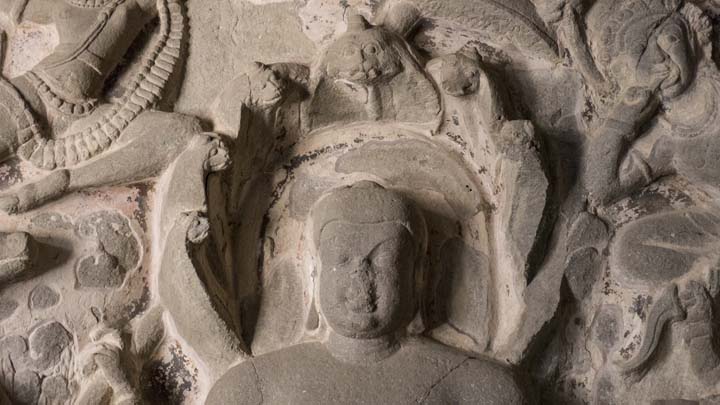
Below is the 23rd tirthankara,Parsvanatha, with his characteristic snake hood.
Parsvanatha, the 23rd tirthankara of Jainism, side wall, Ellora Cave 32Parsvanatha, the 23rd tirthankara of Jainism, with his characteristic snake hood, side wall, Ellora Cave 32, Jain temple
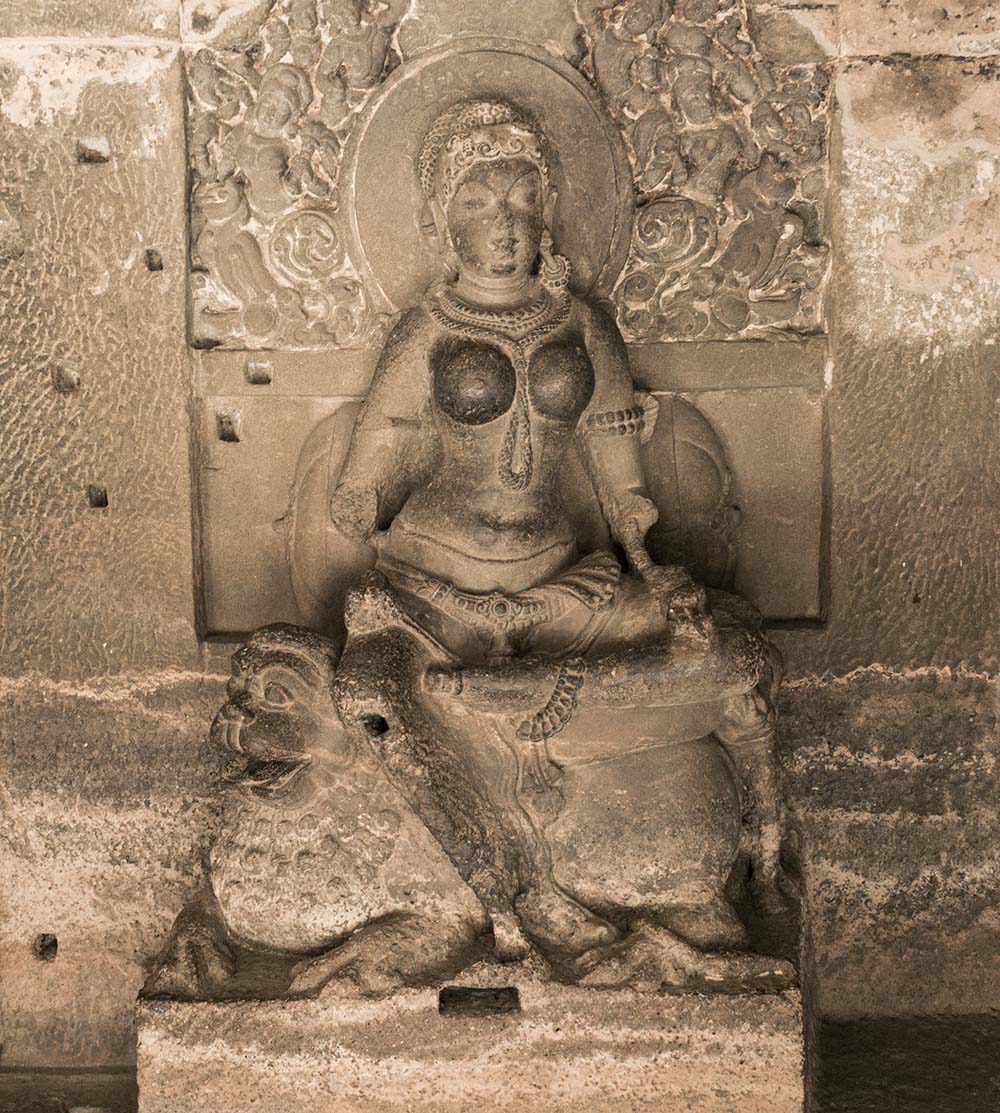
Mahavira is usually flanked by his attendant deities, Indra on an elephant and Ambika on a lion. I found these two carvings especially well done.
Indra riding on an elephant, Ellora Cave 32, Jain temple, India
Ambika riding on a lion, Ellora Cave 32, Jain temple, India
So there you have it…Ellora Caves–what a revelation in artistic and architectural excavation!
Gee, I’ve so far recounted only the September travels through Spiti, Lahaul, and Ladakh. There’s also October, November, and December to cover. Keeping this travelogue about my Fulbright experiences is taking longer than I anticipated! Editing photos (lots) and video (much) take time. So does research and writing.
And guess what? Now I have completed my Fulbright in India! Yes, that’s right, I’m back in the U.S.! It’s unbelievable how time flew by. I arrived just before Christmas holidays to rejoin family and friends, and rang in 2014 at home.
But, dear reader, there is much more to come. This blog is not over yet. After I finished traveling through the Himalayan high altitudes, I went to the lower altitude areas of Dharamsala, Bir, and Rewalsar (Tso Pema) to see the artwork of contemporary monasteries.
Plus, I also went to see the Buddhist carvings and frescoes of Ajanta, Ellora, and Aurangabad Caves in Southern India. These date from 2nd century B.C.E. to 8th century C.E., preceding the Indo-Tibetan period that I have been concentrating on in the Spiti, Lahaul, and Ladakh areas. After researching the sacred artwork of 10th century monasteries such as Tabo, Lamayuru, Lhalung, Mangyu, and Alchi, I felt compelled to see what came before.
Ajanta coming up next! Here is a sneak peak. I promise you’ll never think of the word “cave” the same way again!
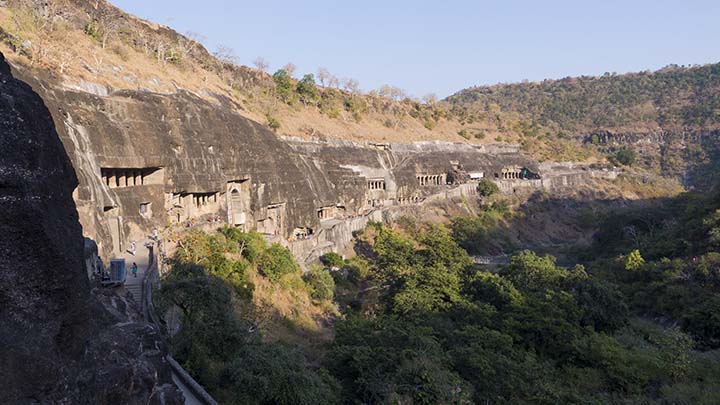
Ajanta Caves, a UNESCO World Heritage site located in a horse-shoe shaped river valley, approximately 30 elaborately carved and painted rock-cut caves dating circa 2nd century B.C.E to 480 or 650 C.E. Buddhist caves, near Aurangabad, IndiaAjanta Cave 26, a chaityahall with stupa, colonnade walkway, and carved relief sculptures. Seen on left wall is Buddha in his parinirvanapose, India
This is not an official U.S. Department of State website. The views and information presented here are solely those of the artist, and do not represent the Fulbright Program, the Department of State, or any other entity.