Buddhism

Key Kye Kee Ki Monastery and the Fine Art of Imprecision

September 5th – Spiti adventure continues…

Key, Kye, Kee, Ki Monastery, Spiti

Spelling is a flexible art in India. One often finds multiple spellings for names, places, and in signs. Take Key Monastery, for instance. It is also known as Kye, Kee, and Ki Monastery. It’s all good, take your pick! I’ve even had one monk spell his own name twice for me because sometimes he goes by Tanzin and sometimes Tenzin.

For a stickler about spelling like I am, this is an interesting lesson in imprecision. Especially if you’re asking for directions to a certain street or hotel, and you find that it’s spelled differently by different people, and you can’t help but wonder if you’re talking about the same place. Well, it’s okay, you’ll just do what you have to do, which is, you’ll find out!

It seems to me there’s a kind of accepted uncertainty principle here. It even extends to what people say. If, for example, you ask someone for directions, and he doesn’t know where the place is, he will not say he doesn’t know. He will give you information about where it is. Yes, that’s right, he will tell you something about what he does not know. My Western mind with its penchant for exactness doesn’t get it at all, but let me take a stab and guess:  This fellow might think to himself, it may not be right, but it may be approximately right, so it will help.

I have noticed that when my Indian friends need directions, they will ask numerous people the same thing. One time, I was driving with a friend and we were looking for a particular site. He stopped to ask probably half a dozen people within only a half mile’s distance, a kind of cross-reference overkill. A precision begotten by statistical probability. The wider you cast your bets, the better your chances are to get the (flexible and imprecise) jackpot. At least, I think it’s something like that…

It seems to me that here in India, it’s implicitly understood that circumstances, and the world, and the universe, are not exact. And more importantly, we are not masters of these spheres, we are just part of the process. Everything is relative, everything changes, everything has the potential for uncertainty at any time. It is readily, deeply accepted and tolerated that things might or might not work out.

One Indian friend quipped, “I.S.T.–Indian Stretchable Time,” (instead of Indian Standard Time) when he told me a story about his friend who was supposed to come pick him up in a remote area by car, but arrived three days later than expected! Okay, so maybe that example is an extreme one, but the moral of the story is not that the friend let him down, but that he came despite the fact that he had deterring factors that prevented him from coming on time!

Oh, the power has just come back here at the hotel, praise be! So I’m quickly plugging everything in to charge. Spiti has been largely without electricity for the past eight months! And it is being doled out to different areas at the moment, so no power here until about 8 or 8:30pm, supposedly anyway, because the past two nights here have been powerless. I can’t understand the reason why exactly. I mean eight months is a long time to have a vital civic repair apparently unattended to, or not tangibly improved.  Not sure if it’s because of devastating natural disaster or simply government mishandling and bad infrastructure. Maybe both. I do know that the next state, Utterakand, has suffered devastating floods and landslides recently, so it’s perhaps spillover?

Today was a bit hard to get kickstarted since I had another headache-filled sleep last night—altitude adjustments still. It’s Day 3 at about 12,000 feet high. Hope tonight will be better. I woke up disoriented, not knowing the time because my iPhone was out of power, head splitting. But we ended up going to Key Monastery after I spent the morning charging at a nearby café. The owner is getting power from the petrol station’s generator across the street. Thank goodness for their help! Otherwise, I literally would not be able to continue my work without charged batteries for my camera, or power to backup files onto laptop!

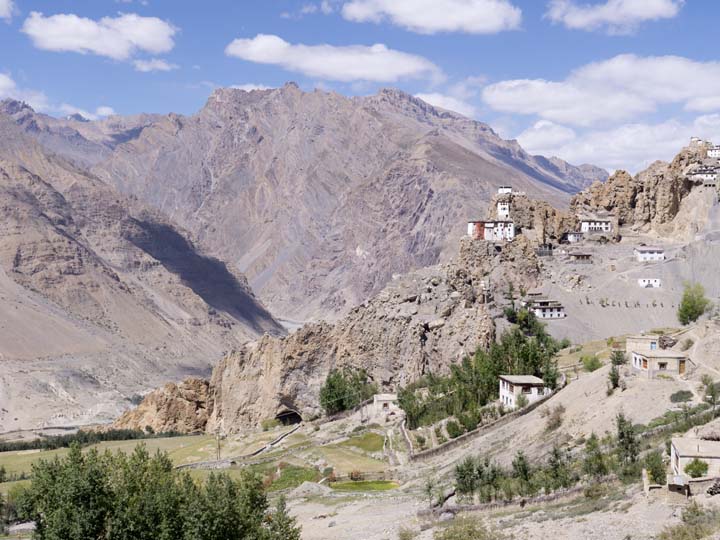
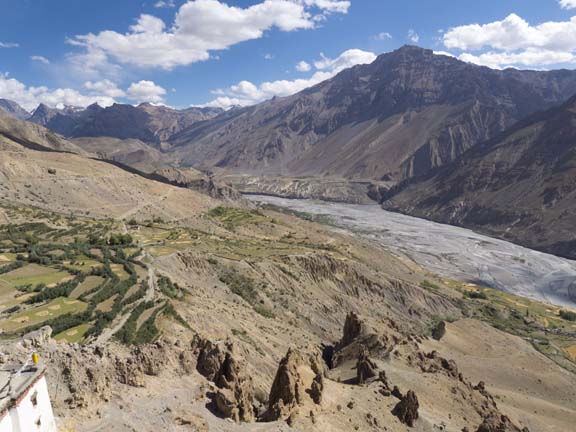
En route to Key Monastery, Spiti, India
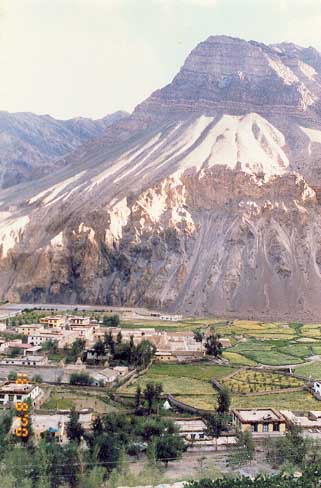
View of Spiti Valley en route to Key Monastery, India

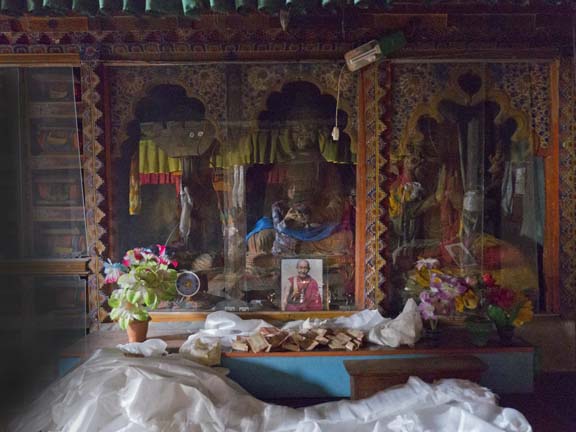
Key Monastery’s current spiritual leader is Lochen Tulku, the 19th reincarnation of Losatwa Rinchen Zangpo, the Great Translator wand former abbott who was so instrumental in this area for revitalizing Buddhism, translating all the original Sanskrit sutras, and building new monasteries in the 10th-11th centuries.

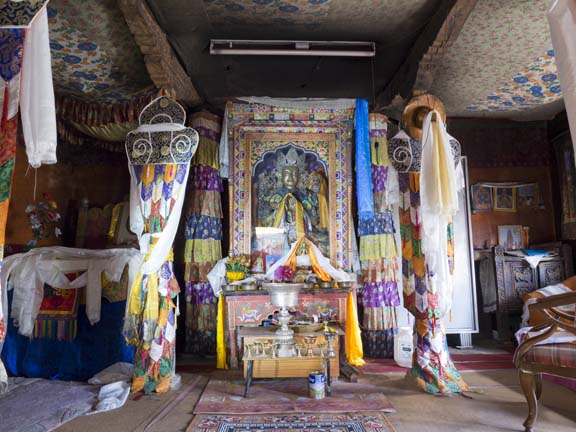
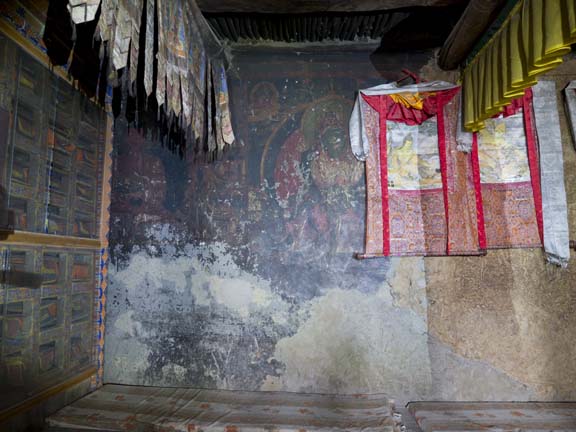
It turned out to be difficult to get permission to photograph the older murals here, despite my having a Spitian connection to a high level administrative monk. The concession is I can photograph the new assembly hall, which is nice but not so interesting for my Indo-Tibetan mural and mandala project. Nonetheless, the day spent at the monastery was pleasant. The monks were kind and invited us to tea, showed us the older temples, and merely asked that we not photograph. J’s local Spitian friend has offered to do some further investigation on my behalf, and we will see if possibly in a couple of days, there may be an opportunity to shoot the older murals.

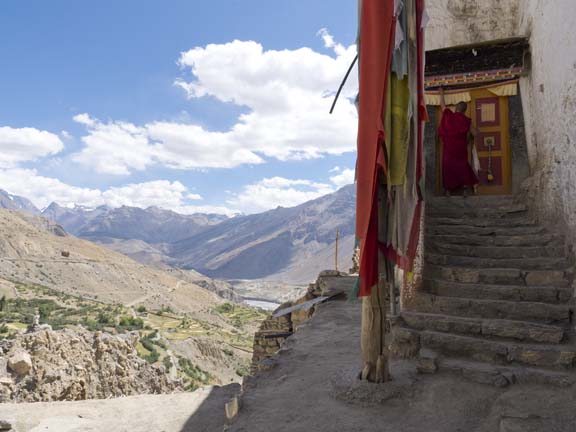
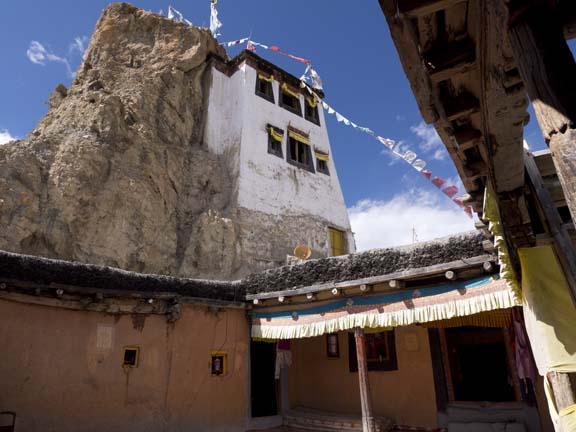
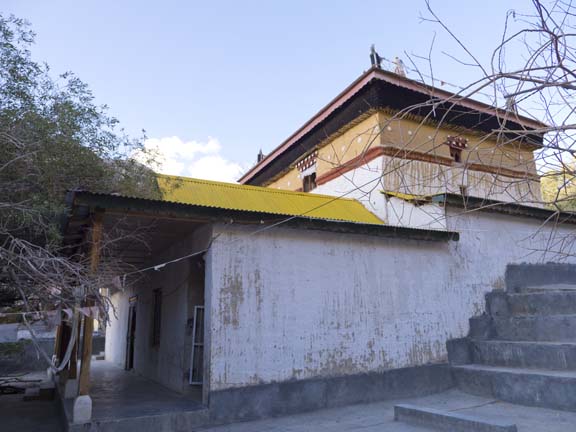
View of Key Monastery's new main temple, Spiti
View of Key Monastery’s new main temple and assembly hall, Spiti

All photos © 2013, Eva Lee.

Dhangkar and Lhalung Monasteries in Spiti

Image
Dhangkar Monastery is seen on the ridge in the upper right. It consists of multi-storeyed buildings perched together, containing five different devotional halls.

September 4th

Our first day out to photograph was at Dhangkhar and Lhalung Monasteries. Both places granted permission because of local and monastic support. I was on my first documenting journey, and how positive an experience it was!

Dhangkar Monastery's Lha O-pa Gompa
Entering Dhangkar Monastery’s Lha O-pa Gompa.
Dhangkar Monastery
Dhangkar Monastery clings to its rocky outcrops. Shown here is the level in which the Dukhang and Lhakang Gongma may be accessed.

I’ll let the images speak for themselves, but it bears saying that Dhangkar was an original home of the ruling Spitian kings over a thousand years ago, built on a ridge and rock outcrop as a fortress. It clings to the mountain with its whitewashed buildings and traditional thatched roofs. Some buildings seem to be built one on top of the other.

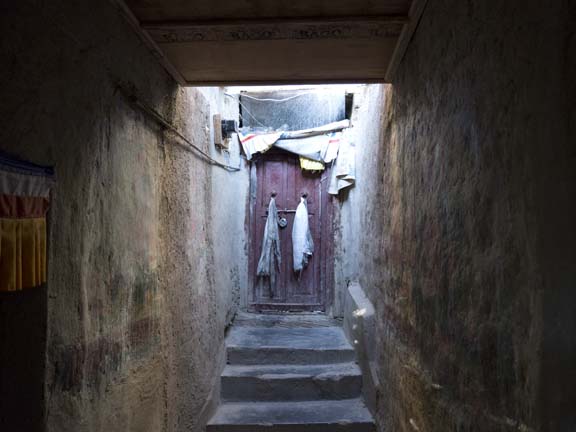
Dhangkar Monastery narrow passageways

The interiors are navigated by narrow stairs (more like ladders, they’re so steep) and often low-ceilinged passageways. And when you scramble higher and higher, some stairs lead to the rooftops where you climb some more, on gravelly footpaths next to sheer cliff drops, in order to get into other adjacent buildings. Whenever you step outside, you are stunned by the incredible panorama of Spiti Valley in its splendor before you, dotted by the verdant, partitioned farmlands below, and the rigor of the sun casting impressive shadows across the mountain ridges.

View of Spiti Valley from rooftop of Lha O-pa Gompa, Dhangkar Monastery

Inside the Dukhang, which was the former assembly hall for monks before the new one was built a few years ago, sits a life-sized statue of Vajradhara, the “Diamond Being” who sees the ultimate nature of reality. One who does so is said to have wisdom, or right view.

Vajradhara statue, Dhangkar Monastery, Spiti

Kanjur Lhakang, library, Dhangkar Monastery

In the lower level Kanjur Lhakang (library containing Buddhist scriptures) are three wooden figures: Lama Chodrag, Shakyamuni, the historical Buddha, and Maitreya, the future Buddha. On the walls are faded and sooty murals, which one can barely see. It’s easy to understand from these murals alone why in 2006 Dhangkar Monastery was named by World Monuments Fund as one of the 100 most endangered sites in the world.

Kanjur Lhakang, library, Dhangkar Monastery
Kanjur Lhakang library of Buddhist scriptures, Dhangkar Monastery, Spiti, India

In the uppermost building of Lha O-pa Gompa is Lhakang Gongma, which has the most to see in terms of murals. Its central back wall dominates with Shakyamuni, Je Tsongkhapa (the reformer and Gelugpa founder of the 14th century), and Lama Chodrag.

Lhakang Gongma murals, Dhangkar Monastery
View of murals on the back central wall of Lhakang Gongma, Dhangkar Monastery, Spiti

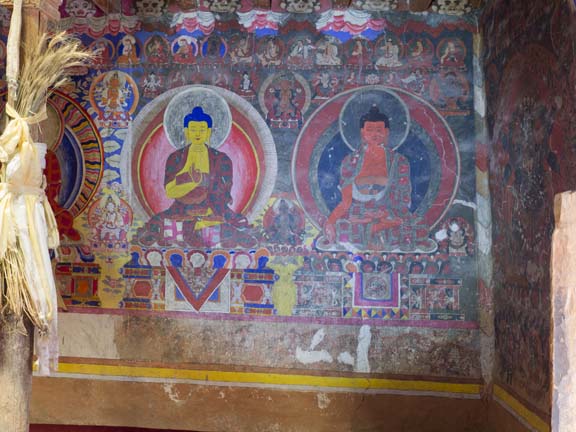
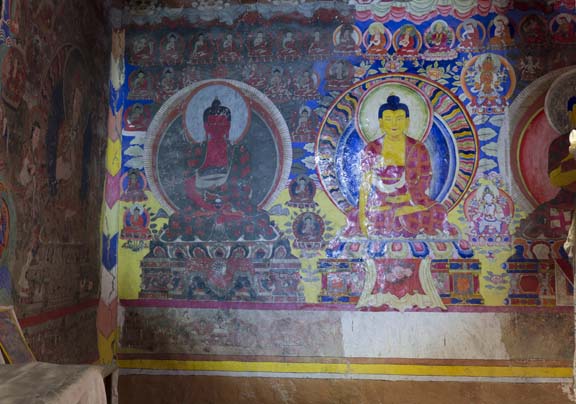
The adjacent walls depict various manifestations of Buddha. I was struck in general by how varied the paintings are in terms of color, style, and deterioration. It’s clear evidence of selective repainting over the centuries. In the back central wall, for example, Shakyamuni is obviously brighter and more saturated in color than the other two figures. According to Peter van Ham’s book, The Forgotten Gods of Tibet: Early Buddhist Art of the Western Himalayas, only a few of the paintings have been left untouched. The rest stylistically suggest a date of around 17th century.

Buddha murals, Lhakang Gongma, Dhankar Monastery
Buddha murals, Lhakang Gongma, Dhankar Monastery, Spiti
Buddha murals showing evidence of repainting over the centuries, Lhakang Gongma, Dharkar Monastery
Buddha murals showing evidence of repainting over the centuries, Lhakang Gongma, Dhangkar Monastery

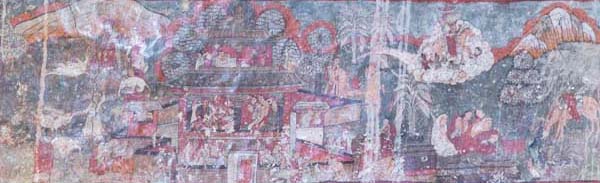
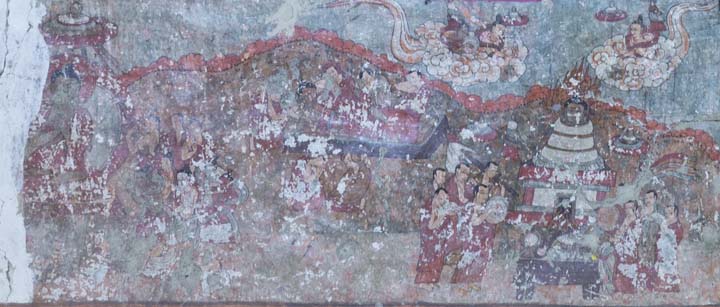
Of note in the murals is the frieze below the main figures, which largely depicts the life of Prince Siddartha, who became the historical Buddha, Shakyamuni. Tabo Monastery has a similar frieze in its Tsug Lhakang, the main assembly hall. Much of it is faded but the below two images are readily identifiable as the life of Siddartha at the palace of Kapilavastu, and the death of Buddha.

Dhangkar_Lhakang Gongma frieze
Life of Prince Siddartha at the palace of Kapilavastu, painted frieze at Lhakang Gongma, Dhangkar Monastery
Death and cremation of Buddha, painted frieze at Lhakang Gongma, Dhangkar Monastery

We were told by locals that Dhangkar is older than the famous Tabo Monastery because, as the ancient home of indigenous kings, it contained a private temple from before the time of The Great Translator Rinchen Zangpo, pre-dating 10th century. Indeed, at the very top of the Dhangkar citadel are the remains of the palace, which you climb up to through a sleepy and steep quaint village that looks like it has maintained its same way of life for millenia.

Later in the day, we went to Lhalung Monastery. I really loved this small temple pictured below.

Lhalung Monastery, Spiti
Lhalung Monastery’s Serkhang or Golden Hall, Spiti

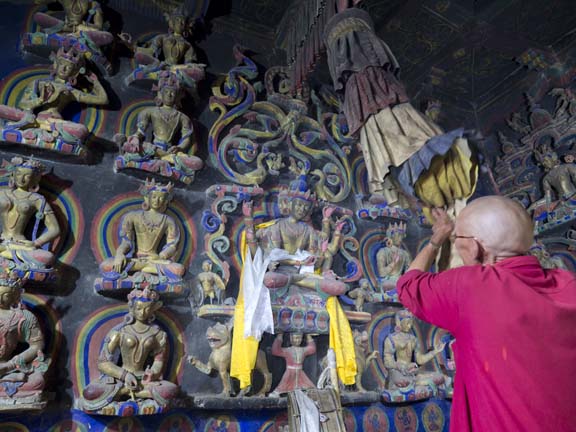
Lhalung Monastery, believed to be founded by The Great Translator Rinchen Zangpo, late 10th century C.E., was quite impressive. You enter through a narrow passageway to get to its Serkhang, which means literally House of Gold, but more often referred to as Golden Hall. Attached to its walls are sculptures of deities and other Buddhist personages. Three-dimensional figures in relief against the interior architecture of Buddhist temples are a distinctive feature of Indo-Tibetan artistry in Spiti and Ladakh areas. Similar ones are found at Tabo, Alchi, and Mangyu Monasteries.

Experience the rare and beautiful interior of Lhalung Monastery’s Serkhang by seeing a walk-through video here.

Entrance to Lhalung Monastery's Serkhang or Golden Hall
Entrance to Lhalung Monastery’s Serkhang or Golden Hall

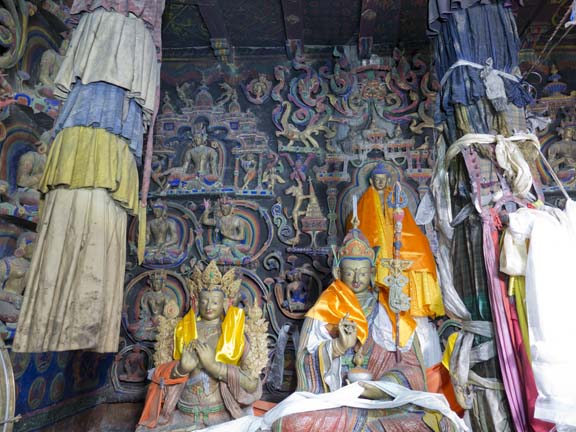
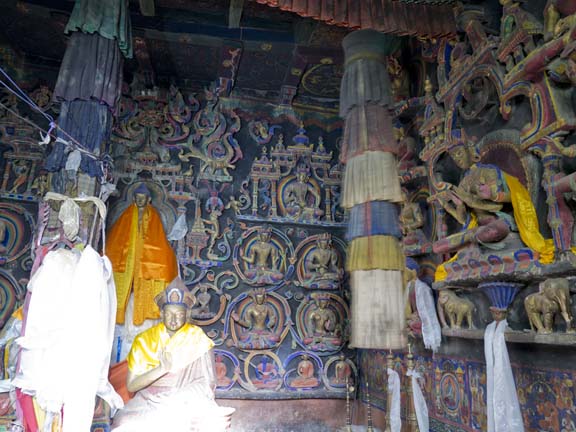
Once inside, the splendor of the ornately gilded and polychromed clay figures strikes you. The sculptures fill the temple practically from floor to ceiling. There are over 51 figures mounted on the walls or placed in the temple, arranged in mandala formations on each wall. Geshe-la said that these types of cantilevered relief sculptures are specific to the Trans-Himalayan region and are not found in Buddhist temples anywhere else.

On the central wall is Shakyamuni in the middle, flanked by two elaborate groups of five figures, each dominated by a deity–identified as Dharmadhatu Vagishvara, a complex form of Manjushri on the left, and Vajrasattva on the right. These figures are set in architectural alcoves, while the others are contained within lotus motif scrollwork, accented by decorative animals and dancers.

Serkhang, Golden Hall, Lhalung Monastery
Maitreya, Guru Rinpoche, and Rinchen Zangpo (partly visible on right behind the column) form a trinity in the Serkhang altar of Lhalung Monastery, Spiti

Visible below is the right wall with sculptures arranged in a Prajnaparamita mandala, with Vairocana in the center surrounded by four Dyanibuddhas or Buddha-families: Ratnasambbhava, Akshobhya, Amoghasiddhi, and Amitabha, and their female attendants.

Serkhang, Lhalung Monastery, Spiti
Rinchen Zangpo statue among a pantheon of sculpted deities, Serkhang (Golden Hall), Lhalung Monastery

On the left wall (photo below) is a Vajradhatu mandala arrangement around the three-faced and eight-armed Saravid Vairocana. Around him are the 16 deities in his cycle, including once again the Buddha families of Ratnasambhava, Akshobya, Amitabha, and Amoghasiddhi.

Vajradhatu Mandala, Serkhang of Lhalung Monastery, Spiti
Left wall with Vajradhatu Mandala, Serkhang of Lhalung Monastery, Spiti

So now, that’s a lot of deities in one small temple! Their plethora really conveys not only aesthetic richness but also the complexity of Tibetan Buddhist tantric practice. What do all these deities represent in these mandala arrangements? Put simply, mandalas are visual guides for a practitioner in their meditation. They are aids in the realization of the true nature of mind and reality. As an oral and esoteric tradition, one needs a lineage teacher. Experiential understanding of this leads to liberation from conditioned existence–that is to say, leads to enlightenment or nirvana. Here is a succinct description of what the Five Buddha Families represent.

Geshe-la had said that the temples in these areas really demonstrate only the lower three tantras, not highest yoga tantra, which is mainly what Tibetan Buddhists practice today. The lower three are more concerned with purification, whereas the fourth level is actualizing self and deity, and therefore, enacting profound experience and understanding of emptiness. In The Great Translator Rinchen Zangpo’s time, late 10th century, focusing on the three lower tantras was a way to go back to roots and revitalize/reform tantric practice in Tibet which had grown distorted. This was partly the reason for the enormous interest in the original texts and their teachings, translating them from Sanskrit to Tibetan.

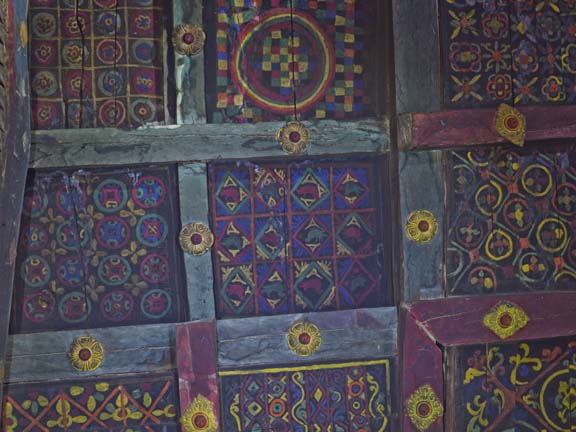
Lastly, the coffered ceilings were painted with delightful and folk-looking decorative motifs. Now I know what scholars mean when they speculate that these must reflect 10th century Kashmiri–influenced textiles.

Coffered ceiling of Serkhang, Lhalung Monastery, Spiti
Coffered ceiling of Serkhang, Lhalung Monastery, decorated with Kashmiri-influenced patterns that scholars believe reflect 10th century textile designs.

All photos © 2013, Eva Lee.
 

The Great Translator Rinchen Zangpo

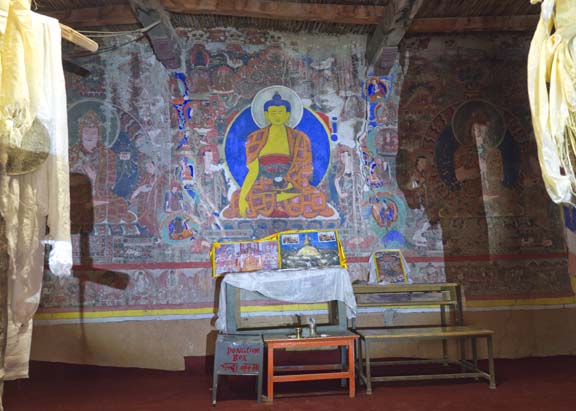
I’m currently reading David Snellgrove’s “Indo-Tibetan Buddhism: Indian Buddhists & Their Tibetan Successors.” It concentrates on the tantric period of Buddhist theory and practice, from the 8th to the 13th centuries. This was a fertile time of the transmission of Buddhism from India to Tibet. I’m particularly interested in the prodigious legacy of The Great Translator Rinchen Zangpo (958–1055 C.E.) who translated voluminous original Sanskrit sutras into Tibetan, and therefore helped preserve the doctrines and teachings. These original Sanskrit sources are now largely lost in India.

Tabo Monastery, Spiti, Himachal Pradesh, India
Photo: Tabo Monastery

Rinchen Zangpo is also credited with building over one hundred monasteries in Western Tibet, many still existing now in modern day Indian Himalayas, including the famous Tabo Monastery in Spiti, Himachal Pradesh.

I really look forward to seeing Tabo’s murals. They are extensive and among the best preserved from Rinchen Zangpo’s time. In addition to the art, its architecture is an excellent example of mandala layout and structure, built in direct relationship to sutra descriptions. Founded in 996 C.E., Tabo is considered to be the oldest continuously functioning Buddhist monastery in India and the Himalayas.