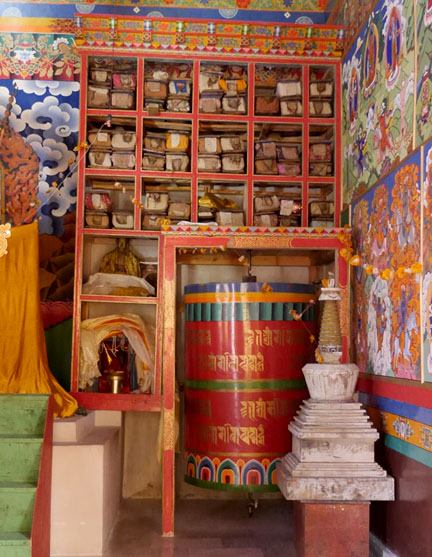
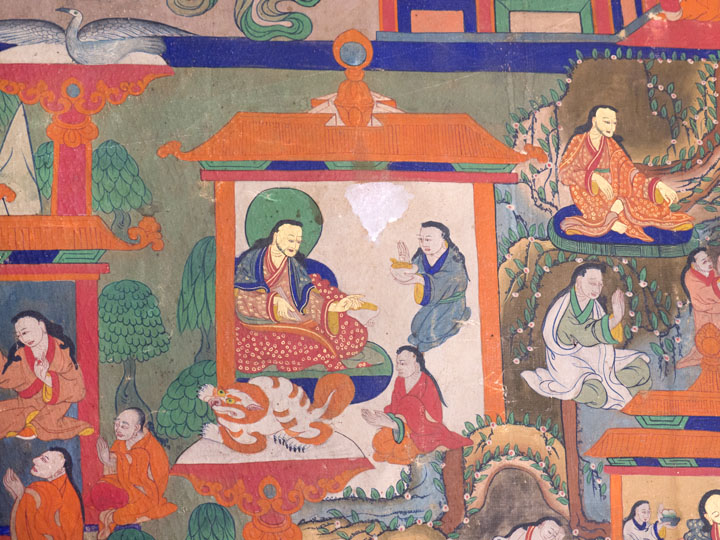
New Video Documentaries: Interior Views of Indo-Tibetan Temples at Tabo, Lamayuru, Lhalung and Mangyu Monasteries
Posted
Tabo Monastery Tsug Lhakhang, Spiti, India
At long last, I have completed four short video documentaries of the interiors of Indo-Tibetan monasteries that flourished during the 10th to 12th centuries. I feel so very honored to have had the opportunity to visit, research, and document these incredible temples.
The temples are:
Tabo Monastery’s Tsug Lhakhang, the Main Assembly Hall, renowned as the oldest continually functioning Tibetan Buddhist monastery, the art of which the Dalai Lama said “delightfully expresses the vigor of the transmission of Buddhism from India to Tibet and the dynamic mingling of cultures.” Established in 996 C.E. in ancient Western Tibet, now Spiti, India
Lamayuru Monastery’s Senge Lhakhang, or Lion Temple, established in the 11th century on a plateau in what is now Ladakh, India. Ca. 11th century, the oldest temple at Yamayuru Monastery. Contains well-preserved and rare Indo-Tibetan clay sculptures of Vairocana, Dhyani (Supreme) Buddhas, and Vajradhatu mandalas, including Gonkhang with protector deities, Ladakh, India
Lhalung Monastery’s Serkhang, the Golden Hall, founded in the early 11th century and located in present-day Spiti, India.
All four sites are among the rare Indo-Tibetan temples still found today with extant, fairly well-preserved, poly-chromed clay sculptures which depict the Five Supreme or Dhyani Buddhas, along with their associated 32 deities. These sculptures form a distinctive sacred art of this period.
After viewing these videos, which show the visual expression of Buddhism, I hope you will find inspiration to learn more about the philosophy and practice of Buddhism.
The wealth of empirical knowledge gathered through millenia by Buddhist meditation practitioners not only benefits those seeking spiritual development, but also those looking for less stress and more happiness. Who wouldn’t want that?
I believe this tradition offers a tremendously positive impact on contemporary society.
Look further, and see for yourself how psychology, health, and medical fields have made advances in treatments based on meditation. For example, neuroscientists in their research on the human brain have garnered great insights in studies on meditation and its effects on cognition and emotional regulation. A pioneer on this Dr. Richard Davidson of The Center for Healthy Minds. One result is the development of Mindfulness Based Stress Reduction (MBSR) pioneered by Dr. John Kabat-Zinn which has been applied with great success as a non-pharmaceutical approach to coping with pain and emotional challenges.
Less stress, more happiness. Again, who wouldn’t want that?
I wish you all the best in your curiosity, and your journey towards learning about mind and well-being, hallmarks of Buddhist practice.
Betwixt: New Animation and Experimental Film by Eva Lee
Posted
Found adventures and forgotten homes, dreams of departures and arrivals. Yes, that is the description for “Betwixt,” my latest new animation and experimental film.
You want to see a sneak peek, you say? Why not! Click on the image below.
Still from “Betwixt,” new animation and experimental film by Fulbright artist Eva Lee
Inspired by research on Tibetan Buddhist mandalas in Indian Himalayas. Made possible in part by support from Fulbright Scholar Program.
Ellora Caves: Buddhist, Hindu, and Jain Coexistence
Posted
December 12-13, 2013
After seeing Ajanta Caves–which were amazing and beyond my imagination of what carved and decorated ancient Buddhist caves would look like–I visited Ellora Caves, which stunned me further because of the elaborate artistic and architectural feats!
Panorama view of Ellora Caves, founded 600-100 C.E., near Aurangabad, IndiaEllora Cave 32, featuring a free-standing temple in center courtyard
Founded after Ajanta from about 600 to 1000 C.E., this complex of 34 caves has some breathtaking sanctuaries of unbelievably grand scale, and free-standing temples. Yes, that’s right, freely standing buildings that were carved out of once solid rock cliff!
Besides the monolithic bravado, the Ellora complex, about 106 kilometers away from Ajanta, is also unique because it consists of Buddhist, Hindu, and Jain caves. The approximately two kilometer stretch of Deccan Traps in which these caves are excavated side by side testify to the peaceful ancient coexistence of these three major Indian religions.
The first twelve caves are Buddhist and appear to be the oldest, dating circa 600 to 800 C.E. They comprise monasteries and one chaityaor temple. The Hindu ones are Caves 13 to 29, perhaps the best known being Cave 16, the Kailash Temple. These were built between 600 to 900 C.E. The Jain group of caves are 30 to 34, and were the last to be excavated, circa 800 to 1000 C.E.
Ellora Cave 11 facade, Buddhist monastery, ca. 600-800 C.E.
Buddhist Caves 11 and 12 went to the next level—literally. Compared to their Ajanta predecessors, these three-storied monasteries are impressive, surpassing the Ajanta two-storied excavations in terms of number of floors and scale. What struck me immediately about both cave facades were their architectural simplicity. They looked modern to me, and I was surprised by what it called to mind. The austere repetition of columns and openings, the lack of carved adornment, and the same feeling of monumentality as one walks up to their courtyards strangely reminded me of the experience I had seeing Italian EUR architecture, in particular the Palazzo della Civilta Italiana, built in Rome between 1938 and 1943.
The space and time of day I was there also created very much the still and surreal feeling of Giorgio de Chirico’s paintings.
Ellora Cave 11 facade, Buddhist monastery, ca. 8th century C.E.Delights of the Poet, Giorgio de Chirico, 1913, oil on canvasFacade of Ellora Cave 12. Photo: Indiaing.zening.info
The plain facades of Caves 11 and 12 give no hint of the richly carved sculptures within. I had assumed from the exterior that the interiors would be simple, probably cells for a large number of devotees. From my modern mentality, the buildings looked like they were ancient boarding rooms with shared veranda on each floor.
Ellora Cave 11 veranda
Little did I know that the rooms on each floor of Cave 11, the first one I saw, would house sanctums.
Stairway at end of second floor veranda leading to lower level, Ellora Cave 11
Each one would be a variation of the below sanctum. They were so plentiful that I can’t remember how many I saw. Typically, the central figure was a massive Buddha, flanked symmetrically by large-scaled Avalokiteshvara and Vajrapani, life-sized standing bodhisattvas, seated small buddhas, and flying divine figures.
Massive Buddha statue flanked by Vajrapani, bodhisattvas, seated small buddhas, and flying figures in sanctum of Ellora Cave 11Massive Buddha statue flanked by Avalokiteshvara, bodhisattvas, seated small buddhas, and flying figures on opposite side of Ellora Cave 11 sanctumStanding life-sized statues of bodhisattvas, sanctum of Ellora Cave 11Standing life-sized statues of bodhisattvas on opposite side, sanctum of Ellora Cave 11Courtyard of Ellora Cave 11 curiously marked by intersecting small channels which I can only surmise were chiseled out for drainage.
Cave 12 dates to circa 8th century C.E., and is known as “Teen Tal” because of its three floors. The first and second floors have a pillared halls, antechambers and sanctums with cells. The third floor, while similar in plan has extensive sculptures along the perimeters of a great colonnaded hall.
View along right front wall with figure of seated Buddha at end of side wall, Ellora Cave 12 third floor
The front wall has Buddhas seated on double lotuses with foliage and umbrellas projecting overhead.
View along left front wall with figure of seated Buddha at end of side wall, Ellora Cave 12 third floorDetail of seated Buddhas in meditation pose, front wall of Ellora Cave 12 third floorView of front and side walls, Ellora Cave 12 third floor
Visible above on the left is Buddha seated on a lion throne with fly-whisk attendants.
Pictured below is the antechamber, which has large sculptures of Padmapani and Vajrapani flanking the sanctum entrance and twelve goddesses seated on lotus thrones. There is evidence that these were once painted.
In fact, based on the preceding Ajanta practices, I assume that most of the carvings in the Ellora caves were also plastered and painted. So when you look at these images, imagine that the columns, statues, and other architectural elements were adorned with colors and designs, painted faces, and other details. What rich interiors!
Antechamber, with front wall of seated buddhas visible on right, entrance to sanctum has modern protective screen door which helps to reduce bat nesting, Ellora Cave 12 third floorLooking down towards right side wall, Ellora Cave 12 third floorView of one of the many Buddhas seated on lion thrones, side walls of Ellora Cave 12 third floorView of one of the many Buddhas seated on lion thrones, side walls of Ellora Cave 12 third floor
If you find the scale of this Buddhist cave impressive, how about Cave 5? It measures 53.28 x 36.63 meters, or 175 feet deep x 120 feet wide.
Panorama view of Cave 5, Buddhist monastery, Ellora, IndiaPanorama view of Cave 5 looking back towards the valley, Buddhist monastery, Ellora, IndiaInner sanctum with seated Buddha, Ellora Cave 5
Cave 10 is a really lovely chaitya, similar to the apsidal plans of Ajanta Caves 19 and 26, but its facade is more ornate, featuring a wraparound pillared veranda and side porticos that lead to chambers.
Facade of Ellora Cave 10Panoramic view of Ellora Cave 10 facadePanoramic view of Ellora Cave 10 facade from second levelColossal statue of seated Buddha on a lion throne flanked by Padmapani and Vajrapani, Ellora Cave 10Detail of colossal statue of seated Buddha on a lion throne flanked by Padmapani and Vajrapani, Ellora Cave 1Back wall of Ellora Cave 10Detail of Gallery on back wall of Ellora Cave 10
These are the highlights of the Buddhist caves at Ellora. I hope that, like me, you will now never think of the word “cave” the same again! Instead of conjuring up only oddly shaped, naturally formed, sooty rock shelters, the word will hereon also bring to mind colonnaded halls, monumental sculptures, carved friezes, painted barrel vaulted ceilings and other graceful elements of the ancient excavated architecture of India.
Next up will be the best of Ellora’s Hindu and Jain caves!
My travel companion K and I left Keylong at 5:00 a.m. to head to Leh. The wonderful and inspired Lahauli adventure had come to an end, and it was now time for Ladakh!
It was a long drive of about 11-12 hours on the Manali-Leh Highway, with stops for photos, breakfast and lunch. Unbelievable rugged terrain that seems to endlessly unfurl its textural vistas as you drive along hour after hour. Empty, cold, semi-arid desert across vast mountain ranges.
Rugged terrain of Manali-Leh Highway, en route to Ladakh
Like the road trip from Spiti to Lahaul, the land is at once austere and captivating. Fortunately, unlike the jagged, unpaved highway from Spiti to Lahaul, this one was rather well-paved and maintained. Besides tourists, it’s well-used by the military guarding the Sino-Indian border, and there are checkpoints along the way where all vehicles must stop and register passing through.
En route, one passes places with quaint names like Zingzingbar and Lachulung-la, ascending ever higher. From our starting point at Keylong, it’s 3349 meters altitude going up to the high point of Tanglang-la of 5328 meters. I felt short of breath at times, but thank goodness I’m long over altitude adjustments (the first week in Spiti was vice-grip-like, headache-filled nights in addition to shortness of breath), though it is no joke to continue to take precautions and be aware of the dangers of high altitude sickness. People can die from it, and pretty quickly, too.
Roadside tent dhabas (eateries) and basic dormitory accommodations are set up for the summer season from about June to September, Manali-Leh Highway
There are no villages or towns the whole stretch of road from Keylong to Leh, only roadside stops for food or overnight stays. These are makeshift temporary seasonal tents that offer cots for travelers to sleep in and a basic menu of dishes such as paranthas, rice and dahl, chow mein. Breakfast was at one of these places.
Interior of a roadside dhaba (eatery) with cots for overnight stays, Manali-Leh Highway, Ladakh
Shortly after taking off on the road again after breakfast, we saw this. Can you spot the little guy in the below photo?
Manali-Leh Highway
Didn’t see him? Okay, then look here…
Marmot out in morning sun, Manali-Leh Highway, en route to Ladakh
Marmots were poking their heads out of rock crevices, or walking out in the open like this one, presumably searching for breakfast. Cute pudgy little things, they reminded me of our local American groundhogs.
Driver G was really nice, good conversationalist, great driver. He is a trekking guide and luxury tent campsite owner in Manali who conducts Himalayan adventure trips. He is also an old friend of K’s. K said G saved his life once on a mountaineering trip.
With his four wheel drive flatbed truck, he would deftly take uphill shortcuts connecting switchback roads, such as here at the Gata Loops, the part of the highway famed for its 21 hairpin turns.
The part of Manali-Leh Highway famed for its 21 hairpin turns on the road, en route to LadakhGate Loops on Manali-Leh Highway, en route to LadakhTurquoise water offset against the pinks of the mountain range and red-siena ground cover. Yes, it really looks like this on parts of the Manali-Leh Highway heading to Ladakh!
Kangla Jal trekking pass point and India Gate reminds me of out West in Zion or Bryce Canyons in the U.S.
Near Kangla Jal trekking pass, Manali-Leh Highway, en route to LadakhIndia Gate, near Kangla Jal trekking pass, Manali-Leh Highway, en route to Ladakh
Lunch was at another tent site, where people really make do with little water and toilets are open air. One gets good at finding large rocks to befriend!
Lunch en route to Ladakh on Manali-Leh Highway
Not long after leaving the lunch site, we came upon the plateau portion of the trip called Morey Plains. Instead of traveling through passageways and valleys, this section was a wide open flat expanse of land.
Morey Plains, Manali-Leh Highway, en route to LadakhBeginning of Morey Plains, Manali-Leh Highway, en route to LadakhJust straight road! Morey Plains, Manali-Leh Highway, en route to Ladakh
The Himalayan mountains along the way are diverse in colors and shapes. Some are more black like these below, and others more pink and warm flesh tones gradating into earth reds as you see more of as you get closer to Leh.
Natures sculpts some stunning shapes and presents here nuanced gray and black tones along the Manali-Leh HighwayThe Himalayas, as far as your eye can see…Large cars are just specks on the thready-looking roads
When we reached Tangla-la, the high point with an altitude of over 17,500 feet, it was marked by a large shrine and elaborate prayer flags. Other travelers stopped for a gander and to marvel that they, too, had made it to this point on the road to Leh. Inside the shrine there were Hindu and Buddhist deities.
Tanglang-la Pass with shrine and prayer flags, the highest point on the Manali-Leh Highway at 5328 meters (over 17500 feet), en route to Ladakh, IndiaShrine at Tanglang-la Pass, the highest point on the Manali-Leh Highway at 5328 meters (over 17500 feet)Hindu and Buddhist deities, inside shrine at Tanglang-la Pass, the highest point on the Manali-Leh Highway en route to Ladakh, India
How did people in ancient times manage traveling through this rough barren terrain? Actually many of them didn’t and perished along the way. I’m thinking of Rinchen Zangpo’s party of 21, whom King Yeshe O’d sent from Guge, Western Tibet, to India in the late 10th century, only 2 of whom made it back alive.
IS IT NOT? Khardung-la is the first highest pass in India.
As you get closer to the city of Leh on the highway, you begin to see stupas and chortens in the landscape. This little monastery is among the first signs of permanent dwellings as you come out of the hinterlands and approach civilization, still about two hours’ drive before reaching the outer monasteries of Leh, such as Stakna.
The scenic view of Stagna Monastery as you come out of the remoteness of the Manali-Leh Highway and reach outskirts of Leh, Ladakh, IndiaMuch of Leh looks like this combination of vast dry flatlands adjacent to mountains with villages nestled in the valleys.
Lahaul’s Trinity: Drilbu Ri, Phakpa, and Markul Devi
Posted
September 17th Lahaul adventure continues…
The spiritual power of Lahaul, known as beloved Garsha Khandroling to Buddhists, lies in its sacred trinity of Drilbu Ri, Phakpa, and Markul Devi. These sites form the Three Vajras of right body, speech, and mind. The Three Vajra concept is akin to the Western religious concepts of righteous deed, word, and thought.
View of Chandrabhaga Valley en route to Triloknath, about one hour drive from Keylong, Lahaul
If you read my previous post, then you already know the experience at the summit of Drilbu Ri is sublime. This mountain is associated with Chakrasamvara, the enlightened body of Buddha. The other sites of the trinity are Phakpa Temple in Triloknath, associated with Avalokiteshvara and enlightened speech, and Markul Devi Temple in Udaipur, associated with Vajravarahi and enlightened mind. (By the way, this is Udaipur in the state of Himachal Pradesh, not the one in Rajasthan.)
After finishing the kora around Drilbu Ri, it seemed natural to visit the other two places, Triloknath and Udaipur, as a continuation of pilgrimage experience. Both are within an hour-and-a-half’s drive from Keylong, so that was my agenda for today! As with Dribu Ri, Hindus and Buddhists alike consider Phakpa and Markul Devi holy sites.
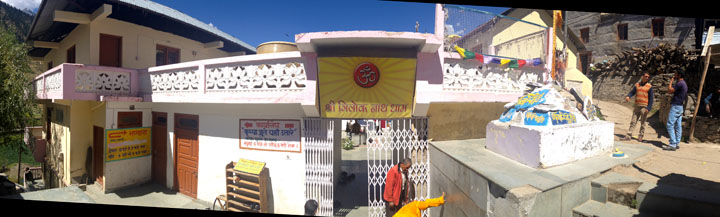
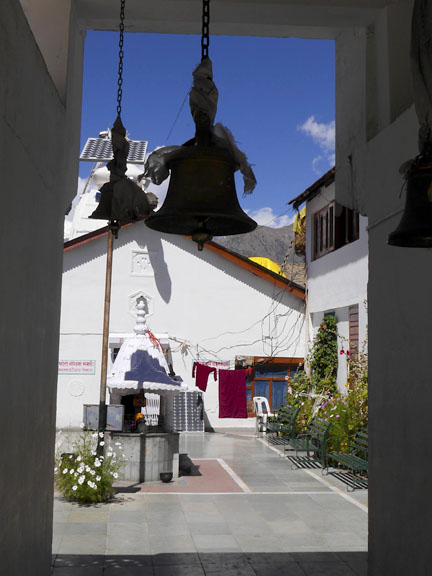
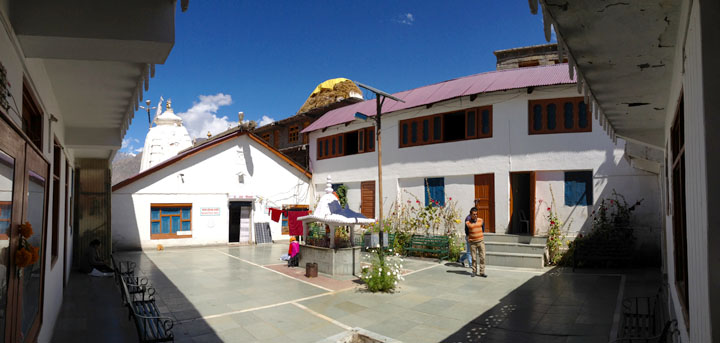
Phakpa temple of Triloknath, Lahaul, as seen from the entrance to its courtyardEntranceway to Phakba Temple, Triloknath, Lahaul. Visitors ring bells overhead.Inner courtyard of Phakpa. Not much can be seen of the original architecture at this ancient site. What exists now looks like contemporary vernacular. The building at left contains the inner sanctum and an interior circumambulatory
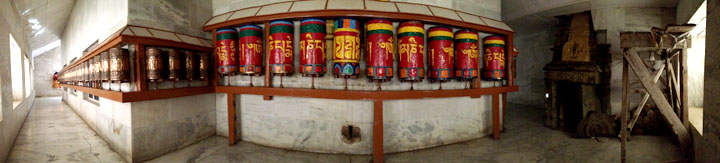
At Phakpa Temple, one can circumambulate the inner sanctum upon entering. The ample interior corridor contains Tibetan Buddhist mani prayer wheels one can spin for manifold blessings. Inside them are Avalokiteshvara’s six-syllabled mantra, Om Mani Padme Hum, the recitation of which is said to activate mental states conducive for peace and enlightenment.
The interior circumambulatory, Phakpa Temple, Triloknath, LahaulGilded architectural detail that looks Hindu-influenced, Phakpa Temple, Triloknath
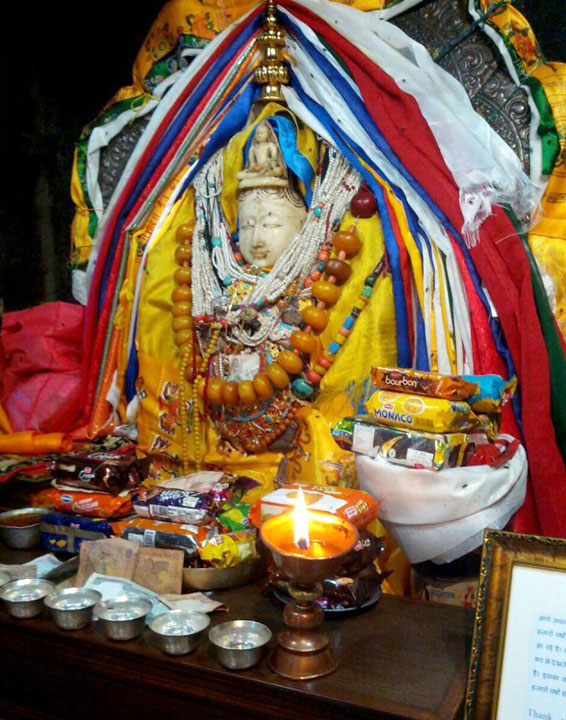
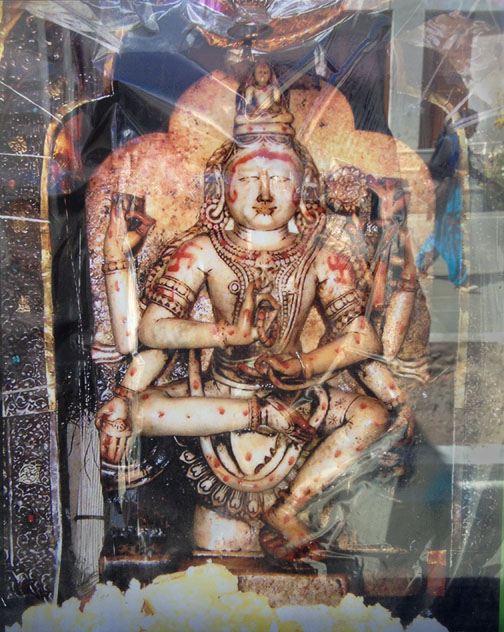
The inner sanctum contains a white marble statue of Avalokiteshvara, bodhisattva of great compassion, believed to be a miraculous self-arisen object found by a shepherd and installed in Triloknath. The statue is revered by Hindus as Shiva.
White marble statue of Avalokiteshvara, Phakpa Temple, Triloknath, Lahaul, revered by Hindus as Lord Shiva. Photo: www.fpmt.org
Here is a view of it without ritual embellishments. This is a poster I photographed in the courtyard.
Avalokiteshvara statue at Phakpa Temple, Triloknath, Lahaul
The statue is a six-armed version of Avalokiteshvara. In Tibetan Buddhism, he is also popularly depicted with a thousand arms and eleven heads. This manifestation occurred when Amitabha Buddha, coming to the bodhisattva’s aid, split his head and arms so he could better hear, see, and help the suffering. The Dalai Lama is considered a human incarnation of Avalokiteshvara, or Chenrezig as he is known in Tibetan.
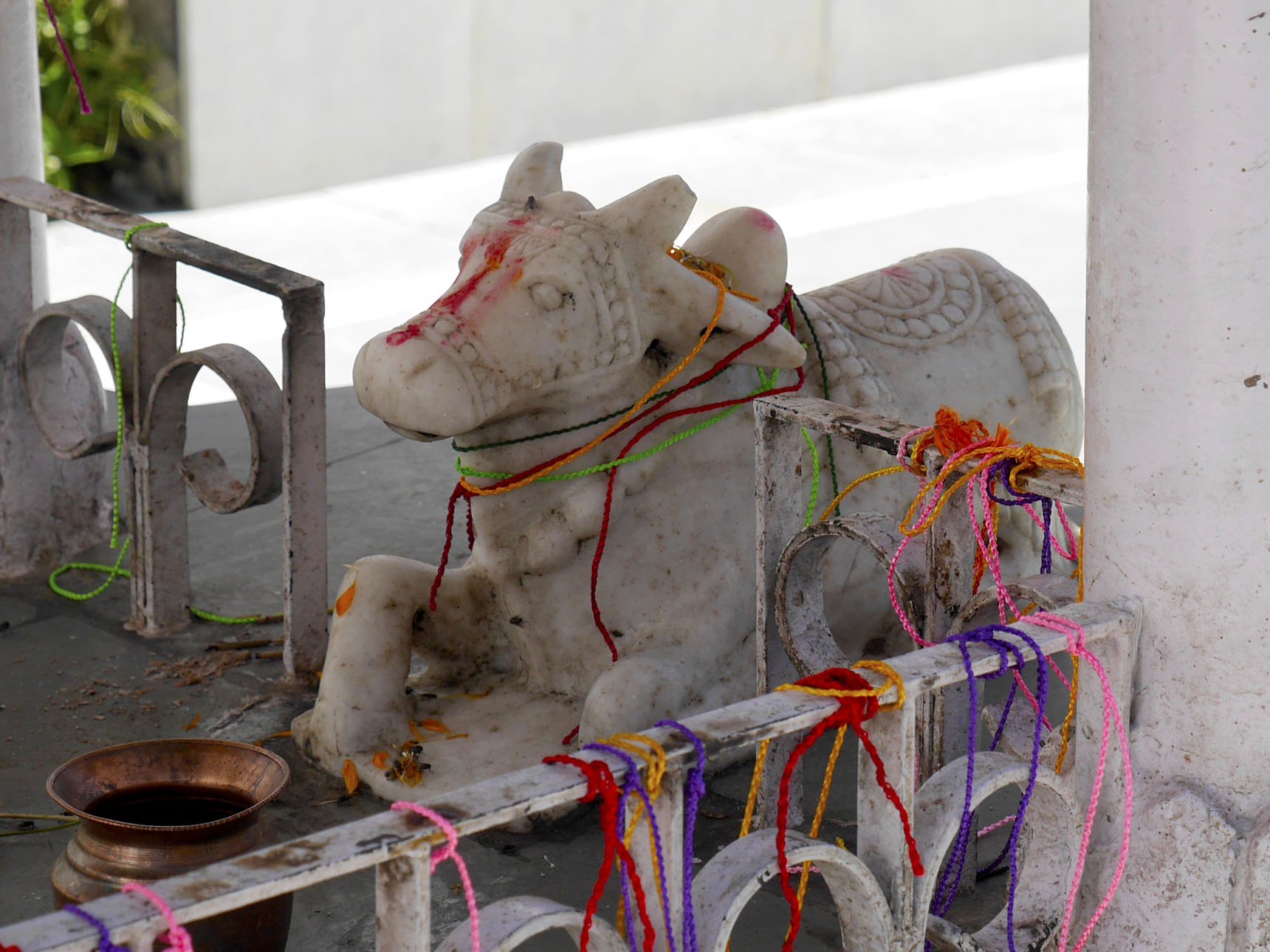
Nandi – the cow is a sacred animal to Hindus, representing life and the sustenance of life. This sculpture is located in the center of exterior courtyard at Phakpa Temple, Triloknath, Lahaul
After Triloknath, I headed to nearby Udaipur to see Markul Devi Temple.
View of Himalayan Mountains on the way from Triloknath to Udaipur, Lahaul
As was the case from Keylong to Triloknath, before long, we hit road construction again and were delayed because all traffic was halted. In this rugged terrain and climate, highways take a beating, and road maintenance and improvement is always happening. This one was a major operation, and not visible in the photo is a large crew of construction workers down the left side of the mountain where the dirt is being deposited.
Road construction en route to Triloknath, LahaulRoad construction en route to Udaipur, Lahaul
Often road workers are women with young children on their backs. Or sometimes the little ones keep themselves busy playing or sleeping on the construction site. I am not kidding! I have seen children sleeping hazardously close to the edge of a cliff, or running among machinery and equipment. So far, on my travels throughout Spiti and Lahaul, this is true everywhere. It is hard labor. Men and women break rocks by hand with hammers, dig mountainsides with pickaxes, haul dirt in baskets on their heads, and so forth. Driver D tells me most laborers are poor and come from Nepal, or are tribals from other states of India. As itinerant workers, they sleep in makeshift tents right there onsite for the season, until the cold weather comes and road work is halted.
Markula Devi Temple, Udaipur, Lahaul
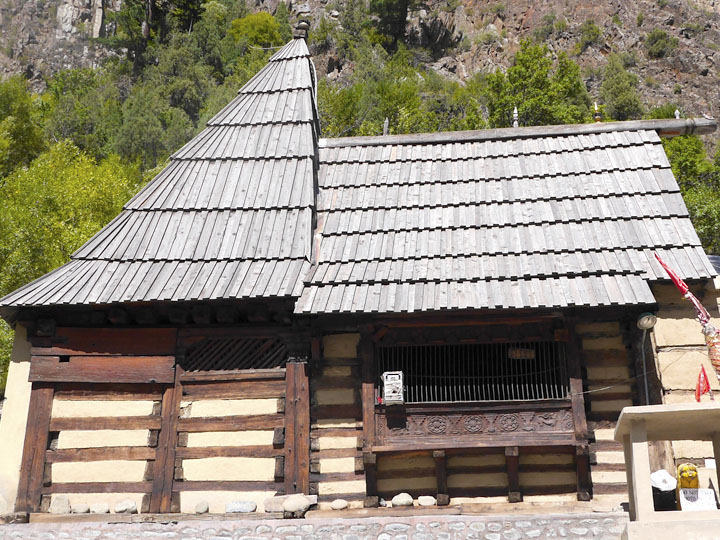
If you have been on an extended trip to see Indo-Tibetan Buddhist sacred sites in Spiti and Lahaul, what is immediately apparent about Markul Devi Temple is that it does not look at all like what you’ve seen elsewhere. Most of the structures I’ve seen from the same period, 11th-12th centuries, have been white-washed or painted mud and stone structures with flat roofs of the same materials, some perhaps thatched. Markul Devi is instead made from wood and stone with a highly pitched wood-shingled gable roof.
Markul Devi Temple exterior is an example of 8th century Kashmiri architecture in Udaipur, Lahaul
The Indian government traces its architectural style back to 8th century Kashmir, though the current structure is a reproduction from 11th century onward. It is protected by Archeological Survey of India, considered the last building of its kind to exist.
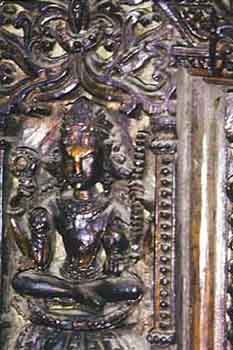
Wood carving from interior of Markul Devi Temple, Udaipur, Lahaul. Photo: http://ignca.nic.in
The interior is also different from other Indo-Tibetan interiors I’ve seen. It is a stunning example of fine Indian woodwork. Massive and deeply carved single pieces of wood form nine elaborate ceiling panels. There are several ornate pillars and architraves, window panels, and the decorated facade of the inner sanctum. The fine carvings depict mainly Hindu subjects and figures, but there are also Buddhist references, such as the panel of Shakyamuni Buddha, and the scene with a three-headed Vishnu. The small shrine holding a silver statue of the Hindu goddess Kali is revered by Tibetans as Vajravarahi.
Shown at right is a detail of the wood carving possibly from the facade of the inner sanctum.
So there you have it…Lahaul’s trinity of Drilbu Ri (body), Phakpa (speech), and Markul Devi (mind)–revered by both Hindus and Buddhists. Implicit in their mutual respect for these places and their associated deities is their acceptance of each other’s pantheon. I admire this. An Indian acquaintance once said to me that he believes, ultimately, all gods are the same.
Sept 16th Drilbu Ri Mountain kora (circumambulation)
5 a.m. with flashlight in hand and some provisions in a backpack, I started out in the dark to meet my guide S at a spot on the Drilbu Ri trail marked by a large barren tree.
Beginning of trekking trail for Drilbu Ri kora (circumambulation) from Kardang Monastery, Lahaul. The destination is the top of the mountain near where those seven peaks appear at upper left.
I had spent the night at Kardang Monastery, and once again had the pleasure of the company of nuns. It’s remarkable how details of one’s life narrative can be dispensed with when there is just mutual warmth felt between people. We chatted with whatever English they had (and for my part, zero Tibetan) and with mutual hand gestures. They cooked thukpa noodles in a delicious vegetable soup. I hadn’t eaten much that day having worked through lunch shooting photos at Guru Ghantal, so I was happy to carb-up for the next day’s trek.
Lovely Kardang Monastery nuns making thukpa noodles for dinnerDrilbu Ri mountain as seen from across the Bhaga River, Lahaul
Drilbu Ri kora—my gosh, what can I say? Getting to the summit whooped me! At almost 15,000 feet (4400 meters) altitude, I was short of breath at the start, and then later gasping for breath every 10 to 15 paces of steep uphill climbing. We reached the top shortly before 10 a.m. My guide, bless him, was so patient, calm, and encouraging with the words, “Slowly, slowly…” which he repeated like a mantra, each time with a gentle head tilt, the infamous Indian bobble.
About two hours into trekking with guide S, Keylong is seen below (looks like thin line) on the opposite mountain across the valley.Ascent further up takes you into an area filled with a kind of red grassy plant that colors the mountain sideAs we climbed higher the mountain curved more and changed to rocky terrainFurther up, the mountain is steeper, more angled, and here is where we hit the snow line, snow visible on right
The last part was the steepest and most difficult. I marveled that I was still going on only half a Nutella sandwich, some pieces of chocolate, and two mango juices. Hardly nutritious, but then again, hunger becomes more of a concept, given the altitude and level of exertion.
Looking up towards the summit of Drilbu Ri Mountain, the top being where those prayer flags look like a dotted line. At this point more snow on the ground. Yes, it looks steep and then got even steeper!Still looking up at the summit, the ascent gets more vertical and narrower!Finally arrival at the summit of Drilbu Ri by scrambing through this narrow and angled pass
Well, it was worth being reduced to crying “uncle.” When we got to Drilbu Ri’s summit, it was indeed a living mandala as the locals promised. 360-degree panorama of magnificent glacial mountains that take your breath away–literally and figuratively! No wonder the Himalayas is called “the roof of the world.” As you stand stuck in awe, the amazing height and expanse somehow melds with your inner sense of worldy, or maybe otherwordly, home. Yes, you, small and insignificant in this vast geological time and space, still get to be part of it all.
View of Keylong down in Bhaga River Valley from the summit for Dribu Ri MountainView of Keylong down in Bhaga River Valley from the summit for Dribu Ri MountainUnbelievable immensity, view of the other side of the Drilbu Ri Mountain looking down towards Gondhala Village. This is where you begin the descent down, a lot less steep but looks deceptively smooth and “easy.”View of Keylong down in Bhaga River Valley from the summit of Dribu Ri Mountain, Lahaul. On right is a Buddhist shrine housed in a small yellow structure in which Lahauli pilgrims are lighting butter lamps and incense as offerings. Hidden under many kata offering scarves further to the right is also a small Hindu shrine dedicated to the sacred union of Shiva and Parvati.Butter lamps and other offerings in Buddhist shrine on top of Drilbu Ri Mountain, Lahaul. Hindus also consider this a sacred site and there is a separate shrine dedicated to the sacred union of Shiva and Parvati.
In fact, Drilbu Ri is sacred to Tibetan Buddhists as Chakrasamvara’s abode. It is important to understand here that none of the Buddhist tantric deities are believed to exist externally. Rather, they represent the ultimate and profound state of mind which sees that self and phenomena are empty of inherent existence. If this is an intriguing idea for you, then you may want to learn more about the distinctive Buddhist philosophy of dependent origination.
Chakrasambava is understood as a wrathful manifestation of Buddha for combating the compelling mental condition of perceiving things as concretely existing. Tantric yoga practices are essentially visualizations of the deity that enact illusion and dissolution of self through identifying with the deity’s Buddha-nature. With the initiation and guidance of a qualified teacher, the practitioner gains the benefit of seeing things as they really are—that is, illusory and empty of inherent existence. This is what’s called wisdom. Cultivating wisdom together with compassion form the complementary two wings for full flight to enlightenment.
Tibetan Buddhists believe that pilgrimage to sacred sites like Drilbu Ri is a great purification of self-centered concerns in order to adopt more expansive mental states that are conducive for wisdom. Overcoming hardships and challenges on a kora can act as a propeller on one’s spiritual path, especially if the site has been graced by the spiritual energies of realized practitioners. Masters such as Nagajuna, Ghantapa, Gotsangpa, Orgyenpa, Taktsang and Rangrik Repas have come to meditate on Drilbu Ri over the past millennia.
View of Keylong side of Drilbu Ri Mountain, looking towards the shrines and my guide S. It’s hard to imagine how people manage to string up these long expanses of prayer flags over the terrain!
Traditionally, Tibetans have traveled hundreds or even thousands of kilometers, often in full body prostration, to complete such pilgrimages. I understand that Drilbu Ri and Mount Kailash are two of the foremost sites for kora. It is said that the completion of such circumambulations bring manifold results, multiplying divine merit.
More expanses of prayer flags at the summit of Drilbu Ri Mountain. On the left side is the descent down to Gondhala and on the right side was the ascent up from Kardang Monastery/Keylong side, Lahaul
As for me, I came here to research Indo-Tibetan mandalas as a visual artist. Then found, as I was told, that Lahaul does not have so much in the way of drawn images of mandalas. Rather, the land itself is a mandala which one should experience physically. I’m glad I did.
Numerous stupas are found all along the top ridge of Drilbu Ri Mountain, like sentinels holding up prayer flags, LahaulExhilaration, okay, maybe augmented by some oxygen deprivation at the summit of Drilbu Ri Mountain, about 15,000 feet (4400 meters) altitude.
The weather was such a wonderful wide range all that day. Dawn began with some overcast clouds, which then gradually lifted later in the morning to give way to wholesome, crystal clear sunshine by late morning when we reached the top. After a picnic brunch of omelette sandwiches with Indian pickles which S brought with him, a light snowfall came to herald our time to pack up and start the hike down the other side of Drilbu Ri Mountain. The destination was Gondhala Village, where we would then get a bus or taxi back to Keylong.
Oh, and by the way, I thought making it to the top of Drilbu Ri meant the hard part was over. Not so. The return on the other side of the mountain was less steep, more graduated but MUCH longer distance. It was also colder and so windy at times that you literally had to resist being blown over a decline. I was so grateful S had brought me an extra jacket to wear.
Where the descent on the other side of Drilbu Ri Mountain begins, looking towards Gondhala Village, Lahaul. The clouds were surreal, at once looking like huge chunks but then moving like ethereal wisps across the mountains.
Descending was a different stamina test, for the knees and thighs instead of the breath.
The descent on the other side of Drilbu Ri Mountain begins, looking towards Gondhala Village, Lahaul
Later, I felt like my eyes were playing tricks on me because Gondhala never seemed to come any closer no matter how long and how far we walked! The village visually seemed like it stayed the same distance away.
The continued descent on the other side of Drilbu Ri Mountain begins, looking towards Gondhala Village, LahaulThumbs up for completion of Drilbu Ri kora by one experienced trekking guide, and one unsuspecting but game novice.
I finally did get exhausted and waved the white flag. S could see that I indeed had had enough, so instead he lead me to the closest point on the road, and then called trusty ol’ driver D (thank you! thank you!) to pick us up for the ride back to Keylong. I was never so happy before to see a road—wonderful, smooth, FLAT road!
At last, reaching the road on the other side of Drilbu Ri Mountain. Gondhala Village still seemed far around the bend!
Guru Ghantal (Gandhola) Monastery on Drilbu Ri mountain slope, oldest existing monastery in Lahaul
Today was Guru Ghantal. Magnificent! Also known as Gandhola, it is the oldest of the existing monasteries in Lahaul with archeological evidence dating to 1st century C.E. What a place of tremendous significance for its location, history of great masters and activities, and having an ancient charnel ground considered one of the eight sacred ones in the Buddhist world. It is said that the unparalleled 2nd century C.E. Buddhist scholar and meditation master Nagarjuna, founder of Madhyamaka (“Middle Way”) school of thought and considered one of the most important philosophers second only to the historical Buddha himself, spent time in retreat here.
Guru Ghantal on Drilbu Ri mountain slope on upper left, as seen from across Bhaga Valley. Thupcholing Monastery which administers Gandhola is below on the plateau. The green roofs are retreat huts for practitioners. Below is Tandi bridge which crosses the Bhaga River where it joins the Chandra River, Lahaul.
Driver D dropped me off, and after ensuring that the nearby Thupcholing Monastery monk who is associated with Guru Ghantal was going to take the hike up with me, he waited at the bottom rather than accompany us. It’s a pretty steep climb up overgrown paths and sandy trails. The young monk, of course, not only being young but not challenged by high altitude like I was, darted up and would wait patiently for me to catch up, meanwhile chatting about Sino-Indian relations and asking enthusiastically about Western thought. I thought to myself, a veritable 21st century monk right here before me!
On the hike up to Guru Ghantal Monastery with monk guide, Lahaul
Guru Ghantal’s namesake comes from another celebrated master named Drilbupa Guru Ghantapa. He hailed from Nalanda originally as a Brahmin prince who later became a Buddhist scholar monk, and then a yogi. He is revered for introducing a highest yoga tantra, Chakrasamvara, and for attaining full enlightenment by meditating on Drilbu Ri. This mountain also gained its name from him and has since been considered the sacred abode of the deity. Indeed there is little in Lahaul that does not owe its spiritual allegiance to Guru Ghantapa since the area is believed to be charged with the profoundness of his enlightenment and Chakrasamvara’s energy.
As for the monastery’s sacred location, it is not only situated on the slopes of Drilbu Ri, for centuries a pilgrimage site as important as Mount Kailash, it also overlooks the confluence of the mighty Bhaga and Chandra Rivers. Hindus and Buddhists alike consider this an auspicious, powerful junction physically and symbolically, a holy place to cremate the deceased and spread their ashes.
The sacred triangle formed by the confluence of Bhaga and Chandra Rivers, LahaulGandhola as it is today, with corrugated tin roof and in need of preservation, Lahaul. Photo: Kishore Thukral
Today, Guru Ghantal is largely empty and needs preservation. In its heyday over the past millennium, the complex of hermitage, meditation caves, and stupas garnered the presence of great Indian and Tibetan masters such as the ones mentioned, as well as Gyalwa Gotsangpa (whose imprints in stone I’ve written about here) and the Siddha Orgyenpa. When Indian Buddhism declined in about the 13th century, Tibetan Buddhism of the Drukpa lineage continued to flourish here, with Gandhola as the central monastery in Lahaul.
Ground floor of main temple, Gandhola, with statues of Avalokiteshvara, Guru Rinpoche, Lama Temphel, Lahaul
In the latter half of the 19th century, Drukpa spiritual leaders of Bhutan sent Lama Tashi Temphel to Gandhola to guide and teach Lahaulis. He was not only an accomplished lama but he was an artist and physician as well. This brought about a revitalization, because at his leadership, monasteries were restored, rituals improved, and temples beautified with paintings he himself did or trained others to do.
Second floor of Gandhola where there are adjoining monks quarters, the walls were likely painted with Buddhist imagery at one time but today are completely undecorated, LahaulAnother view of second floor, Gandhola Monastery, LahaulView of third floor from second floor looking up into ornate coffered ceiling, Gandhola Monastery, LahaulThe painted coffered ceiling with unusual mandalas, Gandhola Monastery, Lahaul. Photo: Kishore Thukral
According to the book Garsha (see this post for further info), all the sacred deities, mandalas, and Drukpa lineage holders at Guru Ghantal were painted by Lama Tashi Temphel circa 1870. He also painted images at Tayul around this time during its expansion. He built Thupcholing for novices, who would spend three years there before moving on to practice at Guru Ghantal or other monastery. All ancient statues that were originally at Gandhola now reside there.
Center of ceiling with what was likely Chakrasamvara mandala, Guru Ghantal Monastery, Lahaul
Upon reviewing recently with a geshe the photographs I took of the ceiling, he remarked that the mandalas were unusual. The center one, which is rather damaged, is very likely a Chakrasamvara mandala. He believes all smaller ones, though their designs are unconventional, are dakini mandalas.
Very likely a dakini mandala, unconventional design, Guru Ghantal Monastery, LahaulVery likely a dakini mandala, unconventional design, Guru Ghantal Monastery, Lahaul
The ceiling designs all appear to have been painted on paper and then installed. Although there are signs of water damage and disintegration, the overall state is quite intact and still vibrant. The detailed scrollwork is particularly fine and delightfully detailed.
Very likely a dakini mandala, unconventional design, Guru Ghantal Monastery, Lahaul. Of note in this one are the stupas at each of the four gateways which are not painted in conventional proportions.Very likely a dakini mandala, unconventional design, Guru Ghantal Monastery, Lahaul.The mantra Om Mani Padme Hum, ceiling of Guru Ghantal Monastery, Lahaul
On the beams appear lineage masters.
Guru Ghantapa, from ceiling of Guru Ghantal Monastery, LahaulDrukpa lineage masters on beams of ceiling, Guru Ghantal Monastery, Lahaul
On the walls of the third floor are paintings of deities on canvas.
Panorama of third floor wall paintings, Guru Ghantal Monastery, LahaulPossibly Guhyasamaja, wall painting, Guru Ghantal Monastery, LahaulYamantaka, wall painting, Gandhola Monastery, LahaulMarlug Hevajra. wall painting, Gandhola Monastery, LahaulChakrasamvara, wall painting, Gandhola Monastery, LahaulWall paintings on third floor of Guru Ghantal Monastery, LahaulWall paintings on third floor of Guru Ghantal Monastery, Lahaul
As it turned out, my driver should have come up to see Gandhola. I saw a special thing in the gonkhang (chapel usually dedicated to guardian deities) off the main hall of the temple which D was interested in and had never seen. It was dreadlocks of human hair that is supposed to be endowed with spiritual power.
Human hair hanging from beam of gonkhang, Guru Ghantal Monastery, Lahaual
According to legend, hundreds of years ago, a lama was sitting in retreat meditating in this prayer room when he was accosted by a spirit. He managed to grab the spirit by the hair, and hence, this is the miraculous proof of it. D said that encounters with the hair can impart energies, positive or negative, depending on whether your heart is good or not. Gee, does it make a difference that I thought it was yak hair at first? But indeed on closer examination, it looked like human hair, which effects a weird feeling to see such a fetish of unknown origin and purpose.
I heard an alternative suggestion. In the 12th century, revered scholar Sakya Pandita was famous for defeating masters of other religions in debates. In those days, religious debates were taken very seriously. The loser had to adopt the victor’s religion, and in the case of the loser adopting Buddhism, s/he must cut their hair. The loser’s hair therefore symbolized victory for Buddhist philosophy and debate. Perhaps it’s possible that the hair at Guru Ghantal is related to such a debate outcome.
Gonkhang, Guru Ghantal Monastery, Lahaul
The gonkang also contained a standing chest that had two protector deity masks hidden inside. These are typically used in Tibetan Buddhist chamdances. Lama Temphel is credited with improving the cham dances of Shashur Monastery. These ritual are usually created through visionary means. Danced by monks, they are said to be able to transmit profound Buddhist states to the beholder because they are meditative performances.
View of Lahaul Valley from Guru Ghantal (Gandhola) Monastery, where its sacred charnel grounds–one of the eight in the Buddhist world–are marked by an ancient stupa, Lahaul.Majestic view of Himalayan mountains on hiking trail to Guru Ghantal Monastery, LahaulOn trail heading back down to the main road from Guru Ghantal (Gandhola) Monastery, Lahaul
So today, with all the photography done at the monasteries I intended to visit in Lahaul–Shashur, Tayul, Kardang, and Guru Ghantal–I arranged to do the Drilbu Ri kora with a guide. Yes, I’m going to do it! The Thupcholing monk told me that climbing Drilbu Ri is no steeper than climbing up to Gandhola, just that it’s much longer, of course. What he said, together with the fact that I’ve now down mini-treks all around Keylong getting to monasteries and the one from Kardang back to town, emboldened me to go for it!
After all, in Garsha there is more to be found in the space and landscape than there is in paintings, so I was told correctly, and now I know. Even though the monastic sites here date at least to the 10th century if not before, there are no Indo-Tibetan murals to be seen here as there were in Spiti. I was advised along the way that Lahaul is to be experienced physically as a sacred location. All right, then, so what better way than to do the pilgrimage circumambulation of Drilbu Ri mountain, right?
Drilbu Ri Mountain seen from across Bhaga Valley, easily identifiable by its seven peaks and the notch just to the right, where trail to its summit proceeds
Today was Shashur and Tayul Monasteries. Both are not far from Keylong, just several kilometers away. Tayul Monastery was founded in the 17th century, but like Kardang Monastery, little appears to remain from its original period. The current main temple was renovated in the 19th century. Probably the oldest objects to be seen are the ancient stupas one encounters en route, on the hike up to the site.
Ancient stupas on walking trail en route to Tayul Monastery, opposite Drilbu Ri Mountain, Lahaul
It must be reached on foot because there is no motorable road off the main road. The hike up is beautiful, of course, for its vistas. I was glad driver D accompanied me up because the trail is not so clear in some places. Locals do always advise having a guide. I still get winded doing the slightest incline up but hopefully each day will get better as I continue to acclimate to high altitude.
View across Bhaga Valley amid pine trees on trail to Tayul Monastery, Lahaul
Directly opposite is sacred Drilbu Ri mountain. You can always spot it by looking for those seven little peaks in a row that lead to a notched area where one treks up and over to reach the summit.
Drilbu Ri Mountain seen from across Bhaga Valley, easily identifiable by its seven peaks and the notch just to the right, where trail to its summit proceedsStatue possibly of founder and yogi Serzang Rinchen. Tayul Monastery,Lahaul
In fact, the story goes that Tayul, which means “chosen place,” was a location noticed by founder and Drukpa yogi Serzang Rinchen when he made his pilgrimage up Drilbu Ri. From across the Bhaga Valley, after a meritorious kora around the mountain, he saw the site and decided to build a hermitage there which became Tayul Monastery. Upon entering the main temple, one sees the 12 foot statue of Padmasambhava (Guru Rinpoche), revered as a great sage and living Buddha by Tibetans for introducing Buddhism to Tibet in the 8th century, displaying miraculous feats in taming local spirits in the process. Flanking him at the altar are statues of Dakini Singha Mukha, and the wrathful emanation of the guru.
Altar with Padmasambhava (Guru Rinpoche) in center, flanked by Dakini Singha Mukha and wrathful emanation of guruStatue of Singha Mukha, Tayul Monastery, LahaulWrathful emanation of Guru Rinpoche, Tayul Monastery, Lahaul
The original wall paintings from the 19th century by Lama Tashi Temphel, who stayed there and helped expand the monastery, are no longer extant. In its place are new paintings. Unfortunately, I found these contemporary-styled depictions rather stiff in execution, and less refined than older wall paintings I have seen to date in previous monasteries. Lama Temphel also made sacred images at Guru Ghantal Monastery, which happily can still be seen there. It had been suggested to me that Lahaul is not so much a place to find ancient Indo-Tibetan artwork, nor exquisite old wall paintings or mandalas even, as it is a place to be experienced physically as a land of yogi training, legend, and pilgrimage. So far, so true.
View of new wall paintings, Tayul Monastery, LahaulDetail of new wall paintings, Chakrasamvara in center with Guru Rinpoche above and surrounded by dakinis, Tayul Monastery, LahaulDetail of new wall paintings, featuring Drukpa lineage masters, Tayul Monastery, Lahaul
Tayul Monastery contains a complete Kangyur library and a large mani wheel that contains thousands of prayers. When spun, its blessings are activated and multiplies. According to its lamas, this wheel has been known to spin by itself on certain special occasions.
Kangyur library, and mani wheel known to rotate on its own on auspicious Buddhist days, Tayul Monastery, Lahaul
The British-born Tibetan Buddhist nun Tenzin Palmo was one of the first Westerners to encounter high Tibetan lamas in the early 1960s when she first arrived in India. She lived at Tayul for six years before retreating to a cave above it for twelve years. I read her biography Cave in the Snow like it was a suspense-thriller. I found her story and existential experiences riveting. It was a page-turner. Her retreat was abruptly interrupted by immigration authorities. Thus began her exit from solitary yogic practice to being a teacher in the world, a living example of Western and female accomplishment on the dharma path.
I always think that one beneficial outcome of the Tibet situation post-1959 is the creation of a diaspora which has lead to the spread of Buddhism in the Western world.
I saw Shashur Monastery the same day as Tayul. More to come!
Yesterday, J and I came to Kardang Monastery to meet resident yogi and monastery head Lama Paljor-la. After learning about my project, he generously shared stories with us about the murals, objects, and photos in the main temple. J knows quite a lot about the Drukpa Lineage so they both had much to discuss.
Kardang Monastery as seen from across the Bhaga River, Lahaul
Kardang today is perhaps the best known monastery in Keylong owing to its association with the Shakya Shri Drukpa Lineage. Lineage is of terrific importance in Tibetan Buddhism because tantra is a living spiritual tradition transmitted orally in teachings from master to disciple. In this way, there is a connection from generation to generation which can be traced back to the Buddha himself.
Drubwang Shakya Shri (1983-1919) was an exceptional yogi who started out as a cook in a Drukpa monastery in Tibet. His lineage is unique because, through deep, whole-hearted practice, it is said he received his enlightenment directly from Vajradhara, the primordial Buddha. He was widely recognized as an incredible adept by other masters, including His Holiness the 14thDalai Lama. With pure connections going back only a few generations, Shakya Shri lineage is known for its effective master-to-disciple teachings which guide practitioners swiftly along the Buddhist spiritual path. Shakya Shri mastered Mahamudra in the Drukpa Kagyu tradition, and also Dzogchen through the Nyingma lineage. He was later known for being involved with the Ri-me (non-sectarian) movement.
It was Shakya Shri’s disciple Jetsun Norbu Rinpoche, who returned to Lahaul from Tibet after his master had passed away. As holder of his teachings, and in particular of the Six Yogas of Naropa and Mahamudra, he soon attracted 2000 followers from all over the Western Himalayas. Though his hermitage was thriving, he preferred to live in a cave above Kardang Monastery. In time, Kardang became known as a yogic training center.
Cave dwelling above Kardang Monastery, possibly like one that Norbu Rinpoche lived in
As I mentioned in an earlier post, you may have heard of Tibetan Buddhist practitioners who can do unusual physical things. It was some of Shakya Shri’s lineage yogis whom Harvard scientists studied in the 1980s doing tummo practice, in which they can raise the temperature of parts of their body by as much as 17 degrees! One study involved the yogis scantily clothed spending a Himalayan winter’s night outdoors on a rocky ledge at 15000 feet altitude where temperatures reached freezing. The yogis demonstrated they could remain warm and slept through the night without incident. I think most of us would have suffered hypothermia! It occurs to me that Lama Paljor-la could have been one of these yogis.
Kardang Monastery is believed to have been founded about 800 years ago, but nothing seems to remain of its original temple. The current main temple was first built by Norbu Rinpoche in the 1930s, but was rebuilt several years ago by Lama Paljor-la, a disciple of lineage holder and former monastery head Apho Rinpoche. I have had the pleasure of meeting three of Apho Rinpoche’s children in Manali en route to Spiti and coming back from Lahaul: lineage holder Sey Rinpoche, his brother Jampal who is also a recognized reincarnate but prefers to live a quiet life with his family, and Khandro Thrinlay whom I wrote about previously here.
Kardong Monastery, Lahaul
Kardang Monastery is situated directly opposite Keylong on the other side of Bhaga River. See this 360 degree video view below.
[vimeo 145002351 w=600 h=331]
When one enters the main temple, one sees a mixture of old and new murals on the walls. The older ones, possibly no older than the 1930s, were painted originally on canvas so they were removed and reinstalled. They collage the walls alongside newly painted scenes.
Interior of main temple at Kardang Monastery, Lahaul, with lama performing Mahakala prayers
At the altar are Buddha Shakyamuni statue on the middle, Vajradhara on the left and Padmasambhava on the right (also known as Guru Rinpoche, who introduced Buddhism to Tibet in the 8th century).
Vajrdhara on left, Buddha Shakyamuni in center, Padmasambhava on right, altar at Kardang Monastery, LahaulInterior view of Kardang Monastery where older and newer paintings collage the walls, LahaulOlder and newer paintings collage the walls of Kardang Monastery, LahaulInterior view of main temple, Kardang Monastery, LahaulDetail of an older painting depicting a scene from the Life of Buddha, Kardang Monastery, LahaulDetail of an older painting depicting Chenrezig, Kardang Monastery, LahaulDetail of an older painting depicting Padmasambhava with consort, surrounded by protector deities Kardang Monastery, Lahaul
The monastery has a large library which includes the complete Kangyur, given to Norbu Rinpoche by the king of Bhutan, and the complete collection of the Wisdom Words of His Holiness the 4th Gyalwang Drukpa, the spiritual leader of the Drukpa Lineage.
Kardang Monastery has an extensive library of Kangyur scripture and other complete texts. Also seen here are sculptures and relics of lineage mastersGegen Rinpoche on left, His Holiness the 12th (current) Gyalwang Drukpa on right, on altar of Kardang Monastery, LahaulA newly painted guru-yoga mandala on the ceiling, Kardang Monastery, Lahaul
Above the main temple is a room that had belonged to Apho Rinpoche. On the walls are paintings depicting Milarepa’s story that were originally painted on canvas and reinstalled in this new temple.
Apho Rinpoche’s former room above main temple, Kardang MonasteryScenes from Life of Milarepa, older wall paintings from Apho Rinpoche’s former room above main temple Kardang Monastery. Above right are newer paintings.Detail from Life of Milarepa, wall paintings, Kardang Monastery
I’m spending the night here tonight in one of the monastery guest rooms. There’s an Ani-la (nun) who has kindly cooked for me, but mostly Kandang’s community of eight monks and seven nuns are lone retreatants living in simple huts and cooking for themselves.
Detail from Life of Milarepa wall paintings, Kardang Monastery, Lahaul
J left this morning, and took the bus back to Manali. It was wonderful traveling with her, and I’ll miss her company to share travel discoveries with. Yes, so I’ll be here for several days on my own devices, until my next travel companion K arrives and we drive together to Ladakh. On my list of things to do here are to see Shashur and Tayul Monasteries.
View of Keylong from the courtyard of Kardang Monastery on the other side of the Bhaga River, Lahaul
Tomorrow I plan to walk back to Keylong via trail and footbridge across Bhaga River. I hope the paths are clearly visible and I don’t get lost! There’s no taxi to be had here unless I call for one from Keylong. And as Khandro-la’s assistant had told me, Lahaul does not have so much in the way of Indo-Tibetan mandalas, but is rather itself considered a Chakrasamvara mandala manifest, one should experience it on foot. Even though we are at over 11,000 feet altitude, it seems not too hard to go downhill and not terribly far to walk perhaps 5-8 kilometers, so I think I should follow this advice and experience Garsha. After all, I am over the worst of altitude adjustments. I had vice-grip headaches at night which made it hard to sleep, but the head pain progressively improved, and by the end of the first week, went away. So while I’m a bit short of breath sometimes exerting uphill, it’s not a hardship.
Lahaul is known by Tibetan meditation practitioners and adepts as Garsha Khandroling, Land of the Dakinis. Dakinis are energetic female spiritual guides often depicted as blissful and fierce dancers.
Lahaul has an illustrious Drukpa Kagyu lineage of highly realized yogis and yoginis who do the Six Yogas of Naropa, esoteric methods bestowed by master to disciple in direct teachings. These are the meditators who go into seclusion in caves or simple dwellings for years or decades in order to realize spiritual liberation–that is to say, Buddha-nature through tantric wisdom and compassion practices.
As I mentioned in my last post, I have heard about some of the mind-over-matter feats that yogis demonstrate which confound conventional explanations, such as levitation, miraculous healing of the sick, making snow fall, taking bad karma upon oneself for the benefit of another. Another perplexing thing, upon death, the bodies of many advanced practitioners do not decay according to the normal time frame of most people. They are believed to be fully aware in the bardo state, the intermediate stage between death and rebirth.
Well, I’ve learned that while it’s difficult to wrap one’s rational mind around such reported phenomena, sitting on the I-don’t-know fence is a flexible and open-minded place to be. After all, outside of spiritual matters we can’t explain, for example, quantum entanglement or what Albert Einstein called “spooky action at a distance,” but it appears to happen!
The great yogi Shakya Shri
Garsha has attracted and hosted countless masters and disciples in pursuit of enlightenment for over 2000 years in unbroken continuity. Inspirations for pilgrims include the sacred abodes of Chakrasamvara at Drilbu Ri Mountain opposite Keylong; Avalokiteshvara at Phakba Temple in Triloknath; and Varjavahari at Markula Devi Temple in Udaipur.
Keylong, Lahaul’s largest village, has several important monasteries only a few kilometers away. These were flourishing Buddhist centers centuries ago, such as Kardang, Shashur and Tayul Monasteries. The oldest one, Gandhola (Guru Ghantal) dates to 1st century C.E. according to archeological evidence. I visited each of these places and to come will be posts featuring them.
View of Gandhola (Guru Ghantal) Monastery, way upper left, with Thupcholing Monastery below on the plateau. Those green-roofed structures are meditation huts for retreatants. Both sites overlook Tandi bridge where the mighty Chandra and Bagha Rivers join in what is considered by Buddhists and Hindus alike as a sacred union.
The delight to be found in Lahaul is that over time, masters have left legends, relics, shrines, stupas, sacred paintings, sculptures, and other spiritual encounters that dot the landscape awaiting discovery by travelers and seekers. The more you look, the more you will see, but it takes some uncovering. For example, what looks unimpressive on the outside may contain a treasure on the inside, such as Jabjes Monastery in Kardang Village. Or one has to do a bit of breathless hiking up a mountain to see some of these old monasteries, hidden meditation caves, and charnel grounds.
Jabjes Monastery located in Kardang Village was built around a legendary rock with the miraculous imprints of yogi Gyalwa Gotsangpa’s knees and genitalia, which formed in the stone as he passionately chased and tried to embrace a dakini who disappeared into it. The rock may be seen today inside the temple, Lahaul, India.
However, I’m told by locals that most visitors just pass through Lahaul, heading to the more tourist traveled and trekked sites in Ladakh or Spiti. What a pity!
More readily noticeable and understood by travelers is that Keylong stretches along the main trade route between the Rohtang and Baralacha passes above the Bhaga River. Besides being a thoroughfare between Ladakh, Kullu and Spiti regions, it is also the district headquarters of Lahaul and Spiti, with strategic military presence. In addition, above and below the village one sees lush farmlands growing barley, peas, potatoes, corn, cabbage, mustard greens, squash, and much more. Apples and other fruit orchards are plentiful. My local driver D told me that agriculture is the economic mainstay of Lahaul, and judging from some of the mansions built by some farming families, the wealth of this abundant agrarian heartland is evident. The food harvested is transported all over India. I would not have guessed that at an altitude of over 10,000 feet there would be such a cornucopia!
View of Keylong on hiking trail from Kardang Monastery to Keylong
D’s ancestral farmland is in the Manali area of Kullu Valley, but he lives and works in Keylong to service the tourist industry as an extension of the family business. Indeed, it’s all in the family. I’ve learned from Lahaulis and Spitians I met that relatives live and work together. This was always the tradition, and it largely continues today.
Another thing I learned was that unlike Tibetans, Lahaulis, Spitians and Ladakhis, while culturally and historically part of Tibet, are indigenous to their regions, and as such are not refugees in India but full citizens. In addition, they have their own language and customs. In fact, the Indian government recognizes them as ethnic “tribals,” who may therefore qualify for certain affirmative action positions or opportunities.
It isn’t only just the passerby tourist who may miss the treasure to be found in Lahaul. I realized that my driver, while he probably identifies himself as a Buddhist, is fairly uninformed about the great legacy of his roots. At one point in our travels, he asked me how much I knew about the Dalai Lama and Buddhism. I thought it was a prompt for me to in turn ask him what he knew and be enlightened by his local knowledge, but it was not a segue way to that at all! He told me he tried to find books on Buddhism in Hindi, but could not. It pained me to hear this–that someone looking for knowledge could not access it.
D said that Lahaulis are educated in Indian schools, are fluent in Hindi but not Tibetan, and frequently not English, either. I noticed this is especially true of the women, who largely live domestic lives caring for family and have little contact with others. English is spoken mainly to communicate with foreigners. Feeling affinity for Indian culture and language, many Lahaulis have assimilated to a large extent in recent generations. Most cannot read the readily available contemporary books in Tibetan on Tibetan Buddhism to fill in on the lack of local education on this topic. Books in English are plenty, but nor can they read these since the written language is “too deep” to understand. It was an exquisite and sad irony that I, a foreigner from the other side of the world, knew more about his spiritual roots than he did. That he, a resident in the incredible Garsha, a descendent of the local culture, could not find one book he could read to study Buddhism deeper!
Farm land and orchards above and below Keylong Village in the fertile valley of Bagha River, Lahaul
It’s a double whammy of cultural distance and spiritual loss. Without being able to study Buddhist philosophy and learn about its unique teachings on dependent origination, one runs the risk of meaningless ritual practice with no or limited realization of freedom from life’s delusions and sufferings.
What’s more, Tibetan Buddhists have a marvelous literary and scholarly tradition, founded on the translation and study of original source materials. Lotsawa Rinchen Zangpo’s translations of Buddhist scriptures from Sanskrit to Tibetan has not only preserved a written heritage now lost in India but produced a renaissance of tantric study and practice. This was during the late 10th to 11th centuries, a flourishing period referred to as the second great propagation of Buddhism. It is the Indo-Tibetan history I’ve been trailing through the sacred art of mandalas, monastery murals, and sculptures.
Garsha: Heartland of the Dakinis
In fact, a (French) Tibetan Buddhist nun, while living in Keylong, discovered the very same thing–that Lahaulis did not know much about the dharma history of their own land. Furthermore, part of why Lahaul’s Buddhist legacy is little known is due to a dearth of literature on it. So she wrote the book Garsha: Heartland of the Dakinis in 2011, published by the Garsha Young Drukpa Association. I have a copy in English, the language it was originally written in. Currently, it needs to be translated into Hindi for local readers.
It is a remarkable small book, jam-packed with a wealth of information about Garsha’s ancient history, the Drukpa lineage masters, dakinis, the founding of monasteries, anecdotes, local legends, descriptions of sacred sites, miracles, reliquaries, carved stones, and much more. It is probably the most, and perhaps only, comprehensive account of Lahaul’s history from the Buddhist perspective. Because it is written by a monastic with open access to living lineage teachers, and unpublished historic materials in Bhoti/Tibetan, the book is a treasure trove of knowledge.
I learned about the book and purchased it from Khandro Thrinlay la when I met her in Manali en route to Spiti (see earlier post here). She is a lama and direct descendent of the Drukpa Kagyu Shakya Shri lineage, with very close spiritual ties to Lahaul. My travel companion J was happy to find it available for sale later in Keylong because she wanted to buy it and donate copies to Tabo Monastery Library in Spiti and The Library of Tibetan Works and Archives in Dharamsala. Funny thing, though, she did not find it in a book store but at a small travel agency/internet cafe establishment run by a lovely Lahauli man keen on the book. You see what I mean? The more you look, the more you will find around here!
Tabo Monastery Tsug Lhakhang, with meditation caves in the cliffs beyond, Spiti, India
Six-o’clock morning puja for the recently deceased beloved abbot at Tabo Monastery was quite beautiful. I wasn’t fully awake for it, and drifted through listening to each monk use his voice artfully to express himself through prayer. Very nice. I found out later from a lama that while they all learn the basic rhythm, it is up to each individual monk to say the prayer as he wishes. In other words, they all chant the same prayer, but some go out and come in on certain parts, using their voices to inflect sound, create variety, meld, or syncopate, etc.
Afterwards I was able to do some documenting at Tabo today! Limited time, however, permitted only doing the interior of the Tsug Lhakhang, the Great Assembly Hall. I was thrilled because it was the most significant temple in terms of its Vajradhatu mandala arrangement and my research project.
Experience the interior of Tabo Monastery’s Tsug Lhakhang or Main Assembly Hall by watching this video walk-through.
Entering the Great Assembly Hall from its antechamber, Tabo Monastery
Wow, what a place! Dark and dramatic, with rays of light coming in through small ceiling windows, shining brilliantly on the main altar and then fading out towards the periphery of the assembly hall. I was stunned by the large number of statues and paintings to feast my eyes on! In a space that envelopes you in semi-darkness, it took some time to realize that just about every inch of wall and ceiling had been richly decorated.
With over a thousand years of continuous use as a meditation hall, I soaked in the sense of countless generations of monks who have spent their days here in peaceful meditation. I tried to fathom the devotion that Tabo’s Tsug Lhakhang has seen and sheltered. The overall impression is that of quiet yet teeming spiritual beauty.
Founded in 996 C.E. by the Guge (Western Tibet) king Yeshe O’d, the temple and statues are viewed clockwise in a Buddhist kora or circumambulation.
According to scholars, Kashmiri artists were responsible for the refined style of the statues and paintings. At the time, Buddhism had flourished in Kashmir and the region’s art was aesthetically sophisticated in expression and detail. Most of the art was executed circa 1042 C.E. during the renovation of the interior by Jangchub O’d, Yeshe O’d’s grand nephew.
The main altar features a gilded Vairocana. What a sight this tantric deity is with its larger-than-life four bodies, seated back to back, its serene faces looking out in the four cardinal directions. Distinctly Indian features include Indo-style trousers, painted red palms, procession carriage structure, and naga/garuda mount at top.
There are 32 multi-colored, graceful clay sculptures of Vairocana’s associated deities that line the assembly hall walls in Vajradhatu mandala order. Each is seated on a lotus pedestal, and cantilevers out of an attached sculpted halo background. Situated above eye-level, the figures look kindly and seem to lean towards you. Surrounding these deities on the wall are elaborate, colorful fresco paintings—scenes of Prince Sudhana’s pilgrimage and Buddha’s life on the lower frieze area; buddhas, bodhisattvas, other tantric deities and Bon goddesses in the upper area.
Clay statues of tantric deities in Vajradhatu mandala arrangement, Tabo MonasterySudhana’s pilgrimage on lower frieze, Tabo Monastery Tsug Lhakhang. Much of it is too deteriorated to see clearly.Guardian deity at far left, painted buddhas and bodhisattvas on upper areas of Tabo Monastery Tsug LhakhangVairocana statue, main altar, Tabo Monastery Tsug Lhakhang, Spiti, India Distinctly Indian features include Indo-style trousers, painted red palms, procession carriage structure, and naga/garuda mount at top.View of gilded Vairocana statue from inner sanctum, Tabo Monastery Tsug Lhakhang, Spiti, IndiaDetail of gold Vairocana, Tabo Monastery Great Assembly Hall altar, Spiti, India
Tabo’s Main Assembly Hall, and in fact, the whole monastic complex was originally built according to a mandala concept as set forth by the Sarva-tathāgata-tattva-samgraha Tantra, practically a literal translation of it which distinguished this monastery. To the practitioner, therefore, Tabo’s interior and exterior order symbolized his sacred inner and outer realities. (More on this topic in previous post But Wait, A Bit About Mandalas.)
“The main temple, Tsug Lhakhang, was at the center of the whole complex. The center of the temple was also the center of the compound along the east-west axis, having its major statue, Saravid Vairocana, placed in the central spot [now moved to the altar] not only of its surrounding 32 statues but also of the whole complex….Later additions have diluted the concept, but temples from Tabo’s heyday, together with stupas or chorten, form a simple but clearly visible mandala in the architectural layout-plan.” (The Forgotten Gods of Tibet: Early Buddhist Art in the Western Himalayas by Peter van Ham and Aglaja Stirn. See also this book for excellent descriptions and further details on Tabo’s iconography)
Vajradhatu mandala arrangement of Vairocana and 32 associated deities, Tabo Monastery, Spiti, India.
Above is the floor plan of the Main Assembly Hall showing the Vajradhatu mandala arrangement of the Five Buddha Families: Vairocana, Amitabha, Amoghasiddhi, Akshobya, and Ratnasambhava, with their associated deities. These represent aspects of Buddha-nature that guide a practitioner to attain enlightenment according to the lower yoga tantras. Tibetan Buddhists today generally practice highest yoga tantra or Annutarayoga.
Side view of Vairocana statue, main altar, Tabo Monastery, Spiti, India. The statue is built in the tradition of an Indian procession carriage, used for carrying the god around the temple or outside for blessing.
For photography and viewing, I came prepared with flashlights. Thank goodness they were fully charged, and that our current guesthouse has power! We would not have been able to see most of these dark interiors without them.
Vajrahasa statue, part of the Gem family of Ratnasambhava, Tabo Monastery
What a challenge it’s been to ensure my equipment is all charged and ready to go. Sadly, I am told by locals that Spiti in general lacks electricity because the Indian government is remiss in providing good infrastructure to all its citizens, and particularly to those communities that are remote, less populated, and lack political clout. As you can imagine this makes Spiti’s growing tourism especially difficult when hotel and restaurant owners, cyber cafes, etc., must routinely apologize to their clientele for not being able to meet their needs due to lack of power. I got creative with calculating how long my cell phone, laptop and camera equipment would last before finding the next feasible charging place.
Vajrakarma statue, part of the Action family of Amoghasiddhi Tabo Monastery Tsug LhakhangVajrayaksa statue, part of the Action family of Amogasiddhi Tabo Monastery Tsug LhakhangAkshobya statue, Vajra family Tabo Monastery Tsug Lhakhang
Behind the main altar is a small inner sanctum or cella that contains a 13th century statue of Amitabha in an elevated niche, flanked by two crowned statues of bodhisattvas, Padmapani on the left and Mahashtamaprapta on the right. Above him are figures identified as Apsaras or minor gods in the act of homage, and painted on his left and right are female attendants.
Amitabha statue, inner sanctum, Tabo Monastery Tsug Lhakhang Stylistically different from the statues in the main hall, it looks like a later addition or replacement.Padmapani statue, inner sanctum, Tabo Monastery Tsug Lhakhang. Visible on the left are some of the Thousand Buddhas that are painted on the circumambulatory inner walls.Vajrapasa statue guarding entrance to inner sanctum, Tabo Monastery Tsug Lhakhang
A narrow corridor for circumambulation surrounds Amitabha. Its inner walls are richly painted from floor to ceiling with Thousand Buddhas, manifestations of the enlightened one in splendid iteration of the five colors, different robes, lotus pedestals, and haloes.
Buddhas in a Thousand Buddha depiction on inner sanctum circumambulatory walls, Tabo Monastery
On the outer walls are magnificent bodhisattvas and Supreme Buddhas (Tathagatas). These are my favorites! I really appreciate the mastery of these paintings in the inner sanctum. The below bodhisattva is an example of one of sixteen that symbolize aspects of Buddhahood stemming from Vairocana.
Bodhisattva, from outer circumambulatory wall of Tabo Monastery Tsug Lhakhang
The bodhisattva figures literally took my breath away when I saw them revealed by my flashlight! Every brushstroke showed ease, delicacy and variety in execution. The highly inventive and detailed jewelry, as well as the fabric patterns, was a pleasure to discover. In addition, these paintings are well-preserved and dated 1042 C.E. when the temple was renovated. In other words, they appear as they were first created, untouched by other painters or conservators since then. What an incredible indication of the original quality of work that existed!
These inner sanctum figures look different from the ones on the upper register of the Tsug Lhakhang in that they are far more elaborate and refined. Additionally, Indo-Tibetan paintings show a freedom of composition not found in later Tibetan artworks where proportions and poses are more defined by convention.
The Supreme Buddhas were also delightfully painted, exhibiting a similar level of refinement and delicacy but painted at a much larger scale, about life-size.
Supreme Buddha dressed in unusual pleated robe, painted on outer wall of circumambulatory, Tabo Monastery Tsug Lhakhang inner sanctum
I particularly like the sense of ease yet energy that this below Buddha expresses. His face and gaze are sublime, his hands in graceful repose. But his unusual robe depicts rhythm and movement in the undulating sleeves and neckline detail. Coupled with the artist’s use of primary colors and radiating spirals in the halo, the overall effect of this painting is vibrant immediacy.
Supreme Buddha on outer wall, inner sanctum of Tabo Monastery Tsug LhakhangDetail of Supreme Buddha on outer wall, inner sanctum of Tabo Monastery Tsug Lhakhang
Tabo Monastery: Himalayan Setting and Meditation Caves
Posted
Sept 6th, Tabo Village, the Spiti adventure continues…
Tabo Village, where Tabo Monastery is nestled in Spiti Valley unlike other Buddhist monasteries that were built as fortress-like compounds on hilltops
Well, here we are in Tabo! The famed Tabo Monastery is known as the oldest continually functioning Tibetan Buddhist monastery, the art of which the Dalai Lama said “delightfully expresses the vigor of the transmission of Buddhism from India to Tibet and the dynamic mingling of cultures.” Established in 996 C.E. by the Buddhist king of Guge in Western Tibet, Yeshe O’d, and the The Great Translator Rinchen Zangpo, it flourished in a golden epoch of Indo-Tibetan collaboration in spreading Buddhist culture.
Tabo Monastery complex behind stone walls in Tabo Village, Spiti Valley, India
Tabo’s existing sacred artwork and architecture have unique historical significance, not only for the aesthetic evidence of such cultural exchange, but also for its rarity. Due to the enormous destruction during the Chinese Cultural Revolution, where over 6000 monasteries and their artworks were destroyed between 1959-61, practically none of the early examples of Buddhist culture have survived in Tibet. Consequently, the monasteries of the Western Himalayan border areas of Spiti, Lahaul, and Ladakh, once part of Tibet, is of great importance for its legacy of early Tibetan Buddhist culture, and in particular, its connection with India.
Street view of entrance to Tabo Choskhor,Spiti, with the museum and library in building on rightUpon entering Tabo Monastery complex, the first building one sees is Tsug Lhakhang, the grand main assembly hallThe Tsug Lhakhang, Tabo Monastery, Spiti
Of the monasteries I’ll visit, Tabo, Alchi, Mangyu, Lamayuru, and Lhalung strike me as being of special importance. These have exceptional murals, unusual in cross-cultural style and depiction, executed in astounding refinement, with ornate clay sculptures that are cantilevered off the walls in Vajradhatu mandala arrangement of sacred space (more on this in the next post!) This type of work is specific to the area and is not found in any other Buddhist temples in the world. These monasteries also date back to that fertile period of Buddhist philosophical exchange and revitalization from India to Tibet beginning in the 10th century during The Great Translator Rinchen Zangpo’s time.
Documenting the extant artwork and architecture of these sites is essential because they are remarkable, and extreme Himalayan winters and potential earthquakes, such as the one that occurred in 1975, continue to threaten their survival. Proper conservation and restoration is critical for art history and posterity. Of immediate concern is the effects of climate change and increased rainfall in the normally more arid Spiti that has damaged Tabo’s murals and architecture. This 2010 article entitled “A Monastery’s Fading Colours,” published in The Indian Express, is about the challenging circumstances facing the monastery’s care under the maintenance of the Archeological Survey of India (ASI). The Times of India recently questioned the national organization’s general efficacy in its article, “92 ASI-protected Monuments Missing.”
Rear view of Tsug Lhakhang with workers currently repairing the mud exterior. Its back walls are as thick as 2.5 meters!Workers currently repairing the mud exterior of Tabo Monastery, Spiti
I find myself wishing these monasteries were designated UNESCO World Heritage sites, such as the early Buddhist Ajanta Caves are in India, or considered World Monuments. Perhaps this would bring more international attention and expertise to help hasten the appropriate preservation and protection against man-made as well as environmental challenges.
Fortunately, I was able to arrive in Tabo with all my equipment fully charged because the electrical power was mostly on during my previous night in Kaza, Spiti. But unfortunately, I was unable to photograph due to administrative details still to iron out. Perhaps by tomorrow, after the special 6:00 a.m. morning prayers for the recently deceased and venerated abbot of Tabo which will be performed as part the traditional 49 days’ observance. Despite not being able to photograph, the monk in charge of the monastery kindly showed me most of the temples in the complex.
What is so immediately striking is the contrast between the simple exterior architecture of mud brick and the resplendent interiors. Wow, the ornate interiors leave you speechless, what treasures of Indo-Tibetan art, history, and philosophy! Especially the dramatic, dark, moody, pensive main assembly hall (Tsug Lha-khang); the older Dromton Temple (Brom-ston Lha-khang), founded by the main disciple of the great teacher and adept Atisha; Initiation Temple (dKyil-kHor-khang), where monks are initiated; BodhisattvaMaitreya Temple (Byams-Pa Chen-po Lha-khang), with a 20 foot high painted mural of the future Buddha Maitreya; and the Golden Temple (gSer-khang).
View of Tabo Monastery complex showing Dromton Temple on far right and Bodhisattva Maitreya Temple left of it, Spiti, India
Oh, news flash! For incredible floor plans of these temples, including elevations, sections, 3D models, photo montages, and more, see this excellent website of an Austrian research team at Graz University of Technology that has been studying the architectural heritage of the Western Himalayas.
And did I mention caves? Yes, caves on a steep cliff above Tabo Monastery and village where, according to archeological evidence, monks had lived and practiced meditation since the 11th century. Now it is an ASI protected site. Most caves are open spaces showing evidence of ancient occupation–sooty interior walls and carved out niches, etc., as well as perhaps picnic use by modern visitors. But while exploring with my flashlight, I peered into an opening of a small closed door of a dark cave only to find a blanched seated figure looking back at me! Startled and flustered, realizing this was a real person and not a phantom, I muttered a quick, deepest apology, and left in a hurry! Well, I guess today there are still some practitioners who retreat to these caves. Whether this was a tourist trying it out, or a yogi, I have no idea.
Path to numerous caves above Tabo Monastery and village, Spiti, IndiaOne of numerous caves carved into the cliffs above Tabo Monastery, used by monks from the 11th century on, SpitiView of Tabo Monastery from inside a cave, Spiti
Have a virtual walk-through here of the insides of some of these caves:
View of the inside of the above Tabo cave, SpitiView of Tabo caves located on a steep cliffside above Tabo Monastery, SpitiView of Tabo Village from cave sites, Spiti, India
Ok, I hope I have a headache-less night’s sleep tonight. Day four at high altitude and I’m still adjusting, but Tabo is at about 10,000 feet high, 2000 feet lower than Kaza, so it should be better. Need to get up early to make it to 6am puja!
This is not an official U.S. Department of State website. The views and information presented here are solely those of the artist, and do not represent the Fulbright Program, the Department of State, or any other entity.

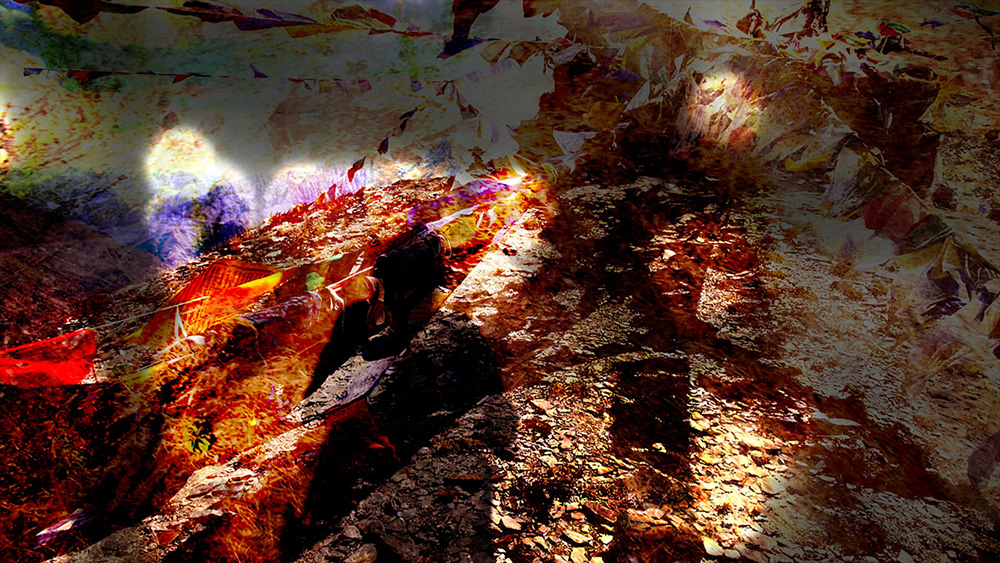


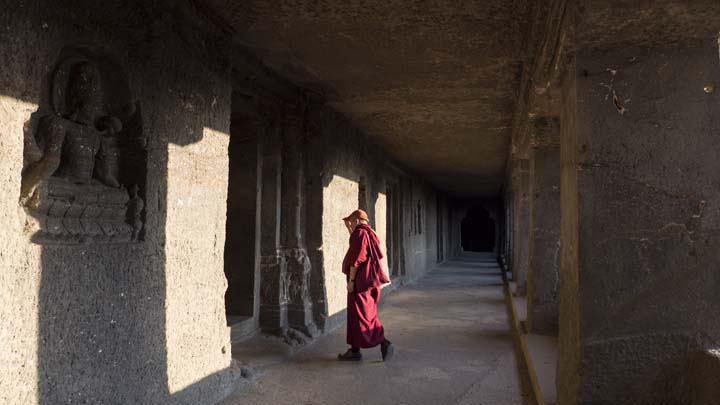


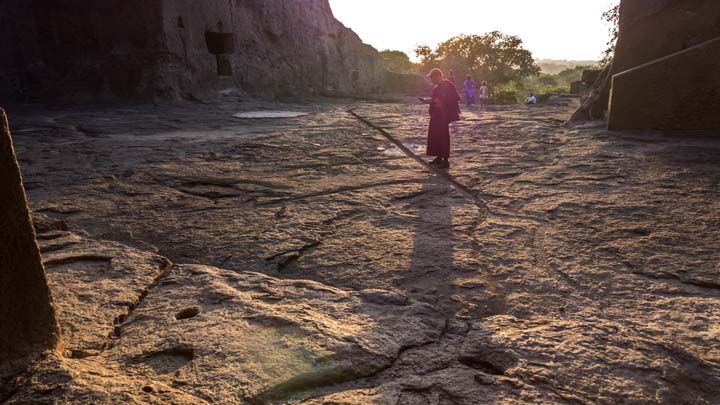
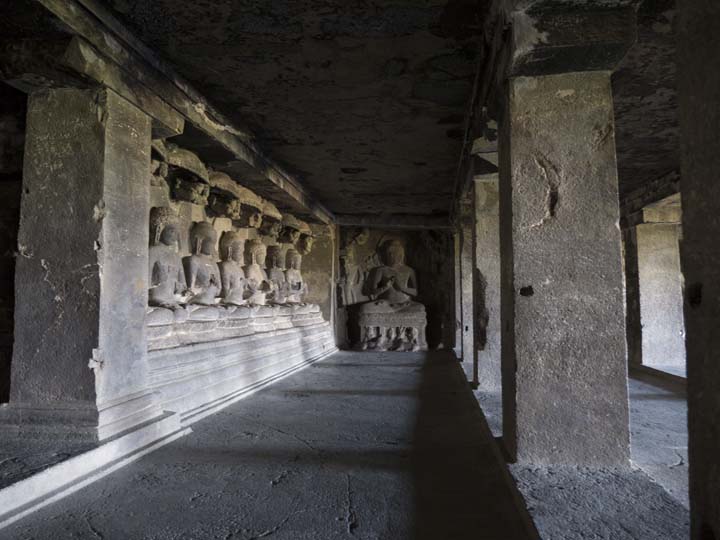

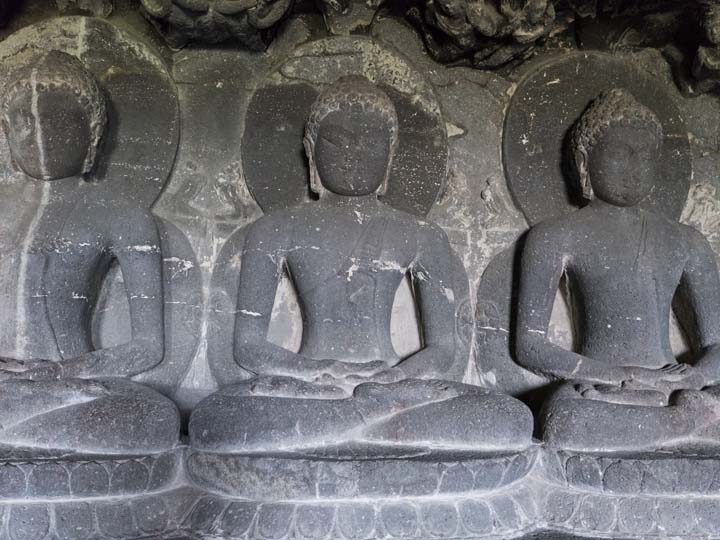


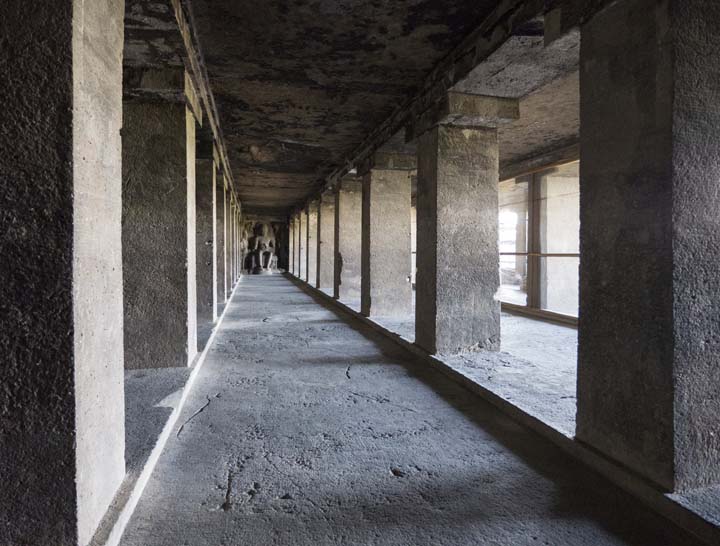
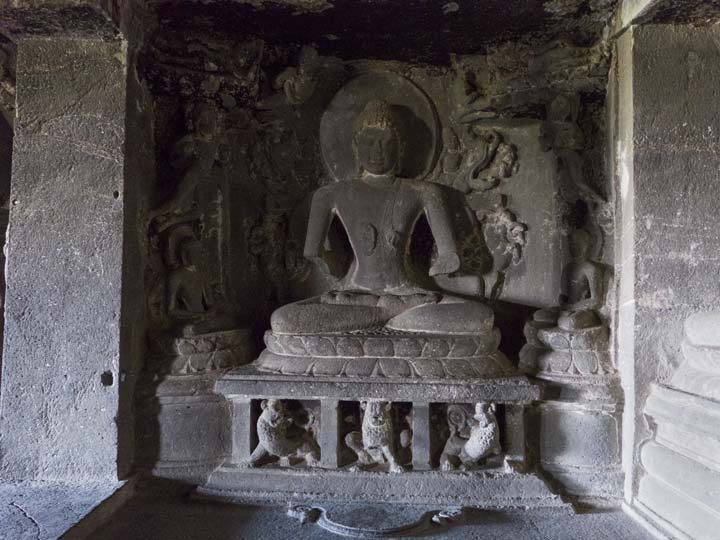


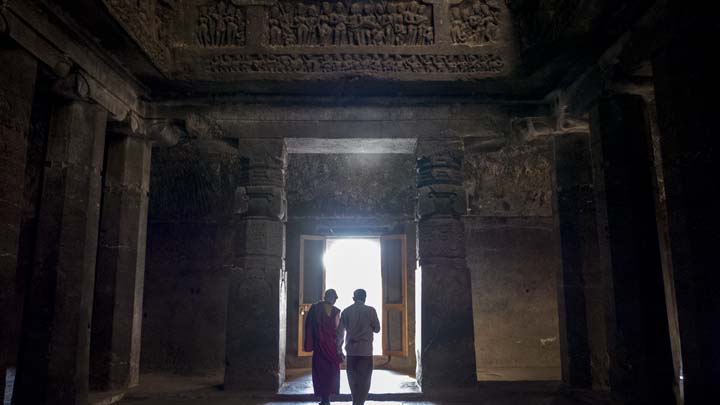
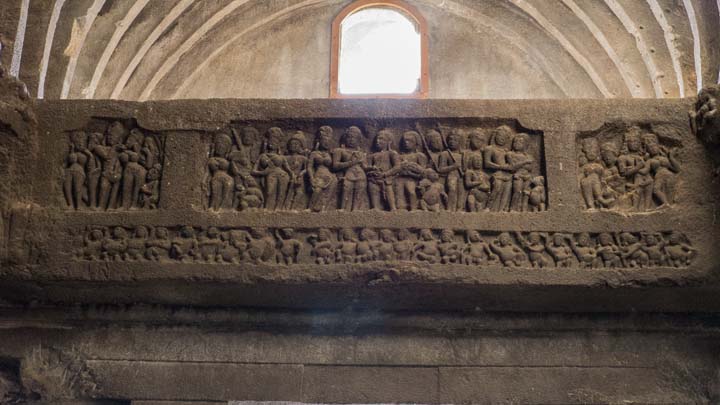
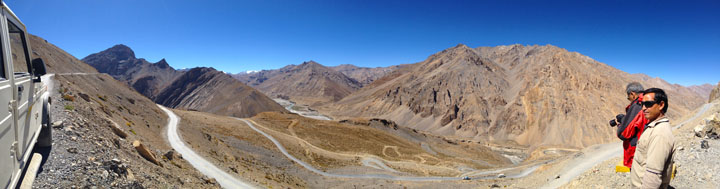


 Marmots were poking their heads out of rock crevices, or walking out in the open like this one, presumably searching for breakfast. Cute pudgy little things, they reminded me of our local American groundhogs.