At long last, I’ve finished editing this documentary! You can see it above or go to this Vimeo link where Yamantaka is uploaded.
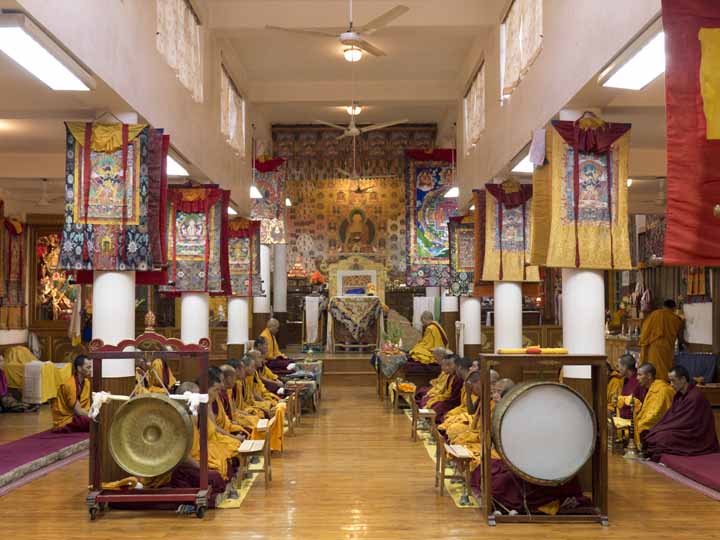
Yamantaka, what an esoteric and complex practice. This candid view of a Tibetan Buddhist highest yoga tantra was filmed over the course of ten days at Namgyal Monastery in Dharamsala, India. You will see monks create an elaborate sand mandala, ritual cakes, and other sacred arts, offer prayers, chant, play ritual instruments, purify and meditate. On the last day, the sand mandala is swept into a vase and released into the world as a blessing for all. This is always the breathtaking but cringe-worthy part, for those of us who treasure and want to hold onto the beauty of a meticulously created mandala.
Ideally, I would have liked to complete and release this documentary last year, but I’ve learned that one simply cannot rush certain things. Especially when careful viewing and understanding of the footage is at stake. Add to this the required post-production magic of removing flickering segments, compensating for low lighting conditions, color adjustments, fixing sound challenges, and so forth, and you have an enduring, long workflow at hand.
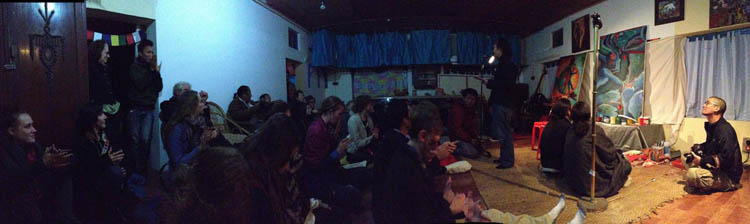
Incidentally, many viewers have asked me about what is happening at around 42:14 in the Yamantaka video, where a young Caucasian man is in the Main Temple talking loudly and animatedly to a gathering of monks. This was a debate exam in session for students of the Institute of Buddhist Dialectics (which adjoins Namgyal Monastery), characterized by dramatic and distinctive hand clapping, body motions, and rhetoric. It was an event unrelated to Yamantaka, but which coincided with it.Tibetan Buddhists have a long and famed tradition of continuing the ancient Indian Buddhist practice of philosophical debate.
Upcoming Fulbright Artist Talk at DNKL Tibetan Buddhist Center
Posted
I am honored to give a Fulbright Artist Talk soon at Do Ngak Kunphen Ling Tibetan Buddhist Center for Universal Peace, Sunday, Feb. 1st, 11:00 am – 12:30 pm in Redding, CT. This center was the co-sponsor, along with Western Connecticut State University, for the Dalai Lama’s talk on Compassion and Creativity a couple of years ago in Danbury, CT. It was on this occasion that I first met DNKL’s community, and when I had the opportunity to film the creation and dissolution of a Compassion Sand Mandala made by Drepung Gomang monks as part of their Sacred Art Tour.
This visual presentation at DNKL, “In Search of Mandalas in the Himalayas,” will include photos and videos taken during my Fulbright research, featuring mandalas of the Tabo Monastery’s main temple, the famed Tsug Lhakhang, and Lamayuru Monastery’s Senge Lhakhang, and others. I will also screen my latest experimental film inspired by research and study of Buddhist philosophy. I look forward to what I’m sure will be engaging discussions with this astute audience!
The talk is Sunday, Feb. 1st, 11:00 am-12:30 pm, followed by reception at DNKL, 30 Putnam Park Road, Redding, CT Tel: 203-664-1574. It will be preceded by DNKL’s usual Sunday community gathering from 10:00 am. Open to the public, all are welcome.
Thoughts on the Eve of Kalachakra in Ladakh 2014
Posted
July 2, 2014
Kalachakra will take place in Ladakh, India, near the city of Leh starting tomorrow July 3 – July 14. I wish I could be there this year, but alas, I will be here at home in the U.S. And on this, the eve of the event, I’m thinking about when I attended the Kalachakra Event for World Peace in Washington, D.C. held in July of 2011.
At that time, I had returned from my first trip to India where I happened to meet one of the organizers of this event. It was not long before he recruited me to help with video content for the large screens at Verizon Center, where the ritual was hosted.
I helped design and produce material for projection onto the arena screens. Content included Kalachakra prayers, and video presentations of photographs which were shown in between ritual sessions during breaks. These were essentially images of Tibetan subjects by noted photographers such as Don Farber, Tenzin Choejor, Abhishek Madhukar, and many others.
In the process of creating the video material, I had the wonderful experience of working closely with an American Tibetan Buddhist nun named Ani Tenzin Lhamo-la. Her guidance was invaluable. I could not have made these videos for Kalachakra without her. What’s more, her friendship, moxie, and insight as a psychotherapist and monastic have been memorable and enduring.
The Dalai Lama with monastics on stage at Kalachakra Event for World Peace, Verizon Center, Washington, D.C., July, 2011. Photo: Tenzin Choejor/OHHDL
I felt most honored to have produced a video chronology of the Dalai Lama’s life in celebration of his 76th birthday, which occurred on the first day of Kalachakra, July 6, 2011.
While I am not at liberty to post the video because it was created exclusively for the birthday occasion, I am so pleased to have had the opportunity to work with archived images of His Holiness. Joining that day to help celebrate the Dalai Lama’s birthday were Mahatma Gandhi’s grandson, Arun, and Martin Luther King Jr.’s son, Martin. It was a historic appearance together.
Kalachakra Event for World Peace, Washington, D.C., July, 2011
I recently suddenly thought of the Dalai Lama sitting in the middle of the thekpu, the ritual platform on which the elaborate Kalachakra sand mandala is created. He does this on the first day of consecrating the ground where the sacred artform is performed, and again when the mandala is about to be dissolved.
I realized that for me, he is the real life version of the deity that resides in the middle of the mandala. Which is to say, I realized in my heart that he is a living example of compassion and wisdom united.
For all its elaborate ritual and complex symbolism, this is the basic goal of tantra—the union of compassion and wisdom. Wisdom of the ultimate nature of mind and reality. The mandala is the guide, the mnemonic image to aide a practitioner towards such enlightenment.
At the end of this ten-day-long event, the sand mandala was swept into a ritual vase to be taken to a nearby body of water and released after chanting and prayers were performed.
Pouring the sand mandala into the water is a way to release blessings out into the world. I was so happy to be part of the small group attending this final ritual act of Kalachakra.
Backstage with Andrew Lazarow and his indispensable assistance, preparing a playlist.Inside the media control room during Kalachakra Event for World Peace 2011A cherished moment of receiving a blessing from the Dalai Lama. Photo: Tenzin Choejor
I send warm thoughts to all those who are now engaged in making Kalachakra happen in Ladakh, India! I hope it is blissful and awakening.
Lastly, I wish a hearty Happy Birthday to the Dalai Lama. Your Holiness, I will be thinking of you this weekend on the 6th!
Dharamsala Home Sweet Home
Posted
I find myself steeped in good memories of McLeod Ganj, Dharamsala, where I lived and continued research for over two months after I finished traveling through Spiti, Lahaul, and Ladakh.
Early morning at Temple Square, near Dalai Lama’s Namgyal Monastery, McLeod Ganj, Dharamsala, IndiaJogibara Road in monsoon season, McLeod Ganj, Dharamsala, India
Home of His Holiness the 14th Dalai Lama, Namgyal Monastery, the Tibetan government-in-exile, and a Tibetan and Indian community, this former British hill station in the foothills of the Himalayas attracts visitors from far and wide. They come to attend teachings, events, study, volunteer, get involved. There are a large number of Western expats living here, too.
I descended from the high altitudes and arrived in McLeod Ganj (approx. 6000 feet altitude) end of September. It was surprisingly still monsoon season, which is usually over by mid-month. But 2013 was a particularly long and relentless monsoon. Everyone agreed. It lasted well into October, and I was drenched many times mistakenly thinking I could quickly go from point A to point B and not get too wet.
The area is one of the wettest in the state of Himachal Pradesh, with up to 120 inches of rain from July to mid-September. 120 inches! In six weeks. That’s 20 inches a week, almost 3 inches a day! You gird yourself for constant moisture, fog, mold, and mildew. Hanging laundry takes close to two days to dry. Resident friends warned me to safeguard all my electronics by putting them in a closet with hot lamps shining on them. It’s practically a whiteout at times, dangerous for driving because you can’t see beyond 10 or 12 feet in front of you on mountainous hairpin turns.
Downpours pelt you like sheets of water performing a sports arena wave (you know, where sports fans get up from their seats and raise their arms overhead in succession). No really, you can actually see this phenomena of denser sheets of rain cascading across less dense ones over the valleys and on the streets. An umbrella is futile. I used one anyway out of stubborn habit, and I was almost always ruefully muttering to myself when I arrived some place with clothing stuck to me like I had put them on straight out of a washing machine with a broken spin cycle. I finally learned that when a Dharamsala monsoon rain starts, you WILL be drenched unless you duck for cover. I started carrying a poncho. And there is a reason why locals wear flip flops and brave the wet streets open-toed. It’s because normal shoes become spongy, perpetually dank and musty.
And then, one day, it’s over! The clouds and mist clear up. The horizon expands and Dharamsala, or Dasa as it is fondly called for short, looks like this.
Post-monsoon season, sunshine galore in Dharamsala
Glorious and crisp, far as your eye can see. Warm and sunny.
View of McLeod Ganj near Namgyal Monastery, Dharamsala, IndiaView of McLeod Ganj from Ashoka Restaurant rooftop, Dharamsala, IndiaView of McLeod Ganj, near Namgyal Monastery
The street vendors no longer have to cover their wares from rain and mud with tarp.
Upper Temple Road, McLeod Ganj, Dharamsala, India
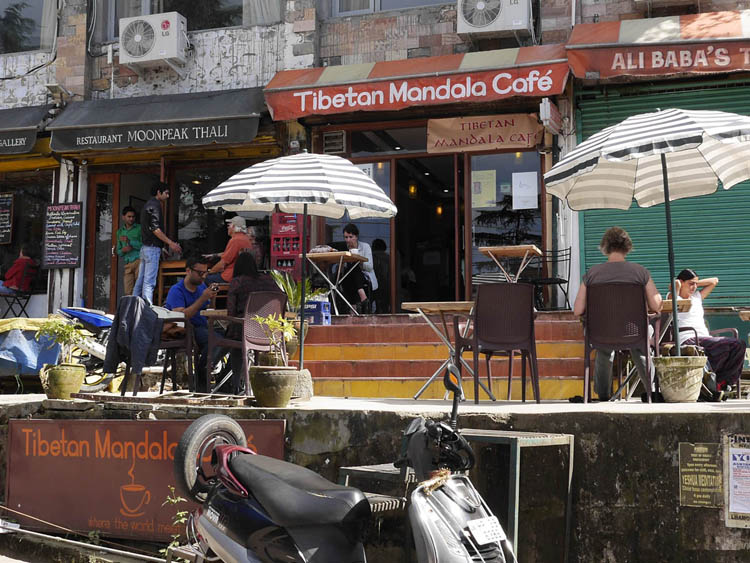
People enjoy outdoor dining and cafes again.
Cafe row on Temple Road, McLeod Ganj, Dharamsala, India
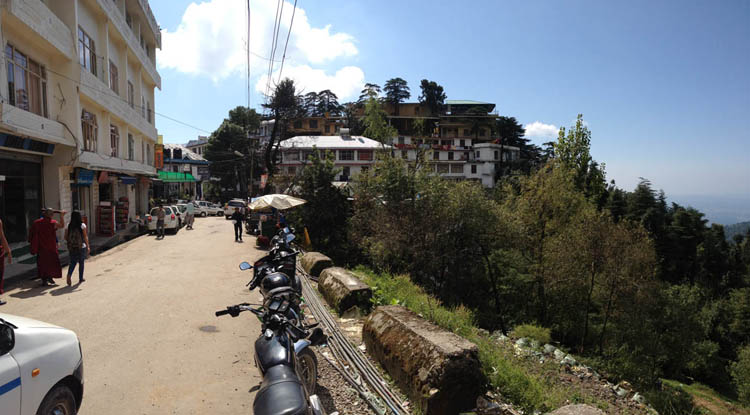
This was my usual walk on Temple Road back to where I was staying, near Namgyal Monastery.
Lower Temple Road, heading towards Namgyal Monastery, McLeod Ganj, Dharamsala, IndiaNamgyal Monastery visible here through the trees. The upper yellow buildings are open to the public where the main temples are located. Lower white buildings are monks quarters and other private areas.
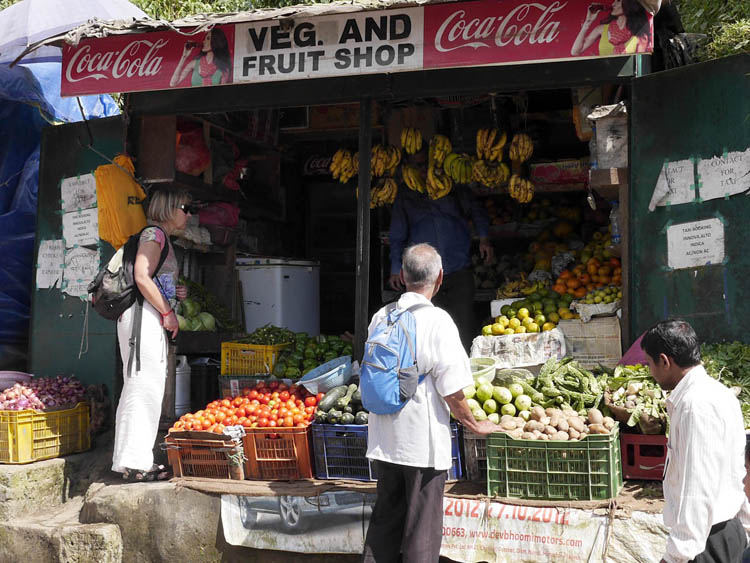
Stores that I became acquainted with along the way.
A typical fruit and vegetable stand, McLeod Ganj, Dharamsala, India
I was a regular at this stationary store. Go figure, I just never had enough pens or pads or envelopes, or superglue. I bought paper clasps here which served as clothespins or toothpaste tube holders, or food clips. Travel makes me look at objects more resourcefully.
Local stationary supply store on Temple Road, McLeod Ganj, Dharamsala, India
This shop always caught my eye with its colorful display.
Clothing store with Western fashions and trekking gear, Temple Road, McLeod Ganj, Dharamsala
At left, the location of a trusty ATM machine! Very important. I was grateful that it always worked, which is not always the case elsewhere in India.
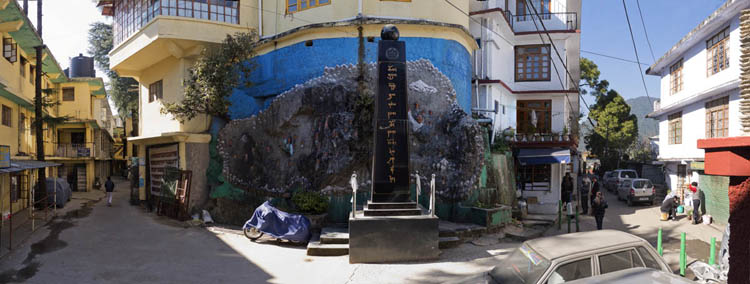
Continuation of Temple Road heading towards the main chowk or square, McLeod Ganj, Dharamsala, India
This is the raucous main square of McLeod Ganj, where several main roads converge. Where buses, taxis, and tourists depart and arrive. Where there is sure to be traffic jams throughout the day caused by congestion, narrow roads, crossing people animals.
The raucous main chowk or square, always a busy meeting place, McLeod Ganj
During my time in Dasa, I had the fortune of attending no less than three of the Dalai Lama’s teachings at Namgyal Monastery, including a Mind & Life conference, which I wrote about here. I also had the honor of audience with local rinpoches, geshes, monks and administrators, as well as observing and documenting the annual Yamantaka highest yoga tantra ritual.
Panorama of entrance to Namgyal Monastery, McLeod GanjAssembly for Yamantaka morning ritual, Namgyal Monastery, McLeod Ganj
Lunch hour outdoor performances during Tibetan Film Festival 2013, held at Tibetan Institute of Performing Arts (TIPA), McLeod Ganj
Plus, a number of music-poetry-art fusion events staged by local artists. Poetry would be read during live musical performances, while a painter begins and completes a painting on canvas in one evening.
Music-poetry-art fusion event, Dharamsala, India
There was a revolving door of gatherings, which I’m grateful to Dasa friends for inviting me to. Diwali celebrations, dinners, movie nights, artist meetings, music jams, salons, fundraisers. Truly warm, good times.
A welcome daily visitor
When not out and about, I was in my apartment, which incidentally came with a kitty. She showed up on my terrace one day.
I must say she was a welcome visitor. Although she left a lot of nose smears looking in through my newly cleaned window, she did accompany me many days as I sat indoors editing footage, photo-correcting, researching, and writing.
Evidence of looking in on me a few too many times
Which reminds me of a story I heard about the Dalai Lama, who once had two cats as pets. After they spent their last days with him in his palace, he decided he would not have pets anymore–too much attachment!
Yes, indeed, I was sad to leave this little one, but happy to learn that she actually belonged to my neighbor.
On my last day in Dharamsala, I left a bag of cat food at their doorstep, then went for a final koraaround the monastery complex on this fine, scintillating morning.
Panorama of Namgyal Monastery circumambulatory, McLeod Ganj, DharamsalaPanorama of Namgyal Monastery circumambulatory, McLeod Ganj
I’ve gone about it all backwards. Backwards in time, in pursuit of mandalas. It all started when I heard that a sand mandala was going to be made at Namgyal Monastery in Dharamsala, India, in 2010. So I went there, and found out that it was a Yamantaka mandala, part of a ten-day-long highest yoga tantra ritual which occurs annually at the Dalai Lama‘s personal monastery. My previous post here describes what little I knew then as I observed and documented the creation and dissolution of it. The resultant film and photographs can be seen here.
When I came back to the U.S., it was as if a floodgate had opened. I needed to learn more. No, not just more, but all I could about Tibetan mandalas–about their variety, their purpose, their history, the meditation practices they engendered, and so forth. What did it all really mean? What modern significance did it have?
My bookshelves began to fill up with writings about tantra and Buddhist philosophy, written by the first Tibetan teachers to venture into the Western world, post-1959 exodus from Tibet. Titles by the Dalai Lama, Chogyam Trungpa Rinpoche, Lama Thubten Yeshe, Dilgo Khentse Rinpoche, as a few examples, abounded. I also read works by contemporary lamas like Dzogchen Ponlop Rinpoche, Pema Choedron, Tsoknyi Rinpoche, Tenzin Palmo. Tibetan scholars and historians David Snellgrove, Robert Thurman, Deborah Klimburg-Salter, Martin Brauen, and others figured in there, too.
All this, in addition to my previous discoveries of well-respected meditation teachers from other Buddhist traditions–Sharon Salzberg, Joseph Goldstein, Jack Kornfeld, B. Allan Wallace. I followed the writing of neuroscientists and clinicians, too, who studied or used meditation in their work. They were also involved with fascinating Mind & Life Institute research or conferences–Richard Davidson, Jon Kabat-Zinn, Paul Ekman, Daniel Goleman.
It was a mindfulness-neuro-tantric-philoso-fest that poured forth!
Meanwhile, in 2011, the ritual experiences continued. I attended the Dalai Lama’s Kalachakra event for World Peace in Washington D.C., and witnessed the Kalachakra Mandala.
In 2012, I was at the Dalai Lama’s talk at Western Connecticut State University at which time I encountered a Compassion Mandala.
At both events, I had the wonderful opportunity of befriending and working with monks, nuns, plus other Buddhist practitioners and followers.
It was a steady flow. The waters at the floodgates just did not tire out. Answers came, and new questions arose.
Thus, on the heels of this, last year in 2013 I arrived back to India to experience and research rare Indo-Tibetan mandalas in Himalayan monasteries of Spiti, Lahaul, and Ladakh. How might they have evolved into Tibetan forms that we know today? What was this Indo-Tibetan 10th to 12th century period called the Second Great Transmission of Buddhism from India to Tibet? What did the sacred art look like? What did it mean?
At the end of my travels through the Himalayan high altitudes, I then thought, let’s reel back in time some more. What came before the Indo-Tibetan era?
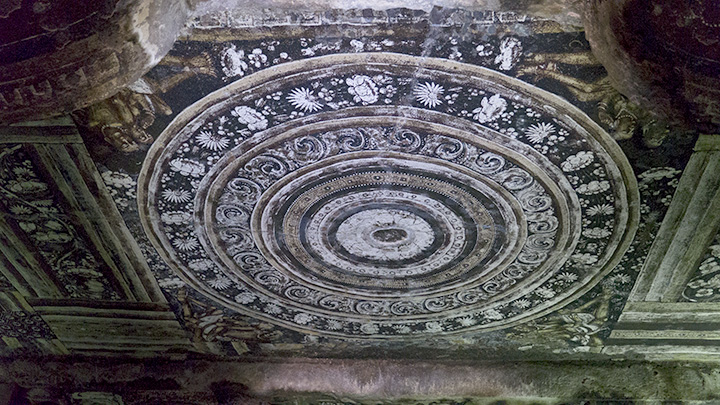
The answer was, Indian Buddhism, which could be seen at Ajanta and Ellora Caves where there are remains of elaborate 2nd to 8th century C.E. wall paintings, sculptures, and architecture. Such purely Indian Buddhist art is still preserved at these South Indian sites in the state of Maharashtra.
Finally, what might have come even before this in India? I mean in B.C.E. times. When I searched further, it seems that the Buddhist art historical record stops here. According to historians, not much still exists before the 1st century C.E. Little is known in India archeologically prior to this time.
So what’s it all about? Why would an artist go for all this? New artwork from my Fulbright experience does beckon me in the studio.
I guess I’m just driven by the big questions about mind and reality, which Buddhist philosophy seems to address best. And moreover, that largely works within a Western scientific paradigm. It doesn’t hurt, either, that an affable spiritual leader like the Dalai Lama continues to inspire and exemplify how one can be intellectually sharp, existentially awake, and compassionately engaged in the world. Despite being a keeper of complex Tibetan rituals and esoteric tantric teachings, he can still keep it simple and distill wisdom down to these words: “There is no need for temples, no need for complicated philosophies. My brain and my heart are my temples. My philosophy is kindness.”
A Chosen Place: Tayul Monastery
Posted
September 14th Lahaul adventure continues…
Tayul Monastery, Lahaul, India
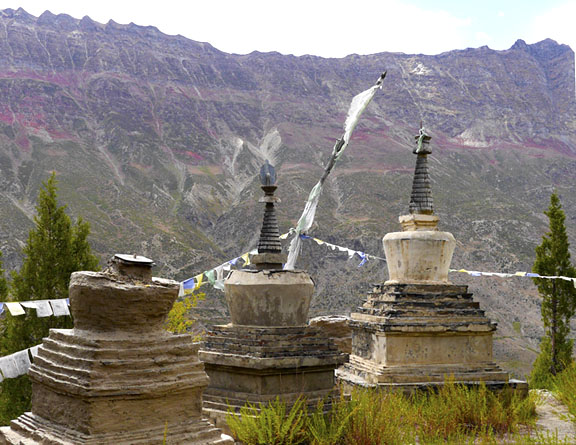
Today was Shashur and Tayul Monasteries. Both are not far from Keylong, just several kilometers away. Tayul Monastery was founded in the 17th century, but like Kardang Monastery, little appears to remain from its original period. The current main temple was renovated in the 19th century. Probably the oldest objects to be seen are the ancient stupas one encounters en route, on the hike up to the site.
Ancient stupas on walking trail en route to Tayul Monastery, opposite Drilbu Ri Mountain, Lahaul
It must be reached on foot because there is no motorable road off the main road. The hike up is beautiful, of course, for its vistas. I was glad driver D accompanied me up because the trail is not so clear in some places. Locals do always advise having a guide. I still get winded doing the slightest incline up but hopefully each day will get better as I continue to acclimate to high altitude.
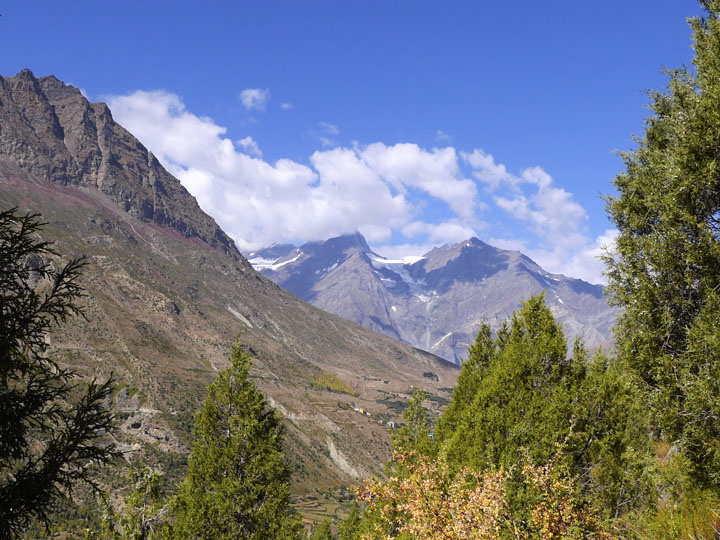
View across Bhaga Valley amid pine trees on trail to Tayul Monastery, Lahaul
Directly opposite is sacred Drilbu Ri mountain. You can always spot it by looking for those seven little peaks in a row that lead to a notched area where one treks up and over to reach the summit.
Drilbu Ri Mountain seen from across Bhaga Valley, easily identifiable by its seven peaks and the notch just to the right, where trail to its summit proceedsStatue possibly of founder and yogi Serzang Rinchen. Tayul Monastery,Lahaul
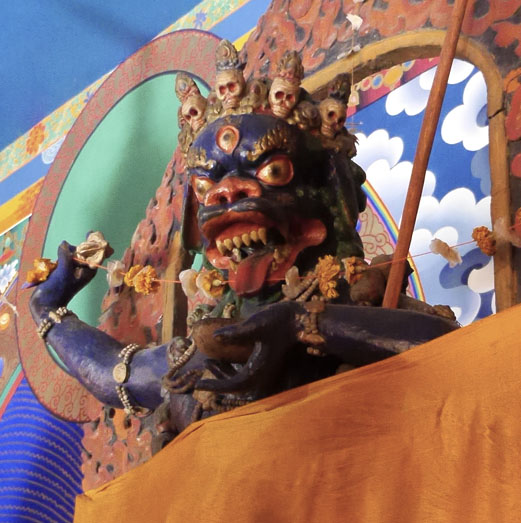
In fact, the story goes that Tayul, which means “chosen place,” was a location noticed by founder and Drukpa yogi Serzang Rinchen when he made his pilgrimage up Drilbu Ri. From across the Bhaga Valley, after a meritorious kora around the mountain, he saw the site and decided to build a hermitage there which became Tayul Monastery. Upon entering the main temple, one sees the 12 foot statue of Padmasambhava (Guru Rinpoche), revered as a great sage and living Buddha by Tibetans for introducing Buddhism to Tibet in the 8th century, displaying miraculous feats in taming local spirits in the process. Flanking him at the altar are statues of Dakini Singha Mukha, and the wrathful emanation of the guru.
Altar with Padmasambhava (Guru Rinpoche) in center, flanked by Dakini Singha Mukha and wrathful emanation of guruStatue of Singha Mukha, Tayul Monastery, LahaulWrathful emanation of Guru Rinpoche, Tayul Monastery, Lahaul
The original wall paintings from the 19th century by Lama Tashi Temphel, who stayed there and helped expand the monastery, are no longer extant. In its place are new paintings. Unfortunately, I found these contemporary-styled depictions rather stiff in execution, and less refined than older wall paintings I have seen to date in previous monasteries. Lama Temphel also made sacred images at Guru Ghantal Monastery, which happily can still be seen there. It had been suggested to me that Lahaul is not so much a place to find ancient Indo-Tibetan artwork, nor exquisite old wall paintings or mandalas even, as it is a place to be experienced physically as a land of yogi training, legend, and pilgrimage. So far, so true.
View of new wall paintings, Tayul Monastery, LahaulDetail of new wall paintings, Chakrasamvara in center with Guru Rinpoche above and surrounded by dakinis, Tayul Monastery, LahaulDetail of new wall paintings, featuring Drukpa lineage masters, Tayul Monastery, Lahaul
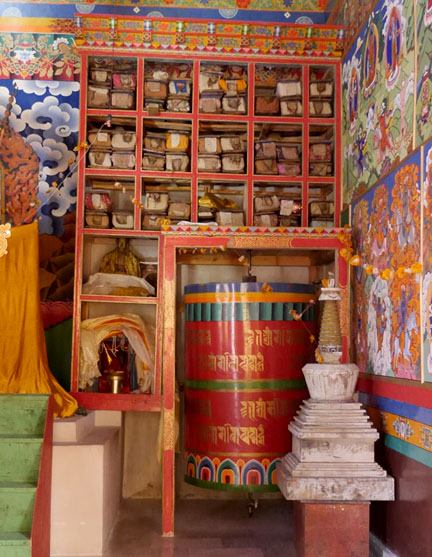
Tayul Monastery contains a complete Kangyur library and a large mani wheel that contains thousands of prayers. When spun, its blessings are activated and multiplies. According to its lamas, this wheel has been known to spin by itself on certain special occasions.
Kangyur library, and mani wheel known to rotate on its own on auspicious Buddhist days, Tayul Monastery, Lahaul
The British-born Tibetan Buddhist nun Tenzin Palmo was one of the first Westerners to encounter high Tibetan lamas in the early 1960s when she first arrived in India. She lived at Tayul for six years before retreating to a cave above it for twelve years. I read her biography Cave in the Snow like it was a suspense-thriller. I found her story and existential experiences riveting. It was a page-turner. Her retreat was abruptly interrupted by immigration authorities. Thus began her exit from solitary yogic practice to being a teacher in the world, a living example of Western and female accomplishment on the dharma path.
I always think that one beneficial outcome of the Tibet situation post-1959 is the creation of a diaspora which has lead to the spread of Buddhism in the Western world.
I saw Shashur Monastery the same day as Tayul. More to come!
Today was spent going to Poekar Monastery, known partly for where Apho Rinpoche had commissioned Bhutanese artists to create a giant Guru Rinpoche statue. One can say that the Bhutanese are present-day masters of sublime Buddhist art. Their style and techniques are favored by Tibetans. I have seen their work grace many contemporary monasteries.
Poeker Monastery on upper right (yes, that little cluster of white above the other little cluster of white which is the village below), Lahaul Valley
While Poekar was not originally on my radar for visiting, J had learned yesterday at a meeting in Manali with one of Apho Rinpoche’s sons, Jampal-la, that he was heading to Keylong for Tara puja (prayer), to be followed by Guru Rinpochepuja the day after. She immediately called to inform me that I should join them. That is to say, in her irrepressible and talented role of what Malcolm Gladwell calls a “connector,” she invited me to join them at her behest and on their behalf! Right, then, another unforeseen opportunity to observe and experience. So, I said OK, thank you!
Statue of Guru Rinpoche, Poekar Monastery, Lahaul. It doesn’t look that big at this angle but this is one-and-a-half stories high. Also known as Padmasambhava, he was the sage who introduced Tibet to Buddhism in the 8th century.
I planned to stay overnight (because J said it was fine to) and brought all my camera equipment and some clothing, all jammed in my wheeling suitcase. But when I got there with the driver, I couldn’t reach Jampal-la on his phone for details, and found while searching for the monastery that it was a good steep half hour hike up! So much for wheeling in my suitcase. It became clear that unless I hoisted my rather heavy suitcase up, the only other option was to go back to my Keylong hotel. Driver D, who had climbed up to the monastery with me to ensure that I was safely escorted, was kind enough to offer to go back down to the car to fetch it, but I didn’t feel good about him doing that!
Anyway, perhaps one day was enough. Maybe better to get to Shashur and Tayul, or Guru Ghantal the next day. These were planned destinations and I wanted to make sure I had enough time to document them. Jampal-la suggested also Phakpa Monastery in Triloknath, a sacred site of Avalokiteshvara, and Markula Devi Temple in Udaipur, sacred site of Vajrvahari.
The Tara puja was an annual event that Poekar Monastery’s American sponsor requests. The resident monks and nuns are yogi retreatants, as most are in Lahaul. Together, they conducted the prayers, chanting in refreshing cross-gender unison, something one doesn’t experience very much since monks and nuns are usually living separate monastic lives.
In fact, Tara as a tantric deity has contemporary feminist appeal. She is referred to in the Perfection of Wisdom (Prajnaparamita) sutra, a very key Mahayana text, and is considered the female form of Avalokiteshvara, the deity of infinite compassion. With these two strong combinations of wisdom and compassion, she embodies powerful aspects of the practitioner’s own Buddha-nature. She has 21 forms or emanations in all, each associated with certain colors and psycho-physical energies.
Green Tara surrounded by her other enamations
During Tara puja, we all sat cross-legged on the floor as is customary. I was flanked by two nuns who would hand me grains of rice to toss in the air at intervals during prayer. Jampal and his wife were guests of honor.
It was nice talking to them both in between prayer sessions. We talked about how the West seems to the East and vice versa. I shared my observations of what I thought was positive and negative about each social order, their apparent outlooks on life, and expectations of how things should be. Jampal-la and his wife shared theirs. I learned from him that, even though he comes from a line of great traditional solitary practitioners, his view is unexpectedly open to contemporary and Western exposure, and it is this:
Begin on the secular level with teachings about how to simply be a good, moral person before getting to the more esoteric and higher teachings. Let individuals develop and choose whether they want to be Buddhist or not. Then if they do, higher teachings can always come later. He has helped to sponsor a group of young girls by sending them to school and working on exactly this approach. In this way, he is aligned with the Dalai Lama’s initiative on secular ethics.
What’s more, their teen is in the U.S. now attending university through the generosity of a sponsor. They feel strongly that young Tibetans should experience what the West has to offer, and then decide for themselves whether to follow that life or come back to the East. Otherwise, they will always feel doubt or curiosity that the (democratic/ materialist/capitalist/etc.) grass is greener on the other side. Eye-opening to chance the risks of the world, coming from a family and lineage legacy of hermitic existence.
The day passed so seamlessly from breakfast to morning prayers, to lunch and afternoon conversation, with such friendliness exuding from everyone at Poekar.
Poekar Monastery nuns, Lahaul
Sadly, when I learned that the next prayer session would continue in a different temple an hour’s ascent further up the mountain (surprise once again) I decided it was too late in the day, and time for me to travel back. Upon hearing this, the nuns and monks, who by now were spread willy-nilly on the hillside climbing up, began to wave and smile and utter lovely goodbyes. They repeatedly implored me to stay over. Truly, their sincerity warmed me so much, I found myself walking away hand clasped to heart.
Poekar Monastery monks, LahaulView of Lahaul Valley from Poekar Monastery village
Yesterday, J and I came to Kardang Monastery to meet resident yogi and monastery head Lama Paljor-la. After learning about my project, he generously shared stories with us about the murals, objects, and photos in the main temple. J knows quite a lot about the Drukpa Lineage so they both had much to discuss.
Kardang Monastery as seen from across the Bhaga River, Lahaul
Kardang today is perhaps the best known monastery in Keylong owing to its association with the Shakya Shri Drukpa Lineage. Lineage is of terrific importance in Tibetan Buddhism because tantra is a living spiritual tradition transmitted orally in teachings from master to disciple. In this way, there is a connection from generation to generation which can be traced back to the Buddha himself.
Drubwang Shakya Shri (1983-1919) was an exceptional yogi who started out as a cook in a Drukpa monastery in Tibet. His lineage is unique because, through deep, whole-hearted practice, it is said he received his enlightenment directly from Vajradhara, the primordial Buddha. He was widely recognized as an incredible adept by other masters, including His Holiness the 14thDalai Lama. With pure connections going back only a few generations, Shakya Shri lineage is known for its effective master-to-disciple teachings which guide practitioners swiftly along the Buddhist spiritual path. Shakya Shri mastered Mahamudra in the Drukpa Kagyu tradition, and also Dzogchen through the Nyingma lineage. He was later known for being involved with the Ri-me (non-sectarian) movement.
It was Shakya Shri’s disciple Jetsun Norbu Rinpoche, who returned to Lahaul from Tibet after his master had passed away. As holder of his teachings, and in particular of the Six Yogas of Naropa and Mahamudra, he soon attracted 2000 followers from all over the Western Himalayas. Though his hermitage was thriving, he preferred to live in a cave above Kardang Monastery. In time, Kardang became known as a yogic training center.
Cave dwelling above Kardang Monastery, possibly like one that Norbu Rinpoche lived in
As I mentioned in an earlier post, you may have heard of Tibetan Buddhist practitioners who can do unusual physical things. It was some of Shakya Shri’s lineage yogis whom Harvard scientists studied in the 1980s doing tummo practice, in which they can raise the temperature of parts of their body by as much as 17 degrees! One study involved the yogis scantily clothed spending a Himalayan winter’s night outdoors on a rocky ledge at 15000 feet altitude where temperatures reached freezing. The yogis demonstrated they could remain warm and slept through the night without incident. I think most of us would have suffered hypothermia! It occurs to me that Lama Paljor-la could have been one of these yogis.
Kardang Monastery is believed to have been founded about 800 years ago, but nothing seems to remain of its original temple. The current main temple was first built by Norbu Rinpoche in the 1930s, but was rebuilt several years ago by Lama Paljor-la, a disciple of lineage holder and former monastery head Apho Rinpoche. I have had the pleasure of meeting three of Apho Rinpoche’s children in Manali en route to Spiti and coming back from Lahaul: lineage holder Sey Rinpoche, his brother Jampal who is also a recognized reincarnate but prefers to live a quiet life with his family, and Khandro Thrinlay whom I wrote about previously here.
Kardong Monastery, Lahaul
Kardang Monastery is situated directly opposite Keylong on the other side of Bhaga River. See this 360 degree video view below.
[vimeo 145002351 w=600 h=331]
When one enters the main temple, one sees a mixture of old and new murals on the walls. The older ones, possibly no older than the 1930s, were painted originally on canvas so they were removed and reinstalled. They collage the walls alongside newly painted scenes.
Interior of main temple at Kardang Monastery, Lahaul, with lama performing Mahakala prayers
At the altar are Buddha Shakyamuni statue on the middle, Vajradhara on the left and Padmasambhava on the right (also known as Guru Rinpoche, who introduced Buddhism to Tibet in the 8th century).
Vajrdhara on left, Buddha Shakyamuni in center, Padmasambhava on right, altar at Kardang Monastery, LahaulInterior view of Kardang Monastery where older and newer paintings collage the walls, LahaulOlder and newer paintings collage the walls of Kardang Monastery, LahaulInterior view of main temple, Kardang Monastery, LahaulDetail of an older painting depicting a scene from the Life of Buddha, Kardang Monastery, LahaulDetail of an older painting depicting Chenrezig, Kardang Monastery, LahaulDetail of an older painting depicting Padmasambhava with consort, surrounded by protector deities Kardang Monastery, Lahaul
The monastery has a large library which includes the complete Kangyur, given to Norbu Rinpoche by the king of Bhutan, and the complete collection of the Wisdom Words of His Holiness the 4th Gyalwang Drukpa, the spiritual leader of the Drukpa Lineage.
Kardang Monastery has an extensive library of Kangyur scripture and other complete texts. Also seen here are sculptures and relics of lineage mastersGegen Rinpoche on left, His Holiness the 12th (current) Gyalwang Drukpa on right, on altar of Kardang Monastery, LahaulA newly painted guru-yoga mandala on the ceiling, Kardang Monastery, Lahaul
Above the main temple is a room that had belonged to Apho Rinpoche. On the walls are paintings depicting Milarepa’s story that were originally painted on canvas and reinstalled in this new temple.
Apho Rinpoche’s former room above main temple, Kardang MonasteryScenes from Life of Milarepa, older wall paintings from Apho Rinpoche’s former room above main temple Kardang Monastery. Above right are newer paintings.Detail from Life of Milarepa, wall paintings, Kardang Monastery
I’m spending the night here tonight in one of the monastery guest rooms. There’s an Ani-la (nun) who has kindly cooked for me, but mostly Kandang’s community of eight monks and seven nuns are lone retreatants living in simple huts and cooking for themselves.
Detail from Life of Milarepa wall paintings, Kardang Monastery, Lahaul
J left this morning, and took the bus back to Manali. It was wonderful traveling with her, and I’ll miss her company to share travel discoveries with. Yes, so I’ll be here for several days on my own devices, until my next travel companion K arrives and we drive together to Ladakh. On my list of things to do here are to see Shashur and Tayul Monasteries.
View of Keylong from the courtyard of Kardang Monastery on the other side of the Bhaga River, Lahaul
Tomorrow I plan to walk back to Keylong via trail and footbridge across Bhaga River. I hope the paths are clearly visible and I don’t get lost! There’s no taxi to be had here unless I call for one from Keylong. And as Khandro-la’s assistant had told me, Lahaul does not have so much in the way of Indo-Tibetan mandalas, but is rather itself considered a Chakrasamvara mandala manifest, one should experience it on foot. Even though we are at over 11,000 feet altitude, it seems not too hard to go downhill and not terribly far to walk perhaps 5-8 kilometers, so I think I should follow this advice and experience Garsha. After all, I am over the worst of altitude adjustments. I had vice-grip headaches at night which made it hard to sleep, but the head pain progressively improved, and by the end of the first week, went away. So while I’m a bit short of breath sometimes exerting uphill, it’s not a hardship.
Thoughts on Craving, Desire, and Addiction in Dharamsala
Posted
I just spent the past week attending Mind & Life Conference which was held with the Dalai Lama at his residence here in Dharamsala, India. Well, that is, I attended the live broadcast of it at the adjacent Namgyal Monastery. I wish I had been able to be at the conference in person!
I’ve been to public ones in the U.S. and India in the past and they are always thought-provoking, authentically open dialogues between scientists, scholars, and contemplative practitioners. I absolutely love these conferences because exciting interdisciplinary ideas emerge and unexpected conversations evolve about, well, what mind is and how we can work with our minds to live skillfully and beneficially.
Organized around a chosen topic, invited presenters speak about their research or practice, then open it up to questions and discussions. In the process, paradigms, assumptions, and philosophical traditions are examined. Issues are raised for how we can improve or solve humanity’s contemporary problems.
The topic of this one was “Craving, Desire, and Addiction.” Check out the Program and Schedule of Events. Mind & Life Institute assembled a remarkable group of participants–neuroscientists, clinicians, a sociologist, a Christian mystical scholar, monks, and others–who brought first-person perspectives to the table. One neuroscientist, Mark Lewis, had been an addict himself and talked about his subjective experience of the craving cycle, and his objective one as a researcher working on identifying the neurological structures of the brain involved in and affected by substance abuse.
Some eye-opening things I learned from research findings include the idea of the “erosion of free will” in addiction. Dopamine and serotonin structures in the brain involved in thinking, restraint, and projected rewards are actually altered and “hijacked” by addiction so that addicts are, in fact, biochemically disadvantaged in breaking the cycle of craving-imagining-planning-taking the substance, as opposed to non-addicts. Studies indicate that addiction recurs even though addicts no longer find pleasure in the substance and know that it will cause them and others harm.
One anthropologist presented some stunning statistics about the regulation of addictive substances as a program of prevention. In the U.S., criminalization of drugs has resulted in disproportionate incarceration. The American population is 5% of the world population, but is 25% of the world’s incarcerated! African-Americans form 13% of the U.S. population, but are 45% of those jailed for non-violent drug offense! There seems to be a serious bias in the implementation of drug laws. Another example, in New York City, more white people use marijuana, but more black people are arrested for it.
These facts, and many other compelling ones on prevention, intervention, and treatment were discussed. Incidentally, Mind & Life will be posting videos of the conference soon on its website. So if you missed the live webcasts, you can watch them archived online. I highly recommend it if you are or you know someone who is affected by substance abuse and addiction.
The conference was profound in scope. Key discussions centered on definitions and experiences of desire and craving, and how they can be met and transformed. It was insightful not only for illuminating root causes of suffering for addicts but for all of us living in contemporary materialistic culture where craving things becomes the norm for excessive consumption. I read recently that acquiring more than what you need was considered by many pre-industrialized indigenous cultures as pathological. What prescience!
It makes a lot of sense when you consider the suffering of anxiety, depression, neuroses, and suicides in the U.S. among young people who are desperately stressed, competing with each other towards educational goals aimed ultimately at attaining material wealth. The documentary Race to Nowhere is a disturbing and sad account of this phenomena. It illustrates a basis for the alarming disconnection between emotional health and well-being, and what is defined as “success” in American life. See the trailer here.
And while I’m on this topic, the book Teach Your Children Well: Parenting for Authentic Success also takes an insightful look at how we are raising and educating kids. The New York Times writes, “It would be easy, on first glance, to dismiss [psychologist] Madeline Levine’s Teach Your Children Well as yet another new arrival in a long line of books that have urged us…to push back and just say no to the pressures of perfectionistic, high-performance parenting. But to give in to first impressions would be a mistake. Levine works with teenagers who are depleted, angry and sad…so lost are they in the pursuit of goals that have drained their lives of pleasure, contentment and connection. ‘Our current version of success is a failure,’ she writes. It’s a damning, and altogether accurate, clinical diagnosis.”
And how much of this cultural milieu might drive people to substance use and abuse in an unfortunate attempt to alleviate suffering? It is known that the harmful patterns of addiction take a profound toll on both the individual and society. According to Mind & Life, addiction to alcohol, tobacco, and illicit drugs, for example, is estimated to cost the United States $600 billion per year. Did you just read that correctly? Yes, you did, $600 BILLION. On the emotional level, it’s immeasurable how deeply it traumatizes families and friends, sometimes for generations.
At this Mind & Life conference, as part of the discussion on effective treatment for addiction, the Dalai Lama advocated prevention through new initiatives in education that increases self-awareness and connection to others through the practice of kindness. Because many social ills come from the hyper-individualism championed by the contemporary industrialized world, such excessive self-focus, he said, ultimately produces separation and unhappiness. It gives rise to an “us and them” mentality which makes aggression, greed, and war possible. Instead, we need to develop not only our thinking skills but our emotional ones as well.
If you’re an educator, counselor, or parent, take a look at this nascent movement and see what you can do to make a difference.
See an example of how incorporating kindness in children’s education works in this PBS video. Groundbreaking studies of children learning through mindfulness and kindness curricula currently under way and developed by University of Wisconsin Center for Investigating Healthy Minds are yielding increases in positive social behavior. See here for further information on this and similar programs.
But Wait, a Bit about Mandalas
Posted
Okay, I know I promised to post Part Two of Tabo Monastery next, but as I’ve been writing, I’ve found it necessary to do a lot of explaining. In fact, so much explaining in between the photos of Tabo’s interior that it’s a bit interrupting. So I’ve decided to get the explaining done with first. All right with you? Great, read on!
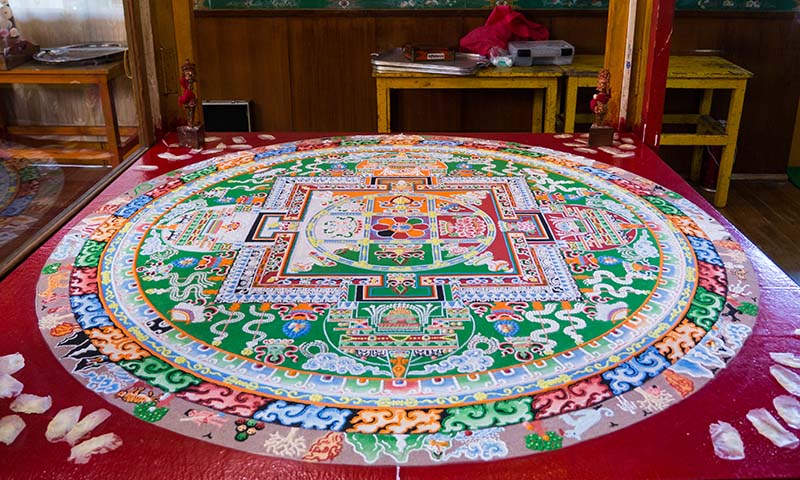
When I first came to Namgyal Monastery in 2010 to observe and document a highest yoga tantra ritual Yamantaka, I knew precious little about the vast world of Tibetan Buddhist tantric deities. What I knew was that an elaborate sand mandala would be made by the Dalai Lama’s monks in their temple in McLeod Ganj, India. I did not know at that time, for example, that this intricate 2-dimensional Yamantaka design represented a 3-dimensional palace, in which the deity resides at the center.
Yamantaka Sand Mandala, Namgyal Monastery, India
I learned that as a sacred art, whether made of sand, cloth, or metal, its purpose is to be a meditation aid to a tantric practitioner. A sort of blueprint, a sand mandala usually depicts a square multi-storied abode with four gates centered within a circle. Every element, from color, dots, vases, banners, letters, animals, etc., represents an essential part of the deity, his or her teachings, and Buddhist philosophy. Each deity in turn has a retinue of associated deities, which are also depicted. A person contemplating the mandala imagines entering into its palace and encountering all these elements, which is to say, meditates on the qualities and teachings they symbolize. To a devout practitioner, a mandala ultimately represents the mind of the Buddha.
An esoteric and advanced practice, Tibetan Buddhist tantra (also known as Vajrayana) is intended for the properly receptive initiate, with guidance from a qualified teacher or lama. It is an accelerated, experiential way to realize the Buddhist wisdom of the ultimate nature of mind and reality, and great compassion. First taught by the historical Shakyamuni Buddha over 2500 years ago, it has been passed through oral tradition by lineage teachers. Its goal is enlightenment of the practitioner for the benefit of all sentient beings. And, believe me, this means all. One of my favorite little prayers is one I learned on a meditation retreat, and it goes like this:
May all beings, large or small
or middling, near or far,
visible or invisible,
born or yet to be born,
May all beings be happy and content.
Let no one deceive another.
Let no one despise another,
whether out of greed, hatred, or ignorance.
And as a mother would risk her life
to save her only child,
let us cultivate this feeling
of loving friendliness towards one another.
Quite a vast scope! And speaking of scope, there are literally hundreds of tantric deities, each with unique mandalas representing different sets of details and qualities specific to his or her teachings and practice. All varieties transmit fundamentally the same Buddhist wisdom and compassion, but each deity provides a different identity with which practitioners, according to their particular personality, can relate to or find affinity with. It is important to note that it is understood in tantra that none of these deities are real in the conventional sense. They do not exist, but are symbols, visualized in their mandala in a specific and procedural meditation practice.
This multiplicity is something Buddhism shares with its Hindu beginnings. Prince Siddhartha, after all, was born and raised a Hindu before his ascetic wanderings led him to enlightenment as Shakyamuni Buddha. I really appreciate India’s cultural acceptance of many-paths-to-the-same-truth. I understand that Hindu deities are so vast they number in the millions. This acknowledgement of relativity, even acceptance of the co-existence of apparent contradiction, is truly an admirable hallmark of Hinduism, and in particular, Buddhist non-duality.
Although intricate, aesthetically compelling, and often mysterious to the non-practitioner, mandalas are meant for religious use and are not intended as works of art for museum or private collection. In fact, I had occasion recently to discuss this very topic with a Buddhist nun. Her position was that tantra is a secret and profound practice, the art of which should only be for the eyes of practitioners. What would it serve to reveal what is not meant for the uninitiated? While I can understand her viewpoint, I believe that since the Tibetan diaspora has led to the spread of Buddhist teachings, and the increasingly ubiquitous access to seeing tantric mandalas, it is better for the sake of education to reveal some things about them accurately rather than risk erroneous speculation and misunderstanding.
In 1988, the Dalai Lama permitted the first public construction of a mandala in the West as a means of teaching about and preserving Tibetan culture. This was the Kalachakra Mandala, an example of which can be seen here, constructed in sand at the Museum of Natural History in New York City by Namgyal monks from Dharamsala, India. He also felt that it would be a benefit because a mandala is thought to bring peace and harmony to the area where it is being created. Even viewing a mandala is believed by Buddhists to be enough to effect positive change for greater compassion, awareness, and a better sense of well-being.
Since the construction of this first mandala in the West, many have been created all over the world. Drepung Gomang Monastery in Southern India has a group of monks who come to the United States annually to demonstrate their arts through the Sacred Arts Tour. Last year, I had the privilege to witness and document a Compassion Sand Mandala which these monks made as an offering to the Dalai Lama on the occasion of his talks on Compassion and Creativity at Western Connecticut State University.
Beyond the artistic representation of a mandala, there is the mandala principle, which I believe was first clearly articulated and taught in the U.S. by Chogyam Trungpa Rinpoche. (See his book Orderly Chaos: The Mandala Principle) From a philosophical point of view, everything is dependently interrelated, the seeming order and chaos are one and the same, the joy and the suffering, and so forth. The apparent dualities abound, and yet they are all constituently the same.
In real life situations, I think of mandala principle as Buddhism-in-action in the sense that your immediate surroundings is your mandala, and all the people you encounter are part of it, too. You have Buddha-nature within you, and so do they. With awareness and practice that comes from meditation, you have at every moment the potential to actualize compassion and wisdom in what you think, what you say, and what you do.
Tabo Monastery: Himalayan Setting and Meditation Caves
Posted
Sept 6th, Tabo Village, the Spiti adventure continues…
Tabo Village, where Tabo Monastery is nestled in Spiti Valley unlike other Buddhist monasteries that were built as fortress-like compounds on hilltops
Well, here we are in Tabo! The famed Tabo Monastery is known as the oldest continually functioning Tibetan Buddhist monastery, the art of which the Dalai Lama said “delightfully expresses the vigor of the transmission of Buddhism from India to Tibet and the dynamic mingling of cultures.” Established in 996 C.E. by the Buddhist king of Guge in Western Tibet, Yeshe O’d, and the The Great Translator Rinchen Zangpo, it flourished in a golden epoch of Indo-Tibetan collaboration in spreading Buddhist culture.
Tabo Monastery complex behind stone walls in Tabo Village, Spiti Valley, India
Tabo’s existing sacred artwork and architecture have unique historical significance, not only for the aesthetic evidence of such cultural exchange, but also for its rarity. Due to the enormous destruction during the Chinese Cultural Revolution, where over 6000 monasteries and their artworks were destroyed between 1959-61, practically none of the early examples of Buddhist culture have survived in Tibet. Consequently, the monasteries of the Western Himalayan border areas of Spiti, Lahaul, and Ladakh, once part of Tibet, is of great importance for its legacy of early Tibetan Buddhist culture, and in particular, its connection with India.
Street view of entrance to Tabo Choskhor,Spiti, with the museum and library in building on rightUpon entering Tabo Monastery complex, the first building one sees is Tsug Lhakhang, the grand main assembly hallThe Tsug Lhakhang, Tabo Monastery, Spiti
Of the monasteries I’ll visit, Tabo, Alchi, Mangyu, Lamayuru, and Lhalung strike me as being of special importance. These have exceptional murals, unusual in cross-cultural style and depiction, executed in astounding refinement, with ornate clay sculptures that are cantilevered off the walls in Vajradhatu mandala arrangement of sacred space (more on this in the next post!) This type of work is specific to the area and is not found in any other Buddhist temples in the world. These monasteries also date back to that fertile period of Buddhist philosophical exchange and revitalization from India to Tibet beginning in the 10th century during The Great Translator Rinchen Zangpo’s time.
Documenting the extant artwork and architecture of these sites is essential because they are remarkable, and extreme Himalayan winters and potential earthquakes, such as the one that occurred in 1975, continue to threaten their survival. Proper conservation and restoration is critical for art history and posterity. Of immediate concern is the effects of climate change and increased rainfall in the normally more arid Spiti that has damaged Tabo’s murals and architecture. This 2010 article entitled “A Monastery’s Fading Colours,” published in The Indian Express, is about the challenging circumstances facing the monastery’s care under the maintenance of the Archeological Survey of India (ASI). The Times of India recently questioned the national organization’s general efficacy in its article, “92 ASI-protected Monuments Missing.”
Rear view of Tsug Lhakhang with workers currently repairing the mud exterior. Its back walls are as thick as 2.5 meters!Workers currently repairing the mud exterior of Tabo Monastery, Spiti
I find myself wishing these monasteries were designated UNESCO World Heritage sites, such as the early Buddhist Ajanta Caves are in India, or considered World Monuments. Perhaps this would bring more international attention and expertise to help hasten the appropriate preservation and protection against man-made as well as environmental challenges.
Fortunately, I was able to arrive in Tabo with all my equipment fully charged because the electrical power was mostly on during my previous night in Kaza, Spiti. But unfortunately, I was unable to photograph due to administrative details still to iron out. Perhaps by tomorrow, after the special 6:00 a.m. morning prayers for the recently deceased and venerated abbot of Tabo which will be performed as part the traditional 49 days’ observance. Despite not being able to photograph, the monk in charge of the monastery kindly showed me most of the temples in the complex.
What is so immediately striking is the contrast between the simple exterior architecture of mud brick and the resplendent interiors. Wow, the ornate interiors leave you speechless, what treasures of Indo-Tibetan art, history, and philosophy! Especially the dramatic, dark, moody, pensive main assembly hall (Tsug Lha-khang); the older Dromton Temple (Brom-ston Lha-khang), founded by the main disciple of the great teacher and adept Atisha; Initiation Temple (dKyil-kHor-khang), where monks are initiated; BodhisattvaMaitreya Temple (Byams-Pa Chen-po Lha-khang), with a 20 foot high painted mural of the future Buddha Maitreya; and the Golden Temple (gSer-khang).
View of Tabo Monastery complex showing Dromton Temple on far right and Bodhisattva Maitreya Temple left of it, Spiti, India
Oh, news flash! For incredible floor plans of these temples, including elevations, sections, 3D models, photo montages, and more, see this excellent website of an Austrian research team at Graz University of Technology that has been studying the architectural heritage of the Western Himalayas.
And did I mention caves? Yes, caves on a steep cliff above Tabo Monastery and village where, according to archeological evidence, monks had lived and practiced meditation since the 11th century. Now it is an ASI protected site. Most caves are open spaces showing evidence of ancient occupation–sooty interior walls and carved out niches, etc., as well as perhaps picnic use by modern visitors. But while exploring with my flashlight, I peered into an opening of a small closed door of a dark cave only to find a blanched seated figure looking back at me! Startled and flustered, realizing this was a real person and not a phantom, I muttered a quick, deepest apology, and left in a hurry! Well, I guess today there are still some practitioners who retreat to these caves. Whether this was a tourist trying it out, or a yogi, I have no idea.
Path to numerous caves above Tabo Monastery and village, Spiti, IndiaOne of numerous caves carved into the cliffs above Tabo Monastery, used by monks from the 11th century on, SpitiView of Tabo Monastery from inside a cave, Spiti
Have a virtual walk-through here of the insides of some of these caves:
View of the inside of the above Tabo cave, SpitiView of Tabo caves located on a steep cliffside above Tabo Monastery, SpitiView of Tabo Village from cave sites, Spiti, India
Ok, I hope I have a headache-less night’s sleep tonight. Day four at high altitude and I’m still adjusting, but Tabo is at about 10,000 feet high, 2000 feet lower than Kaza, so it should be better. Need to get up early to make it to 6am puja!
His Holiness the Dalai Lama giving teachings at Namgyal Monastery. Photo by Abhishek Madhukar
I loved that last week I happened to get back to Dharamsala just in time again for the Dalai Lama’s teachings. This one was on Nagarjuna and Tsongkhapa‘s writings, at the request of a Taiwanese group. Great bookend that I arrived Dharamsala first in August to attend a teaching before leaving for the High Himalayas, and then arrived again to attend a teaching after my journey! This one was four days long, and included an initiation for Vairocana tantra. The town swells with visitors and cars during these times, and then very quickly shrinks back when the teachings end.
I was so happy also to return to my little home-away-from-home here. Very grateful to a friend for helping me find this place, in prime location close to Namgyal Monastery, with wraparound terrace, mountain view, morning sun streaming in. It’s clean, no bad mildew or mold odors like many spaces here are stricken by because of monsoon.
Speaking of monsoon, it is still raining here! Locals said it not only began early this year and would normally be over by mid-September, but is still lingering. I have been caught in it again and totally drenched, thinking rueful thoughts to myself as my pants were soaked and my shoes like wet squishy sponges that would take days to dry. I had expected that by my return in October the rainy season would be over. But, well, who am I to complain? I haven’t even had to live through months of this!
And let me quickly add, it’s better. Did I mention the sun? Yes, many mornings it does come streaming into my room. Such a joy to wake up to! The weather pattern currently is, some sun in the morning, and then by afternoon or evening the mist and clouds roll in. The whiteout this creates make the visibility of the switchback roads about 12 feet ahead.
Upon my return, I met with two geshes for further guidance on research resources and references. I’ve now got thousands of photos and image management to do, and will be spending time identifying what I’ve shot.
I think I will be frequenting the Tibetan Library & Archives a lot. Oh, and what a sight to see when I toured it! It has been, and is still, undergoing renovations since I was last here three years ago. The director is commendably bringing it into the 21st century! I’m thrilled to see that the old museum, previously saddled by poor lighting and exhibition conditions, is now newly expanded and nearing completion. There will be proper track lighting, display cases, and descriptive placards to do its fine collection of paintings and sculptures justice. The library stacks are newly organized in archival and accessible contemporary shelving. Their collection of sacred texts, which are tens of thousands of leaves of text traditionally bundled and kept tied together in fabric, is now being digitally scanned and stored. What else…Oh, a New Media Department! A room with computer monitors dedicated to storing and presenting its new collection of videos and other digital media on Tibetan subjects. Lastly, soon to come will be a new floor of offices and administrative space.
Meanwhile, J organized a film night in which my work was featured along with an American documentary filmmaker, Ronny Novick. In attendance were two chodpas, lay tantric practitioners who do special meditation practices at cemetaries in order to cut through ego and realize emptiness, and who were interested in my latest animation Into the Midst because they said it’s just like what they visualize when they practice Chod. Wow. The conversation that ensued with these Kagyu yogis about some of their inner experiences was eye-opening.
Chodpas are also spiritual healers, and as traveling mendicants, may be invited by community members to conduct prayers for the deceased, the living, and those believed to be wandering spirits. See them in a Chod prayer session here.
Two chodpas, Tibetan Buddhist mendicants who live by travelling and receiving alms for their prayer services, engaged in a Chod session. Tibetans have a strong tradition of welcoming chodpas to stay at their home for a day or two to say prayers for the deceased, the living, and wandering spirits. Photo by Tenzin Tsundue.
This is not an official U.S. Department of State website. The views and information presented here are solely those of the artist, and do not represent the Fulbright Program, the Department of State, or any other entity.