Drilbu Ri

Lahaul’s Trinity: Drilbu Ri, Phakpa, and Markul Devi

September 17th     Lahaul adventure continues…

The spiritual power of Lahaul, known as beloved Garsha Khandroling to Buddhists, lies in its sacred trinity of Drilbu Ri, Phakpa, and Markul Devi. These sites form the Three Vajras of right body, speech, and mind. The Three Vajra concept is akin to the Western religious concepts of righteous deed, word, and thought.

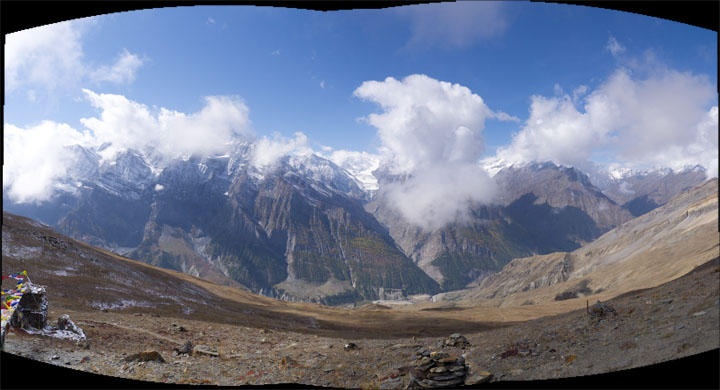
View of Chandrabhaga Valley en route to Triloknath, Lahaul
View of Chandrabhaga Valley en route to Triloknath, about one hour drive from Keylong, Lahaul

If you read my previous post, then you already know the experience at the summit of Drilbu Ri is sublime. This mountain is associated with Chakrasamvara, the enlightened body of Buddha. The other sites of the trinity are Phakpa Temple in Triloknath, associated with Avalokiteshvara and enlightened speech, and Markul Devi Temple in Udaipur, associated with Vajravarahi and enlightened mind. (By the way, this is Udaipur in the state of Himachal Pradesh, not the one in Rajasthan.)

After finishing the kora around Drilbu Ri, it seemed natural to visit the other two places, Triloknath and Udaipur, as a continuation of pilgrimage experience. Both are within an hour-and-a-half’s drive from Keylong, so that was my agenda for today! As with Dribu Ri, Hindus and Buddhists alike consider Phakpa and Markul Devi holy sites.
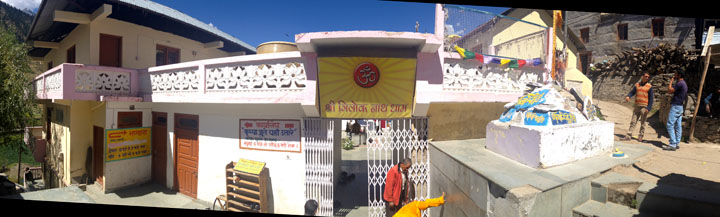
Phakpa temple of Triloknath, Lahaul, as seen from the exterior of its courtyard
Phakpa temple of Triloknath, Lahaul, as seen from the entrance to its courtyard
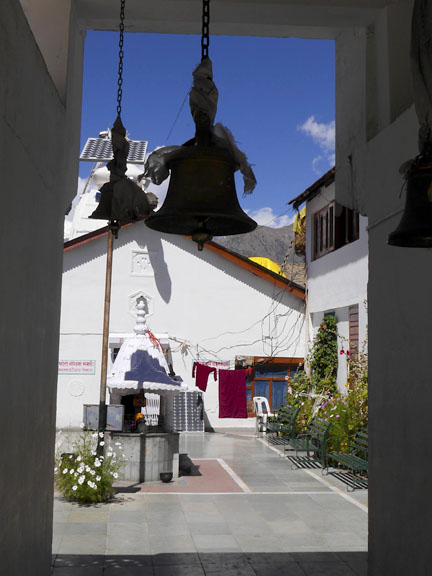
Entranceway to Phakba Temple, Triloknath, Lahaul
Entranceway to Phakba Temple, Triloknath, Lahaul. Visitors ring bells overhead.
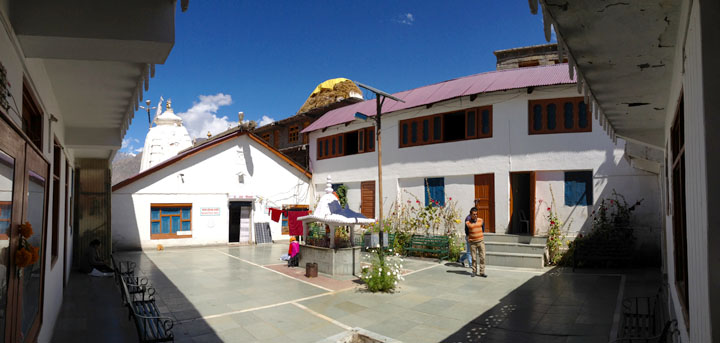
Inner courtyard of Phakpa. Triloknath, Lahaul
Inner courtyard of Phakpa. Not much can be seen of the original architecture at this ancient site. What exists now looks like contemporary vernacular. The building at left contains the inner sanctum and an interior circumambulatory

At Phakpa Temple, one can circumambulate the inner sanctum upon entering. The ample interior corridor contains Tibetan Buddhist mani prayer wheels one can spin for manifold blessings. Inside them are Avalokiteshvara’s six-syllabled mantra, Om Mani Padme Hum, the recitation of which is said to activate mental states conducive for peace and enlightenment.
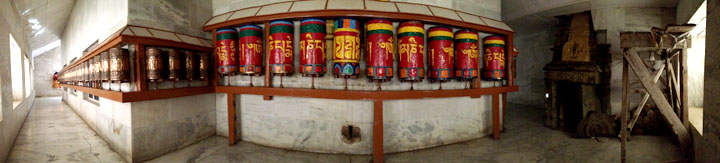
The interior circumambulatory, Phakpa Temple, Triloknath, Lahaul
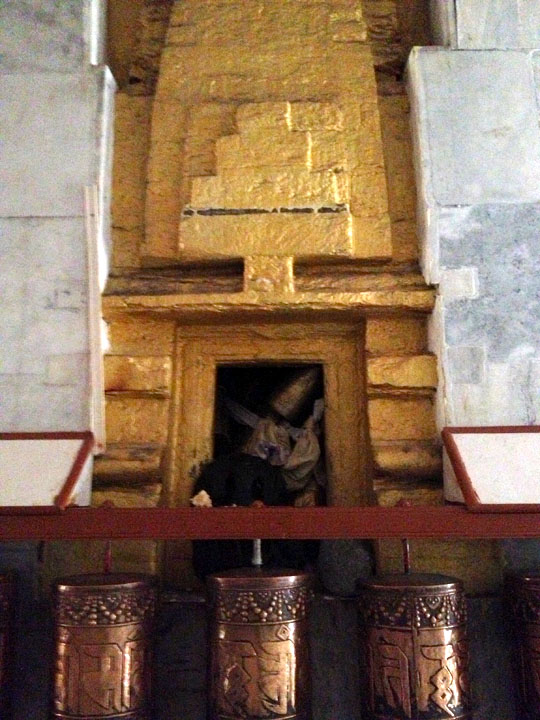
Gilded architectural detail that looks Hindu-influenced, Phakpa Temple, Triloknath

The inner sanctum contains a white marble statue of Avalokiteshvara, bodhisattva of great compassion, believed to be a miraculous self-arisen object found by a shepherd and installed in Triloknath. The statue is revered by Hindus as Shiva.
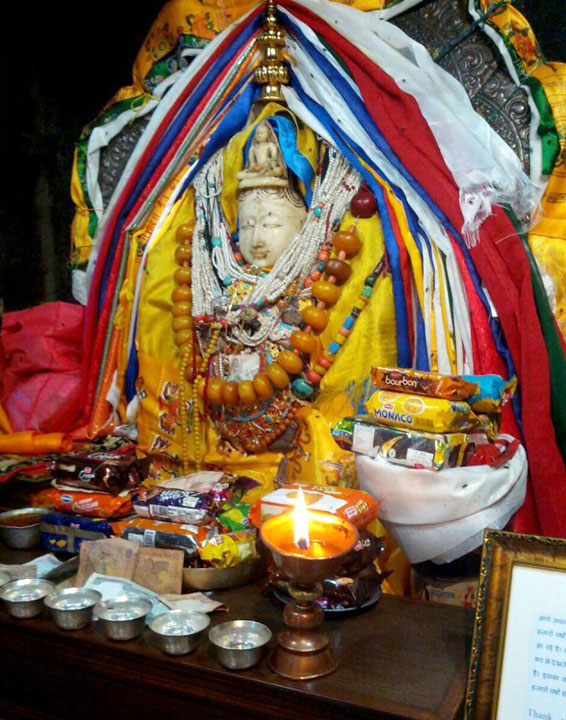
White marble statue of Avalokiteshvara, Phakpa Temple, Triloknath, Lahaul
White marble statue of Avalokiteshvara, Phakpa Temple, Triloknath, Lahaul, revered by Hindus as Lord Shiva. Photo: www.fpmt.org

Here is a view of it without ritual embellishments. This is a poster I photographed in the courtyard.
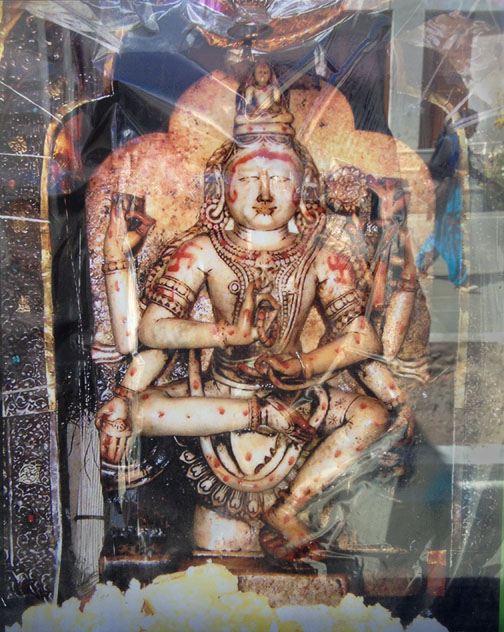
Avalokiteshvara statue at Phakpa Temple, Triloknath, Lahaul

The statue is a six-armed version of Avalokiteshvara. In Tibetan Buddhism, he is also popularly depicted with a thousand arms and eleven heads. This manifestation occurred when Amitabha Buddha, coming to the bodhisattva’s aid, split his head and arms so he could better hear, see, and help the suffering. The Dalai Lama is considered a human incarnation of Avalokiteshvara, or Chenrezig as he is known in Tibetan. 
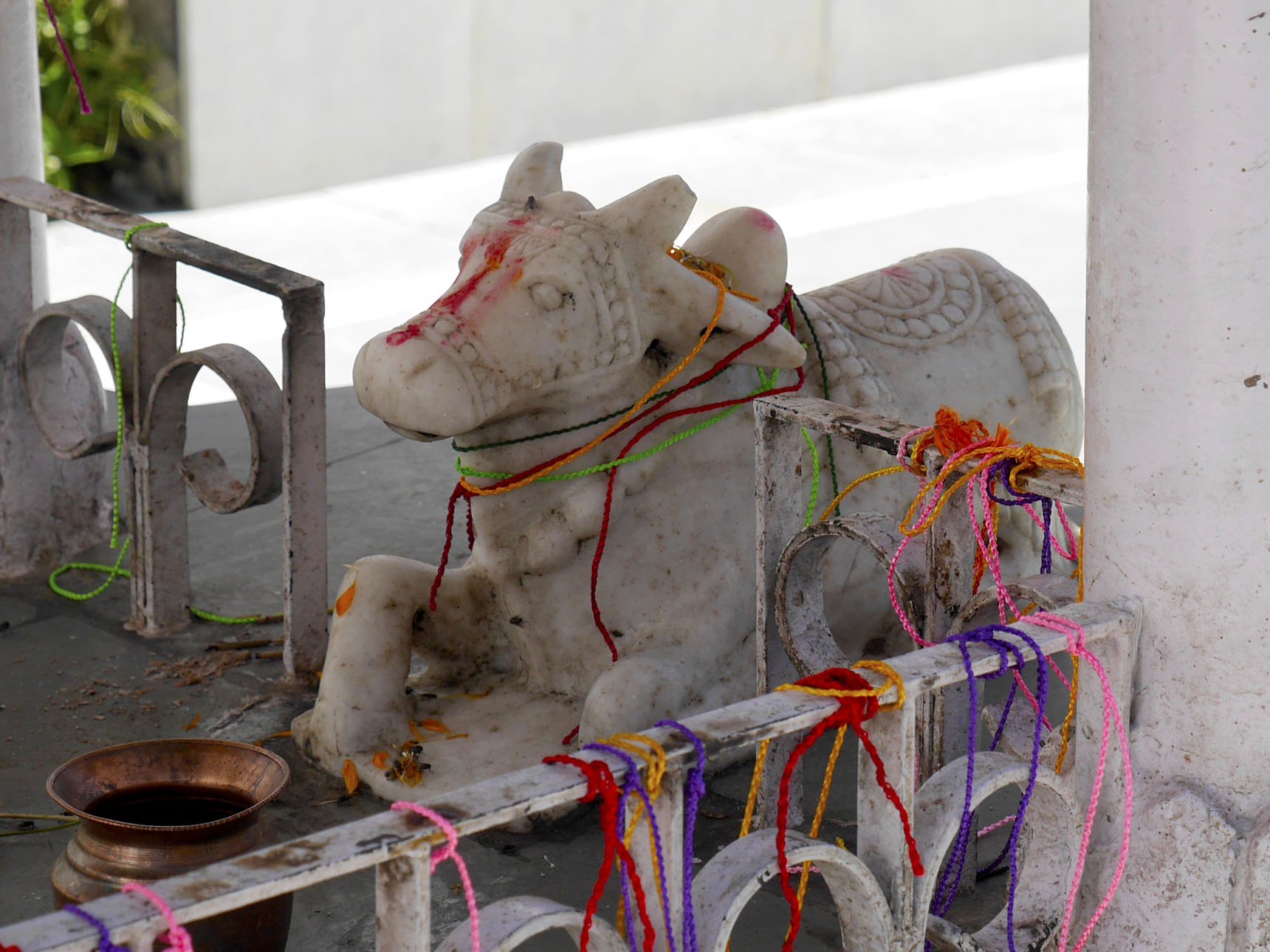
The cow is a sacred animal to Hindus, representing life and the sustenance of life. This sculpture is located in the center shrine of the courtyard at Phakpa Temple, Triloknath, Lahaul
Nandi – the cow is a sacred animal to Hindus, representing life and the sustenance of life. This sculpture is located in the center of exterior courtyard at Phakpa Temple, Triloknath, Lahaul

After Triloknath, I headed to nearby Udaipur to see Markul Devi Temple.
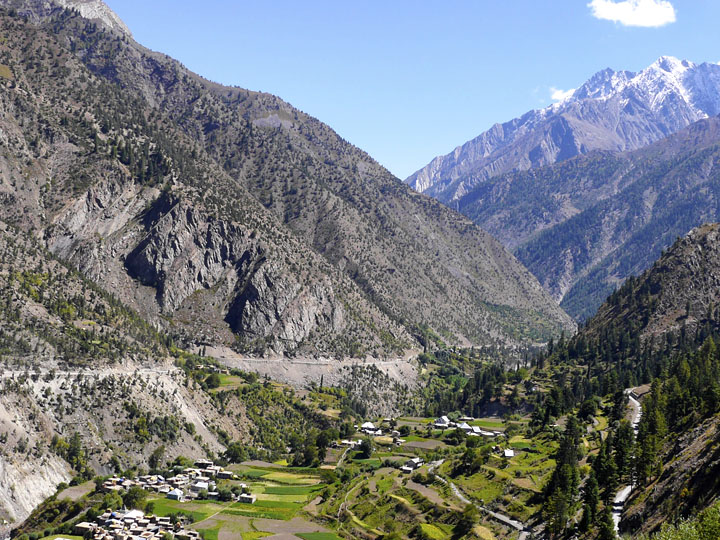
View of Himalayan Mountains on the way from Triloknath to Udaipur, Lahaul

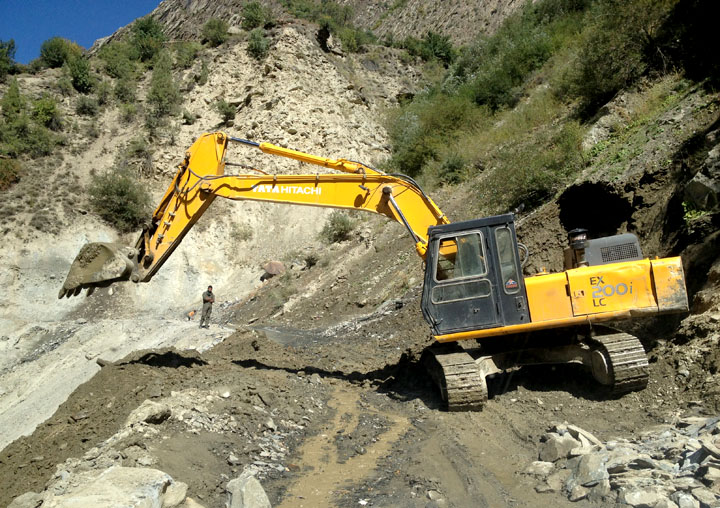
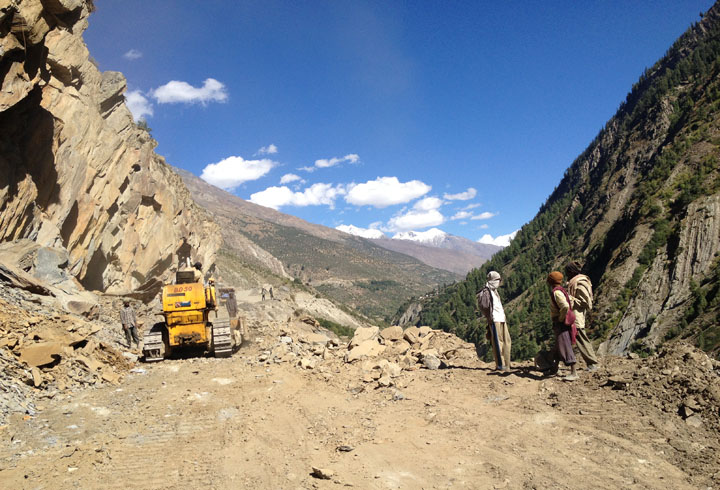
As was the case from Keylong to Triloknath, before long, we hit road construction again and were delayed because all traffic was halted. In this rugged terrain and climate, highways take a beating, and road maintenance and improvement is always happening. This one was a major operation, and not visible in the photo is a large crew of construction workers down the left side of the mountain where the dirt is being deposited.
en route Triloknath_72
Road construction en route to Triloknath, Lahaul
IMG_2934_72
Road construction en route to Udaipur, Lahaul

Often road workers are women with young children on their backs. Or sometimes the little ones keep themselves busy playing or sleeping on the construction site. I am not kidding! I have seen children sleeping hazardously close to the edge of a cliff, or running among machinery and equipment. So far, on my travels throughout Spiti and Lahaul, this is true everywhere. It is hard labor. Men and women break rocks by hand with hammers, dig mountainsides with pickaxes, haul dirt in baskets on their heads, and so forth. Driver D tells me most laborers are poor and come from Nepal, or are tribals from other states of India. As itinerant workers, they sleep in makeshift tents right there onsite for the season, until the cold weather comes and road work is halted.
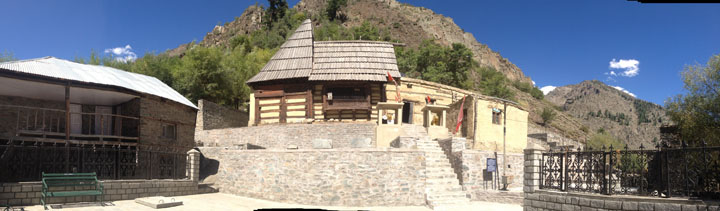
Markula Devi Temple, Udaipur, Lahaul

If you have been on an extended trip to see Indo-Tibetan Buddhist sacred sites in Spiti and Lahaul, what is immediately apparent about Markul Devi Temple is that it does not look at all like what you’ve seen elsewhere. Most of the structures I’ve seen from the same period, 11th-12th centuries, have been white-washed or painted mud and stone structures with flat roofs of the same materials, some perhaps thatched. Markul Devi is instead made from wood and stone with a highly pitched wood-shingled gable roof.
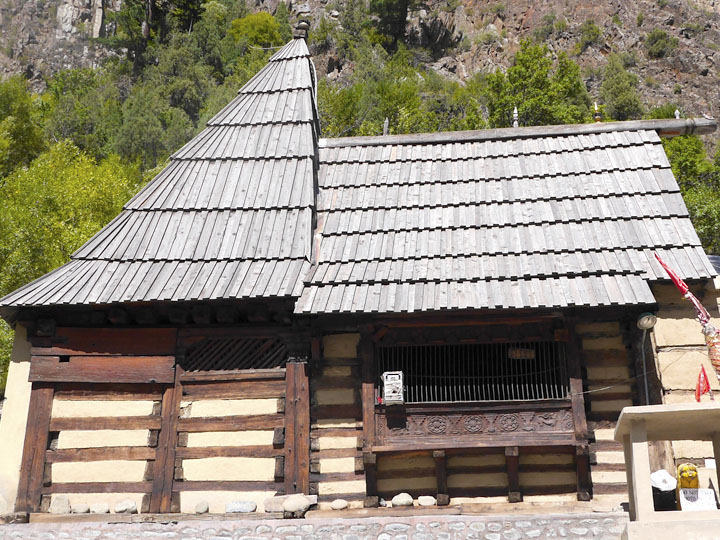
Markul Devi Temple, Udaipur, Lahaul
Markul Devi Temple exterior is an example of 8th century Kashmiri architecture in Udaipur, Lahaul

The Indian government traces its architectural style back to 8th century Kashmir, though the current structure is a reproduction from 11th century onward. It is protected by Archeological Survey of India, considered the last building of its kind to exist.
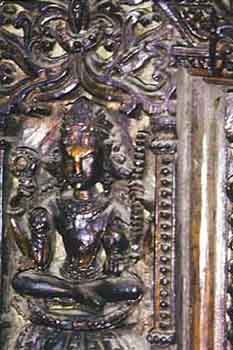
Wood carving from interior of Markul Devi Temple, Udaipur, Lahaul
Wood carving from interior of Markul Devi Temple, Udaipur, Lahaul. Photo: http://ignca.nic.in

The interior is also different from other Indo-Tibetan interiors I’ve seen. It is a stunning example of fine Indian woodwork. Massive and deeply carved single pieces of wood form nine elaborate ceiling panels. There are several ornate pillars and architraves, window panels, and the decorated facade of the inner sanctum. The fine carvings depict mainly Hindu subjects and figures, but there are also Buddhist references, such as the panel of Shakyamuni Buddha, and the scene with a three-headed Vishnu. The small shrine holding a silver statue of the Hindu goddess Kali is revered by Tibetans as Vajravarahi.

Shown at right is a detail of the wood carving possibly from the facade of the inner sanctum.

So there you have it…Lahaul’s trinity of Drilbu Ri (body), Phakpa (speech), and Markul Devi (mind)–revered by both Hindus and Buddhists. Implicit in their mutual respect for these places and their associated deities is their acceptance of each other’s pantheon. I admire this. An Indian acquaintance once said to me that he believes, ultimately, all gods are the same.

All photos © 2013, Eva Lee.

Drilbu Ri Mountain Mandala

Sept 16th Drilbu Ri Mountain kora (circumambulation)

5 a.m. with flashlight in hand and some provisions in a backpack, I started out in the dark to meet my guide S at a spot on the Drilbu Ri trail marked by a large barren tree.

Beginning of trekking trail of Drilbu Ri kora (circumambulation) from Kardang Monastery, Lahaul
Beginning of trekking trail for Drilbu Ri kora (circumambulation) from Kardang Monastery, Lahaul. The destination is the top of the mountain near where those seven peaks appear at upper left.

I had spent the night at Kardang Monastery, and once again had the pleasure of the company of nuns. It’s remarkable how details of one’s life narrative can be dispensed with when there is just mutual warmth felt between people. We chatted with whatever English they had (and for my part, zero Tibetan) and with mutual hand gestures. They cooked thukpa noodles in a delicious vegetable soup. I hadn’t eaten much that day having worked through lunch shooting photos at Guru Ghantal, so I was happy to carb-up for the next day’s trek.

Lovely Kardang Monastery nuns making thukpa noodles for dinner
Drilbu Ri mountain as seen from across the Bhaga River, Lahaul

Drilbu Ri kora—my gosh, what can I say? Getting to the summit whooped me! At almost 15,000 feet (4400 meters) altitude, I was short of breath at the start, and then later gasping for breath every 10 to 15 paces of steep uphill climbing. We reached the top shortly before 10 a.m. My guide, bless him, was so patient, calm, and encouraging with the words, “Slowly, slowly…” which he repeated like a mantra, each time with a gentle head tilt, the infamous Indian bobble.

Drilbu Ri trek, Lahaul
About two hours into trekking with guide S, Keylong is seen below (looks like thin line) on the opposite mountain across the valley.
Drilbu Ri Mountain, Lahaul
Ascent further up takes you into an area filled with a kind of red grassy plant that colors the mountain side
Drilbu Ri Mountain, Lahaul
As we climbed higher the mountain curved more and changed to rocky terrain
Drilbu Ri Mountain, Lahaul
Further up, the mountain is steeper, more angled, and here is where we hit the snow line, snow visible on right

The last part was the steepest and most difficult. I marveled that I was still going on only half a Nutella sandwich, some pieces of chocolate, and two mango juices. Hardly nutritious, but then again, hunger becomes more of a concept, given the altitude and level of exertion.

Looking up towards the summit, Drilbu Ri Mountain kora, Lahaul
Looking up towards the summit of Drilbu Ri Mountain, the top being where those prayer flags look like a dotted line. At this point more snow on the ground. Yes, it looks steep and then got even steeper!
Drlbu Ri Mountain, Lahaul
Still looking up at the summit, the ascent gets more vertical and narrower!
Finally at the top, you arrive through this narrow notch in Drilbu Ri Mountain
Finally arrival at the summit of Drilbu Ri by scrambing through this narrow and angled pass

Well, it was worth being reduced to crying “uncle.” When we got to Drilbu Ri’s summit, it was indeed a living mandala as the locals promised. 360-degree panorama of magnificent glacial mountains that take your breath away–literally and figuratively! No wonder the Himalayas is called “the roof of the world.” As you stand stuck in awe, the amazing height and expanse somehow melds with your inner sense of worldy, or maybe otherwordly, home. Yes, you, small and insignificant in this vast geological time and space, still get to be part of it all.

View of Keylong down in Bhaga River Valley from the summit for Dribu Ri Mountain
Dribu Ri Mountain on other side, Lahaul
Unbelievable immensity, view of the other side of the Drilbu Ri Mountain looking down towards Gondhala Village. This is where you begin the descent down, a lot less steep but looks deceptively smooth and “easy.”
View of Keylong down in Bhaga River Valley from the summit for Dribu Ri Mountain, Lahaul
View of Keylong down in Bhaga River Valley from the summit of Dribu Ri Mountain, Lahaul. On right is a Buddhist shrine housed in a small yellow structure in which Lahauli pilgrims are lighting butter lamps and incense as offerings. Hidden under many kata offering scarves further to the right is also a small Hindu shrine dedicated to the sacred union of Shiva and Parvati.
Butter lamps and other offerings in Buddhist shrine on top of Drilbu Ri Mountain, Lahaul. Hindus also consider this a sacred site and there is a shrine, too, dedicated to the sacred union of Shiva and Parvati
Butter lamps and other offerings in Buddhist shrine on top of Drilbu Ri Mountain, Lahaul. Hindus also consider this a sacred site and there is a separate shrine dedicated to the sacred union of Shiva and Parvati.

In fact, Drilbu Ri is sacred to Tibetan Buddhists as Chakrasamvara’s abode. It is important to understand here that none of the Buddhist tantric deities are believed to exist externally. Rather, they represent the ultimate and profound state of mind which sees that self and phenomena are empty of inherent existence. If this is an intriguing idea for you, then you may want to learn more about the distinctive Buddhist philosophy of dependent origination.

Chakrasamvara, wall painting, Gandhola Monastery, Lahaul, India
Chakrasamvara, wall painting, Gandhola Monastery, Lahaul

Chakrasambava is understood as a wrathful manifestation of Buddha for combating the compelling mental condition of perceiving things as concretely existing. Tantric yoga practices are essentially visualizations of the deity that enact illusion and dissolution of self through identifying with the deity’s Buddha-nature. With the initiation and guidance of a qualified teacher, the practitioner gains the benefit of seeing things as they really are—that is, illusory and empty of inherent existence. This is what’s called wisdom. Cultivating wisdom together with compassion form the complementary two wings for full flight to enlightenment.

Tibetan Buddhists believe that pilgrimage to sacred sites like Drilbu Ri is a great purification of self-centered concerns in order to adopt more expansive mental states that are conducive for wisdom. Overcoming hardships and challenges on a kora can act as a propeller on one’s spiritual path, especially if the site has been graced by the spiritual energies of realized practitioners. Masters such as Nagajuna, Ghantapa, Gotsangpa, Orgyenpa, Taktsang and Rangrik Repas have come to meditate on Drilbu Ri over the past millennia.

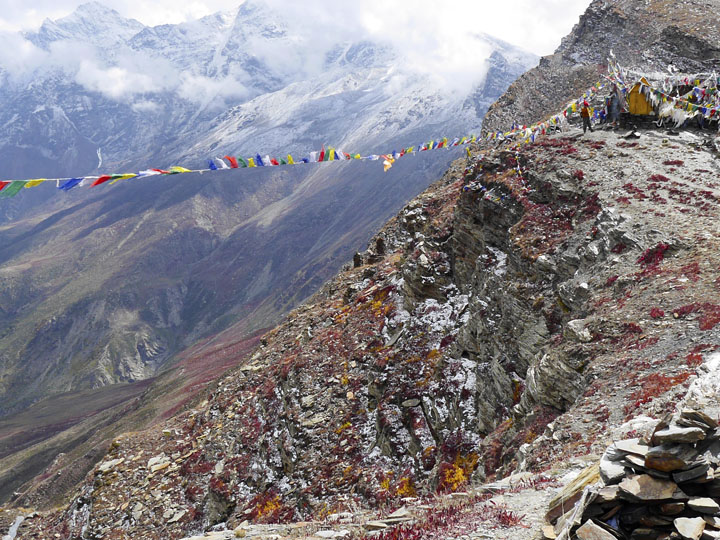
View of Keylong side of Drilbu Ri Mountain, Lahaul
View of Keylong side of Drilbu Ri Mountain, looking towards the shrines and my guide S. It’s hard to imagine how people manage to string up these long expanses of prayer flags over the terrain!

Traditionally, Tibetans have traveled hundreds or even thousands of kilometers, often in full body prostration, to complete such pilgrimages. I understand that Drilbu Ri and Mount Kailash are two of the foremost sites for kora. It is said that the completion of such circumambulations bring manifold results, multiplying divine merit.

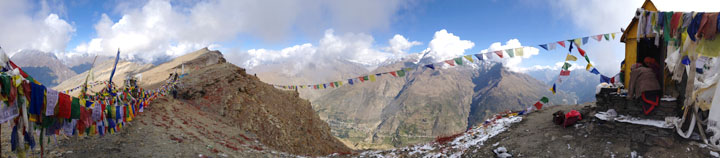
Tibetan Buddhist prayer flags, summit of Drilbu Ri Mouuntain, Lahaul
More expanses of prayer flags at the summit of Drilbu Ri Mountain. On the left side is the descent down to Gondhala and on the right side was the ascent up from Kardang Monastery/Keylong side, Lahaul

As for me, I came here to research Indo-Tibetan mandalas as a visual artist. Then found, as I was told, that Lahaul does not have so much in the way of drawn images of mandalas. Rather, the land itself is a mandala which one should experience physically. I’m glad I did.

View of Keylong side of Drilbu Ri Mountain
Numerous stupas are found all along the top ridge of Drilbu Ri Mountain, like sentinels holding up prayer flags, Lahaul
Top of Drilbu Ri Mountain, Lahaul
Exhilaration, okay, maybe augmented by some oxygen deprivation at the summit of Drilbu Ri Mountain, about 15,000 feet (4400 meters) altitude.

The weather was such a wonderful wide range all that day. Dawn began with some overcast clouds, which then gradually lifted later in the morning to give way to wholesome, crystal clear sunshine by late morning when we reached the top. After a picnic brunch of omelette sandwiches with Indian pickles which S brought with him, a light snowfall came to herald our time to pack up and start the hike down the other side of Drilbu Ri Mountain. The destination was Gondhala Village, where we would then get a bus or taxi back to Keylong.

Oh, and by the way, I thought making it to the top of Drilbu Ri meant the hard part was over. Not so. The return on the other side of the mountain was less steep, more graduated but MUCH longer distance. It was also colder and so windy at times that you literally had to resist being blown over a decline. I was so grateful S had brought me an extra jacket to wear.

Where the descent on the other side of Drilbu Ri Mountain begins, looking towards Gondhala Village, Lahaul
Where the descent on the other side of Drilbu Ri Mountain begins, looking towards Gondhala Village, Lahaul. The clouds were surreal, at once looking like huge chunks but then moving like ethereal wisps across the mountains.

Descending was a different stamina test, for the knees and thighs instead of the breath.

The descent on the other side of Drilbu Ri Mountain begins, looking towards Gondhala Village, Lahaul

Later, I felt like my eyes were playing tricks on me because Gondhala never seemed to come any closer no matter how long and how far we walked! The village visually seemed like it stayed the same distance away.

The continued descent on the other side of Drilbu Ri Mountain begins, looking towards Gondhala Village, Lahaul
13-Drilbu Ri_72
Thumbs up for completion of Drilbu Ri kora by one experienced trekking guide, and one unsuspecting but game novice.

I finally did get exhausted and waved the white flag. S could see that I indeed had had enough, so instead he lead me to the closest point on the road, and then called trusty ol’ driver D (thank you! thank you!) to pick us up for the ride back to Keylong. I was never so happy before to see a road—wonderful, smooth, FLAT road!

The continued descent on the other side of Drilbu Ri Mountain begins, looking towards Gondhala Village, Lahaul
At last, reaching the road on the other side of Drilbu Ri Mountain. Gondhala Village still seemed far around the bend!

All photos © 2013, Eva Lee.

Lahaul: Garsha Khandroling, Land of the Dakinis

Dancing Dakini, Tibet, ca.18th century

Lahaul is known by Tibetan meditation practitioners and adepts as Garsha Khandroling, Land of the Dakinis. Dakinis are energetic female spiritual guides often depicted as blissful and fierce dancers.

Lahaul has an illustrious Drukpa Kagyu lineage of highly realized yogis and yoginis who do the Six Yogas of Naropa, esoteric methods bestowed by master to disciple in direct teachings. These are the meditators who go into seclusion in caves or simple dwellings for years or decades in order to realize spiritual liberation–that is to say, Buddha-nature through tantric wisdom and compassion practices.

As I mentioned in my last post, I have heard about some of the mind-over-matter feats that yogis demonstrate which confound conventional explanations, such as levitation, miraculous healing of the sick, making snow fall, taking bad karma upon oneself for the benefit of another. Another perplexing thing, upon death, the bodies of many advanced practitioners do not decay according to the normal time frame of most people. They are believed to be fully aware in the bardo state, the intermediate stage between death and rebirth.

Well, I’ve learned that while it’s difficult to wrap one’s rational mind around such reported phenomena, sitting on the I-don’t-know fence is a flexible and open-minded place to be. After all, outside of spiritual matters we can’t explain, for example, quantum entanglement or what Albert Einstein called “spooky action at a distance,” but it appears to happen!

The great yogi Shakya Shri

Garsha has attracted and hosted countless masters and disciples in pursuit of enlightenment for over 2000 years in unbroken continuity. Inspirations for pilgrims include the sacred abodes of Chakrasamvara at Drilbu Ri Mountain opposite Keylong; Avalokiteshvara at Phakba Temple in Triloknath; and Varjavahari at Markula Devi Temple in Udaipur.

Keylong, Lahaul’s largest village, has several important monasteries only a few kilometers away. These were flourishing Buddhist centers centuries ago, such as Kardang, Shashur and Tayul Monasteries. The oldest one, Gandhola (Guru Ghantal) dates to 1st century C.E. according to archeological evidence. I visited each of these places and to come will be posts featuring them.

View of Gandhola (Guru Ghantal) Monastery, upper left, with Thupcholing Monastery below on the plateau, overlooking Tandi bridge where the Chandra and Bagha Rivers join.
View of Gandhola (Guru Ghantal) Monastery, way upper left, with Thupcholing Monastery below on the plateau. Those green-roofed structures are meditation huts for retreatants. Both sites overlook Tandi bridge where the mighty Chandra and Bagha Rivers join in what is considered by Buddhists and Hindus alike as a sacred union.

The delight to be found in Lahaul is that over time, masters have left legends, relics, shrines, stupas, sacred paintings, sculptures, and other spiritual encounters that dot the landscape awaiting discovery by travelers and seekers. The more you look, the more you will see, but it takes some uncovering. For example, what looks unimpressive on the outside may contain a treasure on the inside, such as Jabjes Monastery in Kardang Village. Or one has to do a bit of breathless hiking up a mountain to see some of these old monasteries, hidden meditation caves, and charnel grounds.

Jabjes Monastery located in Kardang Village which was once the capital of Lahaul, India
Jabjes Monastery located in Kardang Village was built around a legendary rock with the miraculous imprints of yogi Gyalwa Gotsangpa’s knees and genitalia, which formed in the stone as he passionately chased and tried to embrace a dakini who disappeared into it. The rock may be seen today inside the temple, Lahaul, India.

However, I’m told by locals that most visitors just pass through Lahaul, heading to the more tourist traveled and trekked sites in Ladakh or Spiti. What a pity!

More readily noticeable and understood by travelers is that Keylong stretches along the main trade route between the Rohtang and Baralacha passes above the Bhaga River. Besides being a thoroughfare between Ladakh, Kullu and Spiti regions, it is also the district headquarters of Lahaul and Spiti, with strategic military presence. In addition, above and below the village one sees lush farmlands growing barley, peas, potatoes, corn, cabbage, mustard greens, squash, and much more. Apples and other fruit orchards are plentiful. My local driver D told me that agriculture is the economic mainstay of Lahaul, and judging from some of the mansions built by some farming families, the wealth of this abundant agrarian heartland is evident. The food harvested is transported all over India. I would not have guessed that at an altitude of over 10,000 feet there would be such a cornucopia!

View of Keylong on hiking trail from Kardang Monastery to Keylong, Lahaul
View of Keylong on hiking trail from Kardang Monastery to Keylong

D’s ancestral farmland is in the Manali area of Kullu Valley, but he lives and works in Keylong to service the tourist industry as an extension of the family business. Indeed, it’s all in the family. I’ve learned from Lahaulis and Spitians I met that relatives live and work together. This was always the tradition, and it largely continues today.

Another thing I learned was that unlike Tibetans, Lahaulis, Spitians and Ladakhis, while culturally and historically part of Tibet, are indigenous to their regions, and as such are not refugees in India but full citizens. In addition, they have their own language and customs. In fact, the Indian government recognizes them as ethnic “tribals,” who may therefore qualify for certain affirmative action positions or opportunities.

It isn’t only just the passerby tourist who may miss the treasure to be found in Lahaul. I realized that my driver, while he probably identifies himself as a Buddhist, is fairly uninformed about the great legacy of his roots. At one point in our travels, he asked me how much I knew about the Dalai Lama and Buddhism. I thought it was a prompt for me to in turn ask him what he knew and be enlightened by his local knowledge, but it was not a segue way to that at all! He told me he tried to find books on Buddhism in Hindi, but could not. It pained me to hear this–that someone looking for knowledge could not access it.

D said that Lahaulis are educated in Indian schools, are fluent in Hindi but not Tibetan, and frequently not English, either. I noticed this is especially true of the women, who largely live domestic lives caring for family and have little contact with others. English is spoken mainly to communicate with foreigners. Feeling affinity for Indian culture and language, many Lahaulis have assimilated to a large extent in recent generations. Most cannot read the readily available contemporary books in Tibetan on Tibetan Buddhism to fill in on the lack of local education on this topic. Books in English are plenty, but nor can they read these since the written language is “too deep” to understand. It was an exquisite and sad irony that I, a foreigner from the other side of the world, knew more about his spiritual roots than he did. That he, a resident in the incredible Garsha, a descendent of the local culture, could not find one book he could read to study Buddhism deeper!

Farm land above and below Keylong in the fertile valley of Bagha River, Lahaul
Farm land and orchards above and below Keylong Village in the fertile valley of Bagha River, Lahaul

It’s a double whammy of cultural distance and spiritual loss. Without being able to study Buddhist philosophy and learn about its unique teachings on dependent origination, one runs the risk of meaningless ritual practice with no or limited realization of freedom from life’s delusions and sufferings.

What’s more, Tibetan Buddhists have a marvelous literary and scholarly tradition, founded on the translation and study of original source materials. Lotsawa Rinchen Zangpo’s translations of Buddhist scriptures from Sanskrit to Tibetan has not only preserved a written heritage now lost in India but produced a renaissance of tantric study and practice. This was during the late 10th to 11th centuries, a flourishing period referred to as the second great propagation of Buddhism. It is the Indo-Tibetan history I’ve been trailing through the sacred art of mandalas, monastery murals, and sculptures.

Garsha: Heartland of the Dakinis

In fact, a (French) Tibetan Buddhist nun, while living in Keylong, discovered the very same thing–that Lahaulis did not know much about the dharma history of their own land. Furthermore, part of why Lahaul’s Buddhist legacy is little known is due to a dearth of literature on it. So she wrote the book Garsha: Heartland of the Dakinis in 2011, published by the Garsha Young Drukpa Association. I have a copy in English, the language it was originally written in. Currently, it needs to be translated into Hindi for local readers.

It is a remarkable small book, jam-packed with a wealth of information about Garsha’s ancient history, the Drukpa lineage masters, dakinis, the founding of monasteries, anecdotes, local legends, descriptions of sacred sites, miracles, reliquaries, carved stones, and much more. It is probably the most, and perhaps only, comprehensive account of Lahaul’s history from the Buddhist perspective. Because it is written by a monastic with open access to living lineage teachers, and unpublished historic materials in Bhoti/Tibetan, the book is a treasure trove of knowledge.

I learned about the book and purchased it from Khandro Thrinlay la when I met her in Manali en route to Spiti (see earlier post here). She is a lama and direct descendent of the Drukpa Kagyu Shakya Shri lineage, with very close spiritual ties to Lahaul. My travel companion J was happy to find it available for sale later in Keylong because she wanted to buy it and donate copies to Tabo Monastery Library in Spiti and The Library of Tibetan Works and Archives in Dharamsala. Funny thing, though, she did not find it in a book store but at a small travel agency/internet cafe establishment run by a lovely Lahauli man keen on the book. You see what I mean? The more you look, the more you will find around here!

All photos © 2013, Eva Lee.